

Caribbean governments offer a remarkable range of tax incentives: reduced rates in special economic zones, tax holidays for hotels and manufacturers, exemptions for priority sectors, credits for hiring and for small businesses, relief from customs duties, and accelerated allowances for investment. Used well, they can transform the economics of a project. Yet many businesses that qualify never claim them, claim them late, or lose them through a missed condition.
This article explains the main types of incentive available in the region, why businesses miss out, how the global minimum tax is changing the picture, and how to make sure you receive everything the law allows, and keep it.
The main types of incentive
Special economic zones. Several territories, including Jamaica, offer special economic zone regimes. Approved developers and occupants typically pay a reduced rate of income tax and receive relief from certain customs duties and other taxes, in return for meeting conditions on location, activity, employment and reporting.
Sector incentives. Tourism, manufacturing, agriculture, renewable energy, film and creative industries, and international services are common priority sectors. Guyana, for example, exempted income from agriculture and agro-processing from corporation tax from the 2026 year of income, together with childcare and elderly care services.
Credits and allowances. Employment tax credits, credits for small and medium enterprises, enhanced capital allowances on qualifying assets, and deductions for training or research can reduce tax for businesses outside any special regime. Jamaica’s Tax Guide, for instance, lists an employment tax credit, a credit for micro, small and medium enterprises and relief for companies listed on the Junior Market.
Indirect tax and customs relief. Exemptions or zero-rating for specific goods, and duty concessions on equipment, materials and inputs, can matter as much as income tax relief. Saint Lucia, for example, extended its VAT exemption on key construction materials until November 2030.
Targeted reliefs for individuals and households, such as Saint Lucia’s new deduction for interest on loans used by first-time landowners, which can matter to business owners and their staff.
Relief after disasters. Following major storms, governments often introduce temporary waivers, extended deadlines, duty relief on rebuilding materials and other measures. These are time-limited and easy to miss.
Why businesses miss out
- They do not know the incentive exists, or assume it is only for large investors.
- They apply too late. Many incentives must be approved before the investment is made or the activity begins.
- Conditions are not tracked. Employment numbers, investment amounts, location, reporting deadlines and restrictions on sales into the local market must be met for the life of the incentive. A missed condition can mean repayment, with interest.
- Records are incomplete. Claims for credits and allowances need evidence of the qualifying spending and activity.
- Incentives are not reviewed when the business changes. A new activity, a restructuring or a sale can end an incentive or create a new one.
How the global minimum tax changes the picture
For groups within the global minimum tax (described in Article 3), an incentive that reduces the effective tax rate in a jurisdiction below 15% may simply trigger a top-up tax elsewhere. In that case, the incentive saves nothing for the group. Governments across the region are therefore reviewing their incentive regimes, and some are redesigning them in forms that are treated more favourably under the rules, such as refundable credits tied to real activity.
For most Caribbean businesses, which are well below the threshold, existing incentives continue to work as before. But every business should expect incentive regimes to change over the next few years, and should check the value of any incentive before relying on it in a business case.
A practical approach to incentives
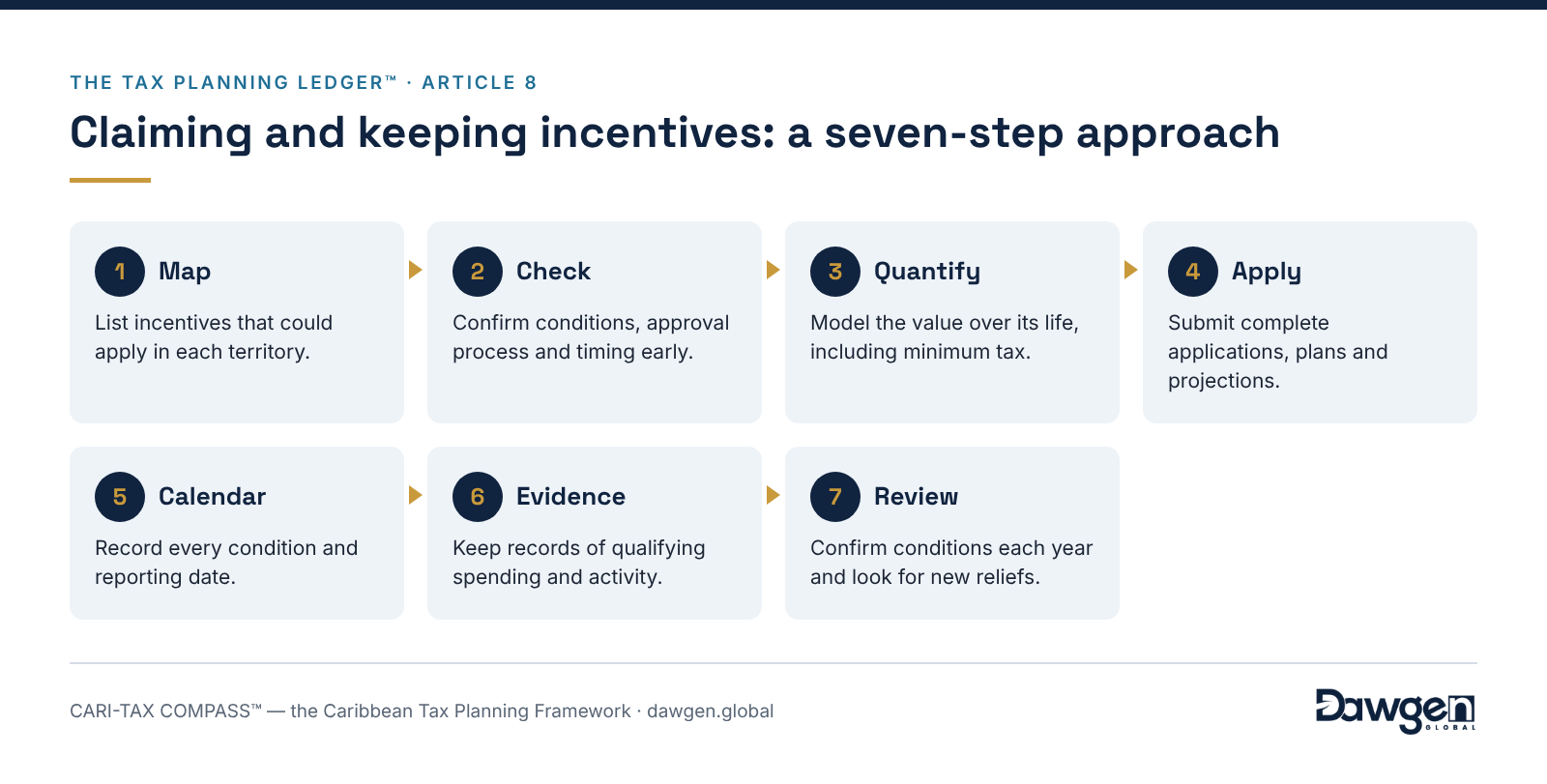
- Map what is available. For each territory where you operate, or plan to, list the incentives that could apply to your activities.
- Check eligibility early. Before committing to an investment, confirm the conditions, the approval process and the timing.
- Quantify the value. Model the incentive’s effect on tax and cash flow over its life, including any minimum tax effect, and compare it with the cost of meeting the conditions.
- Apply properly. Prepare complete applications with the business plans, projections and documents the approving authority expects.
- Build a compliance calendar. Record every condition and reporting date, and assign responsibility.
- Keep the evidence. Maintain records of qualifying spending, employment and activity.
- Review each year. Confirm conditions are being met, and check for new incentives that may now apply.
 Dawgen Global illustration
Questions to ask
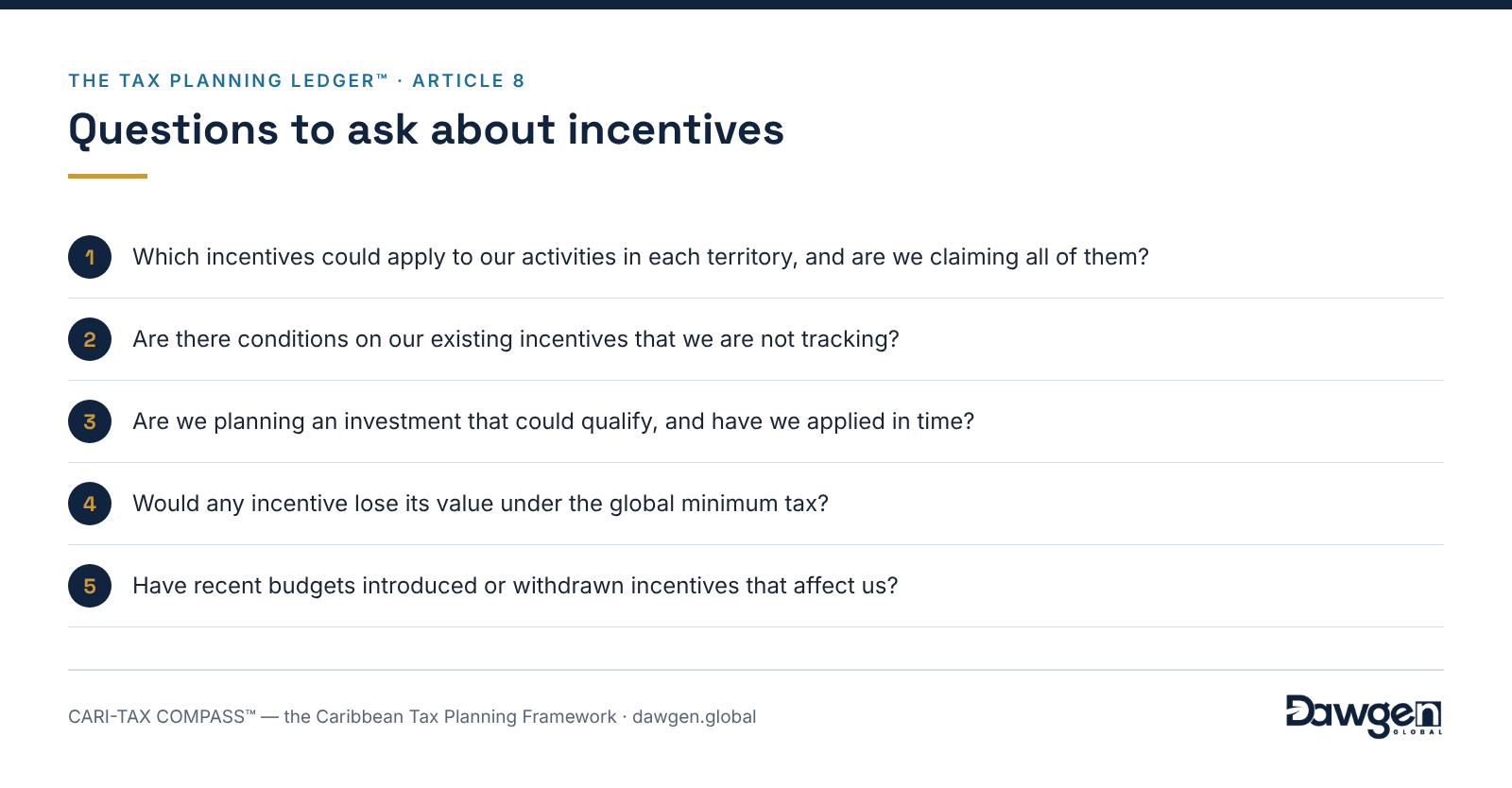
- Which incentives could apply to our current activities in each territory, and are we claiming all of them?
- Are there conditions on our existing incentives that we are not tracking?
- Are we planning an investment that could qualify, and have we applied in time?
- Would any incentive lose its value under the global minimum tax?
- Have recent budgets introduced or withdrawn incentives that affect us?
 Dawgen Global illustration
How Dawgen Global can help
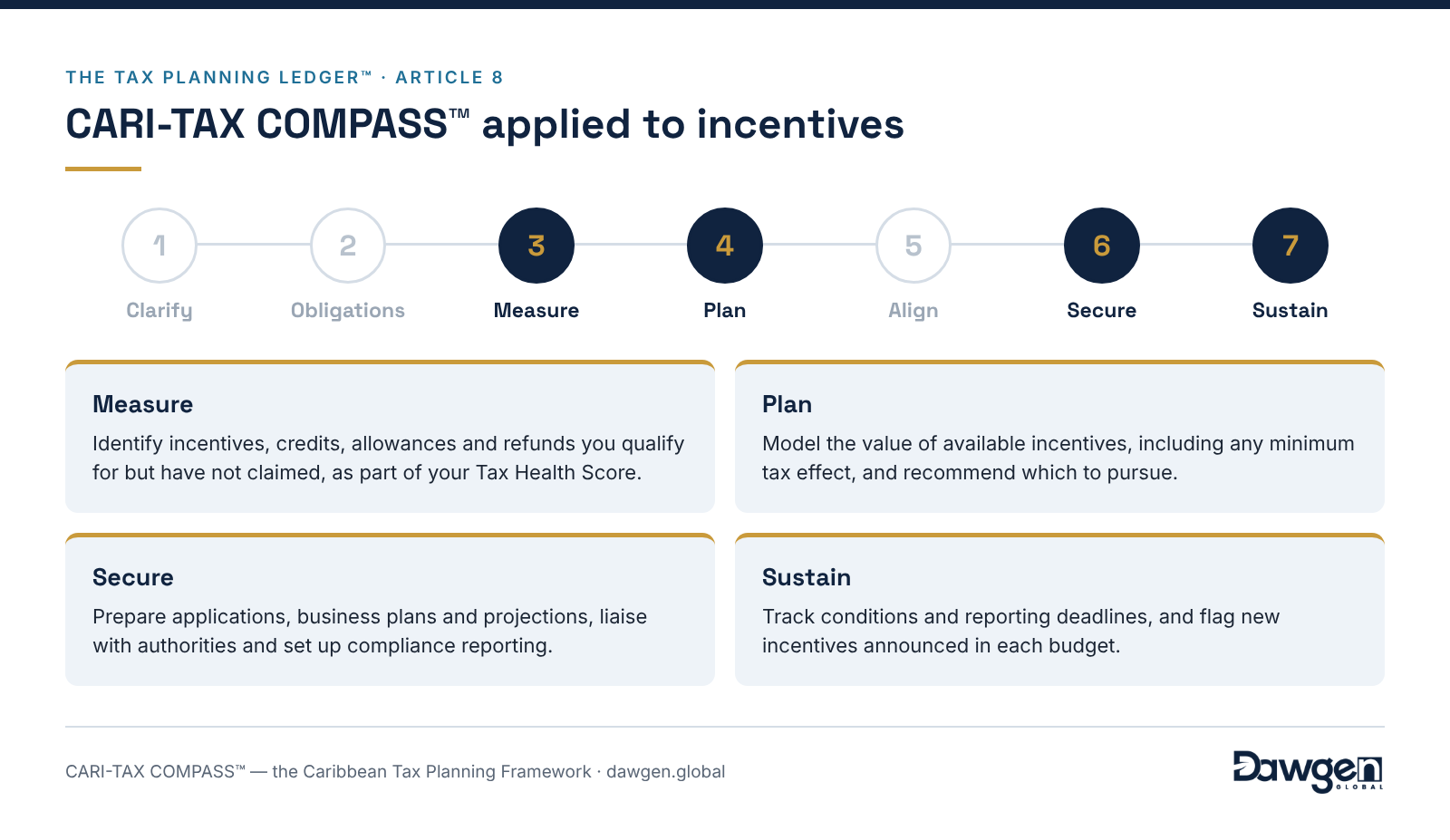
Our incentives and exemptions service is built into CARI-TAX COMPASS™, the Caribbean Tax Planning Framework:
- Measure: as part of your Tax Health Score, we identify incentives, credits, allowances and refunds you qualify for but have not claimed. Efficiency is one of the six dimensions we score.
- Plan: we model the value of available incentives for current activities and planned investments, including any effect of the global minimum tax, and recommend which to pursue.
- Secure: we prepare applications, business plans and projections, liaise with the approving authorities and, once approved, set up compliance reporting.
- Sustain: we track conditions and reporting deadlines and alert you to new incentives announced in the budgets of the territories where you operate.
Our Tax Guides for all 35 territories we serve include a summary of the main incentives in each, which gives our team a regional view of where a project could be most attractive.
 Dawgen Global illustration
Where to start
Take the CARI-TAX COMPASS™ Tax Health Score at dawgen.global/tax-health-score; its efficiency questions ask when your allowances, credits and incentives were last reviewed. Or speak with our Caribbean Tax Service Desk at info@dawgen.global or (876) 926-5210, or with your territory desk at country@dawgen.com.
In Article 9, we turn to family businesses and the tax traps that arise when ownership passes to the next generation.
Dawgen Global — Big Firm Capabilities. Caribbean Understanding.
This article is general information and is not a substitute for advice on your circumstances. Incentive regimes, rates and conditions differ by territory and change frequently; confirm the current position before acting.
About Dawgen Global
Dawgen Global is an independent, integrated multidisciplinary professional services firm headquartered at 47 Trinidad Terrace, New Kingston, Jamaica, serving 35 territories across the Caribbean. Founded and led by Dr. Dawkins Brown, Executive Chairman, the firm is independent and not affiliated with any international network. It delivers a full suite of professional services under one roof: audit and assurance; tax advisory; IT and digital transformation; risk management; cybersecurity; actuarial and insurance regulatory advisory; HR advisory; mergers and acquisitions; corporate recovery; business advisory and strategy; accounting BPO and virtual CFO services; and legal process outsourcing.
The proposition is simple: big-firm capability without the big-firm price. Dawgen Global’s integrated approach is built for the specific complexities and opportunities of the Caribbean market, helping organizations make sharper, better-informed decisions that drive measurable progress.
To explore a partnership, reach out:
- Website: dawgen.global
- Email: info@dawgen.global
- WhatsApp (Global): +1 555-795-9071
- Caribbean offices: +1 876-665-5926 | +1 876-929-3670 | +1 876-926-5210