
A distributor in Jamaica buys stock from its sister company in Trinidad and Tobago. A holding company in Barbados charges management fees to subsidiaries in four islands. A family group lends money from one company to another to fund a new hotel in Saint Lucia. Each of these is a transaction between related companies, and each sets how much profit is taxed in which country.
That is transfer pricing. For years it was seen as a concern only for large multinationals. Today it is one of the most common sources of tax adjustments, double taxation and disputes for Caribbean groups of every size. This article explains what transfer pricing is, why it matters more now, where the risks lie for island-hopping groups, and how to get it right.
What transfer pricing means
When two independent businesses trade, the price is set by negotiation. When two companies in the same group trade, the group sets the price, and that price decides where profit falls. If a Barbados company charges a Jamaican subsidiary a high management fee, profit moves from Jamaica to Barbados. If the Jamaican tax rate is higher, the group pays less tax overall.
Tax authorities therefore expect transactions between related companies to be priced as if the companies were independent: the arm’s length principle. It is set out in the OECD Transfer Pricing Guidelines and is reflected, in different ways, in the domestic law of most Caribbean territories, either through specific transfer pricing rules and documentation requirements or through general anti-avoidance powers that allow an authority to adjust non-arm’s length prices.
Why it matters more now
- More territories have formal rules. Several Caribbean territories have introduced specific transfer pricing legislation, documentation requirements or related-party disclosure in tax returns, and more are expected to follow.
- Authorities share information. Exchange of information agreements, country-by-country reporting for large groups and beneficial ownership registers mean that tax authorities can see the other side of a transaction.
- Revenue pressure. Governments seeking revenue look first at payments leaving the country, such as management fees, royalties, interest and service charges.
- The global minimum tax. For large groups, transfer pricing directly affects the effective tax rate in each jurisdiction, and therefore whether top-up tax is due.
Where island-hopping groups get caught
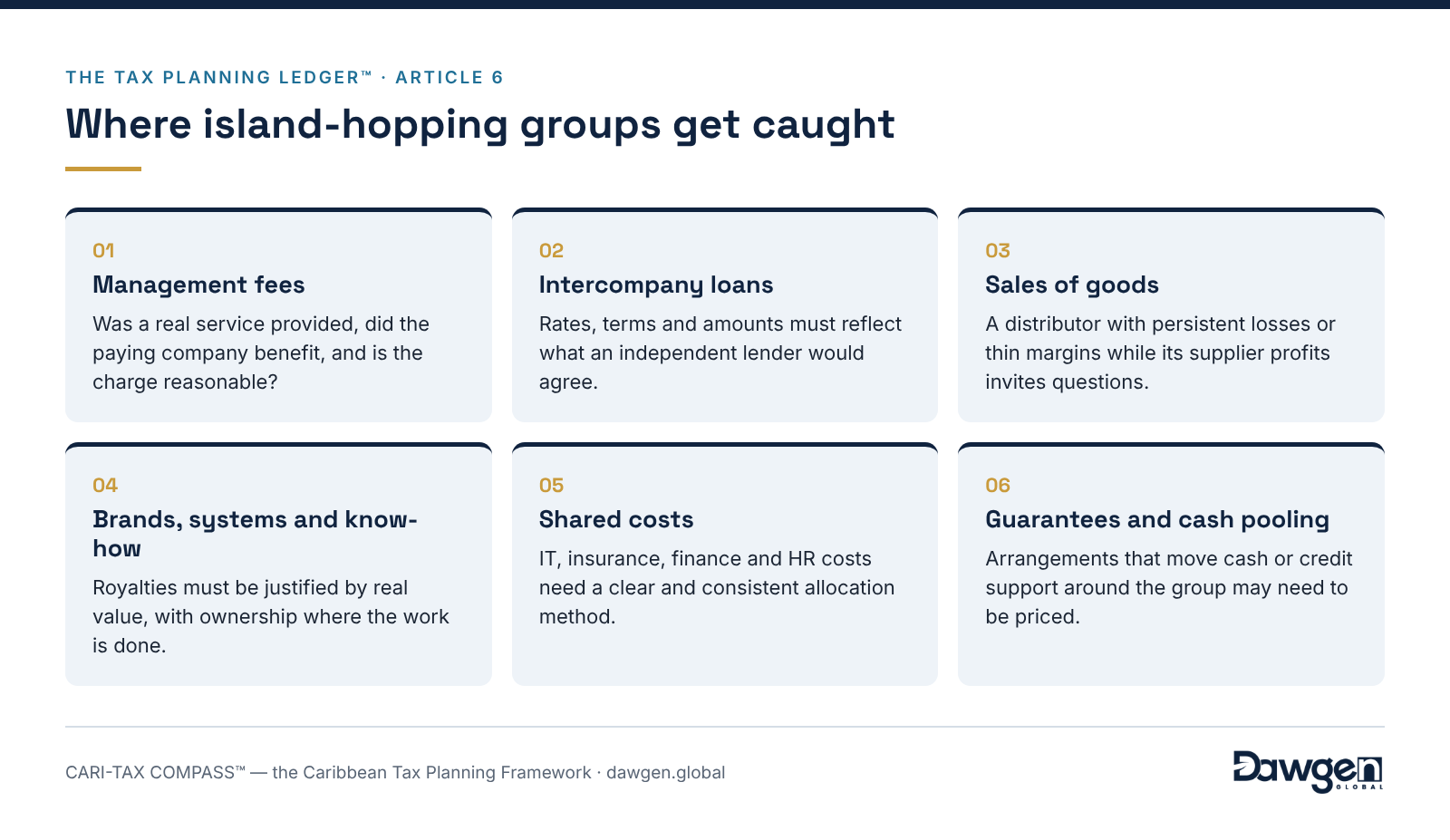
Management fees and head office charges. The most common risk. Authorities ask: was a real service provided, did the paying company benefit, and is the charge reasonable? A fee calculated as a flat percentage of revenue, with no record of the services behind it, is easy to challenge. Many territories also apply withholding tax to such fees, and some restrict deductions for payments to non-residents.
Intercompany loans. Interest rates, terms and amounts must reflect what an independent lender would agree. Interest-free loans, loans that are never repaid, or rates far above market can all be adjusted, and interest limitation rules may restrict deductions.
Sales of goods between group companies. A distributor that consistently makes losses or very thin margins while its supplier makes high profits invites questions about the price of goods.
Use of brands, systems and know-how. Royalties for trademarks, software or business systems must be justified by real value, and ownership of the intangible must sit where the decisions and costs are.
Shared costs. Group-wide costs, such as IT, insurance, finance and human resources, need a clear and consistent allocation method.
Guarantees and cash pooling. Arrangements that move cash or credit support around the group have a value that may need to be priced.
Dawgen Global illustration
What happens when it goes wrong
If a tax authority decides a price was not at arm’s length, it can increase the taxable profit of the local company, assess additional tax, and add penalties and interest. Often the other country does not give a matching reduction, so the same profit is taxed twice. Where tax treaties apply, relief may be available through a mutual agreement procedure, but this takes time, and within CARICOM the double taxation agreement offers its own mechanisms. Without treaties, double taxation may be permanent.
What good transfer pricing looks like
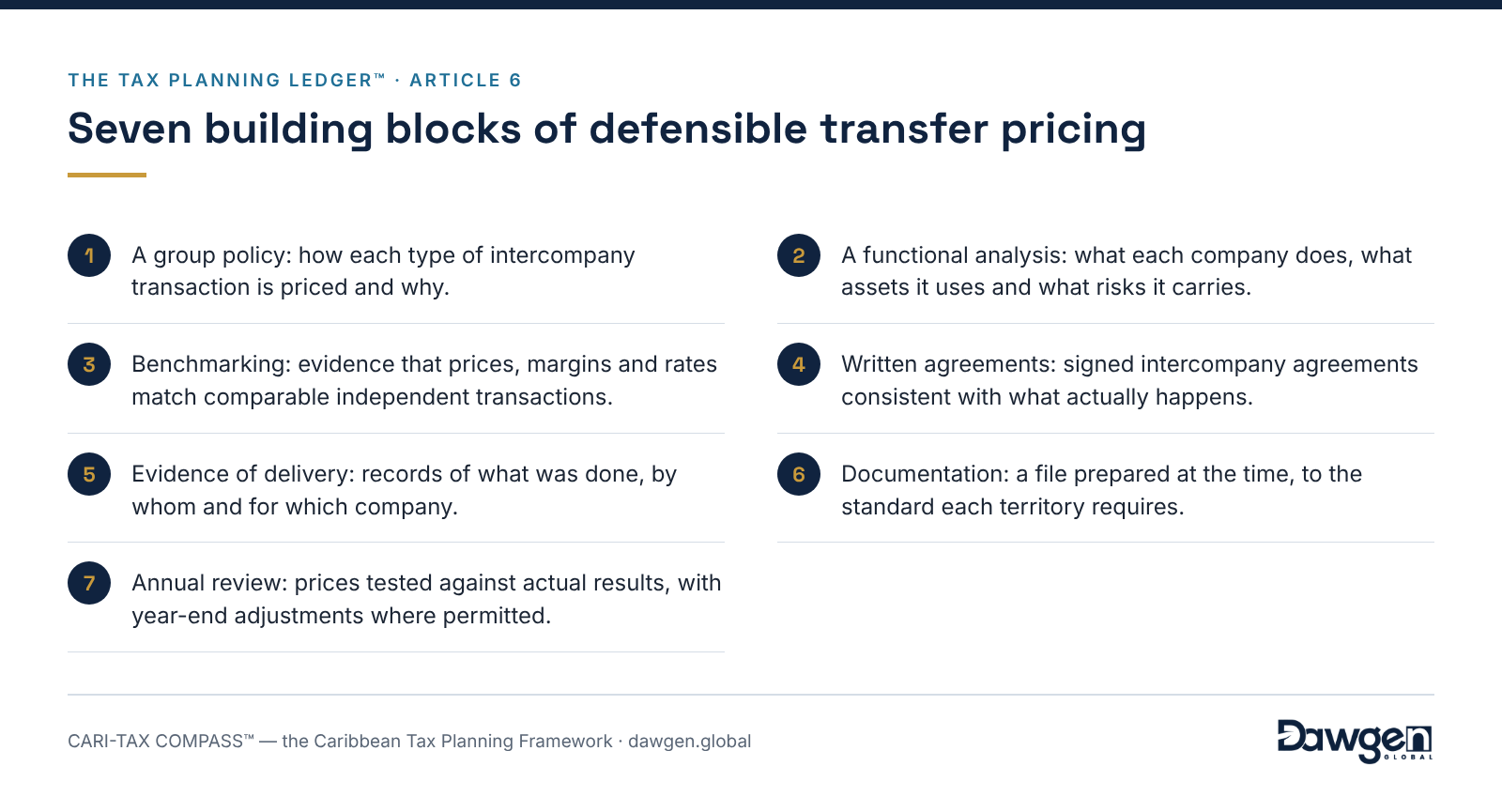
- A group policy. A short written policy stating how each type of intercompany transaction is priced and why.
- A functional analysis. For each company, a record of what it does, what assets it uses and what risks it carries. This is the foundation of every defensible price.
- Evidence that prices, margins or interest rates are in line with comparable independent transactions, using appropriate methods.
- Written agreements. Signed intercompany agreements for services, loans, licences and distribution, consistent with what actually happens.
- Evidence of delivery. For services, records of what was done, by whom, and for which company.
- A file prepared at the time, to the standard each territory requires, ready to give to a tax authority on request.
- Annual review. Prices tested against actual results each year, with year-end adjustments where needed and permitted.
 Dawgen Global illustration
Questions for your next finance meeting
- Do we have a list of every transaction between our group companies, by territory?
- Could we explain each management fee, loan and charge to a tax auditor today, with documents?
- Do our intercompany agreements match what actually happens?
- Are we paying withholding tax correctly on cross-border payments, and claiming treaty or CARICOM relief where it is available?
- Has any territory where we operate introduced new transfer pricing rules or disclosure requirements?
How Dawgen Global can help
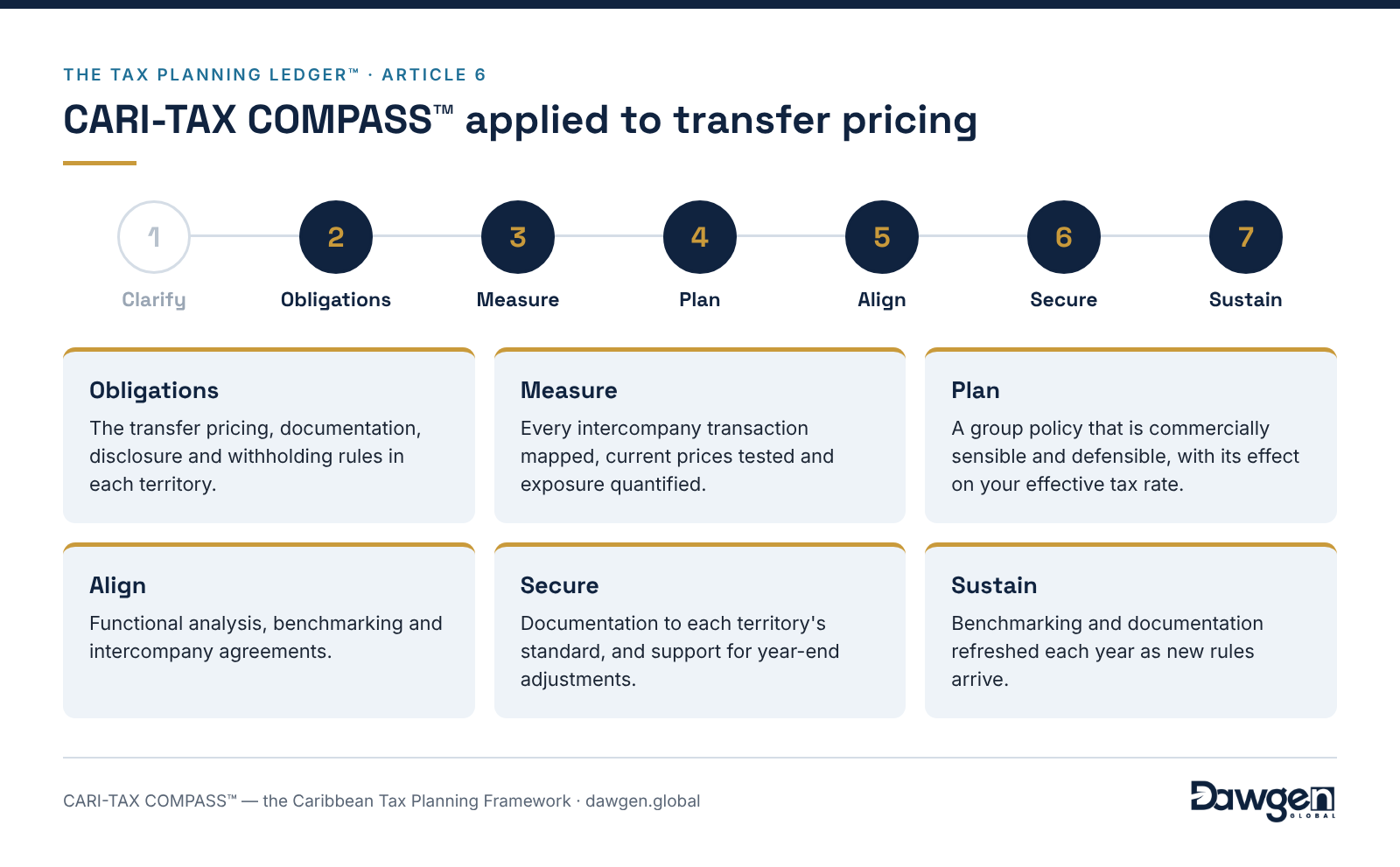
Transfer pricing is a core part of the Align stage of CARI-TAX COMPASS™, the Caribbean Tax Planning Framework, and our Transfer Pricing Documentation Programme applies it to your group:
- Obligations: we identify the transfer pricing, documentation, disclosure and withholding rules that apply in each territory where you operate.
- Measure: we map every intercompany transaction, test current prices and quantify the exposure.
- Plan: we design a group transfer pricing policy that is commercially sensible and defensible, and show its effect on your effective tax rate.
- Align: we carry out the functional analysis and benchmarking, and draft intercompany agreements.
- Secure: we prepare documentation to the standard each territory requires and support year-end adjustments.
- Sustain: we refresh benchmarking and documentation each year and track new rules across the region.
Where a tax authority has already challenged your prices, our tax disputes team prepares the response, and our panel of attorneys supports any litigation.
 Dawgen Global illustration
Where to start
Take the CARI-TAX COMPASS™ Tax Health Score at dawgen.global/tax-health-score; its documentation questions show how ready your group is. Or speak with our Caribbean Tax Service Desk at info@dawgen.global or (876) 926-5210, or with your territory desk at country@dawgen.com.
In Article 7, we consider where a Caribbean group should hold its companies, and how to choose a holding company location.
Dawgen Global — Big Firm Capabilities. Caribbean Understanding.
This article is general information and is not a substitute for advice on your circumstances. Transfer pricing requirements differ by territory; confirm the current position before acting.
About Dawgen Global
Dawgen Global is an independent, integrated multidisciplinary professional services firm headquartered at 47 Trinidad Terrace, New Kingston, Jamaica, serving 35 territories across the Caribbean. Founded and led by Dr. Dawkins Brown, Executive Chairman, the firm is independent and not affiliated with any international network. It delivers a full suite of professional services under one roof: audit and assurance; tax advisory; IT and digital transformation; risk management; cybersecurity; actuarial and insurance regulatory advisory; HR advisory; mergers and acquisitions; corporate recovery; business advisory and strategy; accounting BPO and virtual CFO services; and legal process outsourcing.
The proposition is simple: big-firm capability without the big-firm price. Dawgen Global’s integrated approach is built for the specific complexities and opportunities of the Caribbean market, helping organizations make sharper, better-informed decisions that drive measurable progress.
To explore a partnership, reach out:
- Website: dawgen.global
- Email: info@dawgen.global
- WhatsApp (Global): +1 555-795-9071
- Caribbean offices: +1 876-665-5926 | +1 876-929-3670 | +1 876-926-5210