

Most Caribbean groups were not designed; they grew. A successful company in one island opens a branch in another, buys a business in a third and sets up a property company for its new headquarters. Ten years later the founders own a collection of companies held in different ways, in different places, for reasons nobody quite remembers.
At some point, often when the group raises finance, brings in an investor, plans a succession or expands again, the question arises: should all of this sit under one holding company, and if so, where? This article explains what a holding company does, the factors that decide where it should be, the traps to avoid, and how to reach a decision you can defend.
What a holding company does
A holding company owns shares in the operating companies of the group. A well-chosen holding company can:
- Simplify ownership, so that investors, lenders and family members hold one set of shares instead of many.
- Collect dividends from subsidiaries and reinvest them across the group without first paying them out to the owners.
- Make it easier to sell or bring in investors, at group level or in individual businesses.
- Support succession, by letting ownership pass through one entity under a clear set of rules.
- Centralise group functions, such as treasury, governance and strategy, where it has the people to perform them.
It can also go wrong: a poorly located holding company can add tax at every level, trap cash, attract scrutiny and cost more to run than it saves.
The factors that decide the location
- Tax on dividends received. Does the holding company pay tax on dividends from its subsidiaries? Some territories exempt them, some tax them with a credit for foreign tax, and some tax them in full.
- Withholding tax on dividends paid. Each territory where a subsidiary sits may deduct withholding tax when it pays dividends abroad. The rate depends on domestic law and on whether a tax treaty applies. Within CARICOM, the intra-regional double taxation agreement can reduce or remove withholding tax on dividends between member states, which is a powerful reason to keep holding structures within the region where possible.
- Tax on selling a subsidiary. Many Caribbean territories do not tax capital gains as such, but transfer taxes, stamp duties and rules that treat certain gains as income can apply, both where the holding company sits and where the subsidiary sits.
- Treaty network. A location with treaties covering the territories where the group operates, and the countries where its owners or investors live, can reduce tax on payments and give access to dispute resolution.
- Substance. Tax authorities and treaty partners increasingly ask whether a holding company is genuinely managed where it is registered. Directors who live there, board meetings held there and real decisions taken there are now essential, not optional. Economic substance laws in several centres make this explicit.
- Residence of management. Most Caribbean territories treat a company as resident where it is centrally managed and controlled. A holding company registered in one island but run day to day by founders in another may be treated as resident where they are, with unexpected tax results.
- The global minimum tax. For groups that are, or will become, large enough to fall within it, a low-tax holding location may simply produce a top-up tax elsewhere.
- Legal, regulatory and banking factors. Company law flexibility, courts, exchange controls, the ease of opening and operating bank accounts, reputation with lenders and investors, and the cost of administration all matter as much as tax.
- Where the owners live. The owners’ own tax position, including how dividends and any eventual sale are taxed in their country of residence, often decides whether a structure works.
A practical comparison
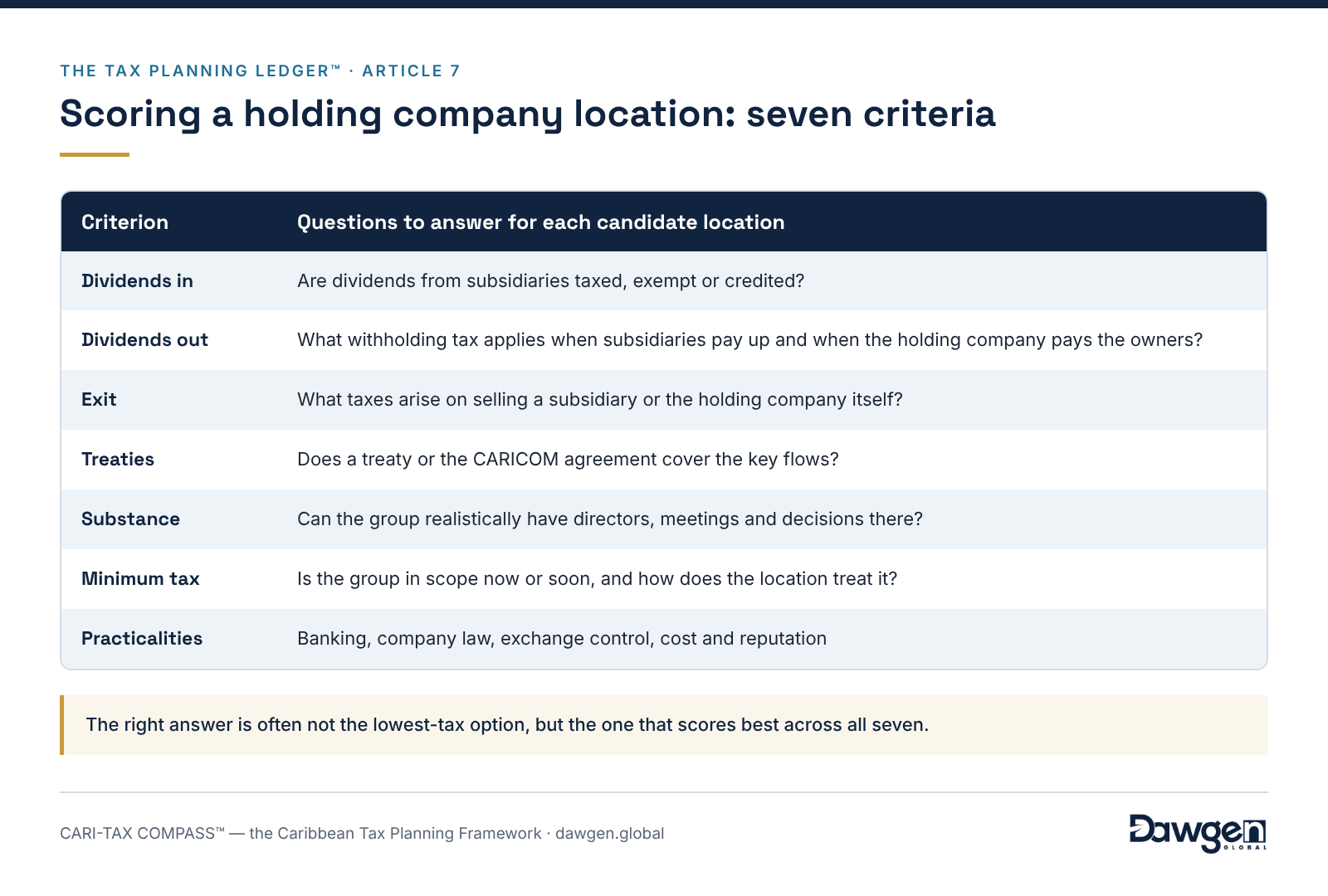
When we assess locations for a client, we score each candidate on the same criteria. A simplified version looks like this:
| Criterion | Questions to answer for each candidate location |
| Dividends in | Are dividends from subsidiaries taxed, exempt or credited? |
| Dividends out | What withholding tax applies when subsidiaries pay up and when the holding company pays the owners? |
| Exit | What taxes arise on selling a subsidiary or the holding company itself? |
| Treaties | Does a treaty or the CARICOM agreement cover the key flows? |
| Substance | Can the group realistically have directors, meetings and decisions there? |
| Minimum tax | Is the group in scope now or soon, and how does the location treat it? |
| Practicalities | Banking, company law, exchange control, cost and reputation |
The right answer is often not the lowest-tax option, but the one that scores best across all seven, for the activities the group actually carries on.
 Dawgen Global illustration
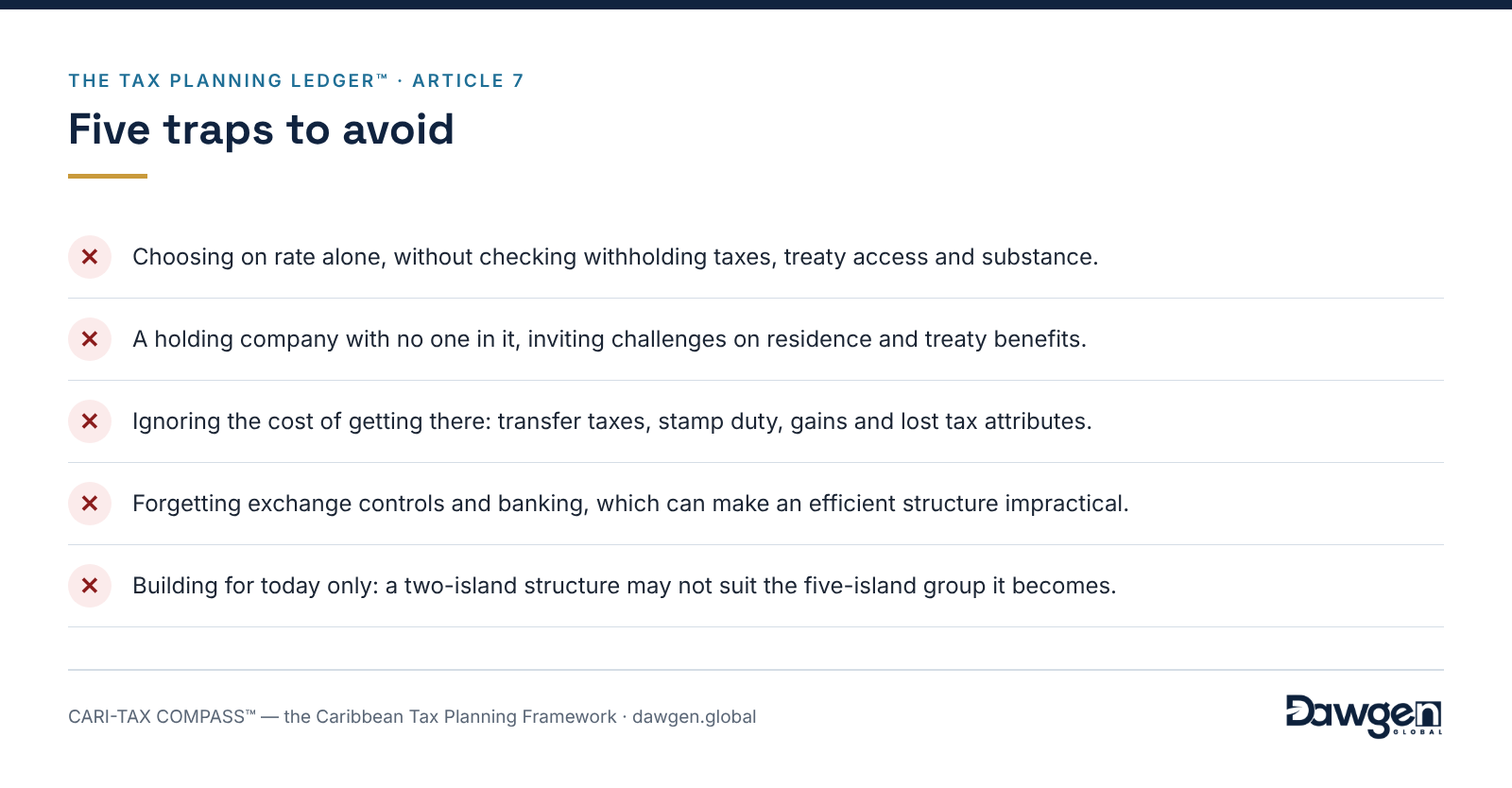
Common traps
- Choosing on rate alone, without checking withholding taxes, treaty access and substance requirements.
- A holding company with no one in it, which invites challenges on residence and treaty benefits.
- Ignoring the cost of getting there. Moving existing companies under a new holding company can trigger transfer taxes, stamp duty, gains and the loss of tax attributes such as losses or incentives. These must be costed first.
- Forgetting exchange controls and banking, which can make a theoretically efficient structure impractical.
- Building for today only. A structure that suits a two-island group may not suit the five-island group it becomes.
 Dawgen Global illustration
How Dawgen Global can help
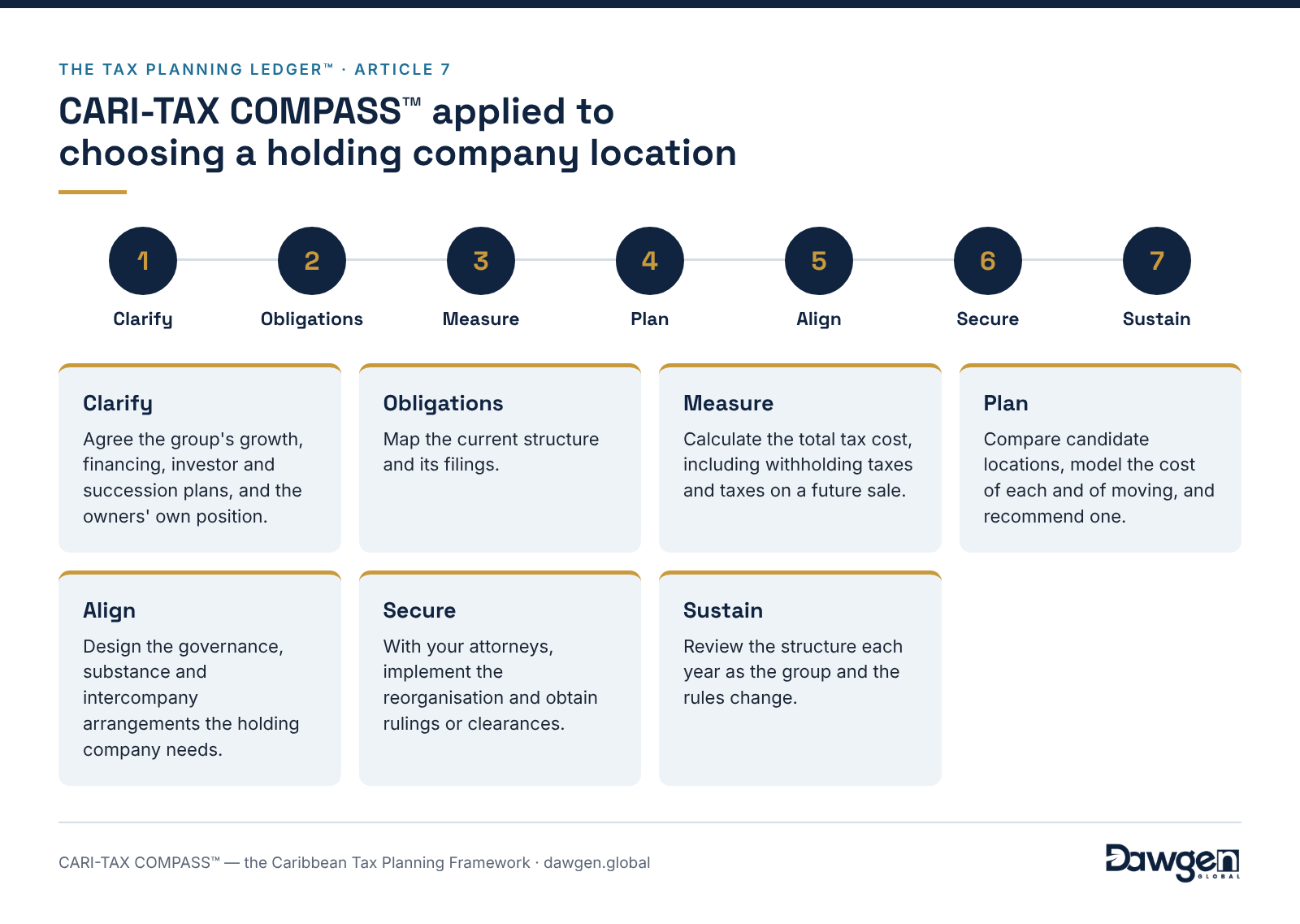
Choosing a holding company location is a typical Plan-stage decision under CARI-TAX COMPASS™, the Caribbean Tax Planning Framework, and our tax planning and structuring service takes you through it:
- Clarify: we agree the group’s growth, financing, investor and succession plans, and the owners’ own position, because the structure must serve them.
- Obligations and Measure: we map the current structure, its filings and its total tax cost, including withholding taxes and taxes on a future sale.
- Plan: using our Tax Guides for all 35 territories we serve, we compare candidate locations on the criteria above, model the tax cost of each and the one-off cost of moving to it, and recommend one.
- Align: we design the governance and substance the holding company needs, and the intercompany arrangements around it.
- Secure: with your attorneys and our corporate services colleagues, we implement the reorganisation, obtain any rulings or clearances and register the new arrangements.
- Sustain: we review the structure each year as the group and the rules change.
 Dawgen Global illustration
Where to start
Take the CARI-TAX COMPASS™ Tax Health Score at dawgen.global/tax-health-score; it asks when your structure was last reviewed. Or speak with our Caribbean Tax Service Desk at info@dawgen.global or (876) 926-5210, or with your territory desk at country@dawgen.com.
In Article 8, we look at incentives and special economic zones, and how to claim what the law allows.
Dawgen Global — Big Firm Capabilities. Caribbean Understanding.
This article is general information and is not a substitute for advice on your circumstances. Rates, treaties and rules differ by territory and change frequently; confirm the current position before acting.
About Dawgen Global
Dawgen Global is an independent, integrated multidisciplinary professional services firm headquartered at 47 Trinidad Terrace, New Kingston, Jamaica, serving 35 territories across the Caribbean. Founded and led by Dr. Dawkins Brown, Executive Chairman, the firm is independent and not affiliated with any international network. It delivers a full suite of professional services under one roof: audit and assurance; tax advisory; IT and digital transformation; risk management; cybersecurity; actuarial and insurance regulatory advisory; HR advisory; mergers and acquisitions; corporate recovery; business advisory and strategy; accounting BPO and virtual CFO services; and legal process outsourcing.
The proposition is simple: big-firm capability without the big-firm price. Dawgen Global’s integrated approach is built for the specific complexities and opportunities of the Caribbean market, helping organizations make sharper, better-informed decisions that drive measurable progress.
To explore a partnership, reach out:
- Website: dawgen.global
- Email: info@dawgen.global
- WhatsApp (Global): +1 555-795-9071
- Caribbean offices: +1 876-665-5926 | +1 876-929-3670 | +1 876-926-5210
Related service: Explore how we can help →