The broken rung is not a dead end. The pyramid produced experts as a by-product; the diamond must produce them by design. This article is the answer — a deliberate apprenticeship to replace the accidental one we are losing.
PART III · THE HARD IMPLICATIONS
From problem to design
The previous article named the broken rung: automate the base, and you remove the routine work through which novices once became experts. It is a genuinely hard problem, and the temptation is to respond with either denial or despair — to pretend the pipeline will sort itself out, or to conclude that expertise is doomed. Both are wrong. The path to expertise can be rebuilt. But it has to be rebuilt deliberately, because the mechanism that used to build it for us is gone.
Here is the reframe that makes the problem solvable. The pyramid never set out to develop people; it developed them as a by-product of needing cheap, leveraged labour. Apprenticeship happened almost by accident, as a side-effect of volume. We mistook that accident for a law of nature — and now that the volume is disappearing, we are discovering that we never actually designed the thing we are about to lose. The diamond asks us to do, on purpose, what the pyramid did by chance: produce experts. That is harder. It can also be far better.
The pyramid produced experts by accident, as a by-product of cheap labour. The diamond must produce them by design.
Engineering the rung
If the old ladder’s middle rungs have fallen away, the answer is not to mourn them but to engineer new ones. Four mechanisms, used together, can rebuild the path from a lean base to an experienced middle — deliberately replacing what the wide base used to provide by chance.
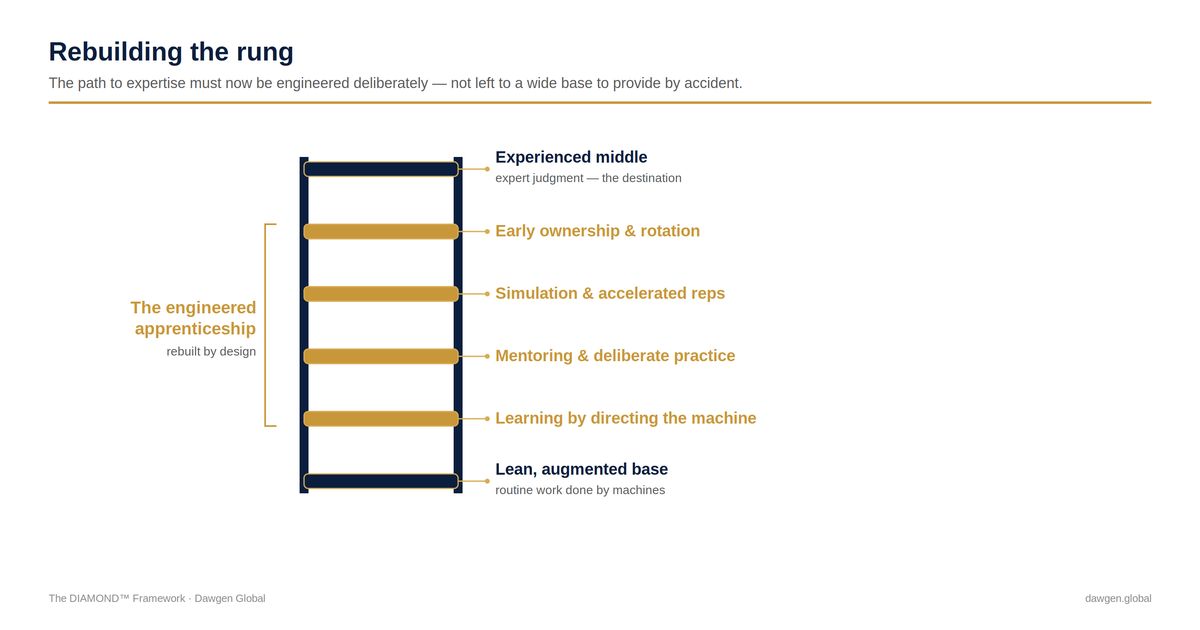
Rebuilding the rung: four engineered mechanisms replace the accidental apprenticeship of the pyramid.
1. Learning by directing the machine
The most powerful new training ground is the one automation itself creates. When intelligent systems perform the routine production, the junior’s job becomes to supervise, review, validate and correct that output — and that work is judgment work from day one. Instead of spending years grinding through volume before being trusted to think, a new professional who must check and challenge a machine’s output is exposed immediately to the questions that matter: Is this right? Why might it be wrong? What does the client actually need? Directed well, the augmented base is not the death of apprenticeship; it is a faster on-ramp to judgment than the pyramid ever offered.
2. Mentoring and deliberate practice
What used to happen by osmosis must now happen by intention. In the pyramid, juniors absorbed judgment by sheer proximity and repetition; in the diamond, that transfer has to be designed — structured mentoring relationships, deliberate practice on the skills that matter most, and experienced professionals whose explicit responsibility is to develop the next layer rather than merely to deliver work. This is the least technological of the four mechanisms and, in many organizations, the most neglected. It is also the one that most directly turns the empowered middle into a teaching engine rather than only a producing one.
3. Simulation and accelerated reps
Expertise is, in large part, accumulated exposure to varied situations. The pyramid delivered that exposure slowly and unevenly, depending on whatever work happened to come through the door. Technology now lets us compress and direct it. Simulations, curated case libraries and AI-generated scenarios can give a developing professional deliberate repetitions — including the rare, difficult and high-stakes situations they might otherwise wait years to encounter by chance. We can, in effect, manufacture the varied experience that the pyramid produced only by accident, and do it faster and more comprehensively.
4. Early ownership and rotation
Finally, the diamond should give people real responsibility sooner and move them deliberately across different kinds of work. With routine production handled by machines, there is no reason to keep capable professionals in a holding pattern for years. Early ownership of meaningful decisions — with support and guardrails — accelerates the development of judgment, and deliberate rotation broadens the base of experience on which that judgment rests. What the pyramid rationed by seniority, the diamond can grant by design.
Deliberate can be better than accidental
It is worth dwelling on the upside, because it is easy to treat the broken rung purely as a loss. The pyramid’s apprenticeship was slow, uneven and wasteful. People spent years on low-value repetition; exposure to genuinely formative work depended on luck and on which partner you happened to sit near; and a great deal of talent was lost or stalled along the way. A deliberately engineered apprenticeship can be faster, fairer and more complete — reaching judgment work sooner, distributing developmental opportunity by design rather than by chance, and ensuring no one waits a decade for experience that could be structured into a few focused years. Done well, the diamond does not merely replace the pyramid’s talent factory; it improves on it.
But it will not happen by default
The catch is commitment. Every one of these mechanisms costs time, money and senior attention now, for a payoff that arrives later — which is precisely why, as the previous article warned, the Nurture dimension is the one most often quietly dropped. An organization that automates its base and reinvests none of the savings into deliberately rebuilding the rung will still get the hollow middle; the tools described here only work if leaders choose to fund and lead them. The broken rung is solvable, but only by organizations willing to treat developing their next generation as a deliberate strategy rather than a hopeful afterthought.
Why this matters for the Caribbean
For the region, deliberate apprenticeship is an unusually good fit — and an unusually urgent need. The Caribbean cannot rely on scale to throw off experts as a by-product; we have never had the volume, and migration thins the ranks further. But intentional development plays to a regional strength: smaller organizations can be more deliberate, more personal and more flexible in how they build people than large bureaucracies bound by rigid programmes. An engineered apprenticeship lets a Caribbean firm develop expertise faster, distribute it more fairly, and — by investing visibly in its people’s growth — give its most capable professionals a powerful reason to build their careers at home rather than abroad.
With the broken rung answered, the series turns to the economics that a diamond demands. The next article examines what happens when value no longer scales with hours — the shift from billing headcount and time to pricing for outcomes.
Are you building experts by design — or hoping they appear?
| Build your next generation by design with Dawgen Global
The organizations that thrive through automation will be the ones that rebuild the path to expertise on purpose — rather than assuming it will look after itself. The tools exist; what they require is intention, investment and design. Dawgen Global helps boards and executive teams across the Caribbean engineer deliberate apprenticeship — turning an augmented base, structured mentoring, simulation and early ownership into a reliable pipeline of experienced judgment. Through the DIAMOND™ Organizational Diagnostic, our advisors assess how your organization develops people today and design a practical apprenticeship and capability strategy fit for a mid-heavy, technology-augmented firm — drawing on our integrated capabilities in HR Advisory, IT & Digital Transformation, and Business Advisory & Strategy. Request a confidential conversation: [email protected] · dawgen.global |
Dawgen Global — Independent. Integrated. Multidisciplinary.
This article is part of “From Pyramid to Diamond,” a Dawgen Global thought leadership series built on the proprietary DIAMOND™ Framework. Dr. Dawkins Brown is Executive Chairman and Founder of Dawgen Global.
© 2026 Dawgen Global. DIAMOND™ is a proprietary framework of Dawgen Global. dawgen.global | [email protected]
About Dawgen Global
Dawgen Global is an independent, integrated multidisciplinary professional services firm headquartered at 47 Trinidad Terrace, New Kingston, Jamaica, serving more than 15 territories across the Caribbean. Founded and led by Dr. Dawkins Brown, Executive Chairman, the firm is independent and not affiliated with any international network. It delivers a full suite of professional services under one roof: audit and assurance; tax advisory; IT and digital transformation; risk management; cybersecurity; actuarial and insurance regulatory advisory; HR advisory; mergers and acquisitions; corporate recovery; business advisory and strategy; accounting BPO and virtual CFO services; and legal process outsourcing.
The proposition is simple: big-firm capability without the big-firm price. Dawgen Global’s integrated approach is built for the specific complexities and opportunities of the Caribbean market, helping organizations make sharper, better-informed decisions that drive measurable progress.
To explore a partnership, reach out:
- Website: dawgen.global
- Email: [email protected]
- WhatsApp (Global): +1 555-795-9071
- Caribbean offices: +1 876-665-5926 | +1 876-929-3670 | +1 876-926-5210


