
Family businesses are the backbone of the Caribbean economy. Many of the region’s best-known names in distribution, manufacturing, retail, construction and hospitality were built by one generation and are now being handed to the next. That handover is one of the most important moments in a business’s life, and one of the most exposed to tax.
Transfers of shares and property can trigger transfer tax, stamp duty and other charges. A poorly timed or poorly structured handover can leave the next generation with a tax bill and no cash to pay it, undo years of earlier planning, or set siblings against each other. This article sets out the main tax issues in family succession, the traps we see most often, and how to plan a handover that protects both the family and the business.
Why succession is a tax event
In most Caribbean territories there is no inheritance tax in the European sense. That leads many families to assume succession is tax-free. It rarely is. Depending on the territory and the assets, a handover can involve:
- Transfer tax and stamp duty on the transfer of shares, land and buildings, whether by sale, gift or on death.
- Tax on gains where the law treats certain disposals as income, or where assets are transferred between companies.
- Withholding tax on dividends or other payments used to fund the handover.
- Loss of tax attributes, such as tax losses or incentives that depend on ownership remaining unchanged.
- Taxes in more than one territory where the family’s companies, property or members are spread across the region or abroad, as is common for families with members in North America or Europe.
The tax cost depends heavily on how the handover is done: by sale or gift, during life or on death, of shares or of assets, directly or through a holding company or trust. These choices can change the total tax many times over.
The traps we see most often
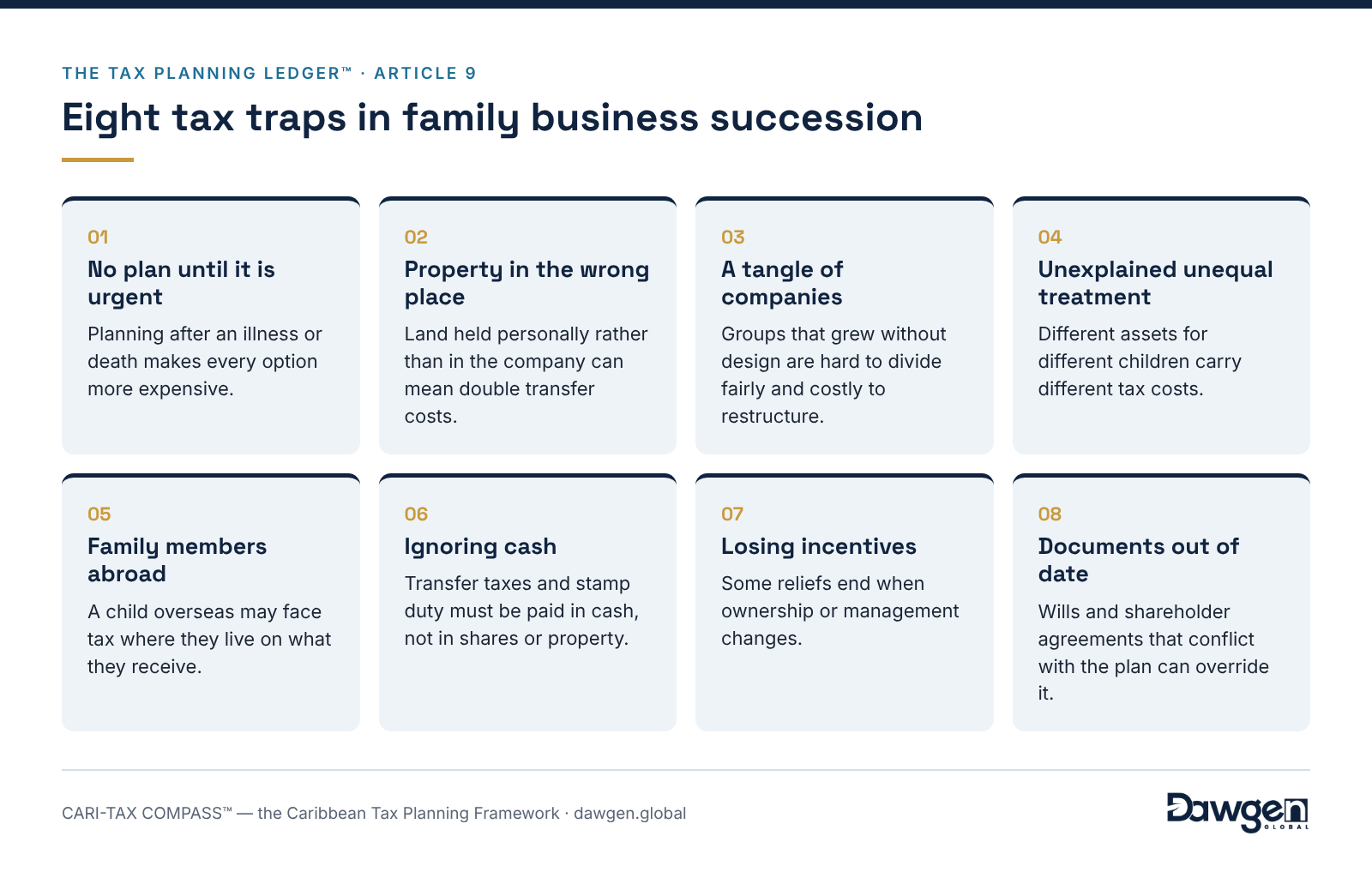
No plan until it is urgent. Succession often starts after an illness or death, when there is no time to plan and every option is more expensive.
Property held in the wrong place. Land and buildings held personally by the founder, rather than in the company that uses them, can mean double transfer costs and disputes over who owns what.
A tangle of companies. Groups that grew without design are hard to divide fairly between children and costly to restructure at the last minute. Article 7 discusses how a holding company can help.
Unequal treatment without explanation. Giving one child control of the business and another child property or cash can be sensible, but if the tax cost of each share is not understood, the result can feel unfair and lead to disputes.
Forgetting family members abroad. A child who lives overseas may face tax in their country of residence on what they receive, and their residence can affect where the company itself is treated as managed and controlled.
Ignoring cash. Transfer taxes and stamp duty must be paid in cash. If the value is locked in shares and property, the family may have to sell assets or borrow in a hurry.
Losing incentives. Some incentives and reliefs depend on the same people continuing to own or run the business. A change of ownership can bring them to an end.
Documents out of date. Wills, shareholder agreements and company articles that do not match the succession plan can override it.
 Dawgen Global illustration
Building a succession plan
A good succession plan answers family questions first and tax questions second. The tax work then finds the most efficient lawful way to deliver what the family has decided.
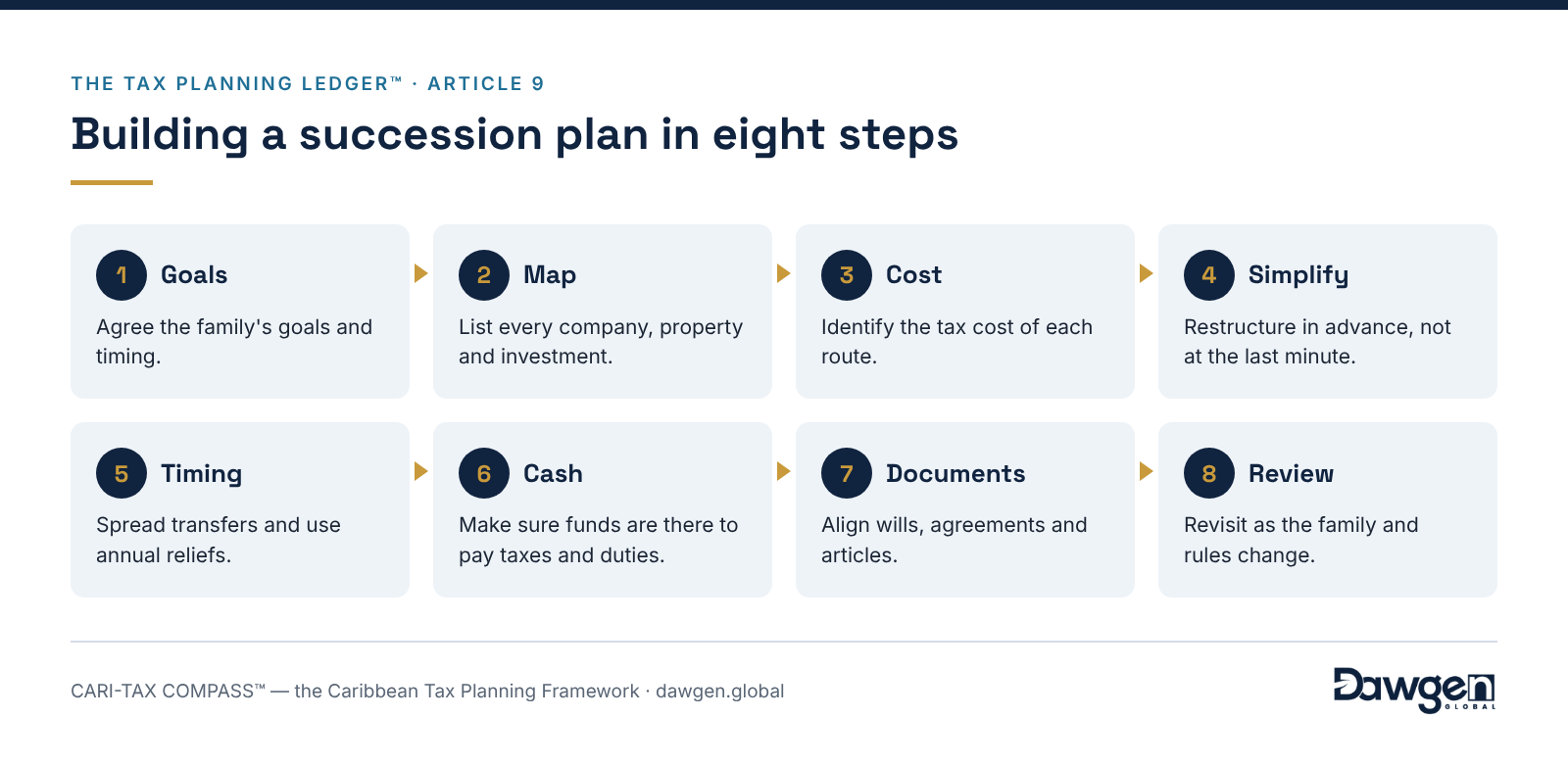
- Agree the family’s goals. Who will own the business, who will run it, how will family members who are not involved be treated, and when should the handover happen?
- Map what the family owns. Every company, property and investment, where it is, who owns it and what it is worth.
- Identify the tax cost of each route. Sale, gift, transfer during life, transfer on death, and transfers through a holding company or trust, in each territory involved.
- Simplify the structure in advance. Moving property into the right company, consolidating holdings or introducing a holding company is usually cheaper years before a handover than at the time.
- Plan the timing. Spreading transfers over time, using annual reliefs where available, and avoiding transfers just before a planned sale can reduce cost.
- Plan the cash. Make sure the funds to pay taxes and duties are available when needed.
- Align the documents. Update wills, shareholder agreements, articles and powers of attorney with your attorneys.
- Review regularly. Family circumstances, tax rules and the business all change.
 Dawgen Global illustration
Questions for the family
- If the founder were unable to work tomorrow, who would make decisions, and on what authority?
- Do we know the tax cost of passing the business to the next generation today?
- Is the family’s property held in the right names and companies?
- Do family members living abroad understand their own tax position?
- Do our wills, shareholder agreements and company documents reflect the plan?
How Dawgen Global can help
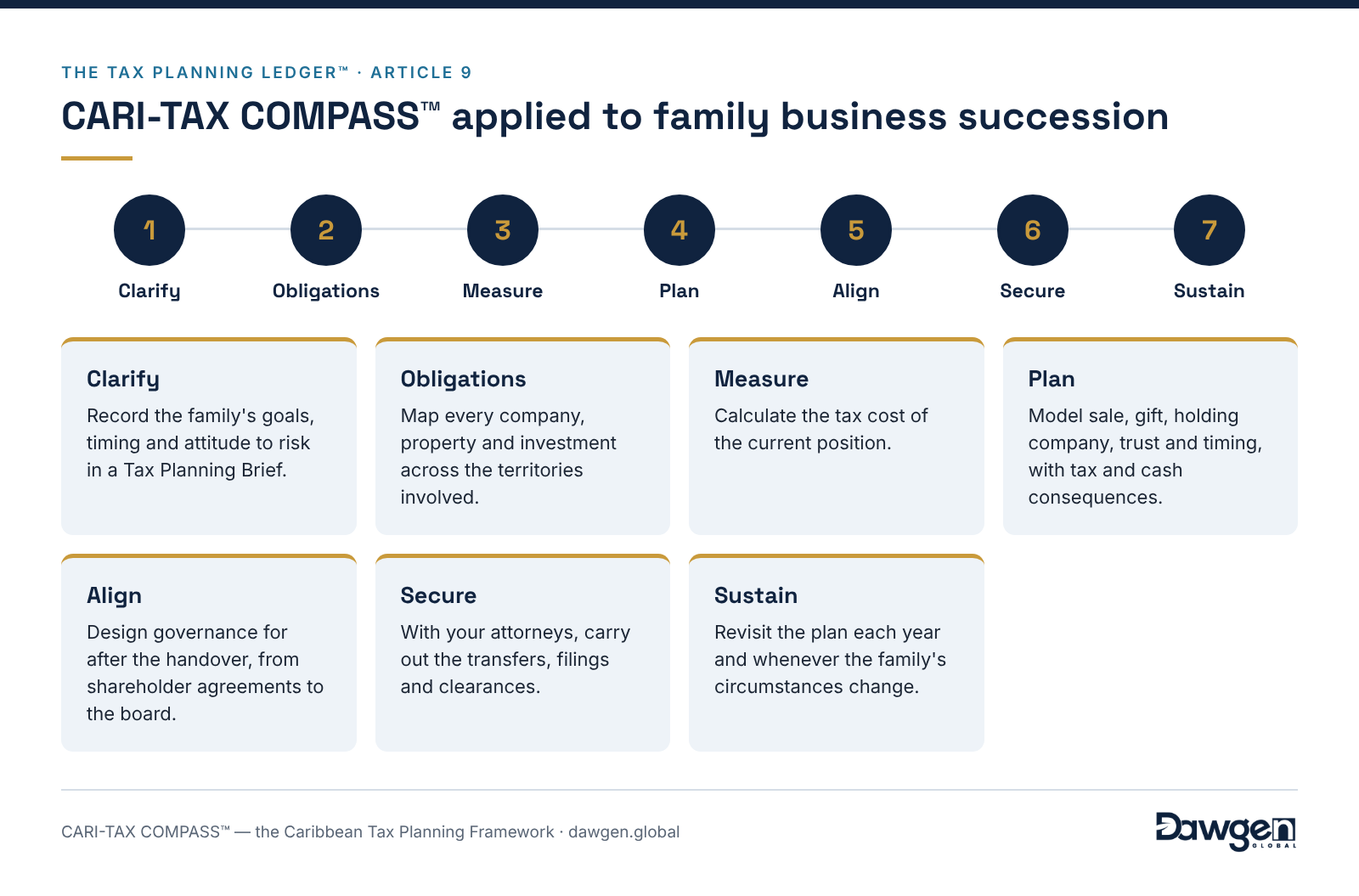
Succession planning is one of the most sensitive pieces of work we do, and we approach it through CARI-TAX COMPASS™, the Caribbean Tax Planning Framework, alongside the family’s attorneys:
- Clarify: we meet the founders and, where appropriate, the next generation, to record the family’s goals, timing and attitude to risk in a Tax Planning Brief.
- Obligations and Measure: we map every company, property and investment across the territories involved and calculate the tax cost of the current position.
- Plan: we model the realistic routes — sale, gift, holding company, trust, timing — and set out the tax, cash and practical consequences of each, so the family can decide with full information.
- Align: we design the governance the business will need after the handover, from shareholder agreements to board composition.
- Secure: with your attorneys, we carry out the restructuring and transfers, prepare the filings and obtain any clearances.
- Sustain: we revisit the plan each year and whenever the family’s circumstances change.
Where a sale to an outside buyer is part of the plan, our tax due diligence and M&A teams prepare the business and advise on structuring the sale.
 Dawgen Global illustration
Where to start
Take the CARI-TAX COMPASS™ Tax Health Score at dawgen.global/tax-health-score as a first check of the business’s tax position. Then speak with our Caribbean Tax Service Desk at info@dawgen.global or (876) 926-5210, or with your territory desk at country@dawgen.com, to arrange a confidential first conversation.
In Article 10, we look at expatriate teams and shadow payroll: getting tax right when people move across borders.
Dawgen Global — Big Firm Capabilities. Caribbean Understanding.
This article is general information and is not a substitute for advice on your circumstances. Succession involves legal as well as tax issues; take advice from your attorneys and tax advisers before acting.
About Dawgen Global
Dawgen Global is an independent, integrated multidisciplinary professional services firm headquartered at 47 Trinidad Terrace, New Kingston, Jamaica, serving 35 territories across the Caribbean. Founded and led by Dr. Dawkins Brown, Executive Chairman, the firm is independent and not affiliated with any international network. It delivers a full suite of professional services under one roof: audit and assurance; tax advisory; IT and digital transformation; risk management; cybersecurity; actuarial and insurance regulatory advisory; HR advisory; mergers and acquisitions; corporate recovery; business advisory and strategy; accounting BPO and virtual CFO services; and legal process outsourcing.
The proposition is simple: big-firm capability without the big-firm price. Dawgen Global’s integrated approach is built for the specific complexities and opportunities of the Caribbean market, helping organizations make sharper, better-informed decisions that drive measurable progress.
To explore a partnership, reach out:
- Website: dawgen.global
- Email: info@dawgen.global
- WhatsApp (Global): +1 555-795-9071
- Caribbean offices: +1 876-665-5926 | +1 876-929-3670 | +1 876-926-5210