
Why AI pays when the work is redrawn around it, not when tools are added to the old way of working, and how small teams inside the business make the redesign happen
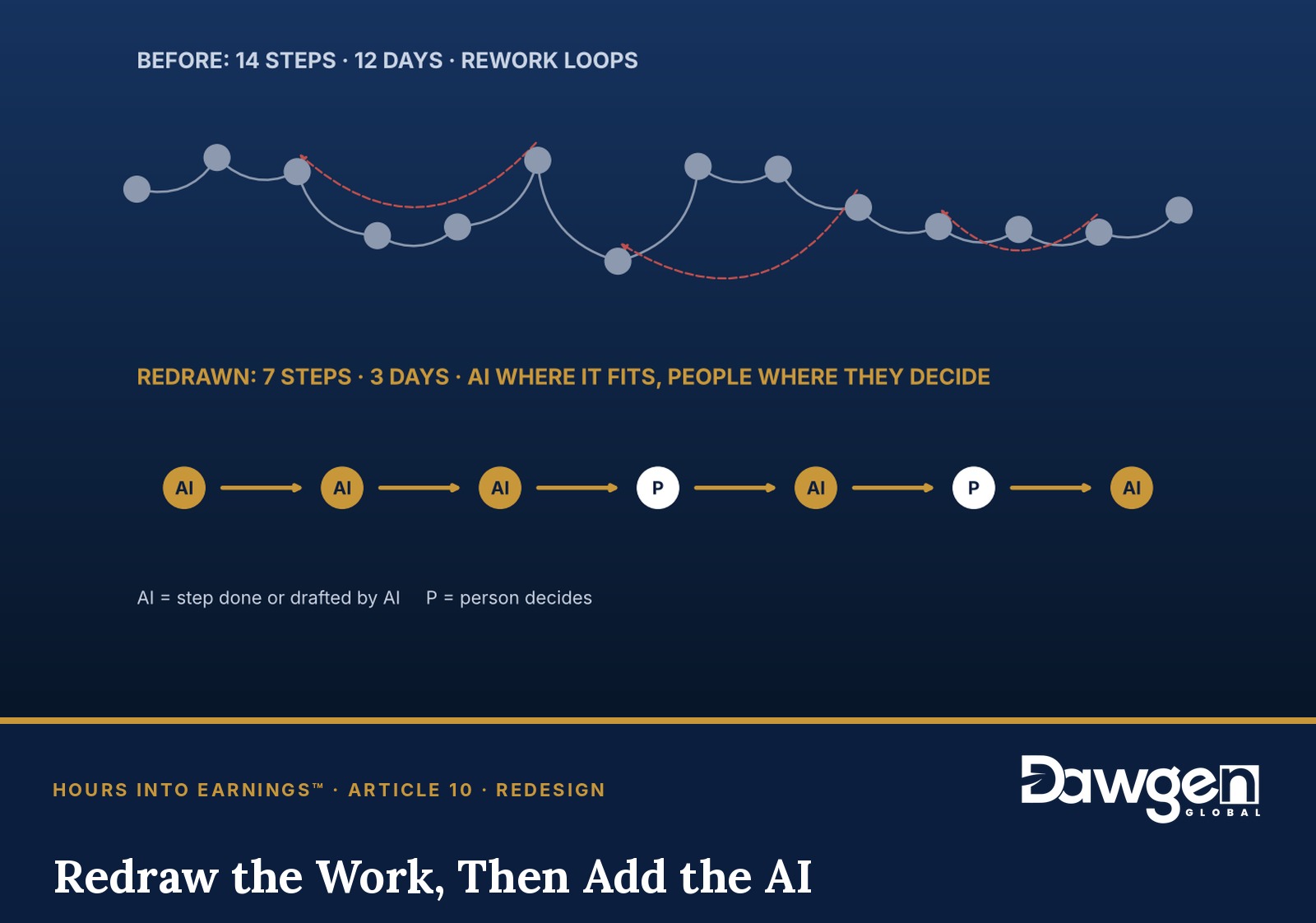
A credit union buys an AI tool that reads loan documents and another that drafts responses to members. The licences are signed, the staff are trained and the tools work exactly as promised. A year later, a loan still takes twelve days to approve, the same fourteen steps still run in the same order, and the loans team is still as busy as it was. The tools have made some steps a little faster. They have not changed the process.
That is the most common story in AI adoption, and it explains much of the gap this series has described since Article 1. Most organizations buy AI the way they buy software: as a tool added to the work they already do. But the value of AI rarely comes from doing the same steps faster. It comes from asking which steps should exist at all once AI is available, and redrawing the work around the answer.
This tenth article of Hours Into Earnings™ argues for a simple shift in emphasis: workflow, not tools. It sets out the evidence that redesign, not technology, separates the AI programmes that pay from those that stall, a five-move method for redrawing a workflow, and the delivery model that makes it happen in practice: small teams working inside the business, alongside the people who do the work.
The value is in how the work is done
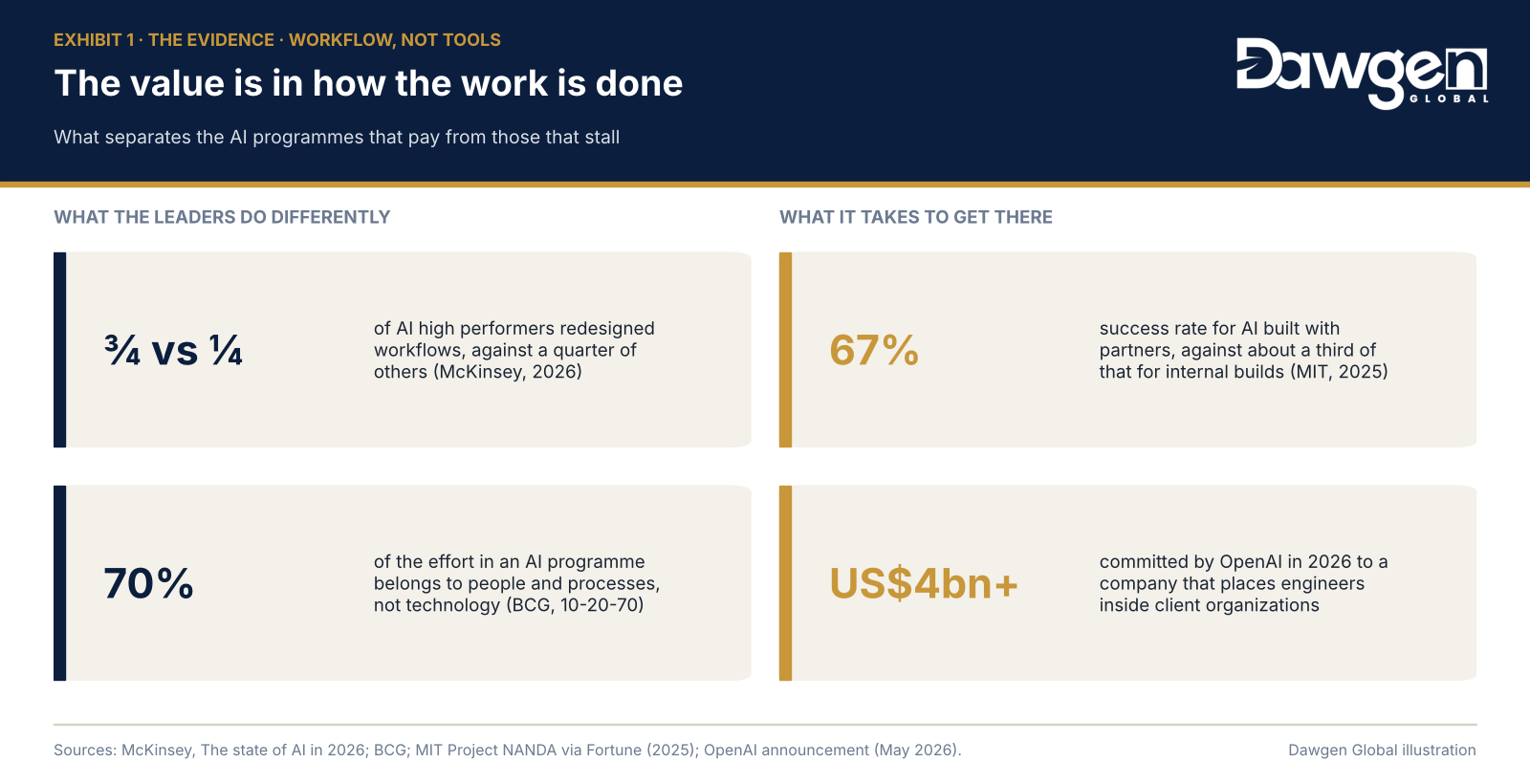
The evidence that workflow redesign drives AI value has become hard to ignore. McKinsey’s The state of AI in 2026 found that nearly three-quarters of AI high performers, the organizations attributing at least 5% of their operating profit to AI, had fundamentally redesigned workflows as a result of AI, up from 55% a year earlier. Among other respondents, the figure was about one-quarter.
Boston Consulting Group has long summarized the same point in its 10-20-70 principle: in a successful AI programme, about 10% of the effort goes into algorithms, 20% into technology and data, and 70% into people and processes. The tools are the smallest part of the work.
MIT’s Project NANDA, in its 2025 study of generative AI in business, found that only about 5% of pilots were producing rapid revenue gains, and traced the failures not to the quality of the models but to a learning gap: generic tools that do not adapt to how a particular business actually works. It also found that AI built with specialized partners succeeded about 67% of the time, while internal builds succeeded only about a third as often.
The largest AI companies have drawn the same conclusion about their own customers. In May 2026, OpenAI launched a deployment company with more than US$4 billion of initial capital, designed to place AI engineers directly inside client organizations to build and run systems in production. The model, often called forward deployment, puts the people who build AI next to the people who do the work.
Why tool-first programmes stall
Buying a tool feels like progress. It has a price, a contract, a launch date and a training session. Redesigning a workflow is slower to start and harder to describe. That is why so many AI programmes begin with tools, and why so many stall in the same five places.
The old steps survive. A tool that reads documents faster does not remove the step where a second person checks the same documents, or the step where the file waits in a queue for a manager. Most of the time in a process is spent waiting between steps, not working in them, and tools rarely touch the waiting.
The tool is fitted to the process, not the other way round. When AI is added to an existing process, the process sets the limits. A tool that could draft a complete credit memo is used only to fill in one field, because the form was designed for a person.
Nobody owns the end-to-end result. Tools are bought by departments. Workflows cross departments. A tool can make one team faster while the overall process stays exactly as slow, because the delay simply moves to the next hand-off.
The freed time is not harvested. As Article 2 showed, time saved by AI becomes value only when it is converted, by avoiding a hire, retiring a cost, absorbing more work or redeploying people. A tool scattered across a process saves minutes in many places, which are rarely enough to convert.
The people who do the work were not involved. Tools chosen by a project team and handed to staff are often worked around. Redesign done with the people who run the process uses what they know about where the real delays and errors are.
The Workflow Redraw™: five moves, one workflow at a time
The Workflow Redraw™ is how The Dawgen Earnings Crossing™ turns AI from a tool into a different way of working. It is applied to one workflow at a time, usually one chosen with the Countable Cost Screen™ from Article 3, and run by a small team working inside the business alongside the people who do the work. It has five moves.
- Map the workflow as it actually runs, not as the procedure manual says it runs: every step, every hand-off, every wait and every loop where work is sent back. Measure the time from start to finish, the staff hours per case and the cost per outcome.
- Remove the steps that exist only because of constraints AI has lifted: re-keying data from one system into another, checking work that a reliable system has already checked, approvals that exist because nobody could see the information in time. This is usually where most of the value lies, because work removed is cheaper than work automated.
- For each step that remains, decide who does it: AI does it, AI drafts and a person decides, or a person does it. Judgement, relationships and accountability stay with people. Reading, matching, drafting, checking and routing go to AI.
- Rewrite the roles, rules, data flows and controls around the new design. Any AI agent that will act on systems or money is licensed under the Agent Licence Test™ from Article 9 before it goes live.
- Run the new workflow alongside the old one for a defined period, measure the results with the Earnings Proof™, record them in the AI Earnings Register™, and only then switch the old way off.
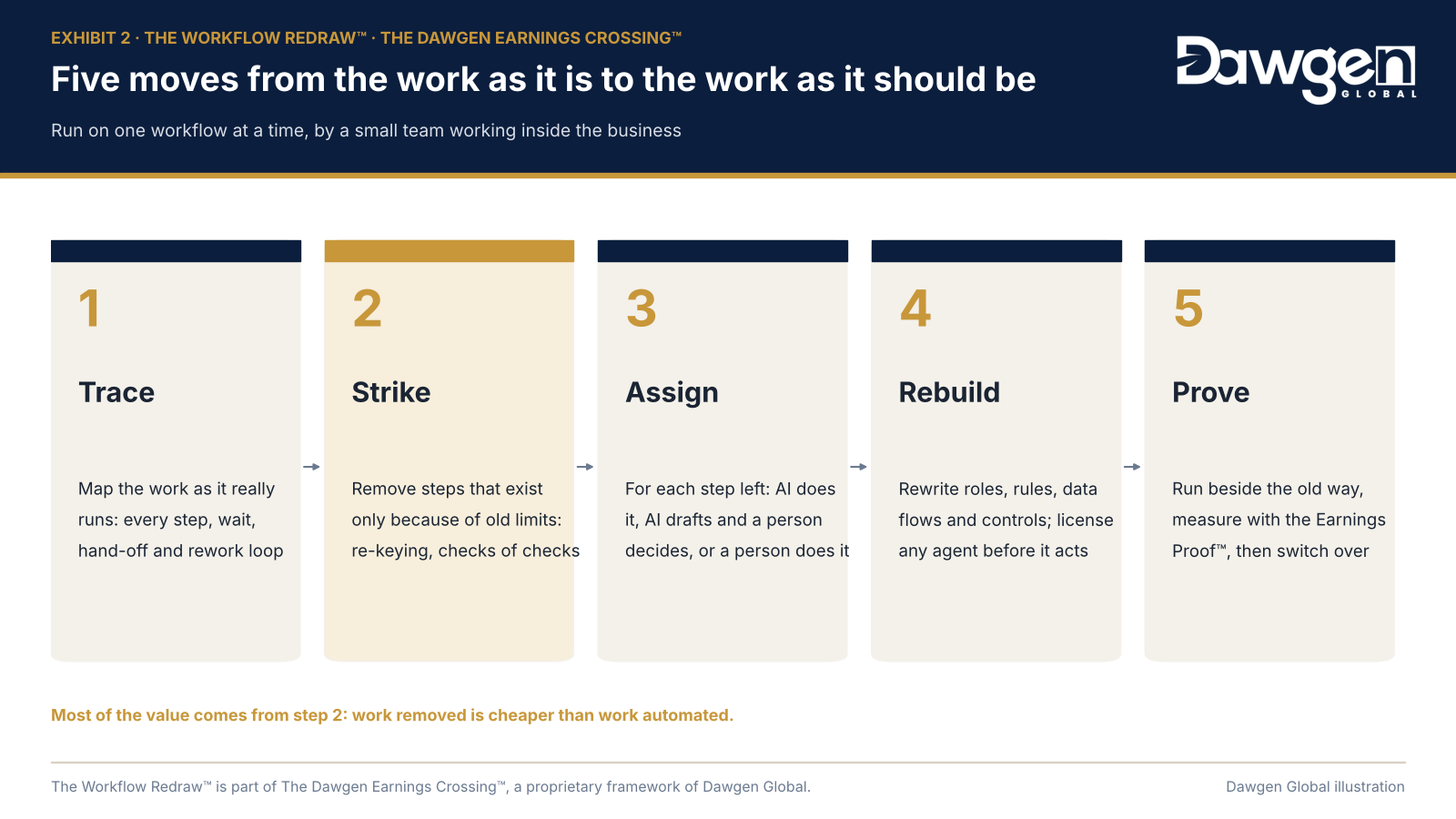
The order matters. Organizations that start at step 3, asking where AI can be used, end up automating steps that should have been removed. Starting at step 1 makes the waste visible; step 2 removes it; only then does AI go where it adds the most.
The arithmetic: same tools, same licence fees, very different results
Return to the credit union, as an illustrative composite. It processes about 9,000 loan applications a year. Before AI, each application passes through 14 steps, takes 12 working days from submission to decision and uses about 6.5 hours of staff time. A loaded staff hour costs about J$2,500.
Tools added. The credit union licenses an AI document reader and a drafting assistant for J$18 million a year. Officers use the reader to extract figures from payslips and bank statements and the assistant to draft letters. The 14 steps remain, including a second officer re-checking every extracted figure and a branch manager signing off every loan regardless of size. Decision time falls from 12 days to 11; staff time from 6.5 hours to 6.0. The half-hour saved per application is spread across several people and is mostly absorbed rather than converted, worth about J$6 million a year. After the licence fees, the programme loses about J$12 million a year.
Workflow redrawn. The credit union runs the Workflow Redraw™ on the same process, with the same tools.
- Trace shows that most of the 12 days is waiting: for missing documents, for the second check and for the manager’s signature.
- Strike removes seven steps. Documents are checked for completeness at the moment of submission, so applications no longer bounce back days later. The second re-check of extracted figures is replaced by automatic validation against the source documents, with exceptions sent to a person. Branch manager sign-off is kept only for loans above J$3 million.
- Assign gives reading, completeness checks, data extraction and the first draft of the credit memo to AI. The credit decision stays with the loans officer, and the larger loans with the manager.
- Rebuild rewrites the loans officer role around member conversations and decisions, and sets the approval thresholds in the system.
- Prove runs the new process in two branches for a quarter before the switch.
| Before | Tools added | Workflow redrawn | |
| Steps | 14 | 14 | 7 |
| Working days to decision | 12 | 11 | 3 |
| Staff hours per application | 6.5 | 6.0 | 2.5 |
| Value a year (J$m) | — | 6 | 74 |
| AI licence fees a year (J$m) | — | 18 | 18 |
| Net gain a year (J$m) | — | −12 | 56 |
The redrawn workflow saves four hours on each of 9,000 applications: 36,000 hours, or about J$90 million of capacity. Applying the Capacity Conversion Rule™ from Article 2, the credit union converts about 60% of it, J$54 million, by not replacing two retiring officers, absorbing growth in applications without new hires and moving officers into member outreach. Faster decisions also win loans that members used to take elsewhere: about 350 more a year, adding about J$20 million of net interest after funding costs and expected losses. One-off change costs, for training, system changes and the parallel run, come to about J$12 million and are recovered in the first three months.
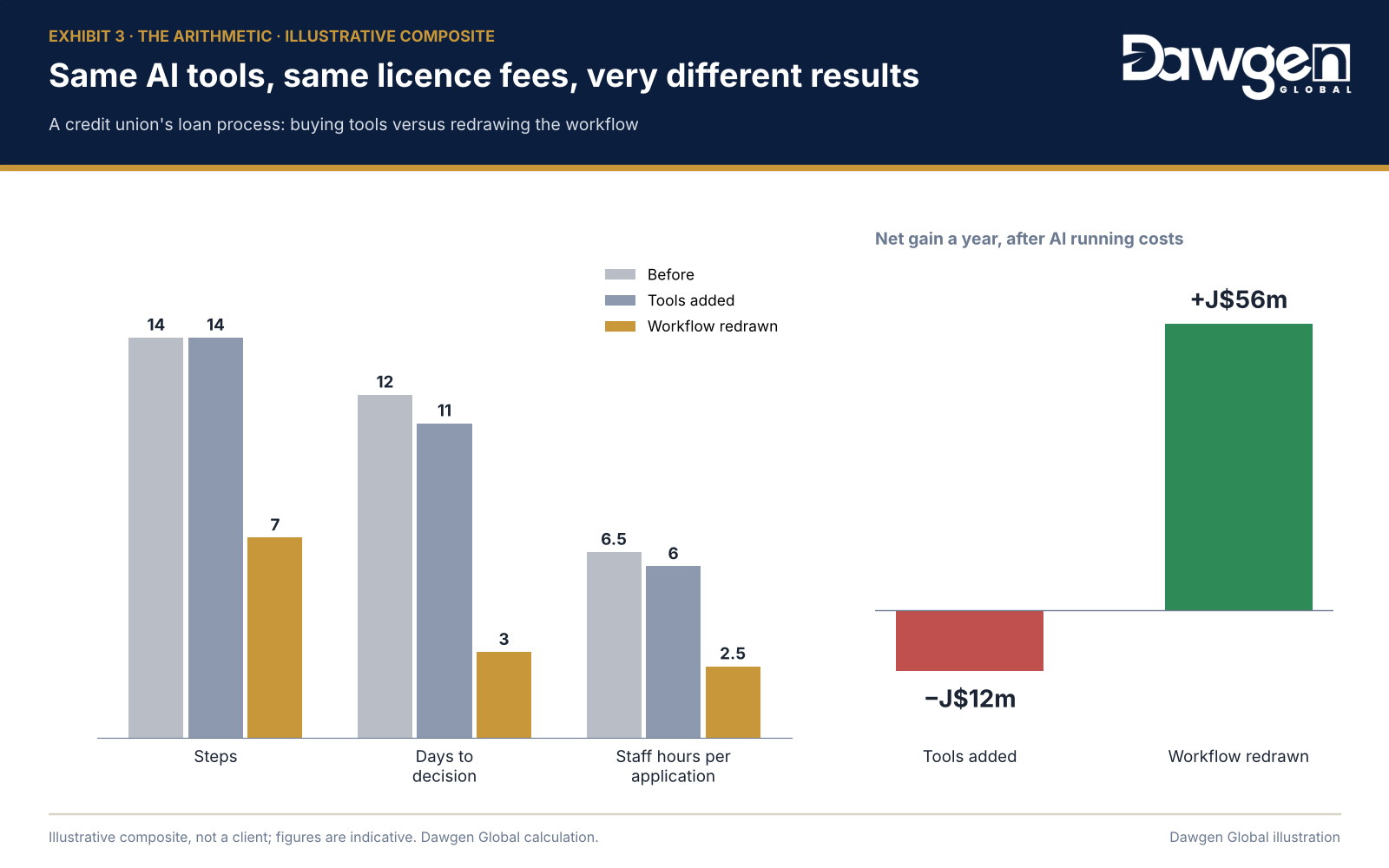
The tools were identical. The licence fees were identical. The difference of J$68 million a year came entirely from redrawing the work.
The composite is illustrative and does not describe any client. Figures are indicative.
How forward-deployed teams make redesign happen
Knowing that redesign matters is easier than doing it. A workflow cannot be redrawn from a boardroom or a vendor’s office. It has to be redrawn where the work happens, with the people who know where the delays and errors really are. That is why the forward-deployed model has spread so quickly: a small team that combines process, finance, data and AI skills works inside the business, on one workflow, until the new way of working is live and proven.
Three features make the model work.
It is short and specific. A sprint takes one workflow from Trace to Prove in weeks, not months. A defined scope and a measured result keep the work honest.
It is built with the people who run the process. The team sits with the loans officers, the payables clerks or the claims handlers. Their knowledge shapes the redesign, and their ownership makes it stick.
It leaves capability behind. The team owns the result until it is proven, then trains the business’s own people to run, measure and improve the new workflow. The next workflow is easier, and the one after that easier still.
Why this fits the Caribbean
Regional businesses have particular reasons to favour workflow over tools.
Budgets are tight, so tool sprawl is expensive. Every additional licence is often paid in US dollars. Redesign gets more from the tools already owned before more are bought.
Processes carry layers of history. Many regional processes have accumulated checks and approvals over decades, often in response to a single past problem. Strike is where those layers are examined, and where many of them can safely go.
Organizations are small enough to redesign whole processes. A regional company can redraw a workflow from end to end in one sprint, across every department it touches, in a way that large multinationals often cannot. That theme is the subject of the next article.
Specialist skills are scarce locally. Few regional businesses employ process designers, data engineers and AI specialists together. A forward-deployed team brings that combination for the length of a sprint and leaves the capability behind.
Three questions to ask this week
Put three questions to the managers responsible for your AI programme:
- For each AI tool we pay for, which workflow did it change, and how many steps did that workflow lose?
- In our most important workflows, how much of the time from start to finish is spent working, and how much waiting?
- Who owns each of those workflows from end to end, across every department it touches?
If the answer to the first question is a list of tools rather than a list of redesigned workflows, the programme is buying technology, not changing how the business works.
The next article, Small Enough to Redesign Whole, argues that the size of Caribbean businesses, so often seen as a weakness, is an advantage in the age of AI.
Which of your workflows should be redrawn first?
Dawgen Global’s Forward-Deployed Crossing Sprints™ place a small team of our process, finance, data and AI specialists inside your business to redraw one workflow at a time. Each sprint runs the full Workflow Redraw™, from Trace to Prove: mapping the work as it really runs, removing the steps that no longer need to exist, assigning the rest to AI or to people, rebuilding roles and controls, and proving the result in the AI Earnings Register™ before the old way is switched off. We own each sprint until the new workflow is live and proven, then train your team to run it. Fees are customized to each client’s circumstances and agreed deliverables.
Request a scoping conversation: info@dawgen.global · (876) 926-5210 · US 855-354-2447 · dawgen.global
Dawgen Global — Big Firm Capabilities. Caribbean Understanding.
About Dawgen Global
Dawgen Global is an independent, integrated multidisciplinary professional services firm headquartered at 47 Trinidad Terrace, New Kingston, Jamaica, serving more than 15 territories across the Caribbean. Founded and led by Dr. Dawkins Brown, Executive Chairman, the firm is independent and not affiliated with any international network. It delivers a full suite of professional services under one roof: audit and assurance; tax advisory; IT and digital transformation; risk management; cybersecurity; actuarial and insurance regulatory advisory; HR advisory; mergers and acquisitions; corporate recovery; business advisory and strategy; accounting BPO and virtual CFO services; and legal process outsourcing.
The proposition is simple: big-firm capability without the big-firm price. Dawgen Global’s integrated approach is built for the specific complexities and opportunities of the Caribbean market, helping organizations make sharper, better-informed decisions that drive measurable progress.
To explore a partnership, reach out:
- Website: dawgen.global
- Email: info@dawgen.global
- WhatsApp (Global): +1 555-795-9071
- Caribbean offices: +1 876-665-5926 | +1 876-929-3670 | +1 876-926-5210