

Why a buyer or lender will pay more for the same AI earnings when the AI behind them is governed, and how to get ready for the questions they will ask
Two regional companies come to market in the same year. They are in the same industry, have the same operating profit and claim much the same benefit from AI. The first can hand the buyer’s advisers a list of every AI system it uses, who owns each one, what data it relies on, how its errors are caught and an independent review of the profit it produces. The second cannot. It uses more AI than it knows, much of it bought by individual departments, and its AI profit exists mainly in management presentations.
The two companies will not receive the same price. The second will be offered a lower multiple, asked to accept part of its price in escrow or as an earnout, and required to give warranties that the first will not need. If it borrows instead, its lender will ask harder questions and charge more.
Most of the previous six articles of Hours Into Earnings™ were about earnings and cash: how AI value reaches the income statement and the balance sheet. This seventh article covers the fifth value lever of The Dawgen Earnings Crossing™, Risk and Multiple: how AI changes what the market will pay for each dollar of earnings. Its argument is simple. The multiple does not move because AI is used. It moves when the risk does. Governed AI lowers the risk a buyer or lender must price. Ungoverned AI raises it, often without the board knowing.
Investors pay for confidence, not for smooth lines
It is tempting to argue that AI raises the multiple by making earnings smoother. The evidence does not support that, and boards should be wary of anyone who claims it. A McKinsey study of earnings volatility found that smoother earnings growth on its own had no measurable effect on price-to-earnings ratios and only a small effect on shareholder returns. Investors look through the line on the chart to what drives it.
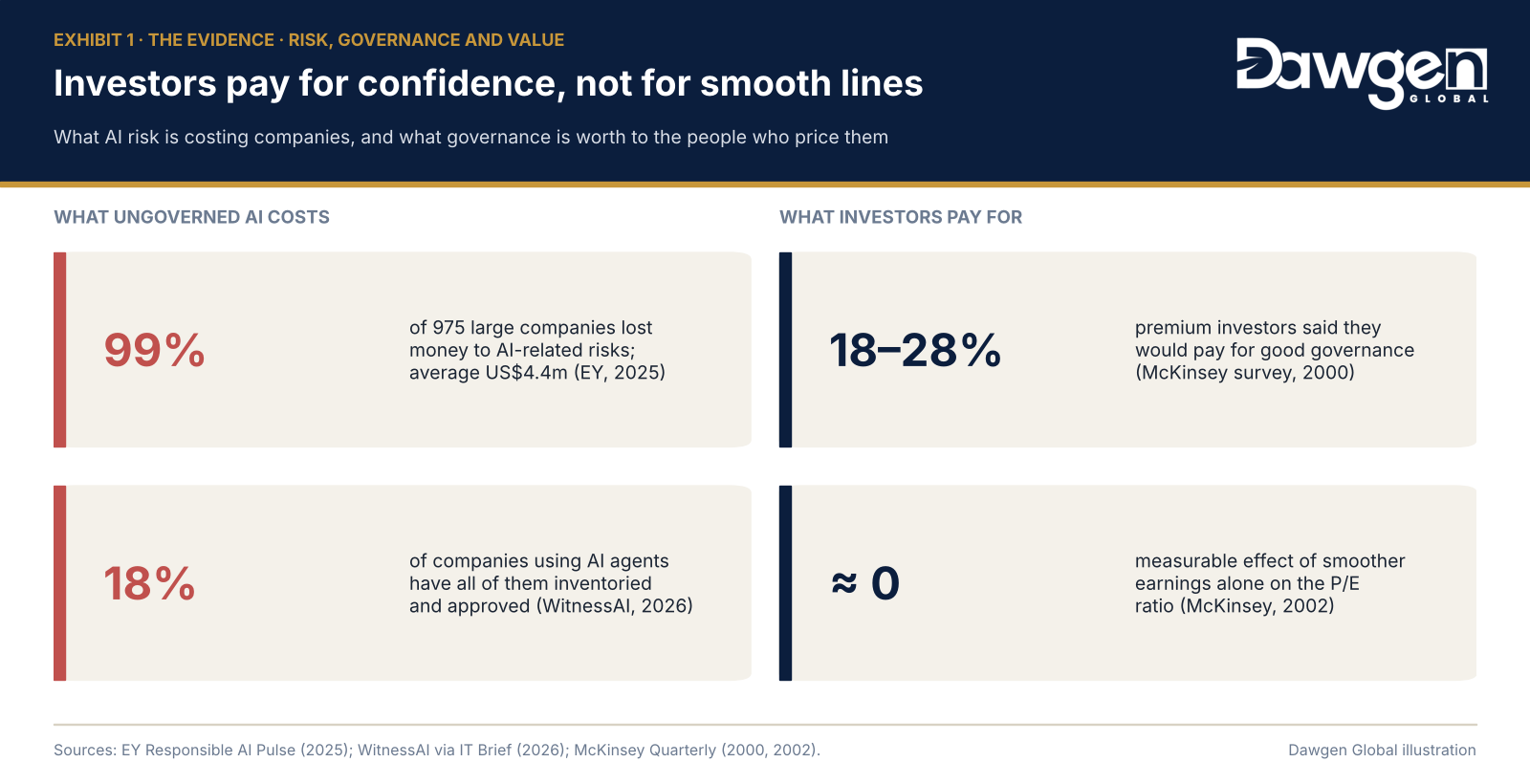
What investors do pay for is confidence that the earnings are real, controlled and likely to last. In an often-cited McKinsey survey of institutional investors, respondents said they would pay a premium of 18% to 28% for a well-governed company: about 18% in the United States and United Kingdom, and 21% to 28% in Latin American markets, where reporting was seen as less reliable. The survey is old and records what investors said rather than what they paid, but its logic is the one every buyer applies: the less it can trust what it is told, the more it discounts.
AI has created a new category of things a buyer cannot trust. EY’s 2025 survey of 975 large companies found that 99% had suffered financial losses from AI-related risks, such as compliance failures, flawed outputs and biased decisions, with an average loss of about US$4.4 million. The same survey found that companies with real-time monitoring of their AI were 34% more likely to report revenue growth. A 2026 survey of 300 large enterprises by WitnessAI, an AI security company, found that 70% were using or piloting autonomous AI agents, but only 18% said all of their agents were formally inventoried and approved.
Buyers have noticed. Law firms advising on acquisitions now recommend specific AI warranties, longer indemnity periods, escrows and earnouts tied to AI performance, and warn that warranty insurers are beginning to exclude AI risks from cover. Every one of those protections is paid for, in the end, by the seller.
How ungoverned AI becomes a discount
A buyer or lender values a business by asking two questions: how much will it earn, and how sure can we be? AI that nobody governs weakens the answer to the second question in five ways.
Unknown exposure. If the company cannot list the AI it uses, the buyer cannot judge what could go wrong. Tools bought on department credit cards, free tools staff use with customer data, and agents acting on systems without approval are all liabilities the buyer must assume exist.
Unclear rights. AI built on customer data that was never consented for that use, or on information supplied by a partner under a contract that does not allow it, may have to be switched off after the sale. The profit it produces goes with it.
Unreliable output. An AI system that prices policies, approves credit or settles claims without monitoring can make errors at scale before anyone notices. A buyer who cannot see the error rates assumes the worst about future write-offs, refunds and regulatory penalties.
Dependency. If the AI profit depends on one vendor whose prices may rise, or on two employees who built the system and could leave, the buyer will discount it or hold back part of the price until it is proved to last.
No proof. Most importantly, if the AI profit has never been recorded, measured against a fair comparison and reviewed by someone independent, the buyer has no reason to pay for it. It is common for a buyer simply to leave unproven AI earnings out of the valuation, or to pay for them only later, through an earnout, if they turn up.
None of these risks needs to happen to reduce the price. It is enough that the buyer cannot rule them out.
The Price Chip Review™: five questions before the buyer asks them
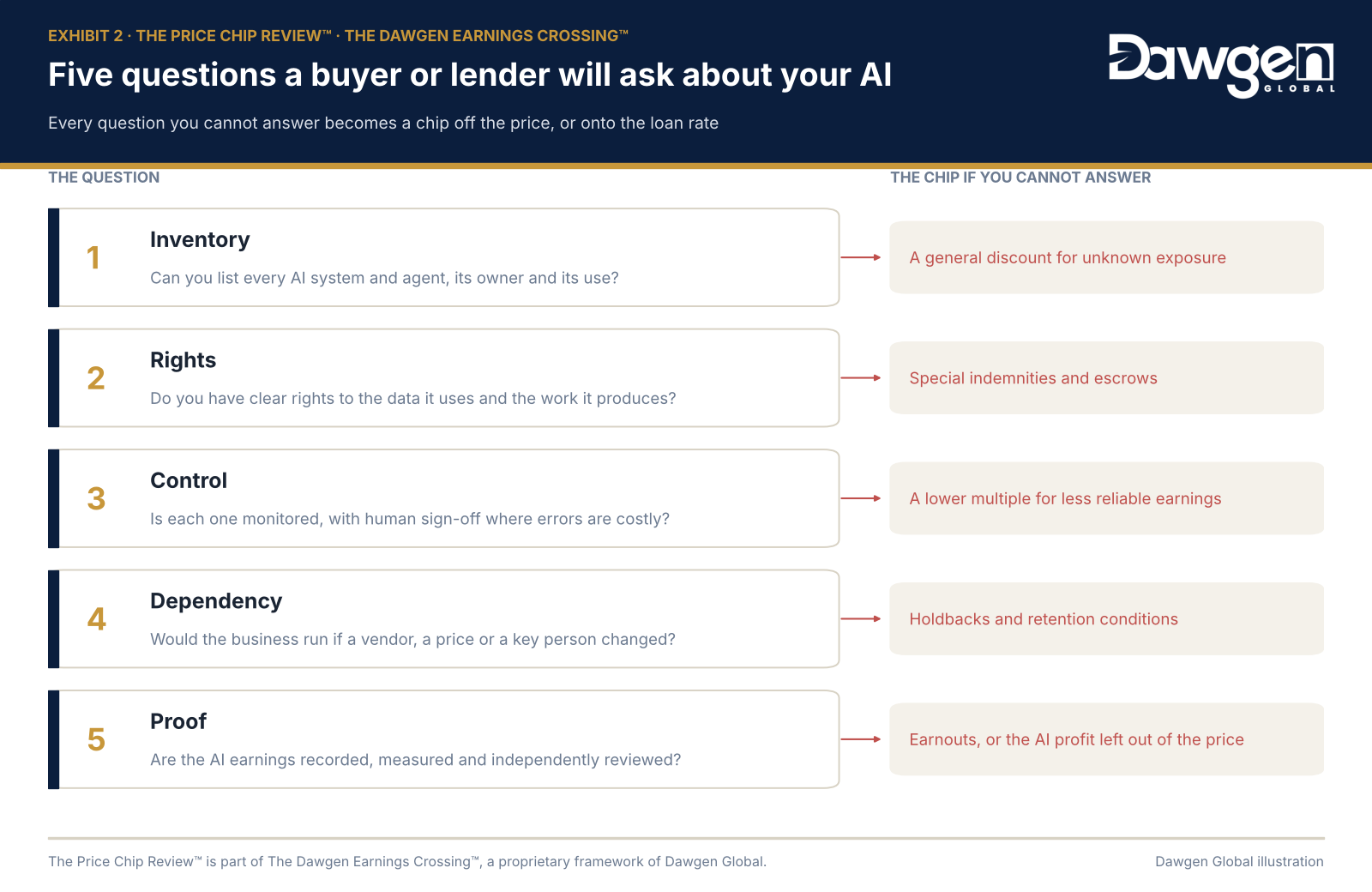
In a sale, a price chip is the reduction a buyer asks for after diligence finds something it did not expect. The Price Chip Review™ is how the Risk and Multiple lever of The Dawgen Earnings Crossing™ finds those chips first, while there is still time to remove them. It asks the five questions a careful buyer, lender or investor will ask about a company’s AI, and records for each one what the company would lose if it could not answer.
| Question | What a good answer looks like | The chip if you cannot answer |
| 1. Inventory: can you list every AI system and agent, its owner and its use? | A maintained register, including tools bought by departments and agents with access to systems | A general discount for unknown exposure |
| 2. Rights: do you have clear rights to the data it uses and the work it produces? | Data use matched to consents and contracts; vendor terms reviewed | Special indemnities and escrows |
| 3. Control: is each system monitored, with human sign-off where errors are costly? | Error rates tracked; thresholds for human review in pricing, credit, claims and payments | A lower multiple for less reliable earnings |
| 4. Dependency: would the business run if a vendor, a price or a key person changed? | Documented systems, a second person who understands each one, exit terms with vendors, usage costs in the budget | Holdbacks and retention conditions |
| 5. Proof: are the AI earnings recorded, measured and independently reviewed? | Every initiative in the AI Earnings Register™, tested by the Earnings Proof™ and reviewed through Earnings Crossing Assurance™ | Earnouts, or the AI profit left out of the price |
The Review is not only for companies planning a sale. The same five questions are asked, in shorter form, by a bank renewing a facility, an investor in a bond or share issue, a regulator conducting an inspection and a reinsurer or insurer pricing cover. A company that can answer them is cheaper to lend to, easier to insure and quicker to sell.
The order matters. Questions 1 to 4 reduce the risk the buyer must price, which protects the multiple. Question 5 makes the AI profit countable, which protects the earnings the multiple is applied to. A company needs both. A well-governed company with unproven AI earnings will have them left out of the price; a company with proven AI earnings but no governance will have them discounted.
The arithmetic: same EBIT, J$1.07 billion more value
Consider an illustrative composite: a Caribbean distribution and logistics group with operating profit (EBIT) of J$900 million. Management attributes J$150 million of that to AI, from route planning, demand forecasting, collections and automated invoice processing. Comparable regional businesses change hands at between 6.0 and 7.0 times EBIT. The shareholders receive an approach from a regional buyer.
The first offer. The buyer’s diligence team asks the five questions of the Price Chip Review™ and gets uncertain answers. There is no AI register. Two of the AI tools use customer data under contracts that do not clearly allow it. Nobody can show error rates for the automated invoice processing, and the route-planning system was built by a single contractor. The AI profit has never been independently reviewed.
The buyer responds as buyers do. It accepts only J$60 million of the J$150 million AI profit as proven, values the business at the bottom of the range, 6.0 times, and deducts J$80 million for the work it will have to do after the sale to bring the AI under control. Its offer is J$4,780 million, with a further 10% to be held in escrow for two years against AI-related claims.
The second offer. The shareholders decline and spend the next year getting ready. Every AI system is registered and given an owner. The two data contracts are renegotiated. The invoice and pricing systems are monitored, with human review above set thresholds. A second engineer learns the route-planning system, and its code and documentation are brought in-house. Every AI initiative is entered in the AI Earnings Register™ and the full J$150 million is reviewed independently.
The same buyer returns. Its offer is now J$5,850 million, with no AI-specific escrow.
| Step | Effect on value (J$m) |
| First offer: AI ungoverned | 4,780 |
| The remaining J$90 million of AI profit is now proven and counted, at 6.0 times | +540 |
| Lower risk earns a multiple of 6.5 times rather than 6.0 times, on J$900 million of EBIT | +450 |
| No deduction for clean-up work after the sale | +80 |
| Second offer: AI governed | 5,850 |
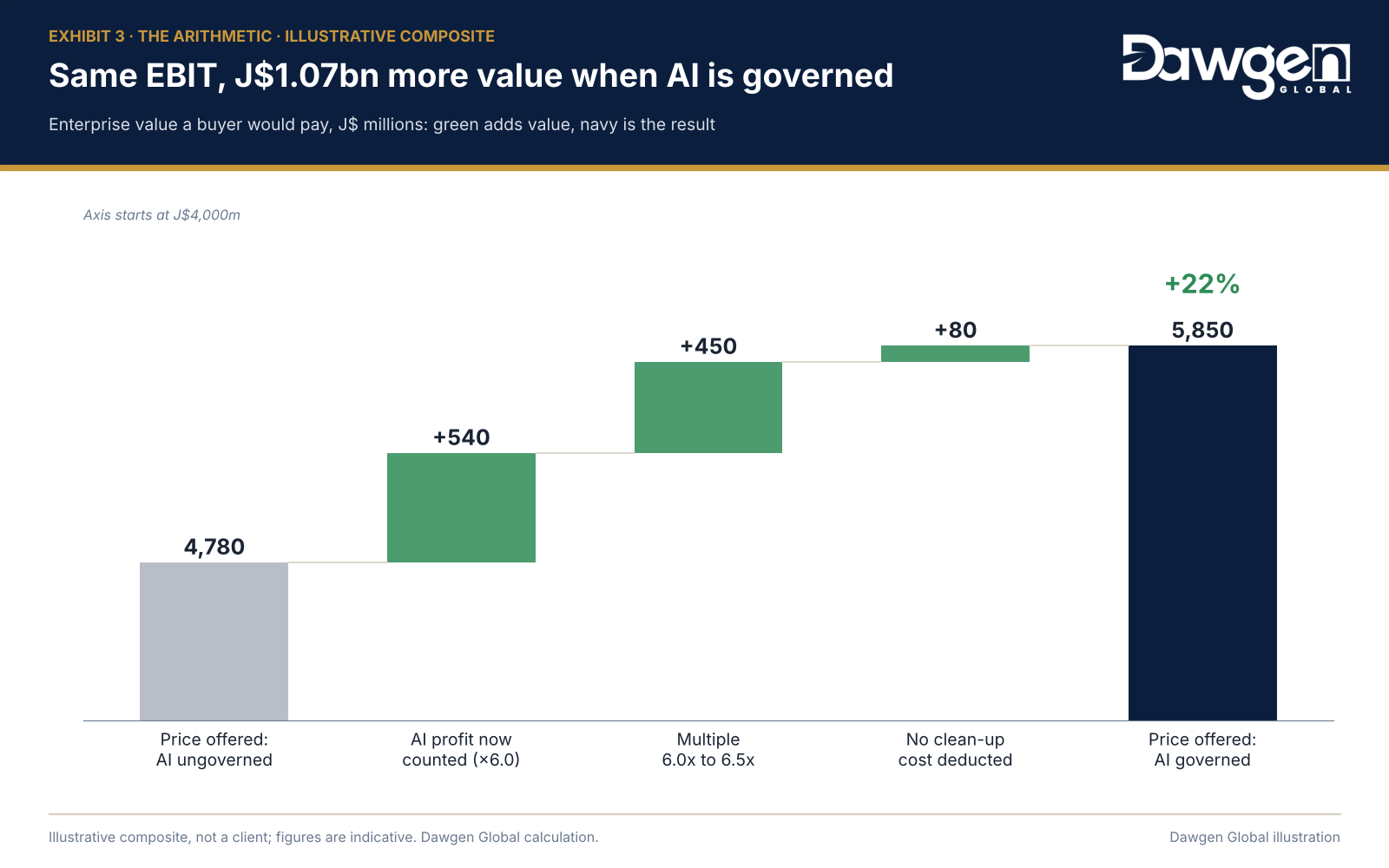
The business earns exactly the same profit in both offers. The difference of J$1.07 billion, or 22%, comes entirely from what the buyer could rely on. The governance work cost a small fraction of that.
The same logic applies to a company that never intends to sell. If the group borrows J$2 billion, even half a percentage point off the interest rate because its lender is more confident in its earnings is worth J$10 million a year.
The composite is illustrative and does not describe any client. Figures are indicative.
Why this matters more in the Caribbean
Four features of regional markets make the governance discount larger here, and the reward for removing it greater.
Few buyers, and many of them from abroad. A regional business for sale may attract only a handful of serious bidders, and several will be international groups or private equity funds. They bring their home-market diligence standards with them, including AI questions their own boards and insurers now require. With few bidders competing, the seller has little power to resist a price chip once one is found.
Data protection law has arrived. Jamaica’s Data Protection Act and Barbados’s Data Protection Act now set rules for how personal data may be used, and other territories are following. AI that uses customer data without a clear legal basis is no longer just poor practice; it is a liability a buyer can quantify.
Succession is coming. Many of the region’s most valuable private companies were built by founders who will hand over or sell in the next decade. AI adopted quickly and informally today will be examined by a buyer, an investor or the next generation of owners tomorrow. Governance put in place now is far cheaper than clean-up negotiated under a deadline.
Governance is at an early stage. Dawgen Global’s Caribbean AI Value & Governance Index places the region’s markets at a foundation stage of AI governance. That is a risk for companies that wait, and an advantage for those that move first: in a market where few companies can answer the five questions, the ones that can will stand out to every buyer and lender.
Three questions to ask this week
Put three questions to management before a buyer, lender or regulator does:
- Can we produce, today, a complete list of the AI systems and agents in use across the business, with an owner for each?
- For the AI that touches customers, money or decisions about people, how are errors detected, and who signs off when the stakes are high?
- If we sold the business next year, how much of our AI profit could we prove to a buyer’s advisers?
If the answer to the third question is “not much”, the AI profit on the management accounts is worth less than it appears, however real it is.
The next article, The Token Bill Is an Operating Line, turns to a cost that most AI business cases leave out: the usage fees, often charged in US dollars, that grow with every query, and how to manage them before they consume the gain.
Would your AI survive a buyer’s diligence?
Dawgen Global’s Earnings Crossing Blueprint™ builds the governance a buyer, lender or investor will look for into your AI programme: the AI register, data rights review, monitoring and human sign-off thresholds, vendor and key-person safeguards, and the AI Earnings Register™ that makes your AI profit provable. For companies preparing for a sale, an investment, a refinancing or a succession, we run the Price Chip Review™ first, so you find the chips before the buyer does. It draws on our risk management, cybersecurity, IT and digital transformation, M&A and AI transformation specialists across the Caribbean. Fees are customized to each client’s circumstances and agreed deliverables.
Request a scoping conversation: info@dawgen.global · (876) 926-5210 · US 855-354-2447 · dawgen.global
Dawgen Global — Big Firm Capabilities. Caribbean Understanding.
About Dawgen Global
Dawgen Global is an independent, integrated multidisciplinary professional services firm headquartered at 47 Trinidad Terrace, New Kingston, Jamaica, serving more than 15 territories across the Caribbean. Founded and led by Dr. Dawkins Brown, Executive Chairman, the firm is independent and not affiliated with any international network. It delivers a full suite of professional services under one roof: audit and assurance; tax advisory; IT and digital transformation; risk management; cybersecurity; actuarial and insurance regulatory advisory; HR advisory; mergers and acquisitions; corporate recovery; business advisory and strategy; accounting BPO and virtual CFO services; and legal process outsourcing.
The proposition is simple: big-firm capability without the big-firm price. Dawgen Global’s integrated approach is built for the specific complexities and opportunities of the Caribbean market, helping organizations make sharper, better-informed decisions that drive measurable progress.
To explore a partnership, reach out:
- Website: dawgen.global
- Email: info@dawgen.global
- WhatsApp (Global): +1 555-795-9071
- Caribbean offices: +1 876-665-5926 | +1 876-929-3670 | +1 876-926-5210