

How AI releases cash from receivables and stock, why boards rarely see it, and how to count it so it stays released
A distributor installs an AI tool that tells its credit controllers which customers to call first, and another that sets reorder points for each product line. A year later, the board asks what the tools delivered. The finance director points to a modest improvement in operating profit. Nobody mentions that the overdraft is J$370 million smaller than it was.
That is the most common way AI value disappears from view. When AI helps a business collect faster and hold less stock, the main result is not profit. It is cash. And cash released from working capital does not appear in EBIT, the measure most boards use to judge an AI programme. It appears on the balance sheet, as receivables and inventory that shrank, and in the finance cost line, as interest that was never paid. Neither is where anyone is looking for an AI dividend.
This sixth article of Hours Into Earnings™ covers the fourth value lever of The Dawgen Earnings Crossing™, Capital Velocity: how quickly cash moves through the business. It sets out where AI releases cash, why the release so often goes uncounted or quietly reverses, and a four-check method for counting it so the board can bank it.
The cash is there. Most of it is waiting.
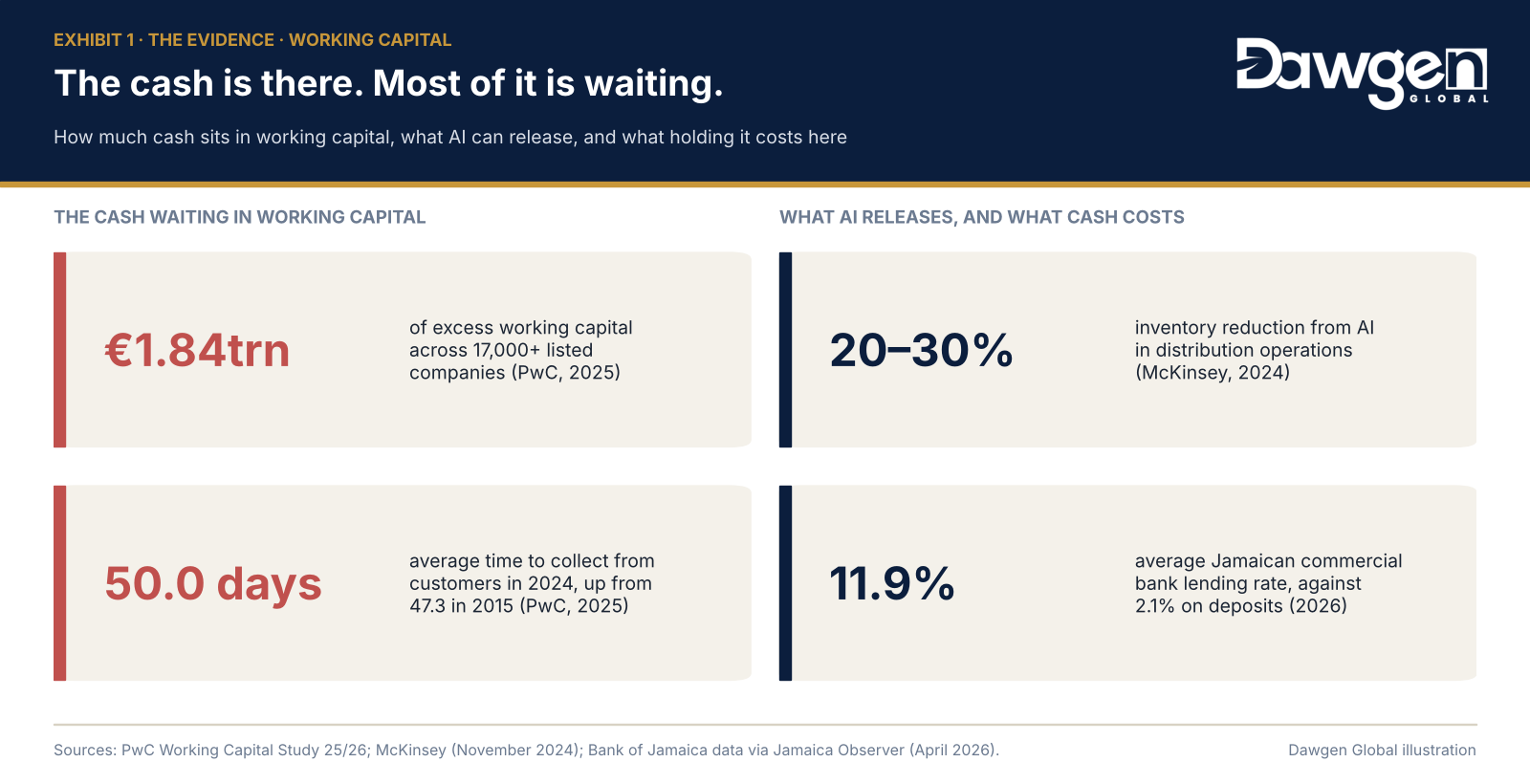
The amount of cash tied up in day-to-day operations is large and, by most measures, growing. PwC’s Working Capital Study 25/26, which covers more than 17,000 listed companies, estimates €1.84 trillion of excess working capital worldwide: cash that sits in unpaid invoices and unsold stock beyond what the business needs. The same study found that companies took 50.0 days on average to collect from customers in 2024, up from 47.3 days in 2015. Some of the deterioration was hidden by companies paying their own suppliers more slowly.
The evidence that AI can release some of that cash is growing too. McKinsey reports that AI in distribution operations can deliver reductions of 20% to 30% in inventory, mainly by forecasting demand more accurately and setting stock levels product by product. In receivables, a survey of 500 North American finance leaders by Wakefield Research, sponsored by the receivables software provider Billtrust, found that three in four companies using AI in accounts receivable had cut the time to collect by six days or more. Vendor-sponsored figures should be read with care, but the direction is consistent.
What makes this lever matter more in the Caribbean than elsewhere is the price of money. In April 2026 the average Jamaican commercial bank lending rate was 11.9%, against 2.1% paid on deposits, according to Bank of Jamaica data reported by the Jamaica Observer. A business that finances its receivables and stock on an overdraft pays close to 12% a year for every dollar left waiting. A business that holds the cash itself earns very little on it. Either way, cash released from working capital is worth far more here than in markets where borrowing costs 5%.
Why nobody counts it
Cash released by AI goes uncounted for three reasons. None of them is that the cash is small.
It lands in the wrong place in the accounts. An AI business case is usually written in the language of the income statement: hours saved, costs avoided, margin gained. Cash released from receivables and inventory is a balance sheet movement. Its yearly benefit, the interest no longer paid, sits below operating profit in finance costs. A board that measures its AI programme by EBIT alone will look straight past the largest number the programme produced.
It belongs to nobody. Receivables belong to credit control, inventory to purchasing and operations, the overdraft to the treasurer. The AI tool belongs to whichever team bought it. When cash is released, no single manager is responsible for counting it, so it is noticed only as a pleasant surprise in the bank balance and then spent.
It slips back. A one-off collection drive can lower the days it takes to collect in a single quarter. So can a delayed shipment that leaves the shelves bare at month-end. Neither is a lasting change, and both reverse. Unless the release is measured properly, the board cannot tell a permanent improvement from a good month, and the next bad month undoes the credit the AI programme was given.
There is a further trap. A company can release cash without improving anything at all, simply by paying its suppliers later. That cash is real, but it was borrowed from partners, and in a small market where a business may depend on two or three key suppliers, it is often borrowed at a price. It should never be credited to AI.
The Cash Velocity Count™: four checks, then convert and price
The Cash Velocity Count™ is how the Capital Velocity lever of The Dawgen Earnings Crossing™ turns an operational improvement into a figure the board can count. It starts from the measures management already reports: the days it takes to collect from customers, the days stock sits before it is sold and the days taken to pay suppliers. Every day of improvement claimed must pass four checks.
| Check | The question | What it removes |
| 1. Seasoned | Is the improvement measured against the same months last year, not last month? | Seasonal swings: December payments, tourist-season stock, the hurricane-season build-up |
| 2. Structural | Is the change built into the system and written policy, such as reorder points, credit limits and collection workflows? | One-off collection drives and month-end timing that will reverse |
| 3. Self-funded | Was the cash paid for by suppliers, through slower payment, or by customers, through early-payment discounts? | Cash borrowed from partners, and cash bought at a price that belongs in the margin |
| 4. Banked | Did cash rise, or borrowing fall, by the same amount? | Days that improved on paper but never became money |
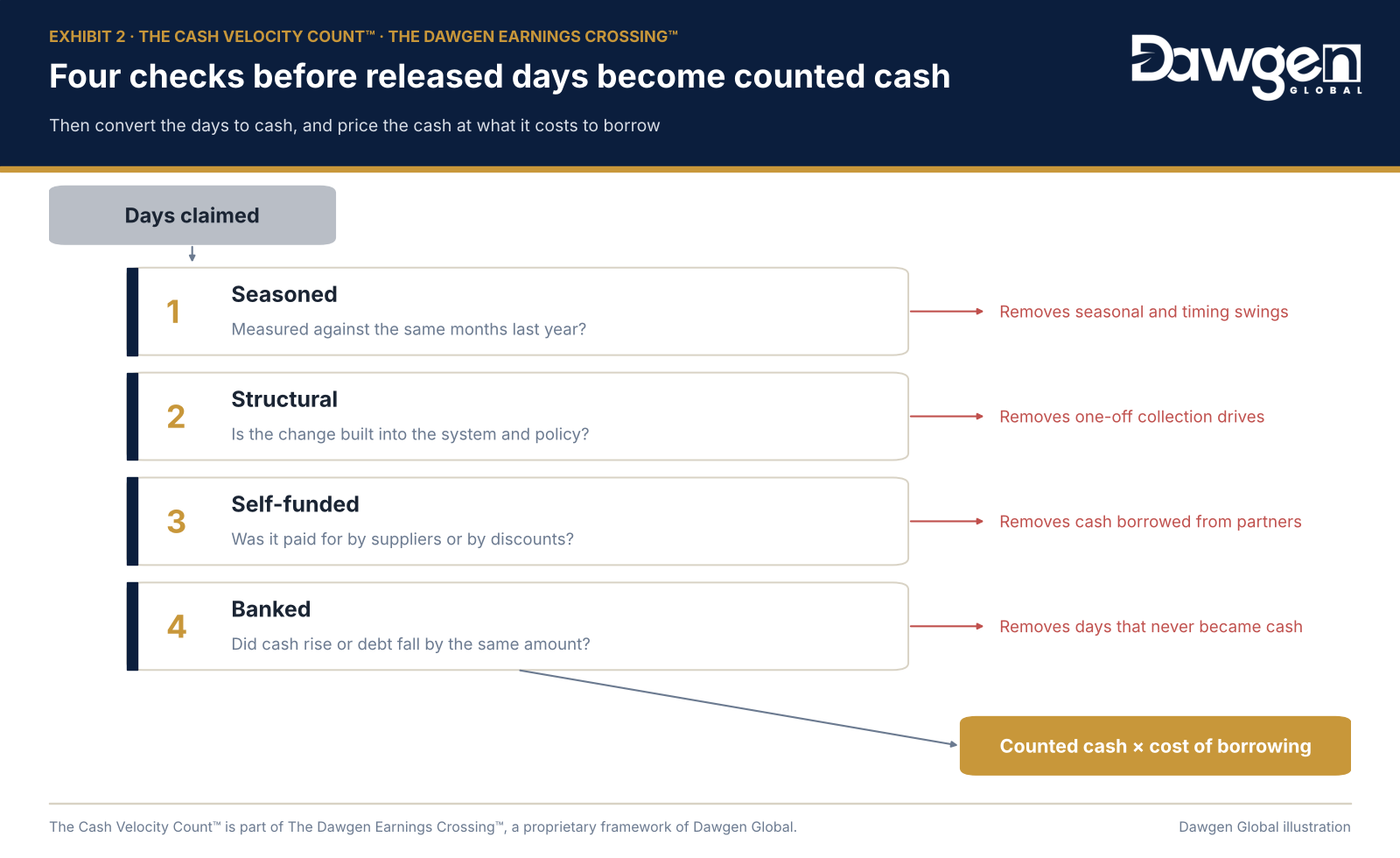
Days that pass all four checks are then converted and priced.
Convert the days to cash. A day of receivables is worth one day of sales. A day of inventory is worth one day of cost of sales. A distributor with J$6 billion of annual sales releases about J$16 million for every day it collects faster.
Price the cash twice, but count it once. The released cash has a one-off value: it repays borrowing or funds investment that would otherwise need a loan. It also has a yearly value: the interest saved, at the rate the business actually pays. Both are real, but they are the same money seen two ways. In a valuation, the one-off release reduces net debt, and that already captures the interest saved; adding both would count the dividend twice.
Finally, the Count asks what the release did to EBIT. Faster collection usually means fewer bad debts. Leaner, better-forecast stock usually means fewer expired, damaged and obsolete items, and sometimes less warehouse space. Those gains are in operating profit, and they belong in the AI Earnings Register™ alongside every other initiative, net of what the AI tools cost to run.
The arithmetic: J$661 million claimed, J$370 million counted
Consider an illustrative composite: a Caribbean importer and distributor of food and household goods with annual sales of J$6.0 billion, cost of sales of J$4.5 billion and operating profit (EBIT) of about J$420 million. It finances its working capital partly on a bank overdraft. One day of sales is worth about J$16.4 million; one day of cost of sales about J$12.3 million.
The company introduces two AI tools. One ranks overdue accounts each morning by likelihood of payment and risk of dispute, so the small credit control team calls the right customers first and resolves invoice queries before they age. The other forecasts demand by product and branch, and sets reorder points that reflect actual shipping lead times rather than habit.
At year-end the project team reports a remarkable result: collection down from 62 days to 48, stock down from 95 days to 70, and supplier payments stretched from 45 days to 55. Converted to cash, that is J$661 million released. The finance director applies the Cash Velocity Count™.
| Check | Finding | Days counted | Cash counted (J$m) |
| Claimed | Receivables −14 days, inventory −25 days, payables +10 days | 661 | |
| 1. Seasoned | Against the same month last year, 5 of the receivable days were year-end payments that come every December, and 7 of the inventory days came from a delayed container that left shelves low | Receivables 9, inventory 18 | 493 |
| 2. Structural | Passed. Credit control works from the AI priority list daily, and the reorder points sit in the inventory system | Unchanged | 493 |
| 3. Self-funded | The 10-day stretch in supplier payments was a treasury decision, not an AI result, and two suppliers have already asked for tighter terms. Excluded | Payables 0 | 370 |
| 4. Banked | Passed. The overdraft fell from J$520 million to J$150 million over the year | Unchanged | 370 |
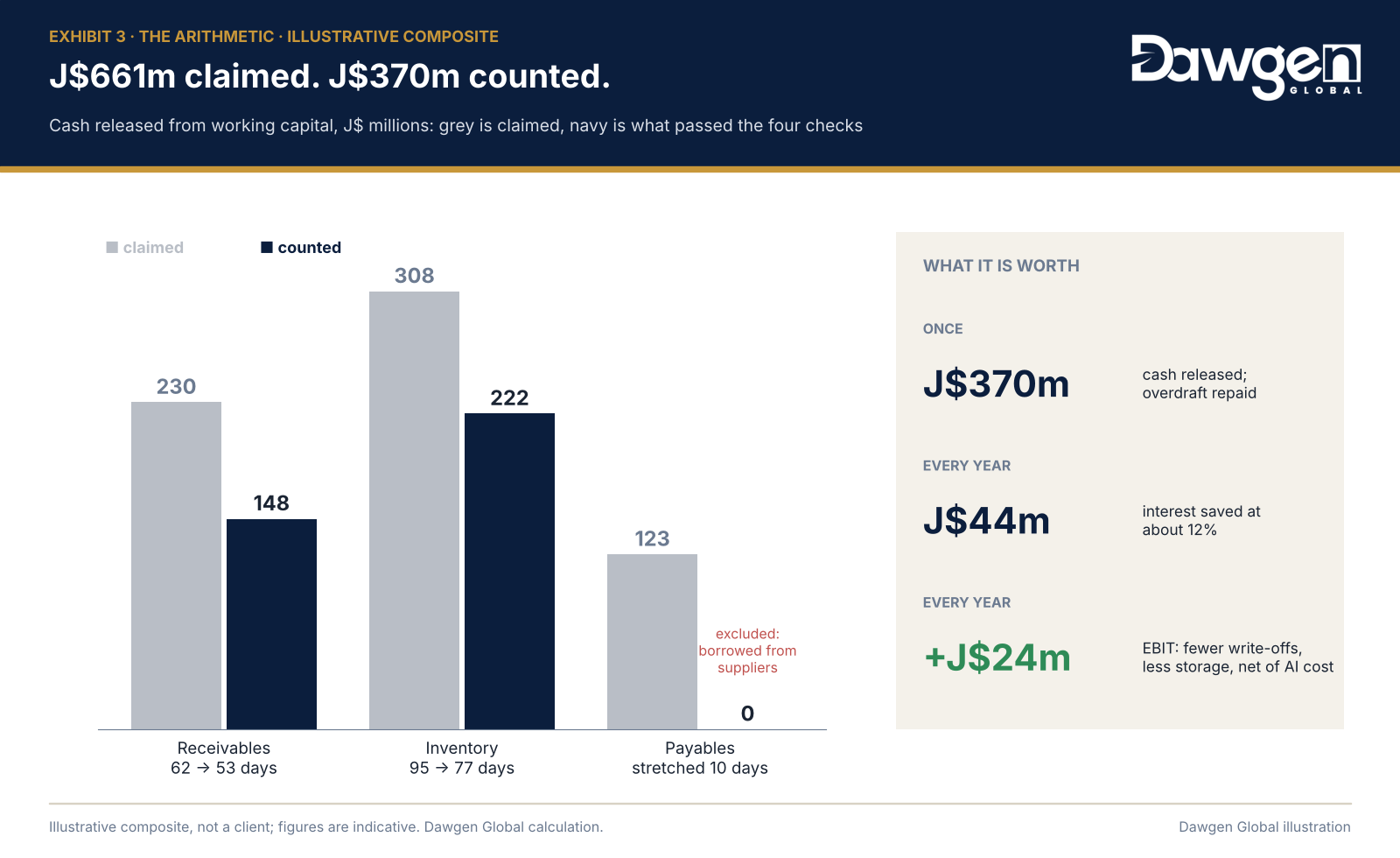
The J$370 million counted is still a large result. Priced and checked for EBIT effects, it is worth:
- Once: J$370 million of cash released, used to repay most of the overdraft.
- Every year, in finance costs: about J$44 million of interest no longer paid, at 11.9%.
- Every year, in EBIT: bad debts fall from 0.8% to 0.6% of sales (J$12 million), expired and obsolete stock write-offs fall on a smaller, better-forecast inventory (about J$11 million), and an overflow warehouse is handed back (J$15 million). After J$14 million a year to run the two AI tools, EBIT rises by about J$24 million, or nearly 6%.
Now consider what the board would have seen if it judged the programme by EBIT alone: a J$24 million gain. The cash dividend, J$370 million once and J$44 million a year in interest, is many times larger, and it is the part most likely to be missed. Valued at six times EBIT, the operating gain adds about J$144 million to the value of the business; the lower net debt adds J$370 million more, directly to what the shareholders own. Counting the interest saving on top of that would count the same cash twice.
The composite is illustrative and does not describe any client. Figures are indicative.
Why the Caribbean cash dividend is larger, and harder to keep
Four features of regional business make this lever both more valuable and easier to lose.
Money is expensive. With commercial lending close to 12% in Jamaica and deposit rates near 2%, every dollar held in receivables or stock carries a high cost. The same release of cash is worth more than twice as much a year here as in a market where borrowing costs 5%.
Stock is held against distance. Most regional businesses import. Shipping lead times are long and irregular, and many firms build stock ahead of the hurricane season. Some of that safety stock is wise. Much of it is habit. AI forecasting is most valuable where it separates the two, product by product, and sets reorder points from actual lead times rather than the buyer’s memory of the last shortage.
Stock is often priced in US dollars. Imported inventory is cash converted into foreign currency and parked on a shelf. Holding less of it reduces the business’s exposure to exchange rate movements as well as its borrowing. The treasurer should see both effects in the Count.
Some customers pay slowly by design. Government ministries, agencies and some large corporates pay on their own schedules, and no AI tool will change that. What AI can do is make sure the invoices sent to them are complete and correct the first time, so that disputes and missing paperwork do not add weeks to a payment that was already slow. The Seasoned check matters most here: public sector payment cycles move with budget calendars, and a release that coincides with year-end payments is not an AI result.
There is also an advantage. A regional business usually has a small credit control team and a few hundred active accounts, not tens of thousands. That makes the change easy to build into daily work, and the Structural check easy to pass: the team simply works from the AI priority list every morning.
Three questions to ask this week
Put three questions to the managers responsible for your AI programme and your working capital:
- How many days of receivables and inventory have our AI tools released, measured against the same months last year?
- Where did that cash go: did borrowing fall, did cash rise, or was it absorbed somewhere else?
- How much of any improvement came from paying our suppliers later, and has that been kept separate from the AI result?
If nobody can answer the first question, the AI programme’s largest result may never have been measured. If nobody can answer the second, the cash may already have been spent.
The next article, The Multiple Moves When the Risk Does, turns from earnings and cash to value itself: how well-governed AI can make earnings more predictable, and why buyers, lenders and investors pay more for predictable earnings.
How much cash is waiting in your working capital?
Dawgen Global’s Earnings Crossing Scan™ is a short, fixed-scope review built on your own ledgers. We measure the days held in receivables, inventory and payables against the same months of prior years, identify where AI forecasting, collections and invoice-quality tools can release cash, and apply the Cash Velocity Count™ to show what that release would be worth once, every year in finance costs, and in EBIT. You receive a ranked list of opportunities and the measures your board should track. The Scan draws on our accounting, business advisory, data analytics and AI transformation specialists across the Caribbean. Fees are customized to each client’s circumstances and agreed deliverables.
Request a scoping conversation: info@dawgen.global · (876) 926-5210 · US 855-354-2447 · dawgen.global
Dawgen Global — Big Firm Capabilities. Caribbean Understanding.
About Dawgen Global
Dawgen Global is an independent, integrated multidisciplinary professional services firm headquartered at 47 Trinidad Terrace, New Kingston, Jamaica, serving more than 15 territories across the Caribbean. Founded and led by Dr. Dawkins Brown, Executive Chairman, the firm is independent and not affiliated with any international network. It delivers a full suite of professional services under one roof: audit and assurance; tax advisory; IT and digital transformation; risk management; cybersecurity; actuarial and insurance regulatory advisory; HR advisory; mergers and acquisitions; corporate recovery; business advisory and strategy; accounting BPO and virtual CFO services; and legal process outsourcing.
The proposition is simple: big-firm capability without the big-firm price. Dawgen Global’s integrated approach is built for the specific complexities and opportunities of the Caribbean market, helping organizations make sharper, better-informed decisions that drive measurable progress.
To explore a partnership, reach out:
- Website: dawgen.global
- Email: info@dawgen.global
- WhatsApp (Global): +1 555-795-9071
- Caribbean offices: +1 876-665-5926 | +1 876-929-3670 | +1 876-926-5210
Related service: Explore how we can help →