
Start Where the Cost Is Countable
Why the back office is the fastest route from AI to EBIT — and how to choose the first three workflows to redesign
When a Caribbean board first approves money for AI, it is usually spent where AI is most visible: a customer chatbot, a marketing content tool, a sales assistant. These are the projects that look good in a presentation and feel like transformation. They are also, very often, the projects whose return is hardest to prove.
Meanwhile, down the corridor, the finance team still keys supplier invoices by hand, reconciles bank statements line by line, chases the same overdue accounts every month, and spends the first eight working days of every month closing the last one. Nobody photographs that work. But every hour of it is already on the payroll, already measured, already countable.
Start where the cost is countable. The fastest route from AI to EBIT runs through the back office: finance, compliance, payroll, procurement and administration. The cost of that work is known to the dollar, the volume is known to the transaction, and the result shows up in the very management accounts the board already reads.
The first article of this series set out The Dawgen Earnings Crossing™; the second showed how to convert freed hours into earnings. This third article is about where to begin. It explains why the back office pays first, offers a simple screen for choosing the first three workflows, and works through a month-end close redesigned from end to end.
The money goes to the front. The return comes from the back.
The research on where AI returns actually appear points in one direction.
MIT’s Project NANDA, after reviewing some 300 public AI deployments and interviewing 150 leaders, reported that more than half of generative AI budgets go to sales and marketing tools, yet it found the biggest return in back-office automation: cutting outsourced process work, reducing spending on outside agencies and streamlining operations. It also found that tools bought from specialist providers and fitted to the business succeeded about two-thirds of the time, while internally built tools succeeded only a third as often.
Finance teams themselves are already moving. Gartner’s 2025 survey of 183 chief financial officers and senior finance leaders found that 59% now use AI in the finance function, up from 37% in 2023. The leading uses were knowledge management (49%), accounts payable automation (37%) and error and anomaly detection (34%). Yet 91% reported only low or moderate impact so far, and those further along were nearly three times as likely to report high impact. Adoption has arrived in the back office; redesign mostly has not.
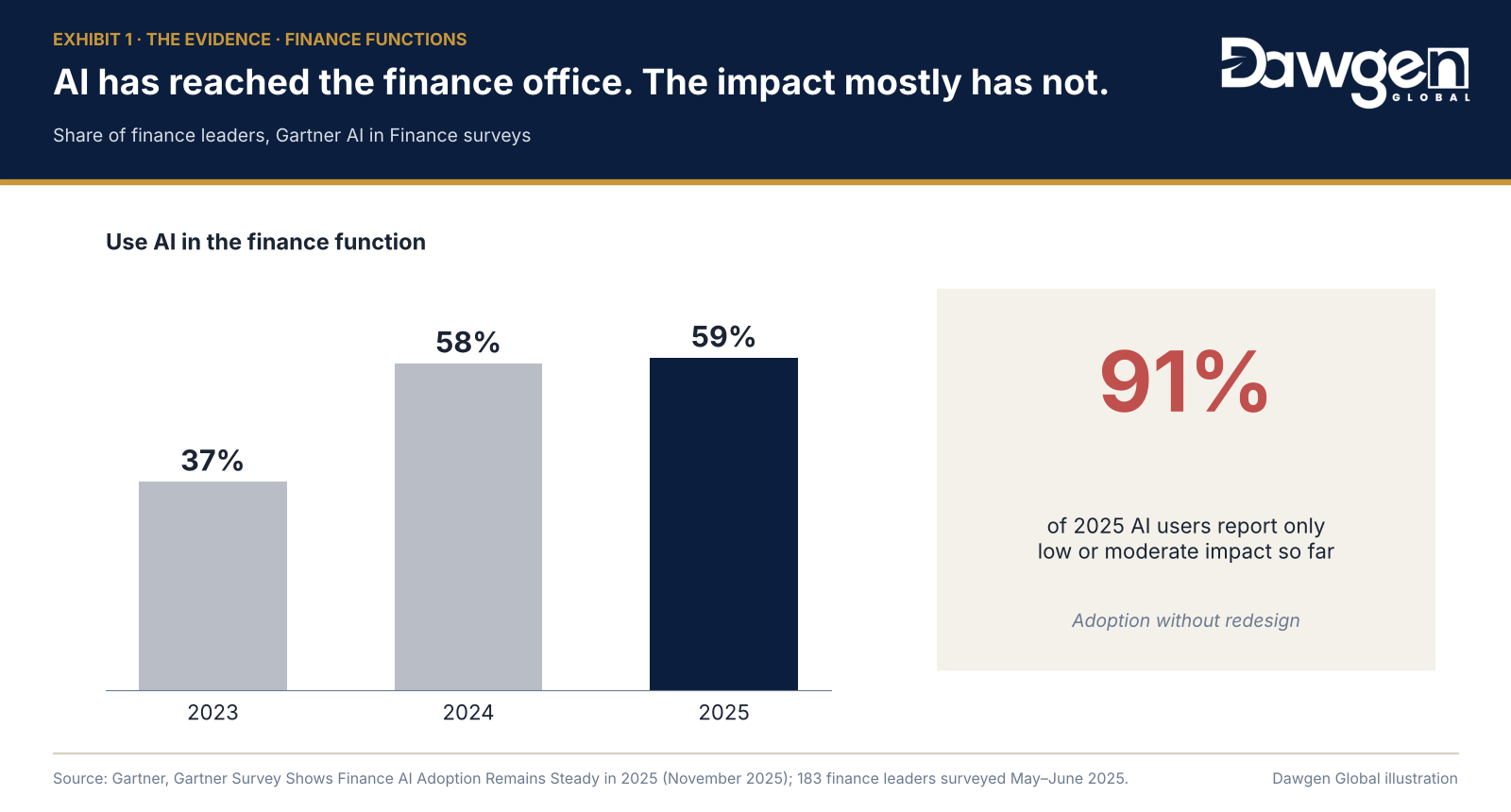
The gap between those two findings is the opportunity. The back office is where AI pays most reliably, and it is also where most organizations have added a tool to an unchanged process rather than rebuilding the process around the tool.
Why the back office pays first
Front-office AI is not a mistake. It is simply harder to prove, and the first AI investment needs to prove itself. The back office has five characteristics that make its returns faster and easier to evidence.
The cost is already measured. Payroll by cost centre, outsourcing invoices, overtime, audit fees and bank charges are all in the ledger today. There is no need to build a new measurement system to see the before and after.
The volume is known. Invoices processed, payments made, reconciliations performed, claims settled, employees paid. When the cost per transaction falls, the management accounts show it without argument.
The work is rules-based and repetitive. Matching, coding, checking, chasing and reporting follow known rules. That is precisely the work current AI tools do well, and where errors are easiest to detect.
There is no customer at risk. A mistake in a redesigned reconciliation is caught by a reviewer before anyone outside the company sees it. A mistake in a customer chatbot is seen by the customer.
The cash effect is direct. Faster invoicing, cleaner collections and fewer duplicate payments release cash in weeks, not years, which is the Cash and capital span of the Crossing working alongside EBIT.
Front-office AI, by contrast, usually claims revenue, and revenue claims are hard to separate from price, season, competition and the sales team’s own efforts. Those projects have their place; Article 5 of this series covers how to prove them. But the first AI investment should be the one whose result nobody can dispute.
The Countable Cost Screen™: choosing the first three workflows
Most organizations do not lack AI ideas; they lack a way to choose between them. The Countable Cost Screen™ is a five-question test that management can apply to every candidate workflow in a single meeting. Each question is scored from 1 to 5, for a total out of 25.
| Question | Scores 1 when… | Scores 5 when… |
| Cost: what does this work cost us a year? | Under the cost of half a role | Several roles, or a large outsourcing or overtime bill |
| Volume: how often does it happen? | A few times a month | Hundreds or thousands of times a month |
| Rules: how rule-based is it? | Every case needs judgement | Most cases follow the same steps and checks |
| Data: is the information already digital? | On paper, in emails or in people’s heads | Already in the accounting system, bank feeds or structured files |
| Exposure: what happens if it goes wrong? | A customer, regulator or the public sees the error first | An internal reviewer catches it before it leaves the building |
Workflows scoring 18 or more are candidates for the first wave. From those, choose three: enough to prove the approach across different teams, few enough to redesign properly. Each of the three then goes through the Earnings Proof™ from Article 1 (which line will it move, what is it today, who signs, when will it show) and is assigned a conversion route under the Capacity Conversion Rule™ from Article 2.
The screen deliberately rewards the dull. A supplier invoice workflow will usually outscore a customer chatbot, not because it is more important, but because its result can be counted in the next set of management accounts.
Six Caribbean back-office workflows ready for redesign
Applied across the regional businesses we see, the screen consistently surfaces the same six workflows. The scores below are indicative; every organization should score its own.
| Workflow | What the redesigned process does | Typical conversion route | Indicative score /25 |
| Bank and account reconciliations | Matches transactions automatically; people review only the exceptions | Absorb or Retire | 24 |
| Supplier invoice processing | Reads invoices, codes them, matches them to orders and flags duplicates and price variances | Retire or Avoid | 23 |
| Month-end close and management pack | Drafts journals, variance commentary and the board pack from the ledger | Absorb, and a faster close | 21 |
| Collections and credit control | Ranks overdue accounts by risk, drafts reminders and schedules follow-up | Redeploy to collections | 19 |
| Payroll checks and statutory filings | Validates pay runs, statutory deductions and filing schedules before submission | Avoid, and fewer penalties | 18 |
| Customer due diligence (KYC/AML) | Pre-screens documents and sanctions lists; officers decide the hard cases | Absorb | 16 |
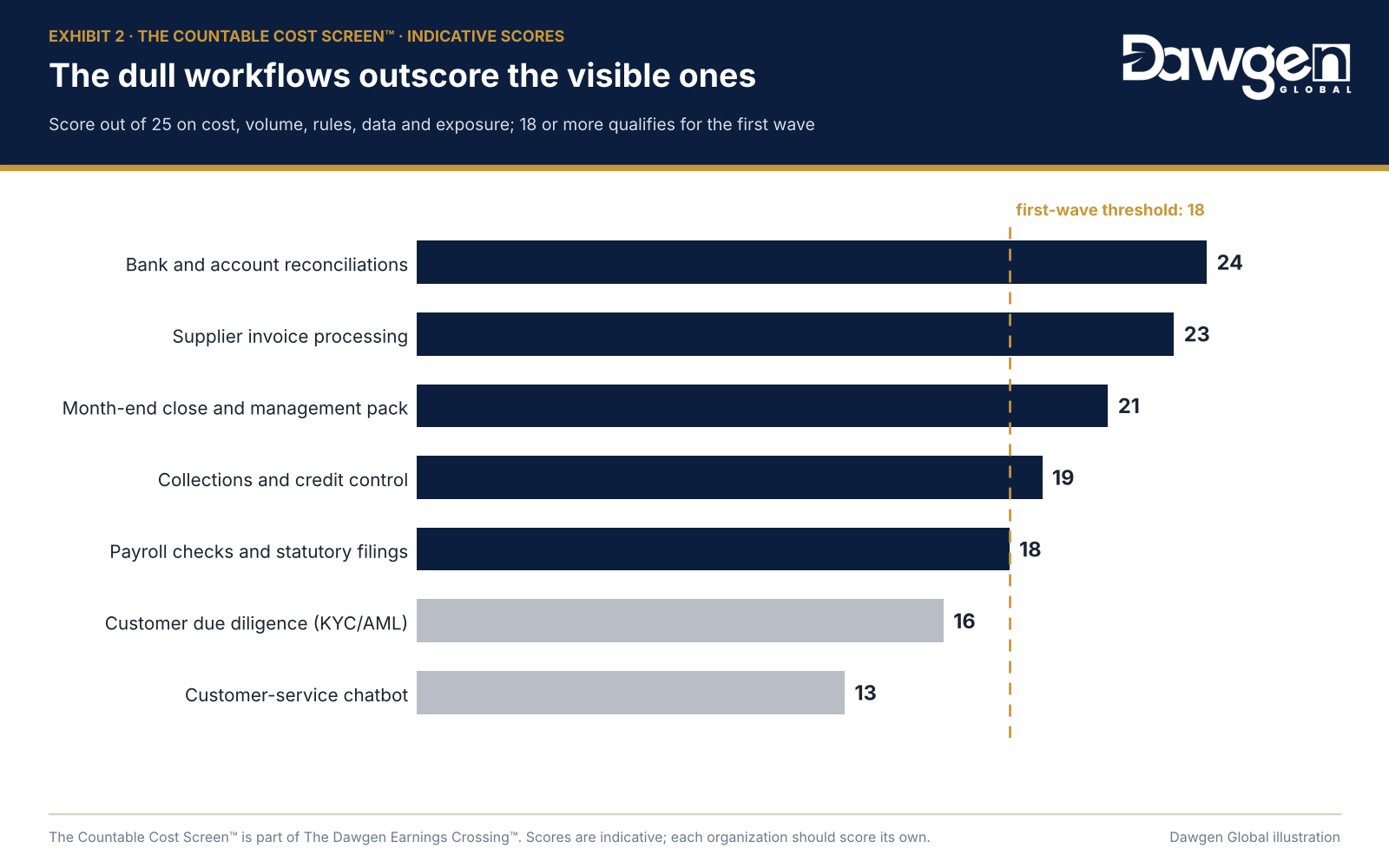
For comparison, a typical customer-service chatbot scores about 13: cost and data are moderate, judgement is frequent, and every error is seen by a customer first. That does not make it a bad idea. It makes it a poor first idea.
Two regional features push particular workflows up the list. Multi-currency operations make reconciliations and invoice matching more laborious than they are in single-currency markets, so the saving is larger. And statutory compliance in most Caribbean jurisdictions is calendar-driven and penalty-bearing, so a workflow that prevents one late filing can pay for itself before it saves a single hour.
The arithmetic: a month-end close redesigned

Dawgen Global illustration.
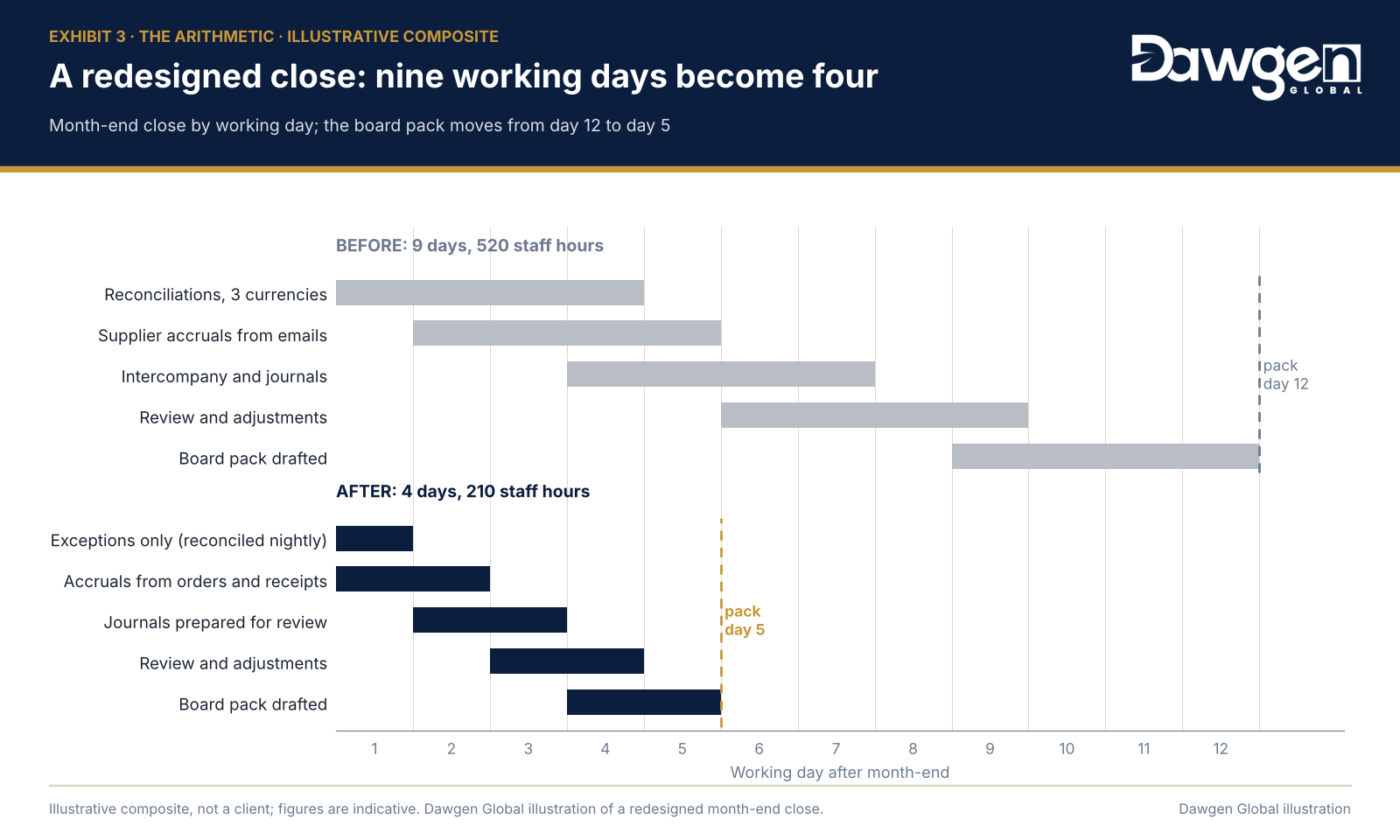
Consider an illustrative composite: a Caribbean distribution group with three subsidiaries and a finance team of eight. Closing the books takes nine working days and about 520 staff hours a month: bank and intercompany reconciliations in three currencies, supplier accruals built from emails, journals keyed by hand, and a management pack that reaches the board on day 12. Finance staff cost the group about J$2,400 an hour.
The group redesigns the close around AI rather than adding a tool to the old process. Reconciliations run every night, not at month-end, so only exceptions remain on day one. Accruals are drafted from purchase orders and receipts. Recurring journals are prepared automatically for review. Variance commentary and the board pack are drafted from the ledger and edited by the financial controller.
| Measure | Before | After |
| Working days to close | 9 | 4 |
| Staff hours per close | 520 | 210 |
| Management pack to the board | Day 12 | Day 5 |
| Hours freed per year | 3,720 (about 2 roles)
|
 Because a redesigned close frees whole days, not scattered minutes, the hours are far easier to convert than those described in Article 2:
| Route | Hours | What the group does | Annual EBIT effect (J$m) |
| Avoid | 1,800 | Does not hire the extra accountant planned for the new subsidiary | 4.3 |
| Retire | 900 | Ends the contract accountant engaged every year-end | 2.2 |
| Redeploy | 600 | Moves an accounts assistant part-time to credit control, cutting bad-debt write-offs | 1.2 |
| Converted | 3,300 (89%) | 7.7 | |
| Less tool and support costs | (2.6) | ||
| Net EBIT gain | 5.1 |
The one-off redesign cost of about J$6 million is recovered in just over fourteen months. And the most valuable change may not be in the table at all: a board that receives its management pack on day 5 instead of day 12 makes every decision a week earlier, every month.
The composite is illustrative and does not describe any client. Figures are indicative.
Redesign, not automation: five moves
Dawgen Global illustration.
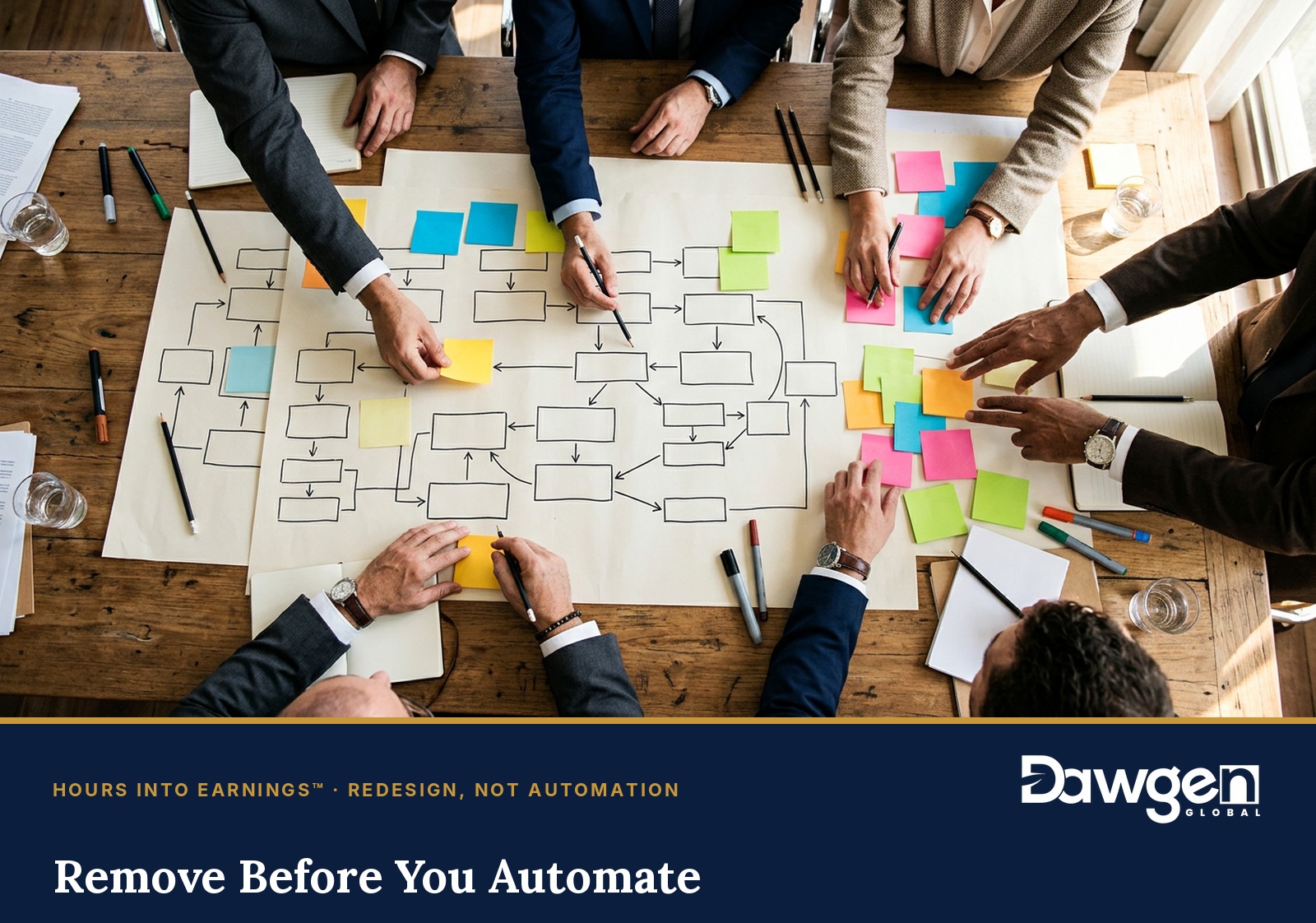
The 91% of finance leaders reporting only modest impact are, for the most part, running AI inside processes designed for people with spreadsheets. Automating a poor process produces a faster poor process. Redesign follows five moves, in this order.
- Map the work as it is, not as the procedure manual says. Follow one invoice, one reconciliation or one payroll run from start to finish and count every hand-off, re-key and wait. Most of the cost hides in the waiting.
- Remove before you automate. Delete the approvals nobody reads, the reports nobody uses and the reconciliations that duplicate one another. Every step removed is a step that never needs a tool.
- Move the work earlier. Reconcile daily instead of monthly; check invoices on arrival instead of at payment. AI makes continuous processing cheap, and continuous processing is what turns a nine-day close into four.
- Let people own the exceptions. Design the process so the tool handles the routine cases and people decide the unusual ones. Make sure the exception queue has a named owner and a time limit.
- Put the controls in the design. Segregation of duties, review evidence and audit trails should be built into the new process from the first day, not added after the external auditor asks. A redesigned back office should be easier to audit than the old one.
The fifth move matters especially in the Caribbean, where many mid-sized companies have small finance teams and rely on a few experienced individuals. A well-redesigned process writes down what those individuals know, which reduces key-person risk and, as Article 7 of this series will show, supports a higher valuation multiple.
Three questions to ask this week
Put three questions to your chief financial officer or finance manager:
- How many working days does our month-end close take, and on which day does the board receive the management pack?
- What does it cost us each year to process supplier invoices, reconcile our accounts and chase overdue debts, including overtime, temporary staff and outsourcing?
- Where have we used AI so far, and did we redesign the process around it or add it to the old one?
If the close takes more than five working days, or nobody can put a cost on the second question, your fastest AI return is sitting in the finance office.
The next article, The Discount You Didn’t Know You Gave, moves from cost to margin: how AI finds the pricing overrides, supplier variances and claims leakage that quietly erode gross profit.
Which three workflows should you redesign first?
Dawgen Global’s Earnings Crossing Blueprint™ applies the Countable Cost Screen™ to your back office, selects the first three workflows, redesigns them end to end with the controls built in, and sets the business case, the conversion route and the run-cost cap for each. It draws on our Accounting BPO and Virtual CFO practice, our risk and audit specialists and our Forward-Deployed AI Transformation Group across the Caribbean. Fees are customized to each client’s circumstances and agreed deliverables.
Request a scoping conversation: info@dawgen.global · (876) 926-5210 · US 855-354-2447 · dawgen.global
Dawgen Global — Big Firm Capabilities. Caribbean Understanding.
Sources: MIT Project NANDA, The GenAI Divide, as reported by Fortune (August 2025) · Gartner, Gartner Survey Shows Finance AI Adoption Remains Steady in 2025 (November 2025)
About Dawgen Global
Dawgen Global is an independent, integrated multidisciplinary professional services firm headquartered at 47 Trinidad Terrace, New Kingston, Jamaica, serving more than 15 territories across the Caribbean. Founded and led by Dr. Dawkins Brown, Executive Chairman, the firm is independent and not affiliated with any international network. It delivers a full suite of professional services under one roof: audit and assurance; tax advisory; IT and digital transformation; risk management; cybersecurity; actuarial and insurance regulatory advisory; HR advisory; mergers and acquisitions; corporate recovery; business advisory and strategy; accounting BPO and virtual CFO services; and legal process outsourcing.
The proposition is simple: big-firm capability without the big-firm price. Dawgen Global’s integrated approach is built for the specific complexities and opportunities of the Caribbean market, helping organizations make sharper, better-informed decisions that drive measurable progress.
To explore a partnership, reach out:
- Website: dawgen.global
- Email: info@dawgen.global
- WhatsApp (Global): +1 555-795-9071
- Caribbean offices: +1 876-665-5926 | +1 876-929-3670 | +1 876-926-5210