

Article 4 of THE NEW BOTTOM LINE™, Dawgen Global’s series on IFRS 18 across the Caribbean. The numbers boards talk about most are moving inside the audited financial statements.
Ask a Caribbean chief executive how the business performed last year and the answer will rarely be “profit for the year”. It will be adjusted EBITDA, underlying profit, core earnings or recurring operating profit. These are the numbers in the chairman’s statement, the investor presentation, the results press release and, often, the bonus scheme.

Until now, those measures have lived outside the audited financial statements. Companies defined them, adjusted them and presented them as they saw fit. IFRS 18 changes that. From 1 January 2027, many of them become management-defined performance measures, and each one must be defined, explained and reconciled in a single note to the financial statements, within the scope of the audit.
This article explains which measures are caught, why a plain “EBITDA” may or may not be one of them, what the note must contain, and what boards should do before the first IFRS 18 report.
What counts as a management performance measure
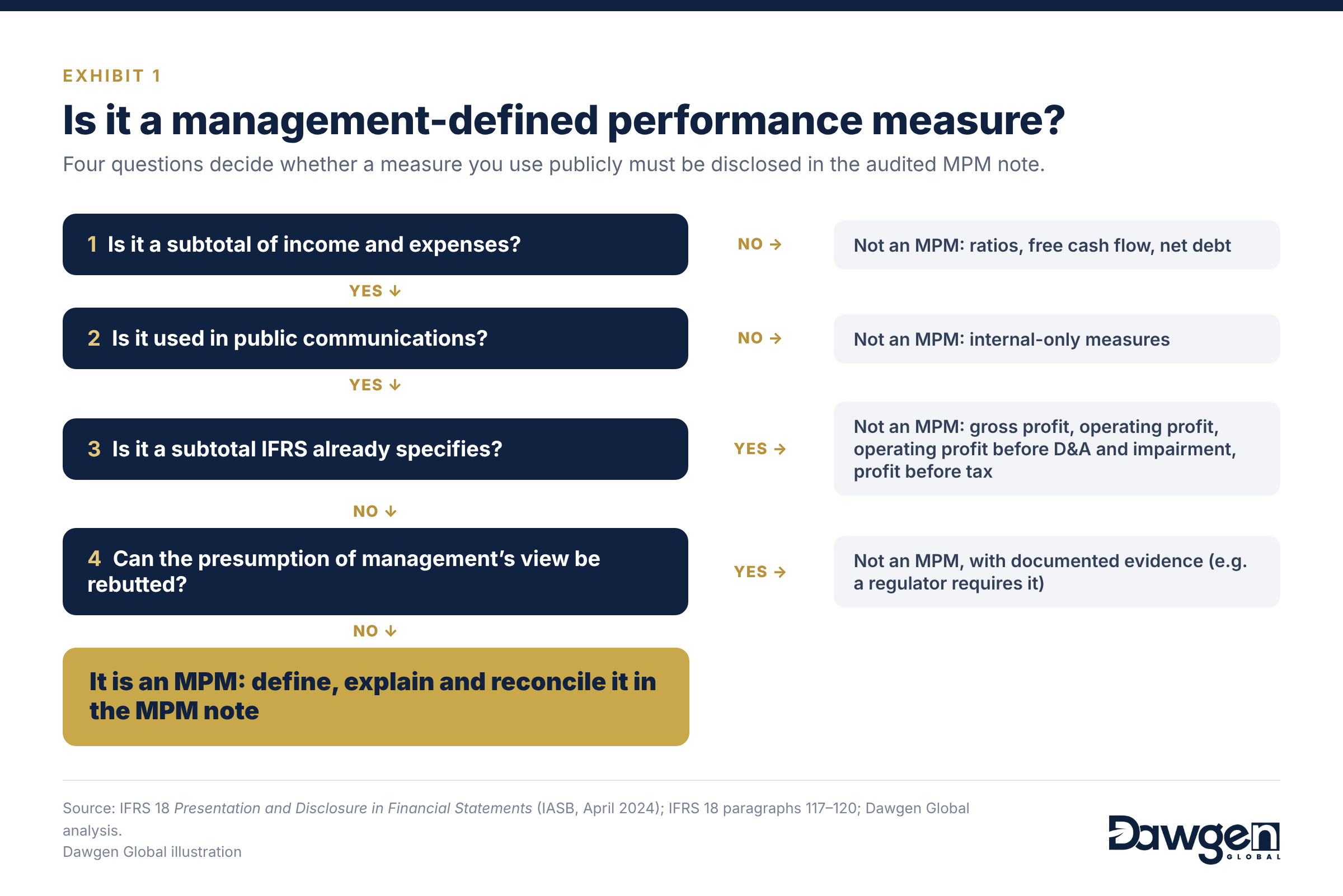
IFRS 18 defines a management-defined performance measure (MPM) as a subtotal of income and expenses that meets three tests:
- It is used in public communications outside the financial statements, such as results announcements, investor presentations, the chairman’s statement or the management discussion in the annual report.
- It communicates management’s view of an aspect of the financial performance of the entity as a whole.
- It is not a subtotal that IFRS already specifies, such as gross profit, operating profit, profit before income taxes or profit from continuing operations.
The second test is less of a hurdle than it looks. IFRS 18 presumes that any subtotal of income and expenses used in public communications does represent management’s view. A company can rebut that presumption only with reasonable and supportable evidence, for example that the measure is used solely because a regulator or lender requires it.
Just as important is what is not caught. Ratios such as margins are not MPMs, although an MPM used as the numerator of a ratio still is one. Measures that are not subtotals of income and expenses, such as free cash flow and net debt, are outside the scope. So are segment measures that do not describe the performance of the entity as a whole.
The EBITDA question
IFRS 18 contains a specific carve-out that matters for EBITDA. One of the subtotals it lists as not an MPM is operating profit before depreciation, amortisation and impairments within the scope of IAS 36. A company whose “EBITDA” is exactly that number does not need to treat it as an MPM.
In practice, few Caribbean EBITDA figures are that clean. Three variations are common, and each one is likely to be caught:
- EBITDA built up from profit before tax. Starting from profit before tax and adding back interest, depreciation and amortisation usually leaves investment income, share of associates and fair value gains inside the measure. Under IFRS 18 those items sit below operating profit, so the result is no longer the exempt subtotal.
- Adjusted EBITDA. Once restructuring costs, one-off legal settlements, foreign exchange losses or other “non-recurring” items are added back, the measure is management’s own definition. That is precisely what the MPM rules are designed for.
- Underlying, core or recurring profit. Any version of profit that excludes items management considers unusual is an MPM if it is used publicly.
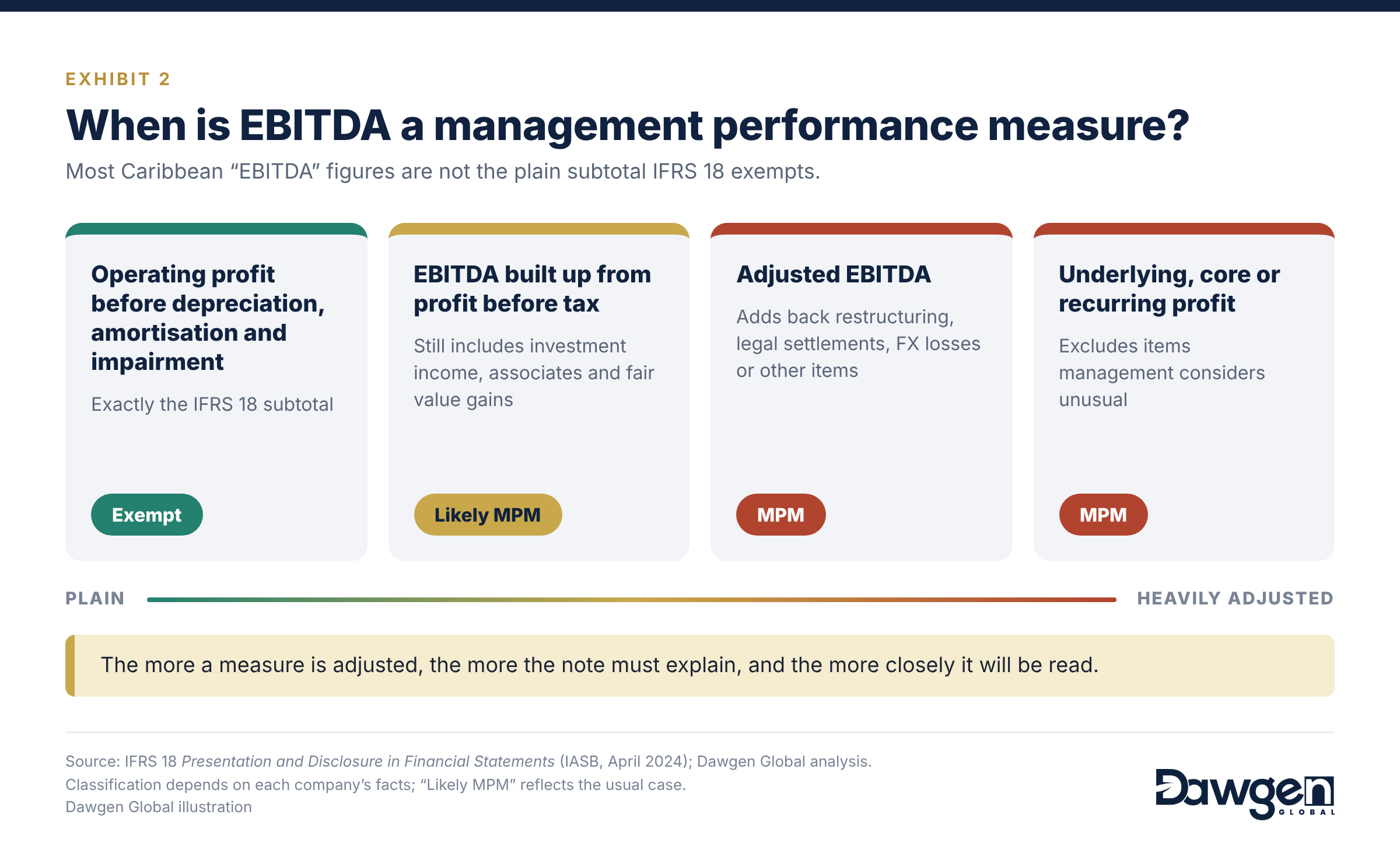
The practical message is simple. The plainer the measure, the less there is to disclose. The more a measure is adjusted, the more the note must explain, and the more closely auditors and regulators will read it.
What the note must say
All of a company’s MPMs must be disclosed together in a single note. For each measure, the note must give:
- A description of the aspect of performance the measure communicates, and why management believes it provides useful information.
- How it is calculated, with a label that faithfully describes it.
- A statement that the measure reflects management’s view and is not necessarily comparable with similarly titled measures used by other companies.
- A reconciliation to the most directly comparable subtotal specified by IFRS, such as operating profit or profit before income taxes.
- The income tax effect and the effect on non-controlling interests of each reconciling item, and how the tax effect was determined.
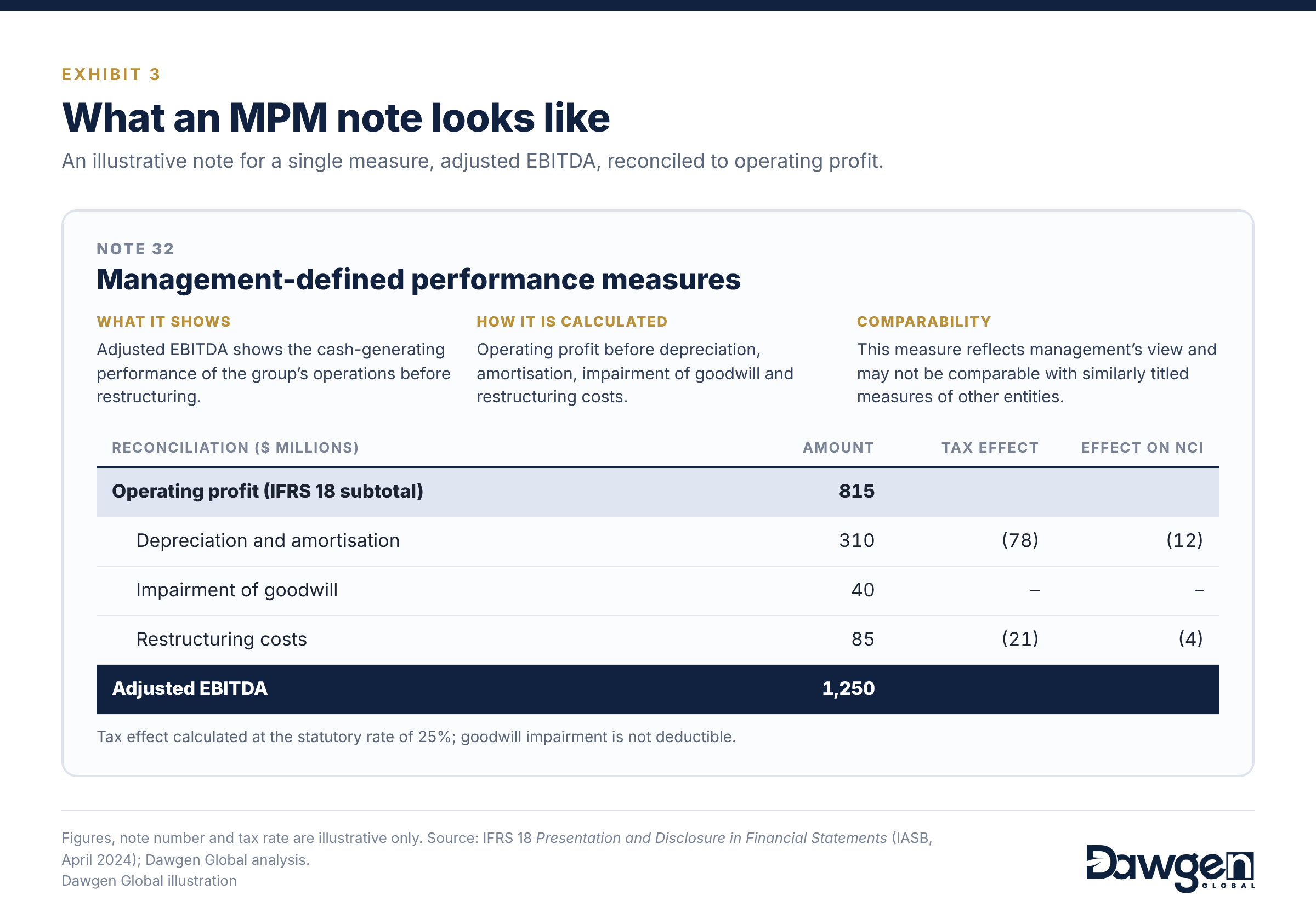
The tax requirement is the one most finance teams underestimate. IFRS 18 allows a practical approach, such as applying the statutory rate in the relevant jurisdiction or a reasonable pro rata allocation. But the method must be chosen, applied consistently and explained. For a group operating across several Caribbean tax jurisdictions, that can mean a separate calculation for each adjusting item in each territory.

If a company changes how an MPM is calculated, adds a new one or stops using one, it must explain the change and the reasons for it, and restate the comparatives. Measures cannot be quietly redefined from one year to the next.
What boards should do now
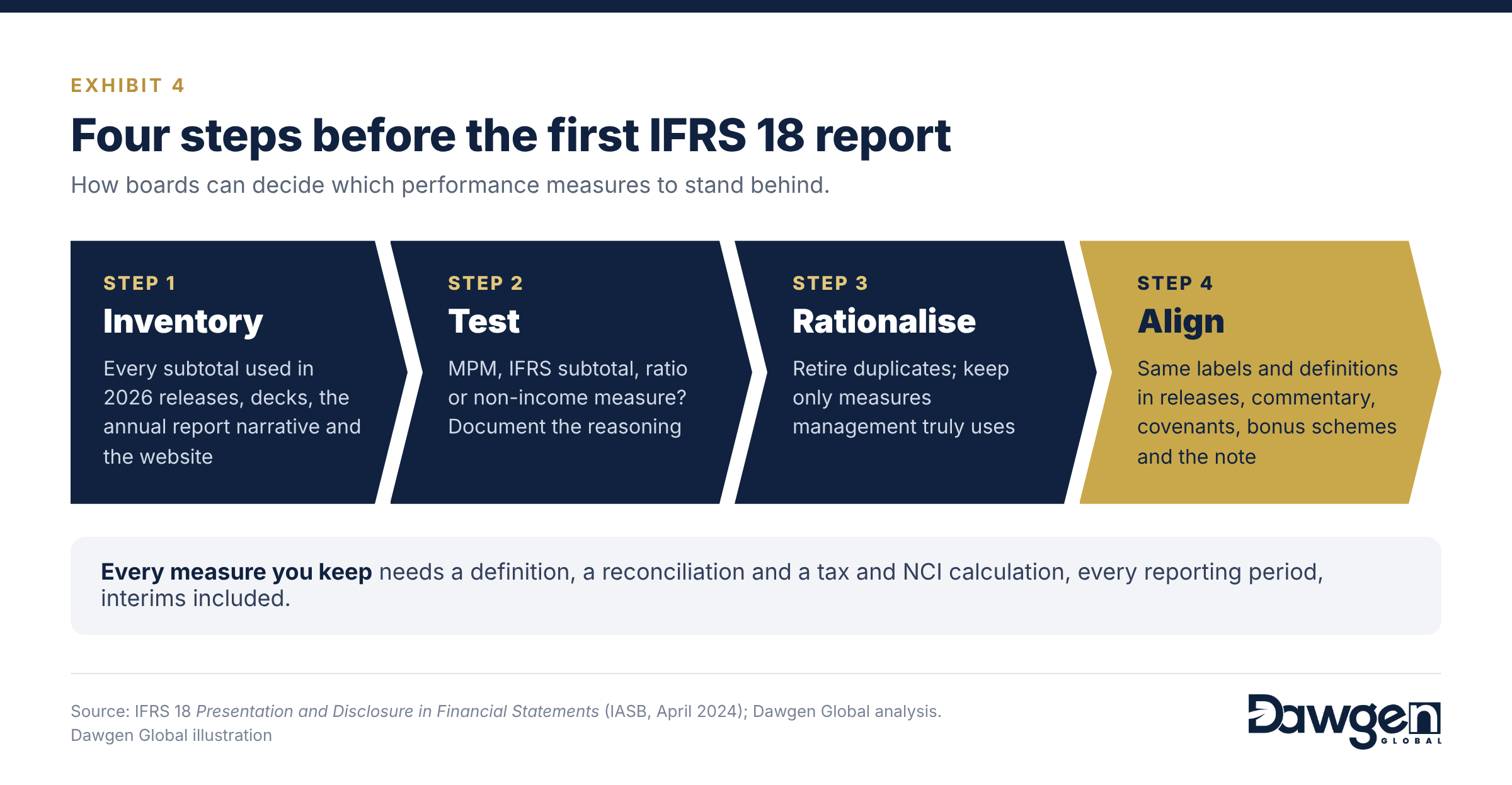
The MPM rules reward companies that decide deliberately which measures they want to stand behind. We recommend four steps before the first IFRS 18 report.
- Take an inventory. Collect every subtotal used in 2026 public communications: results releases, investor presentations, the annual report narrative, the chairman’s statement, the company website and analyst briefings. Most companies find more measures than they expected.
- Test each one. Decide whether it is an MPM, an IFRS-specified subtotal, a ratio or a non-income measure. Document the reasoning, especially if you intend to rebut the presumption.
- Retire measures that duplicate each other or that management no longer uses internally. Every measure kept will need a definition, a reconciliation and a tax calculation every reporting period, including interims.
- Align the narrative. Make sure the same measures, with the same labels and definitions, appear in the press release, the chairman’s statement, the investor deck and the MPM note. Check that executive bonus schemes and loan covenants still refer to measures you will continue to report.
MPMs are not only a disclosure question. Because they are the measures boards use to describe success, the decisions belong at board and audit committee level, not just in the finance team.
How Dawgen Global can help
Dawgen Global helps boards and finance teams across more than 15 Caribbean territories decide which performance measures to keep, and how to present them under IFRS 18.
- Performance Measures Review. An inventory of every measure you use publicly, with a documented assessment of which are MPMs and a recommendation on which to keep.
- MPM Note and Reconciliation Build. Definitions, reconciliations, and tax and non-controlling interest calculations for each measure, for the 2026 comparatives, your first interim and your first IFRS 18 annual statements.
- Covenant and Incentive Scan. A review of loan agreements and executive incentive schemes for definitions that IFRS 18 will affect.
- Board and Audit Committee Briefing. A focused session on the measures the board will be asked to stand behind.
Your headline number is about to come with a footnote. Make sure it is one you are happy to sign.

Book your IFRS 18 Readiness Clinic today.
Email [email protected] or call (876) 926-5210 | US 855-354-2447 | dawgen.global
Previously in this series: Ten Weeks to IFRS 18: Where Caribbean Companies Stand · 2026 Is Already Your Comparative Year · Your First IFRS 18 Interim Will Be Public. Next: Banks, Insurers and the “Main Business Activity” Test.
Dawgen Global is an independent, integrated multidisciplinary professional services firm serving businesses across more than 15 Caribbean territories. Big Firm Capabilities. Caribbean Understanding.
About Dawgen Global
Dawgen Global is an independent, integrated multidisciplinary professional services firm headquartered at 47 Trinidad Terrace, New Kingston, Jamaica, serving more than 15 territories across the Caribbean. Founded and led by Dr. Dawkins Brown, Executive Chairman, the firm is independent and not affiliated with any international network. It delivers a full suite of professional services under one roof: audit and assurance; tax advisory; IT and digital transformation; risk management; cybersecurity; actuarial and insurance regulatory advisory; HR advisory; mergers and acquisitions; corporate recovery; business advisory and strategy; accounting BPO and virtual CFO services; and legal process outsourcing.
The proposition is simple: big-firm capability without the big-firm price. Dawgen Global’s integrated approach is built for the specific complexities and opportunities of the Caribbean market, helping organizations make sharper, better-informed decisions that drive measurable progress.
To explore a partnership, reach out:
- Website: dawgen.global
- Email: [email protected]
- WhatsApp (Global): +1 555-795-9071
- Caribbean offices: +1 876-665-5926 | +1 876-929-3670 | +1 876-926-5210