A finance director’s guide to device as a service: cash flow, currency, accounting, tax and the questions to ask before you sign.
Rethinking how Caribbean organisations equip their people — a three-part series from Dawgen Global.
The capital request nobody enjoys
Every three or four years, the same request reaches the finance committee. The laptops are ageing, staff are complaining, the help desk is overwhelmed, and IT needs a large capital allocation to replace the estate. The request competes with property, vehicles, core systems and expansion. It is frequently deferred. Staff work on slower machines for another year, repair costs climb, and the eventual bill is bigger.
When the replacement does happen, it usually happens all at once. There is a lump of capital expenditure, a surge of work for IT, and a fleet that will age in lockstep and need replacing all at once again.
Device as a service offers finance leaders a different model. Instead of buying devices outright, the organisation pays a predictable monthly amount per user, covering the device, its software and the services that keep it working, with replacement built into the term. Spending can be matched to headcount and adjusted as the organisation grows or changes.
That is an attractive proposition. It is also a long-term commitment, and it deserves the same scrutiny a finance director would apply to any multi-year contract. This article sets out how to evaluate it properly.
Three ways to equip your people
There are three broad models for providing devices. They differ less in the hardware than in who carries the cost, the work and the risk.
| Buy outright | Finance lease | Device as a service | |
| Upfront cash | Full purchase price plus landed costs | Low | Low |
| What the payment covers | The device only | The device only | Device, software, configuration, support, refresh and disposal, as contracted |
| Configuration and logistics | Your IT team | Your IT team | The provider |
| Repairs and support | Warranty, then your cost | Warranty, then your cost | Included at agreed service levels |
| Technology refresh | New capital request | New lease | Built into the term |
| End-of-life disposal and data wiping | Your responsibility | Return to lessor; data risk remains yours unless contracted | Included, with certified data erasure where contracted |
| Cost visibility | Spread across many budget lines | Partial | One per-user figure |
| Flexibility to scale | Buy more or sell surplus | Fixed schedule | Depends on contract terms |
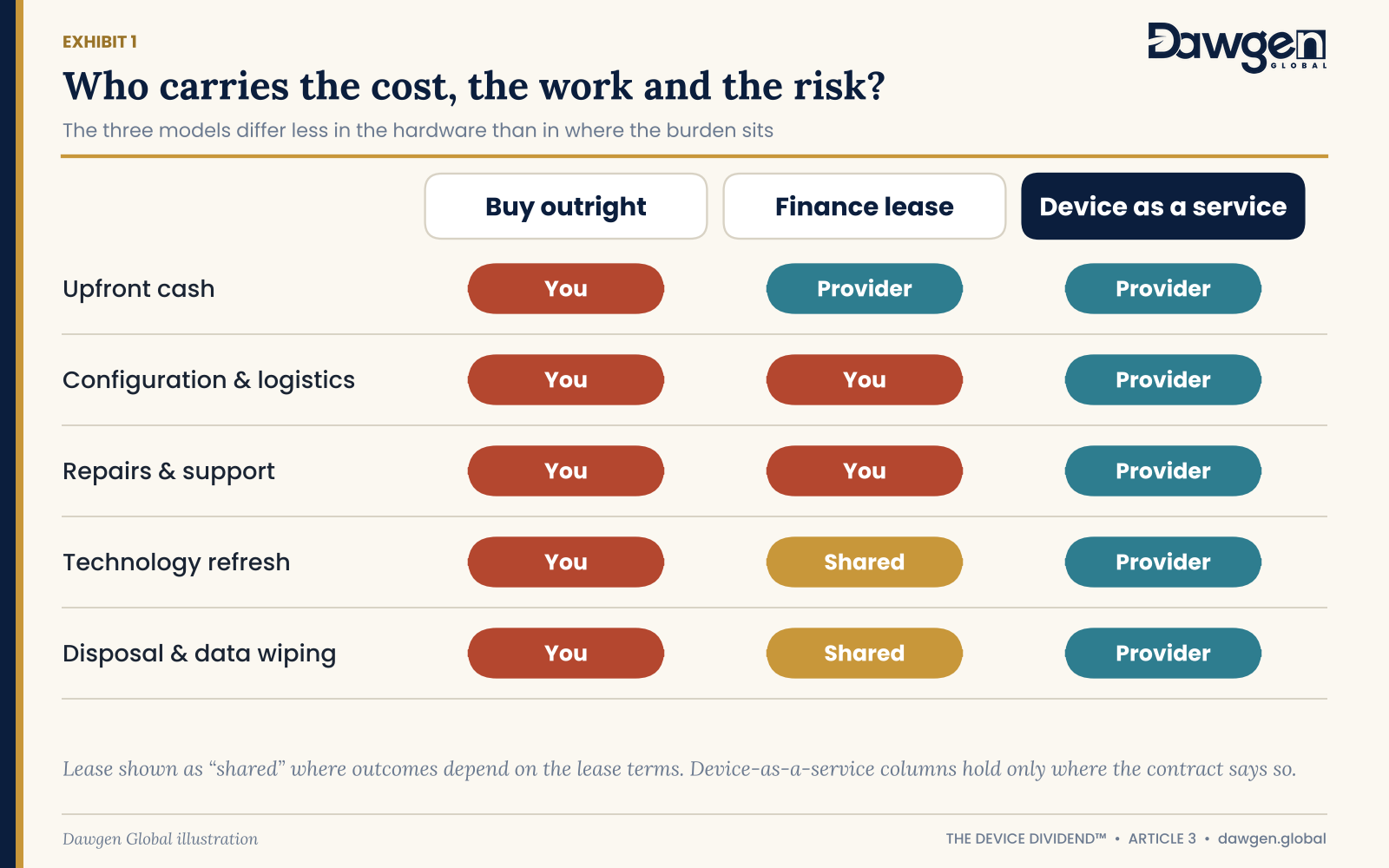
Exhibit 1. The three models differ less in the hardware than in who carries the cost, the work and the risk.
The comparison only holds if the contract actually includes what the right-hand column promises. That is why the contract matters more than the marketing.
A worked example
Consider an organisation equipping 100 staff over four years. The figures below are illustrative assumptions to show how the comparison is built, not quotations or benchmarks.
| Four-year view, 100 users (US$) | Buy outright | Device as a service |
| Year 0 cash outlay | 144,000 (devices plus landed costs) | Nil |
| Annual device payments | Nil | 54,000 (US$45 per user per month) |
| Annual internal costs: preparation, logistics, out-of-warranty repair, disposal | 13,750 | Largely transferred to provider |
| Total cash over four years | 199,000 | 216,000 |
| Technology refresh at end of term | New capital request | Included |
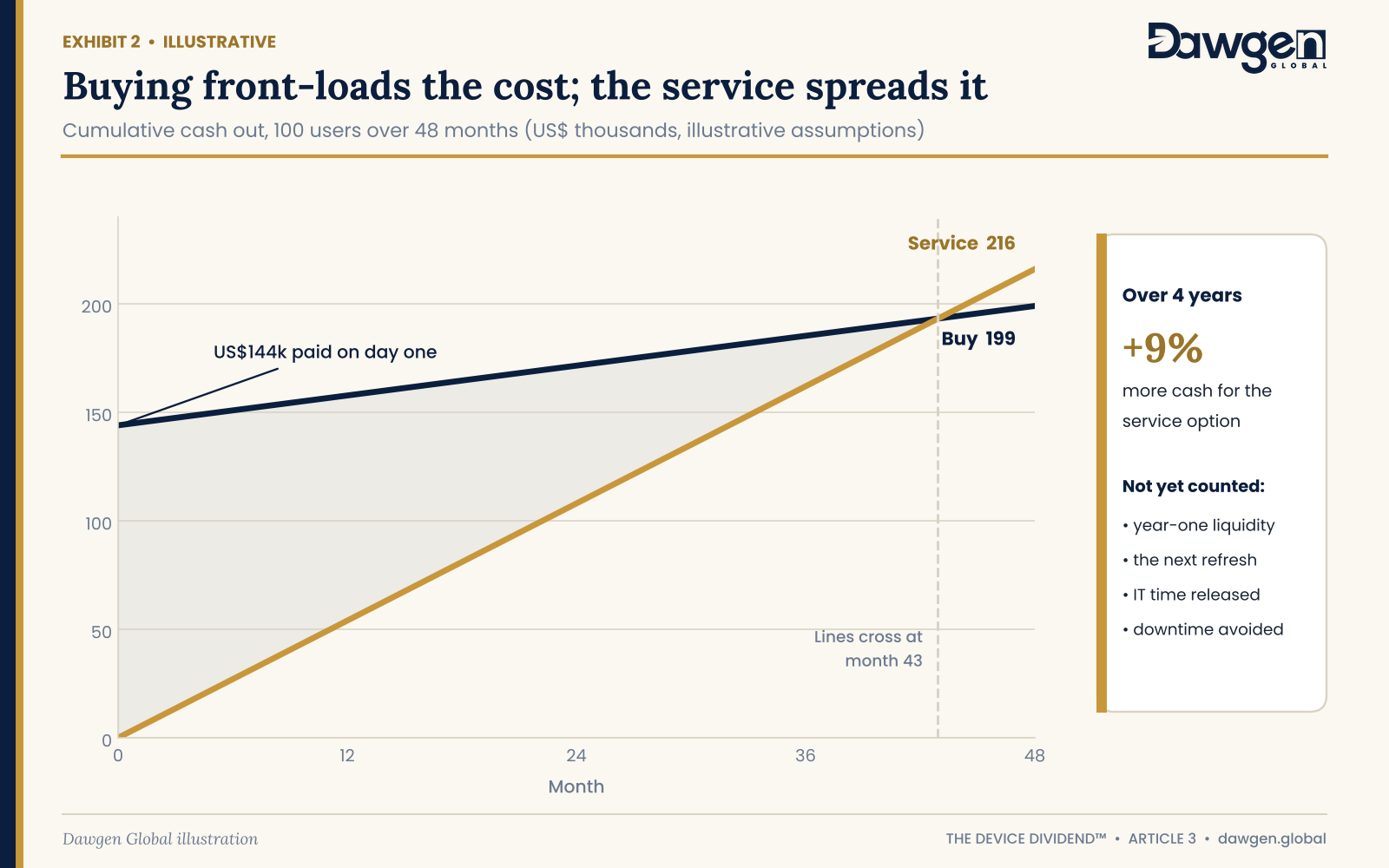
Exhibit 2. Cumulative cash out over four years on the illustrative assumptions: buying front-loads the cost; the service spreads it.
On these assumptions, the managed option costs about 9% more in cash over four years. But that is not the end of the analysis:
- The managed option requires no upfront outlay, so the organisation keeps US$144,000 of liquidity in year one.
- It includes the next refresh.
- It moves configuration and logistics off the IT team.
- The comparison above does not yet include downtime. In our second article we showed that downtime can cost a mid-sized organisation tens of thousands of dollars a year.
The right answer depends on the organisation’s cost of capital, how much downtime a managed service actually removes, and what the IT team does with the time it gets back. The point is that the decision should be made on a full model like this one, not on a comparison of the invoice price against the monthly fee.
Cash flow and budgeting

The most immediate benefit is cash. Replacing a large capital outlay with monthly payments preserves liquidity and borrowing capacity for investments that grow revenue. Some organisations have seasonal cash flow, such as hotels, agriculture and schools that depend on term fees. For them, avoiding a single large payment can be valuable in itself.
It also makes technology costs predictable. The finance team can budget a known amount per employee and watch it rise or fall with headcount. New hires come with a known technology cost. Department heads can be charged for the devices their people actually use.
Two cautions apply in the Caribbean.
First, currency. Many technology contracts are priced in US dollars. A one-off purchase fixes the exchange rate on the day you pay; a multi-year US-dollar subscription carries currency exposure for the whole term. Organisations whose revenue is in Jamaican dollars or another local currency should model that exposure. They should also explore alternatives such as local-currency pricing, fixed-rate terms or natural hedges.
Second, flexibility is a contract term, not a given. Some agreements allow devices to be added and returned freely during the term. Others carry minimum volumes, fixed quantities or early-termination charges. The promise of paying “only for what you need” is only as good as the clauses behind it.
Accounting: it may still be on the balance sheet
A common misconception is that device as a service is automatically an operating expense that never touches the balance sheet. Under IFRS 16, that is not guaranteed.
- A contract that gives you the right to control the use of identified devices for a period may contain a lease, even if it is described as a service.
- Where it does, the lease component is generally recognised as a right-of-use asset and a lease liability. The service components, such as support, configuration and logistics, are accounted for separately.
- IFRS 16 offers recognition exemptions for short-term leases and leases of low-value assets, and the standard cites personal computers and tablets as examples of the latter. Whether an exemption applies depends on the facts of the contract and the accounting policy election made.
- Organisations reporting under IFRS for SMEs or other frameworks may reach a different answer.
The treatment matters beyond the financial statements. It affects reported EBITDA, gearing, and potentially compliance with loan covenants. A finance director who expects an operating expense and is told at year-end that a lease liability must be recognised will not thank whoever negotiated the contract.
Get the accounting analysed before signing, not when the auditors ask.
Tax: the treatment changes with the structure
Tax outcomes also depend on how the arrangement is structured and where the provider sits. Matters to consider include:
- whether monthly payments are deductible as incurred, compared with capital allowances on owned equipment, and how the timing of relief differs;
- how GCT or VAT applies to the device and service components, and whether input tax is recoverable;
- whether payments to a provider outside the territory attract withholding tax, and whether a tax treaty or exemption applies;
- whether import duties and taxes are borne by the provider or passed through; and
- how the arrangement is treated in each territory where devices are used.
In a multi-territory group, these answers can differ from island to island. They belong in the business case, not in a surprise on the first tax return.
What the board should ask
A multi-year technology service contract is a governance matter, not just a procurement one. Boards and audit committees should expect management to answer five questions:
- Has the decision been made on a full lifecycle cost model, including downtime and internal effort?
- What is the total contractual commitment over the term, and who approved it under the organisation’s authority limits?
- How have currency, provider and data-security risks been assessed and mitigated?
- What will management report on cost, uptime and the device estate, and how often?
- What happens if the organisation needs to leave the arrangement, and what would it cost?
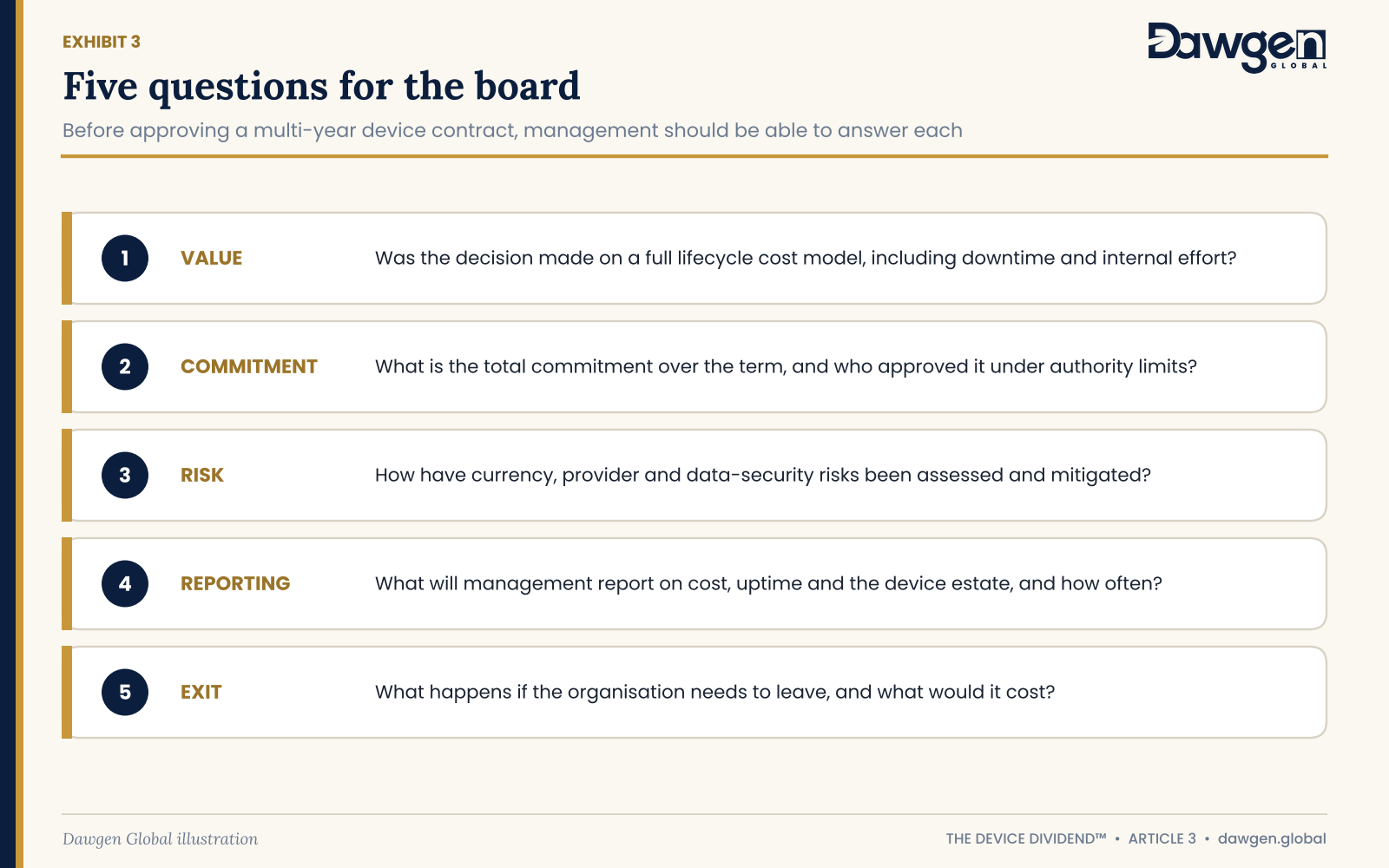
Exhibit 3. Five questions every board should put to management before approving a multi-year device contract.
Ten questions to ask before you sign
- Exactly which hardware, software and services does the monthly price include?
- What service levels apply to repairs and replacements, and in which territories?
- Who bears the landed costs (freight, duty and taxes) in each territory?
- In what currency is the contract priced, and can that be changed or fixed?
- Can devices be added or returned during the term, and at what cost?
- What happens at the end of the term: refresh, return, extend or buy out?
- Who is responsible for loss, theft and accidental damage?
- How is data erased at end of life, and will you receive certification for each device?
- Does the contract contain a lease for accounting purposes, and what are the tax consequences?
- What reporting will you receive on cost, uptime and the device estate?
Questions finance leaders often ask
Is device as a service always cheaper? No. On cash alone it can cost more. The case rests on liquidity, predictability, transferred effort, reduced downtime and built-in refresh. Whether those are worth the difference is exactly what a business case should establish.
Can we keep some devices on the old model? Yes. Many organisations run both models during a transition, or keep specialist equipment outside the programme.
How long are typical terms? Terms are commonly aligned to the useful life of the device, often three to four years, though this varies by provider and device type.
How Dawgen Global helps
Dawgen Global is unusual in being able to answer every one of those questions under one roof. Our advisory, accounting, tax and technology teams work together to build the business case on your numbers. Our global technology partners give us access to enterprise quoting, configuration and channel financing capabilities to price a programme tailored to your organisation.
We compare that programme honestly against buying and leasing. The comparison covers cash flow, currency exposure, accounting and tax in each territory where you operate. Your finance committee and board can then decide on evidence, not on a sales pitch.
| CALL TO ACTION
Commission a Device-as-a-Service Business Case Before you approve another device refresh, see the full financial picture. What you receive ✓ A three-way comparison of buying, leasing and device as a service over the full device life, built on your estate and headcount plans ✓ Cash flow, cost-of-capital and currency analysis of each option ✓ An accounting and tax assessment of the proposed structure in each territory where you operate ✓ A tailored, priced device-as-a-service design and a review of key contract terms ✓ A board-ready summary and recommendation How it works: A short discovery call, a scoping discussion, then the business case. Fees are agreed after scoping. Contact [email protected] · |
This article provides general information and is not accounting or tax advice for any specific arrangement. Figures in the worked example are illustrative assumptions.
About Dawgen Global
Dawgen Global is an independent, integrated multidisciplinary professional services firm headquartered at 47 Trinidad Terrace, New Kingston, Jamaica, serving more than 15 territories across the Caribbean. Founded and led by Dr. Dawkins Brown, Executive Chairman, the firm is independent and not affiliated with any international network. It delivers a full suite of professional services under one roof: audit and assurance; tax advisory; IT and digital transformation; risk management; cybersecurity; actuarial and insurance regulatory advisory; HR advisory; mergers and acquisitions; corporate recovery; business advisory and strategy; accounting BPO and virtual CFO services; and legal process outsourcing.
The proposition is simple: big-firm capability without the big-firm price. Dawgen Global’s integrated approach is built for the specific complexities and opportunities of the Caribbean market, helping organizations make sharper, better-informed decisions that drive measurable progress.
To explore a partnership, reach out:
- Website: dawgen.global
- Email: [email protected]
- WhatsApp (Global): +1 555-795-9071
- Caribbean offices: +1 876-665-5926 | +1 876-929-3670 | +1 876-926-5210


