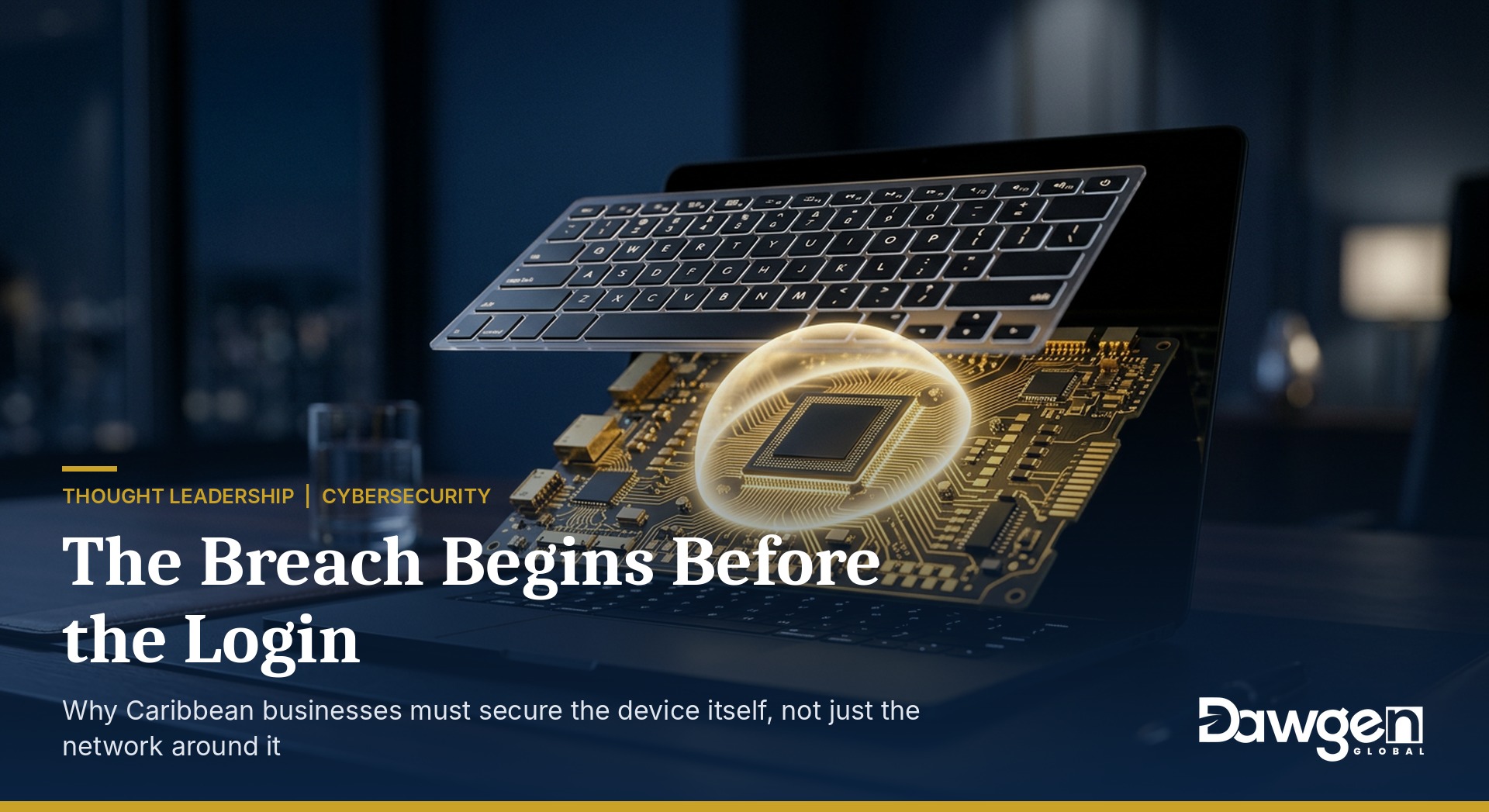
Why Caribbean businesses must secure the device itself, not just the network around it
The laptop nobody suspected
Picture a mid-sized distributor in Kingston. It has a firewall, antivirus on every machine and a managed email filter. The IT provider sends a clean monthly report.
Then the finance manager’s laptop starts behaving strangely. A reinstall of the operating system does not fix it. The problem was never in the operating system: it sat in the firmware, the layer of code that wakes the machine up before Windows ever loads. The antivirus could not see it, because the antivirus starts too late.
This scenario is a composite, but every element of it is real. It describes the blind spot in most small and mid-sized businesses across the region: we protect the network and the software, and we assume the device underneath is trustworthy. Attackers have noticed.
The numbers small businesses would rather not read
Cybercrime is no longer a big-company problem. Global research on small and mid-sized firms by TechAisle paints a sobering picture:
| Measure | Small businesses | Mid-market firms |
| Experienced a security incident | 44% | 54% |
| Average loss per incident (US$) | 1.4 million | 29 million |
| Not very confident they could recover | 60% | 34% |
| No formal security awareness training | 81% | 74% |
| No protocol for responding to an incident | 42% | 37% |
| Feel underprepared compared with peers | 65% | 54% |
Read the third row again. Six in ten small businesses doubt they could recover from an attack. For a Caribbean firm with thin cash reserves, a single serious incident can decide whether the business is still trading next year.
The pattern is consistent: firms are spending on security, but much of the spend sits at the wrong layer.
The device is now the perimeter
Ten years ago, the office was the security boundary. Data lived on a server in a back room and staff logged in from desks inside the building.
That world is gone. Our sales teams work from client sites in Montego Bay and Bridgetown. Finance staff approve payments from home. Hotel managers run operations from a tablet on the property. Each of those devices carries data, credentials and a direct path into the business.
The device is where your people, your data and the attacker meet. If the device cannot be trusted, nothing built on top of it can be fully trusted either.
The layer most businesses never see
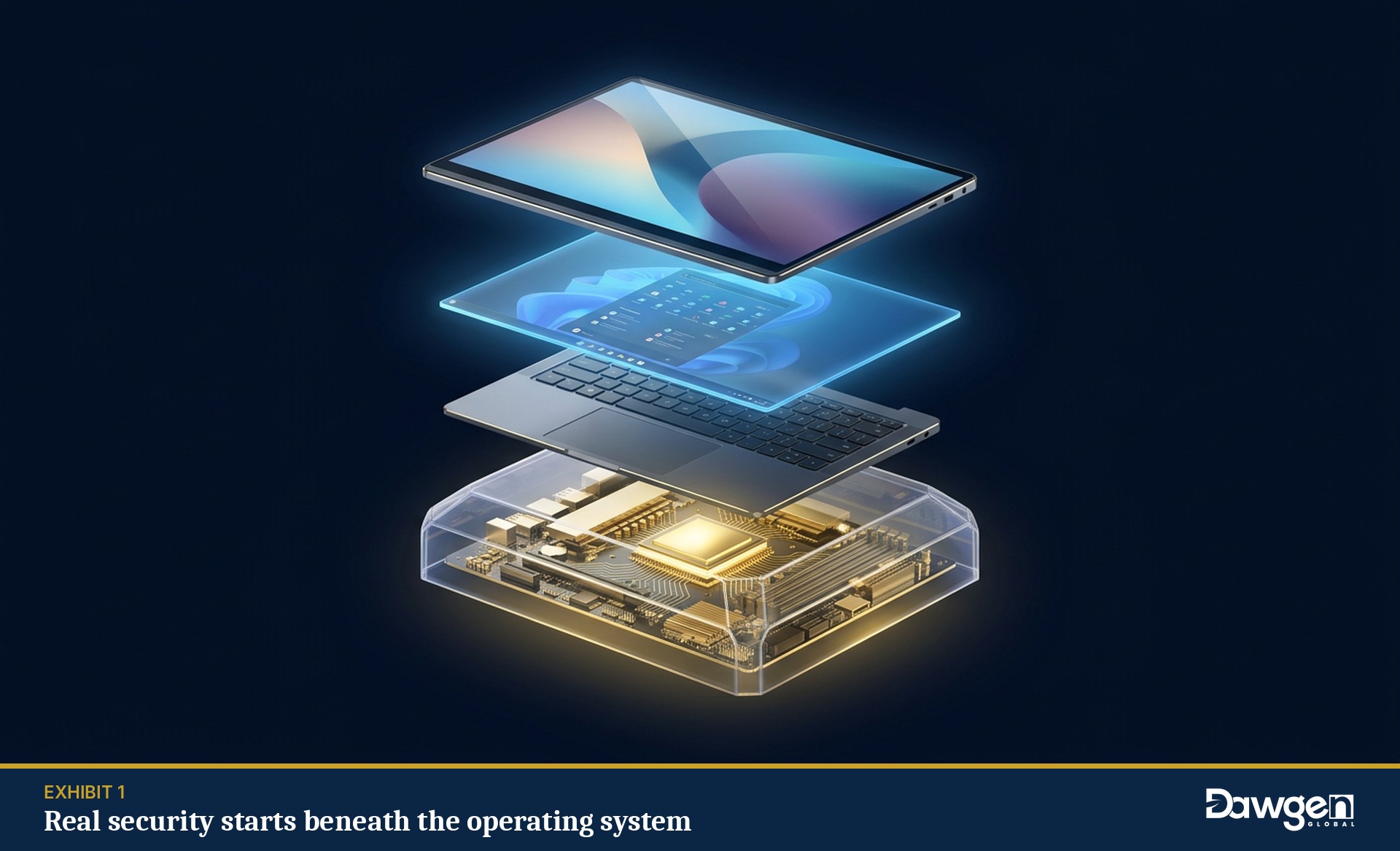
Most security tools run inside the operating system. That leaves three layers underneath them largely unguarded.
- The supply chain. A device can be tampered with between the factory and your front door. Without a verified chain of custody, you cannot prove the machine you received is the machine that was built.
- The firmware. The BIOS and firmware load before the operating system. Malicious code planted here survives reinstalls and hard-drive replacement, and stays invisible to conventional antivirus.
- Identity and keys. Passwords are stolen every day. If the credentials and encryption keys that protect a device live in ordinary software, they can be lifted by ordinary malware.
The answer is security that is built into the hardware itself, not bolted on afterwards. Today, the better-engineered business devices ship with protections such as:
- Verified build and supply-chain assurance, so the device’s integrity can be confirmed from factory to desk.
- Self-healing firmware, which detects corruption of the BIOS and restores a known good version automatically.
- Firmware integrity checking after deployment, so you can confirm, months later, that nothing below the operating system has changed.
- A dedicated hardware security chip that stores keys and credentials apart from the software an attacker can reach.
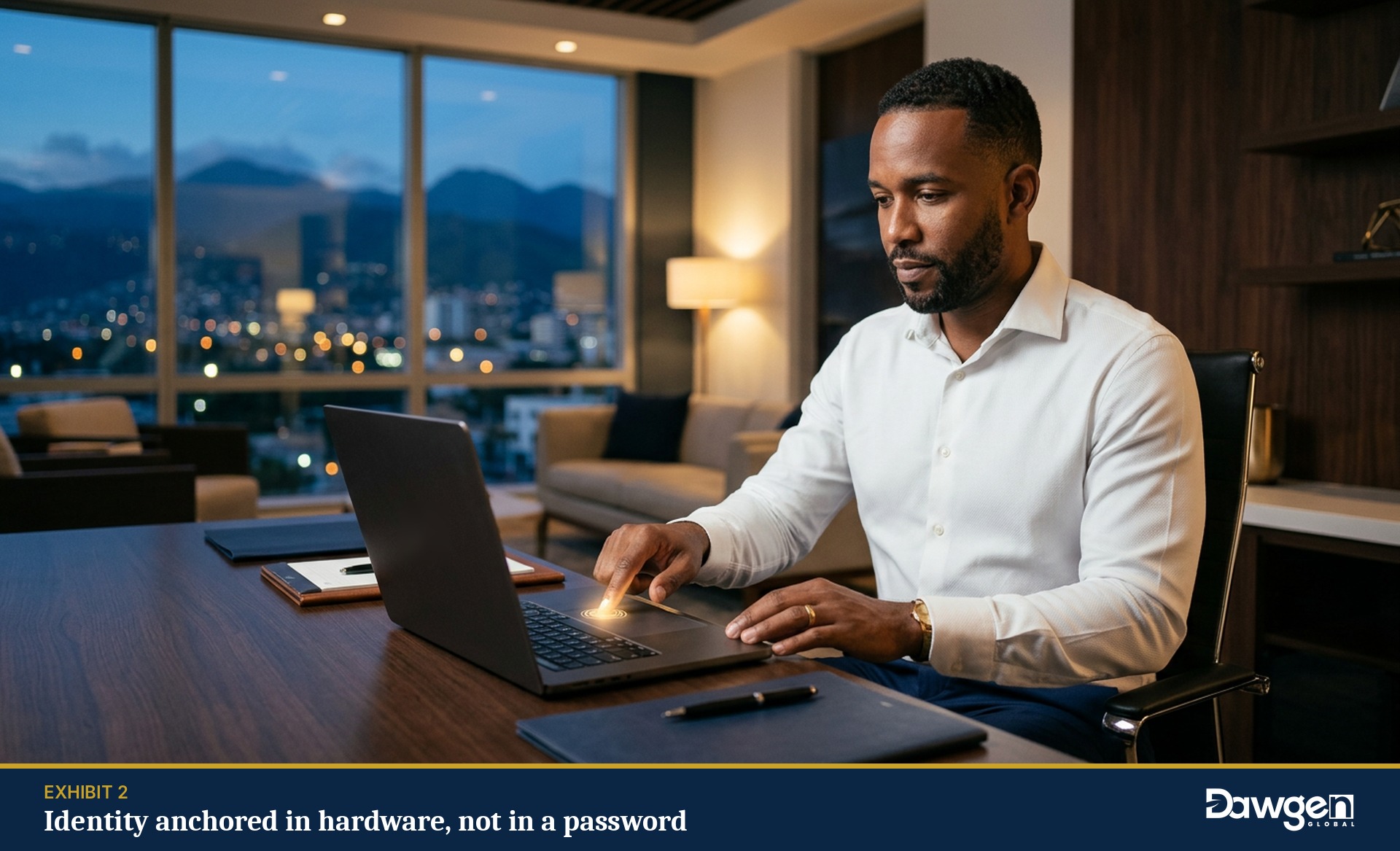
- Fingerprint readers that match on the chip, so a biometric never leaves the sensor and cannot be stolen from the operating system.
Many of these features come standard on business-class devices. Some require activation. Too often, nobody switches them on.
Why this matters more in the Caribbean
Three regional realities raise the stakes.
Skills are scarce. ConnectWise research found that 76% of small businesses lack the in-house skills to handle cybersecurity issues. Most Caribbean firms rely on one or two IT generalists, or an external provider. Protection that works automatically at the hardware level does not depend on a specialist being available at 2 a.m.
Regulators and insurers are asking harder questions. Jamaica’s Data Protection Act, and similar laws in Barbados and other territories, require organisations to apply appropriate technical measures to protect personal data. Cyber insurers increasingly ask about endpoint controls before they quote. “We have antivirus” is no longer a satisfying answer.
Devices travel. In tourism, distribution, field services and professional practice, laptops leave the building every day. A lost or stolen device is a reportable data incident unless its data is protected at the hardware level.
Every laptop purchase is a security decision
Here is the opportunity most leaders miss. Businesses replace their computers every three to five years. That refresh cycle is the cheapest moment to raise your security baseline, because the foundation layer comes with the device.
Yet procurement is usually driven by price, processor and screen size. Security is assumed. Before your next purchase, ask four questions of every device:
- Can the supplier verify the device’s integrity from the factory to our premises?
- Does the firmware detect and repair tampering on its own?
- Are credentials and encryption keys stored in dedicated security hardware?
- Can we check firmware integrity after the device is deployed?
If the answer to any of these is “we’re not sure”, you are buying a blind spot.
From foundation to full protection
Hardware security is the foundation, not the whole house. The strongest approach is defence in depth: independent layers, each covering the gaps in the others.
- Foundation — built into the device. Supply-chain assurance, firmware resilience, a hardware security chip and on-chip biometrics.
- Core — intelligent protection. AI-driven detection that stops ransomware and malware before and during execution, plus endpoint data protection that keeps files encrypted and hidden from unauthorised users.
- Advanced — control of everything that connects. Protection against malicious USB and peripheral devices, with a live inventory of every asset on the network.
The best part for a smaller business: these layers can now be acquired together, from a single source, sized to the budget of the business rather than the budget of a multinational. (We explore that consolidated model in the companion article, Six Tools, No Team.)
Five actions for the next 90 days
- Inventory your devices. Know how many laptops and desktops you have, their age, and who uses them.
- Switch on what you already own. Check whether firmware protection, security chips and biometric login are enabled on existing business devices.
- Rewrite your procurement standard. Add the four device questions above to every purchase.
- Write a one-page incident protocol. Who is called, who decides, and how the business keeps operating if a device is compromised.
- Plan your next refresh around security. Align the replacement of your oldest devices with a layered protection plan.
Secure the foundation before you build on it
Caribbean businesses have invested heavily in firewalls, email filters and antivirus, and those investments matter. But they all rest on an assumption: that the device underneath is trustworthy.
The businesses that will weather the next wave of attacks are the ones that stop assuming and start verifying, from the chip upwards.
Book your Endpoint Security Readiness Review
Dawgen Global helps small and mid-sized businesses across the Caribbean find and close the gaps between their devices, their data and their defenses. In a focused review, our team will:
- assess the security built into your current devices and confirm what is switched on;
- map your exposure across supply chain, firmware, identity, malware and data loss;
- benchmark your readiness against the measures regulators and insurers now expect; and
- give you a costed, layered protection roadmap, aligned to your next device refresh.
Don’t wait for the incident to reveal the gap. Contact us today at [email protected], call (876) 926-5210 or US 855-354-2447, or visit dawgen.global to schedule your review. Every engagement begins with a no-obligation conversation; scope and fees are agreed only once we understand your environment.
Dawgen Global — Big Firm Capabilities. Caribbean Understanding.
About Dawgen Global
Dawgen Global is an independent, integrated multidisciplinary professional services firm headquartered at 47 Trinidad Terrace, New Kingston, Jamaica, serving more than 15 territories across the Caribbean. Founded and led by Dr. Dawkins Brown, Executive Chairman, the firm is independent and not affiliated with any international network. It delivers a full suite of professional services under one roof: audit and assurance; tax advisory; IT and digital transformation; risk management; cybersecurity; actuarial and insurance regulatory advisory; HR advisory; mergers and acquisitions; corporate recovery; business advisory and strategy; accounting BPO and virtual CFO services; and legal process outsourcing.
The proposition is simple: big-firm capability without the big-firm price. Dawgen Global’s integrated approach is built for the specific complexities and opportunities of the Caribbean market, helping organizations make sharper, better-informed decisions that drive measurable progress.
To explore a partnership, reach out:
- Website: dawgen.global
- Email: [email protected]
- WhatsApp (Global): +1 555-795-9071
- Caribbean offices: +1 876-665-5926 | +1 876-929-3670 | +1 876-926-5210


