Hotels, villa owners, musicians and filmmakers are paid through platforms that net off commissions, refunds and foreign tax before any cash arrives. The deposit is not the revenue, and the tax answer starts with who supplied what to whom.
Executive summary
Tourism and the creative industries are the Caribbean’s most visible exports, and both now earn most of their foreign revenue through digital intermediaries. A hotel sells rooms through an online travel agency (OTA); a villa owner lists on a home-rental marketplace; a producer earns streaming royalties, platform advertising shares and synchronisation (sync) licence fees. In each case a platform sits between the business and its customer, holds the data, and pays out a net figure.
The tax rules are moving. Jamaica will bring short-term rental accommodation into General Consumption Tax (GCT) from 1 April 2027 under an order approved by the House on 29 April 2026. The Bahamas already requires home-rental marketplaces to register for value added tax (VAT). OTA commissions paid offshore are imported services that registered Jamaican hotels must self-account for under section 23B of the GCT Act. On the creative side, royalties crossing borders within the Caribbean Community (CARICOM) can be taxed at source at up to 15 per cent under the CARICOM Double Taxation Agreement, and relief at home depends on documentation most creators do not hold.
This article separates the flows, sets out the revenue streams and their tax questions, works through an illustrative creator royalty statement, and describes a rights-to-cash control that protects both revenue and tax positions.
The hotel, the guest and the online travel agency
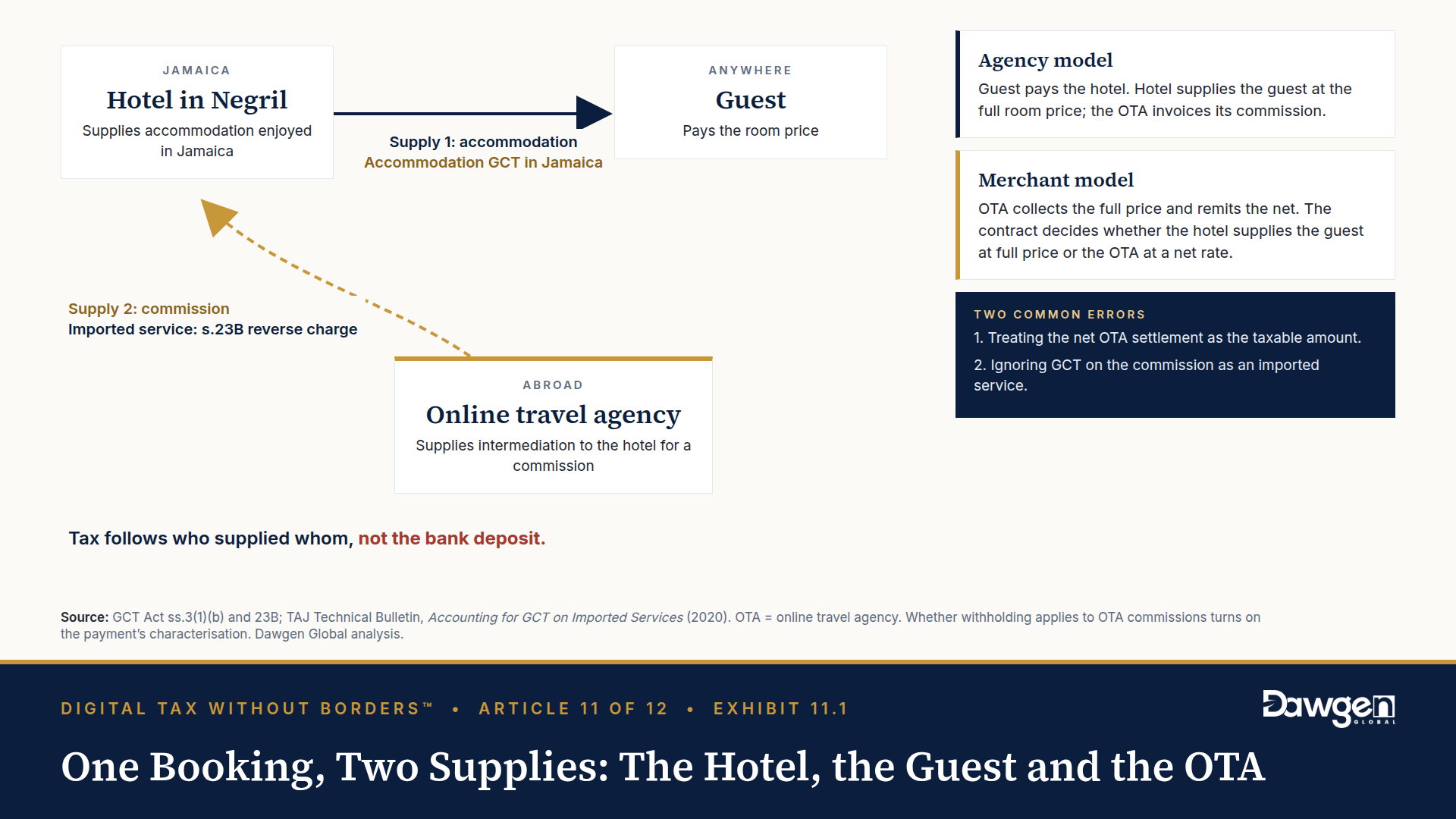
A booking made on a foreign OTA for a stay in Negril involves at least two supplies. The hotel supplies accommodation, physically enjoyed in Jamaica and taxed there whatever the guest’s location or the platform’s residence. The OTA supplies an intermediation or marketing service to the hotel and is paid by commission. Depending on the contract, the OTA may collect the full price from the guest and remit the net (the merchant model), or the guest may pay the hotel directly and the OTA may invoice its commission afterwards (the agency model).
Two errors are common. The first is treating the net OTA settlement as the taxable amount without deciding who supplied whom. Under the agency model the hotel supplies the guest at the full room price and the commission is a cost; under a merchant model the contract decides whether the hotel supplies the guest at the full price or the OTA at a net rate. Accommodation GCT follows that answer, not the bank deposit. The second is ignoring the commission itself. An OTA established abroad is supplying a service to a Jamaican hotel; for a GCT-registered hotel, that is an imported service on which it must self-account under section 23B, as the Tax Administration Jamaica (TAJ) Technical Bulletin of April 2020 explains [4]. Where the hotel’s supplies are fully taxable, the output and input amounts usually offset, but the declaration must be made. Where the commission is deducted before remittance, the hotel should also confirm, on the facts of the contract, whether any withholding obligation arises on the fee.
Short-term rentals enter the net
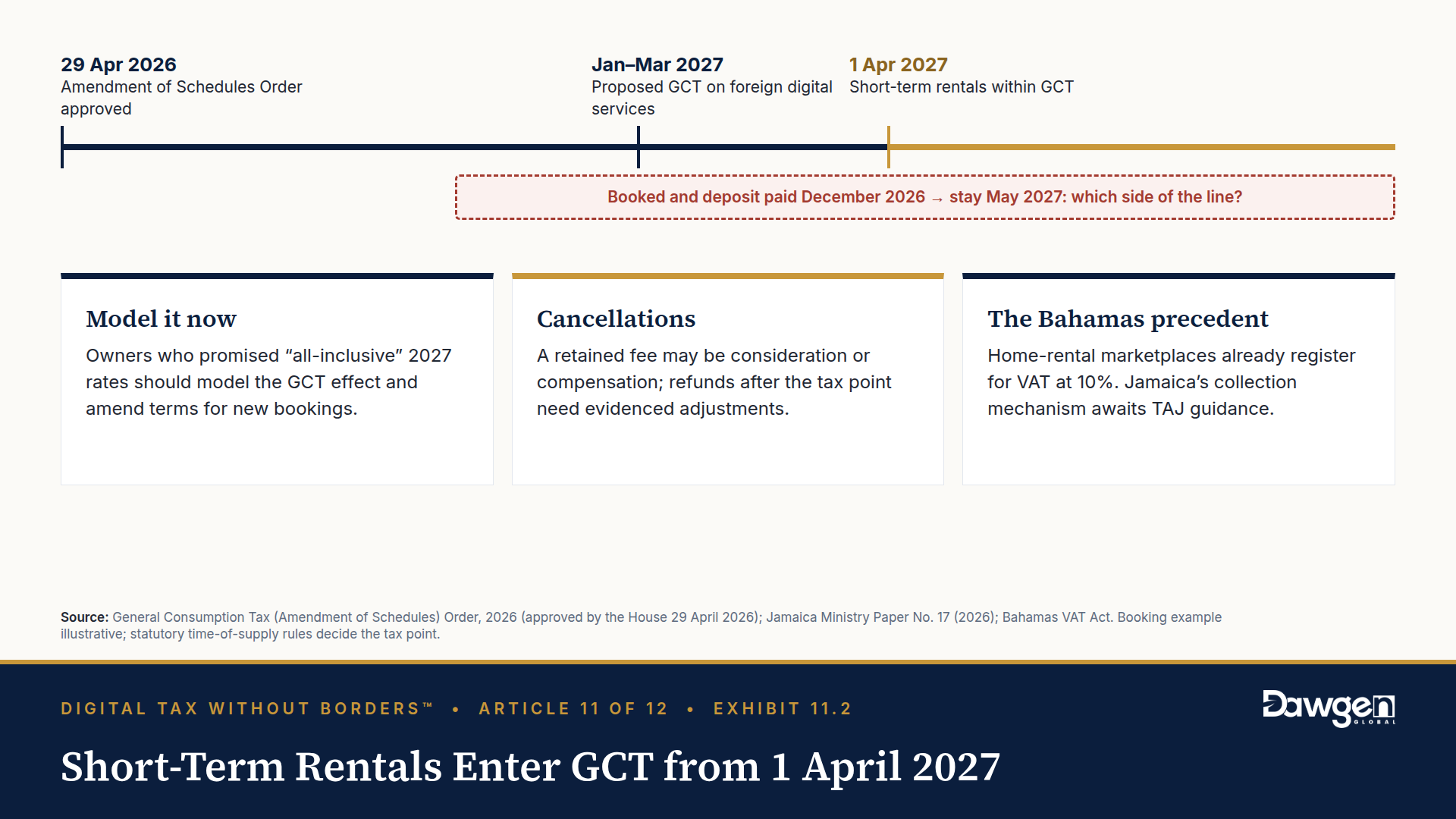
The General Consumption Tax (Amendment of Schedules) Order, 2026, approved by the House of Representatives on 29 April 2026, brings short-term rental accommodation, such as Airbnb-style rentals, into GCT from 1 April 2027 [1]. Villa and apartment owners who have operated outside the hotel regime must now decide whether they will cross the J$15 million registration threshold [13], how their listings will display tax-inclusive prices, and how their platform settlements will be reconciled to returns.
The Bahamas offers a working precedent. Its VAT Act requires home-rental marketplaces to register, alongside non-resident suppliers of electronic commerce services, with the standard VAT rate at 10 per cent [2][3]. Where the platform is responsible, the owner needs transaction-level evidence of what was collected and remitted; where the owner is responsible, it needs the platform’s gross booking data. A Jamaican owner should not assume either outcome until TAJ guidance on the collection mechanism is published.
Bookings that straddle a tax change
Tourism sells forward. A guest may book and pay a deposit in December 2026 for a stay in May 2027, after short-term rentals enter GCT. The statutory time-of-supply rules, not the booking date alone, decide whether GCT applies, and the contract decides who bears it. Owners and property managers who have promised “all-inclusive” rates for 2027 stays should model the effect now and amend terms and conditions for new bookings.
Cancellations add a second layer. A retained cancellation fee may be consideration for a supply, or compensation that is not; a refund after the tax point requires an adjustment supported by evidence. The platform refunds the guest and may keep its commission. The operator needs the original booking, tax charged, cancellation terms, refund and commission reversal in one trail. A net settlement report that collapses these amounts will not support a return.
Key dates. Jamaica: short-term rental accommodation within GCT from 1 April 2027 (Amendment of Schedules Order approved 29 April 2026). Jamaica: proposed GCT on digital services supplied from abroad, planned for January–March 2027, with enabling legislation and guidance not yet published as far as public sources show. The Bahamas: home-rental marketplaces already required to register for VAT.
The creative economy: rights, platforms and withholding
A Caribbean musician, producer or filmmaker rarely sells one thing. A single recording can earn streaming royalties through a digital distributor, a share of platform advertising revenue, a sync licence fee when it is placed in an advertisement or film, direct download sales on the artist’s own site, and fees for live-streamed performances. Each is a different legal transaction: a licence of intellectual property (IP), a revenue share under platform terms, a sale of digital content to a consumer, or a service.
The distinction drives three tax outcomes.
First, withholding at source. A royalty paid across a border is commonly taxed in the payer’s country. Within the region, the CARICOM Double Taxation Agreement of 1994 allows the source state to tax royalties at up to 15 per cent of the gross amount (Article 13) [8]. Jamaica itself withholds 33⅓ per cent on royalties paid to non-residents under domestic law, reduced to 15 per cent under the CARICOM agreement [7] — relevant to a Jamaican studio paying a Barbadian songwriter.
Second, relief at home. Foreign tax deducted from a royalty is only creditable against home tax if the creator can show which country deducted it, on what income, at what rate, and that it was properly due. A line on a statement reading “tax withheld” is not enough.
Third, consumption tax on direct sales. A creator selling downloads or online courses directly to consumers in Barbados, The Bahamas or Suriname is a foreign supplier of digital services in those markets. Barbados charges VAT at 17.5 per cent on such services [9], and Suriname at 10 per cent on foreign business-to-consumer (B2C) electronic services [12]; Grenada, once its 2026 amendment commences, will require non-resident suppliers to register for B2C supplies and allow marketplace operators to be treated as the supplier [10]. Selling through a platform that acts as supplier usually removes that burden; selling from one’s own website usually does not.
For buyers of creative tools — music software, plug-ins, stock footage, editing suites — Jamaica’s proposed GCT on digital services from abroad is the relevant change. Budget 2026/27 projects J$300 million in fiscal year (FY) 2026/27 and about J$4.2 billion a year at full implementation [5][6]. Creators registered for GCT already self-account on imported services; those below the threshold will see the tax as an unrecoverable cost once foreign suppliers begin to charge it.
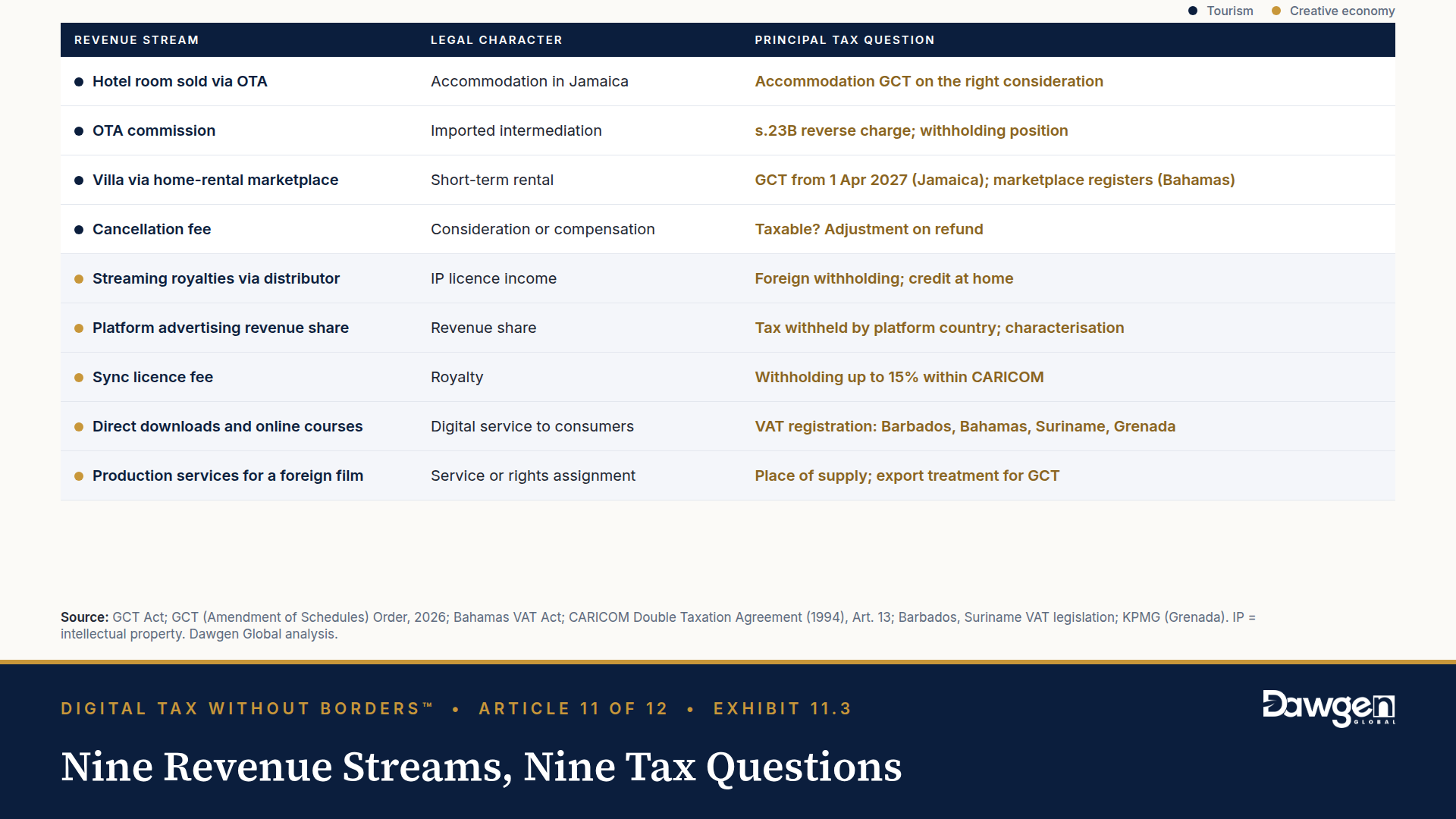
Revenue streams and their tax questions
Illustrative creator royalty statement
The figures below are illustrative and describe no actual person. A Kingston-based producer receives the following for one quarter, all in US dollars:
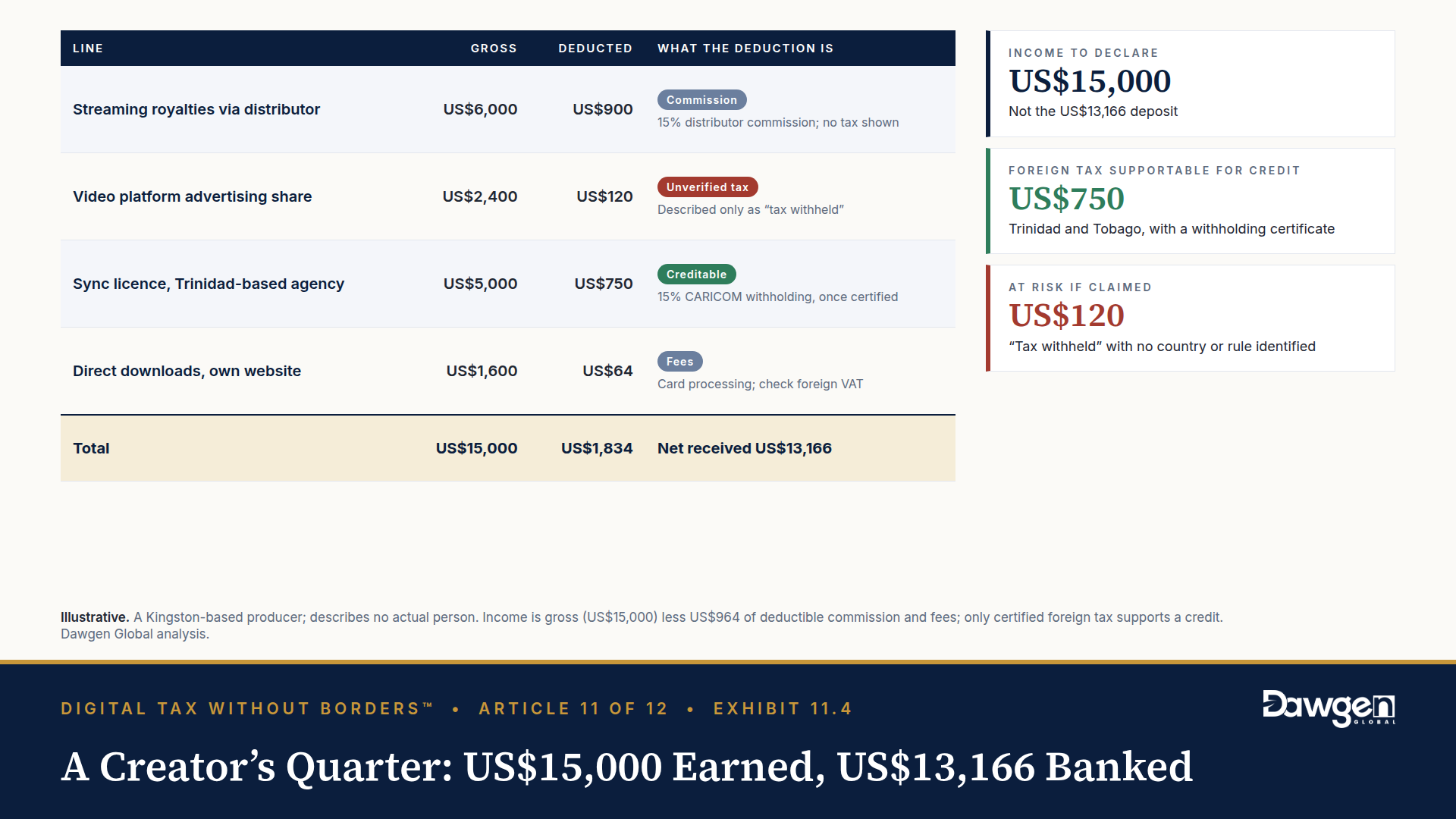
The bank shows US$13,166. The producer’s income is US$15,000, less US$964 of deductible commission and fees. Only the US$750 withheld in Trinidad and Tobago is supported well enough to consider for relief, and only once the agency supplies a withholding certificate. The US$120 cannot be relieved until the platform confirms which country deducted it and under what rule. And if any of the US$1,600 of downloads was sold to consumers in Barbados, The Bahamas or Suriname, the producer must consider whether VAT was due there. A creator who declares the net deposit understates income; one who claims all US$870 of “tax” risks disallowance of US$120 of it.
Rights-to-cash: the control that protects revenue and tax
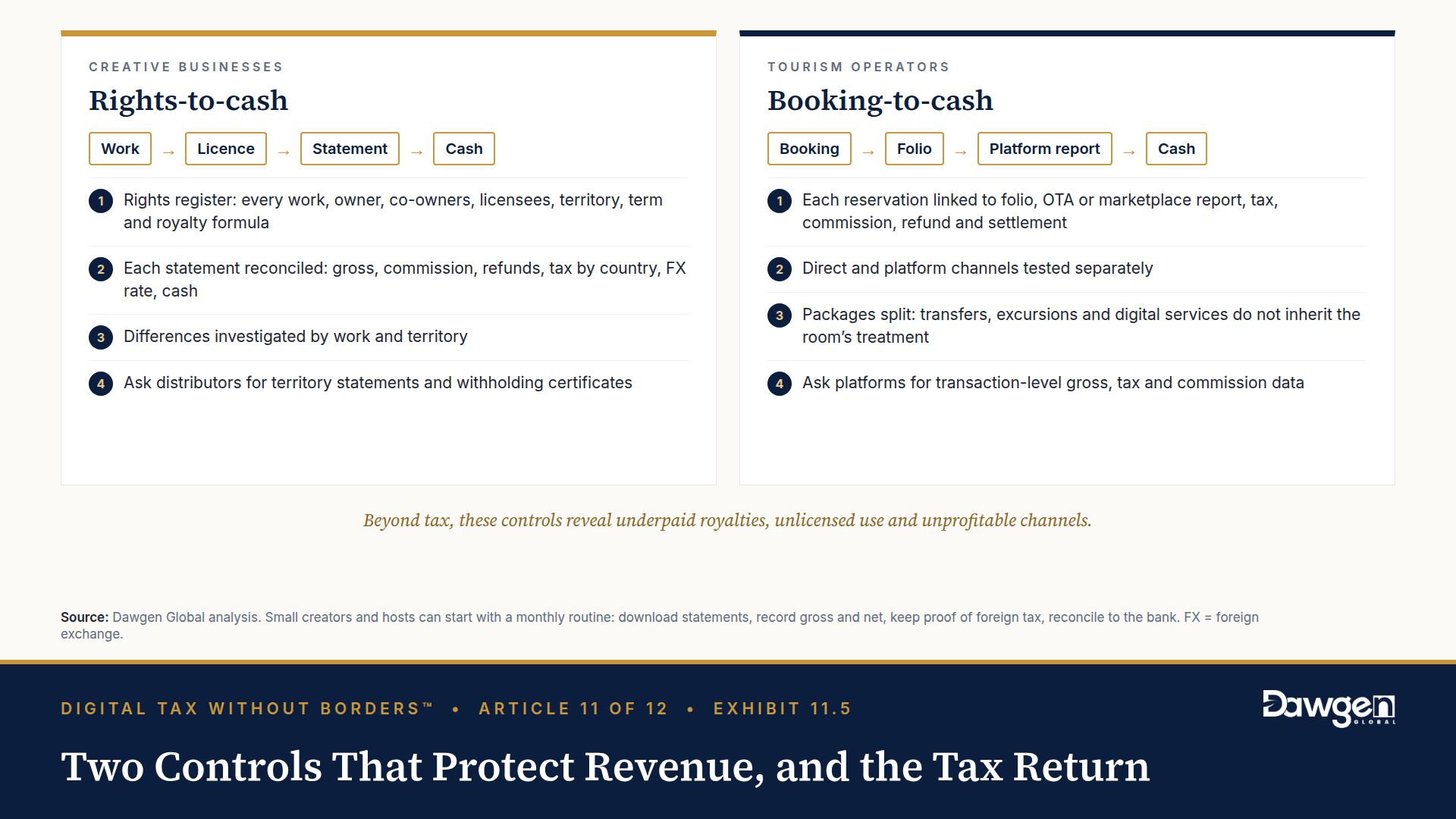
The single most valuable control for a creative business, and the one that most often does not exist, links each work to its cash. A rights register records every work, its owner and co-owners, the distributors and licensees, territories, term, exclusivity and the royalty formula. Each statement then reconciles to that register: gross exploitation revenue, commission, refunds, tax withheld by country, exchange rate and cash received. Differences are investigated by work and territory.
The control earns its keep beyond tax. It reveals underpaid royalties, unlicensed use and unprofitable channels, and it supports the valuation of a catalogue for financing or sale. For tax, it produces the gross income figure, the documented foreign tax and the direct-sales evidence a return requires.
Tourism operators need the parallel booking-to-cash control. Link each reservation to the guest folio, OTA or marketplace report, accommodation tax, commission, refund and settlement. Test direct and platform channels separately. If a room is sold in a package with transfers, excursions or a digital concierge service, record each component and its supplier, because a package price does not automatically inherit the room’s treatment.
Both controls depend on contract terms negotiated in advance. Creators should ask distributors for territory-level statements, a breakdown of tax deducted by country and certificates for relief. Hotels and villa owners should ask platforms for transaction-level gross, tax and commission data and the right to query calculations. Distribution agreements should say who bears foreign tax and who receives any refund. These requests are harder than accepting standard terms, but without them the business cannot defend its own return.
Proportional compliance for small creators and hosts
A global platform can build a tax engine; a solo producer or a single-villa host cannot. Caribbean rules already recognise this. The Jamaican GCT registration threshold keeps smaller businesses out of the return cycle, and platform-collection models, such as Grenada’s provision allowing marketplace operators to be treated as the supplier [10], move the burden to the party with the data. The Organisation for Economic Co-operation and Development (OECD), World Bank, Inter-American Center of Tax Administrations (CIAT) and Inter-American Development Bank (IDB) VAT Digital Toolkit for Latin America and the Caribbean sets out these design options [11].
For a small creator or host, a monthly routine is enough to start. Download every platform statement. Record gross and net amounts in one schedule. Keep proof of every foreign tax deduction. Reconcile to the bank. Update the rights register or listing record for anything new. Keep business and personal receipts separate, and note sales made outside platforms. At year end, that file supports the return and any credit claim. As volume grows, automate. What does not work is reconstructing three years of streaming income from bank deposits when an assessment arrives.
The Dawgen Digital Tax COMPASS™
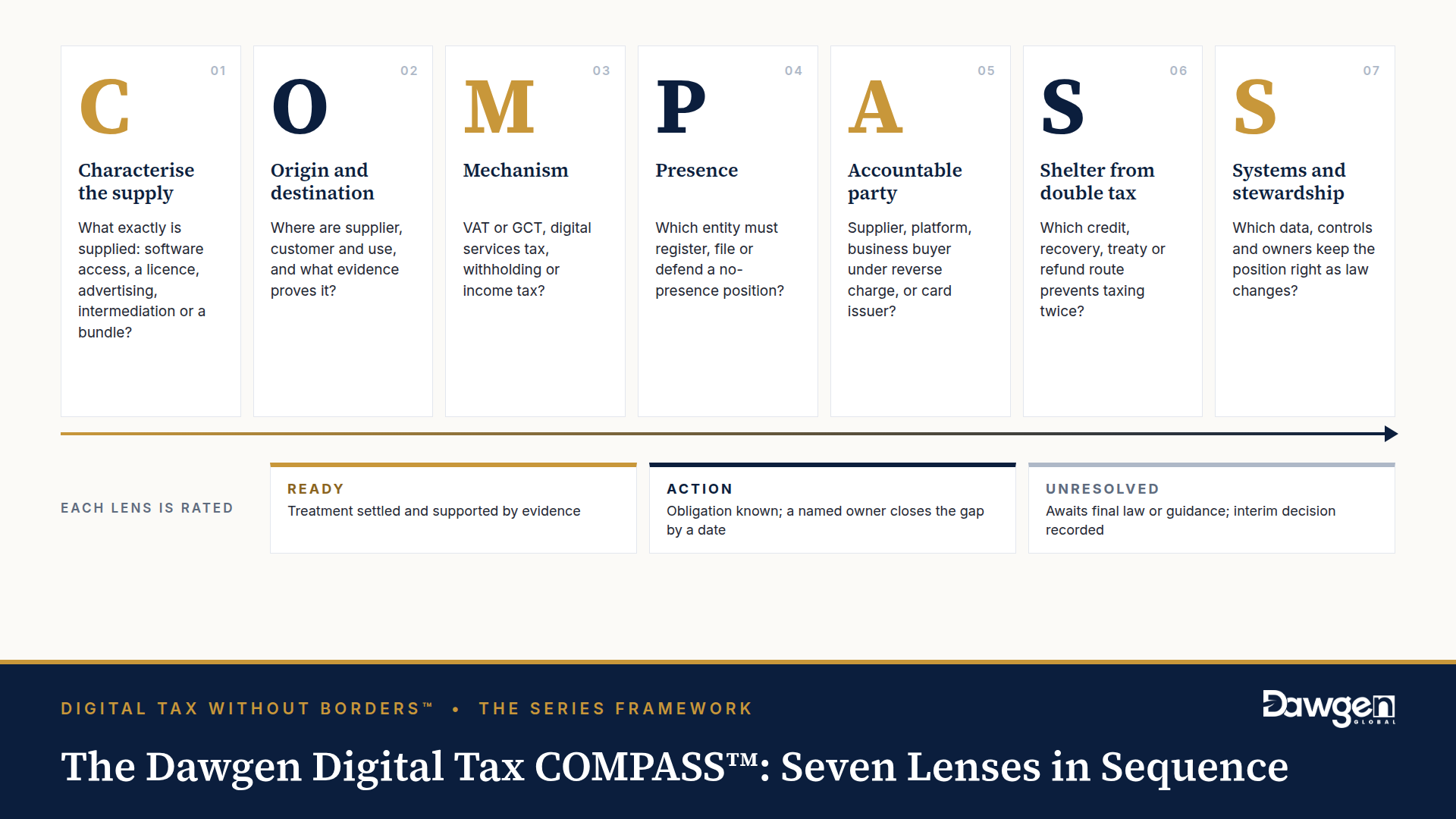
The Dawgen Digital Tax COMPASS™ is the method Dawgen Global uses to turn the broad phrase “digital tax” into specific, answerable questions. It works transaction by transaction, and it applies equally to what a business buys and what it sells. Seven lenses are applied in sequence, because each answer depends on the one before it.
- C — Characterise the supply. What exactly is supplied: access to software, a licence of intellectual property, advertising, intermediation, a professional service delivered remotely, or a bundle of several? The contract and the actual performance decide, not the invoice description.
- O — Origin and destination. Where are the supplier, the customer and the place of use or consumption, and what evidence proves it? Billing address, card country, IP address and contract terms often disagree.
- M — Mechanism. Which tax is in play: VAT or GCT on consumption, a gross-revenue digital services tax, withholding tax on the payment, or income tax on profits? Each has a different taxpayer, base and remedy.
- P — Presence. Which entity has a taxable connection with which jurisdiction, and must it register, file or defend a no-presence position?
- A — Accountable party. Who must actually charge, collect or remit: the supplier, a platform deemed to be the supplier, the business customer under a reverse charge, or a payment intermediary?
- S — Shelter from double taxation. Which credit, input tax recovery, treaty provision or refund route prevents the same value being taxed twice, and is it documented?
- S — Systems and stewardship. Which data fields, controls, owners and monitoring routines keep the position right as volumes grow and the law changes?
Each lens is rated on a simple three-tier scale. Ready means the treatment is settled and supported by evidence. Action means the obligation is known and a named owner is fixing a gap by a date. Unresolved means the answer depends on law or guidance that is not yet final, and an interim commercial decision has been recorded. The output is a transaction-level exposure map and an action plan with owners, not a list of countries. The COMPASS™ identifies and prioritises the questions; each material conclusion is then supported by the law of the jurisdiction concerned.
Applying the COMPASS™ to tourism and creative services
| Lens | What to ask in this context | Evidence to hold |
| Characterise | Is this accommodation, intermediation, an IP licence, a revenue share, a digital sale or a service? Is the cancellation fee consideration? | Contracts, platform terms, rights register |
| Origin and destination | Where is the room or villa, where is the licensee, where is the downloading consumer? | Property records, licensee residence, checkout location data |
| Mechanism | Is it accommodation GCT, reverse-charged GCT on commission, foreign VAT, or royalty withholding? | Transaction map by tax type |
| Presence | Does selling direct to foreign consumers require VAT registration in Barbados, The Bahamas, Suriname or Grenada? | Sales by customer country |
| Accountable party | Does the OTA or marketplace collect, or does the hotel, host or creator? | Platform tax statements, merchant-model terms |
| Shelter | Is foreign withholding documented for credit, and is reverse-charged GCT recovered? | Withholding certificates, input tax workings |
| Systems and stewardship | Do booking-to-cash and rights-to-cash reconciliations run monthly with named owners? | Reconciliation files, exception log |
Questions for the board
- For each OTA contract, have we decided whether we supply the guest or the platform, and does our GCT follow that answer?
- Are we self-accounting for GCT under section 23B on OTA commissions and other imported services?
- How will short-term rental properties we own or manage be priced, registered and reported from 1 April 2027?
- Which 2027 bookings were taken at tax-inclusive prices that did not anticipate GCT, and who bears the cost?
- Can we trace a cancelled booking from deposit to refund, tax adjustment and commission reversal?
- Do our distribution and licence agreements require statements showing tax deducted by country, with certificates?
- How much foreign tax deducted from our royalties is actually supported for relief at home?
- Do we sell digital content or courses directly to consumers in markets that require foreign suppliers to register for VAT?
How Dawgen Global can help
Dawgen Global’s Caribbean Tax Advisory practice helps boards, finance leaders and owner-managers in tourism and the creative industries understand how platform sales, commissions, royalties and new accommodation rules affect their tax position. Using the Dawgen Digital Tax COMPASS™, we map digital transactions across the jurisdictions in which you operate, separate law in force from proposals, quantify exposure and help your team put in place the contracts, systems and controls to stay compliant as the rules change. To discuss your organisation’s position, contact us at [email protected] or visit www.dawgen.global/contact-us.
This is the eleventh article in the Digital Tax Without Borders™ series.
This article provides general information and does not constitute tax or legal advice. The application of tax law depends on specific facts and on the law in force at the relevant date; readers should obtain advice before acting.
Abbreviations used
- B2C — business-to-consumer
- CARICOM — Caribbean Community
- CIAT — Inter-American Center of Tax Administrations
- FY — fiscal year
- GCT — General Consumption Tax
- IDB — Inter-American Development Bank
- IP — intellectual property (in “IP address”, internet protocol)
- OECD — Organisation for Economic Co-operation and Development
- OTA — online travel agency
- sync — synchronisation
- TAJ — Tax Administration Jamaica
- VAT — value added tax
Sources
- The Gleaner, “Airbnb and short-term rentals to face GCT from April 2027”, 30 April 2026. https://jamaica-gleaner.com/article/news/20260430/airbnb-and-short-term-rentals-face-gct-april-2027
- Bahamas Department of Inland Revenue, Value Added Tax Act (consolidated), 2024. https://inlandrevenue.finance.gov.bs/wp-content/uploads/2024/11/Value-Added-Tax-Act.pdf
- VATcalc, “Bahamas VAT on foreign digital services”. https://www.vatcalc.com/bahamas/bahamas-vat-on-foreign-digital-services/
- Tax Administration Jamaica, Technical Bulletin, “Accounting for GCT on Imported Services”, 23 April 2020. https://www.jamaicatax.gov.jm/documents/10181/17838406/Technical+Bulletin+(2020)+-+GCT+Imported+Services_23042020.pdf/547fce5a-fa9c-1481-ec55-6d8e40456f08
- Ministry of Finance and the Public Service (Jamaica), Revenue Measures (including Ministry Paper No. 17, “Revenue Measures for Financial Year 2026/2027”, 12 February 2026). https://www.mof.gov.jm/resources-revenue-measures/
- Jamaica Information Service, “Gov’t projects $29.4B from new revenue measures in fiscal year 2026/27”, February 2026. https://jis.gov.jm/govt-projects-29-4b-from-new-revenue-measures-in-fiscal-year-2026-27/
- PwC, Worldwide Tax Summaries, “Jamaica: Corporate — Withholding taxes”, accessed September 2026. https://taxsummaries.pwc.com/jamaica/corporate/withholding-taxes
- Caribbean Community, CARICOM Double Taxation Agreement, 1994. https://caricom.org/treaties/double-taxation-agreement/
- PwC, Worldwide Tax Summaries, “Barbados: Corporate — Other taxes”, accessed September 2026. https://taxsummaries.pwc.com/barbados/corporate/other-taxes
- KPMG, “Grenada: Nonresident digital services providers subject to VAT”, TaxNewsFlash, May 2026. https://kpmg.com/us/en/taxnewsflash/news/2026/05/grenada-nonresident-digital-services-vat.html
- CIAT, “New toolkit to strengthen value-added taxes on e-commerce in Latin America and the Caribbean”, 23 June 2021. https://www.ciat.org/new-toolkit-to-strengthen-value-added-taxes-on-e-commerce-in-latin-america-and-the-caribbean/?lang=en
- VATcalc, “Suriname 10% VAT on foreign digital service providers 2023”. https://www.vatcalc.com/suriname/suriname-10-vat-on-foreign-digital-service-providers-2023/
- PwC, Worldwide Tax Summaries, “Jamaica: Corporate — Other taxes”, accessed September 2026. https://taxsummaries.pwc.com/jamaica/corporate/other-taxes
About Dawgen Global
Dawgen Global is an independent, integrated multidisciplinary professional services firm headquartered at 47 Trinidad Terrace, New Kingston, Jamaica, serving more than 15 territories across the Caribbean. Founded and led by Dr. Dawkins Brown, Executive Chairman, the firm is independent and not affiliated with any international network. It delivers a full suite of professional services under one roof: audit and assurance; tax advisory; IT and digital transformation; risk management; cybersecurity; actuarial and insurance regulatory advisory; HR advisory; mergers and acquisitions; corporate recovery; business advisory and strategy; accounting BPO and virtual CFO services; and legal process outsourcing.
The proposition is simple: big-firm capability without the big-firm price. Dawgen Global’s integrated approach is built for the specific complexities and opportunities of the Caribbean market, helping organizations make sharper, better-informed decisions that drive measurable progress.
To explore a partnership, reach out:
- Website: dawgen.global
- Email: [email protected]
- WhatsApp (Global): +1 555-795-9071
- Caribbean offices: +1 876-665-5926 | +1 876-929-3670 | +1 876-926-5210


