
One foreign software invoice can carry two Jamaican taxes at once: withholding on the payment and General Consumption Tax on the import. Which applies, and at what rate, turns on a classification most finance teams never write down.
Executive summary
Caribbean businesses now pay foreign vendors for software as a service (SaaS), cloud hosting, online advertising, data and licensed content. Each payment raises two separate questions. The first is whether the payment to a non-resident is subject to withholding tax, which depends on whether it is a royalty, a management or service fee, or ordinary business profits of the vendor. The second is whether the purchase is a taxable import for consumption tax purposes, which in Jamaica means General Consumption Tax (GCT) self-accounted by the buyer under the reverse charge in section 23B of the GCT Act.
In Jamaica the stakes are concrete. Domestic law withholds 33⅓ per cent on royalties and management fees paid to non-residents. The Caribbean Community (CARICOM) Double Taxation Agreement caps both at 15 per cent of the gross amount, and other treaties can reduce the rate further. GCT at 15 per cent applies to the imported service in parallel. Neither tax replaces the other.
This article classifies the common digital payments, shows both taxes on one illustrative invoice, and covers gross-up clauses, the foreign tax credit trap for Caribbean service exporters, and the controls that keep the position right.
Two taxes, two questions, one invoice
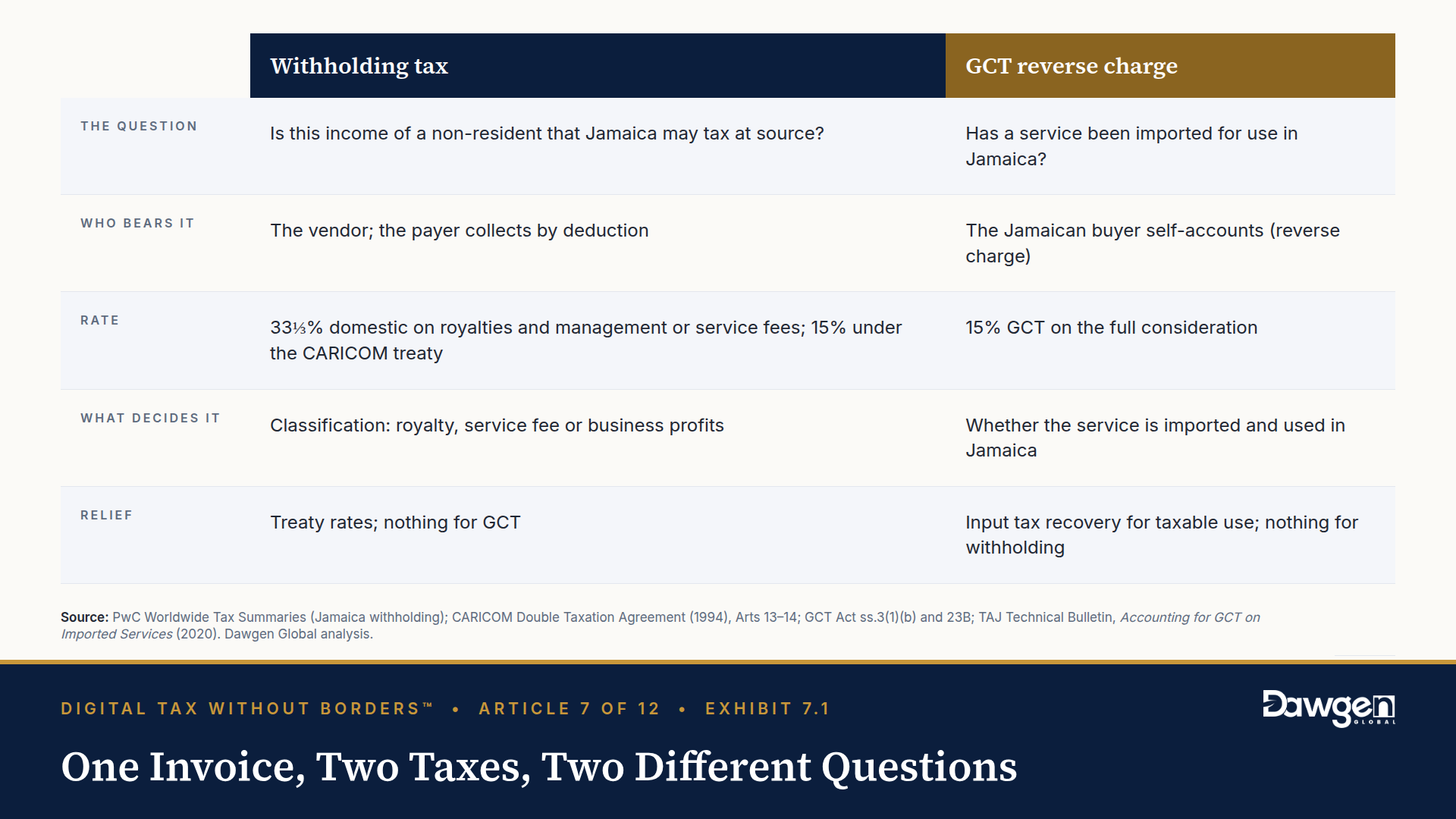
A Kingston-based financial services company buys a customer onboarding platform from a foreign vendor: hosted access, workflow configuration, staff training and a right to reproduce the vendor’s templates in its own customer packs. The vendor sends one monthly invoice headed “software services”, and accounts payable pays it in full by wire. Two taxes have been missed in that single step.
Withholding tax is a tax on the non-resident vendor’s income, collected by the payer. If the payer fails to deduct, the tax authority looks to the payer. In Jamaica, royalties and management or service fees paid to non-residents attract withholding at 33⅓ per cent under domestic law [1]. Under the CARICOM Double Taxation Agreement of 1994, royalties (Article 13) and management fees (Article 14) may be taxed in the source state at no more than 15 per cent of the gross amount [2], and Jamaica’s treaties with partners such as the United States and Canada can reduce rates further [1]. Whether a particular payment is caught turns on how it is characterised under the Income Tax Act and any applicable treaty, and on whether the non-resident has a permanent establishment (PE) in Jamaica, which is why characterisation comes first.
GCT, Jamaica’s form of value added tax (VAT), asks a different question: has a service been imported for use in Jamaica? Sections 3(1)(b) and 23B of the GCT Act bring imported services into charge and require the importer to self-account. The provision entered the Act in 2003, was made operational by the Provisional Collection of Tax (GCT) (No. 5) Order 2014, and is explained in the Tax Administration Jamaica (TAJ) Technical Bulletin “Accounting for GCT on Imported Services” of 23 April 2020 [3]. Individuals importing for private use, and persons below the GCT registration threshold of J$15 million, are excluded [3][4].
The two analyses do not share a definition. A payment can be a royalty for withholding and an imported service for GCT, or business profits with no deduction and still fully within the reverse charge. Treaty relief reduces withholding and does nothing for GCT; input tax recovery can neutralise GCT and does nothing for withholding. Handling one and assuming the other is covered is the commonest exposure we see on digital spend.
Law in force vs proposal. The reverse charge on imported services under section 23B is law in force today. Separately, Ministry Paper No. 17 of 12 February 2026 proposes applying GCT to digital services and intangibles supplied from abroad and consumed in Jamaica, with implementation planned for January to March 2027 [8][9]. That proposal is aimed mainly at consumers and unregistered buyers; registered businesses are already inside the net through the reverse charge.
Classifying the payment: service, royalty or business profits
The same monthly figure can attract nil, 15 or 33⅓ per cent withholding depending on what the vendor actually grants. A royalty is a payment for the use of, or right to use, intellectual property (IP) such as copyright, patents, trademarks or know-how; its hallmark is a right to exploit the IP itself by reproducing, adapting, distributing or sublicensing it. A management or service fee covers managerial, technical or consultancy services, which is where configuration, implementation and remote technical support usually sit. Business profits are everything else a non-resident earns in its ordinary trade, taxable under treaty rules only where it has a PE.
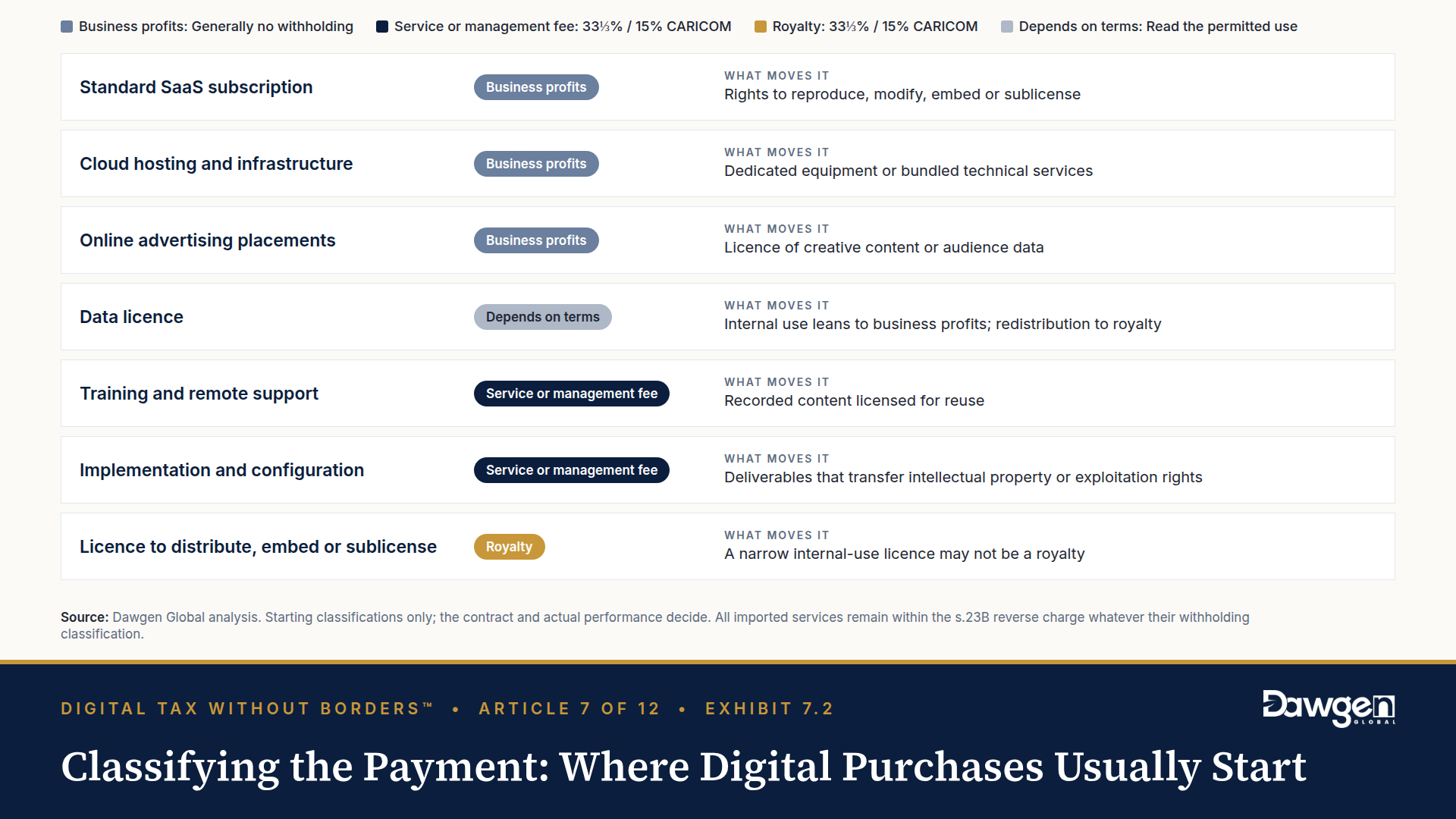
Two shortcuts cause most errors. “All software is a royalty” over-withholds from standard subscriptions and provokes supplier disputes. “All SaaS is business profits” ignores the implementation, licensing and support components on the same invoice.
Advertising deserves a word. Many Caribbean businesses buy placements on global platforms by corporate card, with no invoice reaching accounts payable. A standard placement is usually business profits of the platform; an overseas agency’s campaign fee is a service fee; a licence of creative content or data for reuse can carry a royalty element.
Bundles are where the analysis earns its keep. If a contract prices components separately and the separation is commercially real, each component is classified on its own terms. If it states a single fee for a genuinely integrated service, the dominant character usually governs. An allocation invented after the event to minimise withholding cannot be defended.
One invoice, both taxes: an illustrative calculation
The figures below are invented and the classifications are assumptions for arithmetic only; whether withholding applies to any component depends on the contract and the facts.
A GCT-registered Jamaican company making fully taxable supplies receives a monthly invoice of US$10,000 from a non-resident vendor with no PE in Jamaica. The contract prices four components separately.
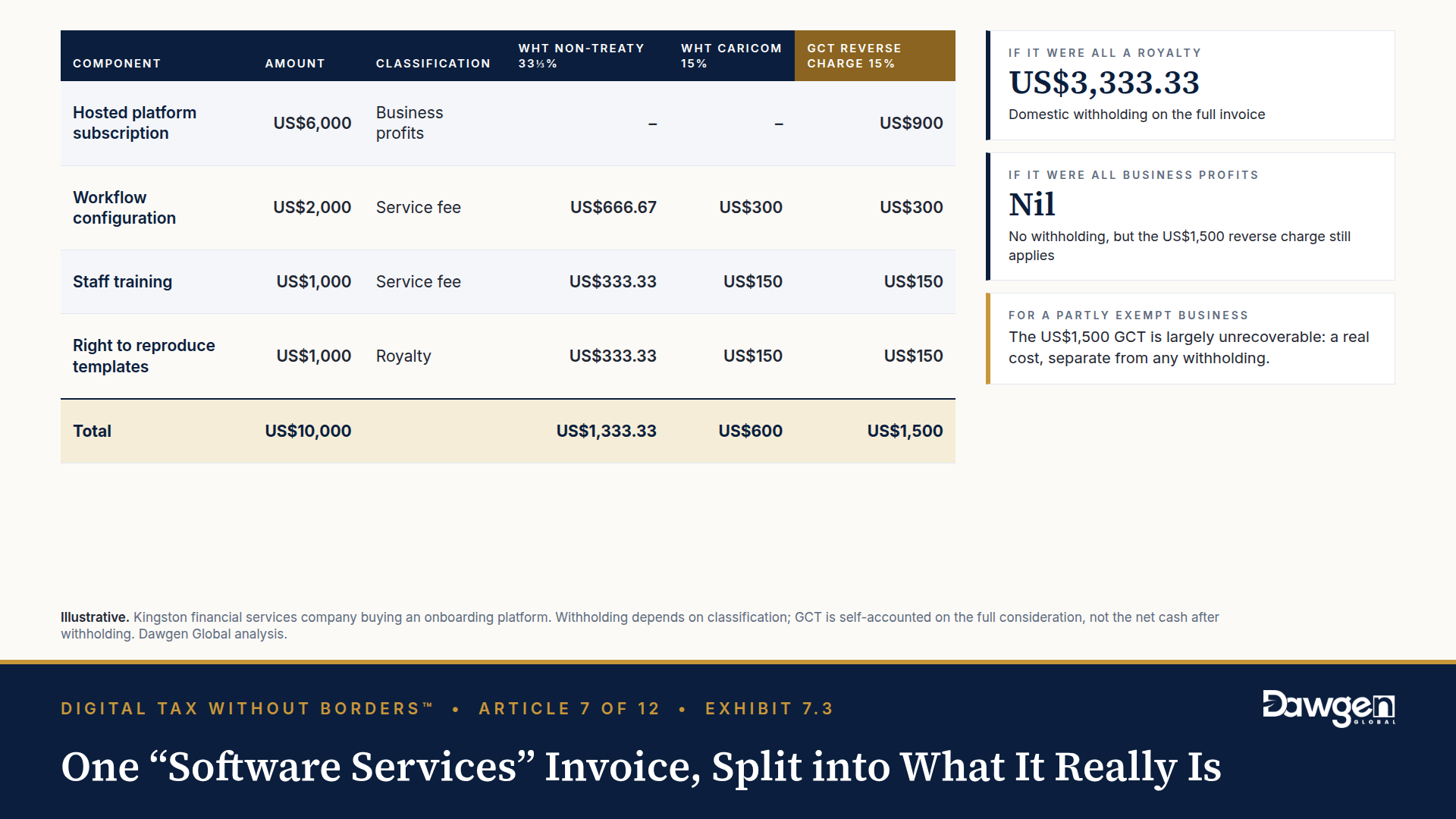
Both taxes arise on one invoice and run through different returns. Withholding is deducted from the payment, remitted to TAJ and evidenced by a certificate to the vendor. GCT is self-accounted on the full consideration for the service, not the net cash after withholding.
The economic burden differs too. For a fully taxable registered business, the US$1,500 of reverse charge GCT is generally recoverable as input tax, subject to the statutory conditions, including the restriction on imported services from connected parties that turns on market value and the supplier’s capacity [3]. A business making exempt supplies, such as many financial services, recovers little or none, so for it the reverse charge is a real cost. Withholding is the vendor’s tax and becomes the payer’s cost only through a gross-up clause or a failure to deduct.
Classification drives the number. Treat the whole US$10,000 as a royalty and domestic withholding is US$3,333.33; treat it all as business profits and it is nil.
Gross-up clauses: who really bears the cost
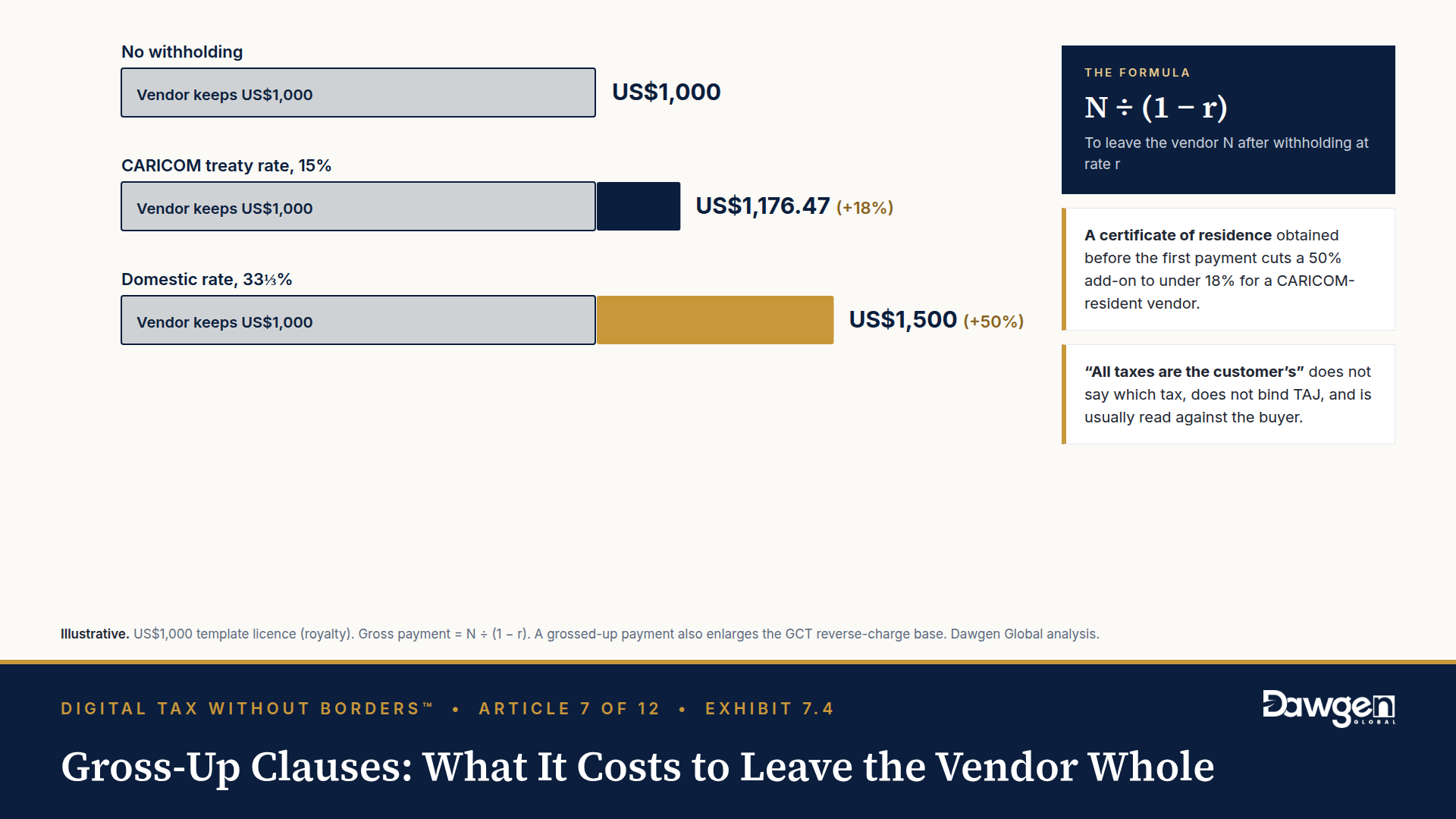
Large vendors’ contracts typically say fees are payable “without deduction or withholding” and that, if withholding is required, the customer pays enough extra to leave the vendor whole. The clause does not change who is liable to tax; it changes who pays. To leave the vendor a net amount N after withholding at rate r, the gross payment is N ÷ (1 − r). On the US$1,000 template licence above, a gross-up at the domestic 33⅓ per cent means paying US$1,500 and remitting US$500, adding 50 per cent to the cost. At the CARICOM treaty rate of 15 per cent the gross is US$1,176.47, a cost of US$176.47. A certificate of residence obtained before the first payment pays for itself quickly. Because the GCT base follows the consideration, a grossed-up payment also enlarges the reverse charge, neutral for a fully taxable business but a further cost for a partly exempt one.
Price the gross-up before signature. Where a vendor insists on net-of-tax terms, require treaty evidence and an invoice split so only genuinely withholdable components are grossed up. Never let a clause that “all taxes are the customer’s responsibility” pass unexamined: it does not say which tax, it does not bind TAJ, and it is usually read against the buyer.
Treaties, Article 12B and the United Nations draft protocol
The CARICOM agreement is source-based by design, letting the payer’s country tax royalties and management fees at up to 15 per cent gross, with dividends at zero [2]. But many of the largest digital vendors contract through entities in countries with which Caribbean states have no treaty, and then the domestic rate applies.
The United Nations (UN) has gone further. Its 2021 Model Double Taxation Convention added Article 12B, “Income from Automated Digital Services”, which lets the source state tax payments for automated digital services such as online advertising, platform access, cloud computing and streaming on a gross basis at a negotiated rate, with the vendor able to elect net-basis taxation instead [5]. It is a model provision with no effect until two states negotiate it into a bilateral treaty.
The larger development is the UN Framework Convention on International Tax Cooperation. Negotiations began in August 2025, and draft texts of the Convention and two early protocols were released in July 2026 [6]. Protocol 1 concerns the taxation of income from cross-border services in an increasingly digitalised and globalised economy. The next session meets in Nairobi from 30 November to 11 December 2026, and final texts are due to the UN General Assembly in September 2027 [7]. This, not the Organisation for Economic Co-operation and Development (OECD), is now the main forum shaping source taxation of services for developing economies.
Nothing in the draft changes withholding today. But contracts signed now for five years should carry a change-in-law clause that allocates any new source tax deliberately, rather than a gross-up clause that passes every future tax to the buyer by default.
The other side of the ledger: Caribbean exporters of services
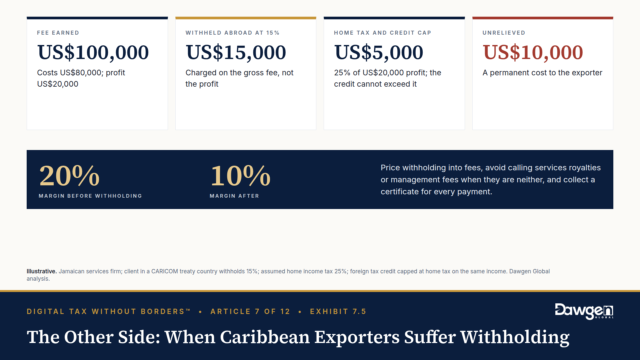
Caribbean firms also suffer withholding. A Bridgetown consultancy, a Kingston software house licensing to a Latin American bank or a Port of Spain engineering firm designing remotely will often see clients deduct tax at source. Relief then depends on foreign tax credits, and the credit is asymmetric: withholding bites the gross fee, home tax bites net profit, and the credit is capped at home tax on the same income.
Illustratively, a Jamaican services firm earns US$100,000 from a client in a CARICOM treaty country that withholds 15 per cent, US$15,000. Its costs are US$80,000, so profit is US$20,000. Assuming for illustration a home income tax of 25 per cent, home tax is US$5,000 and the credit is capped there. The other US$10,000 is unrelieved, halving a 20 per cent margin to 10 per cent.
Exporters should price withholding into fees, avoid describing services as royalties or management fees when they are neither, and collect a withholding certificate for every payment.
Controls: the vendor file and the monthly exception report
For each material foreign digital vendor, hold one file containing:
- the signed agreement, order forms and online terms incorporated by reference, with any component pricing;
- the contracting entity, invoicing entity and bank beneficiary, confirmed as matching or explained;
- a current certificate of residence where treaty relief is claimed, with its expiry date;
- a short classification memorandum covering withholding and GCT for each component, with author and review date;
- the gross-up clause and its priced effect, remittances, certificates issued and reverse charge return entries;
- renewal dates, with review at least 90 days before each.
A change of contracting entity reopens the file, because a new country of residence can change the treaty position overnight.
Accounts payable and card administration should also run a monthly exception report that routes rather than decides. It flags new non-resident payees; descriptors such as licence, royalty, subscription, advertising, data or implementation; mismatches between payee, bank beneficiary and treaty certificate; recurring card charges from one foreign vendor, aggregated; intercompany recharges of licence costs; and any payment made before a classification existed. The two numbers to watch are the value of payments made before clearance and the age of open items.
Group recharges need the same discipline: when a regional parent recharges a global licence to affiliates, each affiliate’s position stands on its own facts.
The Dawgen Digital Tax COMPASS™
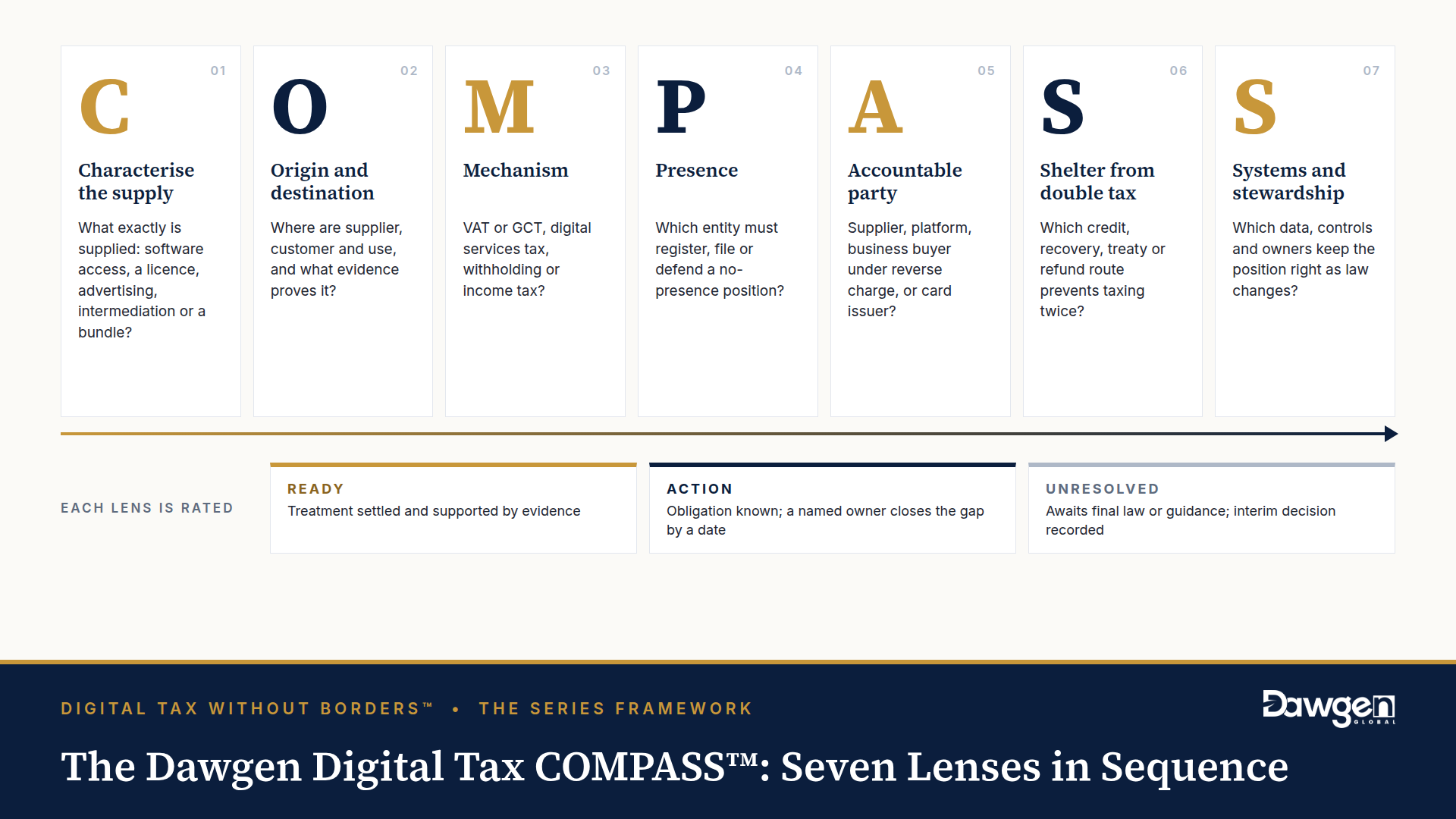
The Dawgen Digital Tax COMPASS™ is the method Dawgen Global uses to turn the broad phrase “digital tax” into specific, answerable questions. It works transaction by transaction, and it applies equally to what a business buys and what it sells. Seven lenses are applied in sequence, because each answer depends on the one before it.
- C — Characterise the supply. What exactly is supplied: access to software, a licence of intellectual property, advertising, intermediation, a professional service delivered remotely, or a bundle of several? The contract and the actual performance decide, not the invoice description.
- O — Origin and destination. Where are the supplier, the customer and the place of use or consumption, and what evidence proves it? Billing address, card country, IP address and contract terms often disagree.
- M — Mechanism. Which tax is in play: VAT or GCT on consumption, a gross-revenue digital services tax, withholding tax on the payment, or income tax on profits? Each has a different taxpayer, base and remedy.
- P — Presence. Which entity has a taxable connection with which jurisdiction, and must it register, file or defend a no-presence position?
- A — Accountable party. Who must actually charge, collect or remit: the supplier, a platform deemed to be the supplier, the business customer under a reverse charge, or a payment intermediary?
- S — Shelter from double taxation. Which credit, input tax recovery, treaty provision or refund route prevents the same value being taxed twice, and is it documented?
- S — Systems and stewardship. Which data fields, controls, owners and monitoring routines keep the position right as volumes grow and the law changes?
Each lens is rated on a simple three-tier scale. Ready means the treatment is settled and supported by evidence. Action means the obligation is known and a named owner is fixing a gap by a date. Unresolved means the answer depends on law or guidance that is not yet final, and an interim commercial decision has been recorded. The output is a transaction-level exposure map and an action plan with owners, not a list of countries. The COMPASS™ identifies and prioritises the questions; each material conclusion is then supported by the law of the jurisdiction concerned.
Applying the COMPASS™ to cross-border digital payments
| Lens | What to ask in this context | Evidence to hold |
| Characterise | Is each component a royalty, a management or service fee, or business profits of the vendor? Is the bundle genuinely separable? | Contract, order forms, statement of work, component pricing, classification memorandum |
| Origin and destination | Where is the vendor resident, and which entity in the group uses the service? | Certificate of residence, contracting and invoicing entity details, user allocation for recharges |
| Mechanism | Does withholding apply, and at what rate? Is the purchase an imported service within section 23B? | Withholding computation, GCT reverse charge workpaper, return lines |
| Presence | Does the vendor have a PE in Jamaica that changes the analysis, for example staff on site during implementation? | Implementation plan, on-site days, vendor personnel records |
| Accountable party | Who deducts and remits withholding; who self-accounts for GCT; is a card or platform payment bypassing both? | Accounts payable and card controls, remittance receipts, certificates issued |
| Shelter | Is treaty relief documented before payment? Is reverse charge GCT recoverable as input tax, and are connected-party restrictions met? | Treaty certificate with expiry date, input tax analysis, connected-party market value support |
| Systems and stewardship | Does the monthly exception report catch new vendors, card spend and entity changes? Who owns renewals? | Exception report, vendor master change log, renewal calendar |
Questions for the board
- What did we pay to foreign digital vendors last year, and what proportion of that spend has a written classification for withholding and GCT?
- How much reverse charge GCT did we self-account on imported services, and does that figure look plausible against our foreign software and advertising spend?
- Which of our material vendor contracts contain gross-up clauses, and what is their annual cost at the domestic rate compared with the treaty rate?
- For which vendors are we relying on treaty relief, and do we hold a current certificate of residence for each?
- How much foreign digital spend runs through corporate cards, and is it inside the same withholding and GCT controls as invoiced spend?
- Where our own business earns fees from abroad, how much foreign withholding did we suffer, and how much of it was actually credited against our home tax?
- Do our long-term contracts allocate the risk of new source taxes arising from the UN Protocol 1 negotiations or similar changes in law?
- Who owns the monthly exception report, and what were the value and age of unresolved items at the last month end?
How Dawgen Global can help
Dawgen Global’s Caribbean Tax Advisory practice helps boards, finance leaders and owner-managers classify cross-border software, cloud, advertising and licence payments correctly, so that withholding tax and GCT are applied once, at the right rate, and at a cost the business has priced. Using the Dawgen Digital Tax COMPASS™, we map digital transactions across the jurisdictions in which you operate, separate law in force from proposals, quantify exposure and help your team put in place the contracts, systems and controls to stay compliant as the rules change. To discuss your organisation’s position, contact us at [email protected] or visit www.dawgen.global/contact-us.
This article provides general information and does not constitute tax or legal advice. The application of tax law depends on specific facts and on the law in force at the relevant date; readers should obtain advice before acting.
Abbreviations used
- CARICOM — Caribbean Community
- GCT — General Consumption Tax
- IP — intellectual property
- IP address — internet protocol address
- OECD — Organisation for Economic Co-operation and Development
- PE — permanent establishment
- SaaS — software as a service
- TAJ — Tax Administration Jamaica
- UN — United Nations
- VAT — value added tax
Sources
- PwC, “Jamaica: Corporate – Withholding taxes”, Worldwide Tax Summaries, accessed September 2026. https://taxsummaries.pwc.com/jamaica/corporate/withholding-taxes
- Caribbean Community, “Agreement among the Governments of the Member States of the Caribbean Community for the Avoidance of Double Taxation and the Prevention of Fiscal Evasion” (CARICOM Double Taxation Agreement), 1994. https://caricom.org/treaties/double-taxation-agreement/
- Tax Administration Jamaica, Technical Bulletin, “Accounting for GCT on Imported Services”, 23 April 2020. https://www.jamaicatax.gov.jm/documents/10181/17838406/Technical+Bulletin+(2020)+-+GCT+Imported+Services_23042020.pdf/547fce5a-fa9c-1481-ec55-6d8e40456f08
- PwC, “Jamaica: Corporate – Other taxes”, Worldwide Tax Summaries, accessed September 2026. https://taxsummaries.pwc.com/jamaica/corporate/other-taxes
- United Nations, “United Nations Model Double Taxation Convention between Developed and Developing Countries”, 2021 update. https://financing.desa.un.org/sites/default/files/2023-05/UN%20Model_2021.pdf
- EY, “UN releases draft Framework Convention on International Tax Cooperation and two early protocols”, Tax Alert, 27 July 2026. https://www.ey.com/en_gl/technical/tax-alerts/un-releases-draft-framework-convention-on-international-tax-cooperation-and-two-early-protocols
- United Nations Department of Economic and Social Affairs, “Intergovernmental Negotiating Committee on the UN Framework Convention on International Tax Cooperation”, 2026. https://financing.desa.un.org/inc/fifthsession
- Ministry of Finance and the Public Service (Jamaica), “Revenue Measures”, including Ministry Paper No. 17, “Revenue Measures for Financial Year 2026/2027”, 12 February 2026. https://www.mof.gov.jm/resources-revenue-measures/
- EY, “Jamaica proposes extending General Consumption Tax to digitally supplied services and intangibles from abroad”, Tax Alert, 25 February 2026. https://www.ey.com/en_gl/technical/tax-alerts/jamaica-proposes-extending-general-consumption-tax-to-digitally-supplied-services-and-intangibles-from-abroad
About Dawgen Global
Dawgen Global is an independent, integrated multidisciplinary professional services firm headquartered at 47 Trinidad Terrace, New Kingston, Jamaica, serving more than 15 territories across the Caribbean. Founded and led by Dr. Dawkins Brown, Executive Chairman, the firm is independent and not affiliated with any international network. It delivers a full suite of professional services under one roof: audit and assurance; tax advisory; IT and digital transformation; risk management; cybersecurity; actuarial and insurance regulatory advisory; HR advisory; mergers and acquisitions; corporate recovery; business advisory and strategy; accounting BPO and virtual CFO services; and legal process outsourcing.
The proposition is simple: big-firm capability without the big-firm price. Dawgen Global’s integrated approach is built for the specific complexities and opportunities of the Caribbean market, helping organizations make sharper, better-informed decisions that drive measurable progress.
To explore a partnership, reach out:
- Website: dawgen.global
- Email: [email protected]
- WhatsApp (Global): +1 555-795-9071
- Caribbean offices: +1 876-665-5926 | +1 876-929-3670 | +1 876-926-5210


