
A 2 or 3 per cent tax on revenue sounds modest until it is set against margin. Digital services taxes are expensive for thin-margin businesses, politically costly for the countries that levy them, and a poor fit for small Caribbean economies.
Executive summary
A digital services tax (DST) is a tax on the gross revenue a large digital business earns from users in a country. It is neither a value added tax (VAT) charged to consumers nor an income tax on profit. The United Kingdom (UK) charges 2 per cent on search, social media and online marketplace revenue from UK users, above group thresholds of £500 million worldwide and £25 million in the UK. France charges 3 per cent above €750 million worldwide and €25 million in France. Canada enacted a 3 per cent tax in June 2024 and repealed it in March 2026 under pressure from the United States (US).
Levied on revenue, a DST can absorb much of the profit in a low-margin line, and platforms pass it on to advertisers and sellers. Caribbean hotels and exporters advertising to British or French audiences pay a slice without ever being taxpayers.
Barbados, The Bahamas and Suriname have instead extended VAT to foreign digital services, and Grenada and Jamaica are following, Jamaica through General Consumption Tax (GCT). For small open economies that is the better route. This article explains why, weighs the counter-arguments and offers five tests for any DST proposal.
What a digital services tax is, and what it is not
A DST picks out defined digital activities, usually online advertising, marketplaces and the sale of user data, and taxes the revenue attributed to users in the taxing country. The taxpayer is the large group, not the user. There is no credit chain and no deduction for costs. The Tax Foundation’s taxonomy distinguishes it from three other tools often lumped together as “digital tax”, though its country status is now dated [1].
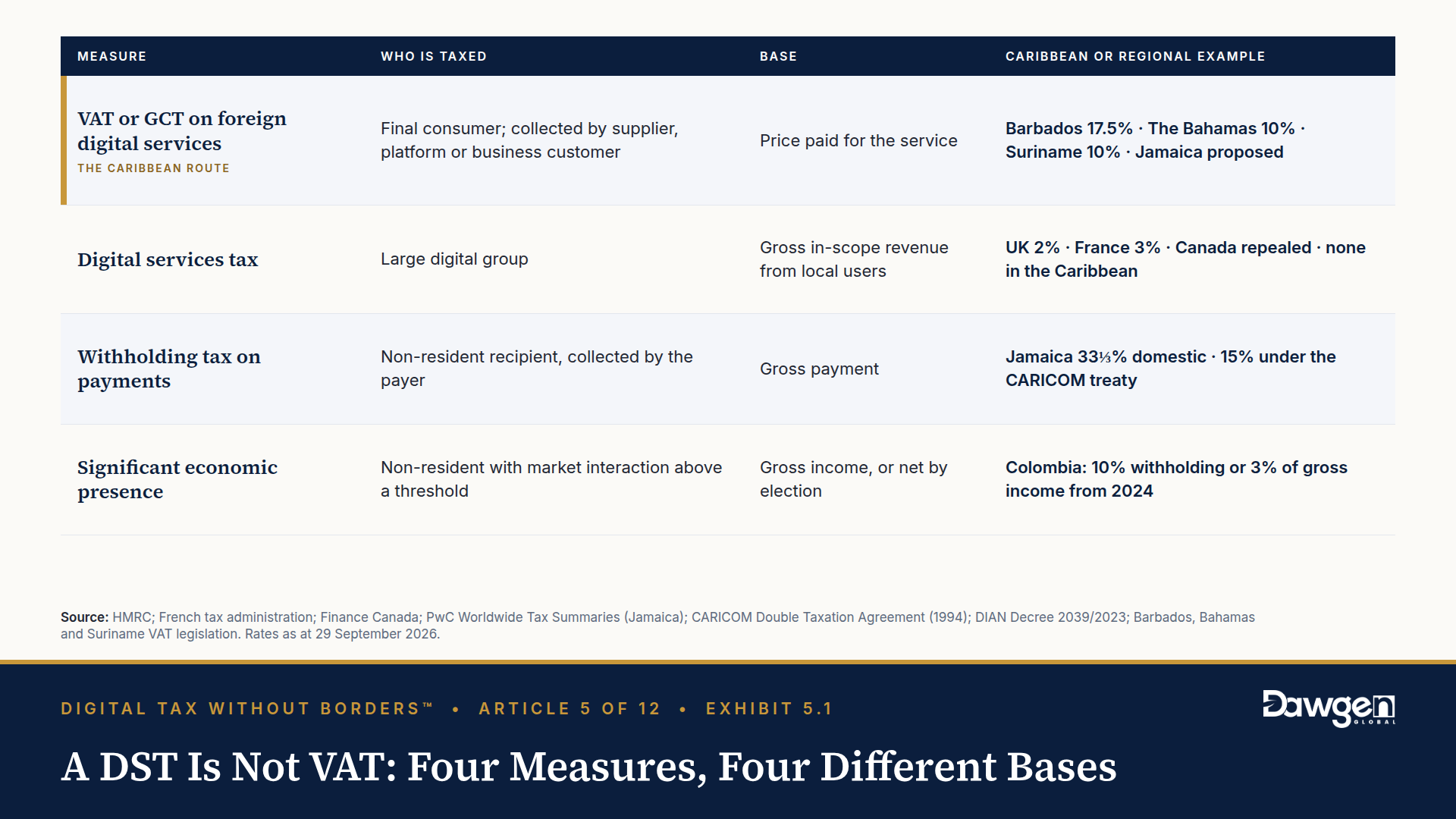
The UK DST has applied since April 2020 and remains in force [2]. In France, a proposal to double the rate was debated in late 2025, but it remains 3 per cent [3]. Colombia’s significant economic presence (SEP) rule, from 1 January 2024, lets non-residents with deliberate and systematic interaction with its market choose between 10 per cent withholding by payment providers and 3 per cent on gross income [4]. It is the closest Latin American cousin of a DST, but sits inside the income tax.
Law in force versus proposal. No Caribbean jurisdiction has enacted a DST. Jamaica’s Budget 2026/27 measure is a proposed extension of GCT, a consumption tax, to digital services and intangibles supplied from abroad. It is not a DST, and board papers, media commentary and client communications should not call it one.
Why a gross-revenue tax bites on low-margin businesses
Income tax and DST rates cannot be compared directly. A 25 per cent tax on profit and a 3 per cent tax on revenue produce the same bill only at a 12 per cent margin. Below that, the revenue tax is heavier; well below it, it exceeds the profit.
Worked illustration
The illustrative chart takes three lines, each with US$100 of in-scope revenue, a hypothetical 3 per cent DST, an illustrative 25 per cent income tax and a deductible DST. It is not a computation under any country’s law; the UK, for example, offers an alternative calculation for low-margin activities.
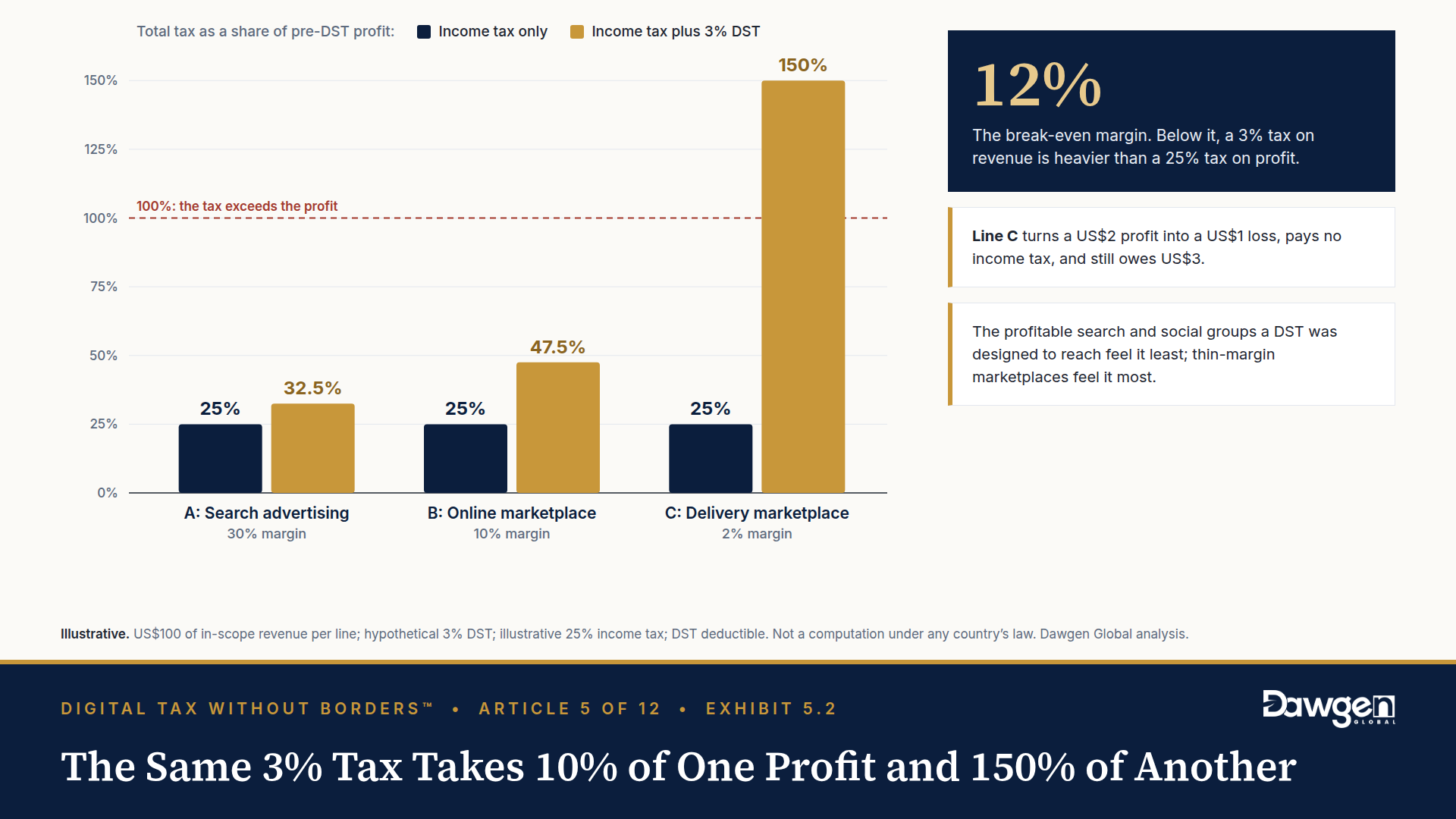
Without the DST, each line bears 25 per cent of its profit in income tax. With it, line A’s total burden rises modestly to 32.5 per cent: income tax of US$6.75 on the reduced profit of US$27, plus the US$3 DST. Line B’s nearly doubles to 47.5 per cent. Line C turns a US$2 profit into a US$1 loss, pays no income tax, and still owes US$3. The deduction softens the blow, but only by the income tax rate: a deductible US$3 levy saves US$0.75 of income tax and leaves US$2.25 of net cost.
Two lessons follow. The highly profitable search and social media groups a DST was designed to reach feel it least; thin-margin marketplace and delivery models feel it most. And a seller should not expect a platform to absorb a cost that exceeds its margin.
Who really pays: incidence and pass-through
The legal taxpayer and the economic payer of a DST are rarely the same. A platform can absorb the tax, raise advertising prices or commissions, cut seller incentives, or leave. In practice, several of the largest advertising and marketplace platforms responded to the European DSTs by adding country-specific surcharges to advertisers’ and sellers’ invoices, tied to where the advertising audience or the customer is located.
That is where a Caribbean business meets a tax it never registered for.
Illustration: a north coast hotel advertising to Europe
A north coast hotel spends US$120,000 a year on digital advertising, 40 per cent aimed at UK audiences and 10 per cent at French audiences. Assume, for illustration, that platforms add surcharges equal to the local DST rate.
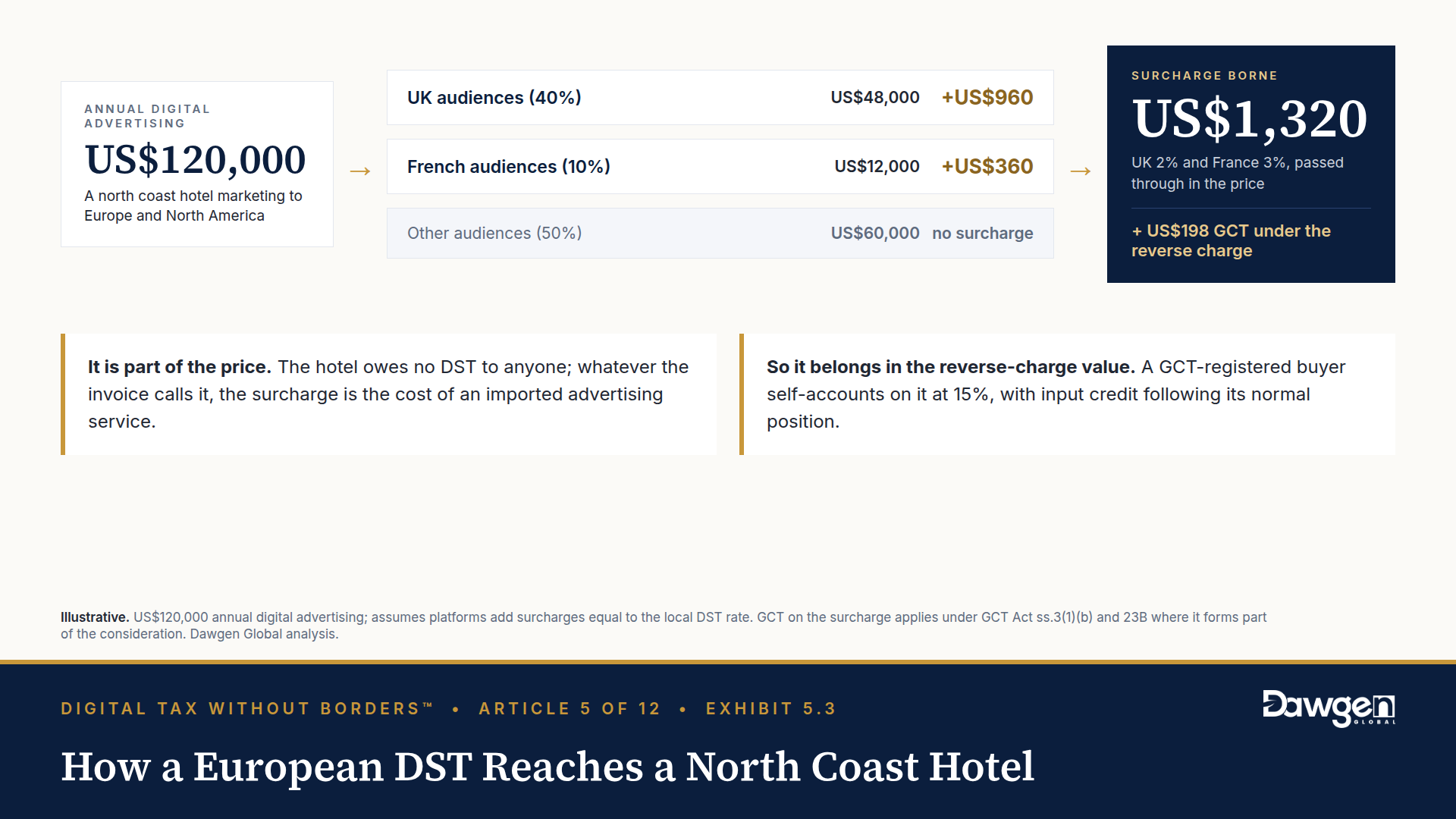
Modest for one hotel; across the region, a steady transfer from Caribbean businesses to European treasuries. Two technical points matter. First, a surcharge is part of the price, not a tax the hotel owes to anyone, whatever the invoice calls it. Second, because it is part of the price of an imported advertising service, a GCT-registered buyer in Jamaica should include it in the value on which it self-accounts under the reverse charge in sections 3(1)(b) and 23B of the GCT Act, with input credit following the buyer’s normal position [5].
The trade dimension
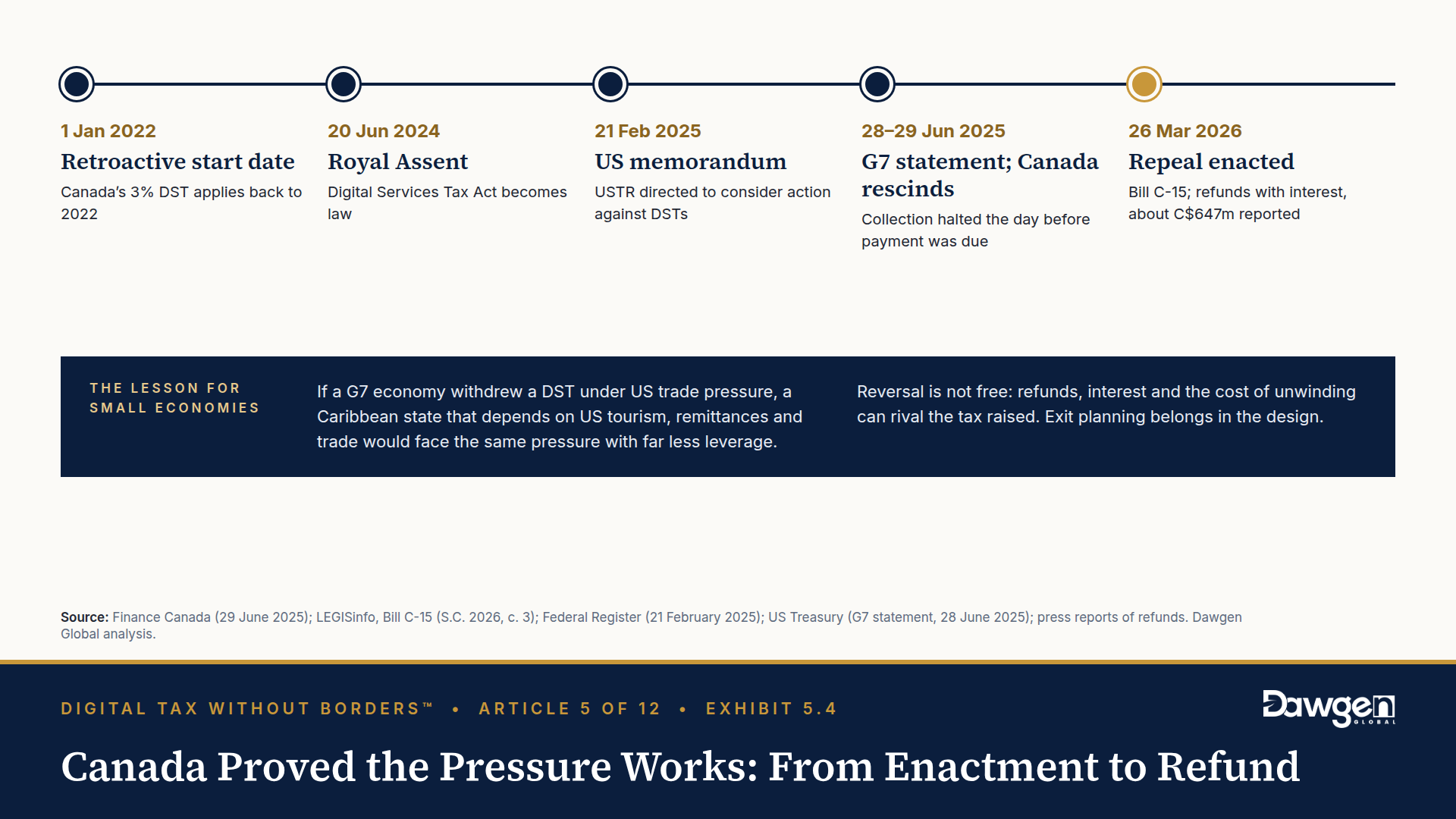
The US regards DSTs as discriminatory, because their thresholds capture mostly American groups. On 21 February 2025 a Presidential Memorandum, “Defending American Companies and Innovators From Overseas Extortion and Unfair Fines and Penalties”, directed the US Trade Representative (USTR) to consider action against countries with DSTs [6]. A proposed retaliatory tax, known as “Section 899”, was dropped from the One Big Beautiful Bill Act in mid-2025 after the Group of Seven (G7) statement of 28 June 2025 endorsed a “side-by-side” approach to the global minimum tax [6].
Canada proved the pressure works. Its 3 per cent tax, retroactive to 1 January 2022, received Royal Assent on 20 June 2024. On 29 June 2025, the day before collection was due, Finance Canada announced it would rescind the tax to advance trade negotiations with the US [7]. The repeal was enacted in Bill C-15, which received Royal Assent on 26 March 2026, and payments are being refunded with interest; the press reported about C$647 million [8]. The UK and France have held firm, but both carry far more negotiating weight than any Caribbean state.
For a small economy that depends on the US for tourism, remittances and trade, a DST might raise a small sum from a handful of groups while exposing the country to trade action worth far more.
The Caribbean policy decision
The region has, in practice, already chosen. Barbados (since 1 December 2019), The Bahamas and Suriname (since 1 January 2023) tax foreign digital services through VAT and require non-resident suppliers to register [9][10][11]. Grenada’s VAT (Amendment) Bill 2026, passed on 7 May 2026, follows [12]. Jamaica’s Ministry Paper No. 17, tabled on 12 February 2026, proposes GCT on digital services and intangibles from abroad, projected at J$300 million in fiscal year (FY) 2026/27 and about J$4.2 billion a year from FY2027/28 [13]. The Dominican Republic has repeatedly tried, and so far failed, to apply its 18 per cent ITBIS (Impuesto sobre la Transferencia de Bienes Industrializados y Servicios) to digital services; a new proposal is being prepared [14]. On 4 March 2026 CARICOM and the Caribbean Organisation of Tax Administrators (COTA) co-hosted a regional workshop on securing VAT on cross-border digital transactions [15].
Why the consumption-tax route suits small open economies
/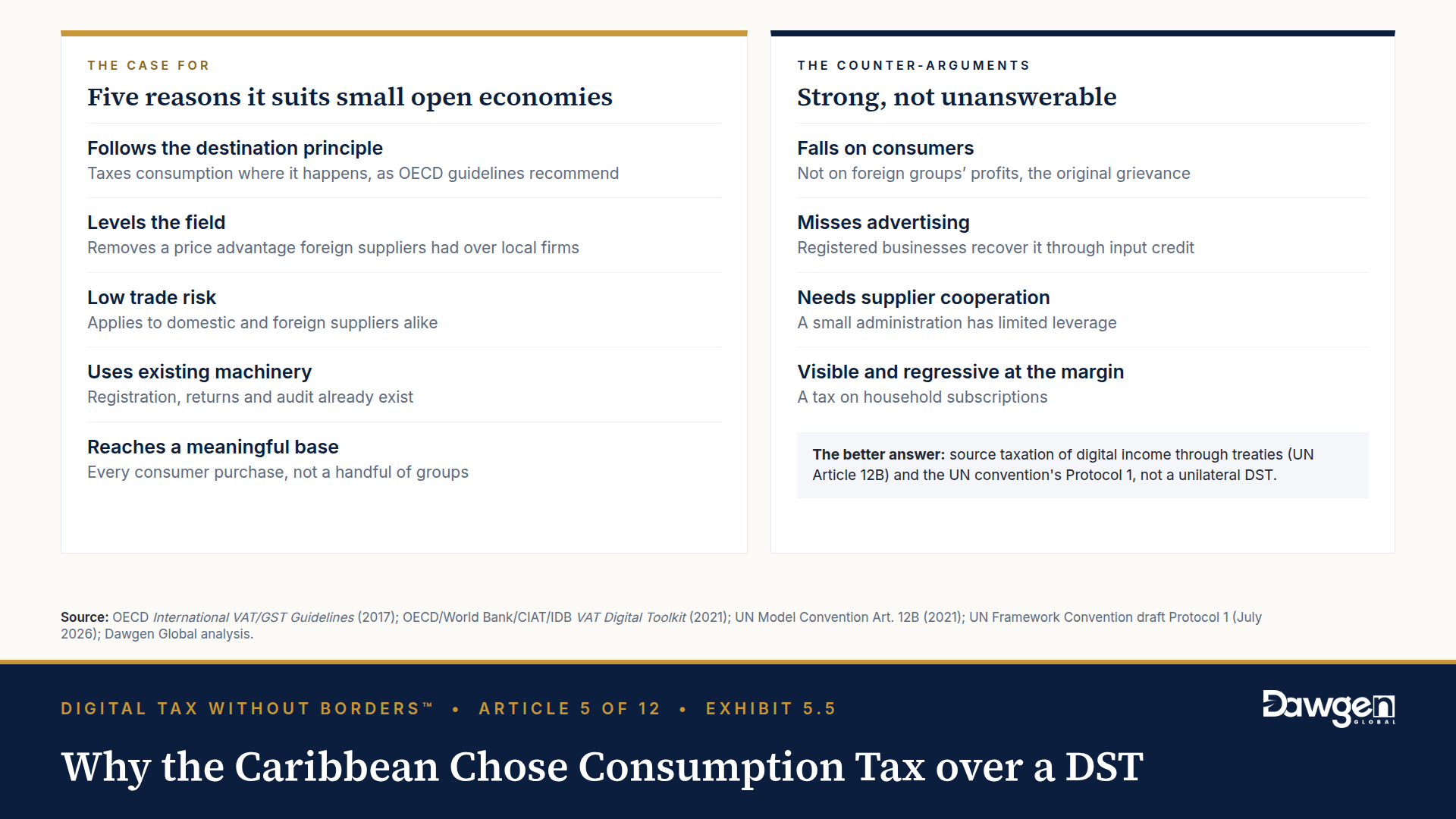
It follows the destination principle. The Organisation for Economic Co-operation and Development (OECD) guidelines on VAT and goods and services tax (GST) tax services where they are consumed [16]. A Jamaican household’s streaming subscription is Jamaican consumption.
It levels the field. A Kingston software firm already charges GCT. Extending the tax to foreign suppliers removes a price advantage unrelated to efficiency.
It carries low trade risk. It applies to domestic and foreign suppliers alike, so it is hard to call discriminatory.
It uses existing machinery. Registration, returns and audit already exist, and the VAT Digital Toolkit for Latin America and the Caribbean, from the OECD, World Bank, Inter-American Center of Tax Administrations (CIAT) and Inter-American Development Bank (IDB), sets out tested models [17].
It reaches a meaningful base. A DST with UK-style thresholds would reach only a few groups; in a small market, that is a narrow base with a high administrative cost per dollar raised.
The counter-arguments
The case is strong, not unanswerable. First, a consumption tax falls on resident consumers, not on foreign groups’ profits, the grievance that produced DSTs in the first place. Second, it raises little from advertising, which registered businesses buy and recover through input credit; a DST reaches revenue VAT by design does not. Third, collection depends on non-resident suppliers’ cooperation, and a small administration has limited leverage. Fourth, a tax on household subscriptions is visible and, at the margin, regressive.
The better answer to the first two lies in income tax and multilateral forums, not a unilateral DST. The United Nations (UN) Model Double Taxation Convention’s Article 12B, added in 2021, allows source-state taxation of income from automated digital services by treaty [18]. The UN Framework Convention on International Tax Cooperation, whose draft Protocol 1 addresses income from cross-border services, gives Caribbean states a seat at the table [19]. The third is met by platform and card-issuer collection models already working in the region.
Five tests for any proposed DST
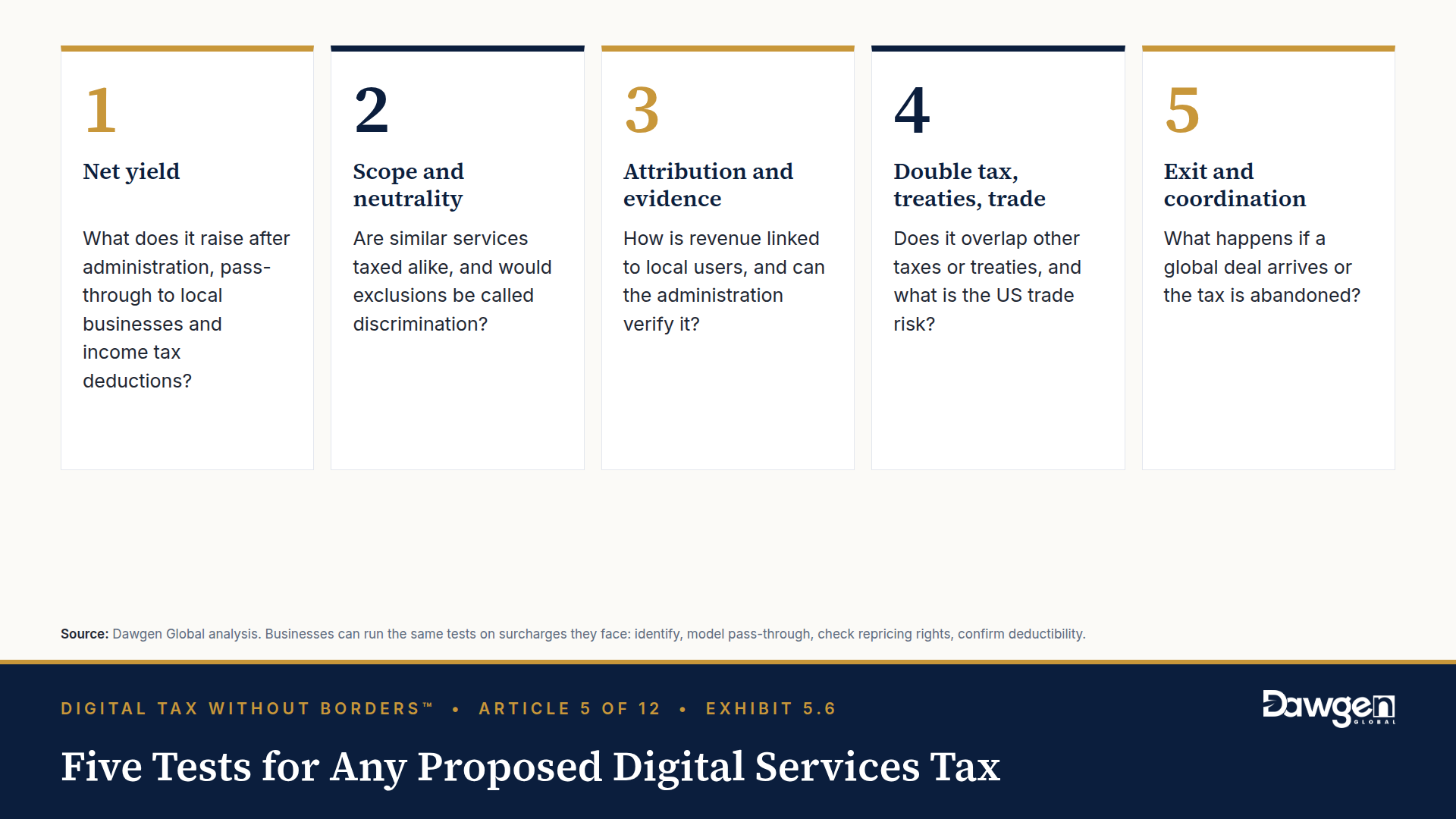
Whether a DST is proposed at home or in a market where a Caribbean business sells, five tests separate a workable measure from a costly one.
- Net yield. What will the tax raise after administration cost, after pass-through to local advertisers and sellers, and after any income tax deduction the same groups claim? A headline gross figure is not a forecast.
- Scope and neutrality. Are economically similar services taxed alike, and are local digital firms caught, or deliberately excluded in a way a trade partner will call discrimination?
- Attribution and evidence. How is revenue linked to local users when advertiser, audience and platform are in different places, what evidence (Internet Protocol (IP) address, billing address, device location) will count, and can the administration verify it?
- Double taxation, treaty and trade exposure. Does the tax overlap with income tax, withholding or another country’s DST; is it compatible with the country’s treaties; and what is the realistic risk of US trade action?
- Exit and coordination. What happens if a multilateral agreement is reached or the tax is abandoned? Canada showed that refunds, interest and reversal can become as significant as the original design.
A business should run its own version: identify each surcharge, model margin under full, partial and no pass-through, check contractual repricing rights and confirm deductibility.
Indirect exposure of Caribbean advertisers and regional platforms
Few Caribbean groups will ever cross a £500 million or €750 million threshold. Their exposure is indirect, and arrives through invoices.
Advertisers. Tourism businesses and exporters advertising to British and French audiences should code surcharges separately, keep the platform’s notice, treat the whole as the price of an imported service, and settle the withholding question.
Sellers on marketplaces. Producers selling to UK or French consumers through global marketplaces may see higher referral fees or surcharges, sharpest on the thin-margin products most small exporters sell.
Regional platforms. A Caribbean-grown booking, delivery or marketplace business will sit far below DST thresholds for years, but should still record where users, advertisers and customers are. The same data supports VAT and GCT compliance, transfer pricing and investor reporting, and cannot be reconstructed later.
The Dawgen Digital Tax COMPASS™
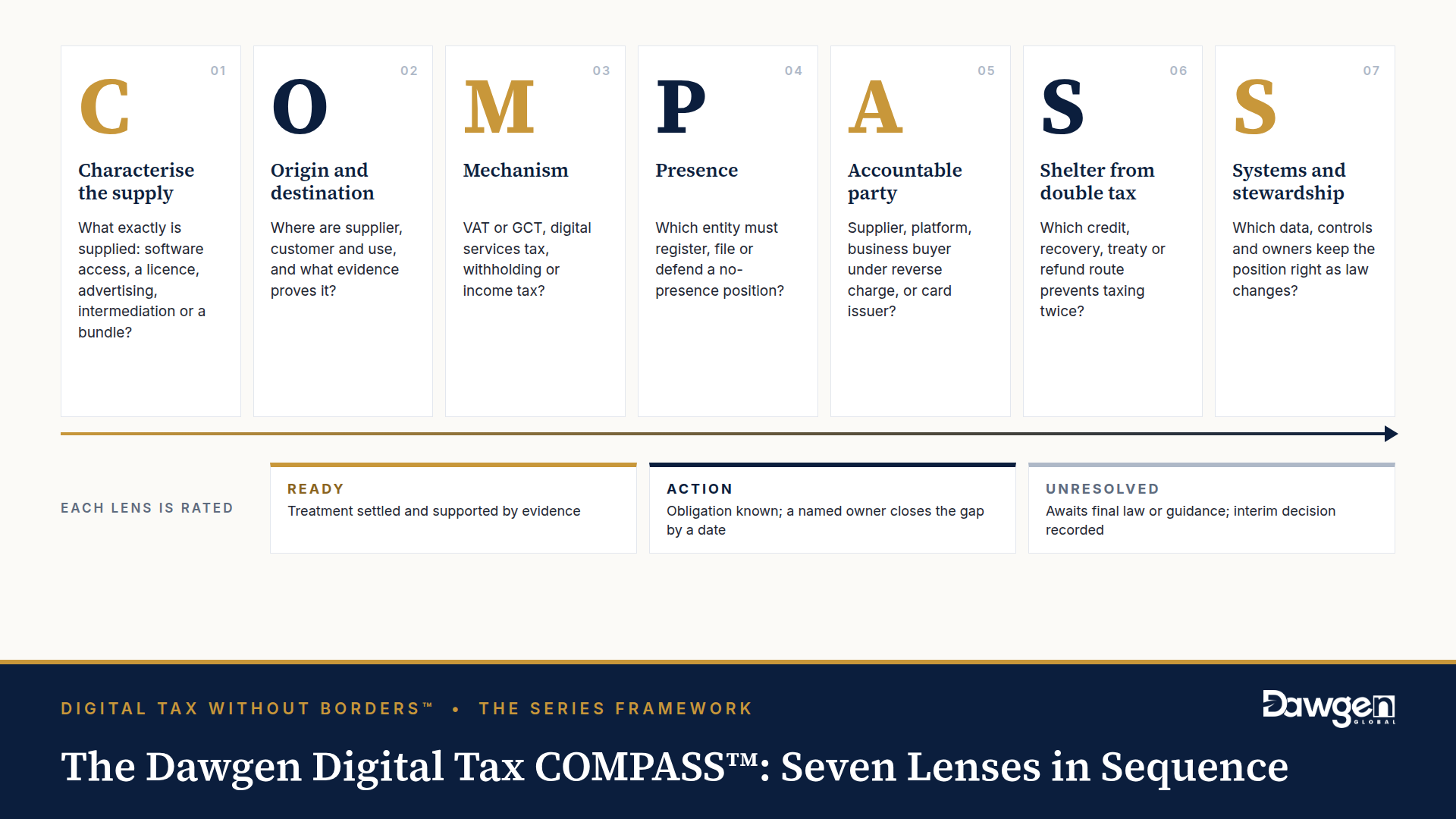
The Dawgen Digital Tax COMPASS™ is the method Dawgen Global uses to turn the broad phrase “digital tax” into specific, answerable questions. It works transaction by transaction, and it applies equally to what a business buys and what it sells. Seven lenses are applied in sequence, because each answer depends on the one before it.
- C — Characterise the supply. What exactly is supplied: access to software, a licence of intellectual property, advertising, intermediation, a professional service delivered remotely, or a bundle of several? The contract and the actual performance decide, not the invoice description.
- O — Origin and destination. Where are the supplier, the customer and the place of use or consumption, and what evidence proves it? Billing address, card country, IP address and contract terms often disagree.
- M — Mechanism. Which tax is in play: VAT or GCT on consumption, a gross-revenue digital services tax, withholding tax on the payment, or income tax on profits? Each has a different taxpayer, base and remedy.
- P — Presence. Which entity has a taxable connection with which jurisdiction, and must it register, file or defend a no-presence position?
- A — Accountable party. Who must actually charge, collect or remit: the supplier, a platform deemed to be the supplier, the business customer under a reverse charge, or a payment intermediary?
- S — Shelter from double taxation. Which credit, input tax recovery, treaty provision or refund route prevents the same value being taxed twice, and is it documented?
- S — Systems and stewardship. Which data fields, controls, owners and monitoring routines keep the position right as volumes grow and the law changes?
Each lens is rated on a simple three-tier scale. Ready means the treatment is settled and supported by evidence. Action means the obligation is known and a named owner is fixing a gap by a date. Unresolved means the answer depends on law or guidance that is not yet final, and an interim commercial decision has been recorded. The output is a transaction-level exposure map and an action plan with owners, not a list of countries. The COMPASS™ identifies and prioritises the questions; each material conclusion is then supported by the law of the jurisdiction concerned.
Applying the COMPASS™ to digital services taxes
| Lens | What to ask in this context | Evidence to hold |
| Characterise | Is the charge on the invoice a tax imposed on us, a reimbursement of the supplier’s tax, or a price increase? | Platform notices, contract repricing clause, invoice samples |
| Origin and destination | Which audiences or customers trigger a surcharge, and does the platform’s targeting data agree with our campaigns? | Campaign targeting reports by country, surcharge breakdowns |
| Mechanism | Is the foreign measure a DST, VAT, withholding or SEP rule, and which do we actually owe? | Legal note per measure with statutory source |
| Presence | Does any group entity approach a DST threshold or an SEP interaction test in any market? | Group revenue by market against published thresholds |
| Accountable party | Who is legally liable, the platform or us, and who bears the cost under the contract? | Contract terms, platform tax statements |
| Shelter | Is the surcharge deductible, and included in the reverse-charge value with input credit where allowed? | Tax computations, GCT or VAT returns, reconciliation of surcharges |
| Systems | Does accounts payable capture surcharges separately and does marketing see channel cost including them? | General ledger coding, quarterly surcharge report |
Questions for the board
- Do any of our board papers or public statements call Jamaica’s proposed GCT on digital services a “digital services tax”?
- How much do we spend on digital advertising aimed at UK and French audiences, and how much of that is now surcharge?
- Are platform surcharges included in the value on which we self-account for GCT or VAT on imported services?
- Which channels run on margins a 2 or 3 per cent revenue-based cost would erase?
- Do our platform and customer contracts allow us to reprice if a supplier passes on a tax cost?
- If a DST were proposed in a market where we operate, have we applied the five tests and submitted views?
- Do regional platforms we own or invest in capture user location well enough for future compliance?
- Who monitors DST developments in our main source markets, and how often do they report?
How Dawgen Global can help
Dawgen Global’s Caribbean Tax Advisory practice helps boards, finance leaders and owner-managers understand what digital services taxes and platform surcharges cost them, and how to respond in pricing, contracts and compliance. Using the Dawgen Digital Tax COMPASS™, we map digital transactions across the jurisdictions in which you operate, separate law in force from proposals, quantify exposure and help your team put in place the contracts, systems and controls to stay compliant as the rules change. To discuss your organisation’s position, contact us at [email protected] or visit www.dawgen.global/contact-us.
This article provides general information and does not constitute tax or legal advice. The application of tax law depends on specific facts and on the law in force at the relevant date; readers should obtain advice before acting.
Abbreviations used
- CARICOM — Caribbean Community
- CIAT — Inter-American Center of Tax Administrations
- COTA — Caribbean Organisation of Tax Administrators
- DST — digital services tax
- FY — fiscal year
- G7 — Group of Seven
- GST — goods and services tax
- GCT — General Consumption Tax
- IDB — Inter-American Development Bank
- IP — Internet Protocol (in “IP address”)
- ITBIS — Impuesto sobre la Transferencia de Bienes Industrializados y Servicios (Dominican Republic VAT)
- OECD — Organisation for Economic Co-operation and Development
- SEP — significant economic presence
- UK — United Kingdom
- UN — United Nations
- US — United States
- USTR — US Trade Representative
- VAT — value added tax
Sources
- Tax Foundation, “Digital Taxation Around the World”, April 2024. https://taxfoundation.org/research/all/global/digital-taxation-around-the-world-2024/
- HM Revenue and Customs, “Check if you need to register for Digital Services Tax”. https://www.gov.uk/guidance/check-if-you-need-to-register-for-digital-services-tax
- Direction générale des Finances publiques, “TSN – Taxe sur les services numériques”. https://www.impots.gouv.fr/professionnel/tsn-taxe-sur-les-services-numeriques
- DIAN, Decree 2039 of 2023 (Colombia). https://normograma.dian.gov.co/dian/compilacion/docs/decreto_2039_2023.htm
- Tax Administration Jamaica, Technical Bulletin, “Accounting for GCT on Imported Services”, 23 April 2020. https://www.jamaicatax.gov.jm/documents/10181/17838406/Technical+Bulletin+(2020)+-+GCT+Imported+Services_23042020.pdf/547fce5a-fa9c-1481-ec55-6d8e40456f08
- Federal Register, Presidential Memorandum, “Defending American Companies and Innovators From Overseas Extortion and Unfair Fines and Penalties”, 21 February 2025 (published 26 February 2025). https://www.federalregister.gov/documents/2025/02/26/2025-03188/defending-american-companies-and-innovators-from-overseas-extortion-and-unfair-fines-and-penalties
- Department of Finance Canada, “Canada rescinds digital services tax to advance broader trade negotiations with the United States”, 29 June 2025. https://www.canada.ca/en/department-finance/news/2025/06/canada-rescinds-digital-services-tax-to-advance-broader-trade-negotiations-with-the-united-states.html
- Parliament of Canada, LEGISinfo, Bill C-15, Budget 2025 Implementation Act, No. 1 (Royal Assent 26 March 2026). https://www.parl.ca/legisinfo/en/bill/45-1/c-15
- PwC, Worldwide Tax Summaries, “Barbados: Other taxes”. https://taxsummaries.pwc.com/barbados/corporate/other-taxes
- Department of Inland Revenue, The Bahamas, Value Added Tax Act (consolidated), 2024. https://inlandrevenue.finance.gov.bs/wp-content/uploads/2024/11/Value-Added-Tax-Act.pdf
- VATcalc, “Suriname 10% VAT on foreign digital service providers 2023”. https://www.vatcalc.com/suriname/suriname-10-vat-on-foreign-digital-service-providers-2023/
- KPMG, “Grenada: Nonresident digital services VAT”, May 2026. https://kpmg.com/us/en/taxnewsflash/news/2026/05/grenada-nonresident-digital-services-vat.html
- Jamaica Information Service, “Gov’t projects $29.4B from new revenue measures in fiscal year 2026/27”, February 2026. https://jis.gov.jm/govt-projects-29-4b-from-new-revenue-measures-in-fiscal-year-2026-27/
- Diario Libre, “La DGII trabaja propuesta de ITBIS para plataformas digitales”, 20 May 2026. https://www.diariolibre.com/economia/finanzas/2026/05/20/la-dgii-trabaja-propuesta-de-itbis-para-plataformas-digitales/3538742
- CARICOM, “Coordinated approach necessary for consistent application of VAT systems – tax officials”, March 2026. https://caricom.org/coordinated-approach-necessary-for-consistent-application-of-vat-systems-tax-officials/
- OECD, International VAT/GST Guidelines, 2017. https://www.oecd.org/en/publications/international-vat-gst-guidelines_9789264271401-en.html
- CIAT, “New toolkit to strengthen value added taxes on e-commerce in Latin America and the Caribbean”, 23 June 2021. https://www.ciat.org/new-toolkit-to-strengthen-value-added-taxes-on-e-commerce-in-latin-america-and-the-caribbean/?lang=en
- United Nations, Model Double Taxation Convention between Developed and Developing Countries, 2021 update. https://financing.desa.un.org/sites/default/files/2023-05/UN%20Model_2021.pdf
- EY, “UN releases draft Framework Convention on International Tax Cooperation and two early protocols”, 27 July 2026. https://www.ey.com/en_gl/technical/tax-alerts/un-releases-draft-framework-convention-on-international-tax-cooperation-and-two-early-protocols
About Dawgen Global
Dawgen Global is an independent, integrated multidisciplinary professional services firm headquartered at 47 Trinidad Terrace, New Kingston, Jamaica, serving more than 15 territories across the Caribbean. Founded and led by Dr. Dawkins Brown, Executive Chairman, the firm is independent and not affiliated with any international network. It delivers a full suite of professional services under one roof: audit and assurance; tax advisory; IT and digital transformation; risk management; cybersecurity; actuarial and insurance regulatory advisory; HR advisory; mergers and acquisitions; corporate recovery; business advisory and strategy; accounting BPO and virtual CFO services; and legal process outsourcing.
The proposition is simple: big-firm capability without the big-firm price. Dawgen Global’s integrated approach is built for the specific complexities and opportunities of the Caribbean market, helping organizations make sharper, better-informed decisions that drive measurable progress.
To explore a partnership, reach out:
- Website: dawgen.global
- Email: [email protected]
- WhatsApp (Global): +1 555-795-9071
- Caribbean offices: +1 876-665-5926 | +1 876-929-3670 | +1 876-926-5210


