
Why Caribbean CEOs Must Read Ratios, Not Just Results
| IN BRIEF
Almost no business is sold, refinanced or valued on the EBITDA (earnings before interest, tax, depreciation and amortisation) in its accounts. It is valued on an adjusted figure, after owner costs, one-off events and planned savings have been added back. Some adjustments are legitimate and necessary; others simply flatter. Because a buyer multiplies every accepted dollar of adjustment by the purchase multiple, the difference can decide millions of dollars of price. This article explains the three kinds of adjustment, why adjustments must cut both ways, the Caribbean conditions that make them contentious, and a five-test ledger any chief executive can apply before a buyer or lender does. |
SECTION 1
The adjusted EBITDA that grew by itself

The information memorandum was handsome. Forty pages, bound, with photographs of the warehouse and the fleet and a chart of revenue climbing steadily for five years. On page twelve, in a navy box, was the number the owner had been waiting to see: Adjusted EBITDA, US$3.5 million.
The owner, who had built the distribution and light-manufacturing business over twenty-five years, knew the statutory accounts showed EBITDA of about US$2.1 million. The broker had explained the difference. The owner’s salary was well above what a hired chief executive would cost, so the excess could be added back. Two family members on the payroll did not really work in the business. There had been a legal settlement, a run of storm repairs, some foreign exchange losses and an inventory write-down, all described as one-off. And there was a restructuring plan that would save a further quarter of a million a year. Added together, the adjustments came to US$1.4 million, two thirds of the reported figure.
At six times EBITDA, a multiple the broker said was achievable, the business was worth about US$21 million.

The preferred bidder commissioned its own quality-of-earnings review. Six weeks later its number arrived: US$2.6 million. It accepted the owner’s salary adjustment, the family payroll, the legal settlement and the costs of the sale itself. It rejected the storm repairs, which had appeared in three of the last four years. It rejected the exchange losses, which arose on every import the business made. It rejected the inventory write-down, which was the ordinary shrinkage of a distribution business. It rejected the restructuring savings, because the restructuring had not happened. And it added something the memorandum had left out: the business occupied a warehouse owned by the founder’s family company at a rent about a quarter of a million dollars a year below market. A buyer would have to pay market rent, so that adjustment went the other way.
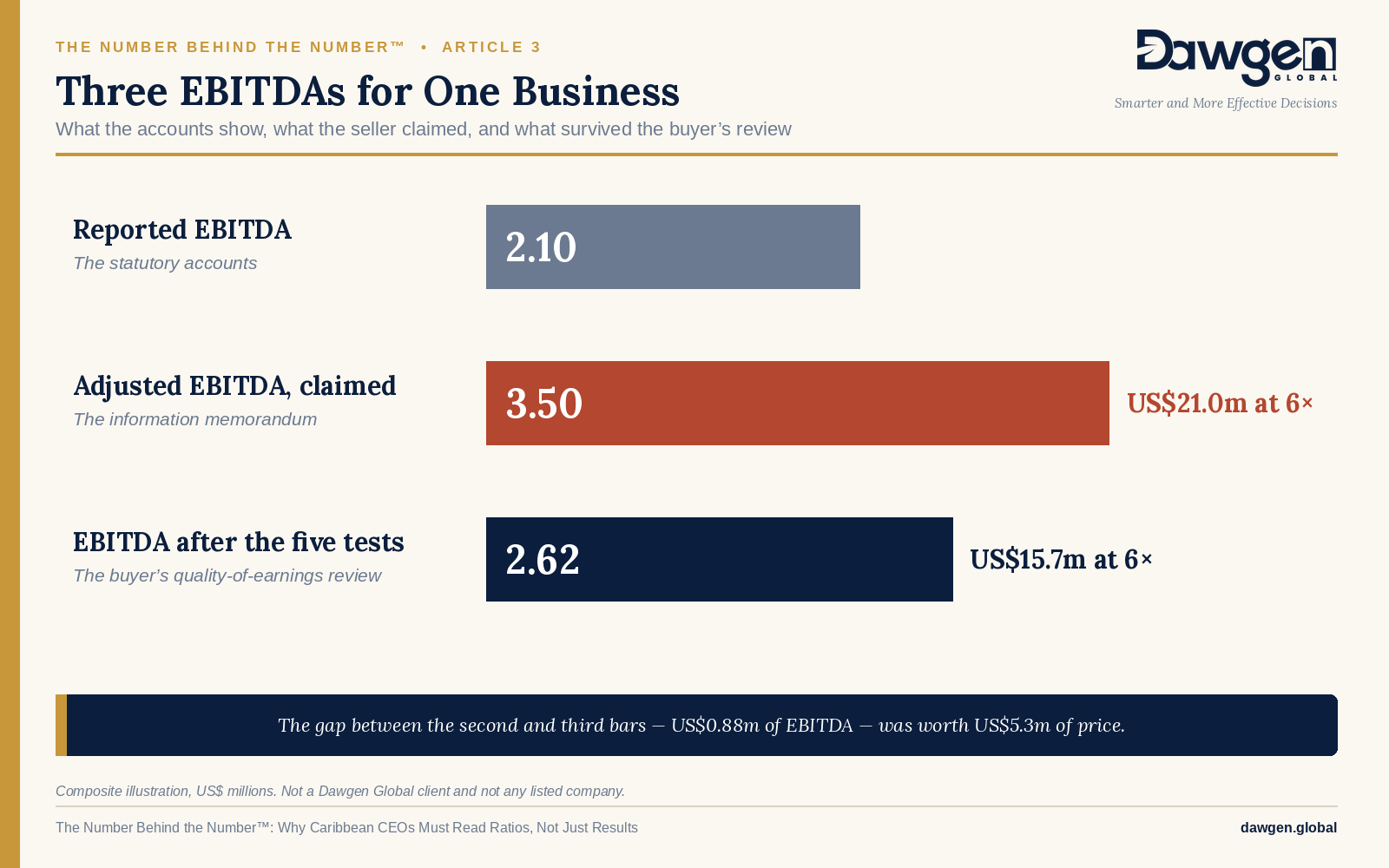
At the same multiple of six, the bidder’s number valued the business at about US$15.7 million.
The gap was US$5.3 million, and all of it came from arguments over adjustments to one line of the income statement.
This is a composite, drawn from patterns seen across the region rather than from any single transaction.
SECTION 2
The Number Behind the Number™ and the E·B·I·T·A Lens™
The Number Behind the Number™ is a twelve-part series on the ratios that decide how a business is financed, valued and judged. Each article stands on its own, so the framework is set out in full here, as it is in every article in the series.
Two measures, one difference
Both measures begin with what the business earns from its operations, before the cost of financing it and before tax.
EBITDA — earnings before interest, tax, depreciation and amortisation — shows operating earnings before any charge for the assets the business uses. It is the figure bankers, bond arrangers and buyers quote most often, because it removes financing choices, tax positions and accounting estimates and so lets one business be compared with another.
EBITA — earnings before interest, tax and amortisation — deducts depreciation, the accounting recognition that buildings, plant, vehicles and equipment wear out and must be replaced. It still excludes amortisation, which relates mostly to intangible assets such as acquired goodwill and customer lists.
| EBITDA − EBITA = Depreciation |
Neither measure is right and the other wrong. EBITDA is the better lens for comparing operating efficiency and short-term debt capacity; EBITA is the better lens wherever replacing assets is a real, recurring cost.
The Wear Ratio
The series connects the two with one additional measure, depreciation as a share of EBITDA:
| Wear Ratio = Depreciation ÷ EBITDA |
It shows how much of every dollar earned before charging for assets is needed simply to keep those assets standing. The higher it is, the further EBITDA overstates what the owners can safely take out or borrow against.
The five lenses
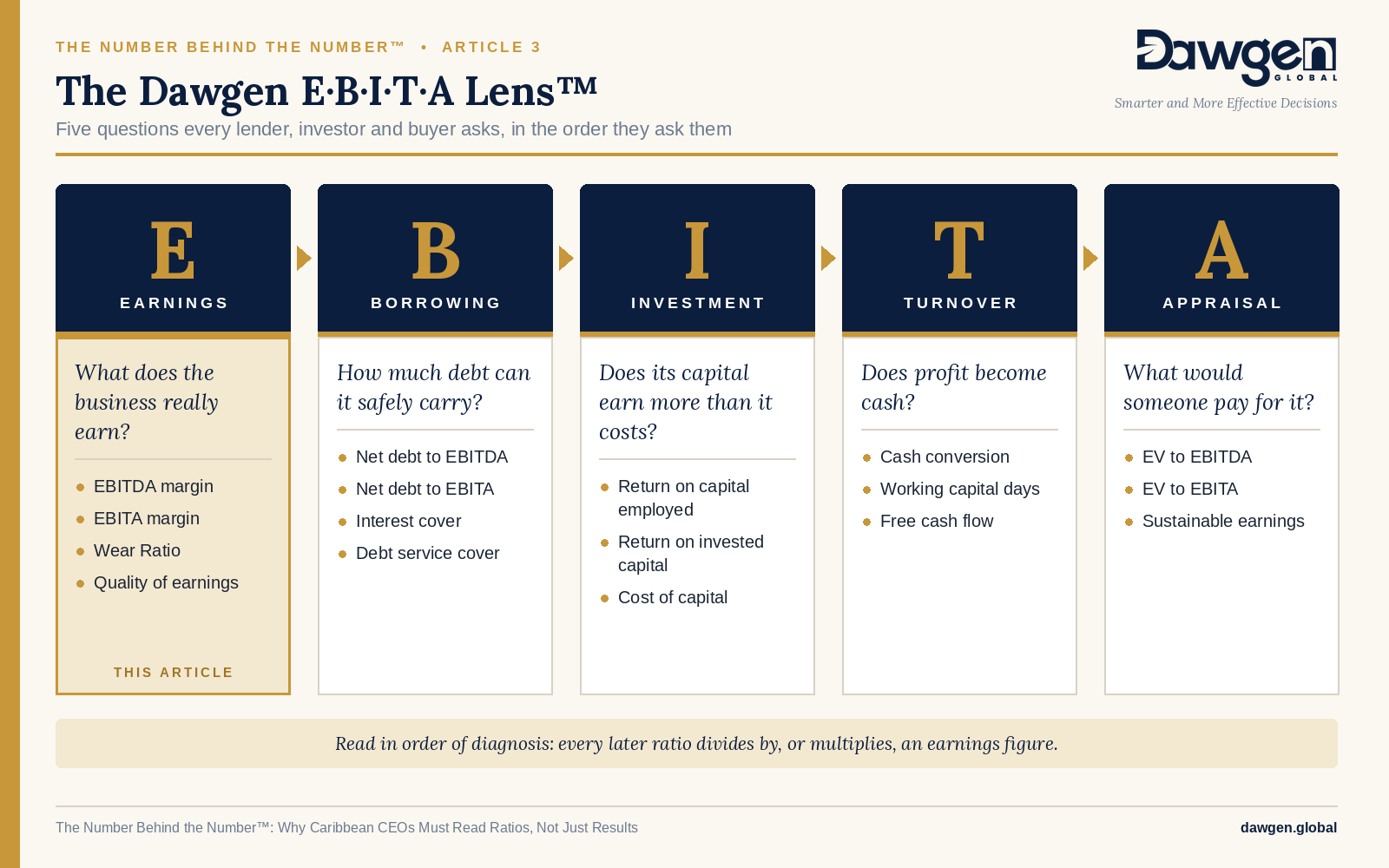
The Dawgen E·B·I·T·A Lens™ turns the acronym into five questions that every serious reader of a company’s accounts asks, in roughly this order.
| Lens | The question | The ratios that answer it |
| E — Earnings | What does the business really earn? | EBITDA margin, EBITA margin, Wear Ratio, quality of earnings |
| B — Borrowing | How much debt can it safely carry? | Net debt to EBITDA and to EBITA, interest cover, debt service coverage ratio (DSCR) |
| I — Investment | Does its capital earn more than it costs? | Return on capital employed (ROCE), return on invested capital (ROIC) |
| T — Turnover | Does profit become cash? | Cash conversion, working capital days, free cash flow |
| A — Appraisal | What would someone pay for it? | Enterprise value (EV) to EBITDA and to EBITA |
This article completes the first lens, Earnings. Articles 1 and 2 asked what the business earns and how much of it is needed to stand still. This one asks whether the earnings figure itself can be trusted, because every later ratio, from leverage to value, is only as good as the earnings number beneath it.
A note on both measures
Adjustments are usually argued over EBITDA, because that is the figure multiplied in a sale and tested in a covenant. Every point in this article applies equally to EBITA. An adjustment sits above depreciation, so every dollar accepted or rejected from adjusted EBITDA is accepted or rejected from adjusted EBITA too. The one exception is examined below: costs moved from the income statement into the asset register, which lift EBITDA and are only partly caught by EBITA.
SECTION 3
The pattern: how adjustments flatter

Adjusting EBITDA is not a trick. It is necessary. The statutory accounts of a private company record what happened under its current owner, and much of that will not continue under a new owner, a new lender’s covenant or a new management team. The purpose of adjustment is to arrive at maintainable earnings: what the business will earn, year after year, in the hands of whoever relies on the number.
The difficulty is that the person preparing the adjustments usually benefits from a higher figure. A seller wants a higher price. A borrower wants more headroom. Management wants a larger bonus. None of this makes adjustments dishonest, but it does mean every adjustment should be read as a claim that has to be proved.
Three kinds of adjustment
Adjustments fall into three families, and they deserve very different levels of trust. Corrections fix an accounting error and are highly reliable once verified. Normalisations remove something real that will not continue, or restate something at market terms; their reliability depends entirely on evidence and on being applied both ways. Pro-forma and run-rate adjustments add something that has not yet happened, and deserve the least trust of all.
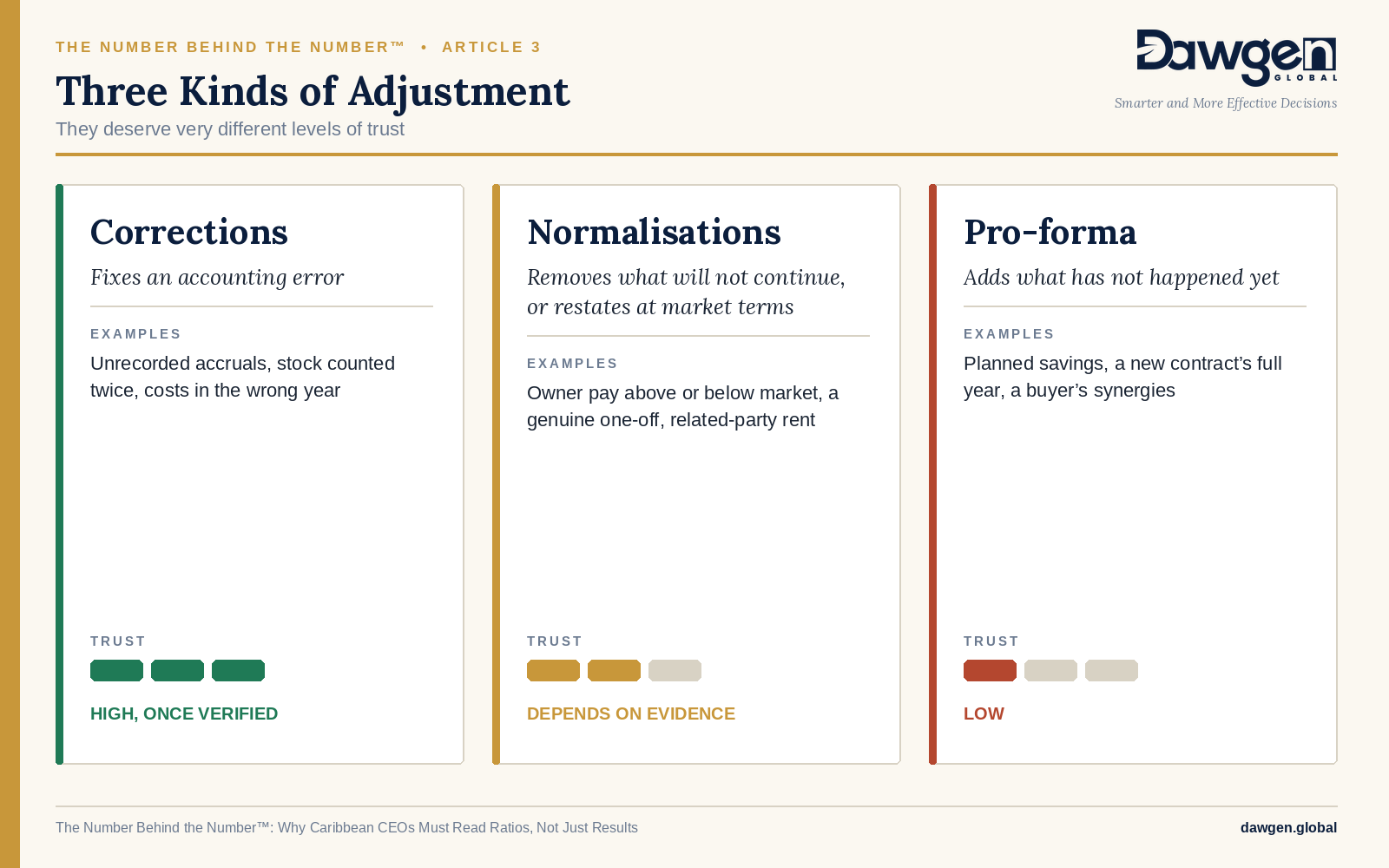
Most disputes arise in the second and third families. Corrections are rarely contentious once the error is found. Normalisations are contentious because they depend on judgement. Pro-forma adjustments are contentious because they ask someone to pay today for earnings that exist only in a plan.
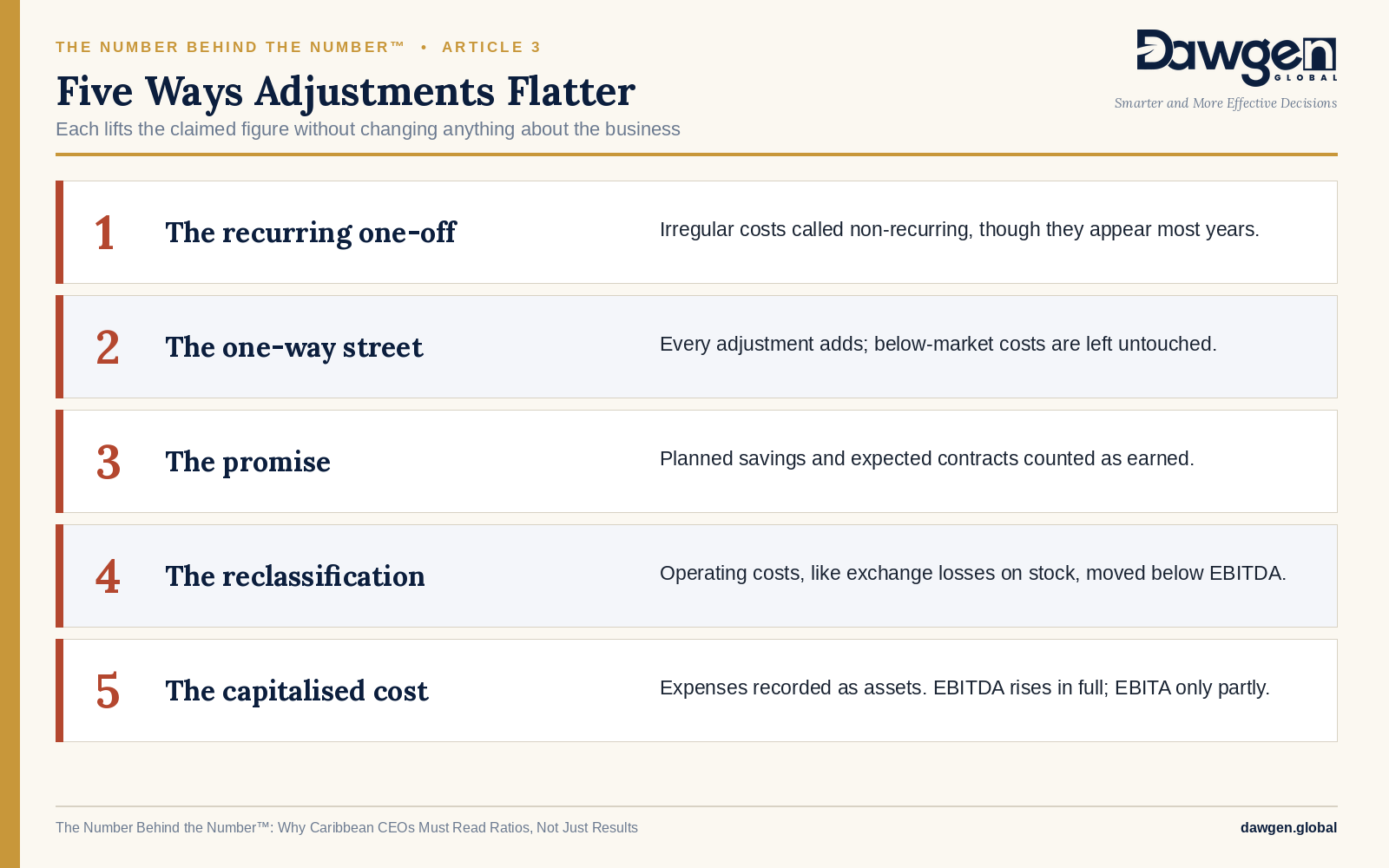
Five ways adjustments flatter
- The recurring one-off. A cost described as non-recurring that appears, under different names, in most years. Storm repairs, legal disputes, system problems and write-downs are normal in most businesses. They are simply irregular.
- The one-way street. Every adjustment increases EBITDA. Costs that are below market, such as a founder working for a modest salary or a family property rented at a discount, are left untouched, even though a new owner would have to pay the full price.
- The promise. Savings or revenues that are planned, expected or “in negotiation” are added as if they were already earned.
- The reclassification. Operating costs are moved below EBITDA. Foreign exchange losses on the purchase of stock, for example, are part of the cost of trading for an importer. Presenting them as “non-operating” lifts EBITDA without changing anything about the business.
- The capitalised cost. Repairs, software configuration or staff time are recorded as assets rather than expenses. EBITDA rises by the full amount. EBITA rises by the amount less the first year’s depreciation, which is why the series insists on reading both. When EBITDA grows much faster than EBITA, ask what has been capitalised.
The test of a good adjustment
A good adjustment has three properties. It is evidenced by documents, not described in a memorandum. It is symmetrical, applied to costs that are too low as readily as to costs that are too high. And it describes the business a new owner, lender or manager will actually inherit, not the business the current owner wishes it were. The rest of this article turns those properties into a working test.
SECTION 4
The Caribbean variant

Adjustments are argued over everywhere. Six features of regional business make them more frequent, larger and harder to settle here.
The owner’s economy inside the company. In many family businesses the company pays for the owner’s vehicles, travel, household staff, school fees or insurance. Removing them is a legitimate adjustment, but only with evidence, and a buyer will also ask whether the owner has been paid a market salary for a full-time job. Many founders pay themselves too little, not too much. When they leave, a hired chief executive costs more, and the adjustment goes the other way.
Family on the payroll, and family working for nothing. Relatives who draw a salary without working in the business can be added back. Relatives who work in the business without being paid, or for a token amount, must be charged at market rates. A buyer will find both, and only the first appears in most memoranda.
Related-party trading at non-market terms. Properties leased from the founder’s holding company, goods bought from a cousin’s supplier, management fees to a sister company in another territory. Each may be at a price that would not survive a change of ownership. Where the terms are favourable to the business, EBITDA is overstated; where they are unfavourable, it may be understated. Either way, the adjustment must be made, and documentation that shows the terms are at arm’s length strengthens every later conversation, including with the tax authority.

Storms, outages and the irregular normal. A hurricane season, a grid failure or a port disruption is not a one-off in this region. It is a cost of doing business that arrives irregularly. A buyer looking at five years of accounts will treat recurring “one-off” disruption costs as part of maintainable earnings, and may average them.
Currency in the cost of trading. Businesses that import in US dollars and sell in local currency incur exchange losses as a normal part of buying stock. Moving those losses below EBITDA as “non-operating” is one of the most common adjustments in the region, and one of the most commonly rejected.
Earnings that never reached the books. Some sellers suggest that the business earns more than the accounts show, because some sales were never recorded. No serious buyer or lender will add back income that is not in the books. They cannot verify it, it may carry tax exposure that becomes theirs, and it tells them the records cannot be relied on for anything else. The only earnings that count are the earnings the business has reported.
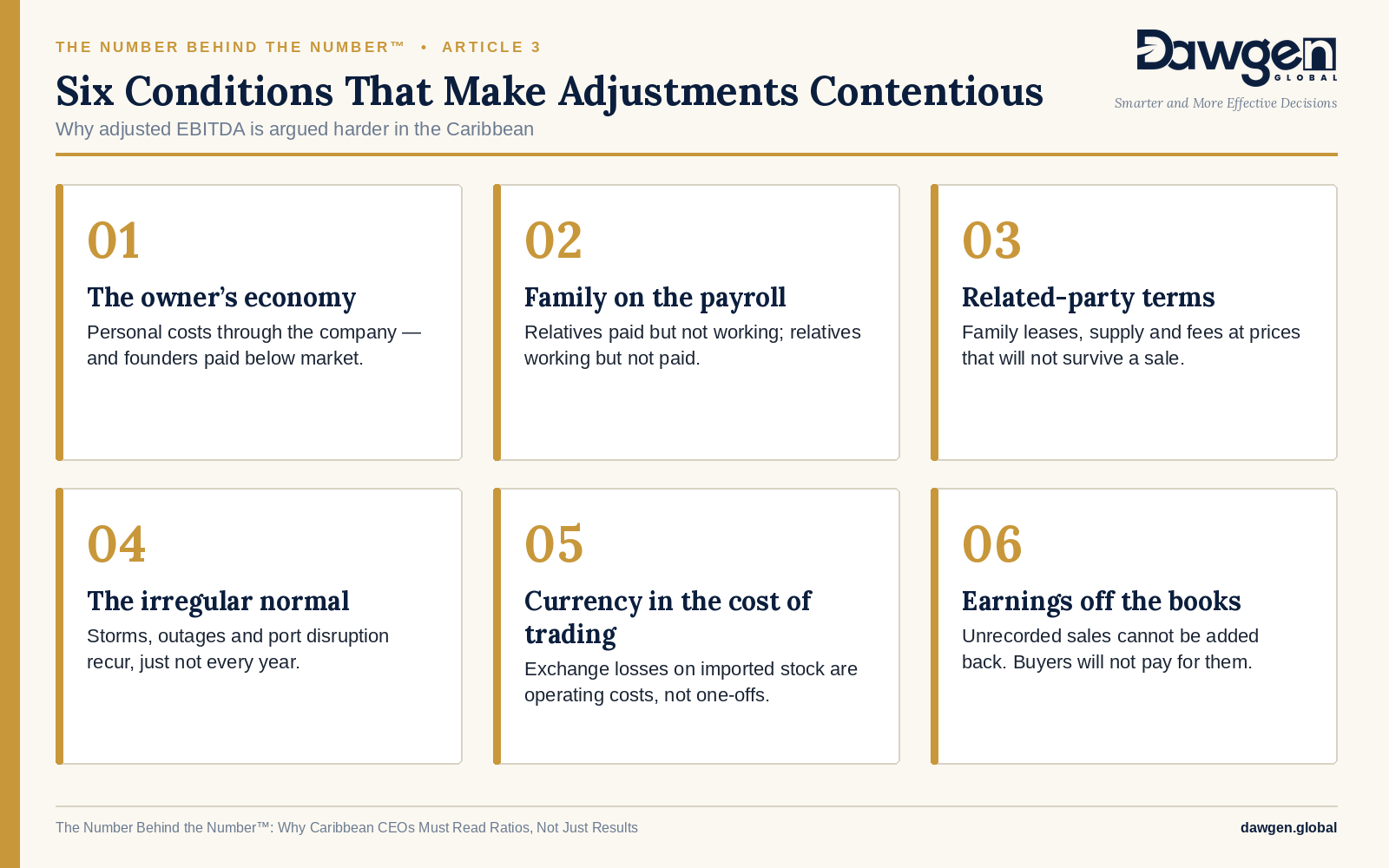
There is also a concession effect worth checking. Some regional businesses benefit from duty waivers, concessionary utility or port rates, or preferential supply contracts tied to a licence or to the current owner. If those benefits will not transfer, or are due to expire, the earnings they support are not maintainable, and an honest ledger adjusts for them.
SECTION 5
What it costs
An adjustment is multiplied. In a sale it is multiplied by the purchase multiple; in a financing it is multiplied by the leverage the lender will allow. That is why arguments over a few hundred thousand dollars of EBITDA become arguments over millions of dollars of value. The ranges are indicative, drawn from general practice rather than survey data.
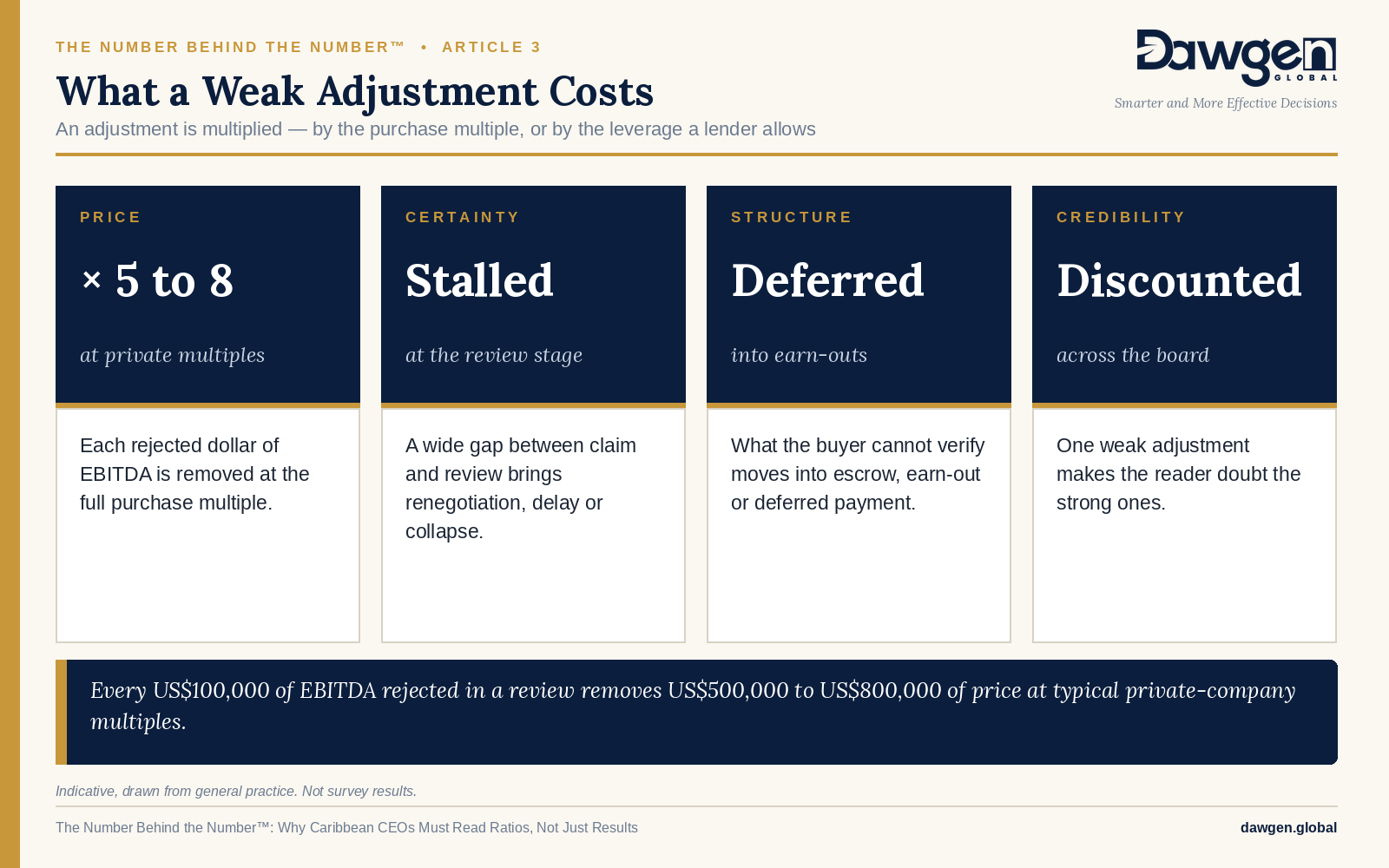
Lenders apply the same discipline in their own way. Many cap the add-backs a borrower may include in covenant EBITDA, or exclude pro-forma savings altogether, so headroom that looked comfortable on the borrower’s adjusted figure can disappear on the lender’s.
The credibility cost is the least appreciated. A buyer who finds that the “one-off” storm costs recur every year does not simply remove them. It starts to ask what else in the memorandum is optimistic, widens the scope of its review, and prices the uncertainty into its offer. Sellers who present only adjustments they can defend usually end up with more of them accepted.
The cost is not only borne at sale. A business that manages to its own adjusted EBITDA every month, rather than its reported figure, will make pricing, borrowing and dividend decisions on earnings it does not have. The flattering number misleads the people inside the business before it misleads anyone outside.
SECTION 6
Reading it properly: the Adjustment Ledger

The discipline that protects a chief executive from flattering numbers is simple to describe: list every adjustment, and put each one through the same five tests before anyone outside the business sees it. We call the result the Adjustment Ledger.
The five tests
- Is there a document behind it: a payroll record, an invoice, a contract, a valuation, a board minute? An adjustment that exists only in a memorandum fails.
- Has a cost of this kind appeared in two or more of the last five years? If so, it is not a one-off, whatever it is called this year.
- Have the adjustments that reduce EBITDA been made with the same care as those that increase it: below-market salaries and rents, unpaid family labour, concessions that will expire?
- Will the benefit pass to the person relying on the number? A new owner will not inherit the founder’s discounted rent, and a lender cannot rely on a supply contract that ends when the founder leaves.
- Has it already happened? Savings that are planned, contracts that are expected and synergies that belong to a buyer are not earnings of the business.
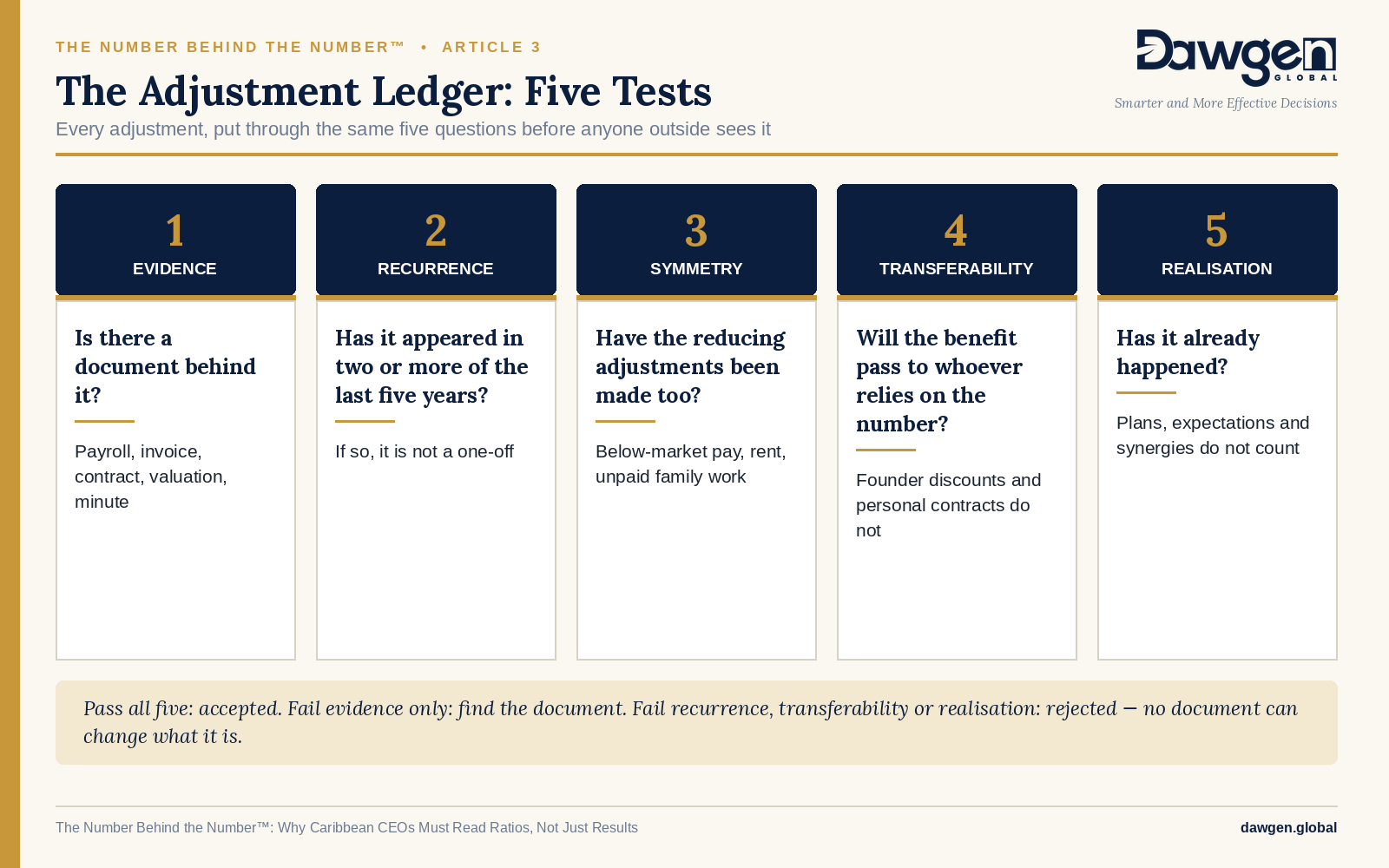
An adjustment that passes all five is accepted. One that fails evidence alone can often be rescued by finding the document. One that fails recurrence, transferability or realisation is rejected, because no document can change what it is.
Two numbers that summarise the ledger
| Adjustment Intensity = Total adjustments ÷ Reported EBITDA |
| Acceptance Ratio = EBITDA after the five tests ÷ Adjusted EBITDA claimed |
Adjustment Intensity shows how far the claimed figure has travelled from the accounts. As an indicative guide, below 15 per cent is usual, 15 to 30 per cent needs strong evidence, and above 30 per cent invites a deep review and a sceptical reader. The Acceptance Ratio shows how much of the claimed figure survives. A seller or borrower who has run the ledger in advance should expect it to be close to 100 per cent.
The composite business, put through the ledger
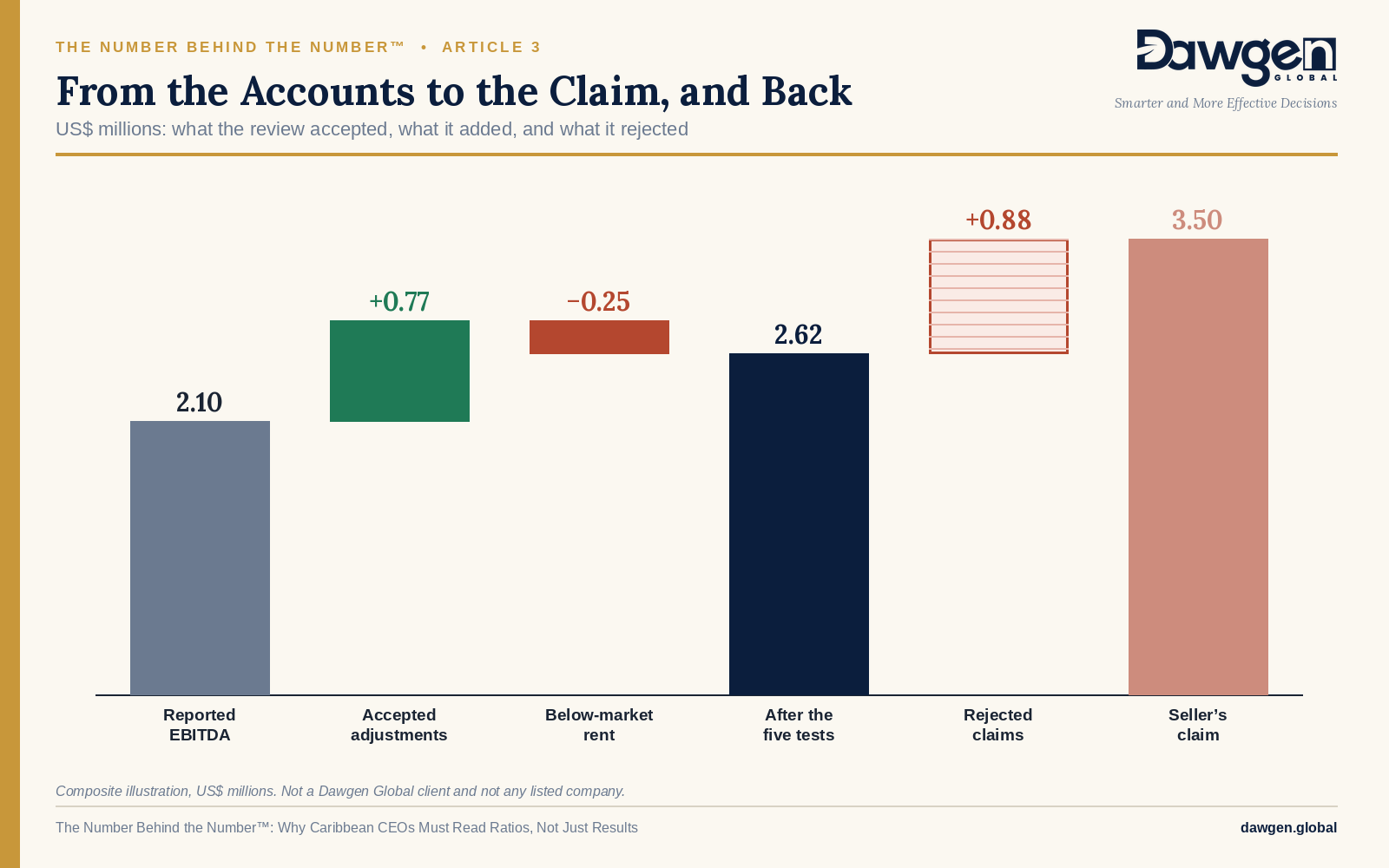
Return to the business in the opening story. Its reported EBITDA was US$2.10 million.
| Adjustment | Claimed | Test failed | Outcome | Accepted |
| Owner’s pay above a market chief executive’s | +0.45 | None; benchmarked | Accepted | +0.45 |
| Two family members not working in the business | +0.12 | None; roles reviewed | Accepted | +0.12 |
| Legal settlement | +0.15 | None; first in five years | Accepted | +0.15 |
| Costs of the sale process | +0.05 | None | Accepted | +0.05 |
| Storm repairs | +0.20 | Recurrence | Rejected | — |
| Exchange losses on imported stock | +0.10 | Recurrence; transferability | Rejected | — |
| Inventory write-down | +0.08 | Recurrence | Rejected | — |
| Restructuring savings | +0.25 | Realisation | Rejected | — |
| Warehouse rent from a family company, below market | Not claimed | Symmetry | Added by buyer | (0.25) |
| Total adjustments | +1.40 | +0.52 | ||
| EBITDA (US$ millions) | 3.50 | 2.62 |
Composite illustration, US$ millions. Not a Dawgen Global client and not any listed company.
The ledger’s two summary numbers tell the story at a glance. On the seller’s claim, Adjustment Intensity was 67 per cent; after the five tests it was 25 per cent. The Acceptance Ratio was 75 per cent. On an EBITA basis, after depreciation of US$0.60 million, the seller’s claim of US$2.90 million became US$2.02 million.
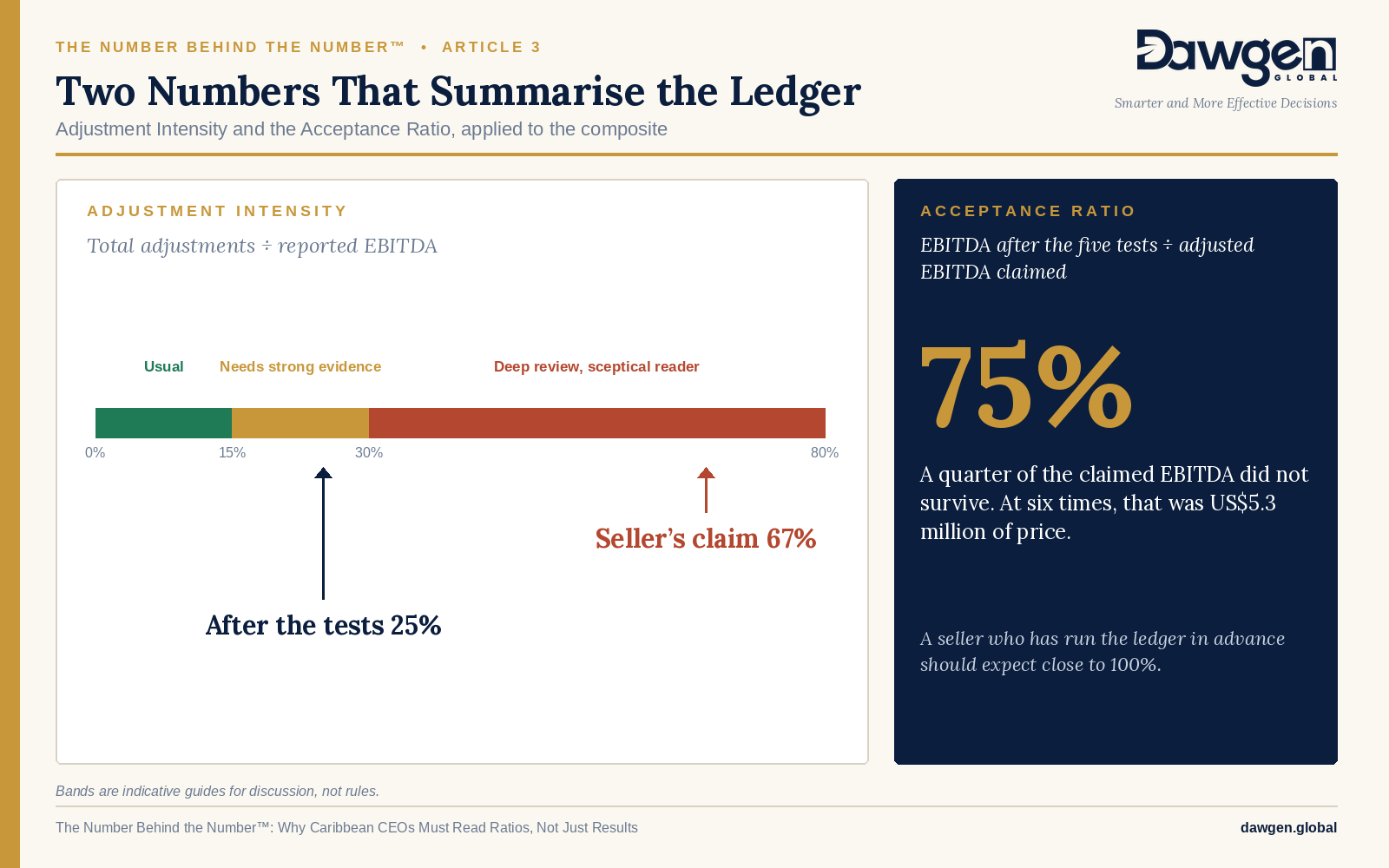
An Adjustment Intensity of two thirds was the first warning. Half of the claimed adjustments failed a test that the owner could have applied at the kitchen table, and one adjustment that should have been in the memorandum, the rent, was missing altogether. Every rejected dollar cost six dollars of price.
What a well-prepared seller would have done
Run through the ledger a year earlier, the same business would have looked very different. The owner could have moved onto a market salary and taken the rest as dividends, so that no adjustment was needed. The warehouse lease could have been reset to a market rent and documented. The restructuring could have been completed, so that its savings appeared in the accounts rather than in a promise. And the memorandum could have presented US$2.6 million of EBITDA with every adjustment evidenced, a number the buyer’s review would confirm rather than cut. The price might have been similar. The certainty, the speed and the seller’s negotiating position would have been far stronger.
The same ledger, used every month
The ledger is not only for a sale. A lender’s covenant definitions, a management bonus scheme and the board’s own reporting all rely on an adjusted figure of some kind. A business that keeps its Adjustment Ledger current, reviewed each quarter and approved by the board, will never be surprised by the gap between the number it manages to and the number others accept.
SECTION 7
Where to start
None of these steps needs a transaction to be under way. Each is easier, and more valuable, done well before anyone asks.
- Write your own Adjustment Ledger. List every item you believe should be added to or taken from reported EBITDA, with the amount and the document that supports it.
- Look back five years for one-offs. Put every “non-recurring” cost from the last five years side by side. Anything that appears in two or more years belongs in maintainable earnings.
- Adjust in both directions. Price your own time, your family’s unpaid work and every related-party arrangement at market rates, and record the adjustments that reduce EBITDA as carefully as those that increase it.
- Fix the causes, not just the numbers. Move onto a market salary, take personal costs out of the company, put related-party leases and supply arrangements on documented arm’s-length terms, and complete planned savings before counting them. The best adjustment is the one that no longer needs to be made.
- Watch EBITDA and EBITA together. If EBITDA is growing faster than EBITA, find out what has been capitalised, and whether it should have been expensed.
- Commission an independent review before you need one. A vendor quality-of-earnings review, carried out before a sale or refinancing, lets you fix what can be fixed and defend what should be defended, on your own timetable rather than a buyer’s.
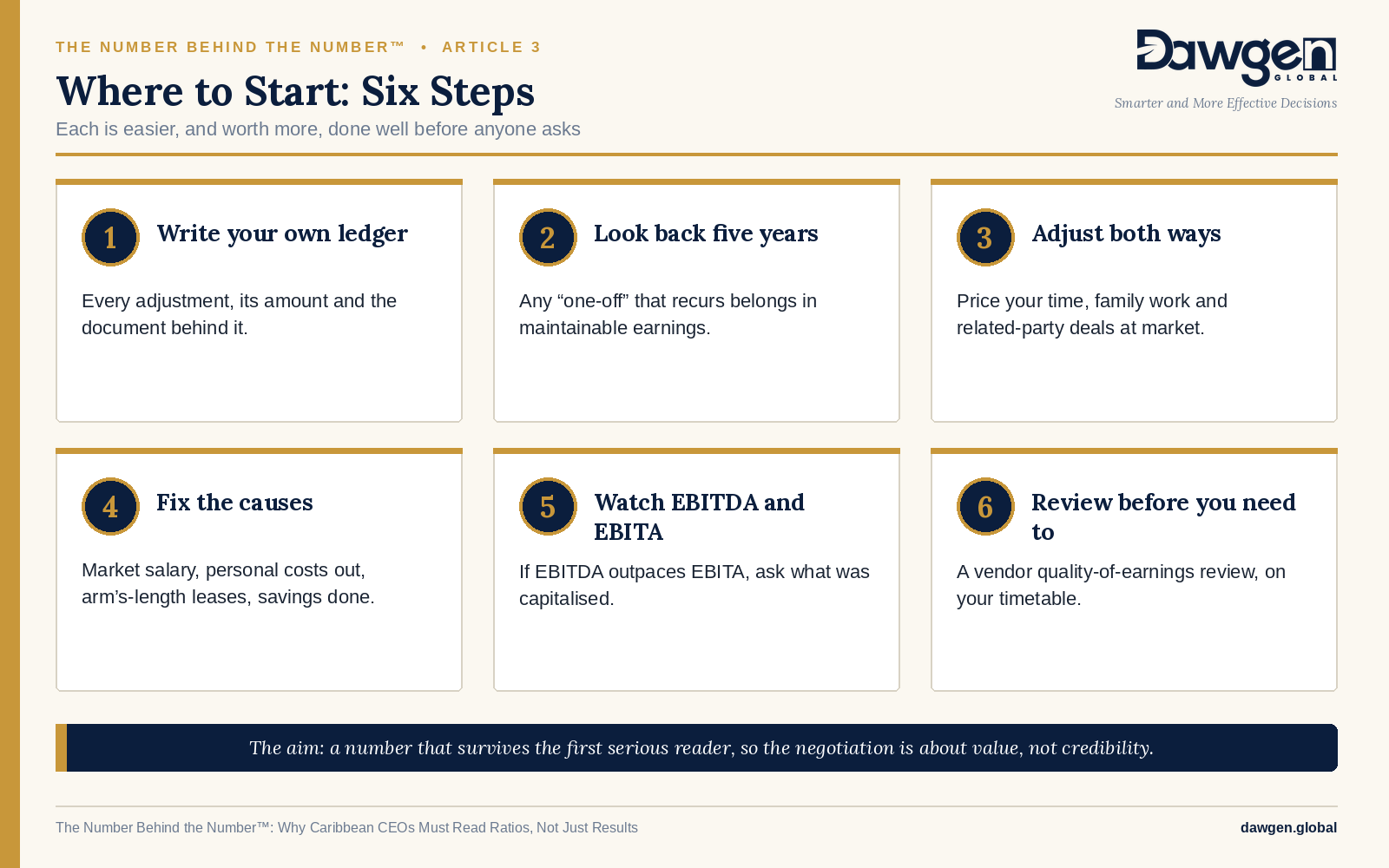
The aim is not to give up legitimate adjustments. Many businesses under-claim them, because the evidence was never kept. The aim is to arrive at a number that survives the first serious reader, so that the negotiation is about value rather than about credibility.

What comes next in the series
Article 4, Your Banker Already Knows Your Net Debt to EBITDA. Do You?, opens the second lens, Borrowing: how lenders translate earnings into debt capacity through leverage, interest cover and debt service coverage, and why the answer depends on which EBITDA, and which adjustments, the lender accepts. Later articles take each lens in turn, and the series closes with the CEO’s One-Page Ratio Dashboard.
Download a copy of this article here: Article3_Adjusted_Until_It_Flatters (1)
| HOW DAWGEN GLOBAL HELPS
Dawgen Global works with chief executives, boards and owners across more than fifteen Caribbean territories to put these numbers to work. ■ The Dawgen E·B·I·T·A Lens™ Ratio Health Check — a fixed-fee review that scores the business on all five lenses, including an Adjustment Ledger of reported EBITDA. ■ Vendor and buyer quality-of-earnings reviews — independent analysis of maintainable earnings before a sale, acquisition or refinancing, through our M&A and Transaction Advisory practice. ■ Earnings integrity and forensic reviews — testing adjustments, related-party flows and capitalised costs, through our Forensic and Risk Advisory teams. ■ Related-party and transfer pricing documentation — putting intra-group and family arrangements on documented arm’s-length terms, through our Tax Advisory practice. ■ The monthly Ratio Dashboard — reported and adjusted EBITDA, EBITA and the Adjustment Ledger every month, through our Virtual CFO and Accounting BPO division. To see how your business reads through the E·B·I·T·A Lens™, or to request a Ratio Health Check or a quality-of-earnings review, contact Dawgen Global. [email protected] | dawgen.global | (876) 926-5210 |
Dr. Dawkins Brown is Executive Chairman and Founder of Dawgen Global, an independent, integrated multidisciplinary professional services firm operating across the Caribbean. Big Firm Capabilities. Caribbean Understanding.
The examples in this series are composites drawn from patterns observed across the region. They do not describe any client, transaction or listed company. Figures described as indicative are illustrative ranges, not survey results.
About Dawgen Global
Dawgen Global is an independent, integrated multidisciplinary professional services firm headquartered at 47 Trinidad Terrace, New Kingston, Jamaica, serving more than 15 territories across the Caribbean. Founded and led by Dr. Dawkins Brown, Executive Chairman, the firm is independent and not affiliated with any international network. It delivers a full suite of professional services under one roof: audit and assurance; tax advisory; IT and digital transformation; risk management; cybersecurity; actuarial and insurance regulatory advisory; HR advisory; mergers and acquisitions; corporate recovery; business advisory and strategy; accounting BPO and virtual CFO services; and legal process outsourcing.
The proposition is simple: big-firm capability without the big-firm price. Dawgen Global’s integrated approach is built for the specific complexities and opportunities of the Caribbean market, helping organizations make sharper, better-informed decisions that drive measurable progress.
To explore a partnership, reach out:
- Website: dawgen.global
- Email: [email protected]
- WhatsApp (Global): +1 555-795-9071
- Caribbean offices: +1 876-665-5926 | +1 876-929-3670 | +1 876-926-5210


