
Most businesses know what they pay for an hour. Far fewer know what an hour costs them, and fewer still can say which job consumed it. That gap is where quoted margin quietly becomes actual loss.
IN SHORT
| The cost of an hour is not the wage rate. It is the wage plus the employer’s own statutory contributions, plus accruing leave, divided by the hours actually available after entitlement and public holidays. Capturing time against the job, costing it at that loaded rate, and requiring overtime to be approved before it is worked turns labour from a monthly total into a figure attached to the work that consumed it. |
SECTION 01
The pattern
A contract is quoted at forty hours a week at the hourly wage, plus a margin that looks comfortable. The work is delivered, the client pays, and at the end of the year the business cannot understand why a full order book produced so little profit. Nothing went wrong operationally. The quote was built on a number that was never the cost.

The wage rate is what lands in the employee’s hand. The cost of employing that person for an hour includes the employer’s own statutory contributions, the leave that accrues while they work, the public holidays they are paid for but do not work, and the training, travel and downtime that are real but unbillable. A business that prices at the wage rate has not made a small error. It has priced every job it has ever quoted on a base that is understated by the same proportion, consistently, in the same direction.
Alongside it sits a second habit. Overtime is approved after it has been worked. The supervisor agrees to the hours in the yard on a Friday afternoon; the approval happens four weeks later, when a manager signs a payslip containing a figure that cannot now be changed. That is not approval. It is ratification of a decision somebody else already made, and it explains why overtime is the one payroll line that rises without anyone ever deciding to increase it.
The third habit is the timesheet reconstructed at month end. Asked on the twenty-eighth what they were doing on the fourth, people answer honestly and inaccurately. The resulting document is a record of intention rather than of work, and it is then used to cost jobs, to bill clients and occasionally to defend a claim.

Underneath all three is a misclassification of what attendance data is for. It is treated as a human resources matter — who arrived late, who left early, who is owed a disciplinary conversation. That is the smallest use of it. The same data, captured against the work rather than against the door, is the only way a business learns which contracts, sites and crews actually make money. Reported at the level of the whole company, gross margin averages the winners and the losers together and tells you nothing about either.
SECTION 02
The Caribbean variant
Six conditions widen the gap between the wage rate and the true cost of an hour in this region.
Employer statutory cost sits on top of every wage. The employer’s own contributions across the several statutory heads are additional to what the employee is paid and are incurred on every hour worked. A business quoting at the wage rate is absorbing that entire layer out of its margin without having priced for it once.
The available year is shorter than it looks. Between annual leave entitlement, sick leave and a long public holiday calendar, the hours an employee is actually available to work fall well below the nominal contracted year. Costing at contracted hours rather than available hours understates the rate on every job.
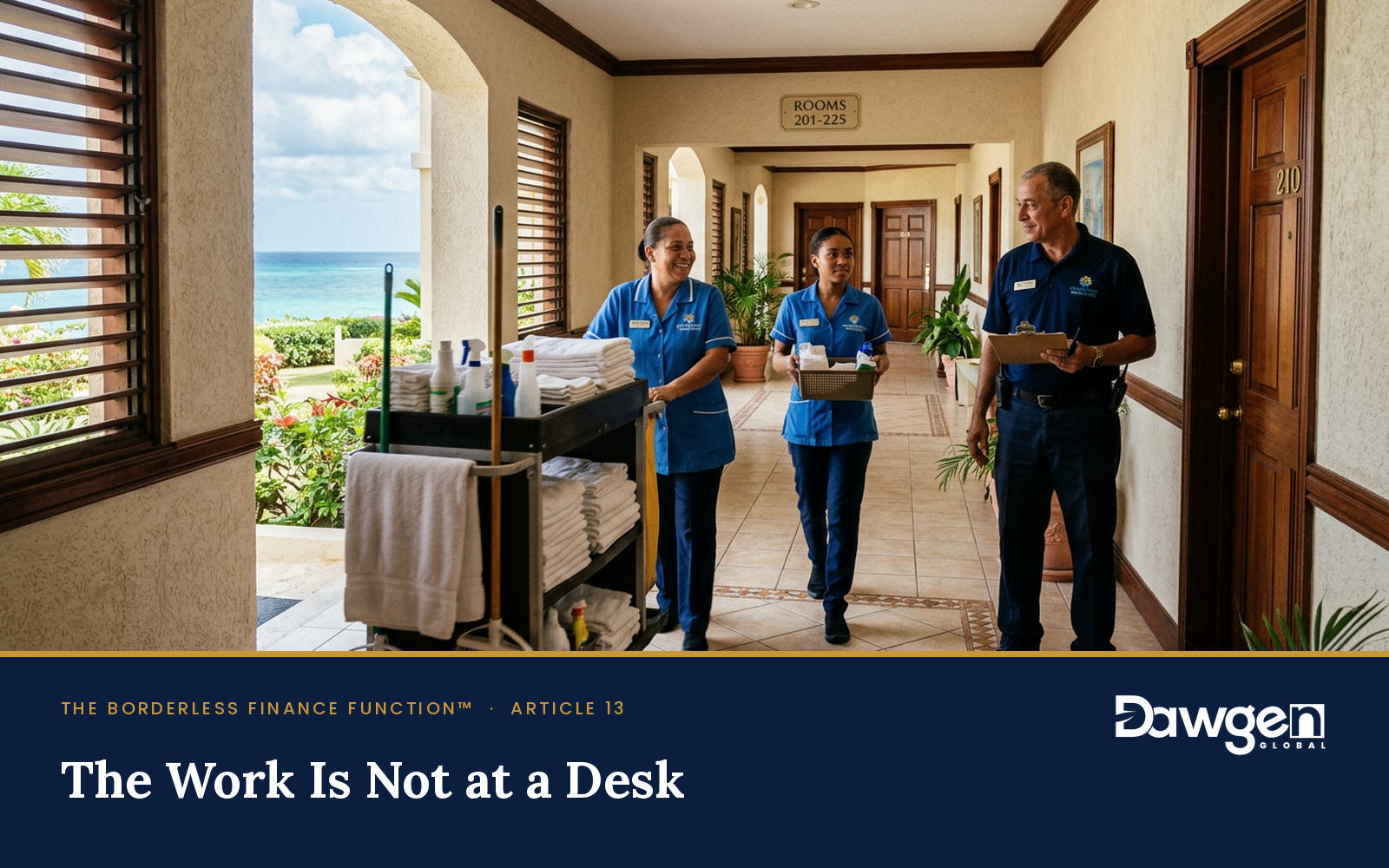
Work happens away from any office. A hotel, a haulage fleet, a farm, a construction site, a security roster. The people whose hours are the cost of sale are precisely the people not sitting at a desk, which is why attendance captured at a door misses the work it is meant to measure.
Operations are seasonal and crews are fluid. In tourism, agriculture and construction, headcount moves with the season and crews are reassigned between sites mid-week. Without capture against a cost object, the labour cost of a busy month can be stated exactly and allocated to nothing.

Overtime becomes structural rather than exceptional. Where basic pay is tight, overtime stops being an occasional response to demand and becomes part of expected household earnings. That inverts the incentive: the people best placed to control overtime are the people who rely on it, which is precisely why the approval has to sit elsewhere and has to happen first.
Approval is verbal and unrecorded. The nod in the yard, the message on a phone, the understanding that Saturday is normally worked. None of it carries a limit, a cost owner or a record, and none of it can be produced later when a client queries a bill or an employee claims unpaid hours.
SECTION 03
What it costs
Labour is usually the largest controllable cost in the business and the one measured with the least precision. The exposure is not dramatic; it is arithmetical, and it repeats on every quote.
Indicative figures, drawn from advisory experience across the region rather than from survey data:
- Ten to twenty-five per cent difference between the wage rate and the fully loaded cost of a productive hour, once employer statutory cost, leave accrual, public holidays and non-productive time are taken into account
- Three to eight per cent of payroll in overtime that was worked before it was authorised, where approval is not enforced in advance
- One to three per cent of payroll lost to transcription, where hours travel from paper to spreadsheet to payroll by hand
- Two to five days of supervisory and administrative time each month spent assembling, chasing and correcting timesheets that were never contemporaneous
- Job-level margin unknown, so loss-making contracts are renewed at the same price and profitable ones are not identified for expansion
The compounding cost is the one that does not appear as a variance. A business that prices from an understated hourly cost wins work it should have lost, on terms it cannot profit from, and interprets the resulting volume as growth. The correction, when it comes, is not an adjustment to one job. It is a repricing of the whole book.
Nobody approves an overtime shift. They approve the payslip that contains it, four weeks later, when the money has already gone.
SECTION 04
What the capability actually does
Six mechanisms turn attendance from an administrative record into a costing instrument.

Time is captured against the work, not against the building. Hours are recorded to a job, site, contract or route at the point they are worked, by the person who worked them or the supervisor present, on whatever device is actually to hand. The question the system answers is not who was here today but what this contract consumed this week.
Each employee carries a fully loaded hourly cost. Wage, employer statutory contributions, accruing leave and recurring allowances are combined into a single rate held on the employee record and updated when any component changes. Costing then uses the cost of the hour rather than the price of it, automatically, on every job.
Available hours are modelled honestly. Contracted hours less leave entitlement, public holidays and scheduled non-productive time gives the denominator that utilisation and recovery should actually be measured against. Most businesses discover at this point that their assumed availability was optimistic by several weeks a year.
Overtime is authorised before it is worked. A request is raised against a job and a limit, routed to whoever holds that limit, and approved or declined with a timestamp. Hours worked without prior authorisation are still captured and paid where they are owed — but they appear on an exception report rather than disappearing into a monthly total.
Labour posts to the job and to the ledger in one movement. The same entry that records the hour costs it to the contract and to the accounts. Job margin becomes available in the month the work was done, while the next quote for similar work is still being prepared, rather than in a post-mortem after the price has been fixed.
Exceptions are reported rather than discovered. Hours with no job attached, overtime without prior approval, employees approaching statutory or contractual thresholds, and jobs consuming materially more hours than were quoted. Each of these is a management decision waiting to be made, and each is currently being made by default.
| Two limits worth stating plainly
Time data will not rescue an underpriced contract. It will tell you that the contract is underpriced far sooner, which is valuable, but the commercial decision remains yours. And capturing time changes behaviour: introduced as a surveillance measure, it will be resisted and the data will be unreliable within two cycles. It has to be introduced, explained and used as a costing instrument, and the reports it generates should be about jobs before they are ever about people. |
SECTION 05
How the Accounting Services BPO Division delivers it
The cost object is defined before any software is configured. Job, site, contract, vessel, route, guest night, acre — the unit the business actually manages and prices. Getting this wrong makes every subsequent report precise and useless, and it is a commercial question rather than a technical one, so it is settled with management first.
Loaded rates are built and the basis is agreed in writing. Each component of the hourly cost is calculated, documented and signed off, so that when a rate is later questioned — by a client, an auditor or a manager defending a quote — the build-up can be produced rather than re-derived.
Capture is configured per workforce group. Office staff, field crews and shift workers do not record time the same way and should not be forced to. Each group gets a method appropriate to how it actually works, with the same coding structure underneath so the data consolidates.
Approval limits are the client’s, and so are the approvals. Overtime limits by role, by value and by job are configured to management’s instruction. The Division reports exceptions and reconciles the result; it does not authorise hours, and it does not release payment.
Reporting runs weekly and monthly. A weekly labour and exception report while the month can still be influenced, and a monthly pack carrying job margin, utilisation against available hours, and the leave and overtime liability reconciled to the ledger.
Rates are refreshed on a calendar, not on request. Loaded rates are rebuilt at each salary review and at each statutory parameter change, so the costing basis does not silently drift away from the payroll that feeds it.
SECTION 06
Where to start
Days 0 to 30 — do the arithmetic once, by hand. Take three representative employees and build the fully loaded cost of one of their hours, including employer statutory cost, leave accrual and available hours. Compare it with the rate used in your last quote. Then take one completed job and reconstruct what it actually consumed in hours against what was assumed. Finally, count what proportion of last month’s overtime was authorised before it was worked. Three numbers, and the case makes itself.
Days 30 to 90 — capture where the cost of sale lives. Live capture for the workforce group whose hours are billable or directly costed, coded to the agreed cost object. Loaded rates configured. Overtime approval enforced in advance at limits management has set. Leave and overtime liabilities recognised in the ledger at current rates.
Beyond 90 days — use it in the quote, not only in the report. Job margin in the monthly pack. Utilisation measured against available rather than contracted hours. Loaded rates refreshed at each review. Quoting standards updated so that no price leaves the business built on a wage rate.
The test is a single question, and it can be asked this afternoon. What does an hour of work cost this business? If the answer that comes back is the wage rate, then it is wrong, and every price the business has quoted is wrong by the same proportion — in the same direction, on every job, for as long as the answer has gone unexamined.

FREQUENTLY ASKED QUESTIONS
Six questions this raises
Is this not just surveillance of our staff?
It is if it is introduced that way, and it will fail if it is. The purpose is to attach cost to work, and the reporting is built around jobs, contracts and sites rather than around individuals. Where a business explains that intention and uses the data accordingly, adoption is straightforward; where the first report produced is a league table of lateness, the data becomes unreliable within two cycles.
Our people work in the field, not at desks. How is their time captured?
By the method that fits how they actually work — a supervisor recording a crew against a job, a mobile entry at the site, a shift roster confirmed at the end of the day. What matters is that the record is contemporaneous and coded to the cost object, not that everybody uses the same device.
What exactly goes into a fully loaded hourly cost?
The wage, the employer’s own statutory contributions, the leave that accrues as the hour is worked, and any recurring allowance that forms part of employment cost — divided by hours genuinely available after leave entitlement, public holidays and scheduled non-productive time. The build-up is documented so it can be defended rather than asserted.
We pay salaries, not hourly wages. Does any of this apply?
It applies more, not less. A salary converts to an hourly cost the moment you ask what a project consumed, and salaried staff are where unmeasured effort hides most easily. The capture can be lighter — days or half-days against a project rather than clock times — but the costing logic is identical.
Will requiring prior approval for overtime not create conflict?
It relocates a conflict that already exists. At present the disagreement happens after the hours are worked, when refusing to pay them is neither fair nor lawful. Moving the decision in front of the work means it is a scheduling conversation rather than a payment dispute, and it gives supervisors a limit to work within rather than a judgment to defend.
How is it priced?
Fixed monthly by scope — headcount, workforce groups, cost objects and reporting cadence — rather than by the hour. The rate build-up and the initial configuration are quoted separately as a one-time project with a defined deliverable, and scope is established by the Finance Function Diagnostic before any fee is quoted.
| Next step
Request the Finance Function Diagnostic. A 45-minute scoping conversation covering headcount, workforce groups, cost objects, approval limits and reporting cadence; a written recommendation on scope, division of labour and transition plan; and a fixed-scope service proposal priced by process, with service levels and exit terms stated. Dawgen Global · Accounting Services BPO Division [email protected] · dawgen.global/contact-us Caribbean (876) 926-5210 | (876) 929-3670 · United States 855-354-2447 Big firm capability without the big firm price. |
Continue reading: One Login for Finance, People and Sales Is Not a Convenience. It Is a Control. (Article 11) · Payroll Is Where Accounting Meets Employment Law. (Article 12) · The Monthly Management Pack, Page by Page. (Article 20)
Indicative figures are drawn from advisory experience across the region and are not survey output. This series addresses patterns observed across accounting and advisory engagements and does not comment on any specific client. Nothing here is legal advice on any particular employment relationship.
About Dawgen Global
Dawgen Global is an independent, integrated multidisciplinary professional services firm headquartered at 47 Trinidad Terrace, New Kingston, Jamaica, serving more than 15 territories across the Caribbean. Founded and led by Dr. Dawkins Brown, Executive Chairman, the firm is independent and not affiliated with any international network. It delivers a full suite of professional services under one roof: audit and assurance; tax advisory; IT and digital transformation; risk management; cybersecurity; actuarial and insurance regulatory advisory; HR advisory; mergers and acquisitions; corporate recovery; business advisory and strategy; accounting BPO and virtual CFO services; and legal process outsourcing.
The proposition is simple: big-firm capability without the big-firm price. Dawgen Global’s integrated approach is built for the specific complexities and opportunities of the Caribbean market, helping organizations make sharper, better-informed decisions that drive measurable progress.
To explore a partnership, reach out:
- Website: dawgen.global
- Email: [email protected]
- WhatsApp (Global): +1 555-795-9071
- Caribbean offices: +1 876-665-5926 | +1 876-929-3670 | +1 876-926-5210


