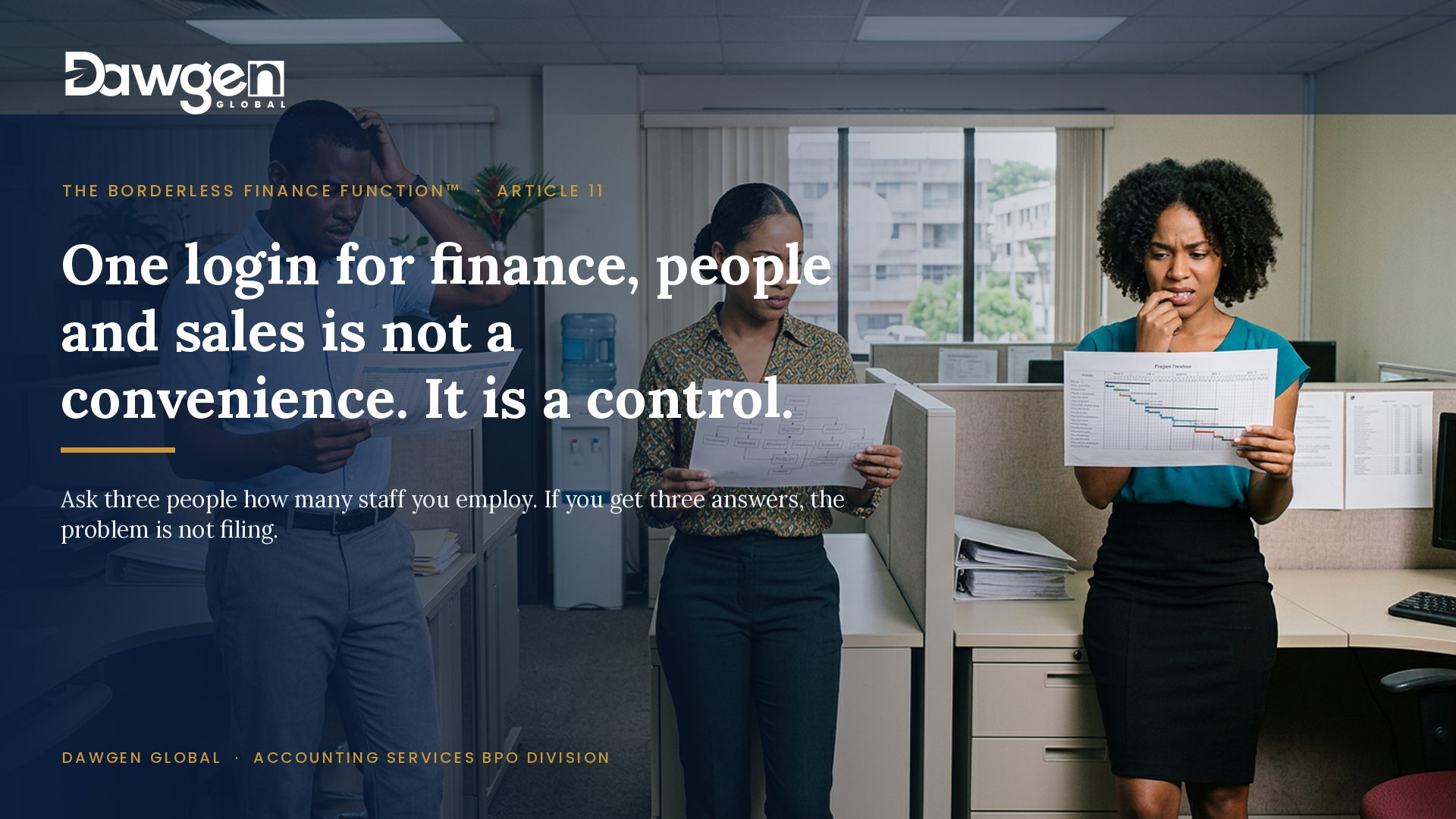
When the ledger, the payroll and the pipeline are three systems, nobody can say who approved what without asking a person. Integration is not about saving keystrokes. It is about making authority a setting instead of a habit.
IN SHORT
| An integrated business platform holds finance, people and operations in one data set under one identity per user, so an employee, a customer or an approval exists once and is visible everywhere it matters. The gain is not fewer logins. It is that authority, segregation of duties and the audit trail become system settings rather than office habits — enforced, dated and evidenced without anyone being asked to remember. |
SECTION 01
The pattern
Ask three people in the same company how many staff it employs.

The human resources file says seventy-one. The last payroll ran sixty-eight. The ledger carries seventy-four across its cost centres, because two people left in the middle of a month and one contractor has been coded to wages since January. Nobody is lying and nobody is careless. Each number is the honest output of a different system, maintained by a different person, correct as at a different date.
That is the whole problem in one question, and the answer changes nothing until somebody notices what it implies. If the business cannot agree on how many people it employs, it also cannot agree on what an hour of work costs, which means it cannot say what a job earned, which means the margin reported at the end of the quarter is an estimate presented as a fact.
Underneath sits a simpler mechanic. Every boundary between two systems is a place where a fact is typed in a second time by a person. The invoice raised in the sales spreadsheet is re-keyed into the ledger. The timesheet written on paper is transcribed into payroll. The purchase authorised in a corridor, or in a message on a phone, arrives in the accounting records as an invoice with no evidence attached that anyone authorised it at all. Each hand-off takes time, and each hand-off is an opportunity for the number to change and for the reason behind it to be lost.

The error rate is not the point. Most of these errors are eventually caught; that is what reconciliation is for, and it is why the close takes as long as it does. The point is what cannot be produced afterwards. When someone asks who approved a payment, on what information, and on what date, a fragmented business answers by asking a person — and people answer from memory, months later, without a record. That is not an administrative inconvenience. It is a control failure wearing an administrative costume, and it is usually discovered by an auditor, a lender or a buyer rather than by the owner.
SECTION 02
The Caribbean variant
Six conditions make this more acute in this region than the general literature suggests.

Groups that grew island by island. A business that trades in four territories rarely chose four systems. It acquired them, one at a time, each with its own chart of accounts, its own numbering and its own idea of what a cost centre is. Consolidation then becomes an act of translation performed in a spreadsheet by the one person who understands all four.
Statutory payroll is genuinely different in every jurisdiction. Jamaican payroll alone carries PAYE, NIS, NHT, education tax and HEART obligations on their own bases and their own filing dates; the neighbouring territory has a different scheme with different thresholds. Payroll in this region cannot be a spreadsheet bolted to a ledger, because the calculation is jurisdictional and it changes.
Finance teams are thin. In a company of sixty people the finance department is frequently two, and the same person raises the invoice, posts it, and banks the receipt. Segregation of duties cannot be achieved by adding headcount to a department that will never have headcount. If it is going to exist at all, it has to come from the system.
Selling is a relationship, so the pipeline lives on a phone. The sales director knows which three deals will close this quarter. Nobody else does, and the cash forecast is built from the receivables ledger, which by definition only knows about business that has already happened.
Season and interruption are certainties. Hurricane season arrives annually, the power goes, the office closes for a week. A server in a back room is a single point of failure for the finance function and for the evidence it holds. Browser-based access to one data set is not a modern preference; it is continuity.
At least two currencies are always in play. Sales in United States dollars, payroll in local currency, borrowings in either. Every system boundary is a place where an exchange rate gets chosen by whoever happens to be typing, and those choices are rarely documented.
SECTION 03
What it costs
The licence fee is the smallest number in this calculation, and quoting it as the cost of an integrated platform is the most common mistake made in the decision.

Indicative figures, drawn from advisory experience across the region rather than from survey data:
- 30 to 50 per cent of a small finance team’s available hours consumed by re-entry, matching and reconciliation between systems, rather than by analysis anybody reads
- Five to fifteen days added to the monthly close where payroll, time and sales have to be reconciled by hand before the ledger can be trusted
- One to three per cent of annual payroll value lost to overpayment and leakage where hours, leave and allowances are transcribed rather than captured
- Ten to twenty per cent uplift in external audit fees where evidence has to be assembled from several systems and reconciled for the auditor rather than produced from one
- Weeks of management attention each year spent settling disputes about headcount, hours and allocations that exist only because three systems hold three versions of the same fact
The largest cost is not on that list, because it does not appear in any ledger. It is the decision taken on the wrong basis: the job quoted at a margin that turned out to be a loss once labour was properly costed, the hire made against a headcount that was already wrong, the facility renewed on a cash forecast that could not see the pipeline. Fragmentation does not usually produce a crisis. It produces a slow, unremarkable pattern of decisions made on partial information, and the pattern is only visible in hindsight.
The cost of running three systems is not three licence fees. It is the labour between them, and the decisions taken while it is being done.
SECTION 04
What the capability actually does

Set the product question aside entirely. The platform tier matters less than the six mechanisms it makes possible, and those mechanisms are the same whichever integrated platform a business eventually selects.
One identity, one permission set. A user is created once and given a role. The role carries what they can see, what they can edit, and the value at which their approval stops counting. Because access is a property of the person rather than of each system, the question “who can authorise a payment of half a million dollars” becomes a report that prints in a second, and the quarterly access review becomes a routine rather than an excavation.
The employee record as the master record. A person is hired once. That single record creates the payroll entry, the time profile, the leave balance, the cost centre allocation and the system access, all carrying the same start date. When the person leaves, the same record reverses all of it on one date. The three answers to the headcount question collapse into one because there is only one place where the answer is held.
Time becomes labour cost without transcription. Hours are captured against a job or a department, the rate is drawn from the employee record, and the cost posts to both the job and the ledger in the same movement. Gross margin by job, by contract or by site becomes available in the month it was earned rather than in a review conducted after the work is finished and the price is fixed.
The pipeline becomes a document chain that ends in cash. Opportunity, quote, order, delivery, invoice, receipt — each document created from the one before it, each carrying the reference of its parent. A weighted forecast then stops being a slide in a sales meeting and becomes an input to the cash forecast, with the conversion assumptions visible and testable against what actually closed last quarter.
Approval becomes a setting rather than a habit. The limit is configured, the request routes automatically to whoever holds that limit, the decision is stamped with a name and a time, and the transaction cannot post without it. Nothing about this requires trust to be withdrawn from anybody. It requires only that the answer to “who approved this” stops being a memory and becomes a field.
One data set produces one set of numbers. Headcount, revenue, cost per hour, margin and utilisation all derive from the same records, so the report prepared by the human resources manager and the report prepared by the accountant cannot disagree. Where the group runs several entities, consolidation and intercompany matching run on that same basis rather than on a translation performed at the end of each quarter.
| Two limits worth stating plainly
Integration does not repair a process that was never defined: configure a weak approval hierarchy faithfully and the system will enforce it faithfully. And not every business needs this tier. A single-entity company with modest volumes, no employees whose time is a cost of sale and no requirement to enforce approvals is properly served by the Cloud Ledger tier, and moving it to an integrated platform buys complexity it will not use. The tier question is answered by the operating model, not by ambition or by revenue. |
SECTION 05
How the Accounting Services BPO Division delivers it

It begins with the diagnostic, not the software. Volumes, entities, users, currencies, the approval map as it actually operates, and the close cadence the business needs. The output is a written recommendation on tier, scope and division of labour. A business that does not need the integrated tier is told so.
Configuration is the engagement. Chart of accounts and entity structure, roles and the permission matrix, approval limits by value and by category, document numbering, job and cost centre structure, and statutory payroll parameters configured per territory. This is the work that determines whether the platform produces control or merely produces reports, and it is done once, deliberately, at the start.
The division of labour is fixed and it does not move. The client retains every approval and every payment release, without exception. The Division operates the ledger, processes transactions and payroll, runs the reconciliations, closes the period and issues the reporting. Dawgen never approves a transaction on a client’s behalf, and the permission matrix is built so that it cannot.
Cadence is published and held to. Transactions processed continuously as documents arrive, bank reconciliation weekly, payroll on the client’s own cycle with statutory filings prepared to their deadlines, the close run on the nine-day calendar, and the nine-page monthly management pack issued with an exceptions report attached.
Evidence is a standing output. Every posting carries its source document in the system rather than in a folder. The permission matrix is reviewed quarterly and re-issued to the board or the owner. When the auditor, the lender or a prospective buyer asks how a decision was authorised, the answer is exported rather than reconstructed.
The arrangement is reversible by design. Service levels, data portability and exit terms are stated in the proposal. The ledger, the documents and the history belong to the client, and the platform subscription can be transferred to them or to another provider without the data being held hostage to the relationship.
SECTION 06
Where to start

Days 0 to 30 — establish what is true today. List every point at which a fact is entered into a system and who enters it; count the places where the same fact is entered twice. Draft a one-page permission matrix setting out who may approve what, to what value, with no reference to any software. Then run the headcount test: ask for the number from human resources, from payroll and from the ledger, and reconcile the three answers. That reconciliation, on its own, will tell you more about the state of the finance function than a month of meetings.
Days 30 to 90 — build the spine. The employee master record built and agreed. Time capture live for the staff whose hours are a cost of sale. Approval workflow configured for purchases and payments at the limits already drafted. Payroll run in parallel for one complete cycle before cut-over, never cut over cold. Nothing here requires the whole business to move at once, and nothing here should.
Beyond 90 days — extend and compress. Pipeline data feeding the cash forecast. Multi-entity consolidation on a single basis. The close compressed toward nine days as manual reconciliation falls away. Access and approval limits reviewed quarterly as standing practice rather than as a response to an incident.
The test at the end is the one from the beginning. Ask three people how many staff you employ. If you get three answers, the issue is not filing and it is not effort. It is that authority and information live in different places, and only one of those can be fixed by working harder.

FREQUENTLY ASKED QUESTIONS
Six questions this raises
Is an integrated business platform the same as an ERP?
Substantially, yes — “ERP” is the older term. What matters is not the label but whether finance, payroll, time, approvals and customer data share one data set and one permission model. A collection of separate applications joined by periodic file transfers is integration in name; the audit trail still breaks at each boundary.
Do we have to move everything at once?
No, and it is usually a mistake. The sequence that works is the employee master record first, then time capture, then approval workflow, then the sales chain. Payroll is always run in parallel for at least one full cycle before cut-over, so the new calculation is proved against the old before anyone depends on it.
Will our outsourced accountants be able to see confidential salary information?
Only what their role permits. Permissions are set by data category rather than by system, so payroll processing can be performed with individual salary detail visible to named users only, and directors’ remuneration can be restricted further. The permission matrix is agreed in writing before configuration begins and reviewed quarterly.
We operate in four territories. Can one system handle different payroll rules?
Yes, provided the statutory parameters are configured per territory rather than assumed to be common. Each jurisdiction’s contributions, thresholds and filing deadlines are held separately while the group consolidates on one basis. This is precisely the case where a single ledger with a spreadsheet payroll stops being viable.
Can we keep our current payroll provider?
Often, yes. Where a provider is performing well, the integration point is the posting of the payroll result and the employee master data, so the ledger and the cost analysis remain complete. The question to test is whether their output can be received as structured data rather than as a PDF that someone re-types.
How is it priced?
Fixed monthly by scope — transaction volume, entities, users, payroll headcount and reporting cadence — rather than by the hour. Scope is established by the Finance Function Diagnostic before any fee is quoted, and reviewed quarterly as volumes change. Configuration is quoted separately as a one-time project with a defined deliverable.
| Next step
Request the Finance Function Diagnostic. A 45-minute scoping conversation covering volumes, systems, entities, approvals and reporting needs; a written recommendation on tier, scope, division of labour and transition plan; and a fixed-scope service proposal priced by process, with service levels and exit terms stated. Dawgen Global · Accounting Services BPO Division [email protected] · dawgen.global/contact-us Caribbean (876) 926-5210 | (876) 929-3670 · United States 855-354-2447 Big firm capability without the big firm price. |
Continue reading: Do You Need a Ledger, or an Operating System? (Article 6) · Payroll Is Where Accounting Meets Employment Law. (Article 12) · Approval Is Not a Signature. It Is a Permission Setting. (Article 22)
Indicative figures are drawn from advisory experience across the region and are not survey output. This series addresses patterns observed across accounting and advisory engagements and does not comment on any specific client.
About Dawgen Global
Dawgen Global is an independent, integrated multidisciplinary professional services firm headquartered at 47 Trinidad Terrace, New Kingston, Jamaica, serving more than 15 territories across the Caribbean. Founded and led by Dr. Dawkins Brown, Executive Chairman, the firm is independent and not affiliated with any international network. It delivers a full suite of professional services under one roof: audit and assurance; tax advisory; IT and digital transformation; risk management; cybersecurity; actuarial and insurance regulatory advisory; HR advisory; mergers and acquisitions; corporate recovery; business advisory and strategy; accounting BPO and virtual CFO services; and legal process outsourcing.
The proposition is simple: big-firm capability without the big-firm price. Dawgen Global’s integrated approach is built for the specific complexities and opportunities of the Caribbean market, helping organizations make sharper, better-informed decisions that drive measurable progress.
To explore a partnership, reach out:
- Website: dawgen.global
- Email: [email protected]
- WhatsApp (Global): +1 555-795-9071
- Caribbean offices: +1 876-665-5926 | +1 876-929-3670 | +1 876-926-5210


