
Why artificial intelligence activity keeps rising while measurable value stays flat — and how to close the gap
Emerging Risk & Transformation Services • 2026
Executive Summary

Artificial intelligence (AI) adoption is not the same thing as AI value, and the distance between them is now measurable.
The most widely cited figure comes from the Massachusetts Institute of Technology’s Project NANDA, whose July 2025 report The GenAI Divide: State of AI in Business 2025 found that 95% of generative AI pilots produced no measurable impact on profit and loss, with only around 5% generating significant value — against enterprise spending the authors put at thirty to forty billion United States dollars. The research drew on roughly 150 leader interviews, a survey of around 350 employees and analysis of 300 public deployments.
That figure deserves a caveat, and it is one an assurance firm should make rather than ignore. The study defined success narrowly: deployment beyond pilot stage with measurable performance indicators and profit-and-loss impact evidenced within six months. Several commentators have argued, reasonably, that this excludes genuine benefits that arrive later or appear outside the profit-and-loss account. The headline is therefore stronger than the underlying claim supports.
But even discounted, the direction is not seriously disputed. Organizations are running pilots. Pilots are not becoming outcomes. And the reason is rarely the technology.
This article sets out where value actually leaks — in prioritization, in readiness, in workflow design, in business cases that cannot be tested, and in benefits that were never collected — and what it takes to close each gap.
1. Adoption Is Not Value
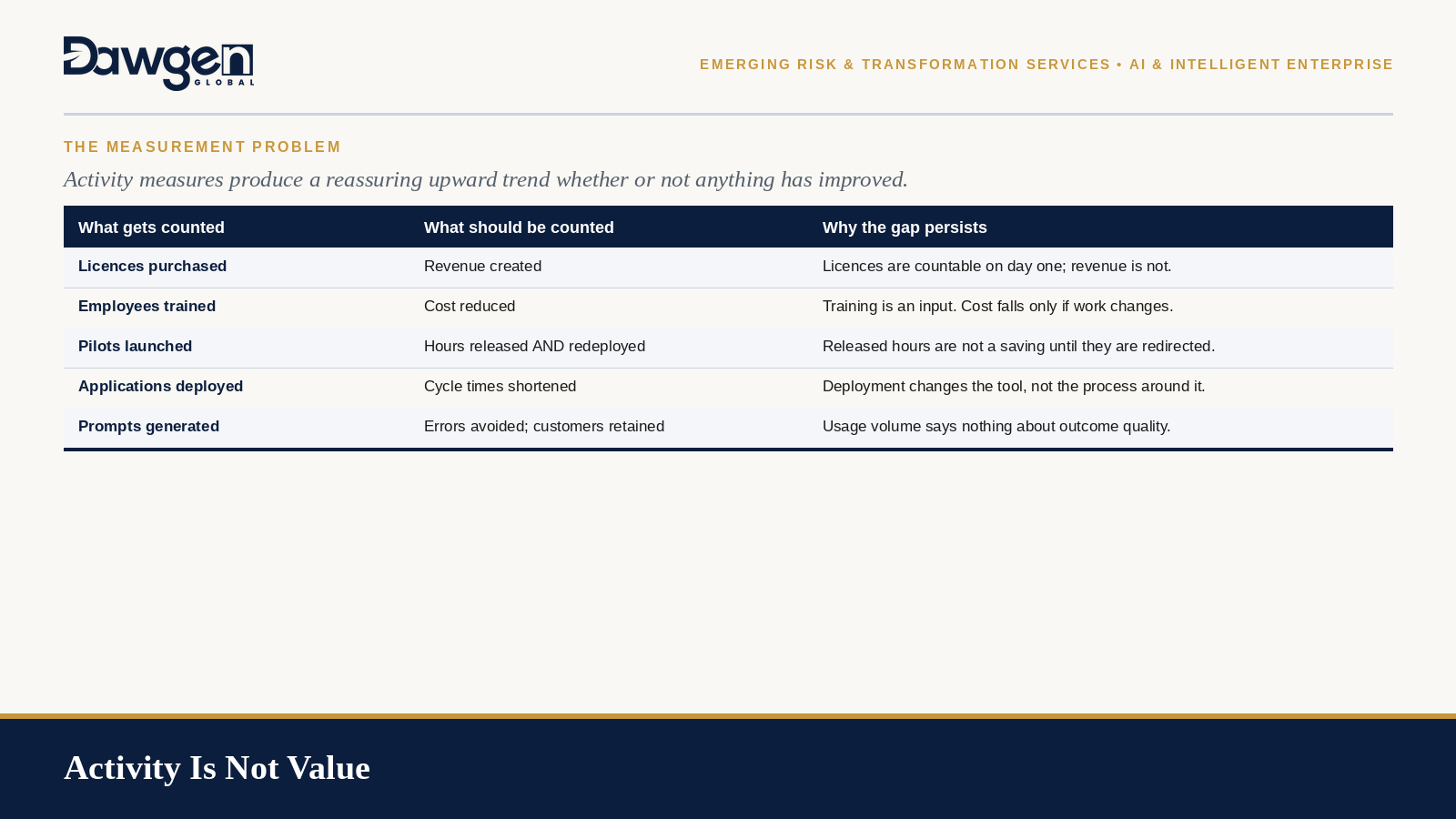
An organization can have hundreds of employees using AI, several licensed applications, multiple active pilots and rising technology expenditure, and still be unable to point to a single changed number in its management accounts.
The measures usually reported — licences purchased, employees trained, pilots launched, applications deployed — describe implementation. They say nothing about revenue created, cost reduced, cycle times shortened, errors avoided, customers retained, risk mitigated or capacity released. Activity is easy to count, which is precisely why it gets counted.
The distinction matters most at the board table, because activity measures produce a reassuring upward trend regardless of whether anything has improved.
2. Why the Gap Persists

In our experience the gap is rarely caused by the technology underperforming. It is caused by five decisions, or non-decisions, made before the technology was ever deployed.
The tool was chosen before the problem was defined. Too many opportunities were pursued at once. The business case was written in a way that could never be tested. The workflow around the tool was left unchanged. And nobody was made responsible for collecting the benefit after go-live.
Each of these is a management failure rather than a technical one, which is good news: they are all correctable without changing a single piece of software.
3. The Technology-First Trap

The sequence that produces the most disappointment is: acquire capability, then look for somewhere to apply it.
It is an understandable sequence. The capability is impressive, the vendor is persuasive, and the cost of entry is low. But it inverts the only order that reliably produces value — identify a problem that costs the organization something, understand why it costs that, and then ask whether AI is the best available way to address it. Sometimes it is. Frequently the honest answer is that a process change, a data fix or a different system would deliver more, faster, for less.
An advisor who cannot say “AI is not the answer here” is not advising.
4. Too Many Use Cases

The second failure is the opposite of too few ideas. An organization runs an ideation exercise, generates twenty or thirty opportunities, and attempts to progress most of them.
The result is predictable. Each initiative receives insufficient attention, none reaches the depth required to change an outcome, and after a year the organization has a portfolio of half-finished pilots and no completed one. Capacity — particularly the attention of the few people who understand both the business process and the technology — is the binding constraint in almost every organization, and it is spent before anything is finished.
Concentration is uncomfortable because it means saying no to ideas that are genuinely good. It is also the single most reliable predictor of whether an AI programme produces anything.
5. Business Cases That Cannot Be Tested

Most AI business cases are written to secure approval rather than to be evaluated afterwards. The difference shows in the language: “improved efficiency”, “enhanced customer experience”, “better decision-making”, “increased productivity”.
None of these can be falsified. A year later, nobody can say whether they happened, which means nobody can say whether the investment worked, which means the next investment is approved on the same basis as the last one.
A testable business case names the specific measure that will move, its current value, the expected value after implementation, the date by which the change should be visible, the person accountable for it, and — critically — the mechanism by which the benefit converts into a financial outcome. A case that cannot state that mechanism is not claiming a benefit. It is claiming a hope.
6. Adoption Without Workflow Redesign

Giving employees an AI tool while leaving the surrounding process untouched produces individual convenience and almost no enterprise value.
If the approval steps are unchanged, the handoffs are unchanged, the review requirements are unchanged and the volume expectations are unchanged, then the work still moves at the speed of the process rather than the speed of the drafting. The AI accelerates one step in a chain whose length is determined by everything else.
Value appears when the process is redesigned around the new capability: steps removed because they existed to catch errors that no longer occur in the same way, roles changed because the bottleneck has moved, handoffs eliminated because one person can now complete what previously required two. That is organizational change work, not technology deployment, and it is the part most programmes skip.
7. Time Saved Is Not Value Collected

This point is made at greater length in our companion article on AI economics, and it bears restating here because it is where the largest overstatement in most business cases sits.
Hours released are not a benefit until they are deliberately redirected. There are only four routes by which released capacity becomes a financial outcome: work that was previously deferred now gets done; volume grows without corresponding hiring; overtime or contract labour reduces; or headcount reduces through a decision the organization has actually made. If the business case does not name which of those four applies, and who owns making it happen, the saving will not arrive.
Not naming the route is not neutral. It is how a programme comes to report benefits that the finance function cannot find.
8. Readiness Is the Precondition, Not the Project
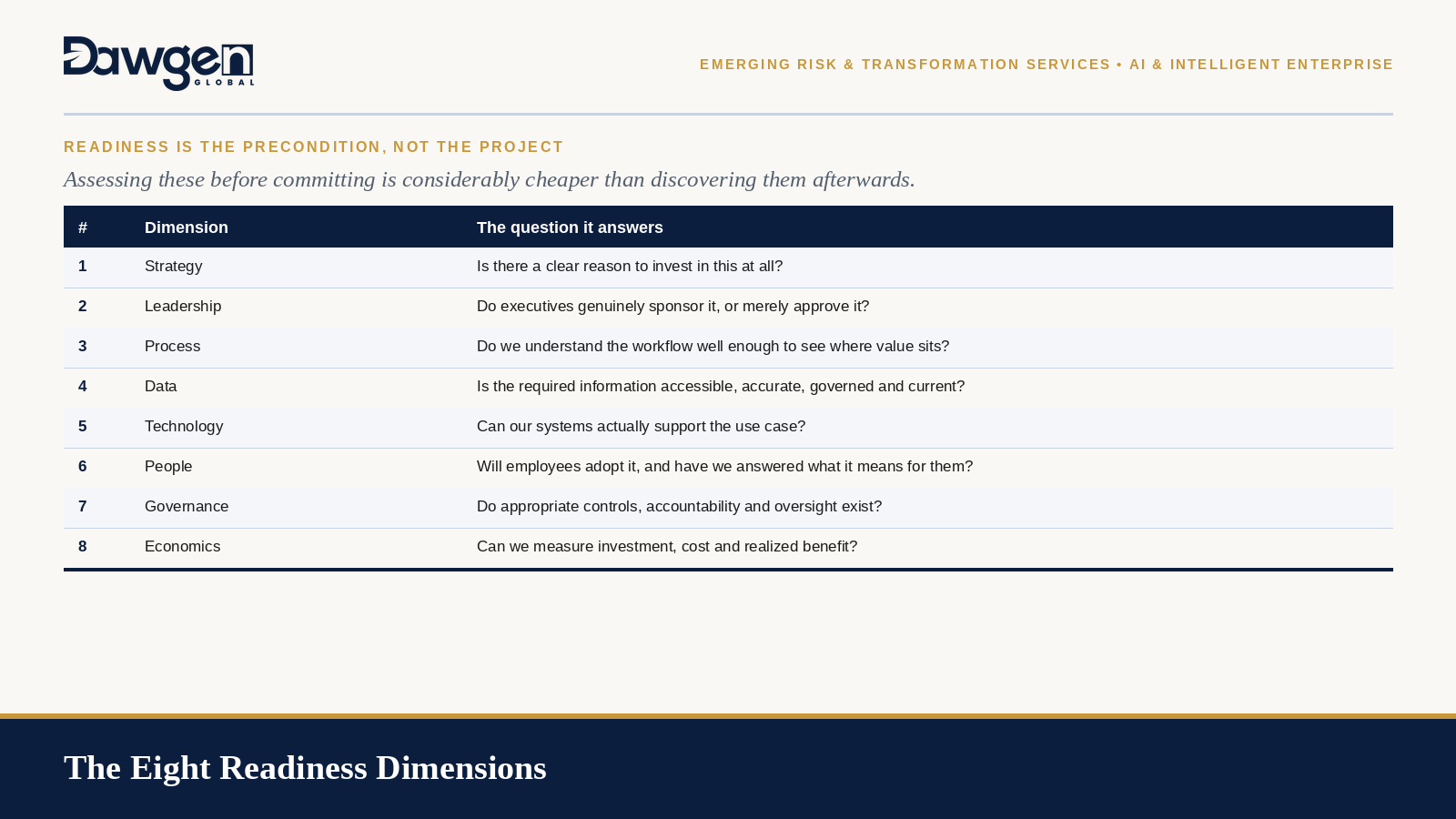
Organizations frequently discover mid-implementation that they were not ready — and readiness is rarely about the technology.
Readiness spans eight dimensions: whether there is a clear strategic reason to invest; whether executives genuinely sponsor the work; whether the process is understood well enough to see where value sits; whether the required data is accessible, reliable and governed; whether current systems can support the use case; whether employees have the capability and willingness to adopt; whether appropriate governance and controls exist; and whether the organization can actually measure investment, cost and realized benefit.
Assessing these before committing is considerably cheaper than discovering them afterwards.
9. Data Readiness Is Usually the Binding Constraint

Of the eight, data is the one that stops the most programmes, and it is the one most frequently assumed rather than checked.
The questions are ordinary. Does the required information exist in a usable form, or only inside documents and individual knowledge? Is it accurate enough that a decision can rest on it? Is it accessible without a manual extraction that becomes a permanent dependency? Is it governed, so that using it does not create a privacy or confidentiality problem? And is it current, or refreshed on a cycle too slow for the use case?
An organization that finds its data is not ready has not failed. It has found the actual project, which is frequently worth doing on its own merits regardless of what happens with AI.
10. The People Question

Adoption is the quiet determinant of value, and it is a change-management problem dressed as a technology one.
Employees adopt a tool when it makes their work better, when they trust its output, when using it is not slower than the alternative, when they understand what they remain responsible for, and when the organization has been honest about what it means for their role. They do not adopt when the tool is imposed, when its errors cost them credibility, or when nobody has answered the question everyone is asking privately.
That question deserves a direct answer rather than a reassuring evasion. Organizations that avoid it get low adoption and cannot explain why.
11. Prioritization: Value, Feasibility and Time to Impact

Ranking opportunities is where most of the available value is either captured or lost.
The assessment should weigh economic benefit, strategic importance, technical feasibility, data availability, process readiness, implementation effort, time to first measurable impact, and risk. A high-value opportunity sitting on unready data belongs behind a smaller one that can be delivered now — because the smaller one produces evidence, and evidence is what funds the next round.
12. Measuring What Actually Changed

Measurement has to be designed before implementation, because the baseline can only be captured beforehand.
The organization needs the current value of the target measure, a defined measurement method that will not change, a comparison population or period where possible, agreement on what would count as success, and a date on which the question will be asked. Without a baseline, the post-implementation debate becomes a contest of assertions, and the assertion of the person who sponsored the investment usually wins.
13. Scale, Stop or Redesign

Every AI initiative should reach a decision point at which one of three things is chosen deliberately.
Scale where the benefit is evidenced and the constraint to wider deployment is understood. Redesign where the idea is sound but the implementation, data or workflow is not. Stop where the benefit is not there.
Stopping is the decision organizations find hardest and need most. A portfolio in which nothing is ever stopped is not a portfolio; it is an accumulation, and it consumes the capacity that the next opportunity needs. The willingness to stop is what distinguishes an AI investment programme from an AI collection.
14. The Caribbean Context

Four features of the regional market shape how value realization works here.
Capacity is the constraint rather than capital. Most Caribbean organizations can fund an AI initiative; far fewer can release the people who understand the process well enough to redesign it. This makes concentration on few use cases more important here than in larger markets, not less.
Process documentation is frequently thin, with critical knowledge held by long-serving individuals rather than written down. That slows the analysis phase and it also means the analysis produces value on its own, independent of the AI.
Scale changes which use cases pay. A workflow that justifies automation at ten thousand transactions a month may not at four hundred. Benchmarks drawn from larger markets can mislead, and the honest answer for some regional use cases is that the volume does not support the investment yet.
And group structures across territories create an advantage that is frequently unused: the same process often runs in several entities, so one well-designed solution can be deployed multiple times. That changes the economics materially — but only if the group looks at its processes as a group rather than as a set of separate companies.
15. Composite Caribbean Case Study

From twenty-seven ideas to four investments
A composite Caribbean organization generated 27 potential AI ideas across customer service, finance, collections, marketing, onboarding, procurement, contracts and analytics. Management’s initial instinct was to pilot as many as possible.
A structured assessment evaluated each against economic benefit, feasibility, process readiness, data availability, implementation effort, risk and time to value. Four represented the strongest combination of impact and deliverability. Several others were genuinely valuable but required process or data improvement first. Some did not justify their complexity at the organization’s transaction volumes.
Management redirected investment to the four, established baselines and named owners for each, and set a review point at six months. Two scaled, one was redesigned after the first attempt did not move the measure, and one was stopped.
The benefit was not identifying where AI could be used. It was establishing where AI should be used first — and being willing to stop the one that did not work.
This is an anonymized composite illustration drawn from patterns commonly observed in the region. It does not describe any specific Dawgen Global client.
16. The Value Realization Lifecycle
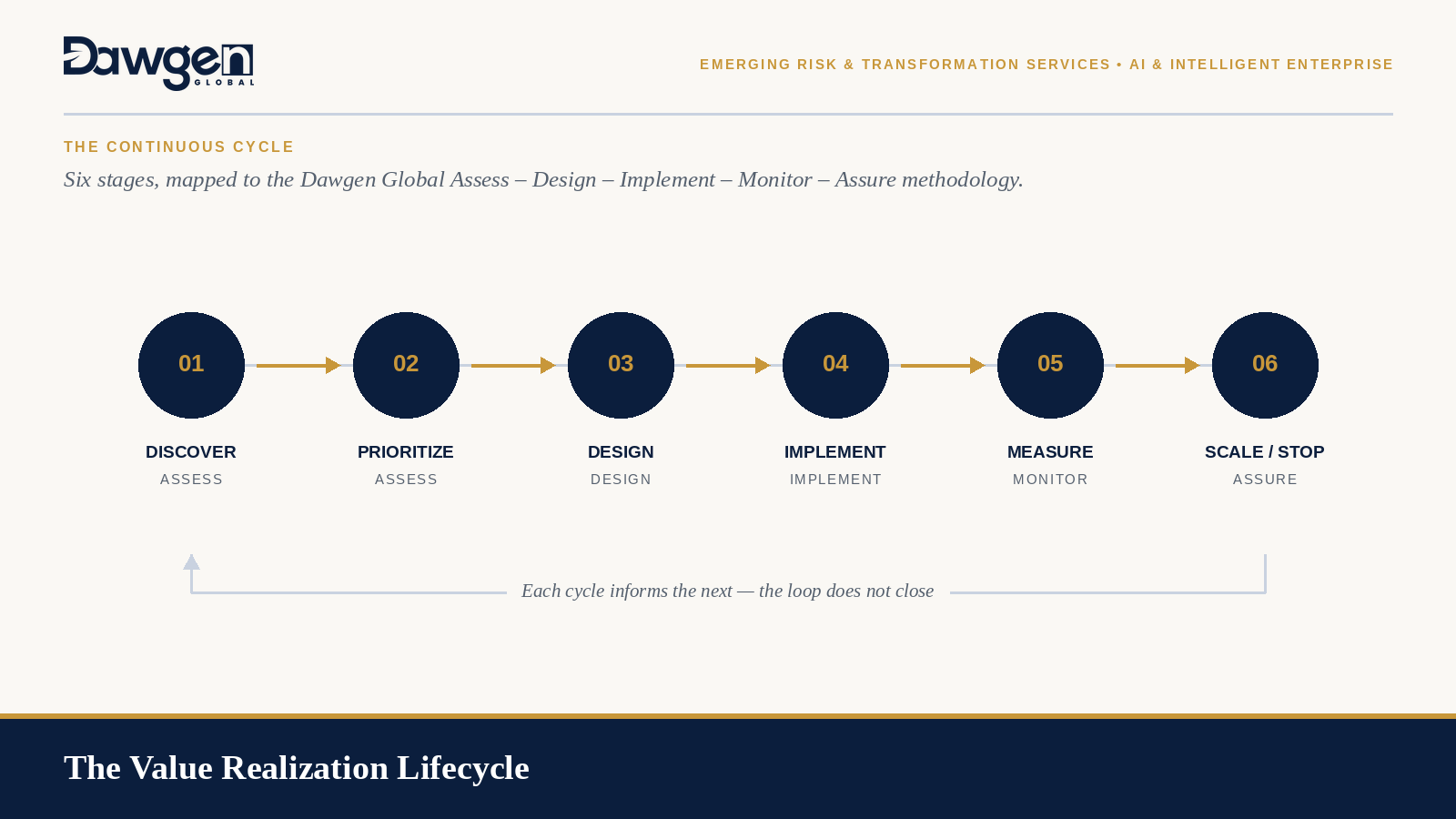
Six stages, delivered within the Dawgen Global Assess – Design – Implement – Monitor – Assure methodology.
17. What Management and Boards Should See
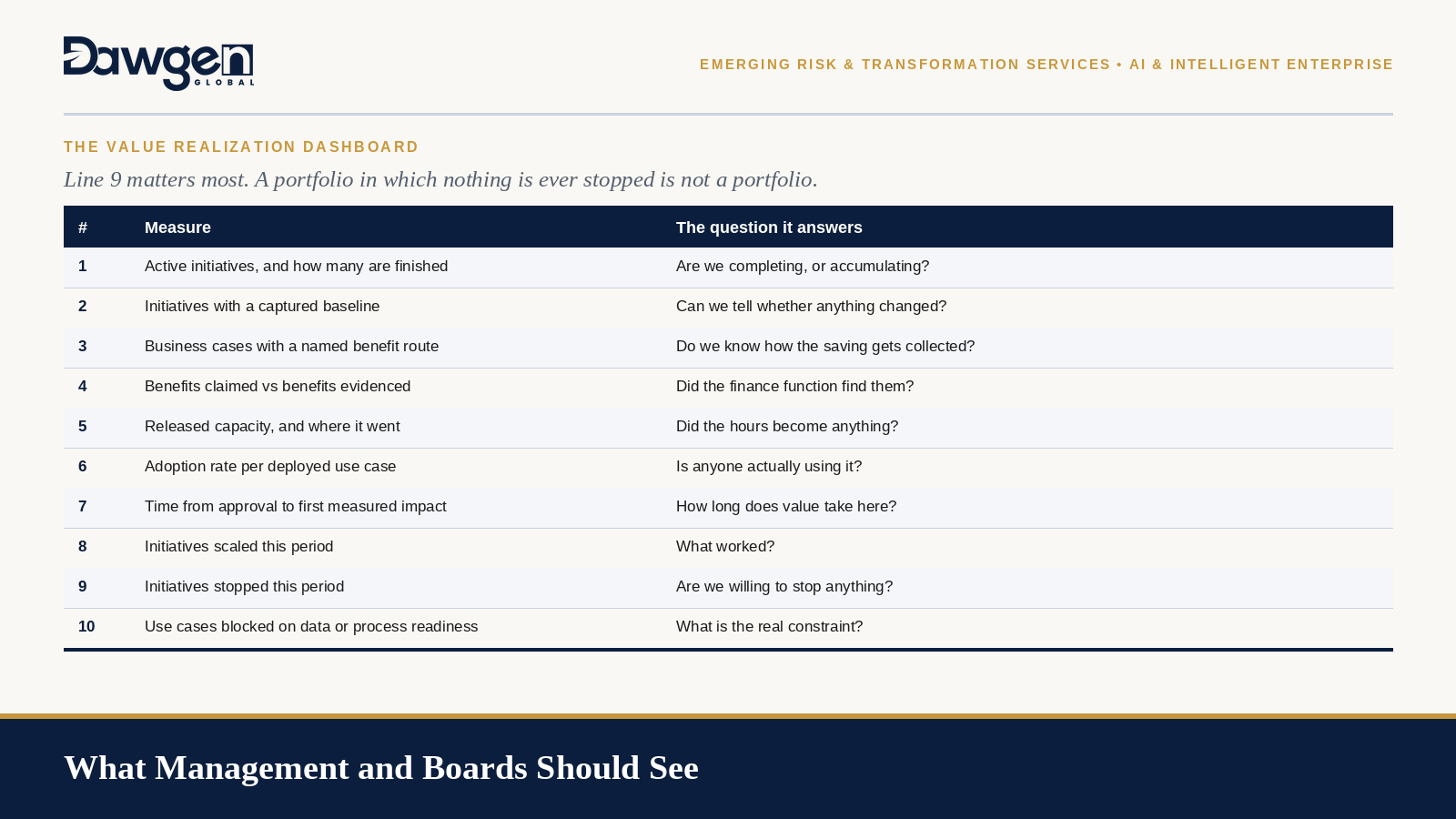
Ten measures that distinguish AI activity from AI value.
18. Questions Boards and Executives Should Ask
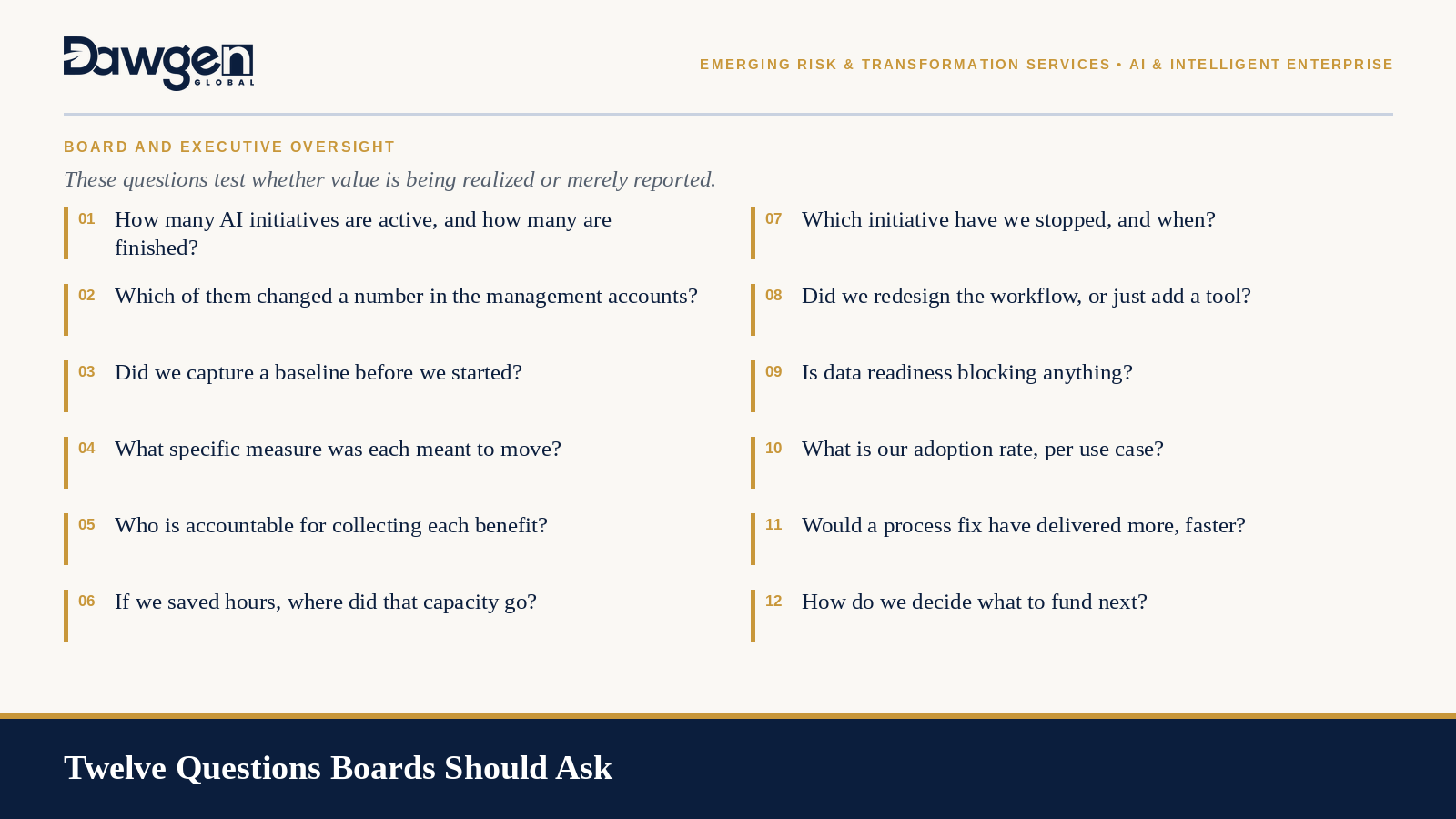
Twelve questions that test whether value is being realized or merely reported.
19. The Dawgen Global Perspective

The organizations that get the most from AI are not those that adopt it most enthusiastically. They are those that choose fewer things, prepare properly, redesign the work around the capability, measure honestly against a baseline they captured beforehand, and stop what is not working.
None of that is specific to AI. It is ordinary investment discipline. What is specific to AI is the ease with which it can be adopted without any of that discipline — which is exactly why so much adoption has produced so little measurable change.
20. How Dawgen Global Can Help
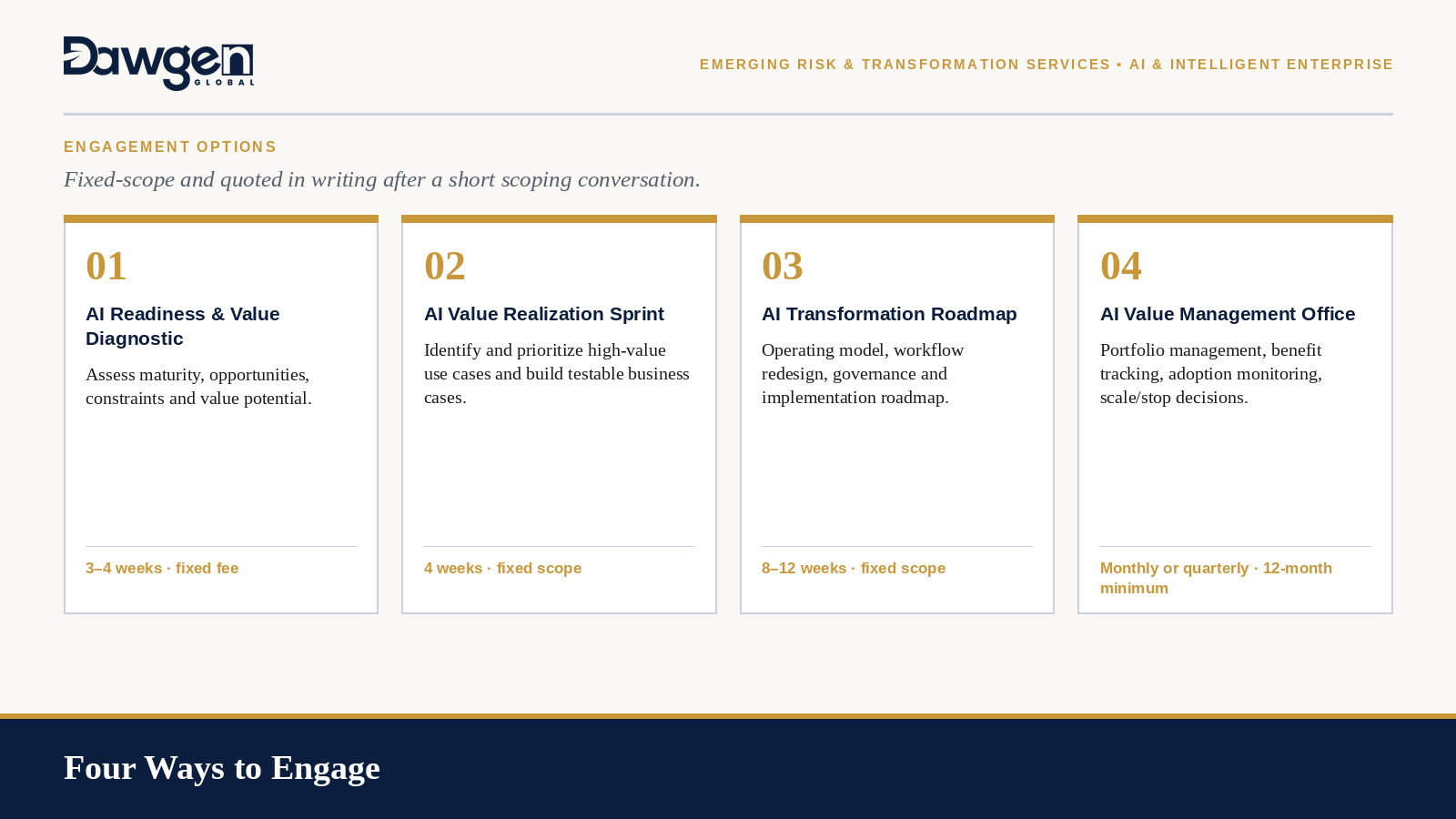
We help organizations assess AI readiness, prioritize use cases against value and feasibility, build business cases that can actually be tested, redesign the workflows around the capability, establish baselines and measurement, and reach evidenced scale, stop or redesign decisions.
Conclusion

Somewhere in most organizations there is a pilot that was declared a success and changed nothing.
It worked. The technology performed. A report was written. And the management accounts look exactly as they would have looked if it had never happened. That is not a failure of artificial intelligence. It is a failure to decide, in advance, what would be different — and to make someone responsible for ensuring that it was.
AI adoption is not the objective. Business value is.
Start with the Dawgen AI Readiness & Value Diagnostic
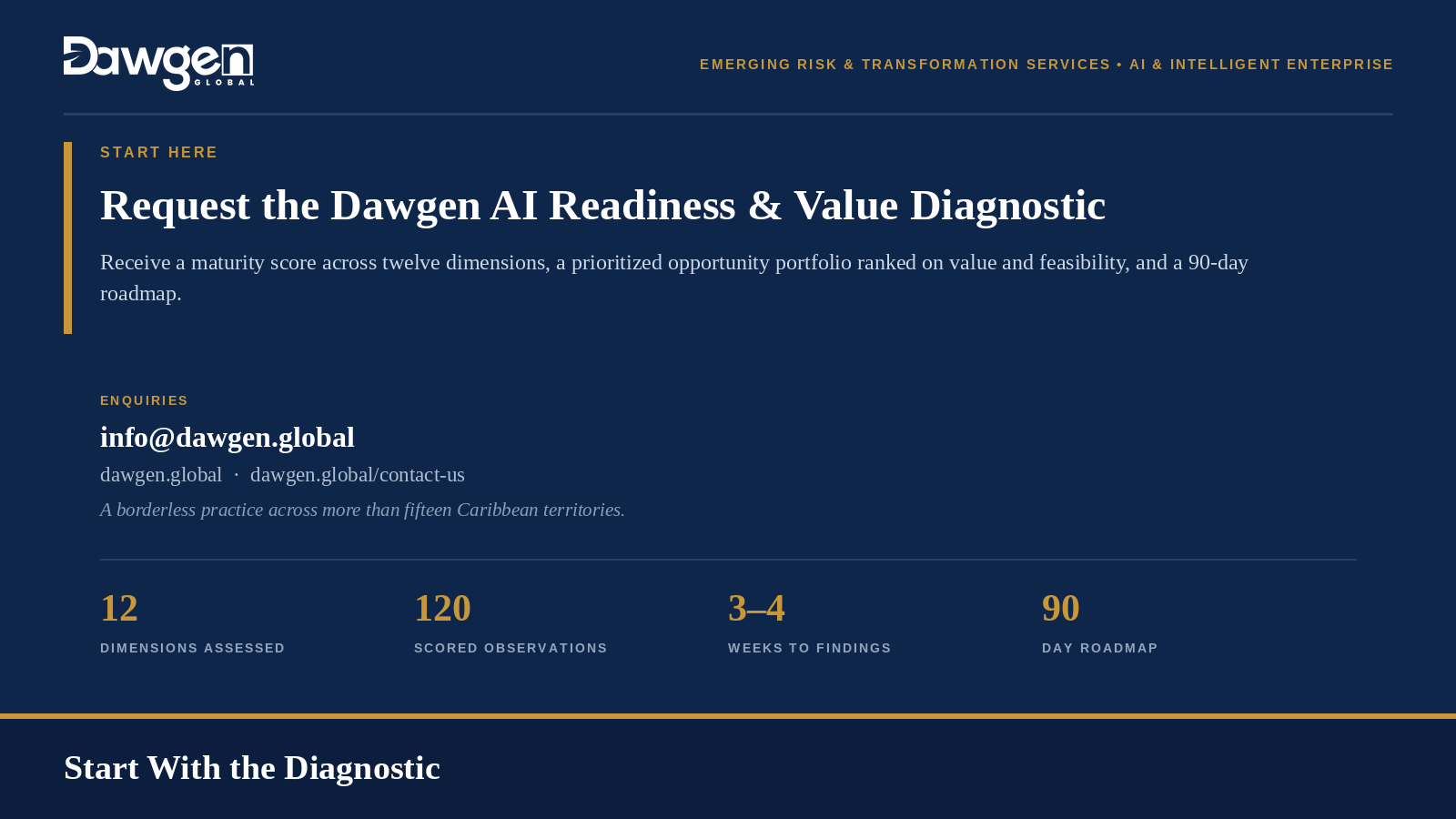
The Diagnostic examines AI strategy, executive alignment, current AI use, process readiness, data readiness, technology, workforce capability and adoption, governance, risk, economics, measurement and benefit realization, and change readiness — across 12 dimensions and 120 scored observations. The result is a maturity score, a prioritized opportunity portfolio and a 90-day roadmap.
Typical duration. 3–4 weeks. Delivery model. Remote, hybrid or on-site across the Caribbean. Fees. Fixed-scope and quoted in writing after a short scoping conversation.
Dawgen Global helps organizations make Smarter and More Effective Decisions.
Dawgen Global operates as a borderless practice across more than fifteen Caribbean territories. Enquiries arising from this publication are handled by email and routed to the relevant service line, wherever the client and the specialist happen to sit.
Sources
- Massachusetts Institute of Technology, Project NANDA. The GenAI Divide: State of AI in Business 2025. July 2025. Cited for the finding that 95% of generative AI pilots produced no measurable profit-and-loss impact, with approximately 5% generating significant value. Reported sample: approximately 150 leader interviews, a survey of approximately 350 employees, and analysis of 300 public AI deployments. Sample figures have been reported inconsistently across secondary coverage.
Important Notices
Client acceptance. All requests for Dawgen Global services are subject to the firm’s client acceptance procedures, including an independence and conflict-of-interest check, before any engagement is accepted.
Independence and scope of service. Where Dawgen Global or an associated firm provides audit or other assurance services to an entity, the services described in this article are provided only to the extent permitted by applicable ethical and independence requirements, including the International Code of Ethics for Professional Accountants issued by the International Ethics Standards Board for Accountants (IESBA). Dawgen Global does not provide independent verification of benefits arising from a programme the firm itself designed for an assurance client.
Nature of the work. Unless an engagement letter expressly provides otherwise, the services described here are advisory in nature. They are not an audit, review or assurance engagement performed under International Standards on Auditing or International Standard on Assurance Engagements 3000 (Revised), and no assurance opinion or conclusion is expressed.
Forward-looking estimates. Business cases, benefit estimates and value projections are prepared from information supplied by management and from assumptions agreed with management. They are estimates of future outcomes, which depend on events and circumstances that may not occur as anticipated. Actual results will differ, and Dawgen Global does not warrant that any projected benefit will be achieved.
Third-party research. Statistics attributed to third parties are taken from the sources listed and have not been independently verified by Dawgen Global. Where a study’s methodology has attracted substantive criticism, that criticism is noted in the text.
Illustrative material. Case studies are anonymized composite illustrations drawn from patterns commonly observed in the region and do not describe any specific Dawgen Global client.
General information only. This article is general in nature, does not take account of the circumstances of any particular organization, and should not be relied upon as professional advice.
Dawgen Global is an independent, integrated multidisciplinary professional services firm and is not a member of any international network.
© 2026 Dawgen Global. All rights reserved.
About Dawgen Global
Dawgen Global is an independent, integrated multidisciplinary professional services firm headquartered at 47 Trinidad Terrace, New Kingston, Jamaica, serving more than 15 territories across the Caribbean. Founded and led by Dr. Dawkins Brown, Executive Chairman, the firm is independent and not affiliated with any international network. It delivers a full suite of professional services under one roof: audit and assurance; tax advisory; IT and digital transformation; risk management; cybersecurity; actuarial and insurance regulatory advisory; HR advisory; mergers and acquisitions; corporate recovery; business advisory and strategy; accounting BPO and virtual CFO services; and legal process outsourcing.
The proposition is simple: big-firm capability without the big-firm price. Dawgen Global’s integrated approach is built for the specific complexities and opportunities of the Caribbean market, helping organizations make sharper, better-informed decisions that drive measurable progress.
To explore a partnership, reach out:
- Website: dawgen.global
- Email: [email protected]
- WhatsApp (Global): +1 555-795-9071
- Caribbean offices: +1 876-665-5926 | +1 876-929-3670 | +1 876-926-5210


