A practical guide to customer trust, decision rights, human oversight and assurance in the age of autonomous AI agents
Emerging Risk & Transformation Services • 2026
Executive Summary
Artificial intelligence is moving rapidly from assisting customer-service employees to interacting directly with customers and taking action on an organization’s behalf. An AI agent may no longer simply answer a question. It may retrieve account information, interpret a request, recommend a product, update a record, schedule a service, issue a concession, initiate a transaction or hand work to another AI system. That transition creates significant opportunities for faster service, greater availability and lower operating cost, but it also transfers decision rights from people and traditional software workflows to increasingly autonomous systems.
The governance challenge is therefore different from the familiar chatbot problem. Organizations must decide what each agent is allowed to know, decide and do; how the customer will be informed; when human intervention is mandatory; how sensitive data will be protected; how errors and complaints will be corrected; and how management can reconstruct the sequence of events if an interaction is challenged. PwC has described AI agents as emerging workforce counterparts that require verified identity, defined roles, task-specific permissions and auditable records. Boston Consulting Group (BCG) similarly argues that fragmented platform-by-platform governance will not be sufficient as agent populations scale. The United States National Institute of Standards and Technology (NIST) has highlighted the importance of strong identity foundations for agentic systems. These are not abstract technology concerns. They are customer, conduct, legal, operational and reputational issues.
For Caribbean organizations, the opportunity is particularly significant. Banks, insurers, credit unions, telecommunications companies, utilities, retailers, tourism businesses and public agencies all operate high-volume customer processes that can benefit from AI-enabled service. At the same time, relatively concentrated markets mean that a serious customer-trust failure can spread quickly across communities and media channels. The appropriate objective is therefore not maximum autonomy. It is governed autonomy: using AI where it creates measurable value while preserving accountability, fairness, transparency, human redress and evidence.
This article explains agentic customer experience (CX) from first principles and proposes a practical governance architecture built around six stages: Discover, Classify, Design, Control, Monitor and Assure. The central principle is simple: when an AI agent acts on behalf of the organization, the organization remains accountable for the customer outcome.
1. From Chatbots to Agents: What Has Changed?
For many years, customer-facing automation meant interactive voice-response menus, scripted chatbots and rules-based self-service portals. These systems could be frustrating, but their behaviour was relatively constrained. A conventional chatbot might identify keywords and return a predefined answer. If the customer needed anything more complex, the interaction was handed to a human employee.
Generative AI changed the quality of the conversation. Systems could interpret natural language, summarize context and generate individualized responses. Agentic AI extends that capability further. An AI agent is designed not only to produce content but to pursue an objective, select intermediate steps, use tools and take actions within defined permissions. In a customer context, this means the system can move from describing what should happen to actually doing it.
A service agent might authenticate a customer, retrieve records, identify a billing problem, select an approved remedy, update the account and confirm completion. A retail agent might recommend a product, search inventory, apply an eligible promotion and place an order. A travel agent might rebook an itinerary when disruption occurs. The value can be substantial because the agent can coordinate tasks across systems rather than merely answer questions.
Salesforce reported in May 2026, in its State of Service: AI Agents Edition survey of 3,075 customer-service professionals, that adoption of AI service agents among surveyed organizations had increased from 39 percent to 66 percent in a year, and that customer satisfaction was the most commonly improved key performance indicator among adopters. In August 2026, its Agentic Enterprise Index also reported rapid growth in deployed agents and agent-performed work. Vendor research should be interpreted carefully, but the direction is clear: agentic customer service is moving from experiment to operating model.
2. Why Agentic Customer Experience Creates a New Governance Problem

The critical difference is agency. When software can act, the organization is effectively delegating a portion of operational decision-making to a digital actor. McKinsey has summarized the issue by describing agency as a transfer of decision rights. That framing is useful because governance is fundamentally about rights, responsibilities and accountability.
The old question for a chatbot was often whether the answer was accurate. The new questions include whether the agent was authorized to access the information, whether it had authority to perform the action, whether the action was reversible, whether the customer understood what was happening, whether a human should have intervened and who is accountable if the outcome is wrong.
The problem becomes more complex when customer-facing agents interact with multiple platforms. PwC has highlighted that an individually authorized action in one system can trigger another individually authorized action elsewhere, creating an end-to-end risk that no single platform control sees. Customer journeys frequently cross customer relationship management, billing, enterprise resource planning, payments, identity, marketing and case-management platforms. Governance therefore has to follow the transaction across the journey rather than stopping at the boundary of a particular application.
3. Customer Trust Must Be Designed Into the Experience

An organization may technically be able to automate a process without customers being comfortable with that automation. Trust depends on whether the customer perceives the interaction as competent, fair, transparent and capable of correction.
Transparency is particularly important. Customers should not be manipulated into believing they are dealing with a human when disclosure is required or appropriate. The exact legal obligation varies by jurisdiction and use case, but a sound governance programme should establish when customers are told that AI is involved, what information should be provided and how that disclosure should be made without creating unnecessary friction.
Trust also depends on redress. A customer who believes an agent made a mistake needs a meaningful route to challenge the outcome. “The system decided” is not an acceptable operating principle. Organizations should define when an interaction can be escalated, how a human reviewer gains access to the context, whether the action can be reversed and how complaints involving AI are classified and monitored.
4. Start With an Agent Inventory and Customer-Journey Map

Governance begins with visibility. An organization cannot govern agents it does not know exist. Customer-facing AI can enter through dedicated agent platforms, customer relationship management products, contact-centre software, marketing systems, websites, mobile applications, cloud tools and third-party service providers.
An agent inventory should record the agent name, business owner, customer journey, purpose, channels, systems accessed, data used, tools invoked, actions permitted, financial authority, autonomy level, human-review requirements, vendor, risk classification and date of last review.
The customer-journey map adds a second layer. It should show where the agent enters the journey, what it receives, what it can change, which systems it touches, where handoffs occur and where a human can intervene. Mapping the journey is important because an apparently low-risk conversational step may trigger a high-risk downstream transaction.
5. Classify Agents by Consequence, Not by Novelty

Not every agent requires the same governance intensity. A website agent that answers opening-hours questions does not create the same exposure as an agent that can reverse a fee, recommend insurance coverage, alter a payment arrangement or influence credit eligibility.
A practical classification should consider customer impact, financial impact, legal or regulatory consequence, data sensitivity, level of autonomy, reversibility, vulnerability of affected customers, external communication risk and the number of downstream systems involved.
Lower-risk agents may require approved content sources, basic disclosure, monitoring and easy escalation. Moderate-risk agents should generally have defined identity, task-specific permissions, validation, transaction boundaries and stronger logging. Higher-risk agents may require mandatory human approval for specified actions, strict authority limits, independent testing, enhanced evidence, periodic control assurance and board-level visibility.
The principle is not that high-risk AI should never be used. It is that greater consequence should result in greater oversight.
6. Identity and Access: Every Agent Needs a Governed Digital Identity

Human employees have identities, roles and access rights. Agents increasingly need comparable treatment. PwC argues that each agent should have a verified identity, defined role, task-specific permissions and auditable records. NIST has similarly warned that agentic deployments are sometimes prioritizing functionality over identity and security foundations.
An agent should not use a broad shared credential simply because that is technically convenient. Management should be able to determine which digital actor performed an action, what permissions it had at the time and which policy allowed the action. Permissions should follow least-privilege principles: the agent receives only the access required to perform its approved tasks.
Identity governance becomes even more important when agents invoke other agents or tools. The organization needs rules governing delegation, impersonation, credential use, session duration and revocation. When an agent is retired or its purpose changes, access should change accordingly.
7. Define Decision Rights and Transaction Authority

One of the most important design exercises is establishing what the agent may decide and do independently. Organizations routinely establish authority limits for human employees. Agentic systems need equally explicit decision boundaries.
For example, a service agent may be authorized to waive a late fee below a specified amount when predefined eligibility conditions are met, but anything above that amount requires human approval. A telecommunications agent might be able to apply an approved retention offer but not design an unapproved discount. A banking agent might provide factual product information but not make a regulated recommendation without the appropriate controls.
Decision-rights frameworks should distinguish information retrieval, recommendation, preparation of action, execution of action and irreversible action. A useful maturity progression is Observe, Advise, Act with Approval and Act Autonomously. Movement toward autonomy should be earned through evidence of performance, not assumed because the technology is capable of it.
8. Human Oversight Must Be Operational, Not Decorative

Organizations often state that a human remains “in the loop.” That phrase is too vague for meaningful governance. The organization must define exactly when human involvement is required and what the human is expected to do.
Human intervention may be mandatory when the agent lacks confidence, the customer disputes information, the transaction exceeds an authority threshold, the customer is potentially vulnerable, a complaint is detected, the interaction concerns a sensitive regulated issue, the agent encounters conflicting data or the requested action is difficult to reverse.
The handoff itself should be designed. The human should receive the relevant context, not force the customer to repeat the entire interaction. The employee should be able to see what the agent did and why, identify any unresolved uncertainty and take control. Poor handoff design can destroy the service benefits that automation was intended to create.
9. Fairness, Vulnerable Customers and Conduct Risk

Customer-facing AI can influence who receives attention, which offer is presented, how a complaint is classified and what resolution is proposed. Those decisions may create fairness or conduct concerns even where the underlying model is not making a formal regulated decision.
Organizations should test whether different customer groups experience materially different outcomes without legitimate reason. They should also consider vulnerable customers, including people facing disability, financial hardship, language barriers, low digital literacy or distress. An agent optimized purely for efficiency may mishandle situations requiring empathy, judgment or special procedures.
Governance should therefore include prohibited practices, sensitive-situation detection, escalation rules, fairness testing, complaint analytics and management review of customer-outcome patterns.
10. Data Governance and Privacy

Agentic customer service depends on context. The more an agent knows about the customer, the more useful it can become. That also increases data risk.
Organizations should define which customer data the agent may access, whether access is necessary for the task, how sensitive data are handled, what information is retained in prompts or logs, whether the vendor can reuse data and how long interaction records are preserved. Cross-border processing may also be relevant for Caribbean organizations using global cloud platforms.
Data governance should follow the principle of purpose limitation: access should be appropriate to the service being provided. An agent helping a customer reset a password may not need access to the same financial or health information available elsewhere in the enterprise.
11. Accuracy, Hallucination and Source Controls

An agent that communicates with customers can generate incorrect information confidently. That becomes particularly dangerous when the agent explains fees, contractual rights, regulatory obligations, product terms or service commitments.
Where possible, organizations should ground customer agents in approved information sources and constrain answers to authoritative material. Content sources should have owners, update procedures and effective dates. The organization should test how the agent behaves when information is missing, contradictory or out of date.
For higher-risk content, the correct behaviour may be to decline to answer and escalate rather than improvise. Governance is therefore partly about teaching the system when not to act.
12. Cross-Platform Control and the Agentic Control Plane
As agents scale, governance cannot depend solely on each platform having adequate controls. BCG has argued for an enterprise AI control plane that unifies identity, policy enforcement, visibility and governance across a multi-agent environment. Salesforce is likewise developing control-plane and agent-fabric concepts because fragmented governance becomes increasingly difficult as agents operate across enterprise systems.
The precise technology architecture will vary, but the governance principle is important. Management needs enterprise-level visibility over agents, identities, permissions, policies, actions, exceptions and cost. Otherwise, an organization may end up with dozens of individually governed agents whose combined behaviour creates risks no one owns.
13. Monitoring: Measure Customer Outcomes, Not Just Agent Uptime
Once an agent is deployed, governance must continue. A system can pass pre-deployment tests and still create problems as customer behaviour, data, integrations, models and business policies change.
Useful monitoring indicators can include autonomous-resolution rate, human-escalation rate, repeat-contact rate, complaint rate, customer satisfaction, transaction reversals, policy exceptions, failed tool calls, hallucination incidents, vulnerable-customer escalations, unauthorized-action attempts and unresolved cases. Management should also watch for drift: the gradual change in performance or behaviour as conditions evolve.
Operational metrics should be paired with risk metrics. A rising autonomous-resolution rate may look positive until complaint severity also rises. The objective is not maximum automation; it is sustainable customer value within approved risk tolerance.
14. Incident Management and Customer Redress

Organizations need a specific incident framework for agentic customer interactions. An incident might include an unauthorized transaction, disclosure of confidential information, misleading advice, discriminatory treatment, repeated hallucination, failure to escalate a complaint, security compromise or material deviation from approved policy.
The response process should define detection, containment, customer notification where appropriate, reversal or remediation, root-cause analysis, regulatory escalation, vendor involvement and control improvement. Customer redress should be practical. Where an AI action caused a problem, the customer should not carry the burden of proving the internal technology failure.
15. Assurance and Auditability
As agentic systems become more consequential, boards, regulators, auditors, customers and business partners will increasingly ask for evidence that governance controls operate. A policy saying that agents have authority limits is less persuasive than logs demonstrating that those limits were enforced and exceptions were reviewed.
Assurance-ready governance should therefore retain evidence of agent approval, risk classification, permissions, testing, source controls, human overrides, incidents, complaints, policy exceptions, model or configuration changes and remediation. Higher-risk agents may justify periodic independent control testing.
The objective is not to create documentation for its own sake. It is to make the organization capable of answering a challenge: what happened, why did it happen, what control applied, who was accountable and what evidence supports the answer?
16. Caribbean Considerations
Caribbean organizations operate in diverse legal and regulatory environments, but several practical features make agentic CX governance particularly important. Many institutions rely on global technology vendors and cloud infrastructure. Customer-service operations may span multiple islands and languages. Regulated sectors such as banking, insurance, telecommunications and utilities have strong customer-treatment expectations. Tourism and retail businesses serve international customers whose home-jurisdiction expectations may influence service design.
Relatively small markets can also magnify reputational consequences. A poor automated interaction involving a vulnerable customer, financial loss or perceived unfairness can move rapidly through social media and traditional media. Trust is therefore an economic asset.
At the same time, many regional organizations have limited specialist AI-governance resources. This argues for proportionate, reusable frameworks rather than unnecessarily complex structures. Governance should be rigorous enough to protect customers and the organization while remaining practical for mid-market operating environments.
17. Composite Caribbean Case Study: From Fast Automation to Governed Automation

Consider a composite Caribbean financial-services organization that deployed an AI service agent to answer account questions, update contact details, handle card-service requests and provide product information. Customer waiting times improved quickly, and management began adding capabilities.
As the agent became more capable, however, governance complexity increased. A new workflow allowed it to initiate certain service changes. Another integration gave it access to additional customer information. Different departments had different assumptions about when a human had to approve a fee reversal. Complaint escalation depended partly on keywords and did not consistently identify customers expressing distress. Technology logs showed system activity but were difficult for risk teams to translate into a customer-outcome narrative.
The organization performed an Agentic CX Governance Diagnostic. The review mapped the end-to-end journeys, classified use cases by consequence, assigned a formal identity to the agent, reduced unnecessary permissions, defined transaction limits, established mandatory escalation conditions, improved vulnerable-customer rules, strengthened customer disclosure and created an evidence standard for higher-risk actions. Monthly reporting combined service metrics with complaints, reversals, exceptions and override data.
The result was not less AI. Management became more comfortable expanding automation because the boundaries were clearer. The organization moved from fast automation to governed automation.
This is an anonymized composite illustration and does not describe a specific Dawgen Global client.
18. A Practical Dawgen Agentic CX Governance Framework

Dawgen Global recommends a six-stage lifecycle. Discover the agents, customer journeys, data, integrations and owners. Classify each use case by autonomy and consequence. Design decision rights, disclosures, escalation, redress and governance ownership. Control identity, permissions, transaction limits, approved information, testing and logging. Monitor customer outcomes, incidents, drift, complaints and exceptions. Assure the environment through evidence, independent testing and continuous improvement.
This architecture should operate as a cycle rather than a one-time implementation project. Agent capabilities will change, vendors will update models, new integrations will be introduced and management will seek greater autonomy as confidence grows. Each material change should trigger governance review.
19. Questions Boards and Executives Should Ask
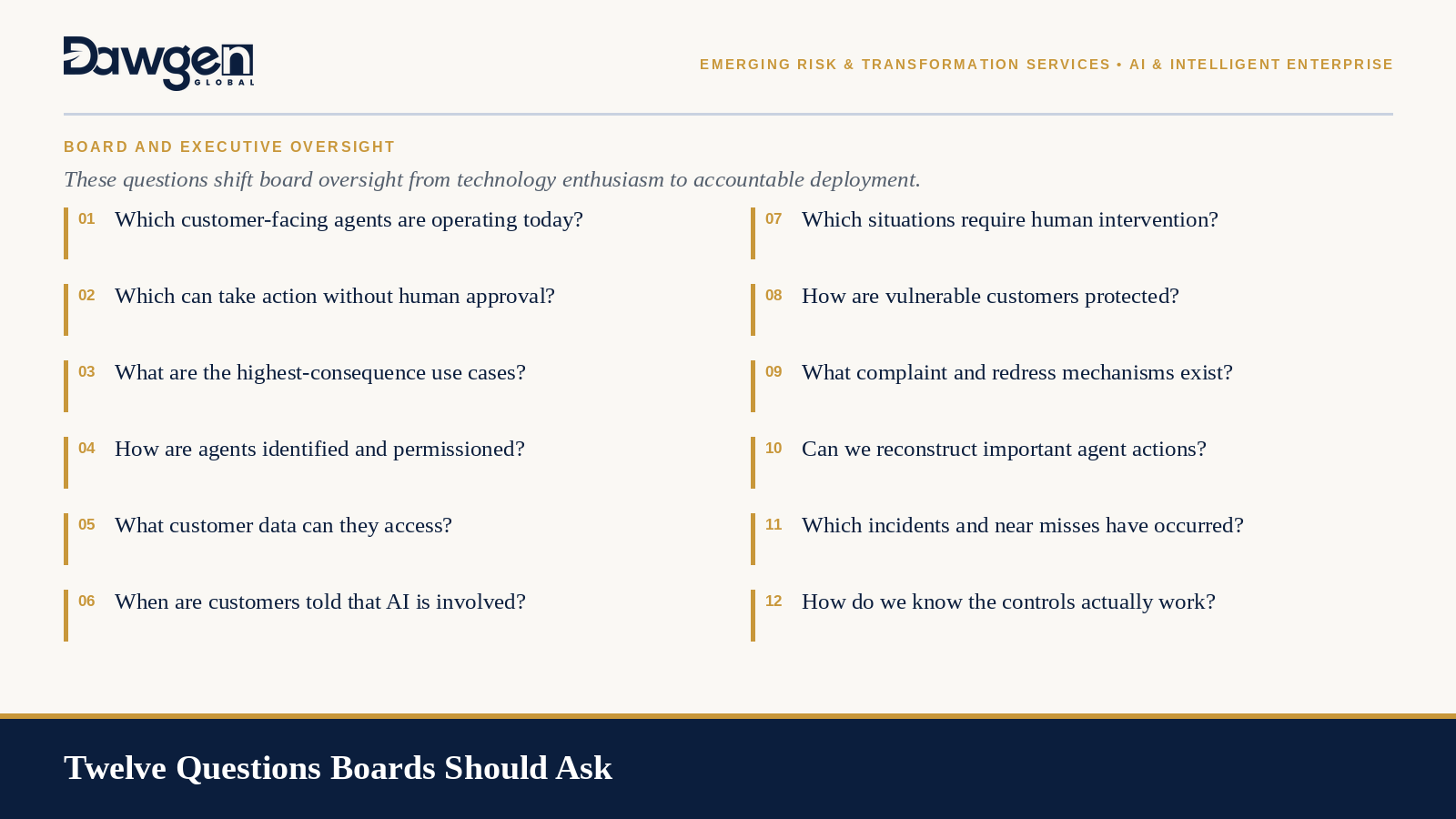
Boards do not need to approve every agent action, but they should understand where consequential decision rights have been delegated. Useful questions include: Which customer-facing agents are operating today? Which can take action without human approval? What are the highest-consequence use cases? How are agents identified and permissioned? What customer data can they access? When are customers informed that AI is involved? Which situations require human intervention? How are vulnerable customers protected? What complaint and redress mechanisms exist? Can we reconstruct important agent actions? Which incidents and near misses have occurred? How do we know the controls actually work?
These questions shift board oversight from technology enthusiasm to accountable deployment.
20. The Dawgen Global Perspective

Organizations should resist two extremes. The first is avoiding agentic customer service because the technology creates unfamiliar risks. The second is pursuing maximum automation simply because the technology can perform more tasks.
The more sustainable position is governed autonomy. Give agents sufficient capability to create customer and economic value, but define boundaries according to consequence. Preserve human judgment where it matters. Make escalation easy. Protect data. Test outcomes. Monitor continuously. Retain evidence.
Agentic customer experience should ultimately be evaluated against the same fundamental standard as any other service model: does it produce fair, reliable and valuable outcomes for customers while operating within the organization’s risk appetite and obligations?
21. How Dawgen Global Can Help
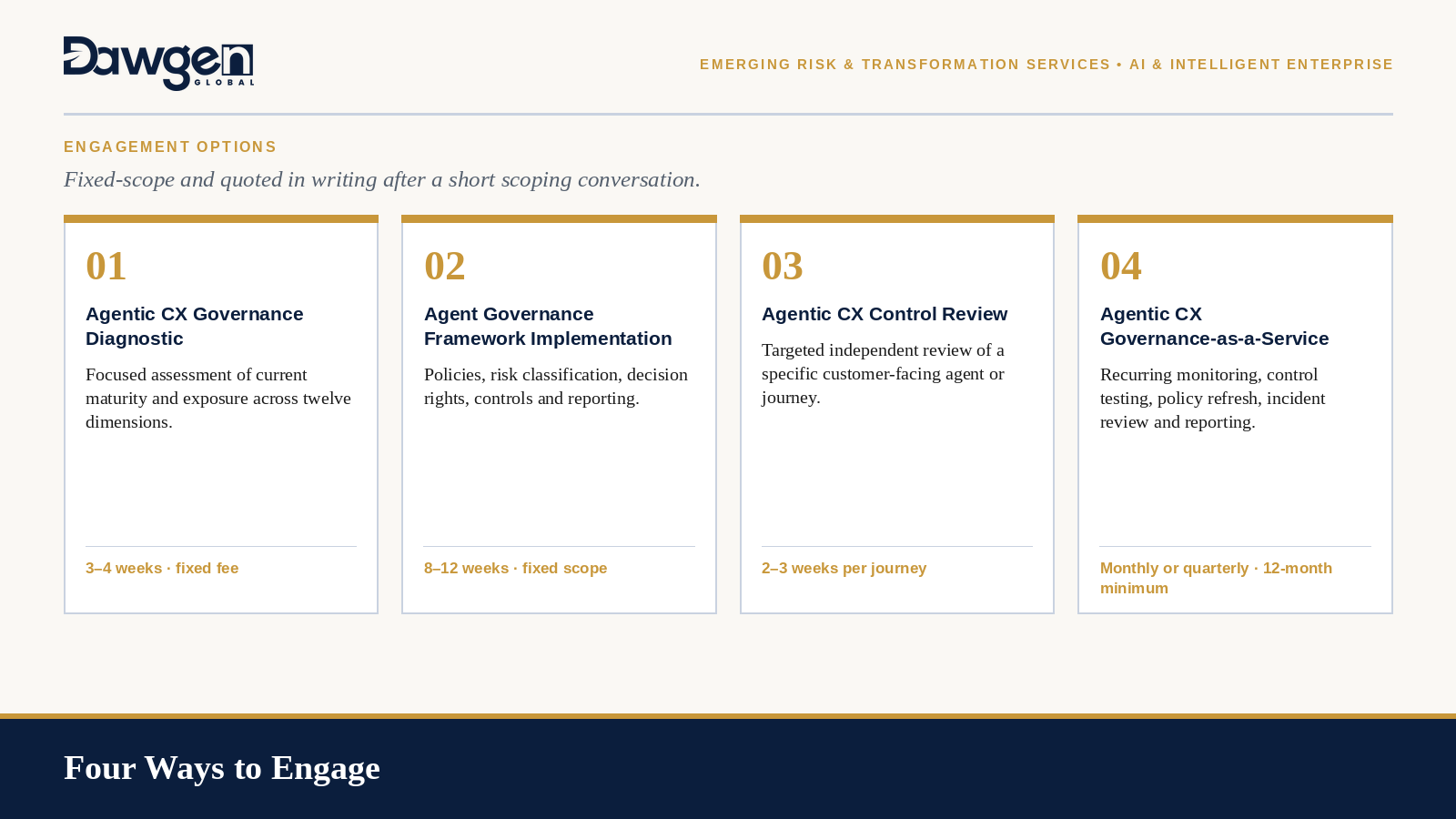
Dawgen Global’s Agentic Customer Experience Governance Services help organizations assess, design, implement and monitor the governance required for customer-facing AI agents. Services can include agent inventory and journey mapping, autonomy classification, decision-rights design, identity and access governance, customer-disclosure standards, human-escalation architecture, privacy and data controls, transaction limits, output validation, complaint and vulnerable-customer controls, cross-platform governance, incident management, dashboards, control testing and assurance readiness.
Organizations may begin with a focused diagnostic, move into framework implementation or retain Dawgen for recurring governance and independent review.
Conclusion: When the Agent Acts, the Organization Is Still Accountable
AI agents can transform customer experience by combining conversational intelligence with the ability to take action. That capability can improve availability, reduce friction, increase capacity and create new forms of personalization. It also creates a new form of operational delegation.
The central governance principle should therefore remain clear: when an AI agent acts on behalf of the organization, accountability does not transfer to the machine. The organization remains responsible for the permissions it granted, the data it exposed, the rules it designed, the human oversight it required and the customer outcome that followed.
The organizations most likely to benefit from agentic customer service will not necessarily be those that automate the largest percentage of interactions. They will be those that know where autonomy creates value, where human judgment remains essential and how to demonstrate that the resulting system deserves customer trust.
Start with the Dawgen Agentic Customer Experience Governance Diagnostic
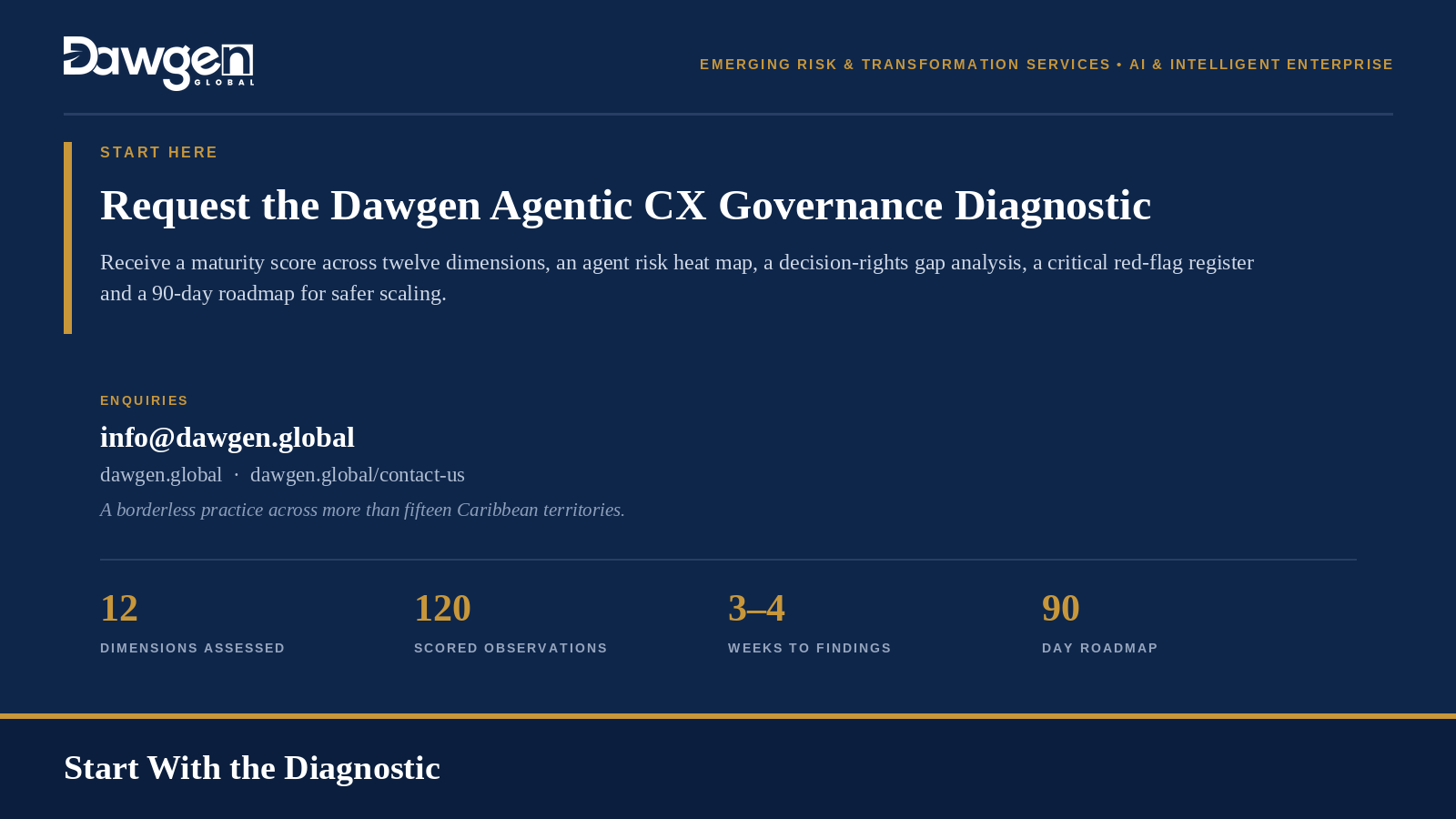
The Diagnostic assesses agent inventory and ownership, customer-impact classification, agent identity and access, decision rights, human escalation, data and privacy, transparency, fairness, vulnerable-customer controls, output reliability, cross-platform controls, complaints and redress, monitoring, incidents and assurance readiness across 12 dimensions and 120 scored observations. The result is a maturity score, a prioritized risk profile and a practical roadmap for safer scaling.
Typical duration. 3–4 weeks. Delivery model. Remote, hybrid or on-site across the Caribbean. Fees. Fixed-scope and quoted in writing after a short scoping conversation.
Dawgen Global helps organizations make Smarter and More Effective Decisions.
Contact
Email [email protected]
Web dawgen.global
Dawgen Global operates as a borderless practice across more than fifteen Caribbean territories. Enquiries arising from this publication are handled by email and routed to the relevant service line, wherever the client and the specialist happen to sit.
Sources
- Trust and Safety Outlook 2026: AI agents as workforce counterparts — what governance should look like. 17 July 2026.
- BCG, Enterprise AI Control Plane: The CIO’s Guide to Governing and Accelerating AI Agents, 14 August 2026.
- National Institute of Standards and Technology. Back to the Future: Why Agentic AI Needs a Strong Identity Foundation. Cybersecurity Insights blog, August 2026. nist.gov/blogs/cybersecurity-insights/back-future-why-agentic-ai-needs-strong-identity-foundation
- New Research: AI Service Agents Improve Customer Satisfaction (State of Service: AI Agents Edition; survey of 3,075 customer-service professionals, commissioned by Salesforce). 20 May 2026.
- Agentic Enterprise Index 2025–2026. August 2026. [Vendor-published index — confirm exact title and date before publication.]
- PwC and Salesforce. Rebuilding Your Contact Center with Agentic AI. May 2026.
Important Notices
Client acceptance. All requests for Dawgen Global services are subject to the firm’s client acceptance procedures, including an independence and conflict-of-interest check, before any engagement is accepted.
Independence and scope of service. Where Dawgen Global or an associated firm provides audit or other assurance services to an entity, the services described in this article are provided only to the extent permitted by applicable ethical and independence requirements, including the International Code of Ethics for Professional Accountants issued by the International Ethics Standards Board for Accountants (IESBA). Advisory, design and implementation services are not provided in a manner that would create a self-review threat to an assurance engagement.
Nature of the work. Unless an engagement letter expressly provides otherwise, the services described here are advisory in nature. They are not an audit, review or assurance engagement performed under International Standards on Auditing or International Standard on Assurance Engagements 3000 (Revised), and no assurance opinion or conclusion is expressed.
Third-party research. Statistics and findings attributed to third parties are taken from the sources listed and have not been independently verified by Dawgen Global. Where research has been produced or commissioned by a technology vendor, that fact is stated so that readers can weigh it accordingly.
Illustrative material. Case studies are anonymized composite illustrations drawn from patterns commonly observed in the region and do not describe any specific Dawgen Global client.
General information only. This article is general in nature, does not take account of the circumstances of any particular organization, and should not be relied upon as professional advice.
Dawgen Global is an independent, integrated multidisciplinary professional services firm and is not a member of any international network.
© 2026 Dawgen Global. All rights reserved.
About Dawgen Global
Dawgen Global is an independent, integrated multidisciplinary professional services firm headquartered at 47 Trinidad Terrace, New Kingston, Jamaica, serving more than 15 territories across the Caribbean. Founded and led by Dr. Dawkins Brown, Executive Chairman, the firm is independent and not affiliated with any international network. It delivers a full suite of professional services under one roof: audit and assurance; tax advisory; IT and digital transformation; risk management; cybersecurity; actuarial and insurance regulatory advisory; HR advisory; mergers and acquisitions; corporate recovery; business advisory and strategy; accounting BPO and virtual CFO services; and legal process outsourcing.
The proposition is simple: big-firm capability without the big-firm price. Dawgen Global’s integrated approach is built for the specific complexities and opportunities of the Caribbean market, helping organizations make sharper, better-informed decisions that drive measurable progress.
To explore a partnership, reach out:
- Website: dawgen.global
- Email: [email protected]
- WhatsApp (Global): +1 555-795-9071
- Caribbean offices: +1 876-665-5926 | +1 876-929-3670 | +1 876-926-5210


