

A Guyanese public servant holding an ACCA qualification is paid an additional G$15,000 a month. A master’s degree attracts G$22,000; a doctorate G$32,000. The payment attaches to the person, not to the post — two officers doing identical work on the same grade may be paid differently according to what they have qualified in. We have found nothing equivalent in any other jurisdiction in this study, and it raises a question every employer competing for professional staff should have an answer to.
A different logic
Every pay structure examined in this series so far rests on the same principle: pay attaches to the job. A post is evaluated, placed in a grade, and whoever holds it is paid the rate for that grade. Two people doing the same work are paid the same. This is the foundation of job evaluation, of internal equity, and of every structure we have measured.
Guyana’s 2024 public service agreement introduced something that does not fit that logic at all.
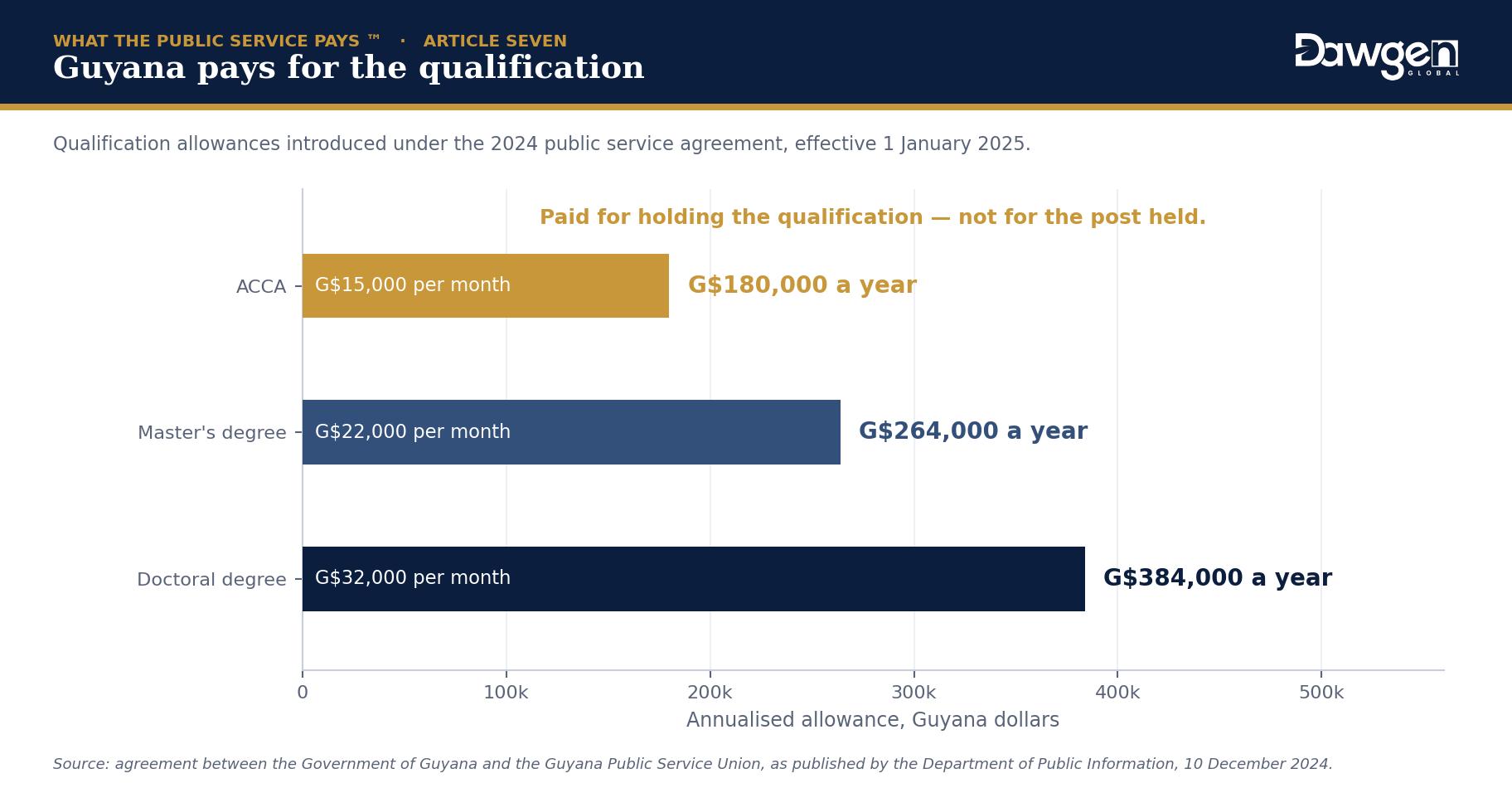
Exhibit 1. Qualification allowances introduced under the 2024 agreement, effective 1 January 2025.
Annualised, these are G$180,000 for ACCA, G$264,000 for a master’s degree and G$384,000 for a doctorate. They are paid for holding the qualification. The post the holder occupies does not determine entitlement.
| A CAVEAT WE HAVE TO STATE
We cannot yet express these premiums as a proportion of salary, because Guyana’s current salary scale is not among the documents we have been able to obtain. The classification instrument available to us dates from 1973 and its grade architecture has since been replaced. The absolute amounts are firm; the relative weight is not, and we will not estimate it. This is one of the specific gaps we are asking for help with. |
Pay for the job, or pay for the person
The distinction Guyana has introduced is one of the oldest arguments in compensation, and it is worth setting out properly because most organisations operate somewhere between the two poles without having decided to.
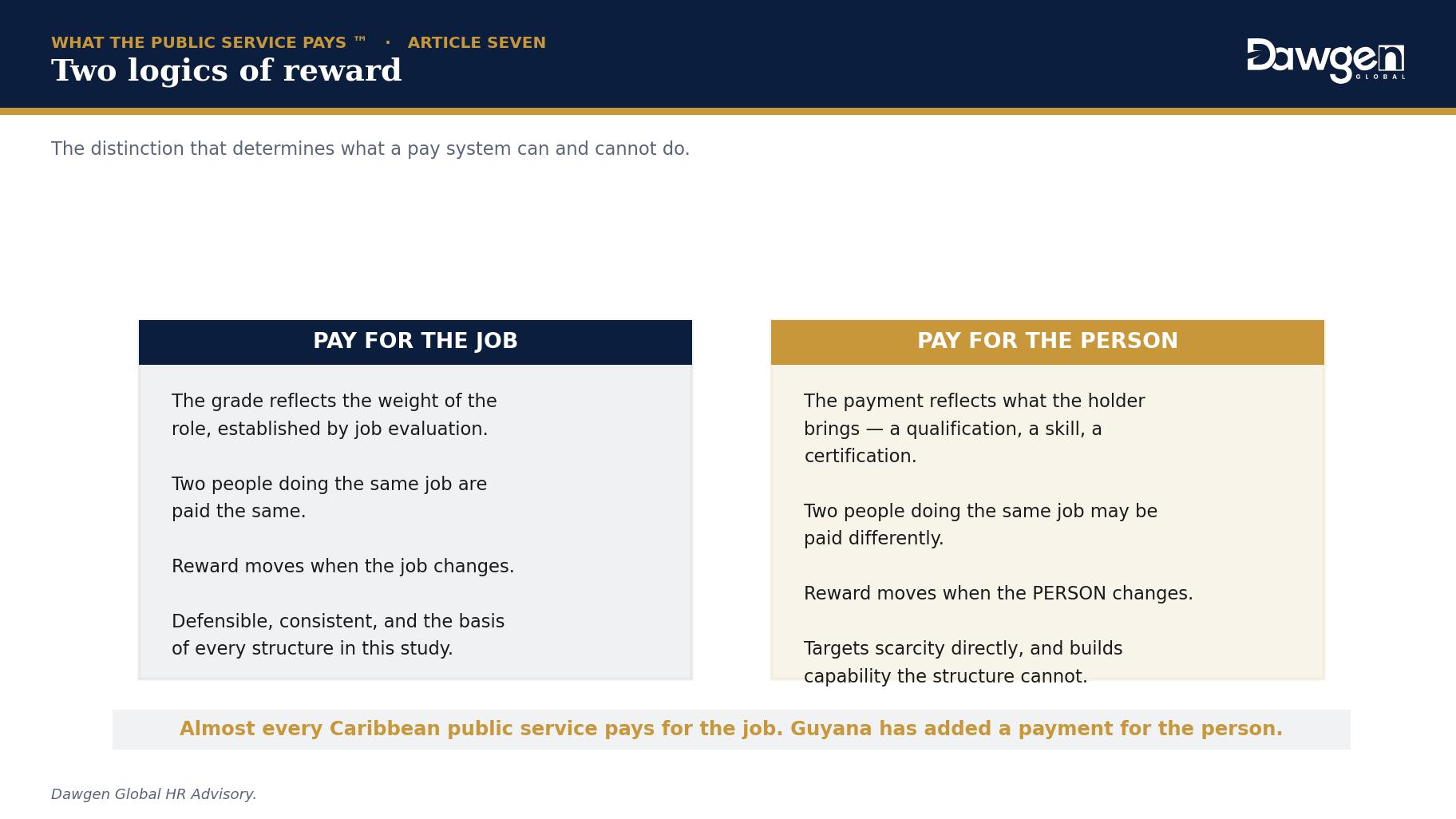
Exhibit 2. The two logics of reward, and what each can and cannot do.
JOB-BASED PAY says the rate follows the work. Its virtues are consistency and defensibility: a grading decision can be explained, challenged and upheld, because it rests on an assessment of the job rather than a judgement about the person. Its limitation is that it cannot respond to scarcity. If the market prices two equally weighted jobs differently, a job-based structure has no mechanism to reflect that.
PERSON-BASED PAY — which appears in the literature as skills-based or competency-based pay — says the rate follows what the holder brings. Its virtue is precision: it can target exactly the scarcity the organisation faces, and it can build capability that the grade structure alone will not. Its limitation is that it breaks the rule that equal work receives equal pay, which is the rule most employees believe they are working under.
Neither is wrong. But an organisation that has never chosen between them usually discovers it has drifted into the second by accident, one retention case at a time, while still telling its people it operates the first.
Why a government would do this
Guyana’s scheme was introduced explicitly to incentivise education and professional development within the public service, and the reasoning is worth taking seriously rather than treating as generosity.
A small state faces a particular version of the capability problem. It needs qualified accountants, engineers, statisticians and lawyers in the same proportions as any state, but it draws them from a much smaller pool, and the qualified members of that pool are internationally mobile in a way that less qualified staff are not. An ACCA qualification is a passport as much as a credential.
Faced with that, a government has three broad options. It can pay more for the posts that require qualification, which means regrading them and disturbing the whole structure. It can recruit qualified people from outside, which is expensive and does not build domestic capability. Or it can pay its existing staff to qualify, which is what Guyana has done.
| THE ECONOMIC LOGIC
A qualification allowance is, in effect, a subsidy for human capital formation paid by the employer who will benefit from it. It converts a training cost the individual would otherwise bear into an ongoing payment, and it does so without touching the grade structure. For a state that needs more qualified people than its labour market currently produces, that is a coherent instrument — arguably a more coherent one than paying market premiums to import the same skills. |
Four ways to pay for scarcity
A qualification allowance is one of four instruments available when an organisation cannot fill a role at the rate its structure provides. They are not interchangeable, and the choice between them has consequences that outlast the problem being solved.
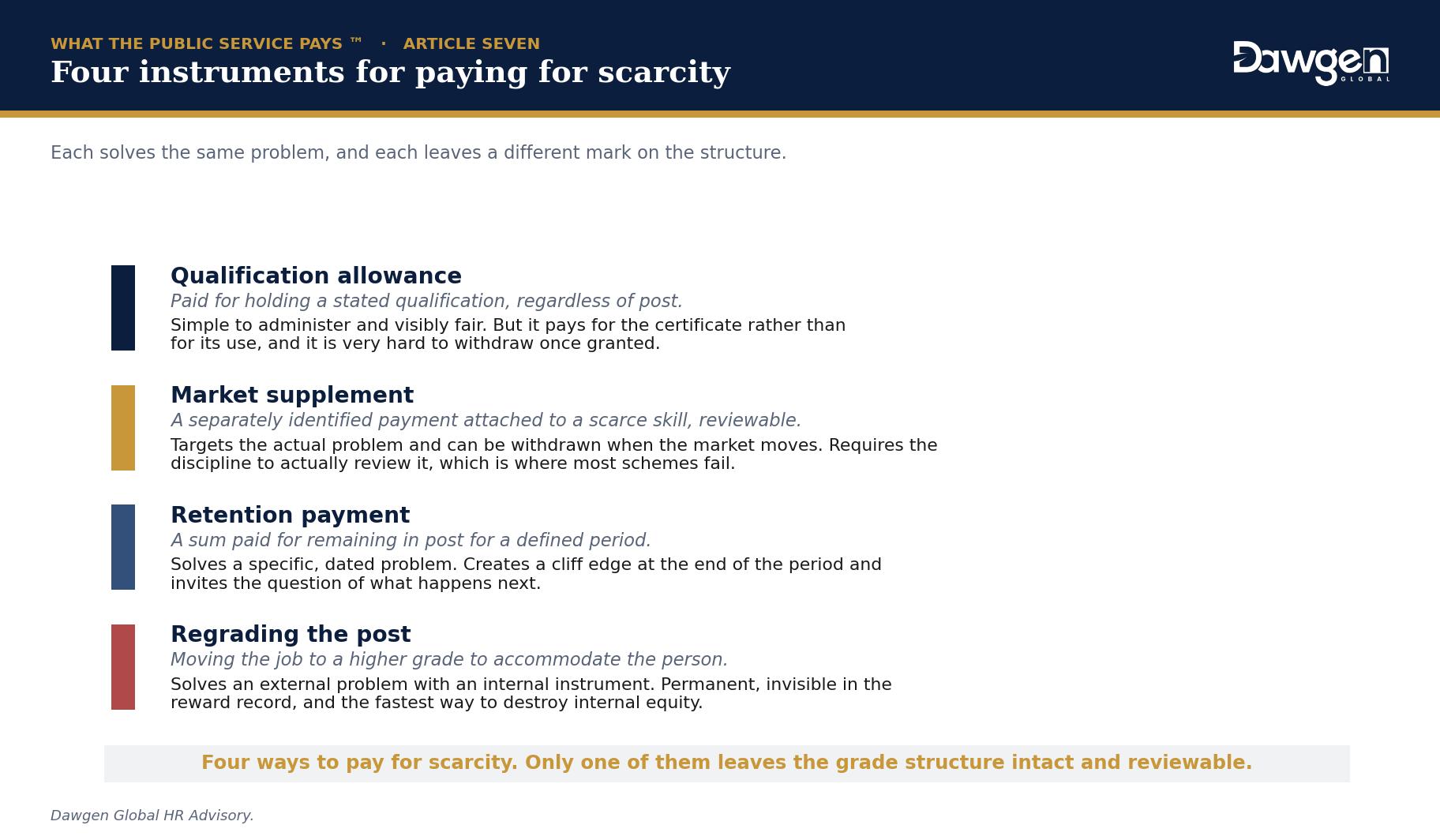
Exhibit 3. Four instruments for paying for scarcity, and what each leaves behind.
The fourth is the one organisations reach for most readily and should reach for least. Regrading a post to accommodate a person solves an external problem with an internal instrument. It is permanent, it disappears from the reward record because it looks like an ordinary grading decision, and it is the mechanism by which internal equity dissolves — not through any single unreasonable decision but through the accumulation of reasonable ones.
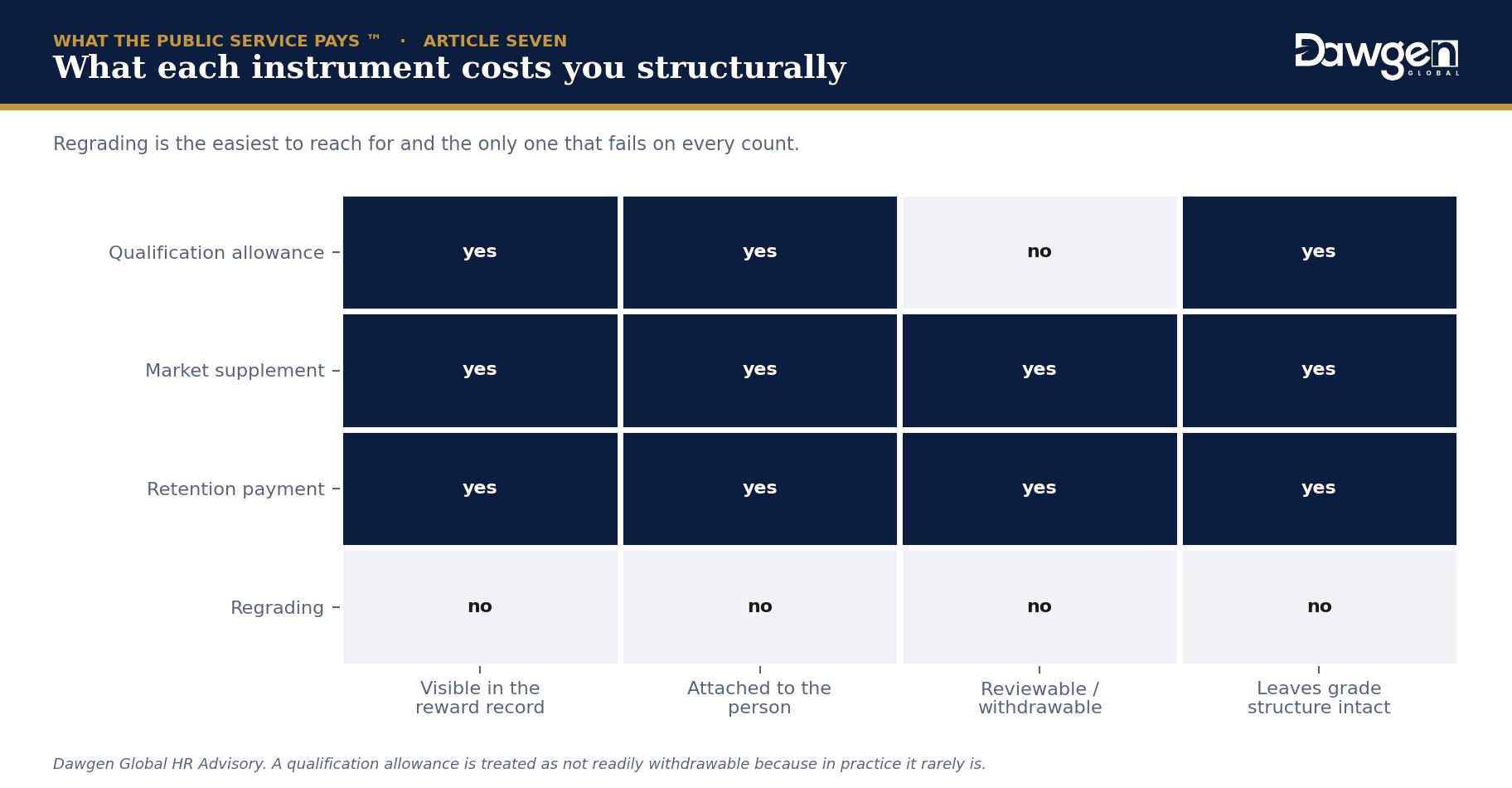
Exhibit 4. The four instruments against the four properties that matter structurally.
The market supplement scores well on every count, which is why it is the textbook answer. Its weakness is not in design but in discipline: a supplement that is never reviewed becomes a permanent addition to pay that nobody can explain, and reviewing it means telling someone their pay is going down. Very few organisations have the stomach for that conversation, which is why so many supplements quietly become salary.
A qualification allowance sits awkwardly on the scorecard. It is visible and attached to the person, which is good. But it is very hard to withdraw — you cannot un-qualify someone — and so in practice it behaves as a permanent commitment from the moment it is granted.
When paying for the person works
Skills-based and qualification-based pay have a substantial track record, and it is mixed in a way that is well understood. The conditions that separate success from failure are known.
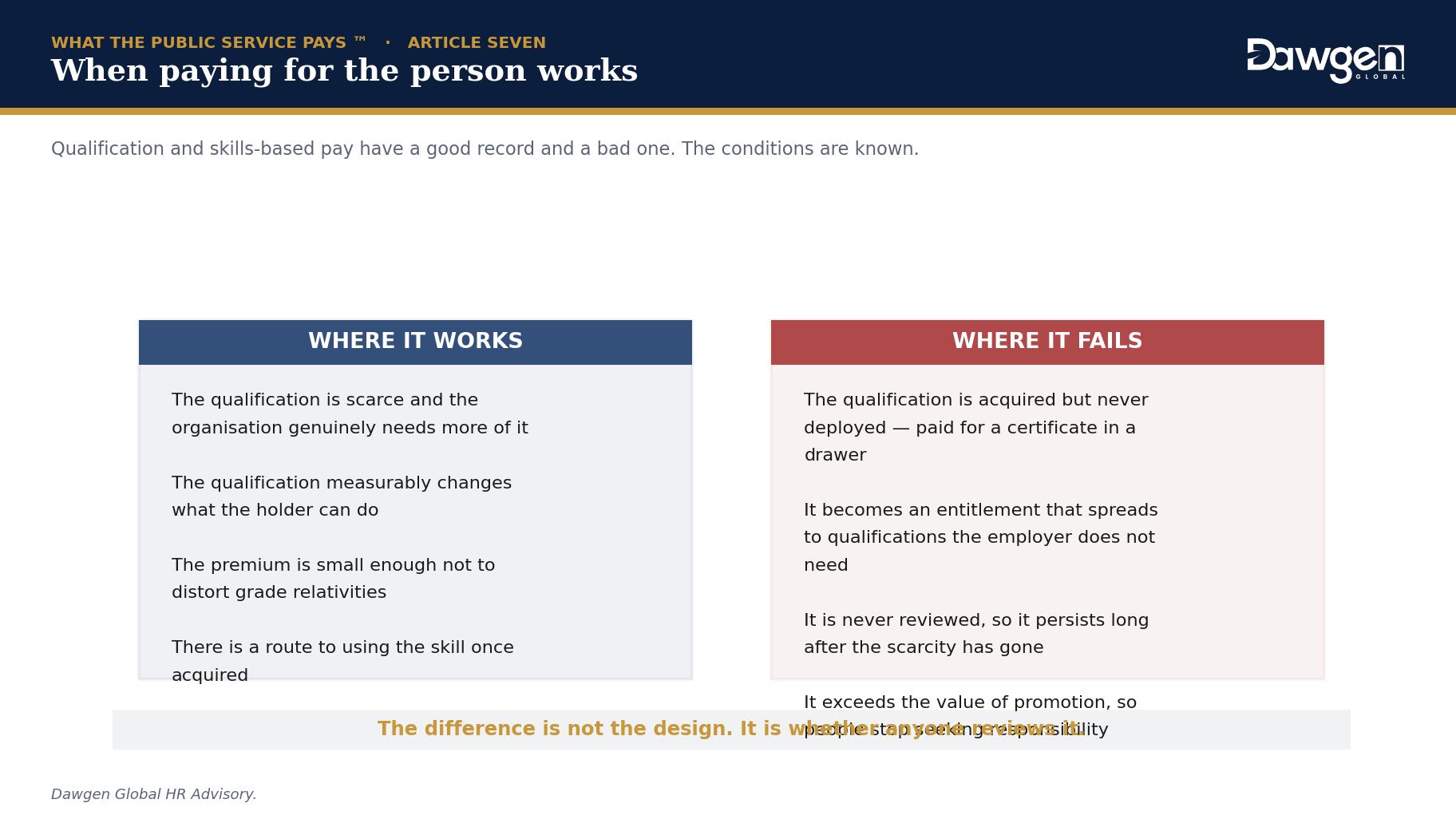
Exhibit 5. The conditions under which qualification-based pay succeeds and fails.
The deployment problem
The most common failure is paying for acquisition rather than deployment. An organisation announces a premium for a qualification, staff obtain it, the premium is paid — and nothing about how the work is done changes, because there is no route to using the new skill in the post the person occupies.
This is not the employee’s fault, and it is entirely predictable. If the scheme rewards the certificate, the certificate is what it will produce. Designing for deployment means either restricting the premium to posts where the skill is used, or creating the roles in which it can be, and both are harder than announcing an allowance.
Scope creep
The second common failure is expansion. A premium introduced for one scarce qualification attracts a reasonable question from holders of a different qualification, and then a third. Because the original scheme was framed around qualification rather than scarcity, there is no principled basis on which to refuse.
Guyana’s scheme has a feature worth noting here: it names three specific categories — ACCA, master’s, doctorate — rather than establishing a general principle that qualification attracts payment. Whether that boundary holds is a question for its next agreement, and it is the question we would be watching.
The promotion problem
The third failure is the subtlest. If a qualification premium is large relative to the value of promotion, an organisation has told its most capable people that acquiring a credential pays better than taking on responsibility.
Consider the arithmetic in a structure like Jamaica’s, where a grade step is worth an average of 22.7 per cent. A qualification premium worth a comparable amount makes qualifying and promotion equally attractive — and qualifying is more certain, since it depends on the individual rather than on a vacancy arising. In a flatter structure like Cayman’s, where a grade step averages 12.2 per cent, a premium of the same size would dominate promotion entirely.
| A TEST WORTH APPLYING
Express your qualification premium as a proportion of the value of one promotion. If it is a large fraction, you have created a genuine choice for your staff between developing credentials and developing responsibility. That may be exactly what you intend. It is very rarely what anyone decided. |
The measurement problem it creates
There is a consequence of person-based pay that matters for anyone doing the kind of research this series reports, and it is worth stating because it will recur as more jurisdictions are collected.
A pay structure can be described. You can publish a scale, state the increments, name the grades, and a reader can establish exactly what any post pays. Person-based payments cannot be described that way, because what a post pays now depends on who is in it.
In Guyana, the question ‘what does an accountant in the public service earn’ has no single answer. It depends on whether that accountant holds ACCA. Two officers on the same grade, doing the same work, differ by G$180,000 a year. Neither figure is wrong; the question is underspecified.
| HOW WE HANDLE IT
Our methodology records qualification allowances as a monetised component with the holder-not-post basis explicitly disclosed. A benchmark role therefore carries a base figure and a stated qualification premium, rather than a single blended number. A blended figure would be more convenient and would misrepresent both the officer who holds the qualification and the one who does not. |
The same problem arises with market supplements, retention payments and acting allowances, and it is a general limitation of any pay comparison. A structure describes what an employer offers. It does not describe what an employer pays, and the gap between those two widens with every person-based instrument added.
Why this affects the private sector more than the public
Public services tend to be structurally conservative: person-based payments are the exception, introduced deliberately and usually published. Private employers are the reverse. Individual negotiation, counter-offers, market adjustments and discretionary uplifts are routine, and almost none of it is documented as a scheme.
The practical result is that private sector pay data is systematically harder to interpret than public sector data, even where more of it exists. A published salary band in a private firm frequently describes a starting point for negotiation rather than a rate. This is worth remembering when public and private figures are set against one another: they are often measuring different kinds of thing.
What this means for professional firms
There is a specific commercial consequence here for accountancy, legal, engineering and consulting firms in the region, and it is worth being direct about it.
A government that pays a standing premium for ACCA has changed the market for ACCA-qualified staff in that jurisdiction. It is not merely a competing employer; it is an employer that has publicly priced the qualification itself, separately from the role. Any firm recruiting a qualified accountant in Guyana is now bidding against a package whose qualification component is explicit and published.
That has two implications. The first is straightforward: the reservation wage for a qualified accountant has moved, and a firm benchmarking against public sector salary alone will miss it, because the premium sits outside salary.
The second is more interesting. Professional firms have historically competed for qualified staff on the strength of the qualification pathway itself — study support, examination leave, the prestige of training in practice. Where a public employer now pays cash for the same credential and offers a pension besides, the traditional proposition needs restating rather than assuming.
The mirror question
Most professional firms in this region already operate a version of person-based pay without describing it as such. Newly qualified staff receive an uplift on admission. Holders of a second qualification are paid more. Nobody calls this a qualification allowance, but that is what it is.
The difference is that Guyana has written it down, fixed the amount, and published it. A firm that pays for qualification informally has all the cost of a qualification premium and none of the clarity — and cannot tell a candidate what qualifying is worth, because nobody has decided.
Designing one properly
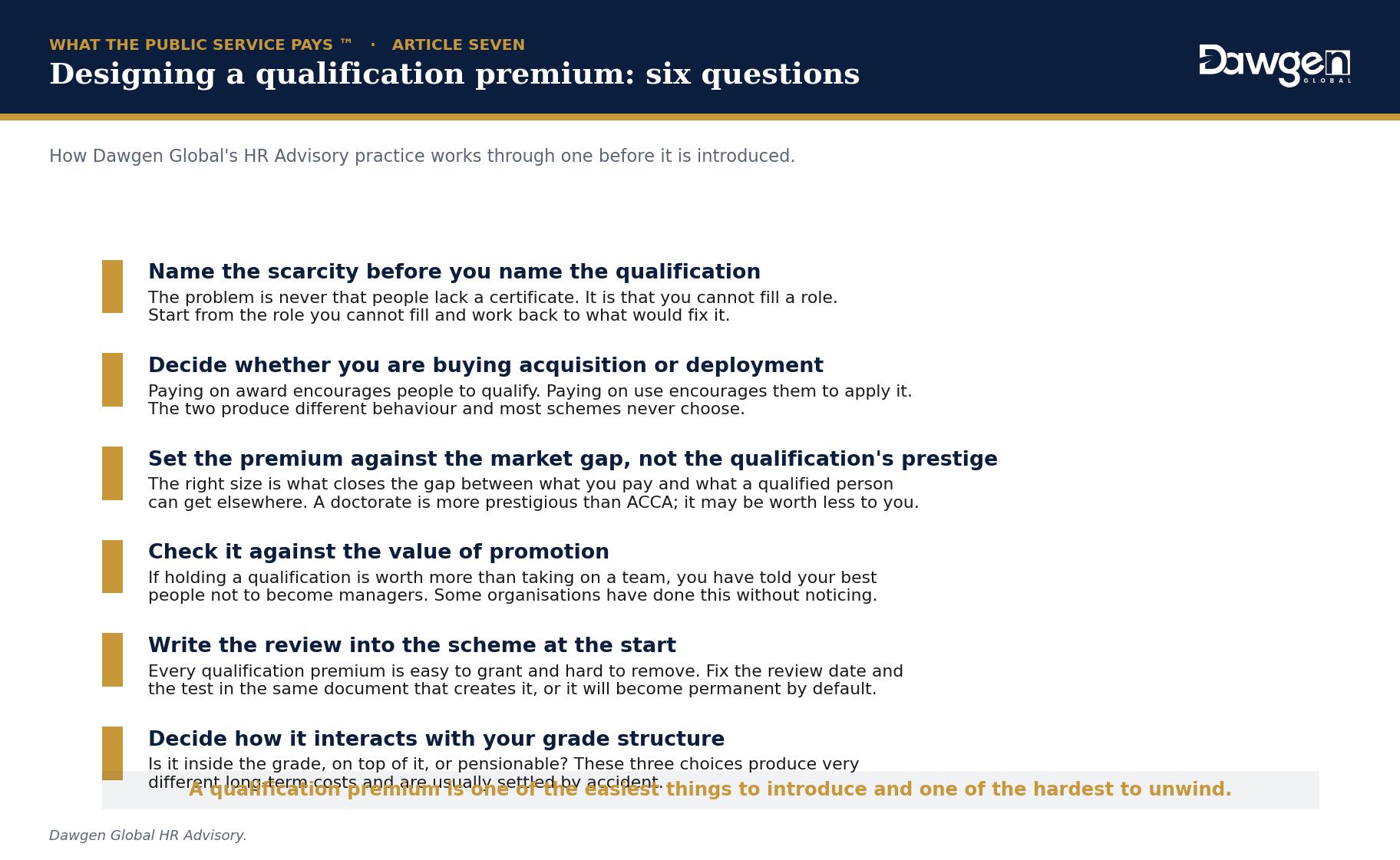
Exhibit 6. Six questions, in the order our HR Advisory practice works through them.
The first question is the one most often skipped, and skipping it is why so many schemes drift. The problem is never that people lack a certificate; it is that a role cannot be filled or a capability is missing. Starting from the qualification rather than the gap produces a scheme that pays for credentials the organisation does not need.
The fifth is the one that determines whether the scheme is still working in five years. Every qualification premium is easy to introduce and hard to unwind. Fixing the review date and the review test in the same document that creates the scheme is the only reliable way to keep it reviewable, because a review that has to be initiated will not be.
And the sixth is the one with the largest long-term cost attached. Whether a premium sits inside the grade, on top of it, or counts toward pension are three different decisions with very different consequences, and in our experience they are usually settled by whoever processes the first payment.
Three tests before you introduce one
Compressing the six questions into the three that decide most cases:
- Would you pay this to someone who already holds the qualification and is doing the same job today? If yes, you are paying for a stock of existing credentials rather than encouraging new ones, and the cost is immediate and permanent. That may be the right answer, but it should be a deliberate one, because the recruitment benefit is nil and the retention benefit is uncertain.
- What happens to the premium if the person moves to a post where the qualification is irrelevant? If it follows them, you have created a personal allowance that will outlive its purpose. If it does not, you have created a barrier to internal mobility, because moving costs money.
- Is it pensionable? This single question can double the long-run cost of a scheme and is almost always answered by default rather than decision. A non-pensionable premium is cheaper and worth less to the recipient; a pensionable one is a much larger commitment than the monthly figure suggests.
An organisation that can answer those three has thought about the scheme properly. In our experience most cannot answer the third.
A note on our work
This research sits within Dawgen Global’s HR Advisory practice, which advises on job evaluation, grading reviews, pay structure design and reward benchmarking across the Caribbean. Qualification and market premiums come up in most grading reviews we run, usually because an organisation has accumulated several informal ones and wants to regularise them. The regularisation is rarely the hard part. Deciding what the organisation actually intended to buy is.
A closing observation
Guyana’s scheme is a small item in a large agreement, and it would be easy to read it as a minor concession in a negotiation. We think it is more interesting than that.
A government that pays for qualification has made an implicit statement about where its constraint lies. It is not saying that its posts are underpaid, which would call for a scale increase. It is saying that it does not have enough qualified people, and that the fastest route to more of them runs through its existing staff rather than through the labour market. For a small state, that is very likely correct.
Whether other jurisdictions follow is a question the next two years will answer, and one we will be watching as the remaining eleven are collected. If they do, the market for professional qualifications in this region will change in a way that every employer of qualified staff — including this firm — will have to respond to.
Next in this series
Article eight looks at what happens when a jurisdiction cannot be compared at all — not because its data is hidden, but because its pay has not been settled for a decade.
| AN INVITATION
We are seeking Guyana’s current public service salary scale, without which the qualification premiums above cannot be expressed as a proportion of pay. More broadly, eleven of the sixteen jurisdictions in this study have not yet been collected. Public service ministries, personnel departments and statistical offices wishing to supply information, or to correct anything published in this series, are invited to contact the firm. Corrections will be acknowledged and reflected, and the institution supplying them credited. |
SOURCES
Agreement between the Government of Guyana and the Guyana Public Service Union, 2024, as published by the Department of Public Information, 10 December 2024. Public Service of Guyana Classification and Revised Salaries and Wages Plan, Public Service Ministry, June 1973. Government of Jamaica, Salary Scales for Monthly Paid Staff 2022-2025, Ministry of Finance and the Public Service. Cayman Islands Government Salary Scale effective 1 January 2025, Appendix B to Personnel Circular 11 of 2024. Grade-step percentages are Dawgen Global calculations from those published scales. Annualisation of monthly allowances is at twelve months.
This article is the seventh in What the Public Service Pays™, a Dawgen Global series drawn from research across sixteen Caribbean jurisdictions. Dawgen Global is an independent, integrated multidisciplinary professional services firm serving the Caribbean. Enquiries: [email protected] | dawgen.global
About Dawgen Global
Dawgen Global is an independent, integrated multidisciplinary professional services firm headquartered at Dawgen Towers, 47-49 Trinidad Terrace, Kingston 5, Jamaica, serving more than 15 territories across the Caribbean. Founded and led by Dr. Dawkins Brown, Executive Chairman, the firm is independent and not affiliated with any international network. It delivers a full suite of professional services under one roof: audit and assurance; tax advisory; IT and digital transformation; risk management; cybersecurity; actuarial and insurance regulatory advisory; HR advisory; mergers and acquisitions; corporate recovery; business advisory and strategy; accounting BPO and virtual CFO services; and legal process outsourcing.
The proposition is simple: big-firm capability without the big-firm price. Dawgen Global’s integrated approach is built for the specific complexities and opportunities of the Caribbean market, helping organizations make sharper, better-informed decisions that drive measurable progress.
To explore a partnership, reach out:
- Website: dawgen.global
- Email: [email protected]
- WhatsApp (Global): +1 555-795-9071
- Caribbean offices: +1 876-665-5926 | +1 876-929-3670 | +1 876-926-5210


