
A widely used international salary website reports that the highest-paid civil servant in Barbados earns about BBD 19,060 a year. The lowest substantive grade in the Barbados public service — the cleaner, the general worker, the maid — is paid BBD 25,891. The site’s ceiling sits twenty-six per cent below the real floor. This is the information a decision-maker currently finds, and it is the reason we spent six months building something better.
A number that cannot be right
Type a question about Caribbean public sector pay into a search engine and you will be offered an answer within seconds. It will be presented confidently, with medians and quartiles and a currency symbol. It will look like data.
One such source states that a civil servant in Barbados earns approximately BBD 12,000 a year, that the lowest reported salaries sit at about BBD 7,040, and that the highest stretch to roughly BBD 19,060. The page explains helpfully that the middle fifty per cent of earners sit inside that band, and suggests the reader work out which quartile they fall into.
Now set that against the Barbados Schedules of Personal Emoluments for 2026-2027, the document laid before Parliament that sets out every established post in central government with its salary provision. The lowest substantive grade in the service — the classification covering cleaners, general workers and maids — carries an annual salary of BBD 25,891. A Clerical Officer sits between roughly BBD 25,891 and BBD 39,708. An Accountant sits between about BBD 50,624 and BBD 61,645. A Permanent Secretary is paid BBD 164,782.
| THE SCALE OF THE ERROR
The website’s stated maximum for the entire Barbados civil service, BBD 19,060, is twenty-six per cent below the actual minimum of BBD 25,891. Its central figure of BBD 12,000 is less than half the lowest grade in the service. And the real range does not stop at BBD 19,060; it continues to BBD 164,782, more than eight times higher. The figures are not slightly out. They describe a different country. |
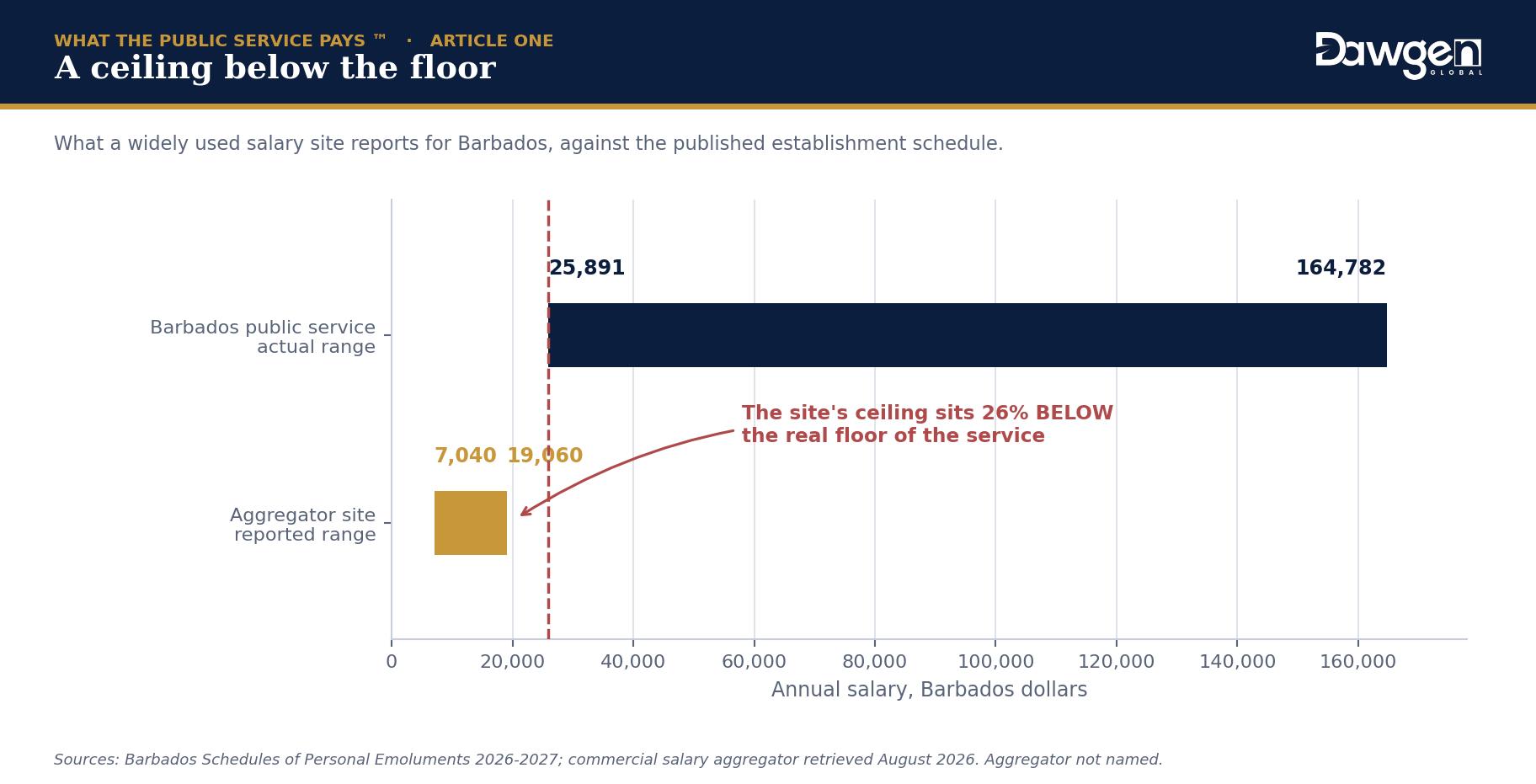
Exhibit 1. What a widely used salary site reports for Barbados, against the published establishment schedule.
A second widely used site offers a range for the Government of Barbados that begins and ends at the same number — approximately BBD 137,833 for a Director, both as the highest-paid role and the lowest-paid role. That is what a single crowd-sourced data point looks like when it is presented as a distribution.
We are not naming these sites, because the point is not that any particular operator has been careless. The point is structural. These platforms aggregate self-reported figures and modelled estimates, and they perform reasonably in large labour markets where thousands of people submit data. In a public service of a few thousand people, in a jurisdiction few of their users come from, they have almost nothing to work with — and they publish anyway, because publishing something is what the business model requires.
The consequence is that the most accessible information about Caribbean public sector pay is systematically wrong, and there is no accessible alternative. That is the gap this series exists to close.
Why this matters, and to whom
Public sector pay is not an academic curiosity. It is a live input into at least three sets of decisions taken across the region every week.
The employer setting a salary
In most Caribbean economies the government is the largest single employer of professional labour. It employs more accountants than any firm, more engineers than any contractor, more nurses than any private hospital and more IT staff than any bank. When a private employer sets a salary for a qualified accountant, the public service is the competing offer, whether or not the employer has thought about it that way.
Yet a Caribbean HR director benchmarking against the public sector has, at present, no reliable source at all. They can ask around. They can look at a vacancy notice if one happens to be open. They can consult one of the aggregator sites and be misled by a factor of two. What they cannot do is look up, on a consistent basis, what the public service pays a person doing the job they are trying to fill.
The investor or firm establishing under the Treaty
A company expanding under the Revised Treaty of Chaguaramas — establishing in a second CARICOM member state, or moving staff between them — needs to know two things: what it costs to hire a given skill in each jurisdiction, and whether staff can lawfully be moved. The second question has answers, if imperfect ones. The first, at the level of specific skills rather than national averages, does not.
National average wage figures are published and are useful for some purposes, but they cannot answer the question actually being asked. An investor does not hire an average. They hire a systems administrator, a financial controller, a registered nurse. The dispersion between those roles within a single economy is far wider than the dispersion of national averages between economies.
The citizen and the fiscal debate
Public sector wage bills are a live argument in nearly every Caribbean jurisdiction, and that argument is conducted almost entirely without comparative evidence. Assertions that the public service is overpaid, or underpaid, or bloated, or hollowed out, circulate without anyone being able to say how the jurisdiction compares with its neighbours on any consistent measure.
This matters commercially as well as civically. A firm advising on public sector reform, or negotiating on either side of a wage settlement, is operating in the same evidential vacuum as everyone else.
The vocabulary problem
Before any of this can be discussed sensibly, a set of terms needs to be settled. A great deal of confusion about public sector pay is not disagreement about facts; it is two people using the same word to mean different things. What follows is the vocabulary this series will use, and it is worth reading even by those who work in compensation daily, because several of these terms are used loosely in ordinary conversation and precisely in official documents.
| Term | What it means | Why it is easy to get wrong |
| Basic salary | The fixed amount attaching to a post before any allowance, overtime or benefit is added. | In much of the Caribbean, basic salary is a minority of what an officer actually receives. Comparing basic salaries alone can understate reward by a quarter or more. |
| Salary scale | The published structure of rates attaching to a class of posts, usually running from a minimum to a maximum. | A scale is not a salary. It is a range within which an individual’s salary sits, depending on how long they have served. |
| Grade or pay band | A single scale within the larger structure, into which posts of comparable weight are placed. | Grade structures do not map between jurisdictions. Jamaica’s Pay Band 9 and Barbados’s Z16-8 are not equivalents and cannot be compared as such. |
| Incremental point | One of the fixed steps within a scale. An officer normally advances one point a year, subject to conditions. | The number of points varies by jurisdiction and sometimes by service within a jurisdiction. Thirteen in Jamaica’s core service, eight in its health families. |
| Band minimum and maximum | The first and last incremental points of a scale. | A published minimum may be administratively closed to new entrants, in which case it is not the real entry rate. This is the case in the Cayman Islands. |
| Band midpoint | The arithmetic midpoint between minimum and maximum. Used as the standard comparison point. | The midpoint is not the median of the incremental points where increments are unequal, and the two can differ materially. |
| Band spread | The maximum divided by the minimum. A measure of how much room an officer has to grow without promotion. | Often overlooked entirely, and it determines career earnings more than the entry salary does. |
| Increment method | Whether steps are a fixed percentage of the previous point (geometric) or a fixed cash amount (arithmetic). | Two scales with the same start and end pay very differently in the intervening years. |
| Compression ratio | The ratio of the top of the service to the bottom. | The single most revealing structural measure, and the one most sensitive to which posts you choose as top and bottom. The basis must always be stated. |
| Establishment | The set of approved posts, as distinct from the people occupying them. | An establishment schedule lists posts, not employees. A post may be vacant, or filled in an acting capacity. |
| Total reward | Basic salary plus allowances, employer pension cost, employer health cost and other guaranteed benefits. | The correct basis for any public-private comparison, and the one almost never used. |
| Pensionable and contract | Whether a post is held on established terms with a pension, or on a fixed-term contract usually with a gratuity in lieu. | The same post on the two bases carries materially different total reward. Reporting one without saying which is a common and serious error. |
Two of these deserve expansion, because they carry most of the analytical weight in what follows.
Band spread, and why it decides careers
Suppose two jurisdictions both start an accountant at the equivalent of US$25,000. In the first, the scale runs to US$33,600 — a spread of 1.34. In the second, it runs to US$31,600 — a spread of 1.26. On day one the two offers are identical. After twelve years of ordinary incremental progression and no promotion whatever, the first accountant is earning six per cent more than the second, every year, for the rest of their career, with the difference compounding into pension entitlement.
An employer who matches the entry salary and offers no incremental structure is competitive on the day of hire and materially behind within five years. A great deal of what is loosely described as public sector retention advantage is simply this.
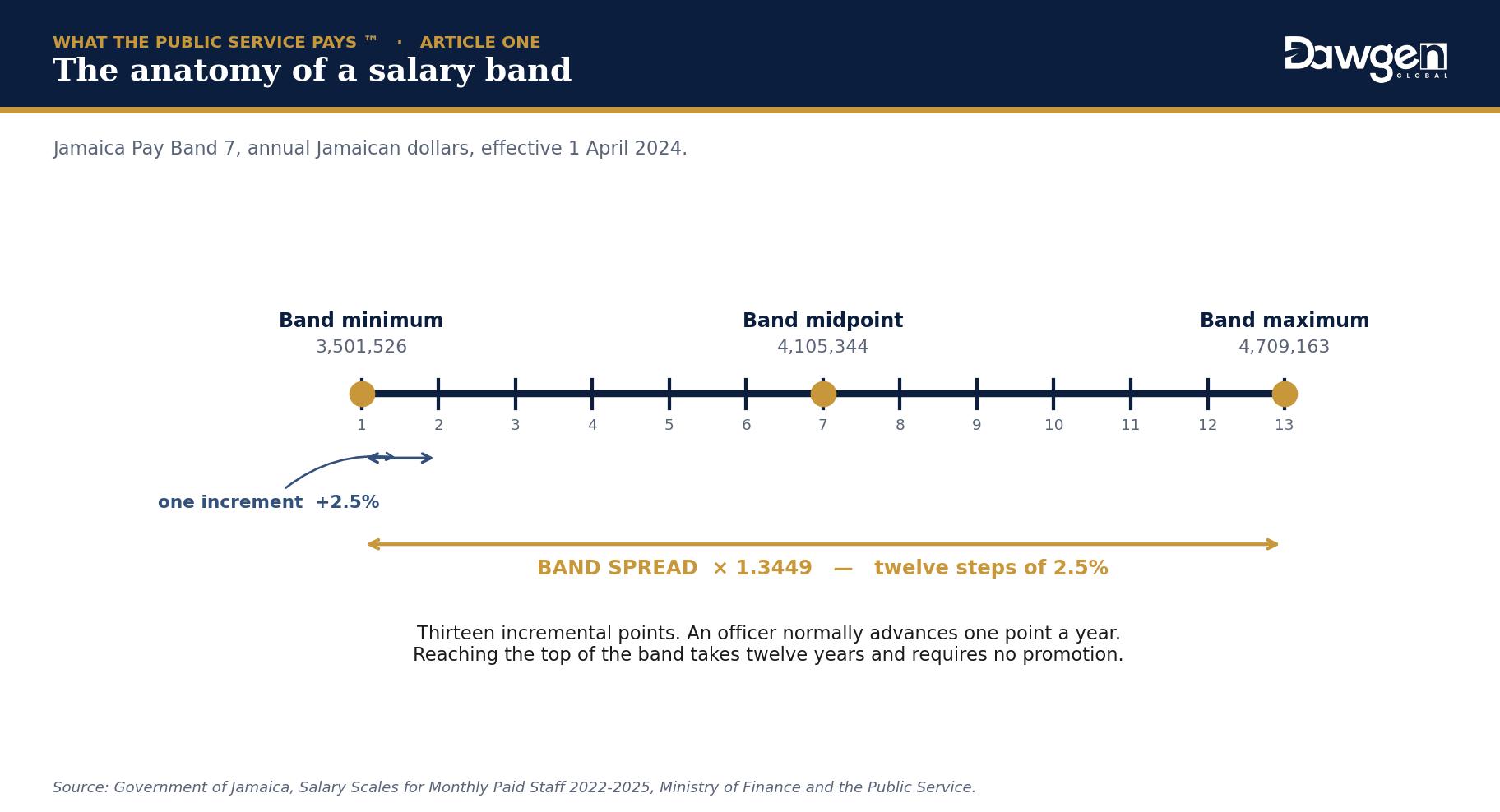
Exhibit 2. Every part of a salary band, using a real Jamaican pay band.
The point is easier to see than to describe. Two officers hired on the same day at the same salary, one on a band of spread 1.3449 and one on a band of spread 1.2637, diverge steadily for twelve years without either being promoted and without either doing anything differently.
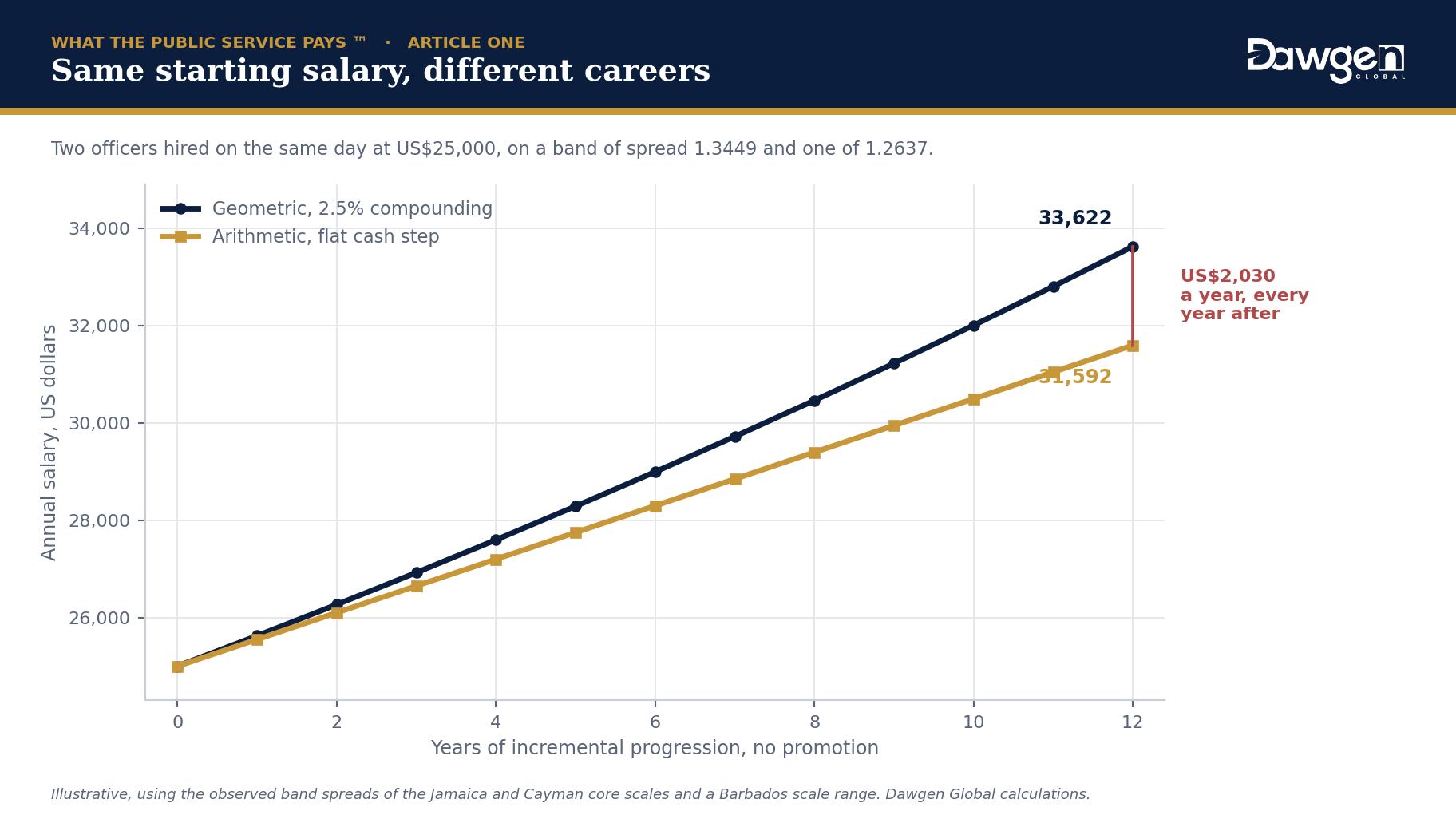
Exhibit 3. Twelve years of ordinary incremental progression from an identical starting salary.
Total reward, and why basic pay misleads
Caribbean public services are allowance-heavy by international standards. Jamaica’s pre-restructuring system carried approximately 185 separate allowances, and the government’s own account of the reform records that allowances made up a large proportion of total compensation for some groups. That was precisely why the restructuring was undertaken.
Allowances are not incidental. In Jamaica, the travelling allowance attaching to a Pay Band 7 post is worth JMD 894,924 a year against a band minimum of JMD 3,501,526 — a little over a quarter of basic pay, and non-taxable. Employer pension and health costs sit on top of that again. In the Cayman Islands, where the Auditor General has published audited figures, total remuneration across 4,566 civil servants came to 1.29 times salary, and for senior management 1.36 times.
| THE PRACTICAL IMPLICATION
Any comparison of public and private pay conducted on basic salary alone will understate public sector reward, and in the jurisdictions we have measured it will do so by somewhere between a quarter and a third. An employer who benchmarks against a public sector basic salary and concludes they are paying competitively may be significantly behind on the measure that governs whether a candidate accepts. |
Five reasons the region resists comparison
If the data is public, why has nobody assembled it? The answer is not secrecy. Almost everything needed is published somewhere, by constitutional requirement. The obstacles are structural, and there are five of them.
One: every jurisdiction has a different architecture
Jamaica runs sixteen pay bands in its core civil service and separate ladders for health and the disciplined services. The Cayman Islands runs eighteen grades keyed to job evaluation points. Barbados uses alphanumeric scale codes — Z16-8, Z23-17, S1, CX — that carry no obvious relationship to one another until you obtain the underlying ranges. Guyana operated a forty-range structure that has since been replaced by a numbered grade system. None of these maps onto any other.
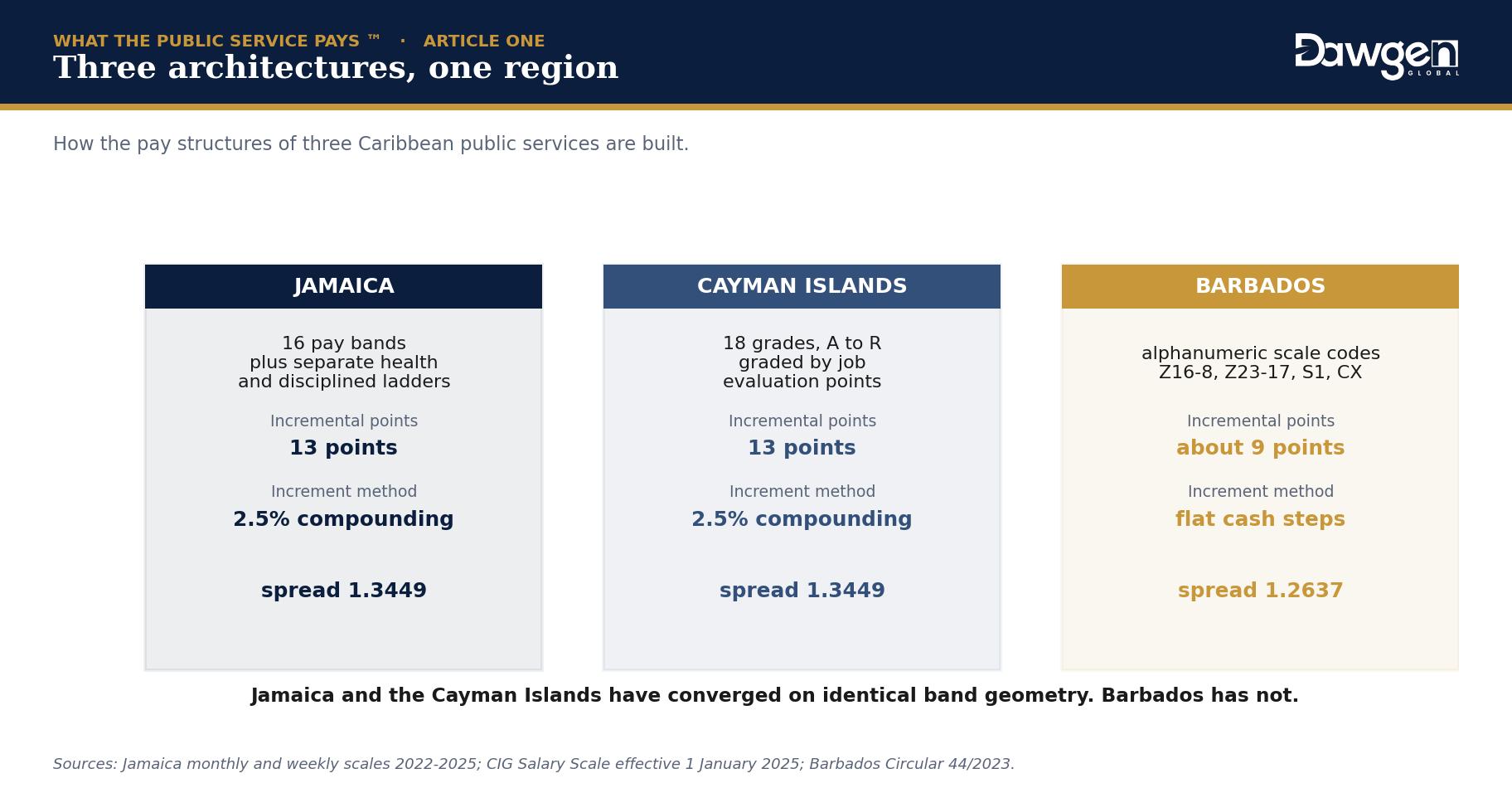
Exhibit 4. Three Caribbean pay structures compared. Two have converged; one has not.
Two: the same job carries different titles and different weight
A post called Senior Accountant in one jurisdiction may sit four grades below a post of the same name in another. Titles are not a reliable guide, and neither are grades. The only workable approach is to define a set of benchmark roles by their duties and qualification requirements, and then map each jurisdiction’s posts onto them — which is laborious, and which is exactly what we have done.
Three: the money and the post are in different documents
In Barbados, the Schedules of Personal Emoluments give the post, its establishment count and its scale code — but not the range attaching to that code. The range appears in vacancy circulars issued when the post falls open. In Jamaica the reverse is true: the salary scales are published in full, but the mapping of job titles to those scales is not, because a great many professional roles sit on a generic management ladder rather than on function-specific scales. Neither jurisdiction publishes both halves in one place.
Four: currency and cost of living pull in opposite directions
Nine of the sixteen jurisdictions in our study operate a currency pegged to the United States dollar. Four float or are managed. Converting at market rates tells you what an employer pays and what governs talent mobility. Converting at purchasing power parity tells you what the pay is worth to the person receiving it. Expressing pay as a multiple of GDP per capita tells you where the post sits within its own society. These three lenses can rank jurisdictions in opposite orders, and choosing one silently is how a comparison becomes an argument.
Five: some jurisdictions have no settled answer
This is the obstacle nobody anticipates. Trinidad and Tobago’s Budget Statement 2026 records that public service wage negotiations remain outstanding for both the 2014-2016 and the 2017-2019 periods, and that the Chief Personnel Officer has been instructed to submit a revised offer. A jurisdiction can be impossible to compare not because its data is hidden but because its pay is unsettled, and any figure obtained is subject to retroactive revision.
What we did
Over the past six months Dawgen Global has been assembling Caribbean public sector pay onto a common basis. The approach is worth describing, because the method is the product.
We began by defining twenty-three benchmark roles, selected on two tests: the post must exist in substantially the same form in every Caribbean public service, and it must have a genuine private sector analogue. Without the first test the comparison fails; without the second it is interesting but useless for benchmarking. The roles run from office attendant at the base of the service, through clerical, accounting, legal, technology, policy and nursing posts, to the permanent secretary at the apex.
We then defined eighteen components of total reward, specifying for each whether it is monetised, described, or excluded. Fixed allowances attaching to a post are in. Reimbursable expenses are out, because reimbursement of a cost is not reward. Employer pension value is in. Overtime is out, because it is not guaranteed.
We then wrote fourteen harmonisation rules — the conventions that make sixteen sets of accurate figures comparable rather than merely accurate. A single reference date. One convention for band midpoints. Three-year averaging for volatile measures. An explicit rule that where a jurisdiction’s basis differs, we record the difference rather than adjust the figure to fit.
And we ran a five-jurisdiction pilot — Jamaica, Barbados, the Cayman Islands, Guyana and Trinidad and Tobago — before committing collection effort across all sixteen. The pilot’s purpose was to discover what would go wrong while it was still cheap to discover it. It succeeded, in the sense that it overturned one of our central assumptions and forced eleven corrections to the method.
| THE CORRECTION THAT MATTERED MOST
We had assumed the Estimates of Revenue and Expenditure would be the universal source, because every Caribbean parliament must lay them and their personnel schedules map posts to scale codes. That is true of Barbados. It is not true of Jamaica or Guyana, whose Estimates are organised by programme and object of expenditure with no establishment detail at all. Two of five jurisdictions broke the rule. The genuinely universal source turned out to be the published vacancy circular. |
What is actually published, and what is not
The pilot produced a map of what each jurisdiction makes available. It is more varied than one would expect of a region with a common administrative inheritance.
| Jurisdiction | What is published | What is not |
| Jamaica | Complete salary scales for every job family, several as downloadable spreadsheets. A summary insert giving allowance rates by classification. | Any mapping of job titles to scales for the generic management ladder, which carries HR, procurement, policy and economist roles. |
| Barbados | A full establishment schedule listing every post with its scale code and provision. Vacancy circulars giving complete scale ranges. | A consolidated scale schedule. Ranges must be assembled circular by circular. |
| Cayman Islands | The complete salary scale, eighteen grades, annual and monthly, with its own history of adjustments printed on it. | Any post-to-grade mapping. Grading is by job evaluation points, so the mapping requires evaluation outcomes. |
| Guyana | A detailed allowance schedule and a wage bill disaggregated by occupational category — the best workforce composition data in the pilot. | The current salary scale. The available classification instrument dates from 1973 and its architecture has since been replaced. |
| Trinidad and Tobago | Current salaries for standardised legal contract positions, with allowances. Senior constitutional offices via the Salaries Review Commission. | A settled general service scale, because the relevant negotiations remain open. |
One point in that table deserves emphasis because it is so often misunderstood. Trinidad and Tobago’s Salaries Review Commission publishes detailed, authoritative reports that are easy to find and frequently cited. Its own 120th Report records that its remit covers approximately 325 categories of office representing an establishment of about 950 persons. Against a public service of tens of thousands, that is a fraction of one per cent. Anyone treating SRC reports as Trinidad and Tobago’s public service pay data — which is where a search will lead them — would be describing 950 people and implying a great many more.
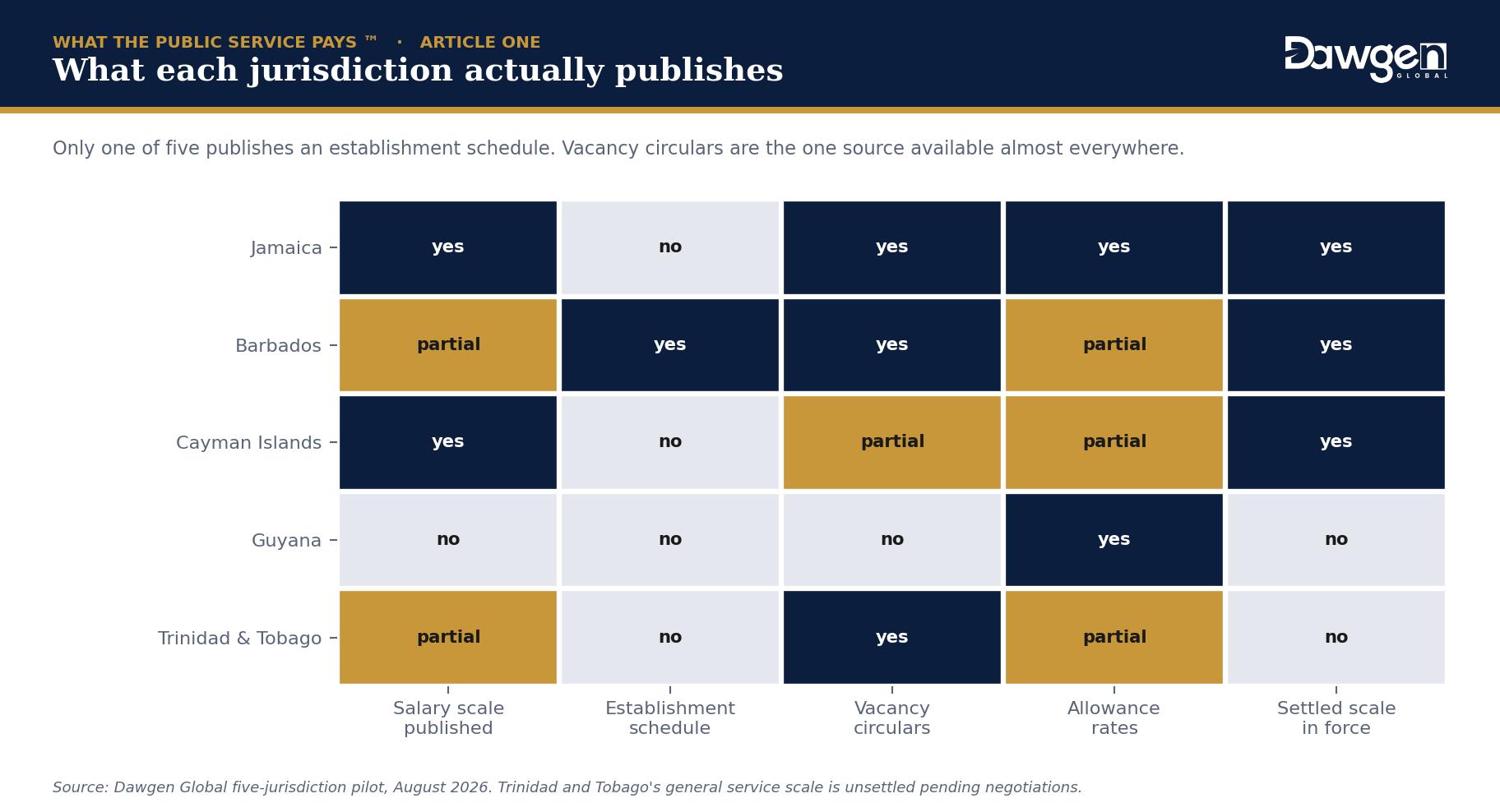
Exhibit 5. What each of the five pilot jurisdictions makes available.
Using public sector pay data responsibly
While the full comparison is being completed, employers still have to set salaries. The following five tests are the ones our HR Advisory practice applies before relying on any public sector figure, and they are worth applying to any source, including ours.
- Ask what the number is. Is it a scale minimum, a scale maximum, a midpoint, or the actual pay of a particular incumbent? These are four different quantities and they are routinely conflated. An establishment schedule typically shows what the current holder is paid, which is a point on the scale, not the scale itself.
- Ask what is included. Basic salary only, or basic plus allowances? Before or after tax? Before or after employee statutory contributions? Does it include employer pension and health cost? In the jurisdictions we have measured, the difference between the narrowest and broadest of these definitions is between a quarter and a third of the total.
- Ask when it applies. A scale in force is not the same as a scale agreed, and neither is the same as a scale being negotiated. Ask for the effective date, and ask whether any settlement is outstanding that would revise it retroactively.
- Ask which service. Core civil service, teaching service, health service, disciplined services and state-owned enterprises are frequently on entirely separate structures within the same jurisdiction. Jamaica’s health families do not sit on the core pay bands at all. A figure that does not say which service it describes is not usable.
- Ask whether the post is established or contract. The same role on the two bases carries materially different total reward — a pension on one, typically a gratuity on the other — and comparing across them without saying so is one of the more common errors in this field.
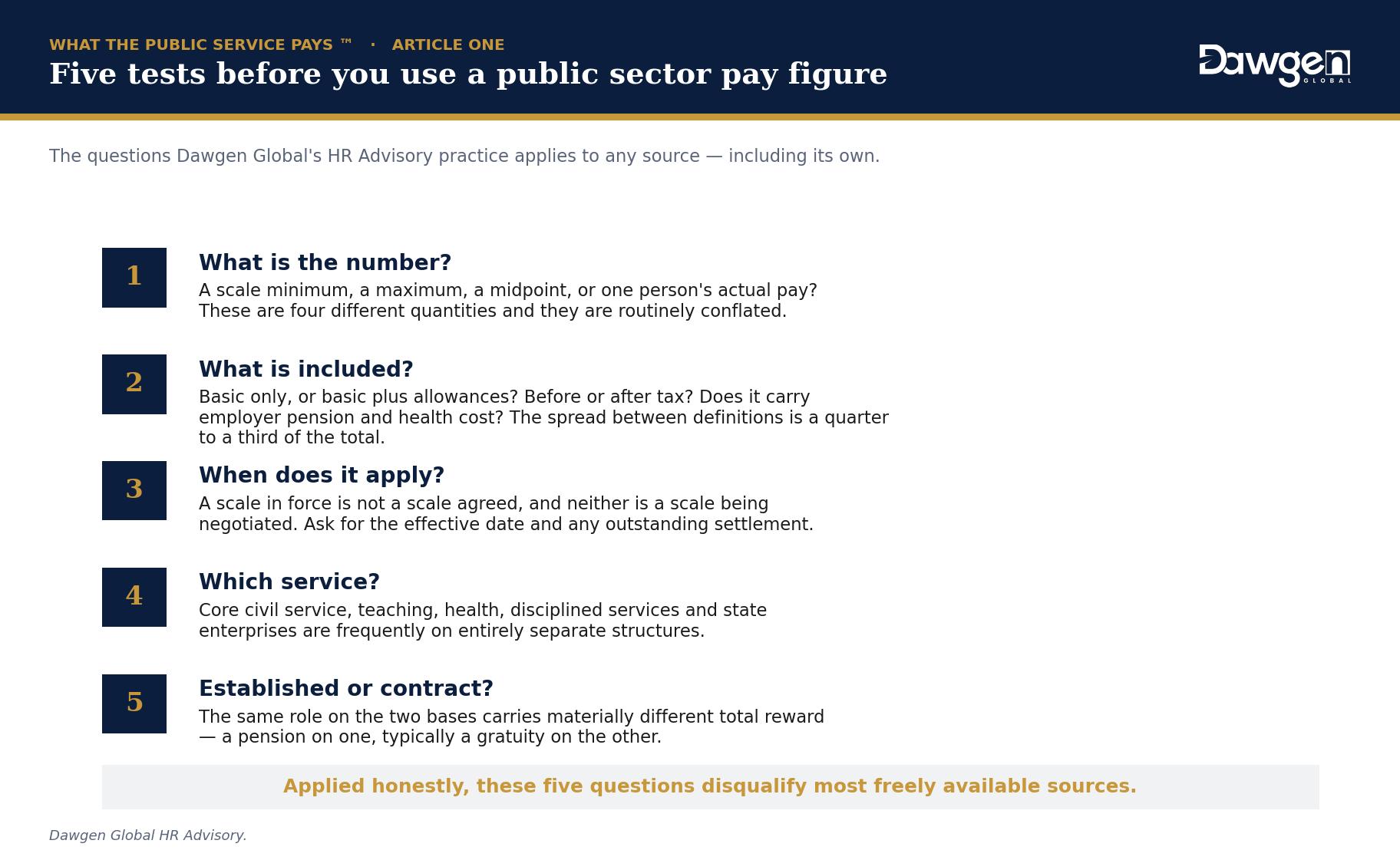
Exhibit 6. The five tests, applied by Dawgen Global’s HR Advisory practice to any source including its own.
Applied honestly, these five questions will disqualify most freely available sources on Caribbean public sector pay. That is the correct outcome. A benchmark that cannot survive five questions should not be the basis of a salary decision.
A note on what we do with this
This research sits within Dawgen Global’s HR Advisory practice, alongside the work we do for clients on job evaluation, pay structure design, grading reviews and reward benchmarking. The techniques are the same ones described above: define the role by its content rather than its title, establish what is genuinely comparable, be explicit about total reward rather than headline salary, and refuse to publish a comparison the evidence will not carry. We have applied them here to sixteen public services because nobody had, and because our clients kept asking a question that could not be answered.
What this series will cover
Over the coming months this series will publish the findings as they stand, one at a time, with every figure traced to a named source document. Among them:
- Two Caribbean public services, with no shared pay policy, have built identical salary bands — thirteen incremental points at two and a half per cent, to five decimal places.
- The distance between the top and the bottom of a public service varies by a factor of nearly four across the region, and the widest gap is at the bottom, not the top.
- In one jurisdiction where audited figures exist, employer health care costs four and a half times what the pension promise does — inverting the assumption most reward analysis makes.
- One jurisdiction’s principal allowance is worth a quarter of basic pay at junior professional level and under a tenth at the top, making it quietly regressive.
- One pays a monthly premium for professional qualification — a reward component found nowhere else in the region, and one that bears directly on the market for accountants.
Each of those will be an article. Each will state its sources. And each will close, as this one does, with an invitation.
| AN INVITATION
Eleven of the sixteen jurisdictions in this study have not yet been collected, and in several of the five that have, documents remain outstanding. Public service ministries, personnel departments, statistical offices and central banks wishing to supply information, or to correct anything published in this series, are invited to contact the firm. Corrections received will be acknowledged and reflected. A published figure that turns out to be wrong is a problem; a published figure that nobody can check is a worse one. |
SOURCES
Barbados, Schedules of Personal Emoluments 2026-2027, Government Printing Department. Public Service of Barbados Circular No. 44/2023, Ministry of the Public Service, 31 August 2023. Government of Jamaica, Salary Scales for Monthly Paid Staff 2022-2025 and Summary of Public Sector Salary Scales, Ministry of Finance and the Public Service. Cayman Islands Government Salary Scale effective 1 January 2025, Appendix B to Personnel Circular 11 of 2024. Cayman Islands Office of the Auditor General, Remuneration of the Cabinet, Judiciary, MPs and Key Management Personnel within the Civil Service in 2022, November 2023. Republic of Trinidad and Tobago, Budget Statement 2026, and the 120th Report of the Salaries Review Commission, 24 October 2024. Ratios and conversions are Dawgen Global calculations from those published sources. Commercial salary aggregator figures were retrieved in August 2026 and are not named.
This article is the first in What the Public Service Pays™, a Dawgen Global series drawn from research across sixteen Caribbean jurisdictions. Dawgen Global is an independent, integrated multidisciplinary professional services firm serving the Caribbean. Enquiries: [email protected] | dawgen.global
About Dawgen Global
Dawgen Global is an independent, integrated multidisciplinary professional services firm headquartered at 47 Trinidad Terrace, New Kingston, Jamaica, serving more than 15 territories across the Caribbean. Founded and led by Dr. Dawkins Brown, Executive Chairman, the firm is independent and not affiliated with any international network. It delivers a full suite of professional services under one roof: audit and assurance; tax advisory; IT and digital transformation; risk management; cybersecurity; actuarial and insurance regulatory advisory; HR advisory; mergers and acquisitions; corporate recovery; business advisory and strategy; accounting BPO and virtual CFO services; and legal process outsourcing.
The proposition is simple: big-firm capability without the big-firm price. Dawgen Global’s integrated approach is built for the specific complexities and opportunities of the Caribbean market, helping organizations make sharper, better-informed decisions that drive measurable progress.
To explore a partnership, reach out:
- Website: dawgen.global
- Email: [email protected]
- WhatsApp (Global): +1 555-795-9071
- Caribbean offices: +1 876-665-5926 | +1 876-929-3670 | +1 876-926-5210


