AI Content Assurance, Source Provenance and the New Meaning of a Reliable Document
Executive Summary
On 2 August 2026, a new legal duty took effect across the European Union. Under Article 50 of the EU AI Act, generative AI systems must mark their outputs in a machine-readable format so that synthetic content is detectable as artificially generated. Systems already on the market have until 2 December 2026 to comply. Penalties run to €15 million or three percent of worldwide turnover.
It is the first time a major jurisdiction has legislated content provenance. And it is worth being precise about what it achieves, because the distinction matters more than the deadline.
Machine-readable marking answers one question: did a machine make this? It does not answer the question organizations actually need answered: is it true?
That second question is now producing measurable consequences. In the first quarter of 2026, United States courts imposed at least US$145,000 in sanctions on lawyers who filed briefs containing fabricated citations. One researcher’s database has documented more than 1,100 court proceedings involving AI-generated false authorities. Oregon’s appellate courts moved to a per-infraction fee schedule — a fixed price per fabricated citation — because the volume made case-by-case discretion impractical.
Every one of those matters shares a single root cause. Someone signed a citation they had not read.
This article is about the gap between marking and verification, and about the control environment organizations need to close it.
Two questions provenance answers, and one it does not
Some definitions first, because this field uses several terms loosely.
Generative AI describes systems that create new content — text, images, audio, code, summaries, analyses, recommendations — in response to instructions. Large language models are the form used to generate and process text. They do not work like a database retrieving a verified record; they produce output from patterns learned in training and from whatever is available in the particular interaction. Fluent language is therefore not evidence of factual accuracy.
Hallucination is the term for output that is incorrect or fabricated. The word undersells the problem. A hallucination in this context is rarely absurd. It is a reference with a plausible author, a real-sounding publisher and a credible date, which happens not to exist.
Content provenance means the origin and history of information — where it came from and what happened to it before it reached the final document. This is what Article 50 marking addresses, and what the C2PA Content Credentials standard, referenced by the European Commission’s Code of Practice on Transparency published in June 2026, is designed to carry: a cryptographically signed manifest recording which system generated a file and when.
AI content assurance is different, and it is the part no standard supplies. It is the structured evaluation of AI-assisted content and of the processes that produced it, to establish whether the content is reliable enough for its intended purpose. Depending on scope, it examines factual accuracy, source existence, citation integrity, numerical consistency, human review, confidentiality, approval and evidence retention.
Provenance tells you a document’s parentage. Assurance tells you whether you can rely on it. An organization can be fully compliant with every marking obligation and still publish a board paper built on citations that do not exist.
Why this matters now
Regulation has arrived, and it addresses origin rather than accuracy. The European Commission’s Code of Practice, published on 10 June 2026, gave organizations the first concrete guidance on how to mark AI content, along with an official icon set. It is a genuine advance. But an icon is a claim about how a document was made. It says nothing about whether the statistics inside it are correct.
The courts are no longer treating fabricated citations as embarrassment. They are treating them as sanctionable misconduct, and the penalties have escalated roughly tenfold in eighteen months. What makes the legal cases instructive for every other sector is not the profession involved but the failure pattern: skilled professionals, working under time pressure, accepted plausible-looking references because they looked like every other reference on the page. That failure is available to any organization producing consequential documents.
The standard being demanded is not yet the standard being practised. The same period that produced those sanctions also produced a Northwestern University survey finding that more than sixty percent of federal judges use AI tools in their own work. That asymmetry is not hypocrisy; it is the ordinary condition of a technology moving faster than the conventions around it. But it tells organizations something useful: the expectation being enforced is not do not use AI. It is verify what it gives you, and be able to show that you did.
Existing law already applies in the Caribbean. No CARICOM state has AI-specific legislation. But Jamaica’s Data Protection Act has been in full operation since December 2023, and enforcement provisions are being activated. An employee pasting a client contract into a public AI tool to summarise it creates a data protection exposure today, whatever the document’s eventual quality. And professional liability, consumer protection, financial services regulation and defamation law all attach to the content an organization publishes, regardless of what drafted it. The absence of an AI statute is routinely mistaken for the absence of exposure. They are not the same thing, and the gap between them is where most of the current risk sits.
Synthetic authority

Generative AI has an unusual property: it can combine incorrect information with excellent presentation.
People decide what deserves trust using signals. Professional formatting is a signal. So are sophisticated vocabulary, structured argument, appropriate hedging, detailed explanation and formal citation. Generative AI reproduces every one of them, at no additional cost, whether or not the underlying content is sound.
We describe the result as synthetic authority: content that appears authoritative because of how it is presented rather than because the underlying evidence has been established.
The risk sharpens in predictable conditions — when a reviewer is under time pressure, unfamiliar with the subject matter, impressed by the level of detail, already inclined to agree with the conclusion, or assuming that someone else performed the verification. The last of these is the most common and the most dangerous, because it can be true of everyone in the chain simultaneously.
Consider a single sentence in an AI-assisted board paper: industry demand is projected to increase by 27% over the next three years. A provenance-focused review asks where the 27% came from. Is there an original report or dataset? Who produced it? What period does it cover? Is it current? Did the AI summarise it accurately? Who verified it before the paper was finalised? One unremarkable statistic turns out to require an evidence chain — and in most organizations no part of that chain is captured anywhere.
A document does not become reliable simply because it looks professional. That sentence is obvious when stated plainly and remarkably easy to forget when reading a well-formatted report at four in the afternoon.
Five risks that actually materialise
Factual integrity. Statements may be incorrect, incomplete or insufficiently contextualised. Consequence depends entirely on the document — an error in an internal note may be immaterial; the same error in a regulatory submission is not. Organizations therefore need to identify material statements: those whose inaccuracy could reasonably affect a decision or create meaningful exposure.
Citation and source integrity. A citation is not verified because it looks legitimate. Three separate tests apply. Does the source exist? Does it say what it is cited as saying? And is it represented fairly? A real source can still be misused — its conclusion misunderstood, its qualifications dropped, its findings attributed to the wrong population, its correlation reported as causation, its age concealed.
Numerical integrity. Numbers carry a strong impression of objectivity. Percentages, market sizes, growth rates, ratios, forecasts and calculated amounts each need an identifiable origin. Two distinct checks are required: whether the underlying figure is reliable, and whether it was processed correctly. AI can introduce error at either stage, and a correct calculation performed on an invented input still produces a wrong answer.
Confidentiality and privacy. Assurance must examine not only what AI produced but what was supplied to it. Employees may paste contracts, board papers, client records, financial data, personal information or commercially sensitive research. Organizations need to understand the service terms, data retention, access arrangements, training use and applicable privacy obligations. An excellent final report does not undo a breach that occurred during its preparation.
Human oversight. Many organizations rely on an instruction that employees should “check AI output”. For higher-risk content that is not a control, because it does not specify anything. Did the reviewer read the document, verify each material citation, recalculate important figures, compare claims against original sources, separate assumption from fact, confirm the currency of regulatory information and check how confidential data was handled? Human oversight must be designed as a control, not assumed because a name appears on an approval page.
A risk-based approach is essential
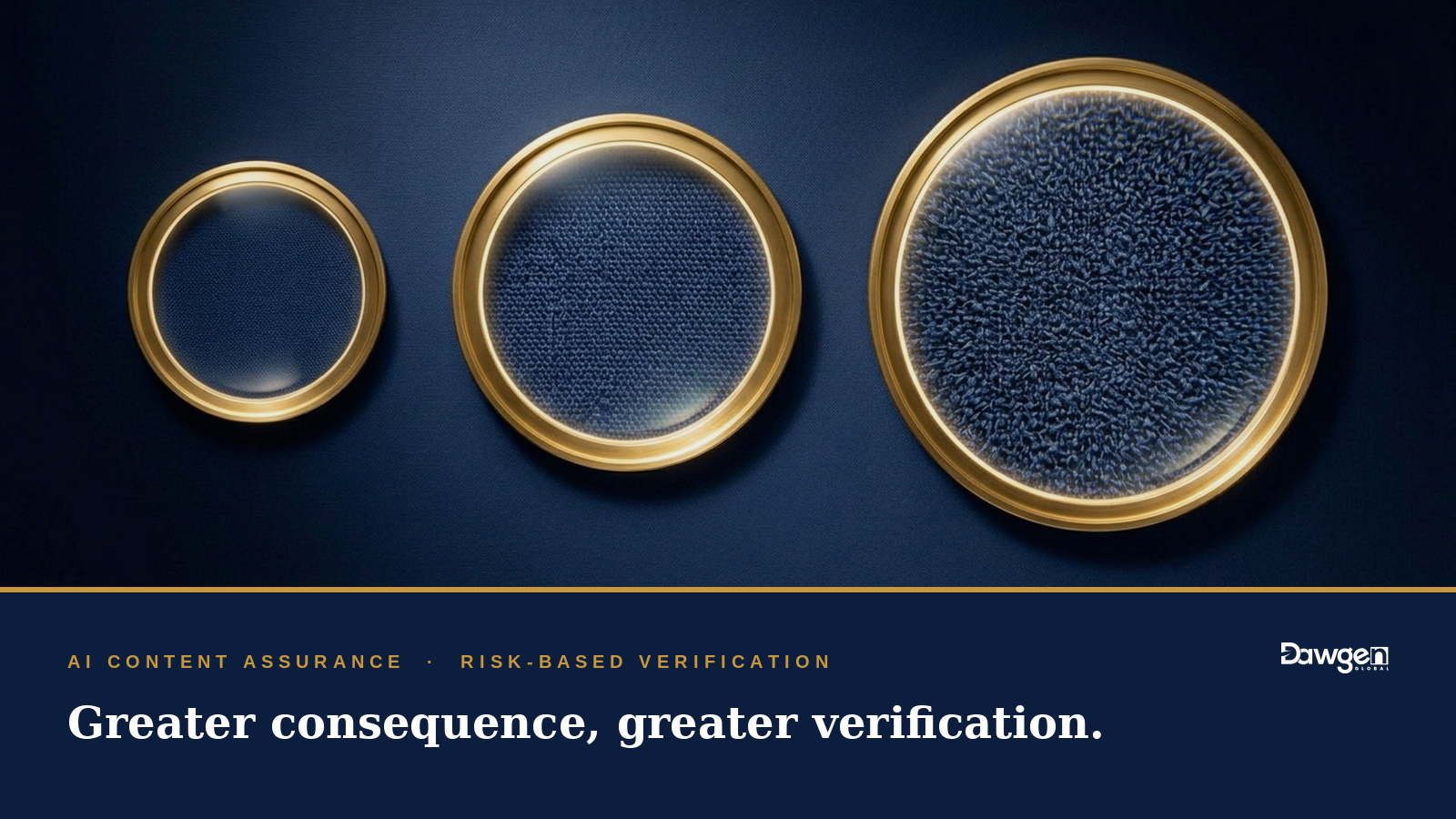
Subjecting every AI-assisted sentence to the same verification would be inefficient and would destroy the productivity the technology exists to create. Review intensity should instead follow the consequence of error.
Lower risk covers internal brainstorming, agenda suggestions, preliminary drafting and stylistic rewriting of already-verified material. Moderate risk covers customer communications, internal research, commercial proposals, website content and market commentary. Higher risk covers board papers, regulatory submissions, financial analysis, investment material, legal and compliance research, public-interest reports and professional opinions.
The governing principle fits on one line: greater consequence requires greater verification.
Two practical points follow. The first is that classification must happen before drafting, not after. A document classified once it is finished has already been produced under whatever standard the author happened to apply, and re-verifying it retrospectively costs several times what building it correctly would have. The second is that classification needs an owner. Left to individual judgement, everything drifts toward lower risk, because lower risk is less work — and the documents most likely to be misclassified are precisely the consequential ones prepared under deadline.
This is also the principle that makes the discipline commercially sustainable. An organization that verifies everything equally will abandon the exercise within a quarter. An organization that verifies in proportion to consequence can maintain it indefinitely, and can explain to a regulator why a given document received the scrutiny it did.
From ad hoc review to a control environment
Five stages convert this from good intentions into a repeatable process.
Discover. Establish how AI contributed. Which tools, which sections, which employees, what information was supplied to the system, what audience the document is for, and what risk classification applies. Without this, reviewers do not know where to concentrate.
Trace. Map material information back to evidence. For each significant claim, establish the original source, its date, its author or issuing body, the relevant page or dataset, its credibility, and the relationship between what the source says and what the document says. This produces a provenance map — and note that it is provenance of evidence, which no marking standard supplies.
Verify. Test the material information. Confirm references exist. Read the original sources. Recalculate figures. Check quotations word for word. Compare authoritative sources against one another. Validate the currency of regulatory statements. Examine assumptions. Consider what has been omitted.
Control. Correct the process that produced the weakness. Approved AI applications, mandatory source capture, prohibited data categories, citation-verification procedures, standardised review checklists, risk classification, independent review for higher-risk material, disclosure protocols, version control, evidence retention, reviewer competency requirements and formal approval workflows.
Report. Exceptions must reach people able to act on them. Reporting should identify unsupported claims, unreliable citations, unverifiable statistics, confidentiality issues, control failures, unresolved exceptions, owners and deadlines. For higher-risk content the organization should be able to show what was reviewed, what was found, what was corrected and who approved the final document.
Evidence retention: the forgotten element
Imagine a regulator questions a statement eighteen months after publication. The organization replies that it checked the statement at the time. The next question is inevitable: can you show us?
For significant AI-assisted content, that means retaining original source documents, source links or identifiers, key datasets, calculation workpapers, review checklists, exception logs, superseded versions, reviewer sign-offs, approval records and relevant AI-use documentation.
Evidence is what converts an assertion of governance into a demonstration of it. It is also the element organizations most consistently omit, because capturing it feels like overhead at the moment of publication and becomes indispensable only at the moment of challenge.
By that point reconstruction is expensive, and it carries a second problem: work assembled after the question was asked looks exactly like work assembled after the question was asked. Contemporaneous records carry a weight that retrospective ones cannot, and no amount of diligence recovers it.
Retention periods should follow the document, not the tool. If a report supports a decision that will be scrutinised for seven years, the evidence behind its material claims has a seven-year life too — a point most organizations have not yet reflected in their retention schedules, because those schedules were written before anything in the drafting process was worth retaining.
A composite Caribbean case study
Consider a composite Caribbean professional-services organization. It had begun using generative AI to accelerate research and prepare initial drafts. A major report intended for external publication contained extensive market commentary, statistics and formal-looking references. It read impressively.
During final review, a senior employee tried to locate several cited publications and could not readily find them. A broader review identified a pattern rather than an incident. Some citations pointed to legitimate sources but carried inaccurate publication details. Others existed but did not fully support the conclusions attributed to them. Several statistics originated in secondary commentary while the report’s wording implied primary datasets. A small number of statements could not be substantiated at all.
The larger finding was structural. The publication process assumed that references appearing in a professionally drafted report had already been checked. No control anywhere required anyone to check them.
Management introduced mandatory source capture, citation verification, risk-based content classification, reviewer sign-off, restrictions on confidential information, evidence retention, escalation of unresolved claims and enhanced approval for higher-risk publications.
The benefit was not the corrected report. It was that future AI-assisted content could be challenged, verified and defended. This is an anonymised composite illustration and does not describe a specific Dawgen Global client engagement.
The Dawgen Global perspective
Two positions should be avoided. The first is that AI-generated content cannot be trusted in any circumstance. The second is that intelligent-looking output deserves the confidence owed to verified professional work. Neither survives contact with practice.
AI is genuinely valuable for accelerating research, structuring ideas, summarising material, improving drafting, comparing documents and identifying patterns. What must be separated is productivity from reliability.
The principle we would put above all others is this: AI can accelerate the production of information, but it cannot absorb accountability for it. The individual or organization publishing, submitting or relying on material information remains responsible for determining that appropriate verification occurred. That responsibility has not moved, and no marking standard will move it.
We also take the view that this is not work most organizations should build a specialist internal function to perform. The volume is uneven — heavy when the control environment is first established, then concentrated around a limited number of consequential publications each year. That profile suits a review relationship better than a permanent hire, particularly where independence from the original preparer is part of what makes the review worth having.
Regulation is heading toward disclosure of origin. Boards, clients, regulators and courts are heading somewhere more demanding — toward evidence of verification. The two are not the same, and the second is considerably harder to retrofit.
Conclusion
Generative AI has made professional-looking information easier to produce than at any previous point in modern business. That is a significant opportunity. It also changes what trust means.
An organization can no longer assume that a detailed reference is genuine, that a polished paragraph is factually sound, or that a confident explanation rests on evidence, simply because the technology produced it fluently. The signals that used to be reasonable proxies for verification have become cheap to counterfeit — not maliciously, but as a by-product of how the technology works.
Content provenance will tell you where a document came from. Content assurance tells you whether you can stand behind it.
Request the Dawgen AI Content Integrity Diagnostic. It examines AI content-generation practices, source-verification procedures, citation controls, provenance, hallucination risk, human oversight, confidentiality, approval workflows, evidence retention, documentation, disclosure practices and assurance readiness — and produces a prioritized roadmap.
Download the Dawgen AI Content Assurance & Provenance Review brochure · dawgen.global/contact-us · [email protected]
Caribbean 876-929-3670 · USA 855-354-2447
At Dawgen Global, we help you make Smarter and More Effective Decisions.
Sources and further reading
- Regulation (EU) 2024/1689 (the EU AI Act), Article 50 — transparency obligations applicable from 2 August 2026; machine-readable marking under Article 50(2) for systems already on the market by 2 December 2026
- European Commission and European AI Office — Code of Practice on Transparency of AI-Generated Content, published 10 June 2026, with accompanying official icon set
- C2PA (Coalition for Content Provenance and Authenticity) — Content Credentials specification v2.3, February 2026
- Reported analyses of United States court sanctions for AI-fabricated citations, Q1 2026; and the Charlotin database of AI hallucinations in legal proceedings
- Norton Rose Fulbright — AI in litigation: update on Gen AI sanctions in 2026
- Jamaica Data Protection Act 2020; Office of the Information Commissioner
Regulatory positions stated in this article reflect the position as at August 2026 and should be verified before being relied upon. This article is general commentary and does not constitute legal, regulatory or assurance advice.
About Dawgen Global
Dawgen Global is an independent, integrated multidisciplinary professional services firm headquartered at 47 Trinidad Terrace, New Kingston, Jamaica, serving more than 15 territories across the Caribbean. Founded and led by Dr. Dawkins Brown, Executive Chairman, the firm is independent and not affiliated with any international network. It delivers a full suite of professional services under one roof: audit and assurance; tax advisory; IT and digital transformation; risk management; cybersecurity; actuarial and insurance regulatory advisory; HR advisory; mergers and acquisitions; corporate recovery; business advisory and strategy; accounting BPO and virtual CFO services; and legal process outsourcing.
The proposition is simple: big-firm capability without the big-firm price. Dawgen Global’s integrated approach is built for the specific complexities and opportunities of the Caribbean market, helping organizations make sharper, better-informed decisions that drive measurable progress.
To explore a partnership, reach out:
- Website: dawgen.global
- Email: [email protected]
- WhatsApp (Global): +1 555-795-9071
- Caribbean offices: +1 876-665-5926 | +1 876-929-3670 | +1 876-926-5210


