
A standing guide for owner-managed businesses, their boards and their advisers
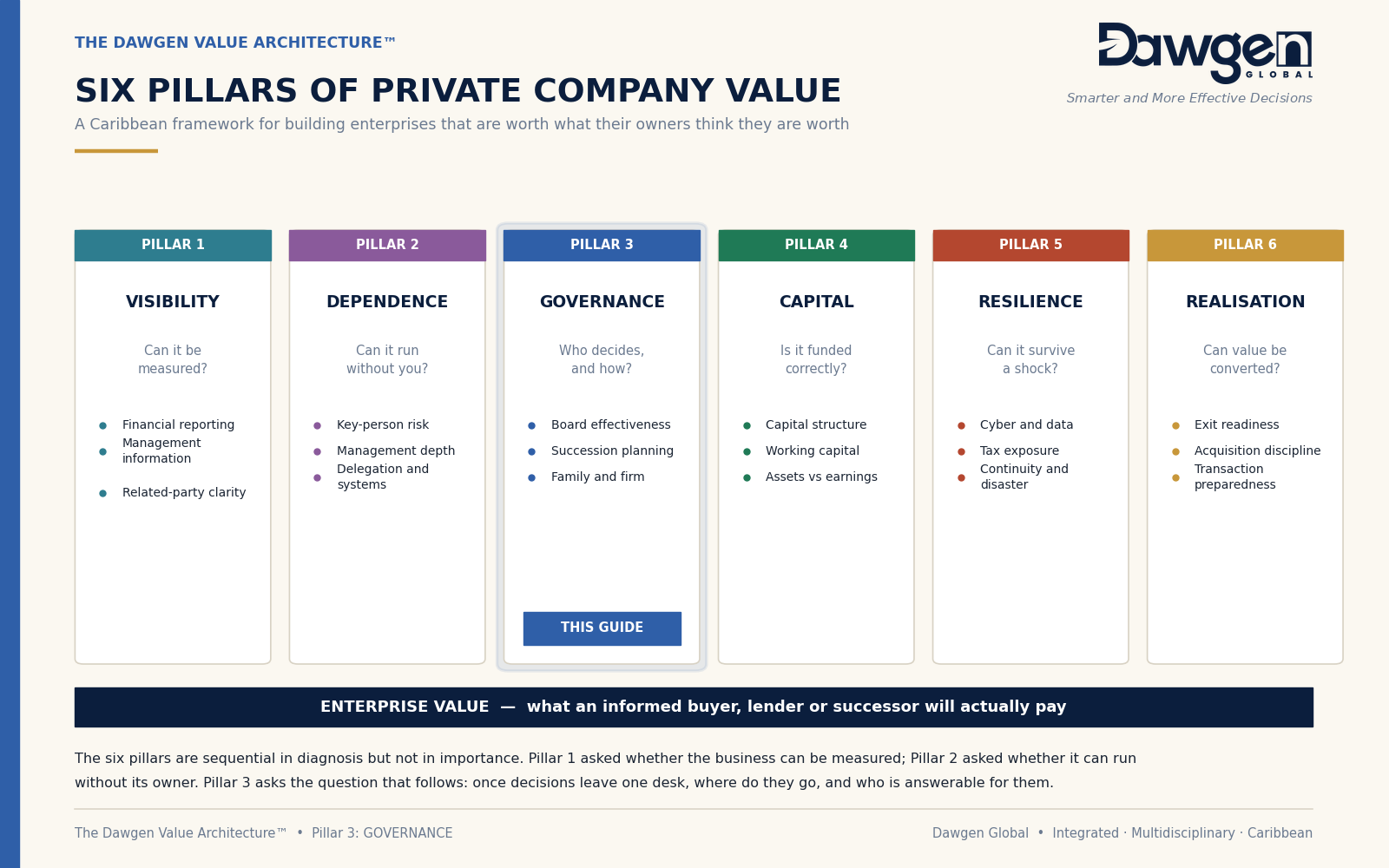
The Dawgen Value Architecture™ — six pillars of private company value. This guide addresses Pillar 3.
The Dawgen Value Architecture™
Most owner-managed businesses in the Caribbean are worth less than the people who built them believe. That is not a comment on the quality of those businesses. It is a comment on the difference between value that exists and value that can be demonstrated to a lender, a buyer, a regulator or a successor. The gap between the two is rarely closed by trading harder. It is closed by building the conditions under which value becomes visible, transferable and durable.
The Dawgen Value Architecture™ is the framework we use to name those conditions. It holds that what a private company is actually worth is determined by six things, each of which can be assessed, scored and improved. The framework was developed from patterns that recur across private company advisory engagements in this region, and it is set out here in full so that owners and boards can apply it to their own businesses without engaging anyone at all.
The six pillars
PILLAR 1 · VISIBILITY Can it be measured?
PILLAR 2 · DEPENDENCE Can it run without you?
PILLAR 3 · GOVERNANCE Who decides, and how?
PILLAR 4 · CAPITAL Is it funded correctly?
PILLAR 5 · RESILIENCE Can it survive a shock?
PILLAR 6 · REALISATION Can value be converted?
The order is deliberate, but it is an order of diagnosis rather than an order of importance. Pillar 1 asked whether the business can be measured. Pillar 2 asked whether it can operate without the person who built it, and answered that the remedy is to move decisions off one desk. Pillar 3 asks the question that necessarily follows: once decisions leave that desk, where exactly do they go, who is answerable for them, and what survives to prove they were taken properly.
How each guide is built
Every guide in the series follows the same structure, so that a reader who has worked through one will know exactly where to look in the next. Each begins with the pattern as it presents itself in practice, then examines the Caribbean conditions that make the pattern harder to resolve here than elsewhere. It then sets out what the problem costs in cash terms, why owners nonetheless leave it unaddressed, and a staged remedy organised into the first ninety days, months three to twelve, and beyond. Each guide closes with a scored diagnostic the reader can complete unaided, and a short section on where to begin.
The guides are written as standing reference documents rather than articles. They are intended to be returned to, worked through with a management team, and used as the basis for a board conversation. Figures presented as ranges are indicative of what we observe in practice and in the published international literature; they are not the output of a survey, and they are labelled as such wherever they appear.
| Where this guide sits
This is Pillar 3 of 6. It addresses board effectiveness, succession planning, and the point at which family and firm must be separated. Pillars 1 and 2 precede it: a board cannot govern what it cannot measure, and it has nothing to govern while every decision still returns to one person. Pillars 4 through 6 follow in sequence, and the capstone across the whole framework is the Private Company Value Scorecard, which consolidates the six diagnostics into a single view of what a business would be worth to an informed buyer, lender or successor. |
SECTION 1
The Pattern

Almost every Caribbean private company has a board. It is named in the incorporation documents, the directors are recorded at the companies registry, and their particulars are filed each year. What most of these companies do not have is a forum in which decisions are taken, tested and recorded. The board exists as a legal fact and not as an operating one, and the distinction is invisible until somebody from outside the company asks to see it.
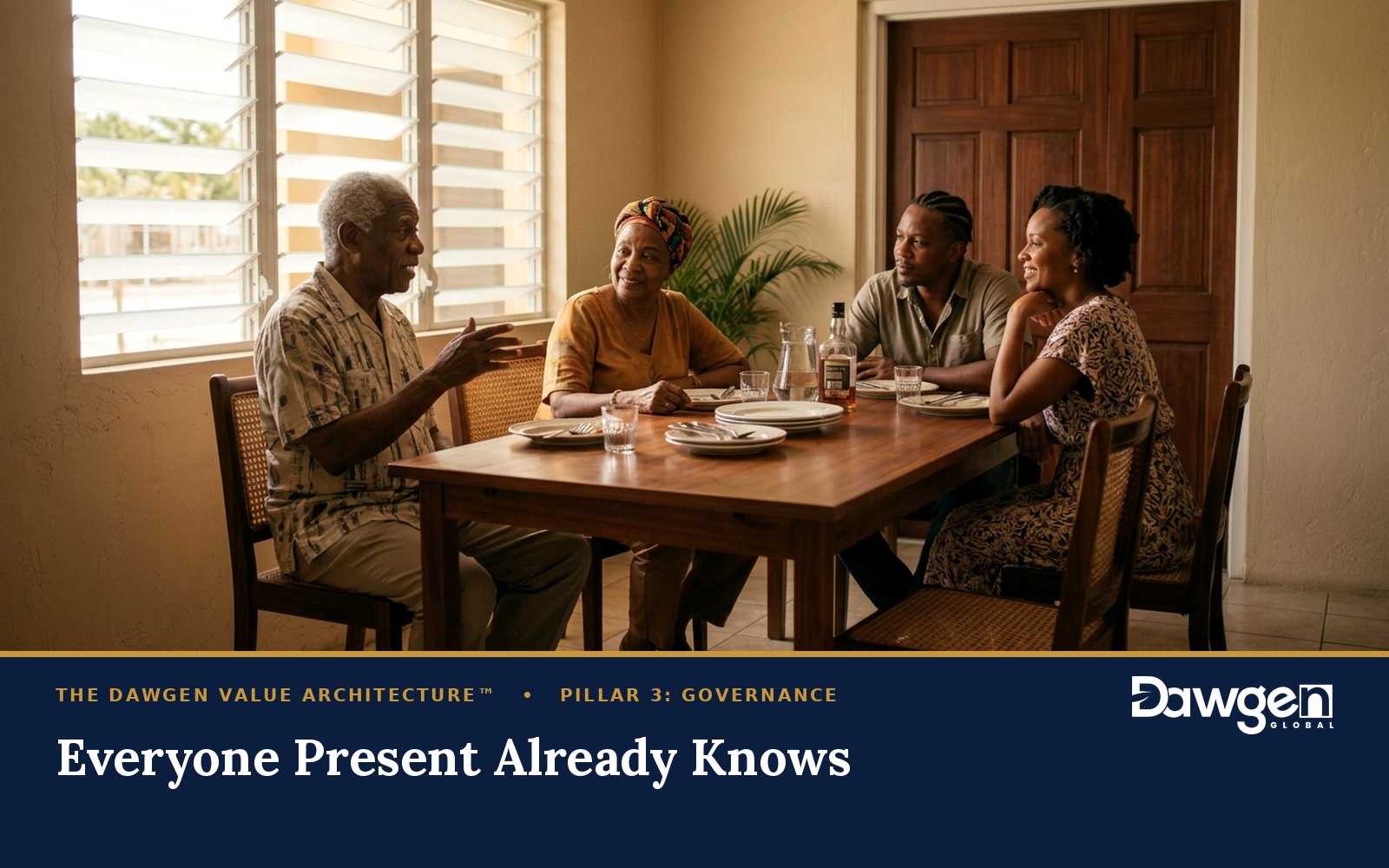
The gap presents itself in three recognisable forms. There is the board that has never met, where minutes are produced once a year by the accountant so that the file is complete. There is the board that is the family, which meets constantly and informally, at the office and at Sunday lunch, and records nothing because everyone present already knows. And there is the board of advisers — respected people, generously giving their time — who offer opinions but hold no authority, carry no duty, and cannot outvote anyone.
A board is not a group of people with a title. It is the place where the decisions that matter are taken, and the record that proves who took them.
Why this is Pillar 3
Pillar 1 established that a business must be able to measure itself. Pillar 2 established that it must be able to operate without its owner, and the instrument for that was the delegation register — a written statement of which decisions may be taken further down the organisation. That register creates an immediate and unavoidable second question. If some decisions have moved down, then the remainder have stayed up. Where is up, who sits there, and what happens in that room?
This is not a theoretical concern. An owner who has genuinely delegated operating authority and has no functioning board has not reduced his key-person risk at all. He has simply moved the undocumented decisions from the operational category into the strategic one, where they matter more and are recorded even less.
The test that settles it
The condition is directly measurable, and the measurement takes an afternoon. Name the five largest decisions the company took in the last twelve months — the capital expenditure, the new facility, the senior appointment, the change in terms with a major supplier, the property. For each one, produce four things: what was decided, who was entitled to decide it, what information was in front of them, and the record made at the time.
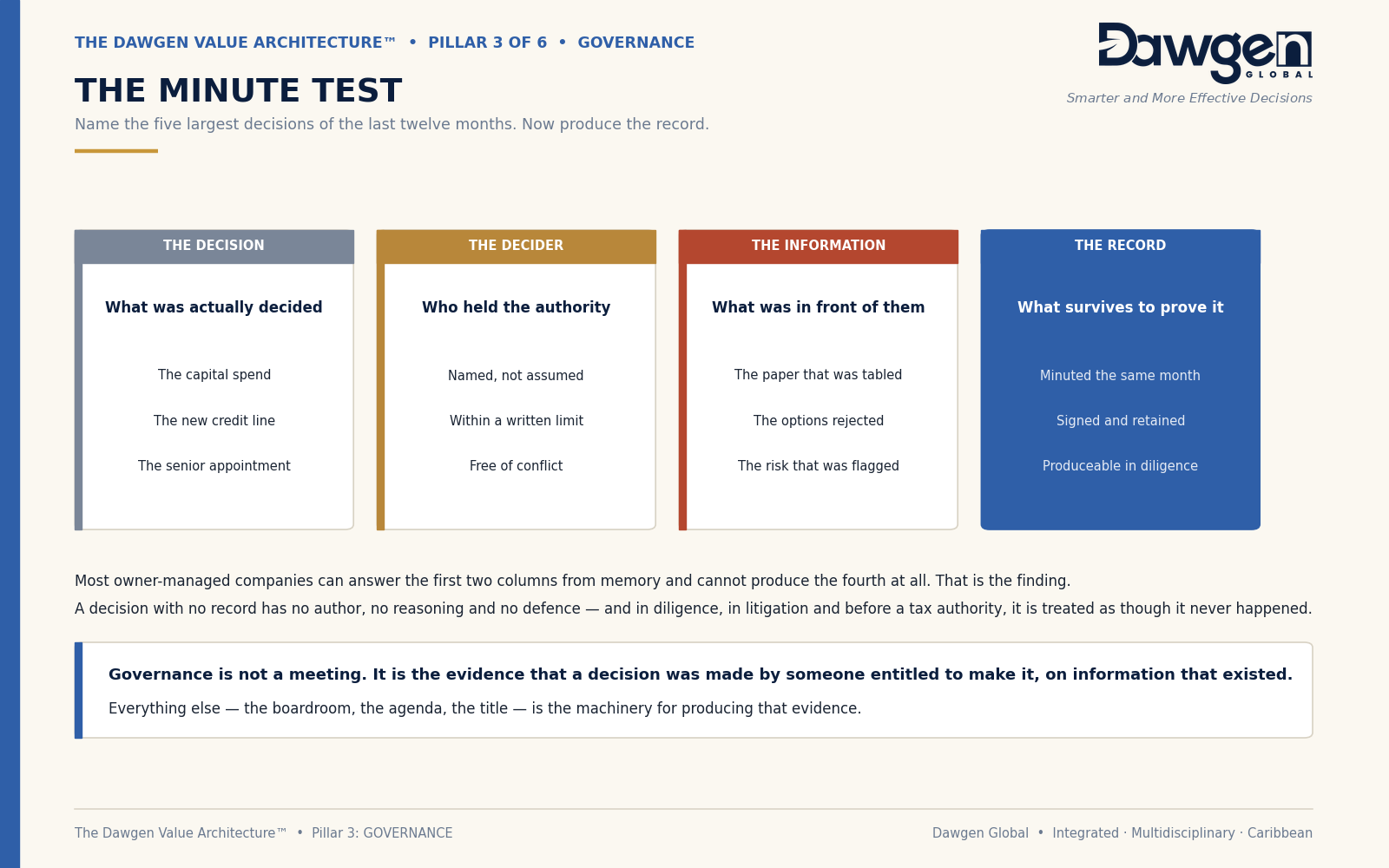
Most owner-managed companies can answer the first two columns from memory, hesitate on the third, and cannot produce the fourth at all. That is the finding, and it is not a clerical one. A decision with no contemporaneous record has no author, no reasoning and no defence. In diligence it becomes a warranty the seller must give personally. In litigation it becomes an assertion rather than evidence. Before a tax authority it becomes an arrangement that nobody can show was made on commercial terms.
SECTION 2
The Caribbean Variant
Weak governance in private companies is universal. What is regional is why the standard remedy — appoint independent directors, meet quarterly, formalise the papers — is so much harder to execute here. Six conditions recur with enough regularity to be treated as structural.
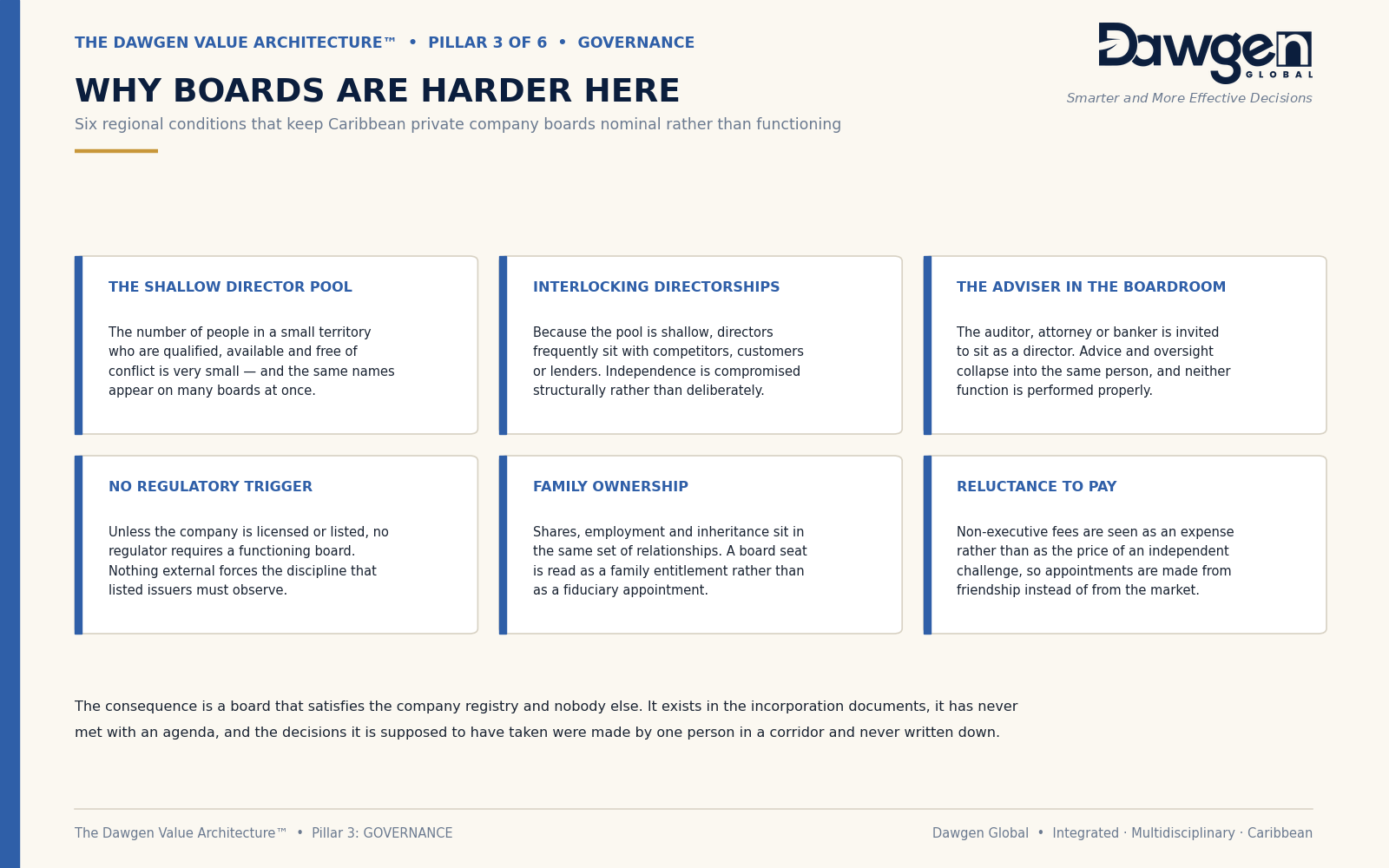
The first is the size of the director pool. In a territory of a few hundred thousand people, the number of individuals who are simultaneously qualified, available, willing and free of conflict is genuinely small, and it is already heavily committed. The advice to recruit a capable independent director is sound, and in many territories there is a waiting list rather than a shortlist.
The second follows directly. Because the pool is shallow, directors sit on many boards at once, and those boards frequently include competitors, customers, suppliers or lenders of one another. Independence is compromised structurally rather than deliberately. A director who must recuse himself from half the agenda is not providing the challenge the appointment was made to secure.
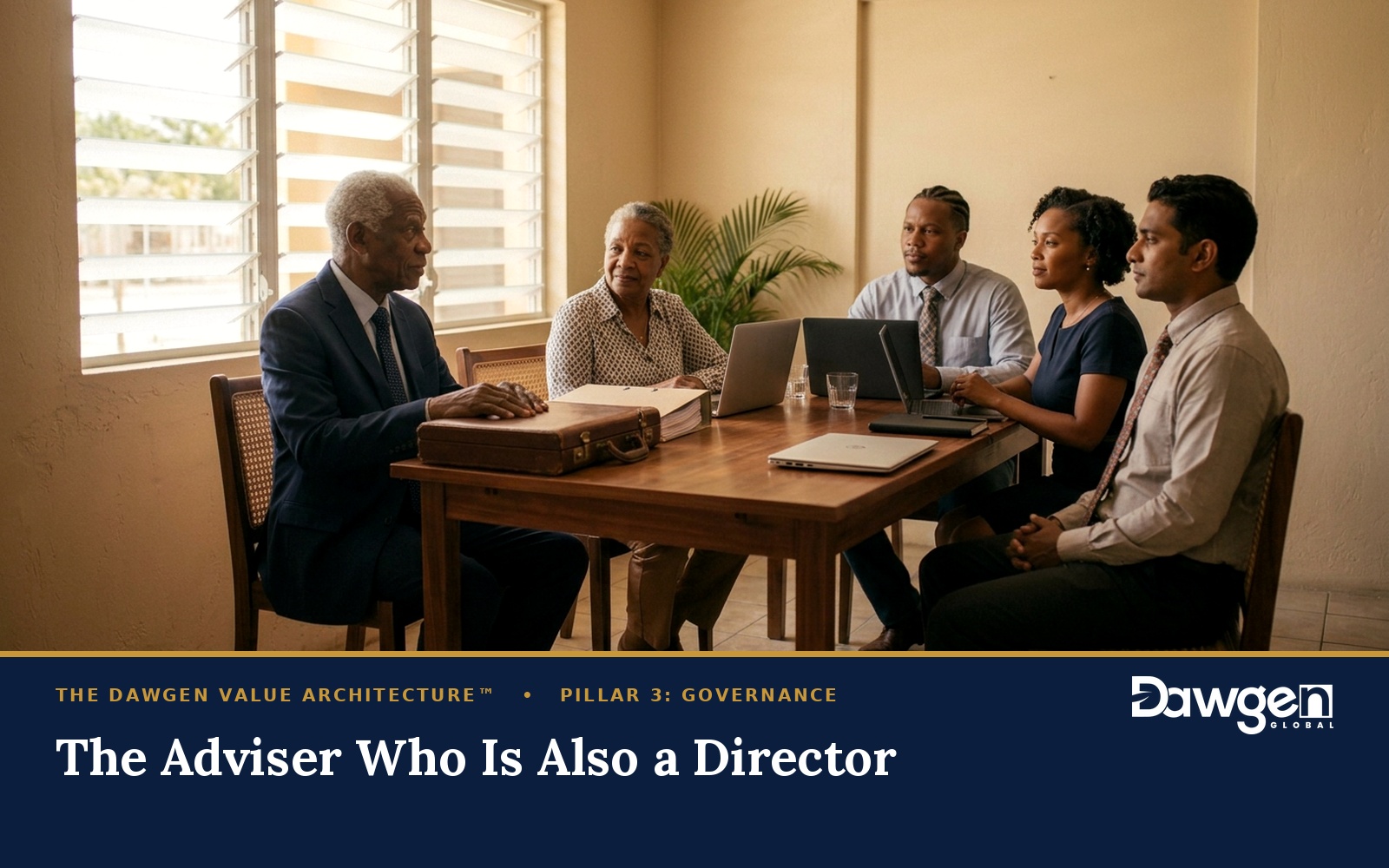
The third is the adviser in the boardroom. It is common and well-intentioned for the auditor, the attorney or a senior banker to be invited to sit as a director. The difficulty is that oversight and advice are different functions, and a person who advised on a transaction cannot afterwards review it independently. Where the auditor holds a board seat, the audit is compromised outright.
The fourth is the absence of a regulatory trigger. Unless a company is listed or holds a licence, no regulator requires it to hold meetings, keep minutes or appoint anyone independent. Listed issuers in this region operate under codes and continuous disclosure obligations. The unlisted company next door, of comparable size and employing comparable numbers, is subject to none of it, and nothing external ever forces the discipline.
The fifth is the entanglement of family and firm. Where shares, employment and inheritance sit in the same set of relationships, a board seat is read as an entitlement of ownership or of birth rather than as a fiduciary appointment carrying duties. The consequence is that the question of who should sit on the board cannot be asked without the question being heard as who is favoured.
The sixth is a reluctance to pay. Non-executive fees are treated as an overhead rather than as the price of independent challenge, so appointments are made from the friendship circle, where no fee is expected and no fee is paid. A director who is a friend, unpaid, and personally indebted to the owner for the appointment is not positioned to disagree with him.
| Why the standard prescription fails here
International guidance begins with board composition, because it assumes a deep market of independent directors and a regulator requiring their appointment. In this region the sequence has to be inverted. The calendar, the reserved matters schedule and the minute come first, because they cost nothing, require no appointment, and work even where the director pool is thin. Composition is a second-year problem, not a first-quarter one. |
SECTION 3
What It Costs

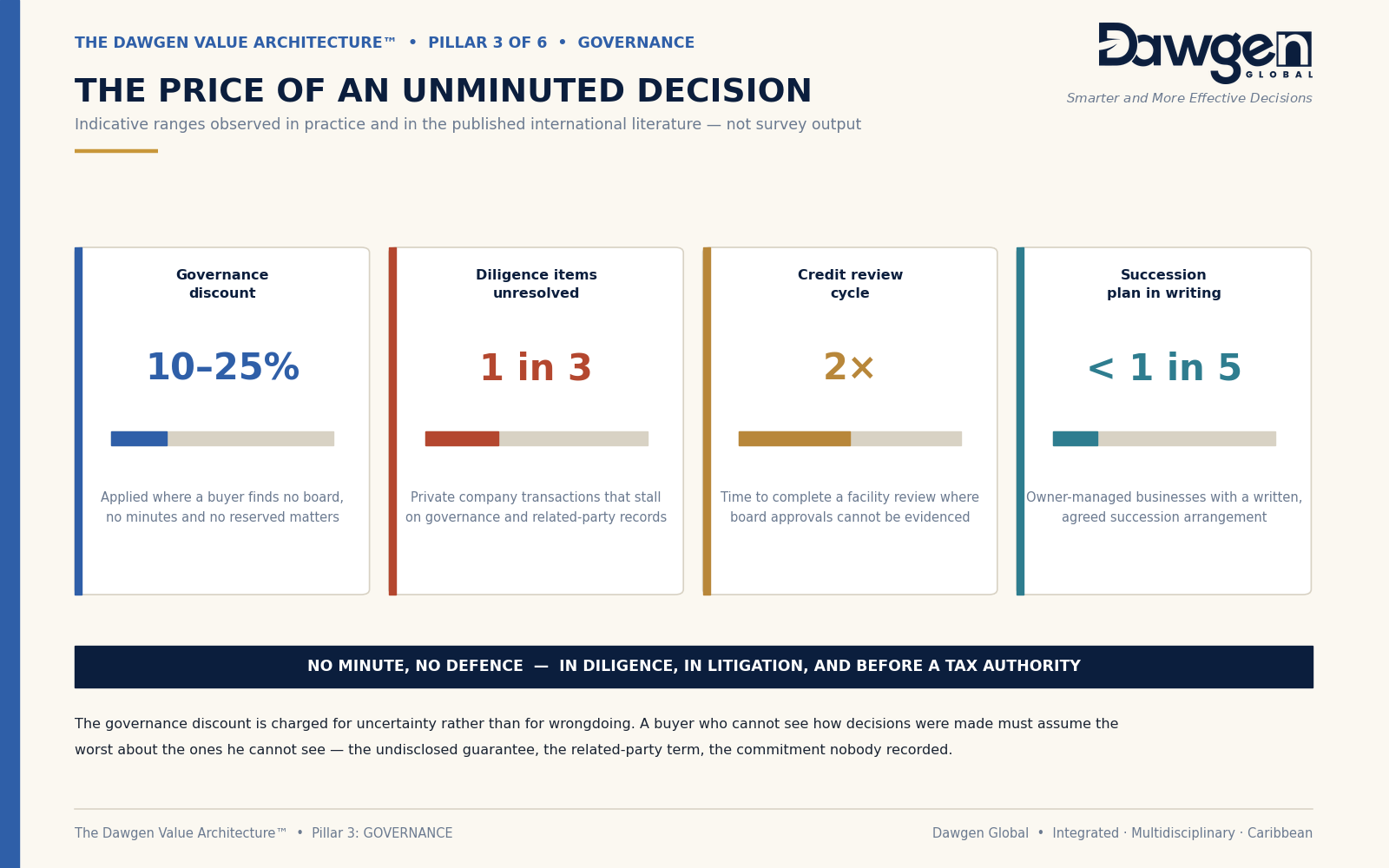
Governance failure is rarely dramatic. It does not usually produce a scandal; it produces a slow, quiet drag on every transaction the company attempts. The ranges that follow are indicative of what we observe in practice and in the published international literature. They are not the output of a survey, and they should be read as orders of magnitude.
It is paid in the price
A buyer examining a private company assesses not only what it earns but how reliably the record of its affairs can be trusted. Where there is no board, no reserved matters schedule and no minutes, the buyer cannot verify that commitments were authorised, that related-party terms were commercial, or that no undisclosed guarantee exists. The response is a discount, commonly in the range of ten to twenty-five per cent, together with a demand that the owner personally warrant everything the record cannot.
It is paid in time
The more common cost is delay. Facility reviews that should take weeks take months because board approvals cannot be evidenced. Transactions stall in diligence on governance and related-party questions that would have been trivial had the register existed. Delay is expensive in itself, and a transaction that loses momentum frequently loses the buyer.
It is paid when the family changes
The largest single loss arrives at succession. Where ownership, employment and control have never been separated in writing, the death or retirement of a founder converts a commercial question into a family dispute — and the business becomes the subject of the argument rather than the thing being preserved. Very few owner-managed businesses in this region have a written, agreed succession arrangement. Almost all of them will need one.
The governance discount is charged for uncertainty, not for wrongdoing. A buyer who cannot see how decisions were made must assume the worst about the ones he cannot see.
SECTION 4
Why Owners Do Not Fix It

The reasons are consistent, and none of them is unreasonable from where the owner is standing.
The first is that a board reads as a loss of control. The owner has spent decades being able to decide on Tuesday what he thought of on Monday, and a reserved matters schedule appears to place that ability in someone else’s hands. The fear is understandable but largely misplaced: in a company the owner controls, the board does not remove his decision. It requires him to state it, in front of others, on paper.
The second is that governance is experienced as bureaucracy. Agendas, packs, minutes and registers look like the machinery of a large organisation imported into a business that has always run on judgement and speed. That impression is fair when governance is over-engineered, which is why the remedy in this guide is deliberately small: four dates, six reserved matters, one page per meeting.
The third is a reluctance to let outsiders see the numbers. In a small market, the concern that a director will learn the margins and repeat them in the wrong company is real. It is answered by confidentiality undertakings, by selecting directors from outside the immediate trade, and by paying them — which converts a favour into a professional engagement with obligations attached.
The fourth is family sensitivity. Appointing a board means deciding who sits on it, and in a family business every seat carries a message about standing and succession. Many owners prefer the ambiguity of no board to the clarity of a board that omits somebody. The cost of that preference is usually paid later, and by the next generation.
The fifth is that nothing has gone wrong yet. There has been no dispute, no investigation and no transaction, so the absence of a record has never been tested. Governance is insurance against events that are individually improbable and collectively near-certain over a business lifetime.
| The correct diagnosis
The absence of governance is not usually a rejection of accountability. It is the absence of a habit that nobody in the business has ever been required to form. Owners who resist a board almost never resist writing down a decision they have already taken — and that is the whole of Phase One. The remedy begins with a diary and a page, not with a constitution. |
SECTION 5
The Remedy
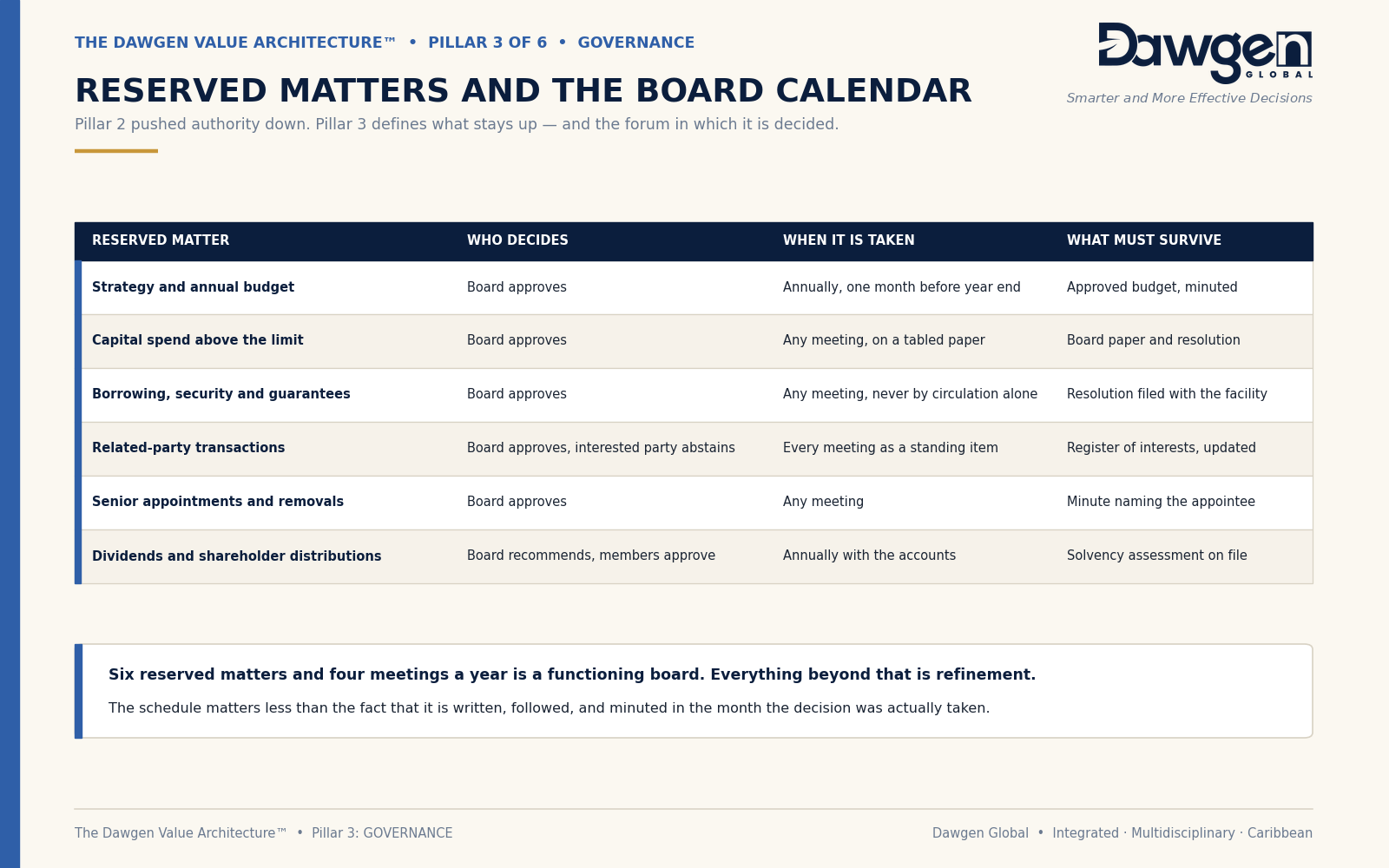
The instrument that does most of the work is a single schedule naming the decisions that are reserved to the board, who takes them, when they are taken, and what record must survive. Pillar 2 pushed authority down through the delegation register. This schedule is its counterpart: it states what stays up, and it makes the two documents together a complete description of how the company decides.
Phase one: the first ninety days
The objective of the first ninety days is not a good board. It is a recorded one. Nothing in this phase requires an appointment, a fee or an adviser.
- Run the minute test on the last twelve months and write down honestly what could not be produced.
- Write the reserved matters schedule — six items is enough to begin.
- Fix four meeting dates for the next twelve months, put them in every diary, and do not move them.
- Adopt a one-page minute format: decision, who decided, what was tabled, what was resolved.
- Open a register of directors’ and connected-party interests, and populate it honestly.
Phase two: months three to twelve
The second phase turns a recorded board into a working one, and does the composition work that Caribbean conditions make slow.
- Build the board pack from the monthly management pack established under Pillar 1 — one source, two audiences.
- Circulate papers three clear days before each meeting, without exception, so decisions are taken on information rather than on presentation.
- Make related-party transactions a standing agenda item, with the interested party abstaining and the abstention minuted.
- Appoint one independent director from outside the friendship circle, and pay a fee.
- Separate the adviser role from the director role: the auditor and the principal attorney advise the company, they do not sit on its board.
Phase three: beyond twelve months
The third phase addresses the two questions that only a functioning board can answer: what happens when the owner stops, and how the family and the firm are kept distinct.
- Put succession in writing for the chair, the owner and each critical role — who acts, and who decides who acts.
- Agree a shareholders’ agreement or family charter covering share transfer, employment of relatives, dividends and dispute resolution.
- Review board performance annually, in writing, however briefly.
- Hold one private session a year without executives present.
- Move to Pillar 4, CAPITAL — a board that functions can now take funding decisions that a lender will accept.
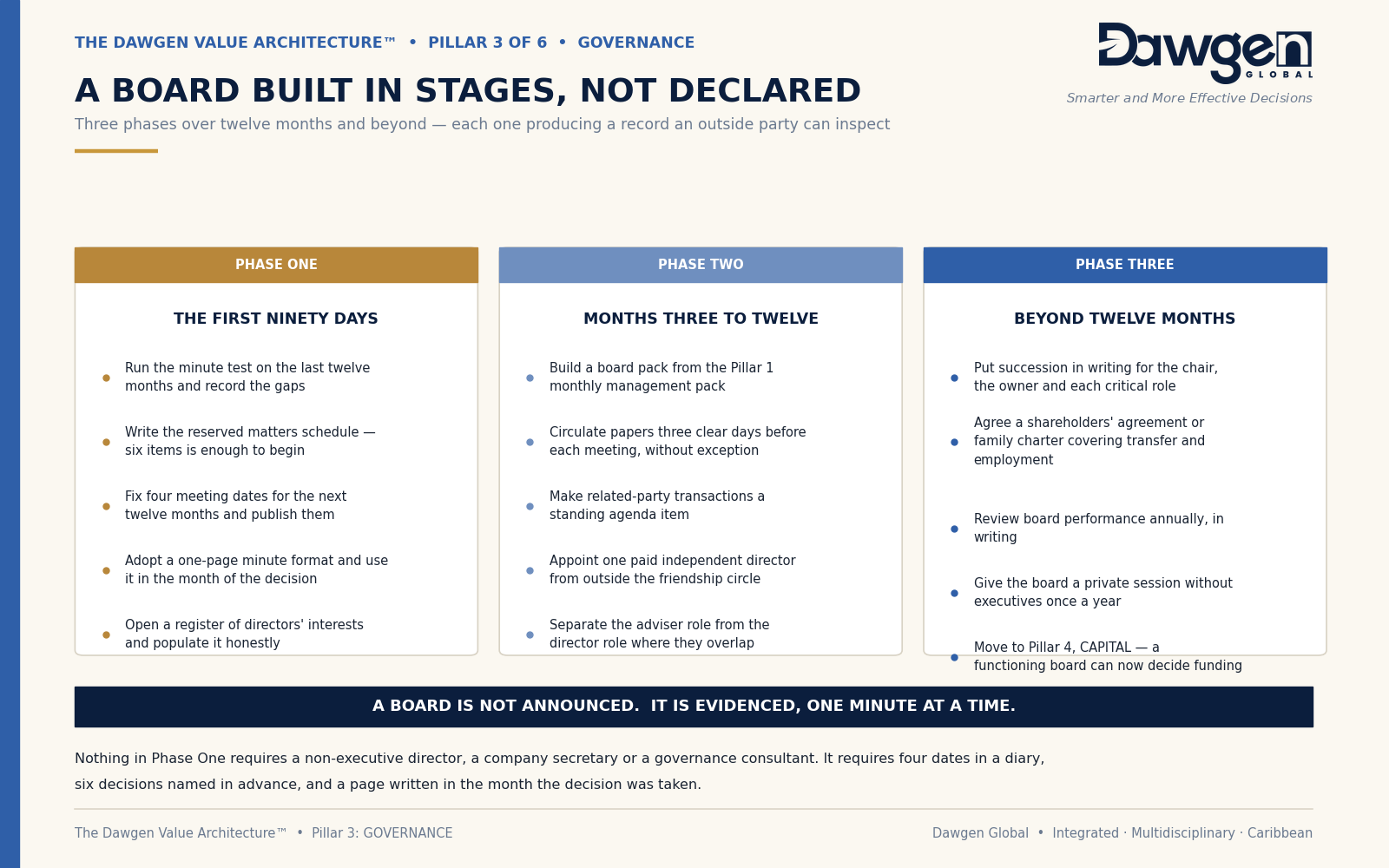
A board is not announced. It is evidenced, one minute at a time.
SECTION 6
The Diagnostic
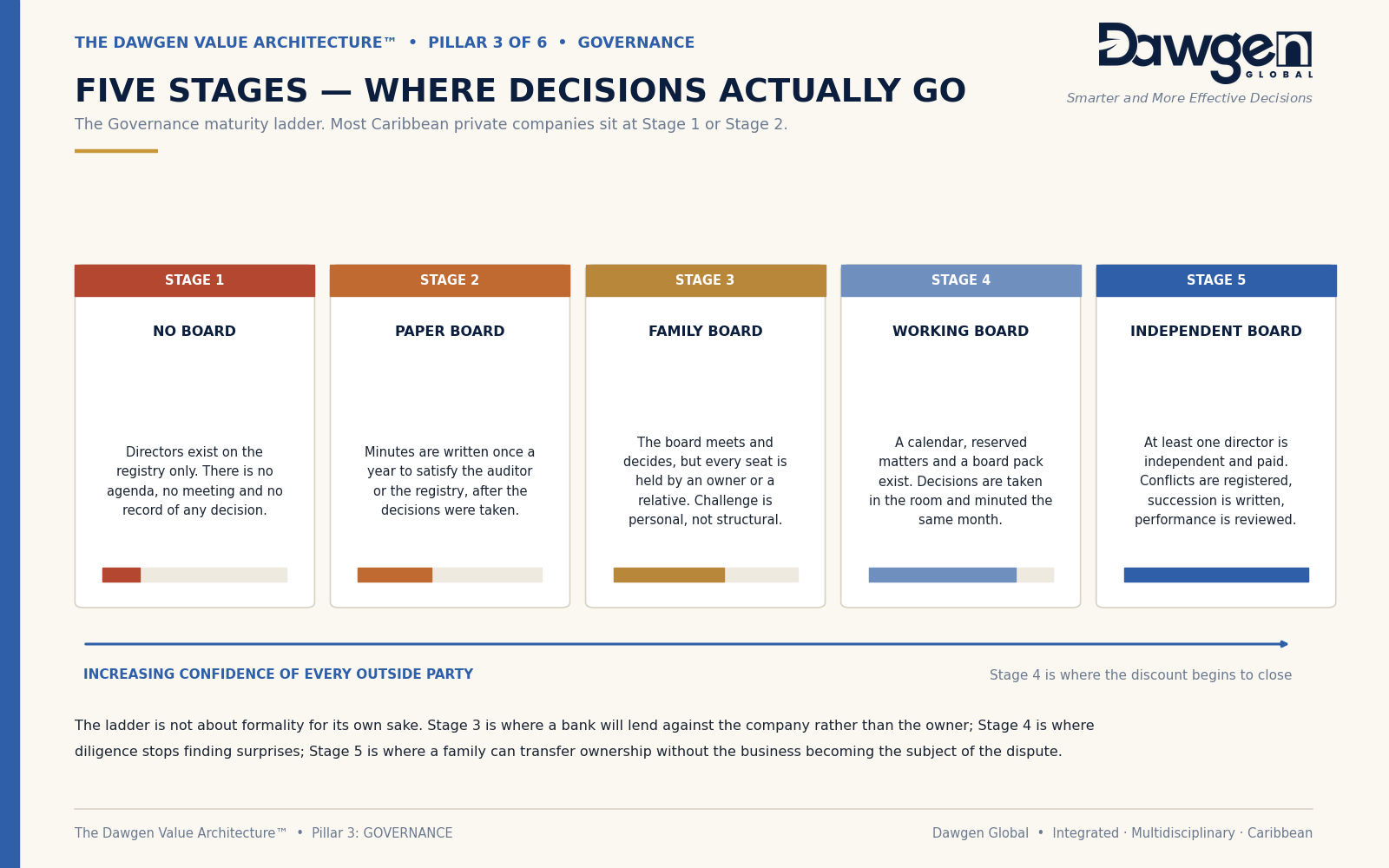
Locate the business honestly on the governance ladder before deciding where to begin. Most Caribbean owner-managed companies sit at Stage 1 or Stage 2, and a considerable number believe themselves to be at Stage 3 because meetings happen without anything surviving them.
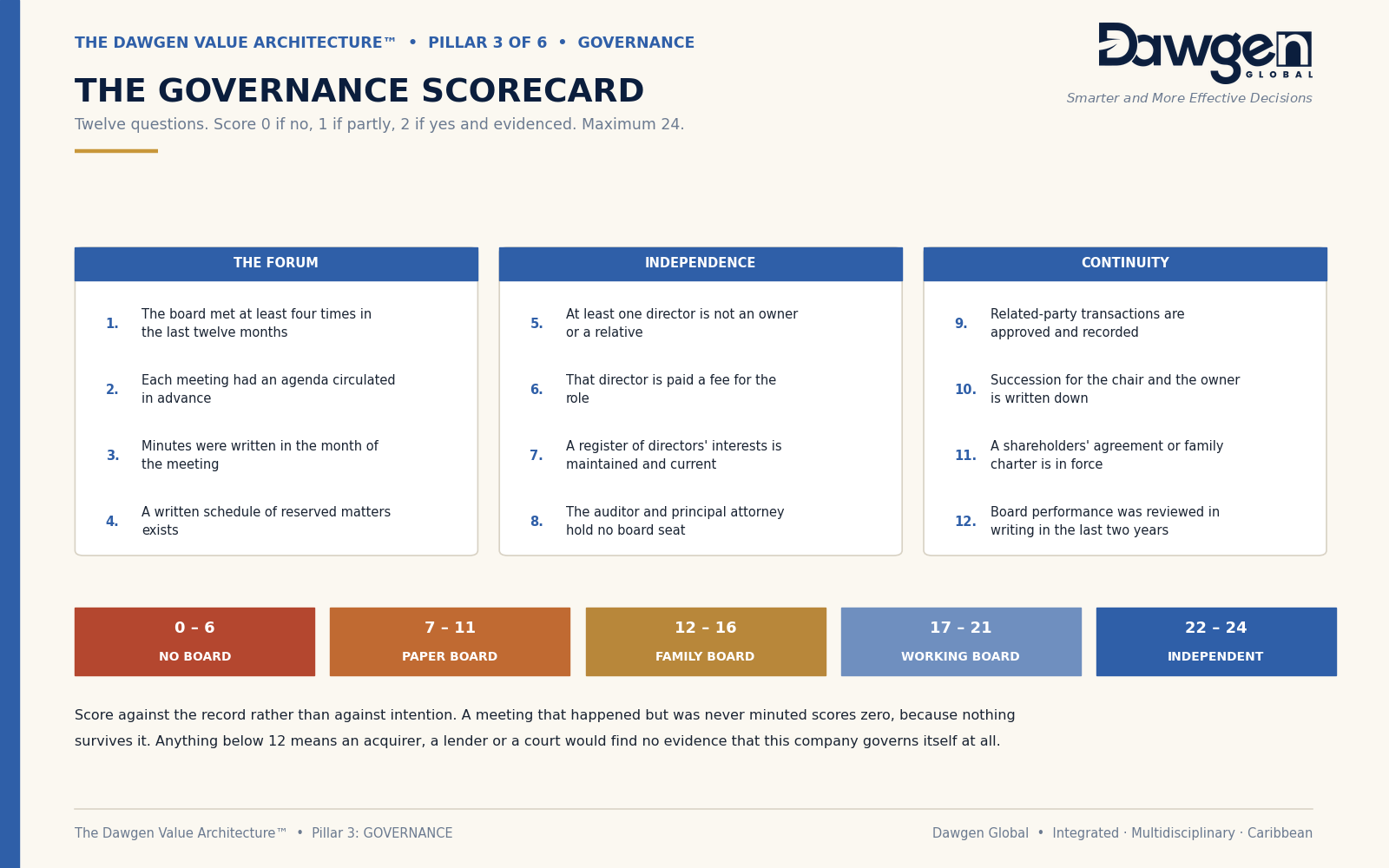
The scorecard converts that judgement into a number. Twelve questions, scored zero for no, one for partly, and two for yes and evidenced. Score against the record rather than against intention: a meeting that took place but was never minuted scores zero, because nothing survives it.
| The test that matters
Apply one question to the whole result: if a buyer’s advisers asked for the board minutes covering the last three years, what would arrive, and how long would it take to assemble? If the answer involves writing anything now, the record does not exist — it is being manufactured, which is the finding rather than the remedy. That question is also the bridge to Pillar 4, which asks whether the capital structure those decisions produced was ever the right one. |
SECTION 7
Where to Start

If you scored between zero and six, do not attempt to build a board. Fix four dates, write six reserved matters, and minute one meeting properly. A single well-recorded meeting is worth more than a constitution nobody follows.
If you scored between seven and eleven, the meetings are happening and the record is not surviving them. The gap is clerical rather than structural, and it closes in a month: minute in the month of the decision, and stop reconstructing the year at audit time.
If you scored between twelve and sixteen, the board works but everyone in the room shares the owner’s interest. The next step is one independent, paid director — and the discipline to let that person disagree in front of the family without consequence.
If you scored above seventeen, the remaining work is succession and separation: the shareholders’ agreement, the family charter, and a written answer to what happens when the founder stops. That work takes longer than everything preceding it and should be started before it is needed.
| The one page to write this week
If nothing else in this guide is acted on, write the reserved matters schedule and put four dates in the diary. Six decisions, named in advance, taken in a scheduled meeting, recorded on one page in the month they were made. It requires no appointment and no expense, and it is the single intervention that moves a company from Stage 1 to Stage 3 faster than any other. |
ABOUT THIS SERIES
The Dawgen Value Architecture™ is a proprietary Dawgen Global framework addressing the six conditions that determine what a private company is actually worth. Each pillar is published as a standing guide: VISIBILITY, DEPENDENCE, GOVERNANCE, CAPITAL, RESILIENCE and REALISATION. The guides are written for Caribbean owner-managed businesses, their boards and their advisers, and are intended to be used without engaging anyone at all.
This series addresses patterns observed across private company advisory engagements and published international evidence. It does not comment on any listed issuer or any specific client, and no company referred to or resembled in these guides is intended to be identifiable.
Next in the series
Pillar 4 — CAPITAL: Is It Funded Correctly? Capital structure, working capital, and the difference between owning assets and earning returns.
Take the diagnostic further
The Dawgen Board and Governance Review applies this scorecard inside your company, tests the record as an acquirer’s advisers would, and delivers a maturity rating, a drafted reserved matters schedule and a board-ready summary.
At Dawgen Global, we help you make Smarter and More Effective Decisions.
About Dawgen Global
Dawgen Global is an independent, integrated multidisciplinary professional services firm headquartered at 47 Trinidad Terrace, New Kingston, Jamaica, serving more than 15 territories across the Caribbean. Founded and led by Dr. Dawkins Brown, Executive Chairman, the firm is independent and not affiliated with any international network. It delivers a full suite of professional services under one roof: audit and assurance; tax advisory; IT and digital transformation; risk management; cybersecurity; actuarial and insurance regulatory advisory; HR advisory; mergers and acquisitions; corporate recovery; business advisory and strategy; accounting BPO and virtual CFO services; and legal process outsourcing.
The proposition is simple: big-firm capability without the big-firm price. Dawgen Global’s integrated approach is built for the specific complexities and opportunities of the Caribbean market, helping organizations make sharper, better-informed decisions that drive measurable progress.
To explore a partnership, reach out:
- Website: dawgen.global
- Email: [email protected]
- WhatsApp (Global): +1 555-795-9071
- Caribbean offices: +1 876-665-5926 | +1 876-929-3670 | +1 876-926-5210


