Why your third-party contracts are the largest unexamined AI exposure in your organization
Ask most executive teams in this region whether their organization uses artificial intelligence and you will get a confident answer. Not yet. Perhaps next year. We are watching it carefully.
Then ask a narrower question. Which of your vendors use AI to process your data?
The confidence disappears — not because anyone is being evasive, but because nobody has ever been asked to know. There is no register. No one owns the question. And the answer, in almost every organization we examine, is: more than you think, in more places than you expected, under contracts that say nothing about it.
You did not adopt AI. Your vendors did, on your behalf, and they did not need your permission.
1. The exposure you inherited at renewal
Consider how software actually changes hands.
Your organization signed for a platform in 2021 or 2022. Procurement ran a process. Legal reviewed the agreement. IT confirmed the integration. Everything worked as it should. The contract addressed confidentiality, service levels, data location, and termination — the things that mattered at the time.
Then, sometime in the last twenty-four months, the vendor added AI capability. Perhaps a summarization feature. Perhaps automated categorization. Perhaps a model that scores, ranks or predicts something about your customers. The release note announced it as an improvement. Nobody at your organization had to approve anything, because nothing about the commercial relationship changed.
Your renewal came around and was processed on the same terms.
You did not decide to introduce AI into that process. You inherited it — at renewal, silently, under an agreement written before the question existed.
This is not a failure of procurement discipline. It is a timing problem that every organization in the region shares. But it does mean that the phrase “our contracts are fine” describes a review that never happened.
2. Above and below the waterline

Above the waterline: the AI your organization chose. Below it: everything else.
There is a useful way to picture third-party AI exposure.
Above the waterline sits the AI your organization chose: a pilot, a licence someone signed for deliberately, a tool the executive team discussed. It is visible, it is small, and it is the thing most AI governance conversations are about.
Below the waterline sits everything else. AI embedded in the platforms that run your payroll, your ledger, your customer records, your helpdesk, your security monitoring, your marketing. Never procured as AI. Never approved as AI. Still processing your data, and in some cases still shaping decisions that reach your customers.
The visible portion is what organizations govern. The submerged portion is what creates the exposure — and by volume it is not close.
The uncomfortable implication: an organization can have a well-drafted internal AI policy, a designated AI owner, an approved tool register, and still be almost entirely ungoverned in practice, because the policy addresses the tip and the exposure is in the mass.
3. Where it actually sits
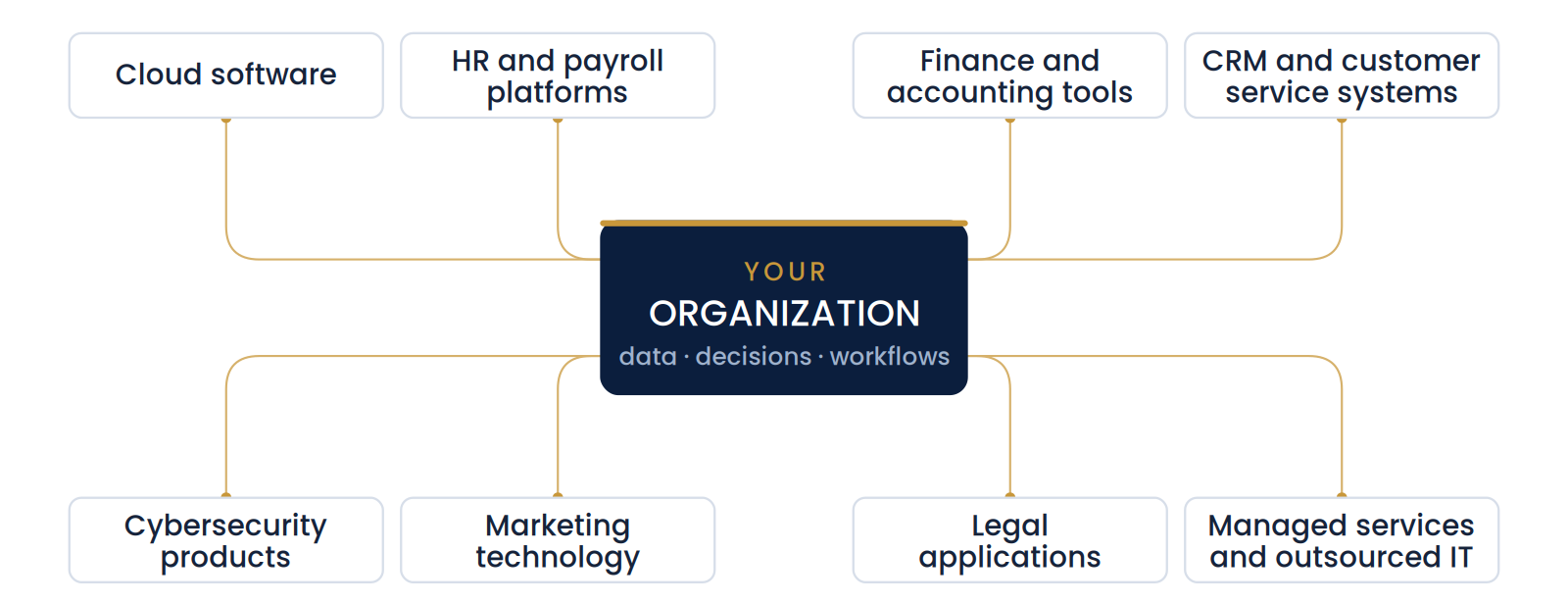
When we run a vendor AI inventory, the capability turns up in the same places with striking regularity.
Cloud software of every description, where AI features are now a standard part of the product roadmap. HR and payroll platforms, which hold some of the most sensitive personal data an organization possesses and have been among the fastest to add screening, drafting and analytics features. Finance and accounting tools, where categorization, anomaly detection and forecasting have quietly become model-driven. CRM and customer service systems, where suggested responses and sentiment scoring now sit between your staff and your customers.
Then the ones that surprise people. Cybersecurity products, which have used machine learning for years and are often the most data-hungry systems in the environment. Marketing technology, which routinely processes customer lists through third-party enrichment. Legal applications, now drafting and reviewing. And managed service and outsourced IT arrangements, where the AI exposure may sit not with your vendor but with a subcontractor you have never contracted with and cannot name.
Each of these was procured for a reason that had nothing to do with AI. That is exactly why the exposure is unmapped.
4. Seven questions
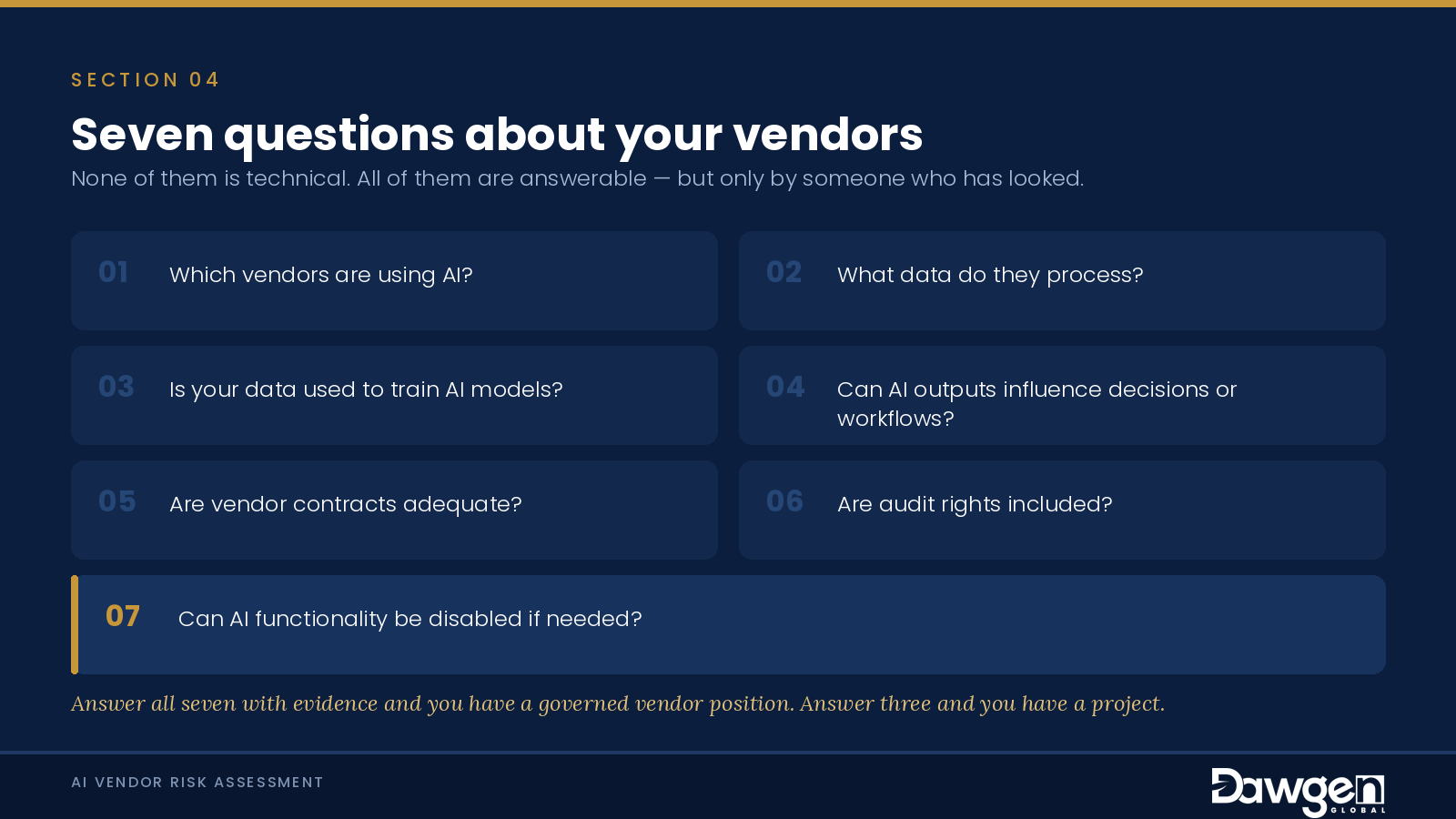
Third-party AI exposure can be diagnosed with seven questions. None of them is technical. All of them are answerable — but only by someone who has looked.
- Which vendors are using AI? Not which vendors market themselves as AI companies. Which ones use it.
- What data do they process? Personal data? Financial records? Customer information? Anything regulated?
- Is your data used to train AI models? Theirs, or a subprocessor’s — and can you evidence the answer?
- Can AI outputs influence decisions or workflows? Does a model’s output reach a customer, a payment, a hiring decision, a credit assessment?
- Are vendor contracts adequate? Adequate for the arrangement as it operates now, not as it was described at signature.
- Are audit rights included? And if they are, have they ever been exercised?
- Can AI functionality be disabled if needed? And if you disabled it, would the service still do what you rely on it to do?
An organization that can answer all seven, with evidence, has a governed vendor position. An organization that can answer three has a project.
5. The clause problem
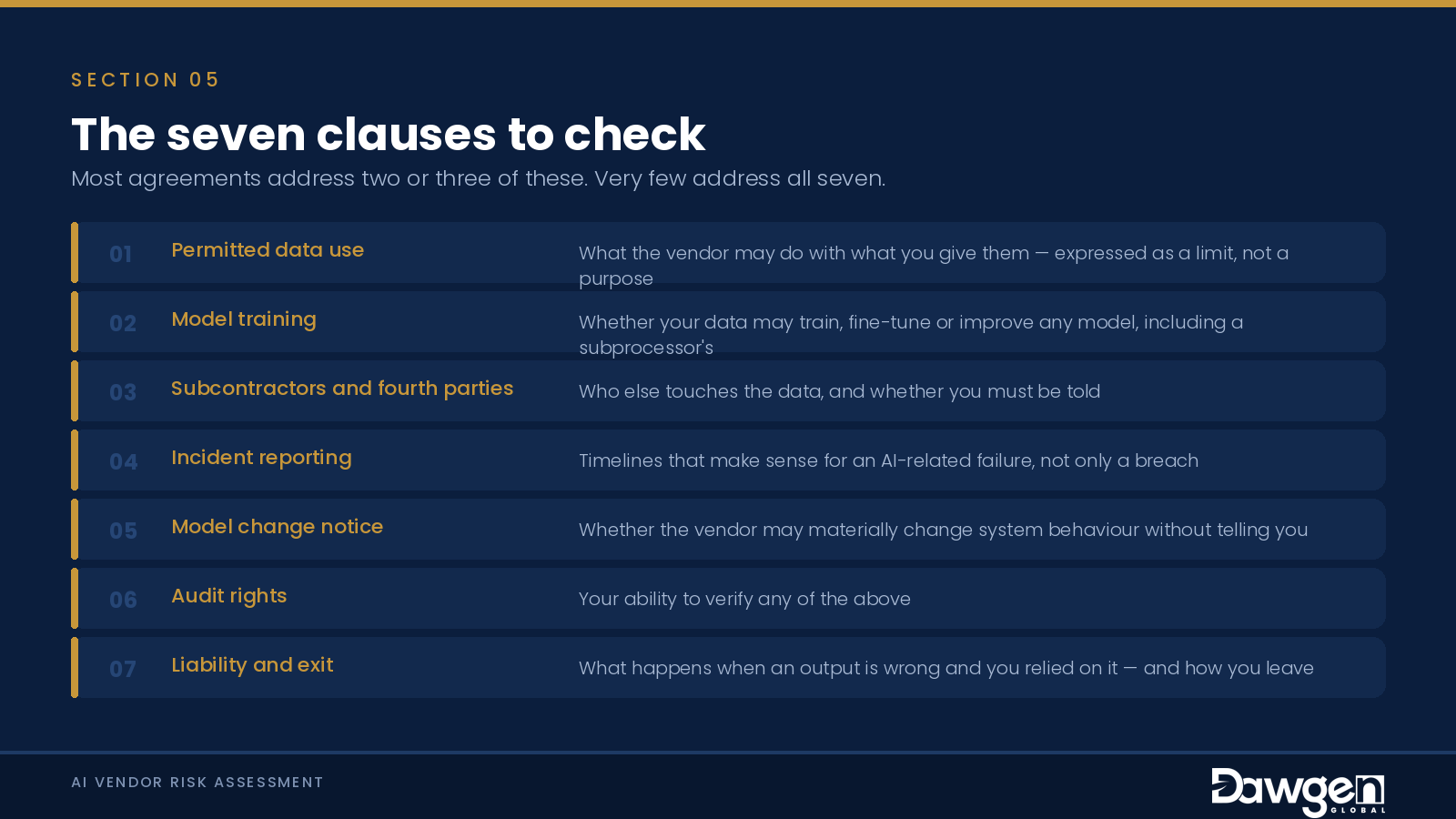
The contractual position is where this becomes concrete, and it is the part most often skipped — because reading contracts is slow, unglamorous work that produces no immediate benefit.
It is also where a regulator, an insurer or a major client will look first, for a simple reason: examining a clause requires no technical expertise whatsoever. They just ask to see it.
The clauses that became material after signature are specific and short:
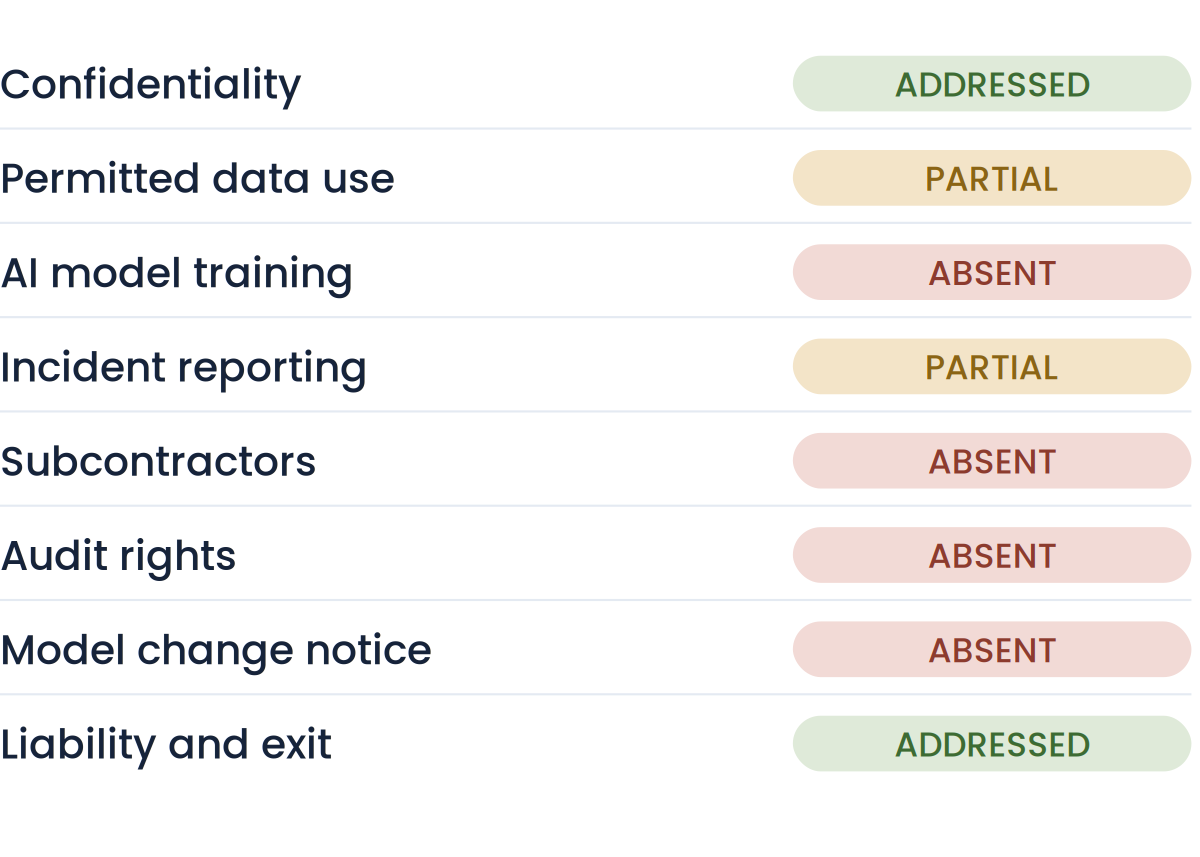
— Permitted data use — what the vendor may do with what you give them, expressed as a limit rather than a purpose
— Model training — whether your data may be used to train, fine-tune or improve any model, including a subprocessor’s
— Subcontractors and fourth parties — who else touches the data, and whether you must be told
— Incident reporting — timelines that make sense for an AI-related failure, not just a breach
— Model change notice — whether the vendor may materially change how the system behaves without telling you
— Audit rights — your ability to verify any of the above
— Liability and exit — what happens when an output is wrong and you relied on it, and how you leave
Most agreements in force across the region address two or three of these. Very few address all seven. That gap is not a legal opinion — it is a finding, and it has a remediation date.
The practical response is not to renegotiate everything. It is to know which agreements matter, and to arrive at each renewal with a specific instruction rather than a general worry.
Illustrative contract gap summary — each agreement tested against the clauses that became material after signature
6. “We asked, and they said it’s fine”
The most common form of third-party assurance we encounter is an email.
Someone asked the account manager whether the platform uses customer data for AI training. The account manager said no. That answer was forwarded, filed, and has served as the organization’s position ever since.
This is not adequate, and the reason has nothing to do with the vendor’s honesty. An account manager is not the party who determines data use; the terms are, and the terms are frequently more permissive than the sales conversation. Product behaviour also changes between conversations. And an assertion — however sincere — cannot be produced as evidence to a regulator, an auditor or a client asking the same question.
What can be produced: the contract clause. The vendor’s published data processing terms. An assurance report or certification and, critically, whether its scope actually covers the AI functionality. A documented AI governance statement. Configuration evidence showing what is enabled in your instance.
The distinction is between what you have been told and what you can show.
Vendor management lives or dies on that distinction, and AI has simply made it sharper.
7. Not every vendor matters equally
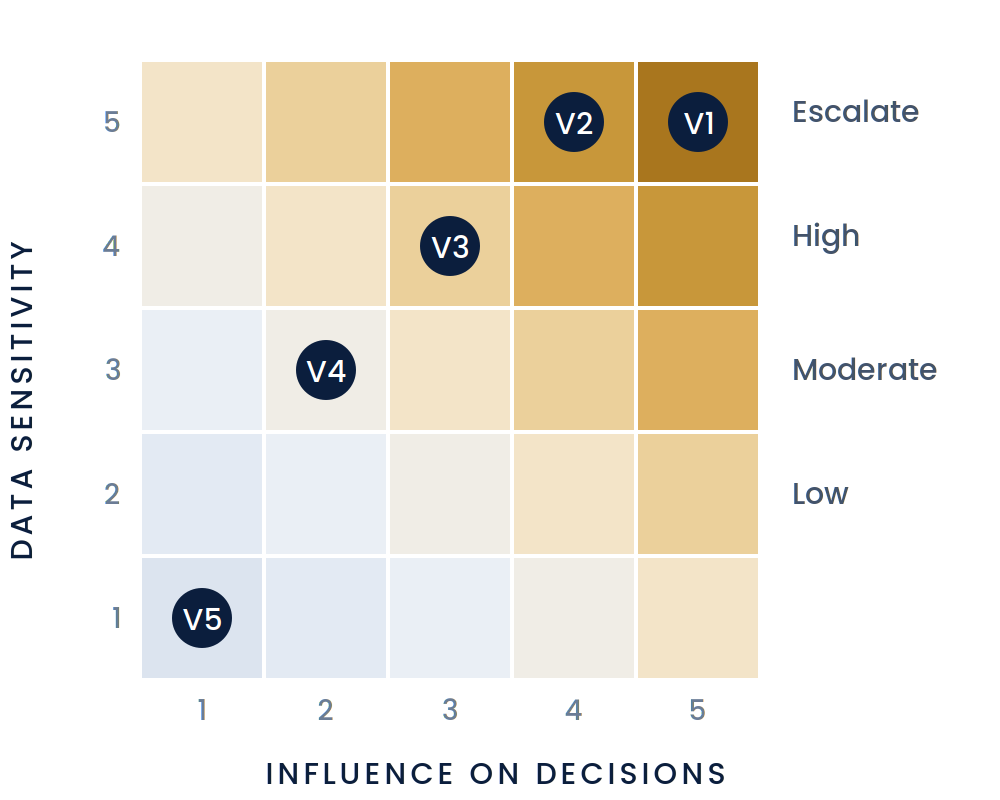
Illustrative vendor AI risk matrix — data sensitivity against influence on decisions
A vendor AI review that treats all suppliers alike will exhaust itself and finish nothing useful. The point of classification is to spend attention where consequence lives.
Two dimensions do most of the work. Data sensitivity — what the vendor actually holds. And influence on decisions — whether the AI output merely assists someone internally, or reaches a customer, a payment, an approval, an assessment.
A vendor high on both is an escalation. A platform holding regulated customer data, where a model influences an outcome that reaches that customer, and where the contract is silent on training and audit rights, is not an item on a register — it is a decision the board should be aware of.
A vendor low on both — an internal productivity tool holding nothing sensitive, producing nothing consequential — needs a line in the inventory and no further work this year.
Between them sits the majority, and the value of the exercise is that it tells you which is which. Most organizations are simultaneously over-worrying about three vendors and under-worrying about two others.
8. The integration surface
There is a second exposure alongside the data and contract questions, and it is the one most likely to be underestimated.
AI features rarely arrive alone. They arrive with connectors, APIs, expanded permission scopes, and new data flows between systems that previously did not talk to each other. An assistant that can “read your calendar and draft the response” needs access to both. A tool that summarizes your ledger needs to reach the ledger.
Each of these is an integration, and each integration deserves the same questions any other would receive. What access rights were granted, and to whom? Is the data encrypted in transit and at rest? Is the activity logged, and can you retrieve the log? Who can revoke the access, and how quickly? What happens on an incident — and is the vendor obliged to tell you?
The pattern we see is that AI features are frequently enabled by default and configured by whoever set them up, without the review a new integration would normally attract. The feature was presented as an improvement to an existing service, so nobody treated it as a change.
9. What a governed vendor position looks like
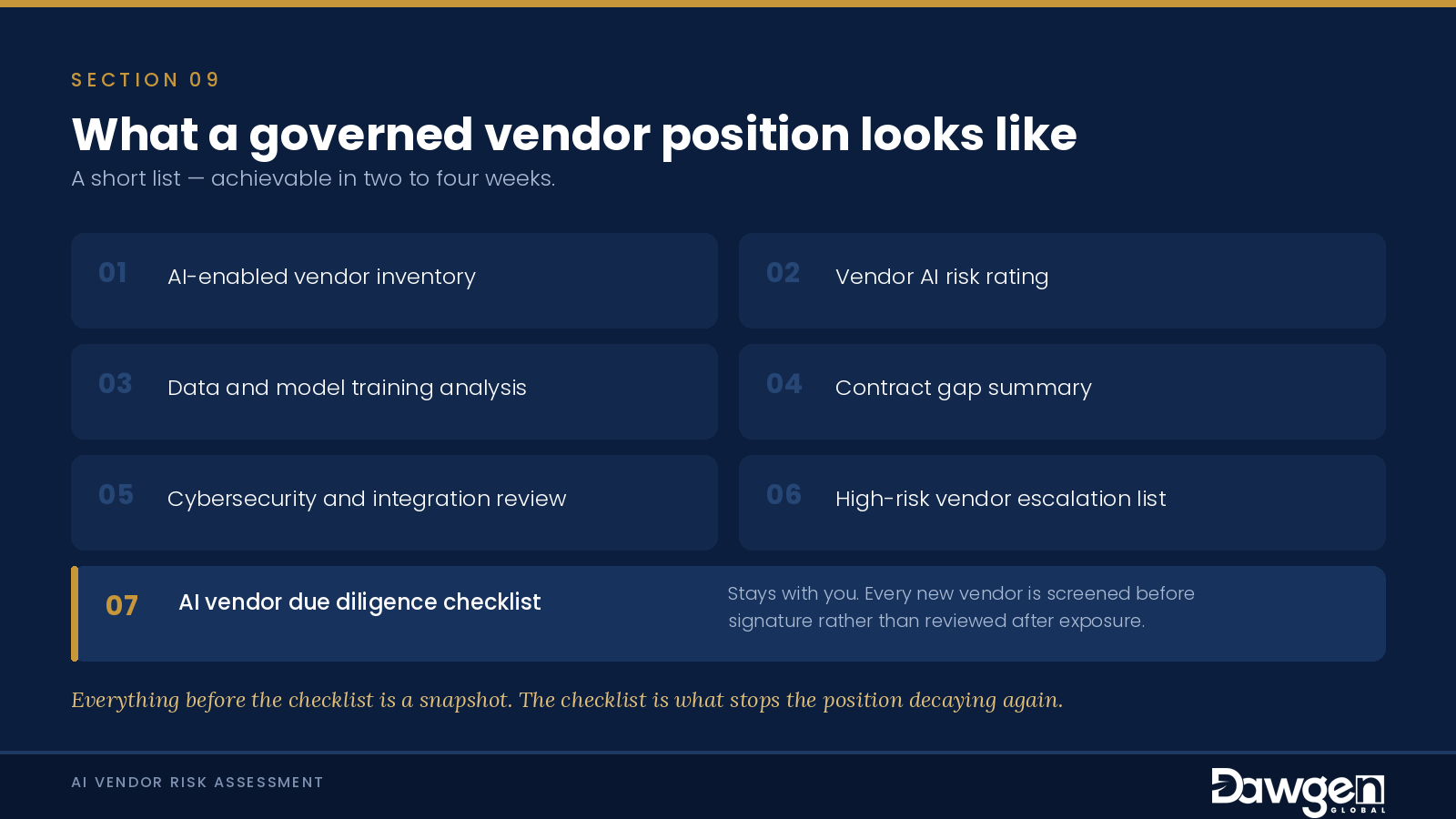
It is a short list, and it is achievable in two to four weeks.
An AI-enabled vendor inventory — which vendors, which systems, which capability. This is the foundation, and most organizations have never had one.
A vendor AI risk rating — each relationship classified by data sensitivity, business criticality, regulatory exposure, decision impact, cyber risk and operational dependency.
A data and model training analysis — what each vendor may do with your data, evidenced from terms rather than conversations.
A contract gap summary — each material agreement tested against the clauses that became relevant after signature, so gaps become renewal instructions.
A cybersecurity and integration review — the connectors, permissions and data flows that came with the features.
A high-risk vendor escalation list — the short list that needs a decision, with what to do about each.
An AI vendor due diligence checklist — which stays with you. From that point, every new vendor is screened before signature rather than reviewed after exposure.
That last item is the one that changes the trajectory. Everything before it is a snapshot; the checklist is what stops the position decaying again.
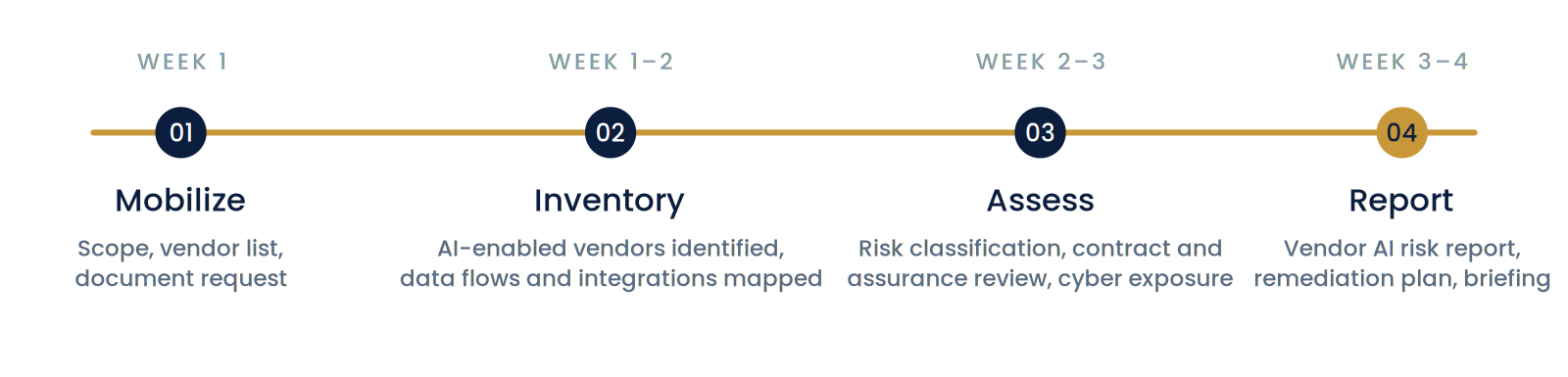
A two-to-four week engagement with a defined end point
10. Start where the leverage is
The instinct is to start with the largest vendor. The better instinct is to start with the next renewal.
Contract leverage is not evenly distributed across the year. It concentrates at renewal, and it disappears the day after. An organization that knows its exposure three months before a major renewal can ask for the clause. The same organization, asking two weeks after signature, is asking for a favour.
So the sequence that works is: inventory first, because you cannot prioritize what you cannot see. Classification second, because attention is finite. Then map the high-risk relationships against the renewal calendar, and let the calendar drive the order of work.
None of this requires a technology programme. It requires a list, a set of questions, and someone whose job it is to ask them.
Your vendors adopted AI without asking you. Governing that is not a matter of catching up with the technology. It is a matter of reading what you already signed, and deciding what you will sign next.
Ten questions for your next board or audit committee meeting
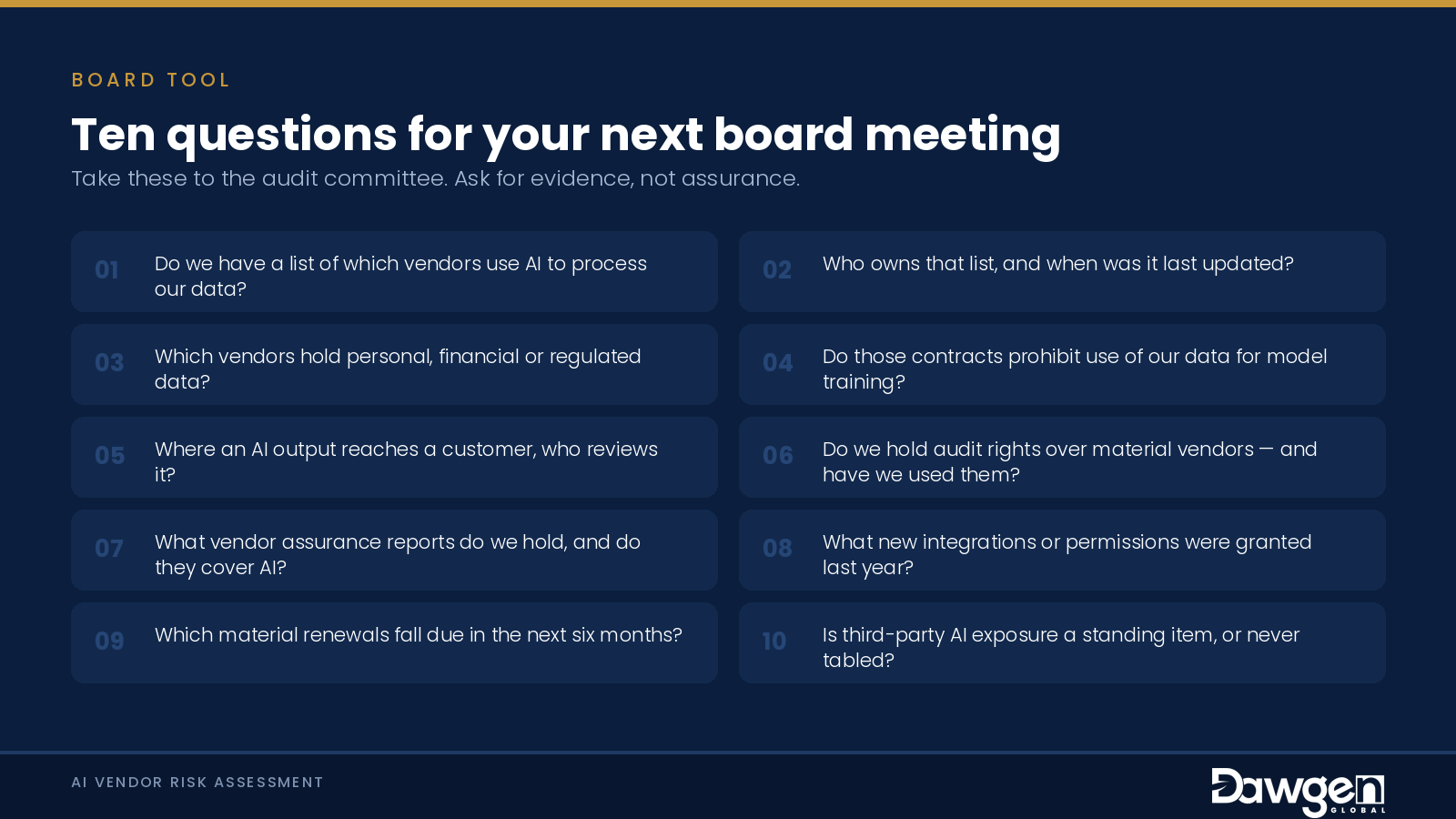
- Do we have a list of which vendors use AI to process our data?
- Who owns that list, and when was it last updated?
- Which of our vendors hold personal, financial or regulated data?
- For those vendors, do the contracts prohibit use of our data for model training?
- Where an AI output influences a decision reaching a customer, who reviews it?
- Do we hold audit rights over our material vendors, and have we ever used them?
- What vendor assurance reports do we hold, and does their scope cover AI functionality?
- What new integrations, connectors or permissions were granted in the last year?
- Which material renewals fall due in the next six months?
- Is third-party AI exposure a standing item, or has it never been tabled?
Frequently asked questions
How long does an AI Vendor Risk Assessment take?
Typically two to four weeks, depending on the number of vendors in scope. Delivery is a digital review supported by vendor documentation review, interviews and a management briefing.
Do you contact our vendors directly?
Only if you want us to. The assessment can be completed entirely from documentation you already hold — contracts, invoices, system inventories and configuration records. Vendor engagement is a decision you make, not a precondition.
We have hundreds of suppliers. Is this practical?
Yes, because most of them are out of scope immediately. The exercise focuses on vendors that touch data or influence decisions. That is typically a small fraction of a supplier list.
What if a vendor refuses to answer?
That is itself a finding, and a useful one. A vendor unwilling to describe its data use in writing is telling you something about the relationship, and it belongs on the escalation list.
Is this the same as our existing third-party risk process?
It extends it. Most third-party risk frameworks predate embedded AI and do not ask about training rights, model change notice or output influence. The assessment adds those questions and leaves you a checklist that carries them forward.
Who typically commissions this?
Chief risk officers, chief financial officers, procurement leads, audit committees and boards. The usual trigger is a renewal, a regulatory enquiry, or a vendor announcement nobody knew how to assess.
Download the brochure
Dawgen Global’s AI Vendor Risk Assessment covers seven review areas — vendor inventory, risk classification, data use and model training, cybersecurity and integration, contract and audit rights, vendor assurance, and remediation — and delivers a vendor AI risk report with a high-risk escalation list and a due diligence checklist you keep.
Download the service brochure for the full scope, deliverables and engagement format.
| REQUEST THE ASSESSMENT
[email protected] | dawgen.global/contact-us 47 Trinidad Terrace, New Kingston, Jamaica | 876-929-3670 | 876-665-5926 | US 855-354-2447 |
About Dawgen Global
Dawgen Global is an independent, integrated multidisciplinary professional services firm headquartered at 47 Trinidad Terrace, New Kingston, Jamaica, serving more than 15 territories across the Caribbean. Founded and led by Dr. Dawkins Brown, Executive Chairman, the firm is independent and not affiliated with any international network. It delivers a full suite of professional services under one roof: audit and assurance; tax advisory; IT and digital transformation; risk management; cybersecurity; actuarial and insurance regulatory advisory; HR advisory; mergers and acquisitions; corporate recovery; business advisory and strategy; accounting BPO and virtual CFO services; and legal process outsourcing.
The proposition is simple: big-firm capability without the big-firm price. Dawgen Global’s integrated approach is built for the specific complexities and opportunities of the Caribbean market, helping organizations make sharper, better-informed decisions that drive measurable progress.
To explore a partnership, reach out:
- Website: dawgen.global
- Email: [email protected]
- WhatsApp (Global): +1 555-795-9071
- Caribbean offices: +1 876-665-5926 | +1 876-929-3670 | +1 876-926-5210


