| IN BRIEF
Most employers know what their workforce costs them this year, because it moves through payroll. Far fewer know what their workforce promises are worth, because those promises mature over decades and only a portion of them is ever measured. This article works through one employer: 480 staff, 95 retirees on a medical plan, paying about US$840,000 a year against benefit promises worth roughly US$17.5 million. The gap is not an accounting technicality. Post-employment medical cover, long-service awards, gratuities and accumulated leave are legally or constructively owed, and they compound quietly while the annual cheque looks manageable. Two ideas do most of the work here: an obligation can exist without a contract, and a benefit whose cost rises faster than the discount rate has no natural ceiling. |
The Cheque Is Not the Cost
A Caribbean employer with 480 staff pays each year for the benefits its people have earned. Retiree medical premiums cost about US$399,000. Long-service awards cost about US$180,000. Gratuities on retirement cost about US$150,000. Leave paid out on departure costs about US$110,000. Total cash: roughly US$840,000, which the finance team treats as the cost of these benefits because that is what leaves the bank.
The obligation behind that cheque is a different number entirely, because every one of those payments is the current instalment of a promise that continues for decades.
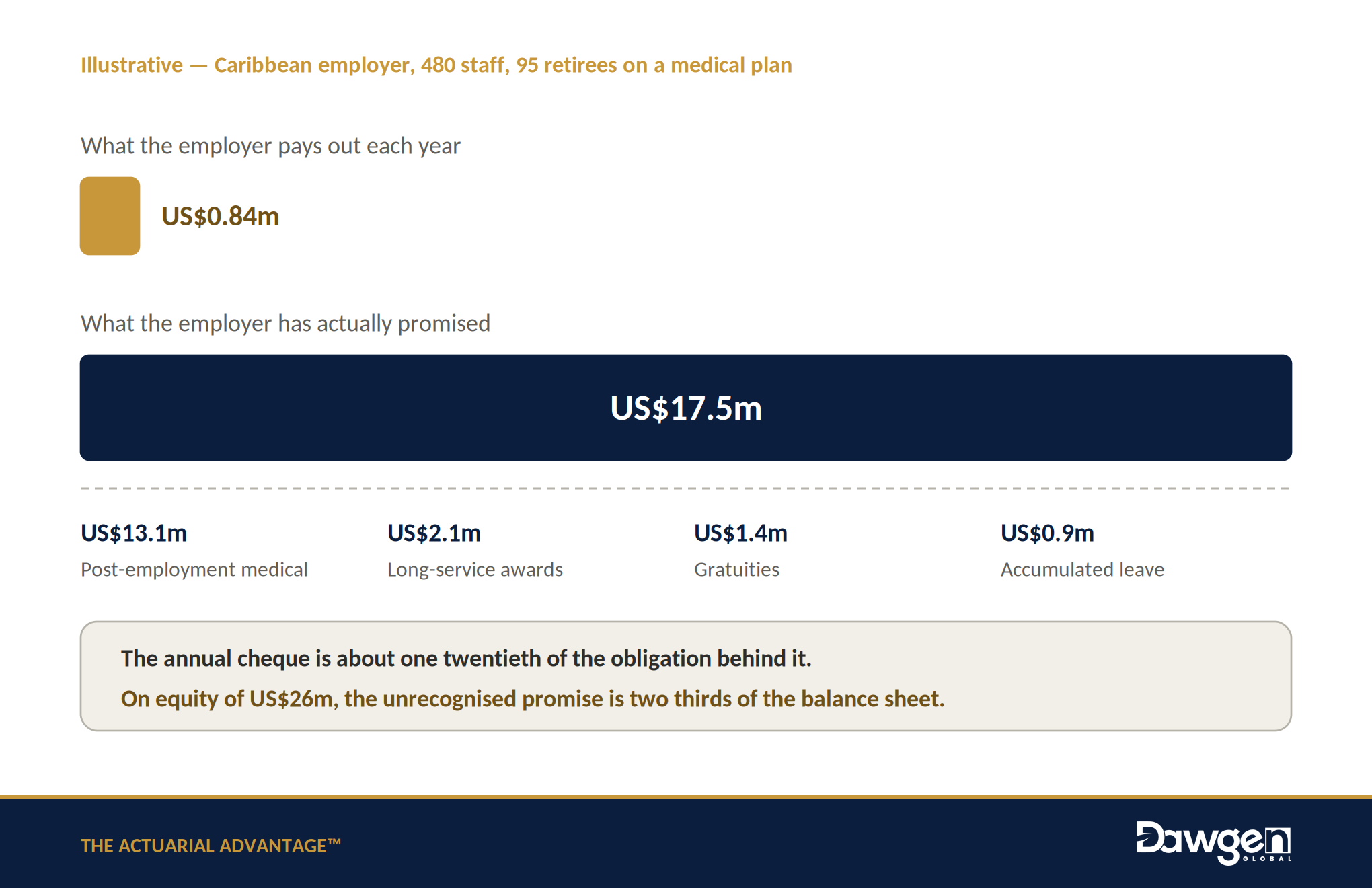
The annual cheque is about one twentieth of the obligation behind it. Figures illustrative.
| Nothing here is a surprise expense. It is an existing obligation that has never been measured, and therefore never appeared. |
This is what IAS 19 exists to correct. The standard requires the employer to measure what has been promised and recognise it, rather than to record the cash as it happens to fall due. Where an organisation has been accounting for these benefits on a pay-as-you-go basis, the first measurement is frequently the largest single adjustment its balance sheet has seen.
The management point is more useful than the accounting one. An obligation of this size affects covenant calculations, distributable reserves, valuation in a sale, and the assessment any lender or acquirer will make of the business. Discovering it during a transaction is materially worse than discovering it now.
Which Promises Have Never Been Counted?
The reason these obligations go unmeasured is rarely negligence. It is that some benefits announce themselves through payroll every month and others do not, and the ones that do not are the ones that accumulate.
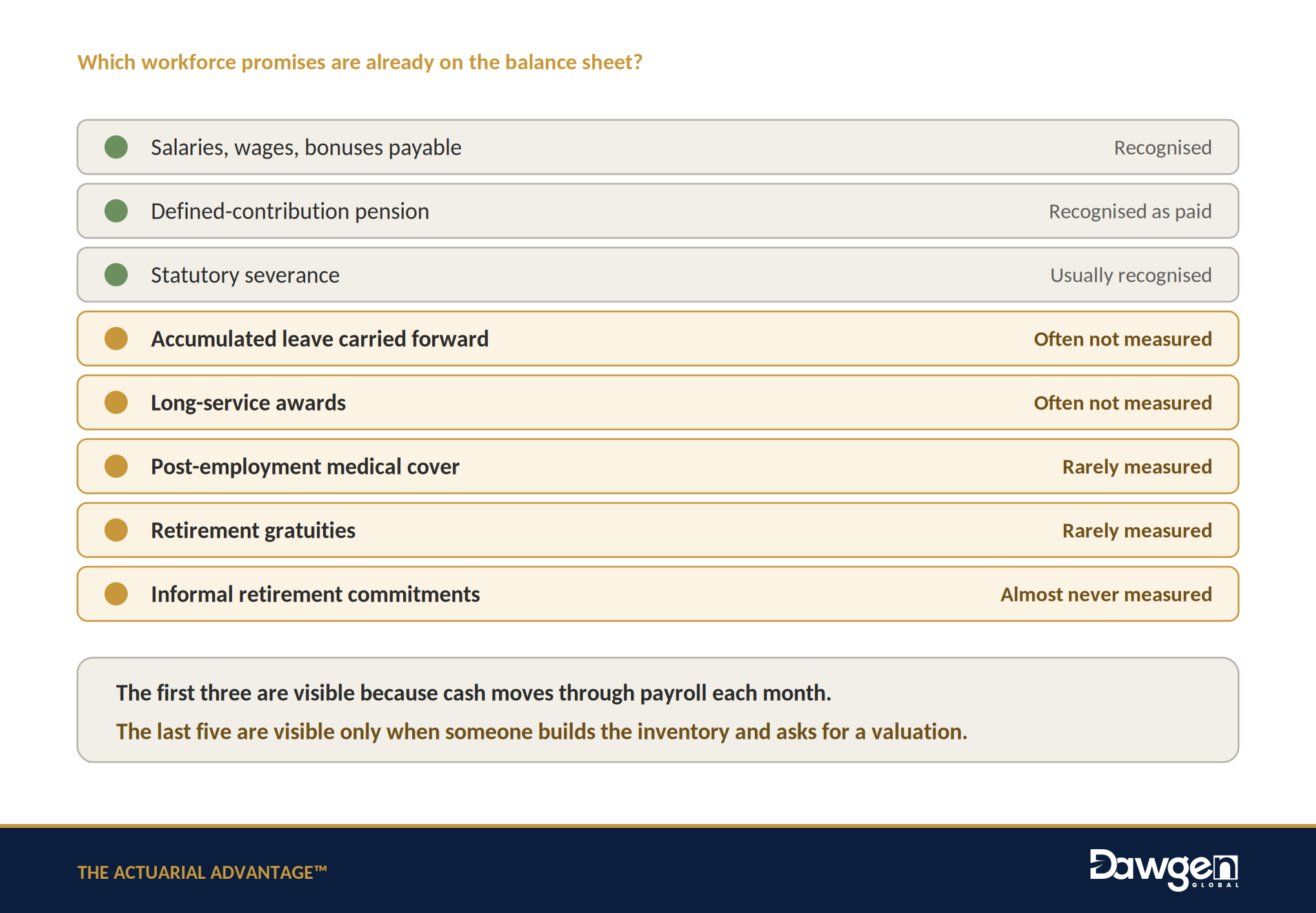
The first three are visible because cash moves monthly. The last five are visible only when someone builds the inventory.
Building the inventory is unglamorous and it is where most of the value in an IAS 19 exercise actually sits. It means reading every employment contract type, every collective agreement, every staff handbook, every board minute approving a benefit, and — most importantly — asking long-serving human resources and payroll staff what the organisation does in practice, as distinct from what its documents say.
That last conversation regularly produces benefits nobody had recorded: a gratuity paid to every retiring employee for twenty years without any policy authorising it, medical cover quietly continued for the surviving spouses of former staff, an ex-gratia payment that has become an expectation. Each is a real obligation. None appears in a contract.
An Obligation Without a Contract
The most commonly missed liability in employee-benefit accounting is the one nobody signed. IAS 19 requires recognition of both legal and constructive obligations — and a constructive obligation arises where an established pattern of practice has created a valid expectation that the employer will continue.
A constructive obligation arises from established practice, not from a signature.
The test is not whether the employer intends to continue. It is whether the employer has left itself any realistic alternative. An organisation that has paid a retirement gratuity to every departing employee for two decades cannot credibly say it has no obligation to the employee retiring next year, whatever the contract omits.
This has an uncomfortable corollary that boards should understand before it is raised by an auditor. If the practice has created an obligation, then discontinuing it is not a costless management decision. It is a plan amendment with an accounting consequence, and depending on the circumstances it may also carry employment-law exposure. The time to establish whether a custom has become a liability is before somebody proposes ending it.
The Benefit With No Ceiling
Among all employee benefits, post-employment medical cover behaves differently, and the difference is arithmetic rather than a matter of degree.
A pension is defined by a formula. Once the salary is known and the service is complete, the payment is fixed and the only remaining uncertainty is how long it continues. Long-service awards are capped by their own terms. Medical cover has no such limit: the employer has promised to fund care whose cost is set by a healthcare market, and that cost has risen faster than general inflation across essentially every market for decades.
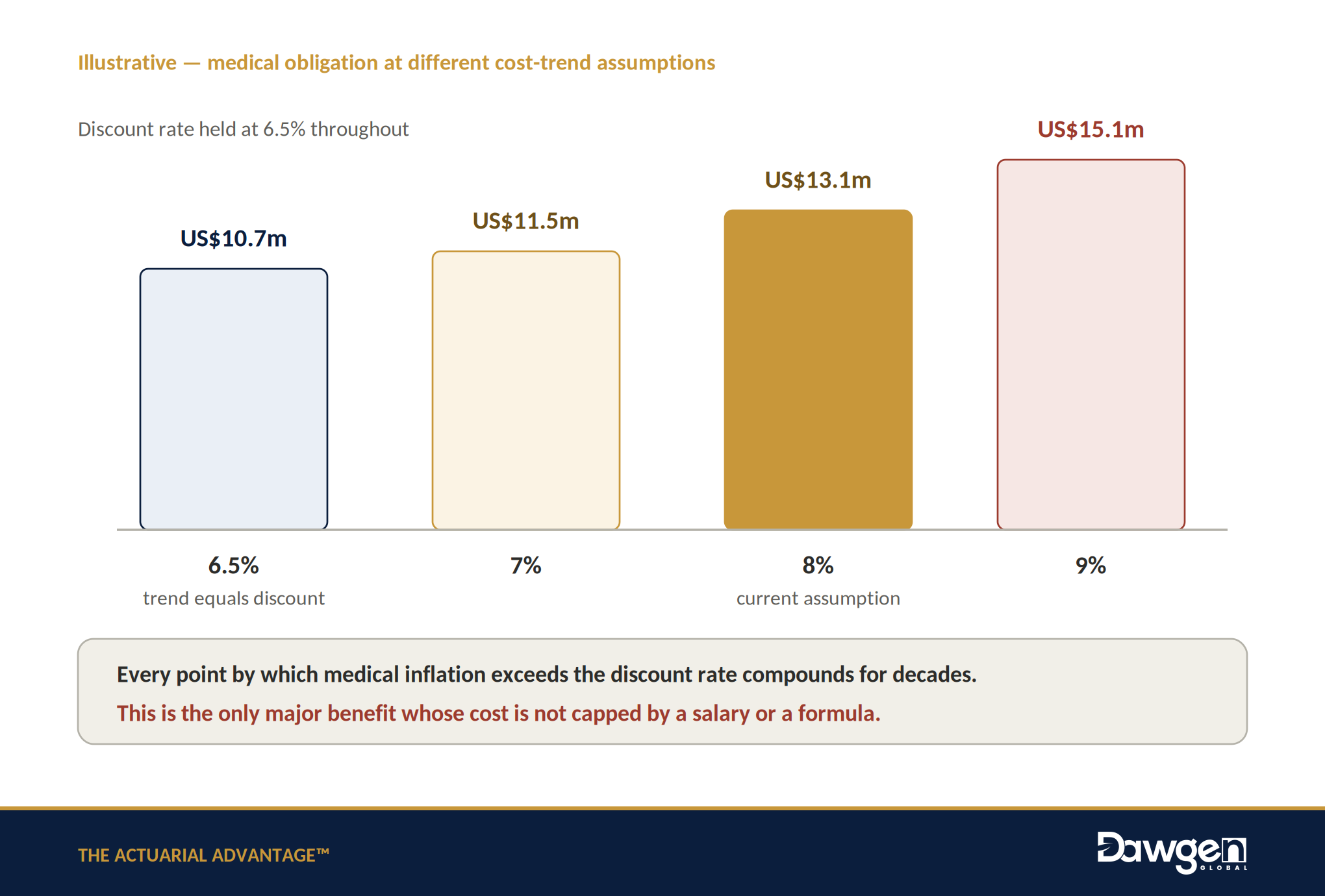
Every point by which medical inflation exceeds the discount rate compounds for decades. Figures illustrative.
If medical costs are assumed to rise at 8 per cent while the obligation is discounted at 6.5 per cent, the excess compounds over the whole projection period. Move the trend assumption to 9 per cent and the obligation rises from US$13.1 million to US$15.1 million. Move it down to match the discount rate and it falls to US$10.7 million.
That single assumption therefore carries a US$4.4 million range on a US$13 million liability, and it is frequently set with less deliberation than any other input in the valuation. It also explains why employers in larger markets have moved so consistently toward capped contributions, defined subsidies and closed cohorts — not because the benefit is unaffordable today, but because an uncapped promise cannot be budgeted.
Two Valuations, Two Purposes
Employers with a funded pension plan sometimes assume they already have what IAS 19 requires. They usually do not, and the confusion causes real difficulty at audit.
| Funding valuation | IAS 19 valuation | |
| Purpose | To determine what the employer must contribute to the plan | To determine what the employer must report in its financial statements |
| Audience | Trustees, the sponsor, the regulator | Auditors, investors, lenders, users of the accounts |
| Assumption basis | Frequently prudent, reflecting funding policy and expected returns | Best estimate, with the discount rate set by reference to high-quality corporate or government bond yields |
| Timing | Often triennial | Every reporting date |
| Typical result | A contribution schedule | A balance-sheet figure and a set of disclosures |
Two valuations of the same plan will normally produce different numbers. That is expected, and it should be explainable.
The practical consequence is that a funding valuation cannot simply be relabelled for the accounts. The assumptions differ, the discount rate basis differs, and the timing differs. An employer that has one and needs the other has not yet met the requirement — and the gap is usually discovered late in the audit, when there is no time to do the work properly.
Why Data Is the Constraint, Not the Actuary
Every figure in an IAS 19 valuation rests on member data, and in most first-time exercises the data is the reason the timetable slips.
The recurring problems are consistent across organisations. Dates of birth and hire dates are missing or implausible. Service records do not reflect transfers between group entities, so long service is understated. Employees who left years ago remain in the file. Beneficiary and dependant records are incomplete, which matters greatly for medical benefits. Historical benefit changes are undocumented, so nobody can establish who is entitled to which terms.
Two consequences follow, and both argue for starting early. Errors in benefit data are not random — unrecorded service and unrecorded dependants both understate the liability, so poor data tends to produce a comfortable answer that is wrong in the same direction. And an auditor is entitled to test the data underlying a material estimate, so weaknesses surface eventually, usually at the least convenient point.
| An organisation that begins this work three months before year end is not commissioning a valuation. It is commissioning a data project with a valuation attached. |
Eight Questions for Boards and Audit Committees
- Do we have a complete inventory of every benefit we provide, including those in collective agreements and long-standing practice?
- Which of our benefits are measured actuarially, and which are recorded only as cash when paid?
- Do we provide any post-employment medical cover, and if so what is it worth?
- Are there benefits we pay by custom that we have never formally approved?
- What medical-cost trend assumption are we using, and who set it?
- When was our employee data last reconciled, and by whom?
- How does our obligation compare with our equity, and does any covenant reference it?
- If we wanted to change or close a benefit, what would it cost us to do so?
| IF SEVERAL OF THESE HAVE NO READY ANSWER
That is the ordinary position rather than a governance failure. None of these figures is produced by routine payroll or financial reporting. The first — the benefit inventory — requires no actuary at all, and it is where the exercise should begin. |
Where This Work Leads
An IAS 19 finding rarely stops at the accounts. A newly recognised obligation leads to covenant testing, distributable reserves and lender conversations. A constructive obligation leads to employment law, contract drafting and human resources policy. A data reconciliation leads to systems, records and internal audit. A benefit redesign leads to tax treatment and member communication. A medical trend finding leads to procurement of the underlying cover itself.
Dawgen Global’s Caribbean Integrated Borderless Delivery model exists so that the analysis and everything that follows sit within one engagement, across multiple Caribbean jurisdictions. Capability is held by the firm and delivered by a team rather than vested in an individual — which matters for a measurement repeated at every reporting date.
The Point of All This
IAS 19 is often treated as a disclosure requirement to be satisfied late in the audit. That framing costs organisations money, because it turns a management question into a compliance chore and defers the answer until it can no longer be acted upon.
| The obligation exists whether or not it is measured. Measuring it is the only step that makes it manageable. |
The employer in this article was not concealing anything. It was paying its benefits, honouring its promises and reporting the cash. What it did not have was any statement of what those promises were worth — and so it could not have told a lender, an acquirer or its own board how large a commitment sat behind an US$840,000 annual line.
The first step is not an actuarial valuation. It is an afternoon spent listing every benefit the organisation provides, including the ones nobody ever wrote down.
How Dawgen Global Can Help
Employee-benefit valuation under IAS 19 is a distinct actuarial specialism. We resource the valuation itself through our associate network of credentialed benefits actuaries, and coordinate delivery within a single Dawgen Global engagement — so the client retains one relationship and one point of accountability across the valuation and everything that follows from it.
The work around the valuation is where our multidisciplinary platform contributes directly:
- Benefit inventory construction, including collective agreements, custom and practice
- Constructive obligation identification and documentation
- Employee and beneficiary data review, reconciliation and remediation
- IAS 19 disclosure preparation, audit readiness and support through the audit
- Covenant, distributable reserves and balance-sheet impact analysis
- Benefit redesign support across tax, employment and human resources implications
- Employee-benefit exposure in mergers, acquisitions and restructuring
- Workforce cost forecasting and enterprise risk quantification
| REQUEST AN ACTUARIAL RISK DISCOVERY SESSION
A structured half-day session with your board, audit committee or executive team, followed by a short written output: a first benefit inventory, which items are likely to require actuarial measurement, what data each would need, and what a first valuation would involve and cost. Where the work calls for employee-benefit valuation specialism, we identify that in the output and set out how it would be resourced. Fixed scope. Fixed fee. Delivered within three weeks. Email: [email protected] · Telephone: 876-929-3670 or 876-665-5926 · US toll free: 855-354-2447 Contact form: www.dawgen.global/contact-us/ |
About Dawgen Global
Dawgen Global is an independent, integrated multidisciplinary professional services firm headquartered at 47 Trinidad Terrace, New Kingston, Jamaica, serving more than 15 territories across the Caribbean. Founded and led by Dr. Dawkins Brown, Executive Chairman, the firm is independent and not affiliated with any international network. It delivers a full suite of professional services under one roof: audit and assurance; tax advisory; IT and digital transformation; risk management; cybersecurity; actuarial and insurance regulatory advisory; HR advisory; mergers and acquisitions; corporate recovery; business advisory and strategy; accounting BPO and virtual CFO services; and legal process outsourcing.
The proposition is simple: big-firm capability without the big-firm price. Dawgen Global’s integrated approach is built for the specific complexities and opportunities of the Caribbean market, helping organizations make sharper, better-informed decisions that drive measurable progress.
To explore a partnership, reach out:
- Website: dawgen.global
- Email: [email protected]
- WhatsApp (Global): +1 555-795-9071
- Caribbean offices: +1 876-665-5926 | +1 876-929-3670 | +1 876-926-5210


