A business that cannot outlive its founder was never an asset. It was a salary with staff — and succession planning is the work that turns it into something that can be inherited, sold, or led into its second generation.
The Problem, Lived
“Winston” is sixty-four, and for thirty years his name has been the guarantee behind a sixty-person security services company in Kingston. In March, a health scare put him in hospital for nine days — nothing dramatic, the doctors said, a warning rather than a verdict. The business received the warning too. For nine days, no one could sign above a modest threshold. A contract renewal sat unanswered because the client would speak only to Winston. Payroll cleared with hours to spare because his operations manager of fifteen years performed quiet heroics with no authority to perform them.
Winston came home to a company that had held its breath for nine days — and to questions he has spent a decade not asking. His daughter is a physician in Toronto and, lovingly and finally, not coming home to run a security firm. His son works in the business, willing but untested, promoted by surname rather than by fire. The operations manager who saved March owns nothing and has quietly begun taking recruiters’ calls. There is no shareholders’ agreement. His will — drafted eighteen years ago — mentions the company in one sentence. And the thought that visits Winston at night is not about death. It is about arithmetic: everything he built is currently worth what it is worth only while he is standing in it.
Winston’s situation has a name in every advisory textbook, but the textbook framing misses what makes it universal here: this is not procrastination. It is avoidance with structure — because succession has been allowed to mean one enormous, unaskable question, when it is actually three ordinary ones that have never been separated.
Why It Happens Here
Article 4 named the taboo: in many Caribbean families, raising succession feels like discussing the founder’s mortality, so the most consequential transition the business will face is the one thing that cannot be mentioned. But the paralysis has more architecture than superstition. Three genuinely different problems — who will lead the business, who will own it, and what happens if the founder is gone tomorrow — arrive fused into a single overwhelming question, and fused questions do not get answered; they get postponed.
The regional patterns then close the exits. The assumed heirs have often migrated or chosen professions — the diaspora is full of doctors and engineers whose parents own businesses with no successor. The capable non-family manager, the person actually holding the operation together, is rarely offered a path to ownership, so their loyalty runs on gratitude with an expiry date. Few owners realize a trade sale is even possible — that businesses like theirs are bought and sold, and that ‘exit’ need not mean the death of a legacy. And beneath everything sits the legal trap almost no one has priced: shares governed by an outdated will, no shareholders’ agreement, no buy-sell mechanism — a structure in which the founder’s death does not transfer the company so much as freeze it, in probate, while the customers and the staff and the value quietly leave through the side door.
| The Nine-Day Test
Article 9 gave you the two-week test for founder dependence. Succession asks the harder version: if you were unreachable in a hospital bed for nine days — starting tomorrow — what breaks? Who signs? Who leads, and does everyone know it? Which customers wait, and which walk? If the honest answers frighten you, understand what you are looking at: not a prediction of tragedy, but a measurement of how much of your life’s work is currently stored in a single, mortal place. The good news is that the measurement can be changed — and the first fixes take a week, not a decade. |
Why Generic Advice Fails
The international succession literature assumes machinery we mostly do not have: employee stock ownership plans with their specific tax legislation, deep private-equity markets circling every family firm, family-office structures built for dynastic wealth. Meanwhile it under-weights what dominates here — migration scattering the natural heirs, thin but real regional buyer markets that must be found rather than waited for, and legal architecture that must be built island by island with local counsel. The principles of succession are universal. The plumbing is jurisdictional, and the plumbing is where estates and companies actually get stuck.
The Framework: The Five Decisions™, Step by Step
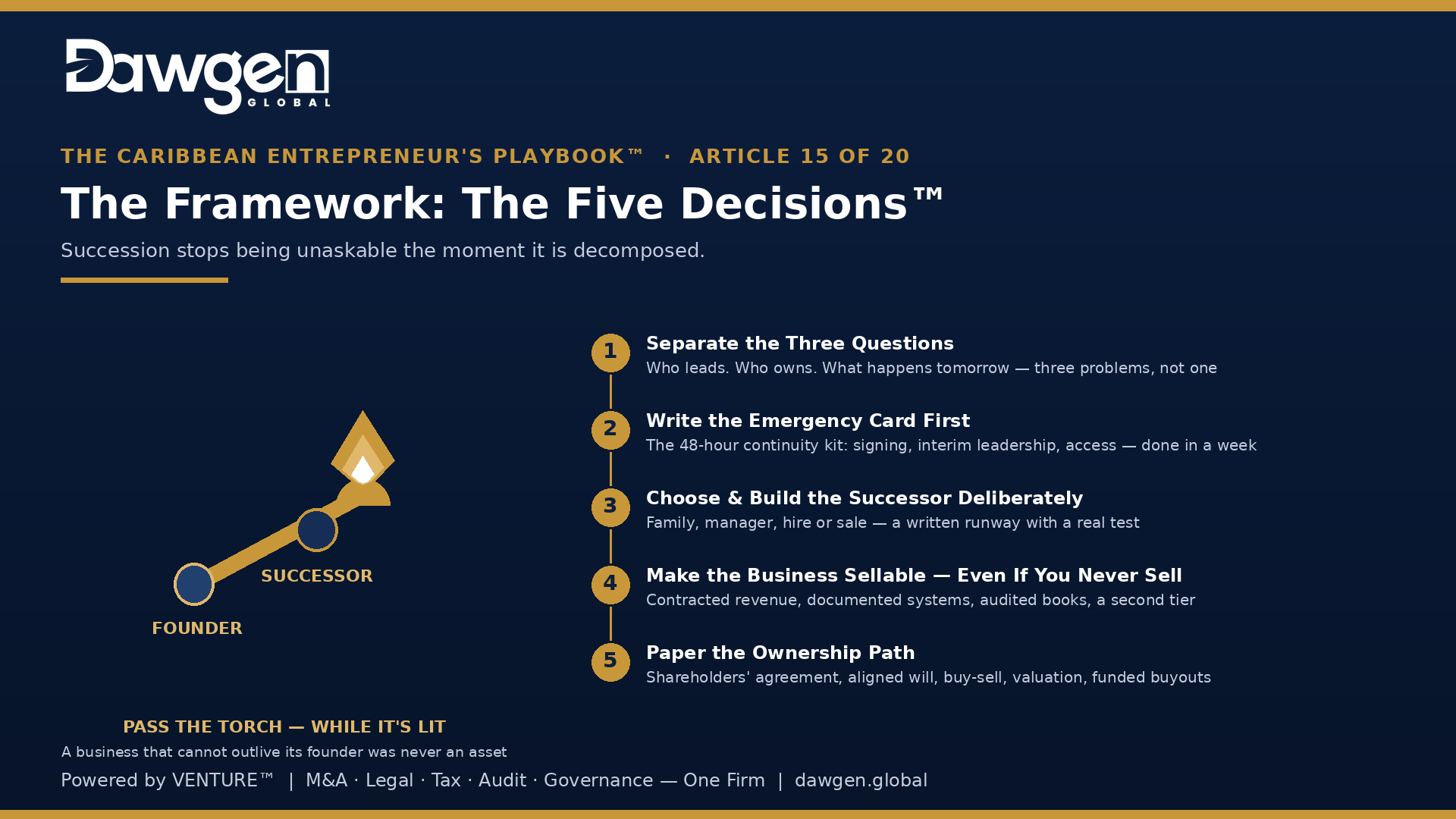
Succession stops being unaskable the moment it is decomposed. Five decisions, taken in order — the first one this week:
- Decision 1 · Separate the Three Questions — Write three headings on one page: Who leads next. Who owns next. What happens if I am gone tomorrow. Leadership succession, ownership succession, and contingency are different problems with different timelines, different tools and — critically — different emotional weights. Fused, they are paralyzing. Separated, the third is urgent and easy, the first is a development project, and the second is a legal project. The paralysis was never the size of the problem. It was the packaging.
- Decision 2 · Write the Emergency Card First — Before any grand plan, build the 48-hour continuity kit: banking and signing authorities that do not die with your availability; a written interim-leadership designation everyone key has seen; access to systems, passwords and critical contacts documented and stored with your attorney or accountant; and the two or three relationships that must hear from a named person within a day. This is a week of work. It converts the nine-day test from catastrophe to inconvenience — and, psychologically, it breaks the avoidance: once the mortality question has been answered in its smallest form, the larger ones lose their paralytic charge.
- Decision 3 · Choose and Build the Successor Deliberately — Family is an option, not a default — and an untested heir is not a plan, it is a hope with a surname. Lay the honest options side by side: a family member developed on a real runway (Article 9’s Five Transfers as the curriculum, with genuine P&L responsibility as the examination); the capable internal manager, possibly via a path to equity or a management buyout; an external professional leader; or a sale to the right acquirer. Then commit to a written development runway of three to five years with milestones that are allowed to fail. The kindest thing you can give a potential successor is a real test early — and the cruelest is a coronation they discover, too late, they never earned.
- Decision 4 · Make the Business Sellable — Even If You Never Sell — Sellability is the great clarifier, because a business a stranger would pay well for is exactly a business an heir can safely inherit: revenue that recurs by contract rather than by the founder’s handshake; systems documented (Article 9), finances audited and clean (Article 8’s capital readiness), customers diversified, a second management tier that runs the engine. Audit your business against a buyer’s checklist annually, whatever your intentions — the gap between ‘as-is’ value and ‘well-succeeded’ value is routinely the largest single sum of money a founder will ever earn or forfeit, and it is earned in the years before the transition, never during it.
- Decision 5 · Paper the Ownership Path — Now the legal architecture, built with professionals: a shareholders’ agreement governing how shares move, vote and are valued; a will updated to align with it — misalignment between the two is how families end up in court against themselves; buy-sell provisions with an agreed valuation mechanism, so no death or exit triggers a pricing war; insurance structured to fund buyouts so the company never has to bleed cash to survive a transition; and the tax treatment of the transfer path examined in advance, in your jurisdiction, not discovered by the estate. This is the decision that stops probate from freezing the company — the paperwork that lets a business grieve its founder without dying of the same cause.
The Framework in Action: A Worked Scenario
The following scenario is a fictional composite created for this series to illustrate the framework. It does not depict any actual business or client of the firm.
Winston’s plan begins where the fear is smallest: the emergency card, completed in eight days. Signing authorities restructured, the operations manager named interim leader in writing, the client-contact protocol documented. The night he signs it, by his own account, is the first uninterrupted sleep since March. Then the three questions come apart. His son is given the answer he deserves rather than the one tradition assumed: a real test — full responsibility for the commercial division, its own P&L, eighteen months, with the explicit understanding that the result, either way, will be respected.
The operations manager receives the conversation fifteen years overdue: a pathway to a minority equity stake, contingent on nothing but staying and continuing to build — separate from whatever the son’s test concludes. The recruiters’ calls stop being taken. The sellability audit sets two years of quiet work in motion: contracts formalized out of handshakes, financials moved to audited statements, the operations playbooks written. In this illustration, the son passes his test the honest way — imperfectly, then convincingly — and at sixty-seven Winston chairs a company with an MD-designate carrying his name, a fifteen-percent shareholder carrying the operations, a shareholders’ agreement and aligned will carrying the structure, and a valuation, per his advisors, now multiples of what an as-is sale would have fetched the year of the hospital bed. The nine days that frightened him turned out to be the most profitable nine days of his career. He simply had to decide to hear them.
Self-Diagnostic: Would Your Business Survive You?
One point for every “no”:
- Would the business pass the nine-day test — signing, leading and serving customers with you unreachable?
- Is there a written interim-leadership designation that key people have actually seen?
- Does your intended successor — family or not — carry real P&L responsibility today?
- Would a stranger’s due diligence find audited financials, documented systems and contracted revenue?
- Do a current shareholders’ agreement and an aligned will govern exactly how ownership moves?
Two or more points means the most valuable thing you own is uninsured against the one certainty in the room. Every year of delay is paid for twice: once in risk, and once in the value the cleanup years never got to build.
When to Call In Help
Succession is the one problem in this Playbook that is structurally multidisciplinary: it needs legal drafting, tax analysis, audited financials, valuation, governance design and leadership development — simultaneously, and talking to each other. Fragmented advice is how shareholders’ agreements contradict wills and development plans ignore tax consequences. Bring in integrated support if you are past fifty-five with nothing in writing; if family and management expectations are diverging in silence; if the nine-day test failed; or if any part of you suspects the business’s value has a founder-shaped hole in it. And begin regardless of your age if you simply intend the business to outlive you — because that intention, unplanned, is only a wish.
| REQUEST A SUCCESSION & EXIT READINESS CONSULTATION
Dawgen Global is built for exactly this problem: our Legal Process, Tax Advisory, Audit, M&A and Governance teams work as one on succession — the emergency continuity kit, successor development runways under LEADRIGHT™ and SCALEPATH™, sellability audits, shareholders’ agreements aligned with estate documents, valuation mechanisms and buyout funding structures. One firm, every discipline the transition needs, in the room together. Contact us today — in complete confidence — to request your consultation. 📩 [email protected] | 📞 876-929-3670 / 876-665-5926 | 🇺🇸 855-354-2447 | 🌐 dawgen.global GET THE FULL PLAYBOOK This is Article 15 of The Caribbean Entrepreneur’s Playbook™ — 20 problems, 20 how-to frameworks, one system. Pre-register at dawgen.global to receive the complete Playbook e-book on release, free. |
About Dawgen Global
Dawgen Global is an independent, integrated multidisciplinary professional services firm headquartered at 47 Trinidad Terrace, New Kingston, Jamaica, serving more than 15 territories across the Caribbean. Founded and led by Dr. Dawkins Brown, Executive Chairman, the firm is independent and not affiliated with any international network. It delivers a full suite of professional services under one roof: audit and assurance; tax advisory; IT and digital transformation; risk management; cybersecurity; actuarial and insurance regulatory advisory; HR advisory; mergers and acquisitions; corporate recovery; business advisory and strategy; accounting BPO and virtual CFO services; and legal process outsourcing.
The proposition is simple: big-firm capability without the big-firm price. Dawgen Global’s integrated approach is built for the specific complexities and opportunities of the Caribbean market, helping organizations make sharper, better-informed decisions that drive measurable progress.
To explore a partnership, reach out:
- Website: dawgen.global
- Email: [email protected]
- WhatsApp (Global): +1 555-795-9071
- Caribbean offices: +1 876-665-5926 | +1 876-929-3670 | +1 876-926-5210


