A defined-benefit pension can be the largest financial risk an organisation carries — quiet for years, then suddenly decisive. De-risking is how a board takes control before circumstances do.
A defined-benefit pension is one of the longest promises an organisation can make. It commits an employer, often decades in advance, to pay a member an income for the whole of their retirement — an income that depends on how long that person lives, what inflation does, how investment markets perform, and where interest rates sit when the promise falls due. For much of the twentieth century this was treated as a benign feature of good employment, a commitment that sat quietly in the background. It is no longer benign, and the organisations that still treat it as background are carrying a risk that can, in a bad year, dwarf the business that hosts it.
The defined-benefit promise has a habit of derailing balance sheets in a particular way: quietly for a long time, and then suddenly. A plan can appear comfortably funded for years while the risks beneath it accumulate, until a fall in interest rates, a slump in markets or a jump in life expectancy turns a modest surplus into a serious deficit — one the sponsor must now recognise, fund and explain. The purpose of de-risking is to take control of that process deliberately, before circumstances take control of it for you.
Why the pension promise is so dangerous
The danger in a defined-benefit plan comes from the nature of the liability itself. It is long-dated, stretching over the lifetimes of members who may not retire for decades and may then draw benefits for decades more. It is sensitive to forces largely outside the sponsor’s control. And it is, in effect, leveraged: the liability is usually large relative to the sponsoring business, so even modest percentage swings translate into sums that matter enormously to the sponsor.
Four risks do most of the damage. Longevity risk is the chance that members live longer than assumed, lengthening every payment stream. Interest-rate risk arises because the value placed on the liability moves inversely with discount rates — when rates fall, the liability balloons. Investment risk is the danger that the assets set aside fail to grow as needed, or fall in value at the wrong moment. And inflation risk threatens any benefit linked to prices or salaries, quietly enlarging the promise year after year. The defining feature of a troubled plan is usually a mismatch — assets exposed to one set of forces while liabilities respond to another — so that the two move apart precisely when alignment matters most.
How it lands on the balance sheet
Modern accounting ensures none of this stays hidden. Under the relevant standard, the difference between a plan’s assets and its liabilities — its funded status — is recognised directly on the sponsor’s balance sheet as a net asset or, more often where there is trouble, a net liability. The changes in that figure flow through the financial statements each year, some through profit and loss and some through other comprehensive income, injecting the volatility of markets, rates and longevity straight into the sponsor’s reported position.
The consequences reach beyond the accounts. A large or volatile deficit can unsettle lenders, complicate a credit rating, deter an acquirer, and constrain the dividends and investment the business would otherwise make. A pension plan that began as a tool for attracting and retaining staff can end up as the single largest financial risk the organisation carries — and one that, left unmanaged, dictates terms to the business rather than serving it.
It is worth dwelling on the question of scale, because it is what makes pension risk uniquely capable of derailing a balance sheet. In a mature plan, the liability can rival or even exceed the value of the sponsoring business itself. When that is so, the pension is no longer a line item within the business; the business is, in financial terms, an appendage of the pension. A swing of a few percent in the value of the liabilities — entirely possible in a single year from a move in interest rates — can then exceed an entire year’s operating profit. Few other risks an organisation runs have that capacity to overwhelm everything else on the page.
The de-risking journey
De-risking is best understood not as a single transaction but as a journey along a spectrum, from a fully open and volatile promise to a liability removed from the balance sheet entirely. It begins with honest measurement — establishing the true funded position and, crucially, the specific risks driving it, because you cannot manage what you have not measured. From there the levers escalate in both effect and finality.
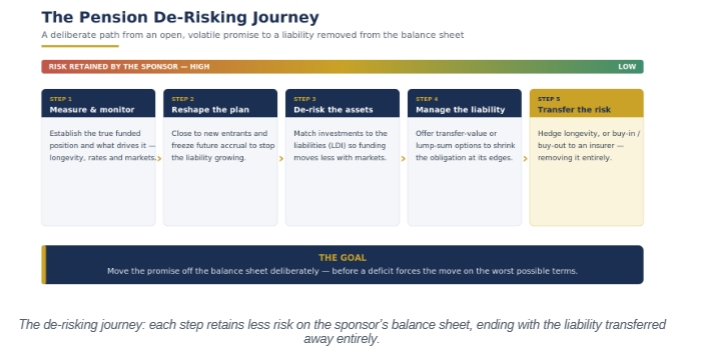
The first practical lever is plan design: closing the plan to new entrants and freezing future accrual, which stops the liability from continuing to grow even as the existing promise remains. The second is investment de-risking — typically liability-driven investment, in which assets are deliberately matched to the behaviour of the liabilities so that funding becomes far less sensitive to swings in markets and interest rates. The third is liability management: offering members transfer values or lump-sum options that, where appropriate and fair, reduce the obligation at its edges. And the most decisive lever is risk transfer — hedging longevity through a swap, or insuring the liability through a buy-in or buy-out, in which an insurer assumes the obligation and the risk leaves the sponsor’s balance sheet for good.
Acting before the crisis
The single most important principle of pension de-risking is that it is far easier, and far cheaper, to do from a position of strength than from one of distress. De-risking a well-funded plan is a manageable, even opportunistic, exercise; de-risking a plan deep in deficit, when markets have already turned, means locking in losses and negotiating from weakness. This is why the best-run sponsors treat de-risking as a planned glidepath rather than a crisis response — setting a funding objective, defining the steps that will be taken as the plan’s position improves, and locking in gains when conditions allow rather than waiting and hoping.
The contrast is stark. A sponsor that measures, plans and acts early controls the timing, the cost and the terms. A sponsor that waits until a deficit forces action discovers that the cheapest and most flexible options have closed, and that the same de-risking now costs far more — if it remains available at all. The promise does not become less dangerous by being ignored; it simply chooses its own moment to demand attention, and it rarely chooses a convenient one.
Consider two sponsors with identical plans. One, well-funded after a strong run of markets, locks in its position — matching assets to liabilities and insuring a tranche of longevity risk while terms are favourable. The other, equally well-funded, judges that the cost of de-risking is unnecessary while the plan looks healthy, and waits. A downturn arrives; rates fall, asset values drop, and the second plan swings into a deep deficit just as the sponsor’s own business comes under pressure. It must now fund the shortfall from a weakened balance sheet, and de-risking — if it happens at all — happens at the worst possible price. Same plan, same starting point; the only difference was the decision to act while acting was still easy.
The Caribbean pension landscape
Defined-benefit arrangements remain significant across the Caribbean — in the public sector, in long-established corporations, and in statutory and national schemes — even as the global shift toward defined-contribution plans continues. That makes pension risk a live issue for many regional boards, and it arrives with local complications. Credible longevity data for Caribbean populations is scarcer than in larger markets, making the most important assumption harder to set. A developed local market for buy-ins and buy-outs barely exists, so the most decisive de-risking lever available elsewhere is constrained. And the assets available to match long-dated local-currency liabilities can be limited, complicating investment de-risking.
None of this removes the need to manage the risk — it raises the premium on managing it well. Where the off-the-shelf solution is unavailable, the tailored one matters more: rigorous local measurement, assumptions grounded in regional reality rather than imported tables, investment strategies built around the instruments that do exist, and a de-risking plan realistic about which levers are genuinely available. The absence of a deep buy-out market is a reason to start the journey earlier, not a reason to postpone it.
What a board should do
For directors, de-risking begins with three questions. First, what is our plan’s true funded position — not the comfortable headline, but an honest measurement on a realistic basis? Second, what are the specific risks driving it, and how exposed are we to a fall in rates, a market downturn or improving longevity? Third, what is our objective — where on the de-risking journey do we want to be, and by when? With those answers, a board can set a deliberate glidepath, govern it actively, and act when conditions are favourable rather than when they are forced.
What a board should not do is treat the pension as someone else’s problem — the trustees’, the actuary’s, the finance team’s — to be reviewed once a year and otherwise left alone. The funded status is the sponsor’s risk and the sponsor’s balance sheet, and the decisions that shape it are board decisions. A board that engages with the pension as the material financial risk it has become is positioned to honour the promise and protect the business. A board that does not is leaving one of its largest exposures to chance.
A defined-benefit pension is a promise worth honouring, and de-risking is not about breaking it — it is about making sure it can be kept without putting the business that stands behind it at risk in the process. The tools to do so exist along a clear journey, from measurement through plan design and investment matching to outright risk transfer. What they require is the decision to act deliberately and early, while the choices are still wide and the cost still manageable. Manage the promise on your own terms, and it remains what it was meant to be. Wait, and it will eventually manage you — usually at the worst possible moment, and always at the greatest possible cost.
| TAKE THE NEXT STEP
Request a Pension De-Risking Review We will measure your plan’s true funded position, identify the risks driving it, and map a practical de-risking glidepath suited to Caribbean conditions — so your board can honour the promise on its own terms, not the market’s. Speak with our Actuarial Advisory team: [email protected] · 876-929-3670 · 876-665-5926 · dawgen.global |
About Dawgen Global
Dawgen Global is an independent, integrated multidisciplinary professional services firm headquartered at 47 Trinidad Terrace, New Kingston, Jamaica, serving more than 15 territories across the Caribbean. Founded and led by Dr. Dawkins Brown, Executive Chairman, the firm is independent and not affiliated with any international network. It delivers a full suite of professional services under one roof: audit and assurance; tax advisory; IT and digital transformation; risk management; cybersecurity; actuarial and insurance regulatory advisory; HR advisory; mergers and acquisitions; corporate recovery; business advisory and strategy; accounting BPO and virtual CFO services; and legal process outsourcing.
The proposition is simple: big-firm capability without the big-firm price. Dawgen Global’s integrated approach is built for the specific complexities and opportunities of the Caribbean market, helping organizations make sharper, better-informed decisions that drive measurable progress.
To explore a partnership, reach out:
- Website: dawgen.global
- Email: [email protected]
- WhatsApp (Global): +1 555-795-9071
- Caribbean offices: +1 876-665-5926 | +1 876-929-3670 | +1 876-926-5210


