No board arrives at continuous governance overnight. It climbs there, one stage at a time. Here is the map — five levels from reactive to continuous — so you can locate where your organisation truly stands, and see the next rung clearly.
Across the previous ten articles, this series has described what continuous governance looks like — six domains monitored in real time, evidence that is always-ready rather than scrambled for, and a board risk report rebuilt around the decision rather than the data. It is a compelling destination. But every director who has read this far is entitled to ask the obvious, practical question: we are not there now — so how do we get there? This article answers it. The path from where most organisations sit today to genuine continuous governance is not a single leap. It is a journey through recognisable stages, and the first step in any journey is knowing precisely where you are standing.
Maturity, not perfection
It helps to begin by dismantling a misconception. Governance maturity is not about having more — more policies, more committees, more pages in the board pack. An organisation can be drowning in documentation and still be governed badly. Maturity is about something subtler: the relationship between the organisation and its own risks, and how quickly and reliably it would know if something began to go wrong. A mature governance function is not one that produces the thickest reports; it is one that is rarely surprised.
Maturity in governance is not how many policies you hold. It is how quickly you would know if one of them had quietly failed.
The five levels
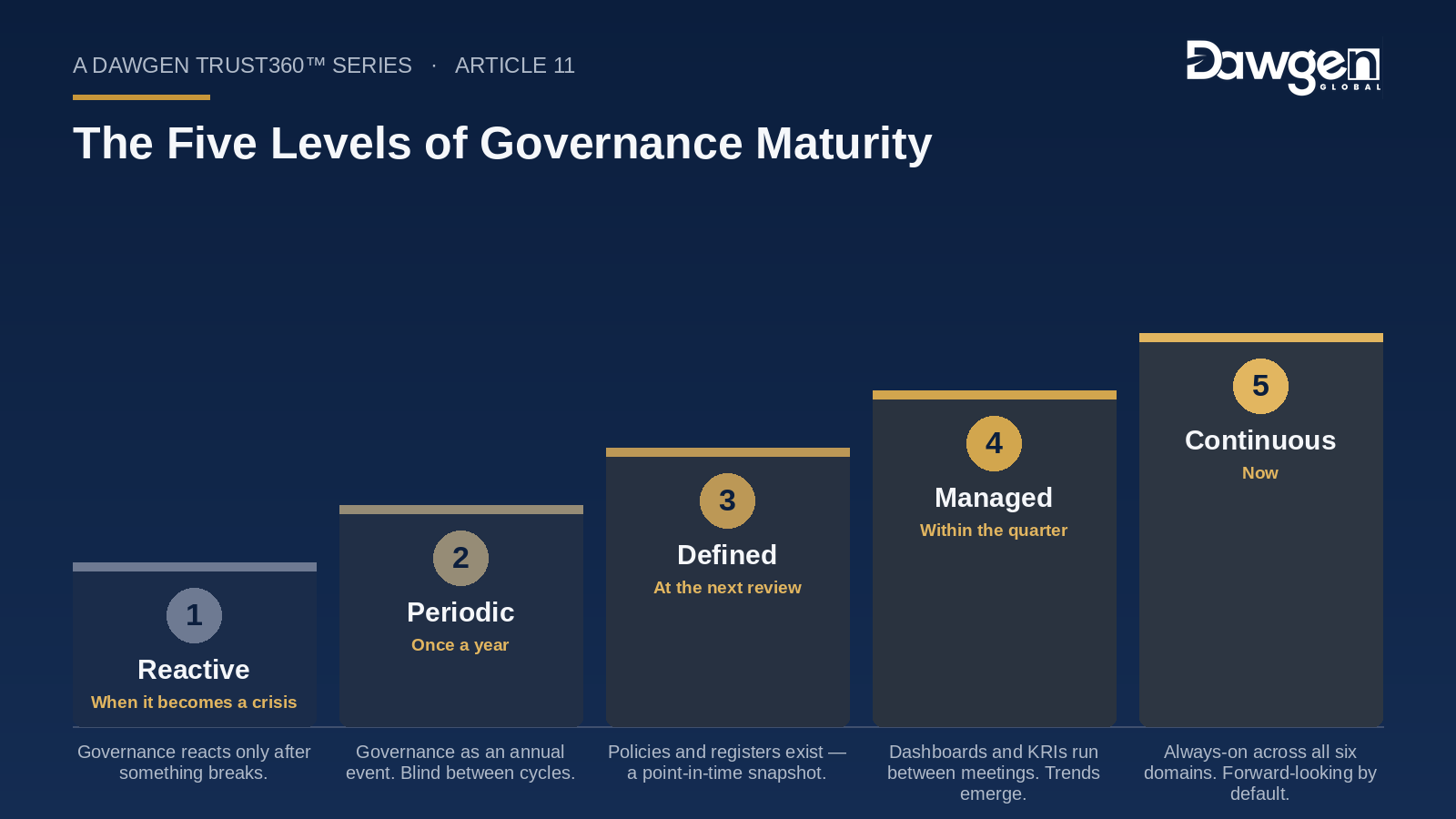
In our work with Caribbean boards, we find governance maturity falls along a five-level spectrum. The levels are not labels to wear with pride or shame; they are a diagnostic, and almost every organisation is further down the ladder than its leadership assumes.
Level 1 — Reactive. Governance happens after something goes wrong. The board learns of a risk when it becomes a crisis: a fraud surfaces, a regulator writes, a system fails. Oversight is firefighting, and the organisation is permanently on the back foot. Many smaller and younger entities live here without quite realising it.
Level 2 — Periodic. Governance has become an event — usually annual. There is an audit, a year-end risk review, a once-a-year refresh of the register. It is a genuine improvement on firefighting, but it is backward-looking by design and blind for the eleven months between cycles. This is where the largest share of Caribbean organisations actually sit.
Level 3 — Defined. The architecture exists. Policies are written, a risk framework is adopted, registers and committee structures are in place, responsibilities are assigned. Governance is now repeatable and no longer dependent on a single capable individual — but it is still largely point-in-time, producing a structured snapshot rather than a live picture.
Level 4 — Managed. Monitoring begins to run between the meetings. Key risk indicators are tracked, dashboards appear, several domains are watched on a rolling basis, and the board starts to see trends rather than mere status. The organisation is no longer purely reacting to the past; it is beginning to read the present.
Level 5 — Continuous. Monitoring is always on, across all six governance domains. Evidence is current by default, the board report is forward-looking and decision-oriented, and governance has become a standing capability rather than a periodic exercise. The organisation is rarely surprised, because it is always watching.
Why you cannot skip a rung
The temptation, once the destination is clear, is to leap straight for it — to buy a dashboard and declare the organisation “continuous.” It does not work, and the reason is instructive. Continuous monitoring at Level 5 depends on having defined what you are monitoring at Level 3 and having established the discipline of doing it regularly at Level 4. A real-time dashboard sitting on top of undefined risks and unowned responsibilities does not produce continuous governance; it produces a continuous stream of noise. Each level builds the foundation the next one stands on. The journey can be travelled briskly, but it cannot be short-circuited.
The honest self-assessment
The single most valuable thing a board can do with this model is to use it honestly. That is harder than it sounds, because organisations consistently overrate themselves — the presence of a policy is mistaken for the practice of governance, and a well-bound annual report is mistaken for live oversight. A useful corrective is to ask not what you have, but what you would know. If a key control failed this month, when would the board find out — next week, next quarter, or only after the damage? If a regulatory requirement changed tomorrow, how long before it reached the boardroom? The speed of your honest answer tells you your level far more reliably than any list of documents.
The Caribbean dimension
For Caribbean organisations this journey carries particular weight. Many of our entities advanced quickly to Level 2 or Level 3 — adopting frameworks and templates, often imported wholesale from far larger institutions — and then stalled, mistaking the existence of structure for the maturity of oversight. The result is a great deal of governance machinery that runs only once a year. Yet the same constraints that make the higher levels seem out of reach — lean teams, directors serving on multiple boards, limited specialist capacity — are precisely the conditions under which always-on monitoring delivers the most, because it does the watching that overstretched people cannot do continuously themselves. The Caribbean board does not need a larger governance function to climb the ladder. It needs a smarter one.
What good looks like
This is the progression that Dawgen TRUST360™ is built to support: meeting an organisation honestly at the level where it stands, and moving it deliberately up the ladder — defining what matters, establishing the cadence, then layering continuous monitoring across all six domains until current, forward-looking oversight becomes the organisation’s default state rather than its annual aspiration. The aim is not to hand a board a Level 5 platform it is not ready to use. It is to walk the journey rung by rung, so that each new capability rests on solid ground beneath it.
Where are you, really?
So here is this article’s test, and it takes one minute. Place your organisation on the five-level ladder — not where you would like it to be, but where it honestly is when you ask the question that matters: how quickly would we know? If the honest answer is “once a year” or “when it becomes a crisis,” you are lower on the ladder than your governance documents suggest — and that is not a failure, it is a starting point. Every organisation now operating continuously was once exactly where you are. The journey is real, the rungs are climbable, and the only genuinely wrong place to be is standing still while convincing yourself you have already arrived.
About the author
Dr. Dawkins Brown is Executive Chairman and Founder of Dawgen Global, an independent, integrated multidisciplinary professional services firm operating across the Caribbean, and Founding Editor of Caribbean Boardroom Perspectives.
Continue the conversation: dawgen.global · [email protected]
Next in the series — Article 12: “The Trust Dividend: Why Continuously Governed Organisations Win.”
About Dawgen Global
Dawgen Global is an independent, integrated multidisciplinary professional services firm headquartered at 47 Trinidad Terrace, New Kingston, Jamaica, serving more than 15 territories across the Caribbean. Founded and led by Dr. Dawkins Brown, Executive Chairman, the firm is independent and not affiliated with any international network. It delivers a full suite of professional services under one roof: audit and assurance; tax advisory; IT and digital transformation; risk management; cybersecurity; actuarial and insurance regulatory advisory; HR advisory; mergers and acquisitions; corporate recovery; business advisory and strategy; accounting BPO and virtual CFO services; and legal process outsourcing.
The proposition is simple: big-firm capability without the big-firm price. Dawgen Global’s integrated approach is built for the specific complexities and opportunities of the Caribbean market, helping organizations make sharper, better-informed decisions that drive measurable progress.
To explore a partnership, reach out:
- Website: dawgen.global
- Email: [email protected]
- WhatsApp (Global): +1 555-795-9071
- Caribbean offices: +1 876-665-5926 | +1 876-929-3670 | +1 876-926-5210


