Governance is almost always counted as a cost — a tax paid to avoid bad outcomes. This final article makes the opposite case: continuous governance is productive, not merely protective. What it produces is trust, and trust pays a dividend that compounds.
Over the previous eleven articles, this series has made a sustained case for continuous governance and shown, domain by domain, how it is built — six areas of oversight monitored in real time, evidence kept always-ready, a board report rebuilt around the decision, and a maturity journey that carries an organisation from reactive firefighting to continuous assurance. It has been, throughout, an argument about method. This final article turns to consequence. Having built all of it, a board is entitled to ask the most important question of all: so what do we actually get? The answer is a single word — the word at the centre of everything this series has carried — trust. And trust, properly understood, is not a sentiment. It is an asset, and it pays.
Governance counted as a cost
For most organisations, governance lives on the wrong side of the ledger. It is filed under cost, compliance and defence — a necessary expense incurred to avoid fines, failures and embarrassment. That framing is not wholly wrong; governance does protect. But it is dangerously incomplete, because an activity understood only as a cost is an activity an organisation will always try to minimise. Budgets are capped, ambition is trimmed, and governance is quietly held to the lowest level that will keep the regulator and the auditor satisfied. The defensive frame caps the investment — and, with it, the return.
Trust is the real product
Shift the frame, and everything changes. The true output of governance is not a clean audit or an unbroken compliance record; those are by-products. The true output is trust — the justified confidence of everyone whose belief in the organisation determines what it is able to do. Lenders, investors, regulators, partners, customers, employees and boards themselves all make decisions about the organisation based on how far they can trust it. Governance is the machinery that earns that trust and, just as importantly, evidences it. And once trust is recognised as the product, it becomes obvious that it is not soft at all. It is among the most economically valuable assets an organisation can hold.
Governance is counted as a cost. Its true output is trust — and trust is the cheapest capital an organisation will ever raise.
The dividend, itemised
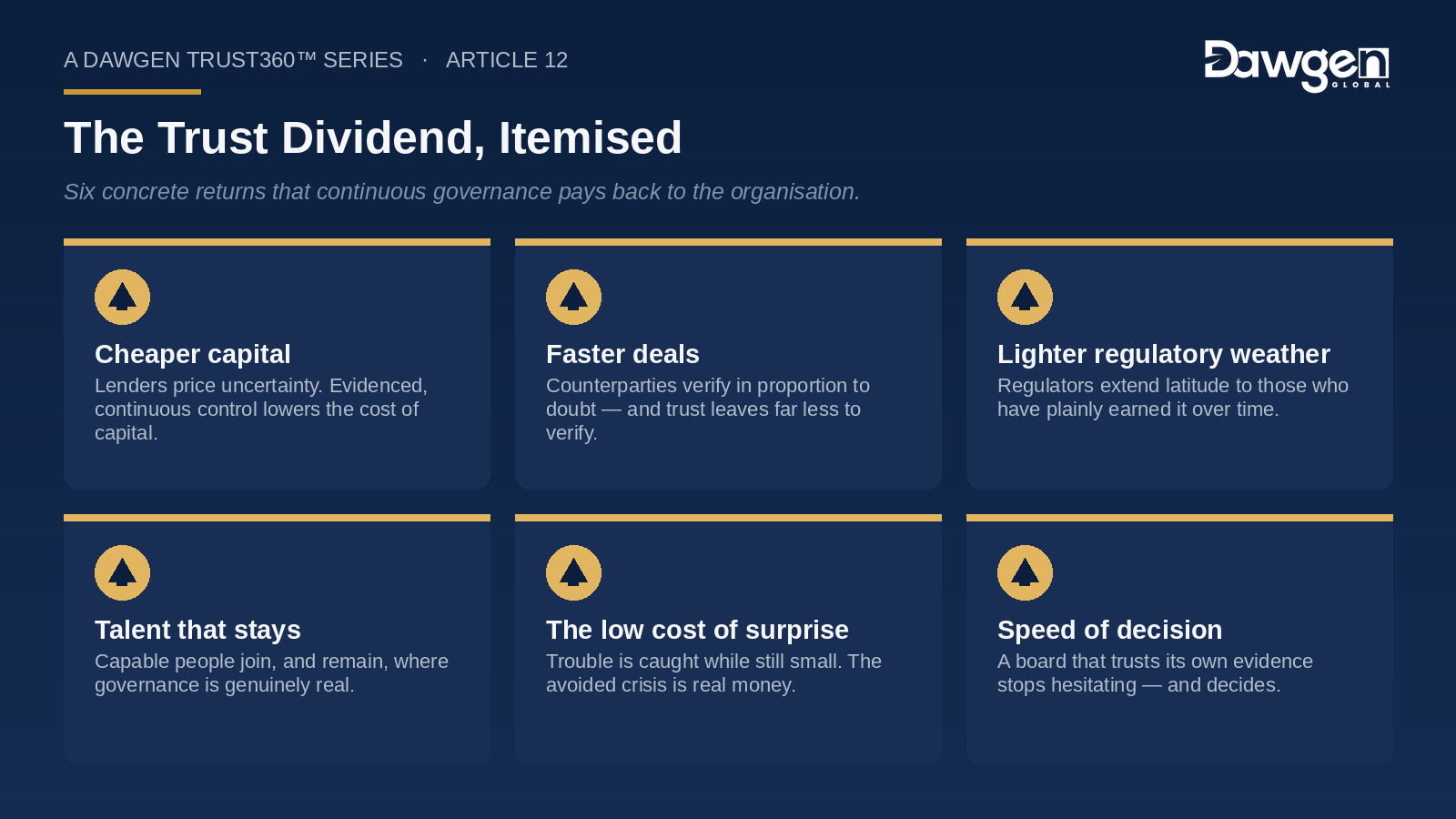
Trust pays in concrete, countable ways. Consider where the dividend lands.
Cheaper capital. Lenders and investors price uncertainty. An organisation that can demonstrate continuous, evidenced control of its risks is a lower-uncertainty proposition — and lower uncertainty is, quite literally, a lower cost of capital. Trust is the discount a well-governed balance sheet earns.
Faster deals. Counterparties conduct diligence in proportion to their doubt. The demonstrably well-governed organisation is diligenced faster and more cheaply, because there is simply less to verify. Trust removes friction from every transaction it touches.
Lighter regulatory weather. Regulators extend latitude to those who have earned it. An organisation with a credible, continuous governance record spends less time under scrutiny and enjoys more constructive relationships when scrutiny does come. Trust buys goodwill that proves priceless in a crisis.
Talent that stays. Capable people are drawn to — and remain within — organisations that are seriously run. Real governance signals to talent that the institution is built to last, and that their own reputation is safe inside it.
The low cost of surprise. Continuously governed organisations have fewer crises, and smaller ones, because they see trouble while it is still small. The avoided catastrophe never appears on a profit-and-loss statement, but it is real money — and trust is what keeps it off the page.
Speed of decision. A board that trusts its own evidence decides faster. Much of the slowness in governance is really a lack of confidence in the information — and continuous, current evidence dissolves that hesitation. Trust, turned inward, becomes pace.
Why continuity is the multiplier
Here is where this final article meets the first. Trust is not built once and banked; it is perishable. A clean audit eighteen months old tells a counterparty very little about the organisation today, and everyone making a decision knows it. Periodic governance produces a snapshot of trustworthiness that begins to decay the moment it is taken. Continuous governance produces something far more valuable — trust that is current. And current trust is the only kind the market actually prices. This is why the dividend compounds only when the governance is continuous: the always-ready evidence, the live monitoring, the forward-looking report are not ends in themselves. They are the mechanism that keeps trust fresh, and fresh trust is what pays.
The Caribbean dimension
For Caribbean organisations this is not an abstraction; it is a competitive strategy. Our enterprises compete for scarce capital, often against larger institutions whose credibility is inherited — from sheer scale, or from membership in a global network. That kind of borrowed trust is not available to most of our organisations. But earned trust is, and it does not require scale to build. A mid-sized Caribbean company that can demonstrate continuous, evidenced governance can offer a counterparty something a far larger but opaquely run rival cannot: justified, current confidence. In a region where credibility has too often been assumed to belong to the big and the foreign, continuous governance is how a Caribbean organisation earns it outright.
What good looks like
This is the whole of Dawgen TRUST360™ in a sentence: a discipline for converting continuous oversight across all six governance domains into a standing, demonstrable position of trust — current, evidenced, and ready to be shown to anyone whose confidence the organisation depends upon. The name was never incidental. The 360 is the all-domain, always-on coverage; the trust is the dividend it returns. The purpose of monitoring everything, continuously, is precisely this — to make the organisation worthy of belief, and able to prove it, at any moment it is asked.
The end of the series, and the beginning of the work
And so we arrive at the end of this series — eleven arguments and one conclusion. For all the registers, dashboards and reports it has discussed, this was never really a series about risk. It was a series about trust: how an organisation becomes one that others can rely on without having to constantly check, and how it keeps earning that reliance in a world that no longer waits a year between questions. The continuously governed organisation does not merely avoid losing. It earns the right to win — cheaper capital, smoother deals, better people, fewer surprises, faster decisions, and a reputation that does its work before any meeting begins. That is the trust dividend. The case for it is now complete. What remains is the only thing that ever truly mattered: to begin.
About the author
Dr. Dawkins Brown is Executive Chairman and Founder of Dawgen Global, an independent, integrated multidisciplinary professional services firm operating across the Caribbean, and Founding Editor of Caribbean Boardroom Perspectives.
Continue the conversation: dawgen.global · [email protected]
This concludes the Dawgen TRUST360™ series — “The Continuous Governance Imperative.”
About Dawgen Global
Dawgen Global is an independent, integrated multidisciplinary professional services firm headquartered at 47 Trinidad Terrace, New Kingston, Jamaica, serving more than 15 territories across the Caribbean. Founded and led by Dr. Dawkins Brown, Executive Chairman, the firm is independent and not affiliated with any international network. It delivers a full suite of professional services under one roof: audit and assurance; tax advisory; IT and digital transformation; risk management; cybersecurity; actuarial and insurance regulatory advisory; HR advisory; mergers and acquisitions; corporate recovery; business advisory and strategy; accounting BPO and virtual CFO services; and legal process outsourcing.
The proposition is simple: big-firm capability without the big-firm price. Dawgen Global’s integrated approach is built for the specific complexities and opportunities of the Caribbean market, helping organizations make sharper, better-informed decisions that drive measurable progress.
To explore a partnership, reach out:
- Website: dawgen.global
- Email: [email protected]
- WhatsApp (Global): +1 555-795-9071
- Caribbean offices: +1 876-665-5926 | +1 876-929-3670 | +1 876-926-5210


