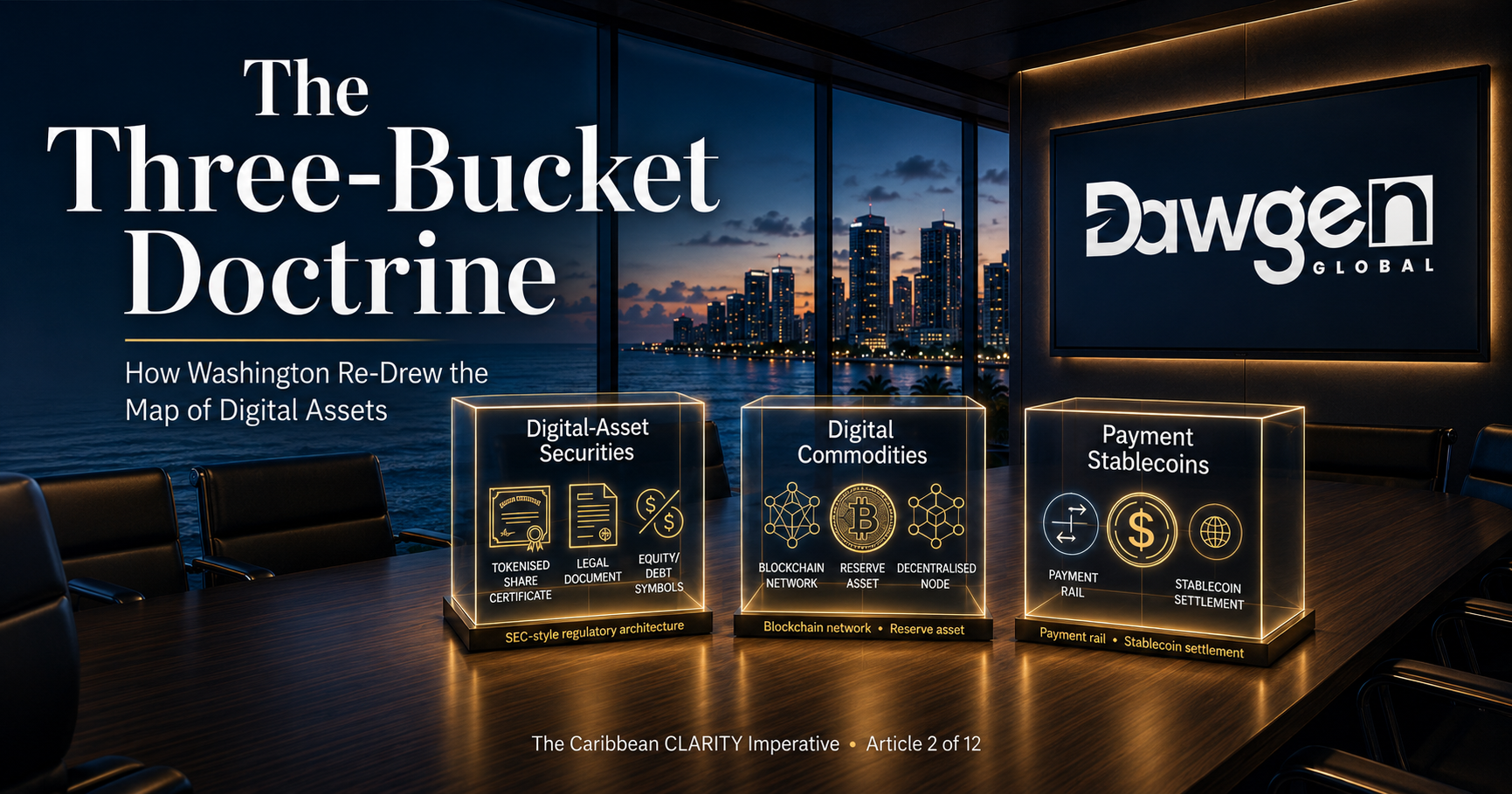
If Article 1 of this series was the news, this article is the map. The CLARITY Act’s most consequential design choice is the explicit division of all digital assets into three regulatory buckets, each with a defined supervisor. The bucket a token falls into determines who regulates it, what disclosures attach to it, who can custody it, and — critically for Caribbean institutions — how Caribbean regulators should think about authorising activity in or related to it. This article takes the trifurcation apart in operational detail.
The Doctrine, Plainly Stated
Every digital asset, under the CLARITY Act, falls into one of three categories: a digital-asset security, a digital commodity, or a payment stablecoin. The test for which bucket applies is not technological — it is economic and structural. The buckets are not mutually exclusive across time: a single project can move from one bucket to another as its network matures. But at any given moment, every regulated digital asset has exactly one primary U.S. supervisor.
| Why the Doctrine Matters
For ten years, every legitimate digital-asset issuer, exchange, broker and custodian in the United States has operated under genuine uncertainty about which agency had authority. That uncertainty has been the single largest deterrent to institutional adoption. The CLARITY Act ends it. Once a token is correctly classified, every downstream question — registration, disclosure, capital, custody, audit, AML — follows from the bucket. |
Bucket One: Digital-Asset Securities (SEC)
A digital-asset security is, in plain English, a token whose economic substance is that of an investment contract or other security as defined by long-standing federal securities law. The Bill does not invent new principles; it applies the Howey test and the broader Securities Act and Exchange Act framework to programmable instruments. If a token’s purchasers are investing money in a common enterprise with the expectation of profits derived predominantly from the efforts of others, it is a security — whether it is a paper share certificate, a ledger entry at a transfer agent, or a token on a public blockchain.
What changes is the disclosure regime. The CLARITY Act creates a tailored disclosure regime for digital-asset securities that adapts existing securities law to the technological reality. Programmable instruments require disclosure about their smart-contract code, their token economics, their governance, their custody arrangements and their interaction with the underlying blockchain. The SEC retains its full anti-fraud authority. What it gains is a framework that allows responsible projects to register and raise capital rather than being driven offshore or into perpetual ambiguity.
Examples of Digital-Asset Securities
- Tokenised tranches of corporate debt or equity offered to U.S. investors.
- Tokenised fund interests in a regulated investment company or private fund.
- STRC and similar bitcoin-backed preferred stock instruments (already registered securities).
- Tokenised real-estate interests where investors expect rental yield or capital gains driven by a sponsor’s efforts.
- Most initial token offerings during the pre-decentralisation phase of a project.
Bucket Two: Digital Commodities (CFTC)
A digital commodity is a non-security digital asset that trades on a functionally decentralised public blockchain, whose value is intrinsic to the network itself rather than dependent on the efforts of a specific promoter. Bitcoin is the paradigm case. Ether is widely treated as one. Many newer Layer-1 tokens are in the bucket as well, subject to fact-specific decentralisation analysis.
The CFTC’s jurisdiction over digital commodities is significant for two reasons. First, the CFTC’s market-structure regime is fundamentally different from the SEC’s — it is principles-based, designed for commodity markets, and historically more accommodating of professional and institutional trading. Second, digital commodities are exempted from state securities laws under the Bill, eliminating fifty-state registration friction. This is a meaningful regulatory cost reduction for compliant intermediaries.
Caribbean Implications of Bucket Two
- Bitcoin and other digital commodities can be held by Caribbean institutions as treasury assets without triggering U.S. securities registration in respect of the holding itself.
- Caribbean exchanges or broker-dealers that wish to serve U.S. clients in digital commodities will need a route to CFTC registration or to operate via a CFTC-registered U.S. counterparty.
- The CFTC has already authorised futures commission merchants to accept Bitcoin and certain stablecoins as customer collateral. Caribbean derivatives participants should expect this to become standard practice within twelve to eighteen months.
Bucket Three: Payment Stablecoins (Banking Regulators + GENIUS)
Payment stablecoins occupy a special category. They are not digital commodities because they have an issuer with redemption obligations. They are not equity-style securities because their purchasers do not expect profits from a common enterprise; they expect par redemption. The GENIUS Act of 2025 governs the issuance side: who may issue, on what reserve, with what redemption rights, under whose supervision. The CLARITY Act governs the trading and intermediation side: how stablecoins move across exchanges, custody arrangements, and the rules for activity-based rewards versus prohibited passive yield.
| Stablecoin Issue | GENIUS Act Position | CLARITY Act Position |
| Who may issue | Bank subsidiaries; OCC-licensed non-bank issuers; certain state-licensed issuers | (addressed by GENIUS) |
| Reserve composition | 1:1 high-quality liquid assets; cash, short-dated Treasuries | (addressed by GENIUS) |
| Redemption rights | At-par redemption rights; defined timelines | (addressed by GENIUS) |
| Bank-style passive interest | (not directly addressed) | Prohibited (Section 404) |
| Activity-based rewards | (not directly addressed) | Permitted for genuine on-chain activity |
| Trading venue rules | (not directly addressed) | Tailored framework for intermediaries |
| Custody by banks | (not directly addressed) | Explicitly authorised |
The Tillis-Alsobrooks compromise on Section 404 is the politically pivotal provision. It draws a line between (a) bank-style passive interest on stablecoin balances — prohibited because it functionally equates stablecoins with insured bank deposits and risks deposit flight — and (b) activity-based rewards genuinely earned through staking, liquidity provision, governance participation or loyalty programmes — permitted because they are economically distinct. The American Bankers Association and other banking trade groups continue to argue that the compromise is too permissive. Expect the line to be tested in implementation.
How the Three Buckets Map onto Caribbean Regulatory Reality
Caribbean regulators are not, of course, bound by U.S. classification. But they will inevitably consider the U.S. bucket as a reference point, in the same way that Caribbean securities regulators have always considered the U.S. registration position of issuers seeking to access U.S. investors. The practical mapping for the principal Caribbean jurisdictions:
| Jurisdiction | Existing Regime | Likely Bucket Mapping |
| Jamaica | FSC guidance on virtual assets; BOJ on stablecoins; no comprehensive market-structure law | FSC for securities-type; BOJ for stablecoin-type; gap on commodities-type |
| ECCU | Virtual Asset Business Act (model law) | Single VASP regime; will need to adopt bucket-aware sub-regimes for SEC-style and CFTC-style activity |
| Bahamas | DARE 2020 (as updated 2024) | Most bucket-aware regime in the region; reasonable alignment already |
| BVI | Virtual Assets Service Providers Act 2022 | VASP-focused; issuance largely outside scope; will adapt for institutional onshoring trend |
| Cayman | Virtual Asset Service Providers Act (updated 2024) | VASP-focused; institutional preference; expect new bucket-aware guidance |
| Bermuda | Digital Asset Business Act 2018 | Mature; expect operational alignment to U.S. bucket terminology |
Three Operational Consequences for Caribbean Institutions
Whatever a Caribbean board’s appetite for direct digital-asset exposure, the three-bucket doctrine has consequences that boards must address now.
Consequence 1: Classification matters before everything else.
Any institution considering issuance of a tokenised instrument, holding of a digital asset, or use of stablecoin rails for payments must first establish which bucket the relevant instrument falls into. The downstream consequences — registration, disclosure, audit, AML, custody, tax — follow from the classification. Get the classification wrong and every downstream control is misaligned.
Consequence 2: Three different sets of legal advisors.
Digital-asset securities require securities counsel. Digital commodities require derivatives and commodities counsel. Payment stablecoins require banking counsel. Caribbean institutions that have historically used a single general-counsel relationship for capital-markets activity will need to either expand that relationship or partner with specialised U.S. counsel. Dawgen Global’s Legal Process Outsourcing discipline is positioned to support this multi-track requirement.
Consequence 3: Audit and assurance requirements diverge by bucket.
Audit of a digital-asset security follows the SEC’s frameworks (and the equivalent IFRS-based Caribbean frameworks for unlisted issuers). Audit of digital-commodity holdings is closer to commodity-inventory audit logic with cryptographic key-management controls layered in. Audit of payment-stablecoin custodial relationships is closer to traditional banking audit. DAGAF™ Pillar 4 (Audit and Assurance) is built to accommodate all three tracks within a single, integrated assessment.
| The Boardroom Test
Before your next audit committee meeting, ask one question: “For every digital-asset position, exposure, or contemplated activity on our books, which CLARITY Act bucket does it fall into, and which Caribbean regulator’s framework is the primary anchor?” If management cannot answer in two sentences per item, the three-bucket doctrine has not yet been internalised. |
Where the Series Goes from Here
The next three articles each take one digital product category in turn. Article 3 examines digital capital — the reserve asset layer — and the question of whether and how Caribbean treasuries should engage. Article 4 examines digital credit. Article 5 examines digital equity. Article 6 then decodes the Saylor architecture in which all three layers integrate. Each article moves from the regulatory framework established here into the practical, sector-specific implications for Caribbean boards.
THE CARIBBEAN CLARITY IMPERATIVE · SERIES MAP
▶ 2. The Three-Bucket Doctrine · you are here
- Digital Capital: The New Reserve Asset Class
- Digital Credit: The Yield Layer the Caribbean Cannot Ignore
- Digital Equity: Tokenised Ownership and Capital Formation
- The Saylor Architecture: Bitcoin, STRC and MSTR Decoded
- The Global Regulatory Convergence
- The Stablecoin Corridor War
- JAM-DEX, DCash and the Sand Dollar
- The Caribbean Offshore Question: BVI, Cayman, Bermuda, Bahamas
- Audit, Tax and Disclosure for Digital Assets
- The Caribbean Boardroom Agenda (Series Finale)
ABOUT THE AUTHOR
Dr. Dawkins Brown is Executive Chairman and Founder of Dawgen Global, an independent, integrated multidisciplinary professional services firm headquartered in Kingston, Jamaica and operating across more than fifteen Caribbean territories. He is the author of the DAGAF™ (Digital Asset Governance & Assurance Framework) and a regular voice in Caribbean boardroom thought leadership.
About Dawgen Global
“Embrace BIG FIRM capabilities without the big firm price at Dawgen Global, your committed partner in carving a pathway to continual progress in the vibrant Caribbean region. Our integrated, multidisciplinary approach is finely tuned to address the unique intricacies and lucrative prospects that the region has to offer. Offering a rich array of services, including audit, accounting, tax, IT, HR, risk management, and more, we facilitate smarter and more effective decisions that set the stage for unprecedented triumphs. Let’s collaborate and craft a future where every decision is a steppingstone to greater success. Reach out to explore a partnership that promises not just growth but a future beaming with opportunities and achievements.
 Email: [email protected]
  Visit: Dawgen Global Website

 WhatsApp Global Number : +1 555-795-9071
Caribbean Office: +1876-6655926 / 876-9293670/876-9265210  WhatsApp Global: +1 5557959071
USA Office: 855-354-2447
Join hands with Dawgen Global. Together, let’s venture into a future brimming with opportunities and achievements


