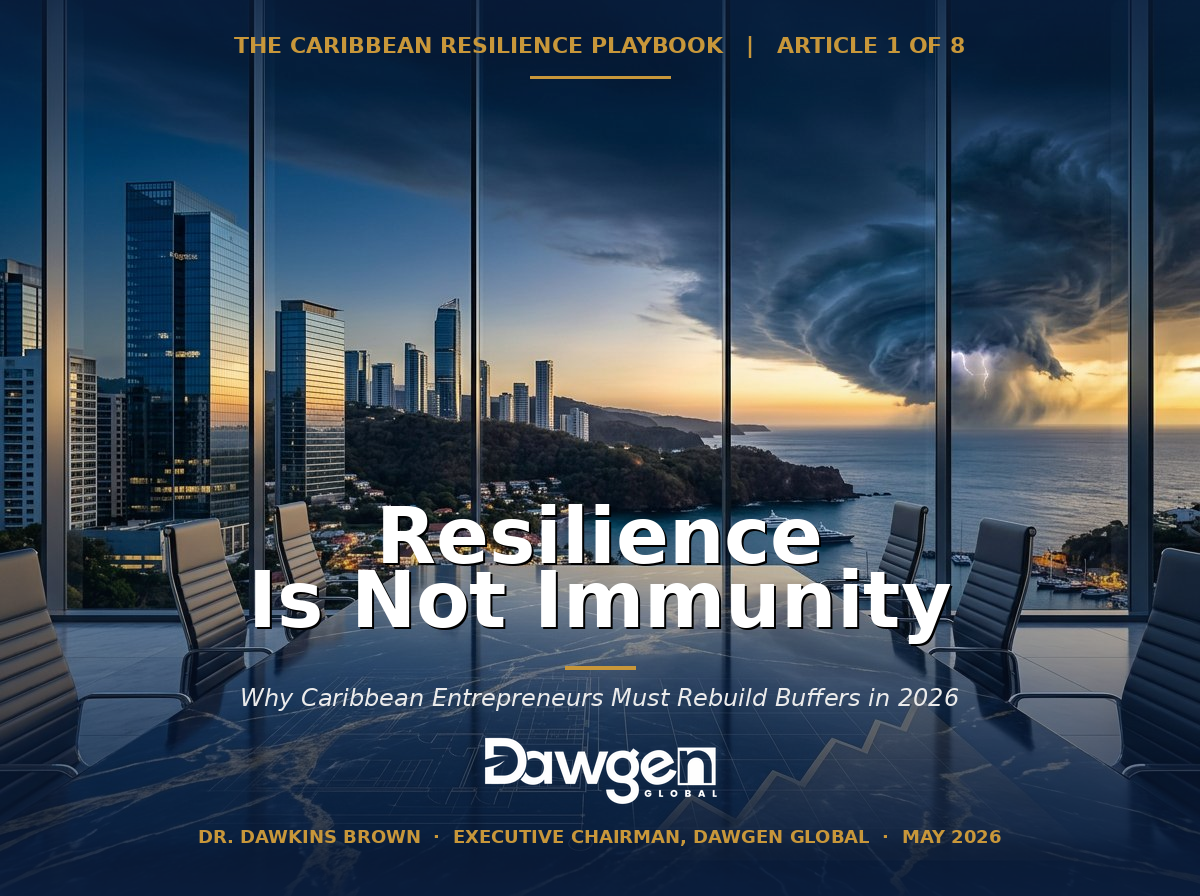
Earlier this year, the Inter-American Development Bank published its 2026 Latin American and Caribbean Macroeconomic Report under the title Resilience and Growth Prospects in a Shifting Global Economy. It is one of the most important documents Caribbean entrepreneurs will read this year. The headline finding is genuinely good news: the region has entered 2026 with low sovereign spreads, contained inflation, unemployment near historic lows, and currencies that appreciated against the U.S. dollar through most of 2025.
And yet, on the very first page of the IDB’s preface, Chief Economist Laura Alfaro Maykall sets out the warning that frames the entire 118-page report. Resilience, she writes, does not imply immunity. Growth remains modest. Long-standing structural constraints — particularly weak productivity growth — continue to limit the region’s ability to generate sustained income gains. Financing conditions remain tight. Higher global interest rates and accumulated debt are translating into larger debt-service burdens, narrowing policy space.
The report is, in other words, a quiet alarm wrapped in a calm scoreboard. Caribbean entrepreneurs who read only the scoreboard will be unprepared for what comes next.
This article opens an eight-week series in which Dawgen Global will translate each major finding of the IDB report into the operating questions that belong on Caribbean boardroom agendas this year. We will cover productivity, AI-led changes in the labour market, critical minerals, external risk transmission, refinancing strategy, monetary policy, and a closing 12-point playbook. We begin with the most important framing of all: the difference between resilience and immunity, and what it means for how entrepreneurs across the region should think about 2026.
The scoreboard is impressive. The buffers are thinner.
Five data points from the IDB’s first chapter define the calm:
- Growth held up. Regional GDP growth is projected at 2.2% for 2025 and 2.1% for 2026 — close to the long-run average and broadly in line with what was expected at the start of 2025.
- Sovereign risk premia have fallen. The median sovereign spread across the region closed 2025 at 209 basis points, down from 268 in 2019. Argentina, Bolivia, and Ecuador — economies that have historically traded at distressed levels — recorded spreads below 700 basis points, lows not seen in many years.
- Inflation is anchored. Inflation has been largely contained across the region, and most inflation-targeting economies have seen inflation return to target by 2025.
- Labour markets are tight. Unemployment rates fell in most countries between June 2024 and June 2025, with joblessness now near its lowest levels in recent years.
- Currencies appreciated. Many regional currencies appreciated against the U.S. dollar through 2025, in contrast to past episodes of global uncertainty when the region typically experienced capital outflows and sharp depreciations.
Read in isolation, these five data points describe a region with rare macroeconomic poise. Read against the IDB’s analysis of the underlying buffers, they describe something more fragile.
The IDB report is unsparing on this point. Long-term interest rates in advanced economies have stayed elevated, reflecting continued uncertainty and the rapid expansion of public debt worldwide — gross public debt in advanced economies is projected to reach roughly 120% of GDP by 2030. Combined with already high public debt levels in our region, higher interest payments are increasingly weighing on public finances. Several Latin American and Caribbean countries are finding it harder to comply with their fiscal rules, and pressures to relax those rules and to shorten debt maturities have intensified.
On the regional ledger, interest payments will surpass 3% of GDP in 2025 — their highest level in more than two decades. Public debt has stabilised above pre-2020 levels and above the IDB’s estimated fiscal-risk threshold of 54.8% of GDP. The interquartile range of public debt across the region’s countries has narrowed since 2019, which the IDB notes signals that elevated debt is becoming widespread rather than concentrated in a few outliers.
The scoreboard says we are resilient. The buffers say we are exposed.
Then there is the climate exposure. The IDB report flags Jamaica’s experience explicitly: FocusEconomics revised Jamaica’s 2025 growth forecast from 1.9% in October 2025 to 0.9% in January 2026, following the landfall of Hurricane Melissa. A single weather event cut a country’s growth forecast roughly in half. The Caribbean’s exposure to extreme weather — and its low resilience to such events — sits behind every other macro buffer the region holds.
Why the macro picture matters at the firm level
It is easy for the entrepreneur to read a macroeconomic report as a document about other people: about central bankers, finance ministries, and bond traders. The IDB’s 2026 report is decisively not that. Each of the dynamics it describes lands on the firm’s profit-and-loss account through one of four channels.
The first is the cost of capital. Global long-term rates remain elevated. Even when central banks cut policy rates, long-term yields have not followed. Caribbean banks price their commercial loan books off these long-term references. The era of the 6%-7% commercial loan that prevailed before 2022 is not coming back in the near term, and any 2026 capital plan should be built on that assumption rather than on hope.
The second is foreign exchange. The IDB’s analysis shows that risk-off episodes — moments when global investor confidence shifts — generate sharp real exchange-rate movements across the region. Caribbean firms with imported input dependencies, foreign-currency debt, or USD-linked customer contracts feel these movements directly in their margins. The report explicitly cites the April 2025 ‘Liberation Day’ tariff episode as a recent example of how fast exchange rates can move when global risk shifts.
The third is demand. Several of the region’s major trading partners — including the United States, the euro area, and China — are projected to grow at modest rates in 2026, with China continuing a long-term deceleration and global growth projected at just 2.8%. Tourism-dependent economies feel this directly. Goods exporters feel it through volume and pricing pressure.
The fourth is fiscal pressure flowing through to the firm. As sovereign debt-service burdens rise, Caribbean governments will face pressure to broaden their tax base, tighten compliance, and slow public-sector contract payments. Each of these reaches the firm — through a higher effective tax rate, longer accounts-receivable cycles for those serving the public sector, and increased regulatory cost.
The four buffers every Caribbean firm should track
If macroeconomic resilience is built on policy buffers, firm-level resilience is built on operating buffers. From our work with Caribbean enterprises across 15+ territories, four buffer ratios consistently distinguish firms that compound earnings through cycles from those that do not.
They are simple. They are measurable monthly. And in our experience, most mid-market Caribbean firms do not track them with the discipline they deserve.
- Buffer 1 — FX liquidity cover. This is the firm’s foreign-currency position relative to its short-term FX-denominated obligations. A firm with USD payables coming due in ninety days and only thirty days of USD revenue cover is exposed. The buffer should be expressed as days-of-cover and reviewed every month, not every quarter.
- Buffer 2 — Working capital cover. This is the cash plus committed undrawn facilities the firm holds against the next six months of operating cash outflows. A firm that runs hot — with very lean working capital because credit was cheap — is exposed when credit becomes expensive. Sixty days of operating coverage is a minimum; ninety is a comfortable buffer for most mid-market enterprises.
- Buffer 3 — Refinancing horizon. This is the weighted average time until the firm’s debt facilities mature. Firms whose entire debt stack matures within twelve months are dependent on a refinancing window that may not be open on the day they need it. Maturity termout — actively extending the average maturity — is one of the highest-leverage moves a Caribbean CFO can make in 2026.
- Buffer 4 — Customer concentration. Firms with more than 30% of revenue from a single customer, or more than 50% from a single sector, are concentration-exposed. In a risk-off episode, customer-level credit risk and sector-level demand risk amplify each other. Concentration that looked like the foundation of growth in good times becomes the source of fragility when the cycle turns.
Resilience is the result of past discipline. It is not a forecast of future immunity.
What belongs on the next board agenda
If the IDB report does its job — and we think it does — every Caribbean board should be asking five questions in its next meeting:
- How sensitive is our 2026 plan to a 100-basis-point increase in the cost of debt? If we cannot answer this within an hour, our finance function is operating on assumptions, not analysis.
- If we look at our debt profile and our maturity schedule, are we comfortable refinancing in a market where long rates stay where they are for the next eighteen months?
- Where is our open foreign-currency position right now, and what is our policy for closing it? ‘We have not had a problem’ is not a policy.
- Which of our customers represents more than 20% of our trade receivables, and what is the credit story behind each of them?
- If a single climate event interrupted our operations for thirty days — as Hurricane Melissa did to a slice of Jamaica’s economy — would our buffers see us through?
These questions are not exotic. They are not speculative. They are the predictable working questions in a year that the IDB has told us, with quiet authority, is one in which resilience must be earned rather than assumed.
How Dawgen Global supports this work
Dawgen Global is an independent, integrated multidisciplinary professional services firm headquartered at 47 Trinidad Terrace, New Kingston, Jamaica, and operating across more than fifteen Caribbean territories. The work described in this article — quantifying the four buffers, stress-testing the 2026 plan, restructuring the debt profile, mapping customer concentration risk — sits at the intersection of three of our practices.
- Business Advisory for the strategic diagnostic, the buffer measurement, and the boardroom-grade synthesis.
- Risk Management for the systematic identification, quantification, and treatment of the four buffer exposures and their interaction.
- Corporate Recovery for firms that diagnose vulnerability through this exercise and need to act on it before the next risk-off episode tests the buffer.
Where the firm has built or acquired earnings momentum that the current capital structure cannot support, our TRANSCEND™ corporate restructuring framework supplies a structured, nine-pillar approach to rebuilding buffer strength while preserving operating continuity.
What’s next in the series
Over the next seven weeks, we will work systematically through the operating implications of the IDB’s report:
- Article 2 turns to the productivity question that, the IDB report shows, has constrained Caribbean and Latin American growth for sixty years.
- Article 3 examines what the IDB Labor Market Observatory data on AI skill demand mean for how Caribbean firms hire and develop talent.
- Article 4 addresses the critical-minerals window and the boardroom decisions it forces.
- Article 5 provides a firm-level stress-test template for a global risk-off episode.
- Article 6 works through refinancing strategy in a higher-for-longer environment.
- Article 7 addresses pricing discipline and treasury modernisation.
- Article 8 delivers the closing 12-point Caribbean Resilience Playbook — a single integrated synthesis built for circulation among the executive team and the board.
Closing
The IDB’s 2026 report is a careful, technical document. Its central message is that the Caribbean and Latin America have built genuine resilience, and that this resilience must be preserved deliberately because the macro financial environment around us is not stable. Resilience is not immunity. It is the consequence of disciplined choices made before they are needed.
That insight scales down perfectly to the level of the firm. The Caribbean entrepreneurs who will outperform from 2026 to 2030 are not the ones who match the regional scoreboard in a calm year. They are the ones who measure their own buffers monthly, rebuild them deliberately, and refuse to confuse a good headline with a strong balance sheet.
That is the work. We are happy to support it.
— ◆ —
About the author
Dr. Dawkins Brown is the Executive Chairman and Founder of Dawgen Global, an independent, integrated multidisciplinary professional services firm headquartered in Kingston, Jamaica, and operating across more than fifteen Caribbean territories. He writes the Caribbean Boardroom Perspectives newsletter on LinkedIn.
Continue the conversation
Subscribe to Caribbean Boardroom Perspectives on LinkedIn for the next instalment.
Direct enquiries: [email protected] | +1-876-929-3670 | dawgen.global
Source
Ayres, J. and Juvenal, L. (2026). Resilience and Growth Prospects in a Shifting Global Economy: 2026 Latin American and Caribbean Macroeconomic Report. Inter-American Development Bank.
About Dawgen Global
“Embrace BIG FIRM capabilities without the big firm price at Dawgen Global, your committed partner in carving a pathway to continual progress in the vibrant Caribbean region. Our integrated, multidisciplinary approach is finely tuned to address the unique intricacies and lucrative prospects that the region has to offer. Offering a rich array of services, including audit, accounting, tax, IT, HR, risk management, and more, we facilitate smarter and more effective decisions that set the stage for unprecedented triumphs. Let’s collaborate and craft a future where every decision is a steppingstone to greater success. Reach out to explore a partnership that promises not just growth but a future beaming with opportunities and achievements.
 Email: [email protected]
  Visit: Dawgen Global Website

 WhatsApp Global Number : +1 555-795-9071
Caribbean Office: +1876-6655926 / 876-9293670/876-9265210  WhatsApp Global: +1 5557959071
USA Office: 855-354-2447
Join hands with Dawgen Global. Together, let’s venture into a future brimming with opportunities and achievements


