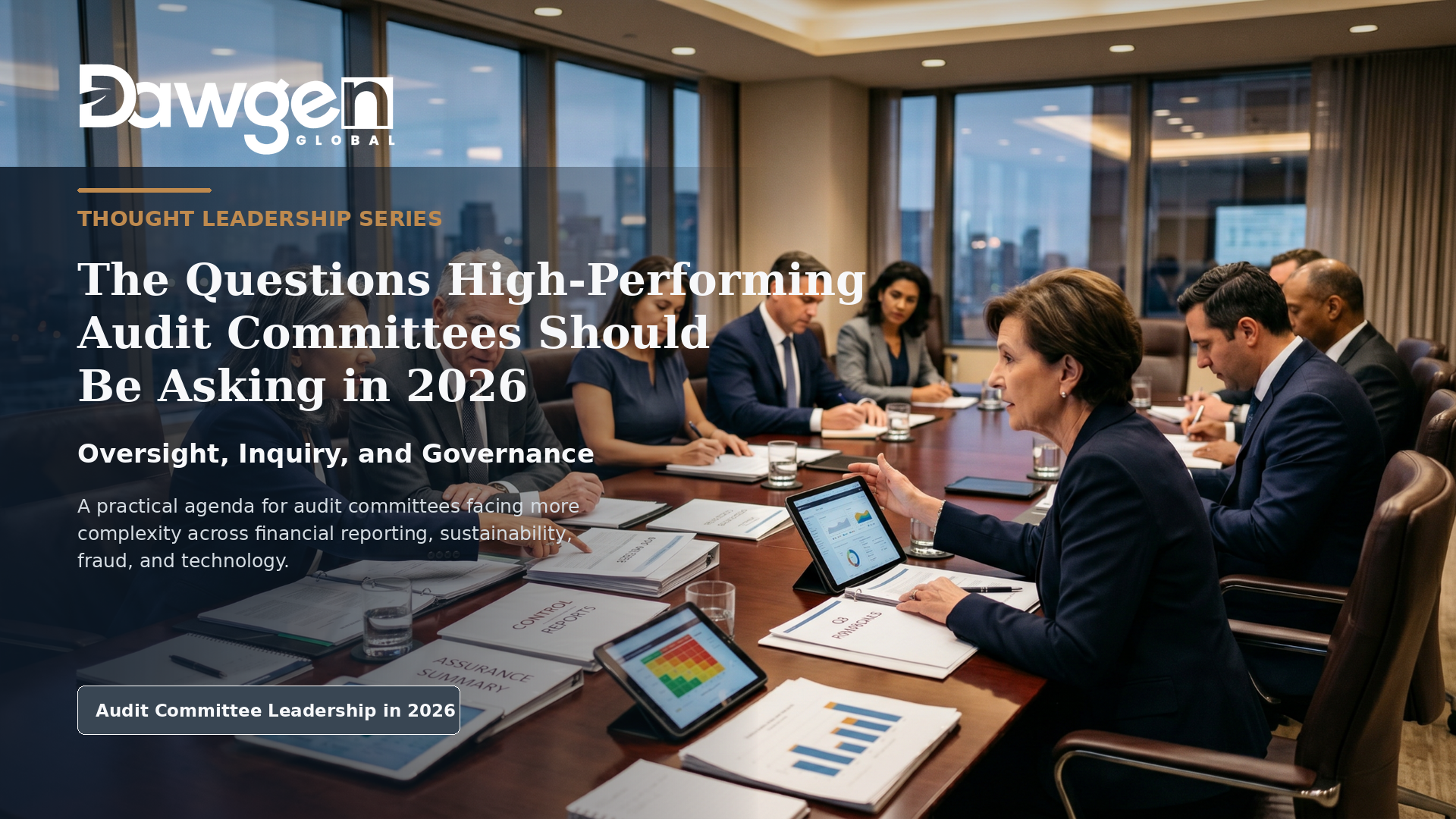
A practical agenda for audit committees facing more complexity across financial reporting, sustainability, fraud, and technology.
| Audit committees in 2026 need sharper questions, not just fuller agendas. Their effectiveness increasingly depends on whether they can probe evidence quality, challenge assumptions, and connect emerging issues across reporting, risk, technology, and assurance. |
Why better questions matter
Audit committees are carrying a broader burden than they did even a few years ago. Financial reporting remains central, but the agenda now also includes cyber resilience, technology risk, culture, fraud pressure, sustainability disclosure, control maturity, and the reliability of management information more generally. Under these conditions, the committee’s effectiveness depends less on the volume of papers received and more on the quality of the questions asked.
Good questions do more than surface problems. They reveal whether management and assurance providers understand the same risks in the same way. They expose assumptions that have gone unchallenged. They highlight where presentation quality may be masking evidence weakness. And they help the committee spend time on the few issues most likely to affect trust in reporting and oversight.
The difference between a routine committee and a high-performing one often lies in this discipline of inquiry.
Questions about evidence and controls
One of the most useful starting points is evidence. Audit committees should ask where the organization remains most dependent on manual processes, spreadsheet controls, late reconciliations, or workarounds outside core systems. They should ask whether key disclosures rely on data that is well controlled, consistently defined, and traceable back to source. They should also ask where control deficiencies are symptomatic of wider process design problems rather than isolated exceptions.
These questions matter because many assurance challenges begin long before the audit. If the evidence chain is fragile, year-end pressure will usually magnify the weakness rather than resolve it. A high-performing committee looks for this early and presses management to address root causes instead of only managing audit consequences.
The aim is not to become operational managers. It is to understand where confidence in reporting is genuinely strong and where it is being held together by effort.
Questions about judgment and challenge
Committees should devote particular attention to areas of heavy judgment. Which assumptions drove major estimates this period? What changed from prior periods? What alternative views were considered and rejected? How were downside scenarios treated? Did internal audit, risk, or external auditors raise concerns that differed materially from management’s position? These questions help test whether judgment has been exercised rigorously or merely asserted.
The same applies to going concern and fraud discussions. A committee should want to know not only the conclusion, but the challenge process behind it. What evidence would most quickly change management’s conclusion? What incentives could distort behavior? Where does override risk sit? What have we learned from near misses, control breaches, or operational stress points? High-performing committees treat challenge as a habit, not a special event.
This is where oversight becomes genuinely valuable, because it can strengthen the quality of management’s own thinking.
Questions about technology and AI
As organizations and audit firms use more technology, committees should ask more precise questions about the role those tools are playing. Are analytics and AI influencing risk assessment, testing, or conclusions? What controls govern those tools? How reliable is the underlying data? What human review takes place? Have any privacy, cyber, or cross-border data issues emerged? These are no longer specialist questions. They are part of the committee’s responsibility for oversight of reporting integrity.
Committees should be especially wary of innovation narratives that sound impressive but remain thin on governance. A high-performing committee wants clarity on use cases, controls, and limitations, not just demonstrations of capability. The goal is confidence, not novelty.
When asked well, technology questions can reveal whether modernization is strengthening assurance or merely reshaping the language around old weaknesses.
Questions about sustainability assurance
Where sustainability reporting is material, audit committees should ask how prepared the organization is for assurance. Which metrics are highest risk? Where are definitions still evolving? Who owns the evidence? How are local teams being aligned with group methodologies? What level of assurance is being targeted, and how is the provider’s scope being coordinated with wider reporting governance? These questions help the committee assess whether the organization is building credibility systematically.
Importantly, committees should avoid letting sustainability oversight float between functions without clear accountability. The more cross-functional the topic becomes, the more deliberate the governance must be. A high-performing committee ensures that management can explain how the moving parts connect.
This matters because weak coordination is one of the fastest ways for non-financial reporting to undermine broader confidence in the enterprise.
Questions that signal real leadership
The best audit committee questions are simple enough to be understood by the whole board and sharp enough to change management behavior. Where are we relying on optimism? What would an external critic find hardest to believe? Which issues are we repeatedly patching rather than solving? What parts of our reporting story are strongest, and which are most fragile? Questions like these create clarity and accountability.
High-performing audit committees are not distinguished by suspicion alone. They are distinguished by disciplined curiosity and a willingness to connect dots across finance, risk, operations, technology, and governance. In 2026, that broader perspective is essential.
An effective committee does not ask more questions for the sake of it. It asks the few questions that change the quality of assurance around the business.
How committees should organize their agenda
A more demanding assurance environment also requires better agenda design. Committees that treat every topic as equally urgent often end up with too much information and too little depth. High-performing committees create thematic continuity across meetings. They revisit recurring risk areas, track remediation explicitly, and use deep dives for the issues most likely to affect trust in reporting or control.
This approach allows the committee to distinguish between items that need monitoring and items that need challenge. It also helps avoid the common problem of sustainability, AI, fraud, or control issues appearing only as occasional side notes rather than as part of an integrated oversight narrative.
Good agenda design is therefore not administrative hygiene. It is part of how committees exercise judgment about where their limited time can matter most.
What management should expect from an excellent committee
Management teams should expect an excellent audit committee to be well prepared, commercially aware, and difficult to reassure with polished summaries alone. Strong committees are interested in process, assumptions, and evidence, not simply conclusions. They are also consistent. They remember prior discussions, follow through on open issues, and notice when the same weakness returns under a different label.
Far from being obstructive, this type of committee often improves management effectiveness. It sharpens escalation discipline, encourages earlier issue resolution, and reinforces the importance of evidence-led decision-making across the organization. Over time, management and the committee can become better partners because challenge is expected rather than personalized.
That is one of the clearest markers of governance maturity in 2026: an audit committee whose questions improve the business, not just the minutes.
What leaders should do now
- Reassess how reporting, controls, governance, and evidence connect across the enterprise rather than managing each issue in isolation.
- Use assurance discussions to surface operational weakness early, especially where judgment, systems, or cross-border coordination are involved.
- Treat audit, sustainability reporting, technology governance, and board oversight as linked trust issues that need an integrated response.
| How Dawgen Global Can Help
Organizations that need stronger assurance readiness, sharper board reporting, or better coordination across finance, risk, technology, tax, legal, operations, and sustainability teams can contact Dawgen Global at [email protected]. Our multidisciplinary approach and borderless delivery model help clients solve audit, assurance, governance, reporting, and transformation challenges as connected business issues rather than isolated workstreams. |
About Dawgen Global
“Embrace BIG FIRM capabilities without the big firm price at Dawgen Global, your committed partner in carving a pathway to continual progress in the vibrant Caribbean region. Our integrated, multidisciplinary approach is finely tuned to address the unique intricacies and lucrative prospects that the region has to offer. Offering a rich array of services, including audit, accounting, tax, IT, HR, risk management, and more, we facilitate smarter and more effective decisions that set the stage for unprecedented triumphs. Let’s collaborate and craft a future where every decision is a steppingstone to greater success. Reach out to explore a partnership that promises not just growth but a future beaming with opportunities and achievements.
 Email: [email protected]
  Visit: Dawgen Global Website

 WhatsApp Global Number : +1 555-795-9071
Caribbean Office: +1876-6655926 / 876-9293670/876-9265210  WhatsApp Global: +1 5557959071
USA Office: 855-354-2447
Join hands with Dawgen Global. Together, let’s venture into a future brimming with opportunities and achievements


