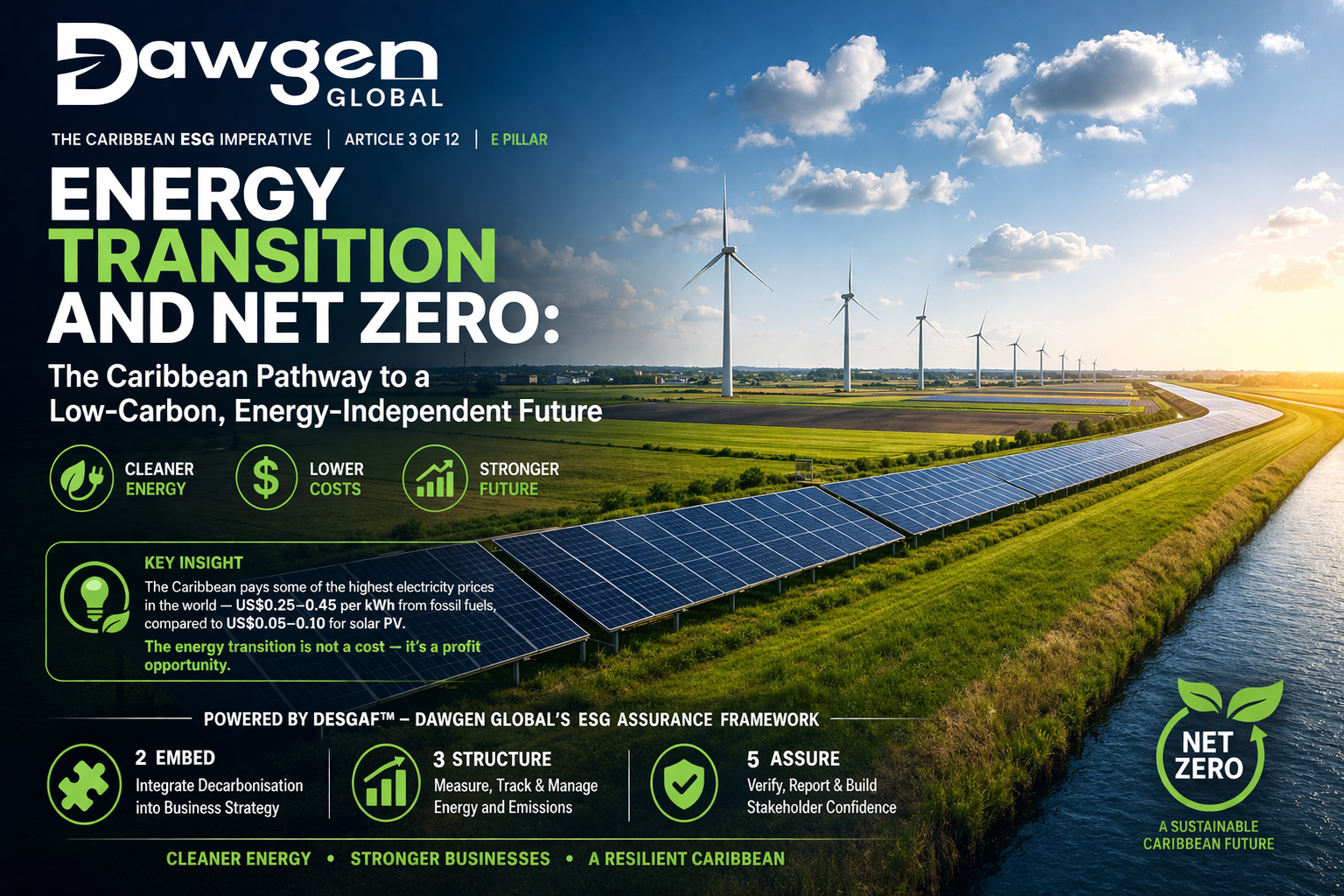
The Energy Transition Is the Caribbean’s Greatest ESG Opportunity
The Caribbean has a relationship with energy that is simultaneously one of its greatest economic vulnerabilities and one of its most compelling strategic opportunities. For decades, Caribbean economies have been among the most fossil fuel-dependent in the world — importing petroleum products at prices that consume a disproportionate share of foreign exchange, powering their grids with diesel generation at electricity costs that are among the highest globally, and building their economies on an energy foundation that is volatile, expensive, and increasingly at odds with the global direction of travel.
The energy transition — the global shift from fossil fuels to renewable energy — is changing this equation for the Caribbean in ways that are fundamentally different from the experience of larger, fossil-fuel-producing economies. For the Caribbean, decarbonisation is not a sacrifice. It is an economic liberation. The Caribbean sits beneath some of the most intense and consistent solar irradiance on earth. Its trade winds blow with a reliability that wind energy developers envy. Its volcanic Eastern Caribbean islands sit above geothermal resources sufficient to power entire island nations. And the cost of the technology needed to harness these resources — solar panels, wind turbines, battery storage — has declined by approximately 90% over the past decade and continues to fall.
This article — the third in Dawgen Global’s The Caribbean ESG Imperative series — makes the case for Caribbean energy transition leadership and provides a practical framework for Caribbean businesses to pursue it. We map the Caribbean’s renewable energy resources and their economic potential. We provide a sequenced net zero pathway for Caribbean enterprises — from baseline measurement through efficiency improvement, electrification, renewable deployment, and supply chain engagement to net zero achievement and verification. We examine the green finance instruments that make the transition financially accessible. And we connect the energy transition to DESGAF™ — showing how embedding decarbonisation into business strategy (Pillar 2), building the measurement systems that track it (Pillar 3), and assuring the disclosures that communicate it (Pillar 5) together produce a credible, investor-grade energy transition programme.
| KEY INSIGHT
The Caribbean pays some of the highest electricity prices in the world — typically US$0.25–0.45 per kWh from fossil fuel generation, compared to US$0.05–0.10 for solar PV in optimal conditions. The energy transition is not a cost for Caribbean businesses — it is a profit opportunity. Every dollar invested in solar, storage, and efficiency in the Caribbean typically generates two to five dollars in fuel and electricity savings over the asset’s life. |
The Caribbean’s Renewable Energy Endowment: What Nature Has Given Us
The Caribbean’s renewable energy potential is extraordinary — a fact that is sometimes obscured by the legacy of fossil fuel dependency and the complexity of island grid management. A comprehensive assessment of the Caribbean’s renewable resources reveals a region that could, with the right policies and investments, achieve effective energy independence from fossil fuels within the next two decades — while reducing energy costs, improving energy security, and dramatically lowering greenhouse gas emissions from the power sector. The table below maps the Caribbean’s principal renewable energy resources and their commercial potential.
| Technology | Caribbean Potential | Key Characteristics | Best Suited Territories | Economics and Trends |
| Solar PV | Exceptional — all Caribbean territories | 5–6 kWh/m²/day average solar irradiance across the Caribbean — among the highest globally; consistent year-round sunshine with minimal seasonality; rooftop and ground-mounted solar now cost-competitive with diesel generation in most Caribbean jurisdictions | All Caribbean territories; particularly strong in Jamaica, Barbados, T&T, Eastern Caribbean; suitable for commercial, industrial, and utility-scale deployment | Cost of solar PV has declined approximately 90% since 2010; levelised cost of energy (LCOE) from solar now typically US$0.05–0.10/kWh in the Caribbean — well below diesel generation at US$0.25–0.45/kWh; battery storage extending usable hours |
| Wind | Good — particularly coastal and elevated sites | Consistent trade winds across most of the Caribbean provide reliable wind resources; Eastern Caribbean islands have some of the best wind resources in the Americas; Jamaica’s mountains and southern coastal plains offer good wind sites; offshore wind emerging as a longer-term opportunity | Eastern Caribbean (Aruba, Curaçao, Barbados, St. Kitts); Jamaica highland and coastal zones; Trinidad northern range sites | Wind LCOE comparable to solar in strong resource sites; less suitable for urban commercial deployment than solar; wind-solar hybrid systems provide more consistent generation profile; important complement to solar in island grid stability |
| Geothermal | Excellent — Eastern Caribbean volcanic arc | The Eastern Caribbean volcanic arc — running from Dominica through St. Lucia, St. Vincent, Grenada, and Montserrat — has significant geothermal potential; Dominica’s geothermal project aims to make the island a net energy exporter; Nevis and St. Kitts have active development programmes | Dominica, St. Lucia, St. Kitts and Nevis, Grenada, Montserrat; not applicable in non-volcanic territories including Jamaica, Barbados, T&T | High upfront development cost but very low LCOE once operational; provides baseload power that complements intermittent solar and wind; significant energy independence potential for volcanic island nations |
| Hydroelectric | Limited — Jamaica has most potential | Jamaica has the most significant hydroelectric potential in the English-speaking Caribbean, primarily in the Blue Mountains watershed; Guyana and Suriname have major hydro potential in their interior rivers; most Eastern Caribbean islands have limited hydro potential | Jamaica (Blue Mountains); Guyana; Suriname; limited opportunities in other territories | Vulnerable to climate change — reduced rainfall in dry seasons affects generation; run-of-river small hydro less vulnerable than large reservoir systems; not a primary transition technology for most Caribbean territories |
| Battery Storage | Critical enabling technology — all territories | Battery energy storage systems (BESS) are the enabling technology for high renewable penetration on Caribbean island grids; falling battery costs (approximately 90% decline since 2010) are making BESS increasingly cost-competitive; coupled with solar PV, BESS extends renewable energy availability beyond daylight hours and supports grid stability | All Caribbean territories; particularly critical for small island grids where frequency stability is challenging at high renewable penetration | Battery costs continue declining; Tesla Megapack, BYD, and other utility-scale systems being deployed across the Caribbean; behind-the-meter storage for C&I customers reducing peak demand charges and providing backup power |
| Green Hydrogen | Emerging — longer-term opportunity | Green hydrogen — produced by electrolysis using renewable electricity — has significant long-term potential as a fuel for heavy transport, industrial processes, and energy storage; Eastern Caribbean islands with excess renewable potential could become green hydrogen exporters; Guyana exploring hydrogen alongside its oil and gas transition | Eastern Caribbean territories with surplus renewable potential; Guyana; Trinidad (leveraging existing petrochemical infrastructure for hydrogen transition) | Currently higher cost than fossil fuel alternatives but declining rapidly; long-term opportunity for Caribbean energy export diversification; significant infrastructure investment required; early-stage planning and feasibility work beginning across the region |
The economic implication of this resource abundance is profound. Caribbean businesses that invest in on-site solar, negotiate corporate PPAs with renewable developers, or participate in community solar programmes are not simply making an ESG commitment — they are locking in electricity prices that are substantially below the fossil fuel generation costs they currently pay, for periods of 15–25 years. In an environment where Caribbean electricity tariffs are subject to volatile fossil fuel price fluctuations, the price certainty of long-term renewable energy contracts is itself a significant commercial value independent of the ESG dimension.
The Economics of Caribbean Energy Transition: The Numbers Have Changed
The financial case for Caribbean energy transition has changed fundamentally over the past decade. In 2010, solar PV cost approximately US$4,000 per installed kilowatt — making it economically uncompetitive with even expensive Caribbean diesel generation. By 2024, the cost of utility-scale solar PV had fallen to approximately US$400–600 per installed kilowatt, and commercial rooftop solar to US$700–1,000 per kilowatt. Battery energy storage — which was prohibitively expensive for most commercial applications as recently as 2018 — has fallen to approximately US$300–400 per kilowatt-hour of storage capacity, enabling Caribbean businesses to store solar energy generated during the day for use in the evening and overnight.
The payback economics for a typical Caribbean commercial solar installation now look like this: A hotel in Jamaica with a peak demand of 500kW and an annual electricity bill of J$180 million (approximately US$1.2 million) at the average commercial tariff could install a 400kW rooftop solar system with 200kWh of battery storage for approximately US$600,000. The system would offset approximately 50–60% of the hotel’s electricity consumption, reducing the annual electricity bill by US$600,000–720,000. The simple payback period is approximately 10–12 months — with the system then generating net savings for the remaining 24–25 years of its operating life.
These economics apply broadly across commercial and industrial sectors in Jamaica and across most Caribbean territories. The specific numbers vary by territory (electricity tariff, solar irradiance, system sizing), but the fundamental dynamic — where the cost of generating solar electricity is a fraction of the cost of buying fossil fuel electricity from the grid — is consistent across the region. Caribbean businesses that have not yet commissioned a solar feasibility study are, in most cases, leaving significant and certain financial savings on the table.
| KEY INSIGHT
A Caribbean business that generates 1 kWh of solar electricity at a cost of US$0.07 (the approximate LCOE of commercial solar in Jamaica) and avoids buying that kWh from the grid at US$0.35 captures a US$0.28 margin on every kilowatt-hour generated. At 1,000 MWh of annual solar generation — a modest commercial installation — that margin is US$280,000 per year. The energy transition is a revenue line, not a cost line. |
The Caribbean Net Zero Pathway: A Sequenced Action Plan
Net zero — the state in which an organisation’s greenhouse gas emissions are reduced to as close to zero as technically and economically feasible, with any unavoidable residual emissions balanced by certified carbon removals — is the destination of the energy transition journey for organisations committed to aligning with the Paris Agreement’s 1.5°C pathway. For Caribbean businesses, the net zero journey is both a competitive imperative — as investors, lenders, and customers increasingly require net zero commitments — and a commercial opportunity — as the path to net zero runs through the most cost-effective energy investment any Caribbean business can make.
The table below provides a comprehensive net zero pathway for Caribbean businesses — sequenced from the immediate baseline measurement activities through the near, medium, and long-term actions that constitute a credible decarbonisation programme.
| Timeframe | Action | What It Involves | Key Frameworks | Caribbean Context |
| Near-term (1–3 years) | Measure and baseline | Conduct GHG inventory (Scope 1 and 2; material Scope 3); establish baseline year; identify largest emission sources; set interim reduction targets; complete energy audit to identify efficiency opportunities | GHG Protocol Corporate Standard; energy audit methodology; sector-specific emission factor databases; third-party verification of baseline inventory | Caribbean organisations typically find their largest Scope 1 sources are captive diesel generation and company vehicle fleets; their largest Scope 2 source is grid electricity; energy audits typically identify 15–30% energy reduction opportunities at positive ROI |
| Near-term (1–3 years) | Reduce energy intensity | Implement no-cost and low-cost energy efficiency measures: LED lighting conversion; HVAC optimisation; compressed air system efficiency; process heat recovery; building envelope improvements; employee energy awareness programmes | ISO 50001 Energy Management System; ENERGY STAR certification; local utility demand-side management programmes | Energy efficiency is the highest-return first step in any decarbonisation programme — reducing the absolute energy load before investing in renewable generation reduces the required renewable capacity and cost |
| Medium-term (3–7 years) | Electrify and switch fuel | Replace fossil fuel combustion with electrification or lower-carbon fuel alternatives: electric vehicle fleet transition; electrification of process heat where feasible; fuel switching from heavy fuel oil or diesel to natural gas as an interim step; LPG to electric cooking in food service operations | IEA EV readiness assessments; process heat electrification feasibility studies; fuel switching cost-benefit analysis | Fleet electrification is commercially attractive for Caribbean businesses with high fuel costs and suitable charging infrastructure; electric vehicles already cost-competitive on total cost of ownership in most Caribbean markets; government incentives accelerating adoption in Jamaica and several Eastern Caribbean territories |
| Medium-term (3–7 years) | Deploy on-site renewable energy | Install solar PV on owned or leased rooftops and available land; negotiate corporate Power Purchase Agreements (PPAs) with renewable energy developers for utility-scale renewable procurement; invest in battery storage to extend renewable hours and reduce grid dependency; participate in virtual PPAs where available | IFC Solar Development Toolkit; Caribbean Development Bank renewable energy financing; DBAJ and local bank green finance products; utility interconnection standards | Commercial and industrial solar PV on Caribbean rooftops typically achieves payback periods of 4–7 years with current incentives; PPAs for utility-scale solar offer long-term price certainty below current fossil fuel tariffs; battery storage adds 2–3 years to payback but provides additional resilience value |
| Medium-term (3–7 years) | Engage the supply chain | Assess Scope 3 emissions from purchased goods and services; set supplier engagement targets; preferentially procure from lower-emission suppliers; work with key suppliers to support their own emission reductions; include ESG criteria in procurement policies | CDP Supply Chain Programme; Science Based Targets initiative (SBTi) guidance on Scope 3 targets; supplier ESG assessment tools | Supply chain engagement is the hardest dimension of decarbonisation for most Caribbean businesses but is increasingly required by IFRS S2 and by the Scope 3 requirements of international customers; start with the largest spend categories and most carbon-intensive inputs |
| Long-term (7–15 years) | Eliminate residual emissions | Address remaining hard-to-abate emissions through technology improvement, process redesign, or certified carbon credits; pursue net zero — meaning near-zero gross emissions with only high-quality, permanent removals offsetting unavoidable residuals; validate net zero claims against Science Based Targets initiative (SBTi) Corporate Net Zero Standard | SBTi Corporate Net Zero Standard; Gold Standard and Verra for carbon credit quality; ICROA for carbon credit integrity; regional carbon market development | Net zero does not mean zero emissions — it means emissions reduced as far as technically and economically feasible, with high-quality removals balancing unavoidable residuals; organisations claiming net zero without interim reduction targets and credible pathways face greenwashing allegations; SBTi validation is the global credibility standard |
| Long-term (7–15 years) | Achieve and verify net zero | Obtain independent verification of net zero achievement; continue annual GHG inventory and disclosure; maintain and strengthen removal activities; engage with international net zero standards development; disclose net zero status with full methodology transparency | ISAE 3000 independent assurance; Carbon Disclosure Project (CDP) A-list rating; TCFD/IFRS S2 ongoing disclosure; CDP Science Based Targets commitment tracking | Net zero is a journey, not a destination — the most credible net zero commitments include annual progress disclosure, independent verification, and a clear methodology for how residual emissions are addressed; DESGAF™ Pillar 5 (Assure) is the mechanism for providing stakeholder confidence in net zero claims |
What a Credible Net Zero Commitment Requires
The global standard for corporate net zero commitments is the Science Based Targets initiative (SBTi) Corporate Net Zero Standard — which requires that organisations commit to: reducing Scope 1 and 2 emissions by at least 90% from a baseline year by no later than 2050; reducing value chain (Scope 3) emissions by at least 90% from the same baseline; and addressing any remaining residual emissions (up to 10% of baseline) with permanent, high-quality carbon removals. The SBTi requires that all targets be independently validated and that organisations submit near-term interim targets (to 2030) alongside long-term net zero targets.
Caribbean businesses that make net zero commitments without the interim targets, measurement systems, and credible transition plans that the SBTi requires are exposed to greenwashing allegations that can be more damaging than having no net zero commitment at all. The most commercially valuable net zero commitments are those that are specific, measurable, independently validated, and accompanied by annual progress disclosure under TCFD or IFRS S2. DESGAF™ Pillar 5 (Assure) provides the independent verification mechanism that transforms a net zero commitment from an aspiration into a credible stakeholder communication.
Energy Transition by Sector: Caribbean-Specific Guidance
Tourism and Hospitality
The tourism sector is both the largest energy consumer in most Caribbean territories and the sector most exposed to the reputational consequences of inadequate ESG performance. International tourists — particularly from Europe and North America — are increasingly environmentally aware, and the premium end of the Caribbean tourism market is explicitly selecting destinations and properties based on sustainability credentials. Caribbean hotels and resorts that invest in energy transition are not just managing ESG risk — they are building a competitive advantage that commands pricing premiums in a market segment that is growing faster than mass market tourism.
For Caribbean hotels, the energy transition pathway typically starts with a comprehensive energy audit — identifying the specific end-uses that account for the largest share of energy consumption (typically HVAC, refrigeration, lighting, and pool heating, in that order) — and progresses through LED lighting conversion, HVAC optimisation, solar hot water (which can be highly cost-effective in the Caribbean), rooftop solar PV with battery storage, and ultimately the pursuit of sustainability certification (LEED, Green Globe, or the Caribbean-specific Travelife standard) that makes the transition visible and credible to guests and operators.
Manufacturing and Agri-processing
Caribbean manufacturing and agri-processing businesses face some of the highest industrial electricity costs in the world, making energy transition particularly economically attractive. Large industrial energy users typically have the roof space, land area, and electricity consumption to justify significant solar installations — and the predictable operating profiles that make solar generation most effective. The energy transition for Caribbean manufacturers should incorporate: industrial energy audit identifying process optimisation opportunities; compressed air system efficiency (often the largest single efficiency opportunity in manufacturing); solar PV for daytime base load; power purchase agreements for 24-hour renewable supply; and — for the most energy-intensive processes — assessment of electrification pathways for process heat.
Financial Services
Caribbean banks, insurance companies, and financial institutions have a dual energy transition role: managing their own operational emissions (typically modest — primarily office energy use and business travel) and managing the financed emissions embedded in their loan and investment portfolios. Financed emissions — the Scope 3 Category 15 emissions of financial institutions — are typically orders of magnitude larger than operational emissions and are increasingly the primary climate focus for Caribbean financial institutions under TCFD and IFRS S2.
For Caribbean financial institutions, the energy transition pathway includes: measuring and disclosing operational Scope 1 and 2 emissions; developing financed emissions measurement capability using PCAF (Partnership for Carbon Accounting Financials) methodology; assessing climate-related financial risk in the loan and investment portfolio; developing green lending and investment products that channel capital toward Caribbean decarbonisation; and — for the largest institutions — developing net zero portfolio commitments aligned with the Net Zero Banking Alliance or Net Zero Asset Managers initiative.
Agriculture and Food Production
Caribbean agriculture faces the dual challenge of being both a significant contributor to GHG emissions (through land use, livestock, fertiliser application, and energy use) and one of the sectors most vulnerable to the physical consequences of climate change (drought, flooding, temperature stress, and pest and disease pressure). The energy transition for Caribbean agriculture encompasses: energy efficiency in irrigation and processing; solar-powered irrigation and refrigeration; reduction of synthetic fertiliser use through organic and precision agriculture approaches; sustainable land use management to preserve carbon stocks; and — for livestock operations — methane reduction strategies.
Agricultural energy transition is also connected to the emerging voluntary carbon market — Caribbean agricultural businesses that sequester carbon through sustainable land management, agroforestry, or soil carbon enhancement may be eligible to generate carbon credits that represent an additional revenue stream alongside the primary agricultural business. The integrity of Caribbean agricultural carbon credits depends on rigorous measurement, reporting, and verification — precisely the services that DESGAF™-aligned assurance provides.
Financing the Transition: Green Finance Instruments for Caribbean Businesses
The energy transition requires capital — capital for solar installations, battery systems, fleet electrification, building retrofits, and the measurement and reporting systems that credibly demonstrate decarbonisation progress. Caribbean businesses have access to a growing range of green finance instruments that are specifically designed to fund exactly these investments, in many cases at lower cost than conventional financing. The table below maps the principal green finance instruments available to Caribbean enterprises.
| Instrument | Type | How It Works | Key Standards / Providers | Caribbean Market |
| Green Bonds | Debt capital markets | Fixed-income instruments where proceeds are restricted to eligible green projects: renewable energy installation; energy efficiency improvements; green building; clean transportation; sustainable water management; biodiversity conservation | ICMA Green Bond Principles; CBI Climate Bonds Standard; Jamaica Stock Exchange; Eastern Caribbean Securities Exchange; IDB Invest green bond programme | Jamaica’s National Commercial Bank and Sagicor have both issued green bonds; Caribbean Development Bank has issued multiple green bonds; sovereign green bonds issued by several Caribbean governments; market growing but still nascent for private sector issuers |
| Sustainability-Linked Loans (SLLs) | Bank lending | Loans where the interest rate is linked to the borrower’s performance against pre-agreed ESG KPIs — typically including GHG emissions reduction, renewable energy percentage, and other material ESG metrics; borrower receives interest rate reduction for meeting targets and faces margin step-up for missing them | LMA/APLMA Sustainability-Linked Loan Principles; NCBJ, Scotiabank Caribbean, Republic Bank, First Citizens — all offering SLL products in the Caribbean; IFC SLL programme | Most commercially accessible green finance instrument for Caribbean businesses; no restriction on use of proceeds; KPIs must be material, ambitious, and measurable; common KPIs include: renewable energy % of total consumption; GHG emissions intensity reduction; energy intensity improvement; waste diversion rate |
| Green Project Finance | Development finance / project loans | Financing for specific green projects — typically large-scale renewable energy, energy efficiency, or sustainable infrastructure — where the loan is structured against the project cash flows; DFI co-financing common | IFC, IDB Invest, CDB, OFID, Proparco — all active in Caribbean green project finance; OPIC/DFC for US-connected projects; European Investment Bank for EU-associated territories | Most common for utility-scale renewable energy projects (10MW+); hotel green retrofit programmes; industrial energy efficiency capex; water treatment and efficiency infrastructure; project finance typically requires proven technology and off-take agreements |
| Climate Risk Insurance / Parametric Products | Insurance / risk transfer | Traditional property insurance enhanced with climate risk modelling; parametric insurance paying out against objective climate triggers (wind speed, rainfall) rather than assessed damage — faster payouts and reduced claims disputes; Caribbean Catastrophe Risk Insurance Facility (CCRIF) for governments | CCRIF SPC for government parametric coverage; Munich Re, Swiss Re, and Lloyd’s for commercial parametric products; World Bank Disaster Risk Financing and Insurance Programme | The Caribbean parametric insurance market is relatively developed at the government level; commercial parametric products for business interruption and property damage from climate events are growing; faster payout than traditional indemnity insurance is particularly valuable for business continuity in post-hurricane recovery |
| Blended Finance | DFI / concessional co-financing | Combination of concessional (below-market) DFI finance with commercial finance to improve the overall economics of green projects; concessional layer absorbs first losses or provides equity to crowd in commercial lending; common for early-stage renewable energy and green infrastructure projects | IDB Lab, IFC First Loss Guarantee, CDB, Green Climate Fund; Caribbean Climate Finance Coalition | Blended finance is particularly important for Caribbean green projects that face high transaction costs relative to project size; the Caribbean Climate Finance Coalition is working to aggregate smaller projects to access institutional capital; Dawgen Global can assist Caribbean businesses in navigating the blended finance landscape |
The Sustainability-Linked Loan: The Most Accessible Green Finance Instrument
Of all the green finance instruments available to Caribbean businesses, the sustainability-linked loan (SLL) is the most immediately accessible for the widest range of enterprise types and sizes. Unlike green bonds — which require capital market access, significant transaction costs, and a pipeline of specific green projects — an SLL is a standard commercial loan where the interest rate is linked to the borrower’s performance against ESG KPIs that are agreed with the lender at the outset.
For a Caribbean hotel, an SLL might link the interest rate margin to targets including: renewable energy as a percentage of total energy consumption (target: 40% by year 3); energy intensity per occupied room night (target: 10% reduction by year 3); and waste diversion rate (target: 60% diversion from landfill by year 3). If the hotel meets its targets at the annual assessment date, it receives a reduction in the interest margin — typically 5–15 basis points per target met. If it misses targets, the margin increases by a corresponding amount, with the step-up funds typically directed to a sustainability fund or charity.
Caribbean banks including NCB, Scotiabank Caribbean, Republic Bank, and First Citizens have all developed SLL products. The IFC has been a significant partner in Caribbean SLL market development. Caribbean businesses seeking their first green finance engagement should approach their existing banking relationship with a proposal to convert their next refinancing into a sustainability-linked structure — demonstrating the ESG performance ambition that justifies the preferential pricing.
| DESGAF™ CONNECTION — PILLARS 2, 3, AND 5
The energy transition directly engages three DESGAF™ pillars simultaneously. Pillar 2 (Embed) — integrating decarbonisation targets and renewable energy strategy into the business plan, capital allocation, and operational management systems. Pillar 3 (Structure) — building the energy monitoring, GHG measurement, and reporting systems that produce the reliable data on which transition progress is tracked and disclosed. Pillar 5 (Assure) — obtaining independent assurance over energy consumption data, GHG emissions inventories, renewable energy percentages, and net zero progress claims — the credibility signal that distinguishes genuine transition leaders from greenwashers. |
Conclusion: The Caribbean Energy Transition Is a Commercial Imperative
The Caribbean energy transition is not a sacrifice demanded by global environmental conscience. It is the most commercially compelling strategic opportunity available to Caribbean businesses in the current decade. The economics are clear: renewable energy is cheaper than fossil fuel generation in the Caribbean. The financial instruments are available: green bonds, sustainability-linked loans, and development finance all provide capital for qualifying investments. The ESG credibility is essential: investors, lenders, and customers increasingly require demonstrable transition progress. And the urgency is undeniable: the physical consequences of the carbon that Caribbean businesses — and the global economy — continue to emit are already landing on Caribbean shores with increasing force.
DESGAF™ Pillars 2 (Embed), 3 (Structure), and 5 (Assure) provide the framework through which Caribbean organisations can build transition programmes that are strategically integrated, data-supported, and independently verified. Dawgen Global’s ESG Advisory Practice provides the expert support — from energy audit and GHG baseline through net zero target setting, green finance advisory, and independent assurance — to make the Caribbean energy transition efficient, credible, and commercially rewarding.
In Article 4 — Biodiversity, Water, and Natural Capital: Caribbean Dimensions — we complete the Environmental pillar by examining the natural resources that underpin the Caribbean economy — coral reefs, marine ecosystems, freshwater systems, and terrestrial biodiversity — and the TNFD framework for natural capital disclosure that is increasingly required by international investors and regulators with Caribbean exposure.
| ACCELERATE YOUR CARIBBEAN ENERGY TRANSITION WITH DAWGEN GLOBAL
Dawgen Global’s ESG Advisory Practice supports Caribbean businesses through every stage of the energy transition and net zero journey — from energy audits and carbon footprint measurement through renewable energy strategy, net zero target setting, transition plan development, green bond framework design, and independent assurance of climate disclosures under DESGAF™. Request an ESG Advisory Proposal Today:
|
About Dawgen Global
“Embrace BIG FIRM capabilities without the big firm price at Dawgen Global, your committed partner in carving a pathway to continual progress in the vibrant Caribbean region. Our integrated, multidisciplinary approach is finely tuned to address the unique intricacies and lucrative prospects that the region has to offer. Offering a rich array of services, including audit, accounting, tax, IT, HR, risk management, and more, we facilitate smarter and more effective decisions that set the stage for unprecedented triumphs. Let’s collaborate and craft a future where every decision is a steppingstone to greater success. Reach out to explore a partnership that promises not just growth but a future beaming with opportunities and achievements.
 Email: [email protected]
  Visit: Dawgen Global Website

 WhatsApp Global Number : +1 555-795-9071
Caribbean Office: +1876-6655926 / 876-9293670/876-9265210  WhatsApp Global: +1 5557959071
USA Office: 855-354-2447
Join hands with Dawgen Global. Together, let’s venture into a future brimming with opportunities and achievements


