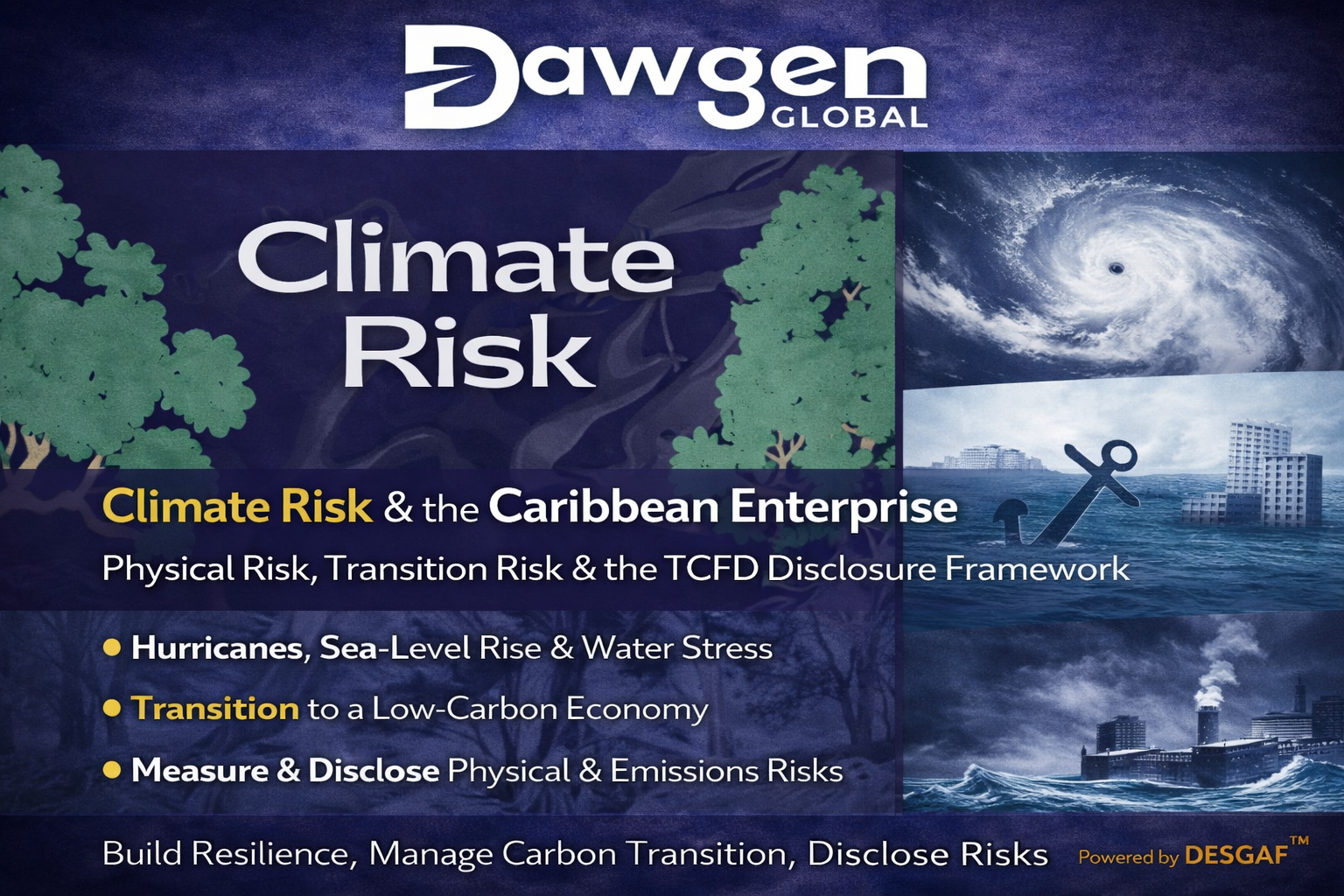
The Caribbean Is at the Frontline of Climate Risk
No region on earth carries a heavier climate risk burden relative to its economic size than the Caribbean. The annual hurricane season — which intensifies with each degree of ocean warming — brings existential risk to infrastructure, agriculture, and tourism assets that took decades to build and represent a disproportionate share of regional GDP. Sea levels are rising at rates that threaten the long-term viability of coastal hotels, ports, and communities. Freshwater stress is increasing across the region, threatening agricultural productivity and the water security of Caribbean populations. And coral reefs — the foundation of Caribbean marine ecosystems, the engine of Caribbean fisheries, and the first line of coastal protection for Caribbean shorelines — are bleaching and dying at rates that were unimaginable a generation ago.
For Caribbean businesses, climate risk is not a long-term scenario planning exercise. It is a present operational reality that already affects insurance costs, asset valuations, supply chain reliability, and business continuity. A hotel group that loses its beach to erosion, a sugar estate that loses a crop to drought, a manufacturer that loses a month of production to post-hurricane infrastructure failure, a bank whose loan portfolio is concentrated in vulnerable coastal real estate — these are not hypothetical climate futures. They are the experiences of Caribbean businesses operating today, in a climate that is already measurably warmer and more volatile than the climate of two decades ago.
This article — the second in Dawgen Global’s The Caribbean ESG Imperative series — provides Caribbean business leaders with a comprehensive guide to climate risk and its disclosure. We examine the TCFD framework — the globally accepted standard for climate risk disclosure that is being incorporated into IFRS S2 and into national regulatory requirements across the Caribbean’s trading partner jurisdictions. We map the physical climate risks most material to Caribbean enterprises sector by sector. We examine the transition risks and opportunities arising from the global shift to a low-carbon economy. We explain the GHG emissions measurement framework — Scope 1, 2, and 3 — that underpins climate disclosure. And we provide a practical pathway for Caribbean organisations beginning or strengthening their climate risk management and disclosure programmes.
| KEY INSIGHT
The Caribbean faces average annual losses from natural disasters equivalent to 2–3% of GDP — a figure that is already the highest of any region globally and that will increase with every degree of additional warming. For Caribbean businesses, climate risk is not a distant ESG consideration — it is the single most material non-financial risk they face, and the one that most directly threatens their ability to create long-term value. |
The TCFD Framework: The Global Standard for Climate Risk Disclosure
The Task Force on Climate-related Financial Disclosures (TCFD) — established by the Financial Stability Board in 2015 and chaired by Michael Bloomberg — developed the framework that has become the global standard for climate risk disclosure. TCFD’s recommendations, published in 2017 and progressively adopted since, are now incorporated into IFRS S2 (Climate-related Disclosures), which the International Sustainability Standards Board (ISSB) has designated as the international standard for climate disclosure. They are also referenced in the EU’s Corporate Sustainability Reporting Directive (CSRD), the SEC’s climate disclosure rules, and the BOJ’s emerging climate-related financial risk supervisory framework for Jamaican financial institutions.
TCFD organises climate risk disclosure around four interconnected pillars: Governance, Strategy, Risk Management, and Metrics and Targets. These four pillars are designed to work together as a coherent system — an organisation that has strong climate governance but no climate strategy, or that sets emissions targets but has no risk management process for climate risk, is not in compliance with TCFD. The framework requires that all four pillars be addressed, and that they be addressed in an integrated way that demonstrates how climate considerations are embedded into the organisation’s actual decision-making rather than siloed in a separate sustainability function. The table below provides a comprehensive reference to the four TCFD pillars, their disclosure requirements, and the specific implementation considerations for Caribbean organisations.
| TCFD Pillar | What It Covers | Key Disclosure Requirements | Caribbean Implementation Note |
| Governance | Board and management oversight of climate-related risks and opportunities | Board oversight of climate risk: Does the board understand climate risk? Is there a board-level committee or designated director responsible? How frequently does the board receive climate risk updates? Management roles: Who in management is responsible for assessing and managing climate risk? What processes exist for escalating material climate developments to the board? | Most Caribbean boards have not yet formally addressed climate risk governance. The first step is a board resolution acknowledging climate risk as a material risk category and assigning oversight responsibility — whether to the full board, audit committee, or a dedicated ESG/risk committee. |
| Strategy | Actual and potential climate impacts on the organisation’s businesses, strategy, and financial planning | Short, medium, and long-term climate risks and opportunities identified. How climate considerations are integrated into strategic planning and capital allocation. Resilience of the organisation’s strategy under different climate scenarios (well below 2°C; 4°C+ warming). Scenario analysis demonstrating how different climate pathways affect the organisation’s financial position. | This is the hardest TCFD pillar to implement. Scenario analysis requires modelling the organisation’s exposure to multiple climate pathways — involving specialist expertise that most Caribbean organisations will need to procure. DESGAF™ provides the methodology framework; implementation requires partnership with climate risk specialists. |
| Risk Management | How the organisation identifies, assesses, and manages climate-related risks | Processes for identifying climate-related risks: How does the organisation identify physical and transition climate risks across its operations and value chain? Integration with enterprise risk management: Are climate risks integrated into the organisation’s overall risk register and risk appetite framework? Risk prioritisation: How does the organisation determine which climate risks are material and prioritise management responses? | Caribbean organisations that have not yet integrated climate risk into their enterprise risk management framework should treat this as an immediate priority — particularly for sectors with high physical climate exposure (tourism, agriculture, coastal infrastructure, financial services). |
| Metrics and Targets | Metrics and targets used to assess and manage climate-related risks and opportunities | GHG emissions: Scope 1 (direct), Scope 2 (purchased energy), and — for organisations with significant supply chains — Scope 3 (value chain) greenhouse gas emissions. Climate-related targets: Net zero commitment (if any) and interim targets; renewable energy targets; energy intensity improvement targets. Transition plan: How does the organisation plan to achieve its climate targets over time? | GHG emissions measurement is the most technically demanding aspect of climate disclosure for most Caribbean organisations. Measurement methodology (GHG Protocol, ISO 14064), boundary setting, and data collection systems all require investment. Start with Scope 1 and 2 — the most directly measurable — before attempting Scope 3. |
TCFD and IFRS S2: The Convergence
IFRS S2 Climate-related Disclosures — issued by the ISSB in June 2023 — builds directly on the TCFD framework and is expected to be adopted by standard-setters across the Caribbean and its trading partner jurisdictions. IFRS S2 requires disclosure of climate-related risks and opportunities using the same four-pillar structure as TCFD, with additional specificity on industry-based metrics using the SASB standards, cross-industry climate metrics, and the GHG emissions measurement requirements.
Caribbean organisations that align their climate disclosure with TCFD today are simultaneously building the foundation for IFRS S2 compliance as it becomes mandatory. The investment in TCFD-aligned climate governance, risk management, and measurement is not duplicated when IFRS S2 arrives — it is the prerequisite. Caribbean boards and CFOs who understand this convergence will treat TCFD implementation as an investment in regulatory compliance readiness, not just an ESG commitment.
Physical Climate Risk: The Caribbean’s Most Immediate Exposure
Physical climate risks are the direct financial consequences of climate change — the damage to assets, disruption to operations, and loss of revenue caused by acute weather events and by the chronic shifts in climate patterns that are already underway. For Caribbean businesses, physical climate risk is the most immediate and most material climate risk category — more urgent than transition risk in most sectors, and already producing measurable financial consequences across the region.
Physical risks divide into two categories: acute risks — specific climate-related events such as hurricanes, floods, and extreme heat episodes — and chronic risks — longer-term shifts in climate patterns such as sea-level rise, increasing average temperatures, changing rainfall patterns, and progressive ecosystem degradation. Caribbean businesses face significant exposures in both categories, and the interaction between acute and chronic risks — a more intense hurricane striking a coast already weakened by sea-level rise and reef degradation, for example — amplifies the total physical risk exposure beyond what either category would represent in isolation. The table below maps the principal physical climate risks facing Caribbean businesses, their severity, how they manifest, the sectors most exposed, and the management responses available.
| Physical Risk | Severity (Caribbean) | How It Manifests | Most Exposed Sectors | Management Responses |
| Acute — Tropical Cyclones | Extreme — all Caribbean territories | Intensifying hurricane frequency and intensity driven by warming sea surface temperatures; Category 4-5 storms causing catastrophic infrastructure damage; storm surge threatening coastal assets; wind damage to agricultural production; supply chain disruption from port and road damage | Tourism and hospitality; agriculture and agri-processing; coastal real estate and infrastructure; manufacturing; ports and logistics; insurance and financial services | Business continuity planning; structural hardening of critical assets; supply chain diversification; parametric insurance; generator and water backup capacity; evacuation and emergency protocols |
| Acute — Flooding and Extreme Rainfall | High — particularly Jamaica, Trinidad, Guyana | Increased frequency of extreme rainfall events causing flash flooding; agricultural crop losses; infrastructure damage; groundwater contamination; displacement of communities near flood-prone areas; health system stress from waterborne disease | Agriculture; real estate development in flood-prone zones; utilities and water services; healthcare; construction | Drainage infrastructure investment; flood risk mapping in site selection; elevated construction standards; crop diversification; early warning systems integration |
| Chronic — Sea Level Rise | High — coastal territories; critical for low-lying islands | Progressive inundation of coastal land; saline intrusion into freshwater aquifers; accelerated coastal erosion; increased storm surge height at equivalent wind speeds; permanent loss of beach and coastal assets; threat to coastal infrastructure including hotels, ports, and roads | Coastal tourism and hospitality; coastal agriculture; ports and shipping; coastal real estate; water utilities | Long-term coastal asset reassessment; managed retreat planning for highest-risk assets; investment in coastal protection infrastructure; fresh water system resilience; property valuation adjustment for long-term flood risk |
| Chronic — Increased Temperature and Heat Stress | Medium-High — affecting productivity and health | Rising average temperatures reducing outdoor worker productivity; heat stress affecting agricultural yields and timing; increased cooling energy costs; reduced air quality; vector-borne disease expansion (dengue, malaria) into previously unaffected areas; coral reef bleaching accelerating ecosystem degradation | Agriculture and agri-processing; outdoor construction and infrastructure; tourism (heat affecting visitor experience); financial services (health insurance costs) | Heat adaptation in workplace design; agricultural variety switching and timing adjustment; cooling system investment; public health investment; vector control programmes; reef monitoring and protection |
| Chronic — Water Stress and Drought | High — particularly Eastern Caribbean, Jamaica dry periods | Reduced freshwater availability from reduced rainfall and aquifer depletion; agricultural irrigation stress; manufacturing process water constraints; tourism resort water supply vulnerability; hydroelectric generation reduction; drinking water security | Agriculture; food and beverage manufacturing; tourism; energy (hydro); water utilities | Water efficiency investment; rainwater harvesting and storage; desalination capacity; drought-resistant crop varieties; water pricing that reflects scarcity; conservation programmes |
| Chronic — Biodiversity and Ecosystem Degradation | High — Caribbean is a global biodiversity hotspot | Coral reef bleaching and death reducing fisheries productivity and coastal protection; mangrove loss accelerating storm surge damage; forest loss reducing watershed protection and carbon sequestration; fisheries stock depletion from temperature and acidification | Tourism (reef-based); fishing and aquaculture; agriculture (pollinator dependency); coastal real estate; carbon markets | Marine protected area investment; reef restoration programmes; mangrove conservation and restoration; sustainable fisheries certification; TNFD-aligned biodiversity monitoring and reporting |
Quantifying Physical Risk: The Role of Climate Scenario Analysis
TCFD requires that organisations assess the resilience of their strategy and business model under different climate scenarios — at minimum a scenario consistent with a 2°C or lower warming pathway and a scenario consistent with higher warming (4°C or above). For Caribbean organisations, scenario analysis is not an abstract modelling exercise — it is a practical tool for understanding how much more exposed their assets and operations will become under different warming trajectories, and for making informed investment decisions about physical risk mitigation.
A Caribbean hotel group conducting physical risk scenario analysis might model: the probability and intensity of Category 4-5 hurricane strikes to its properties under 1.5°C, 2°C, and 4°C warming scenarios; the sea-level rise exposure of its beachfront assets over 20, 50, and 100 year horizons; the impact of reef degradation on beach width and coastal protection; and the effect of increased temperature on guest comfort and energy costs. This analysis directly informs capital allocation decisions — which properties to invest in, which to divest, where to build new capacity, and how much to spend on hardening existing assets.
Few Caribbean organisations currently conduct formal climate scenario analysis at this level of rigour. DESGAF™ provides the governance framework within which scenario analysis should be conducted; the actual analysis typically requires partnership with climate risk specialists who have access to the regional climate models and the technical capability to translate physical climate projections into business-relevant financial impacts.
| KEY INSIGHT
A 1°C increase in sea surface temperature is associated with a roughly 5% increase in the maximum wind speed of Atlantic hurricanes. The Caribbean is already experiencing ocean temperatures approximately 1°C above the pre-industrial baseline — meaning that the most intense hurricanes Caribbean businesses will experience over the next 30 years are meaningfully more destructive than the most intense storms of the past 30 years. This is not a projection — it is physics. |
Transition Risk and Opportunity: The Low-Carbon Economy Arrives in the Caribbean
Transition risks are the financial consequences of the global shift toward a low-carbon economy — the policy, legal, technological, and market changes that accompany the decarbonisation of global economic activity. For Caribbean businesses, transition risks are generally less immediately material than physical risks — the Caribbean’s own carbon pricing and regulatory transition is nascent — but the transition risks arising from the international context in which Caribbean businesses operate are real and growing: EU carbon border adjustments affecting Caribbean exports, ESG requirements from international lenders and investors, and customer sustainability requirements from multinational supply chain partners.
Crucially, the transition also creates significant opportunities for Caribbean businesses — particularly in renewable energy, sustainable tourism, and green finance — that are as material as the risks it presents. The table below maps both the transition risks and the transition opportunities most relevant to Caribbean enterprises.
| Transition Risk / Opportunity | Caribbean Urgency | How It Manifests | Most Exposed Sectors | Strategic Response |
| Policy and Legal — Carbon pricing | Medium — approaching | Introduction of carbon taxes or emissions trading schemes in Caribbean jurisdictions or in trade partner markets; EU Carbon Border Adjustment Mechanism (CBAM) imposing carbon costs on exports from high-emission producers; potential Jamaican carbon pricing mechanism under NDC commitments | Energy-intensive manufacturing; cement, steel, and construction materials; agriculture with high fertiliser and machinery emissions; fossil fuel-dependent transportation | GHG emissions measurement and reduction planning; fuel switching; energy efficiency investment; engagement with regional carbon pricing policy development |
| Policy and Legal — Disclosure mandates | Medium-High — accelerating | Mandatory ESG and climate disclosure requirements being introduced in Caribbean financial regulators’ supervisory frameworks; IFRS S1/S2 adoption by Caribbean standard-setters; listing requirements on Caribbean stock exchanges evolving to include climate disclosure; international standards applying to Caribbean subsidiaries of multinationals | All listed companies; financial institutions; large private sector enterprises with international investors or lenders | TCFD-aligned disclosure programme development; DESGAF™ implementation; data systems investment; board and management capacity building on climate disclosure |
| Technology — Fossil fuel stranding | High — long-term but structurally significant | Caribbean islands with significant fossil fuel generation face stranded asset risk as renewable energy costs continue to decline; diesel generators and heavy fuel oil plants face accelerating obsolescence; fossil fuel import dependency creates balance of payments vulnerability as global transition accelerates | Energy utilities; heavy manufacturing with captive generation; islands with significant fossil fuel infrastructure | Renewable energy transition planning; participation in regional energy sector reform; on-site solar and storage investment; power purchase agreement negotiation with renewable providers |
| Technology — Renewable energy opportunity | High — Caribbean’s strongest transition opportunity | Rapidly declining solar, wind, and battery storage costs creating compelling economics for Caribbean renewable energy transition; Caribbean Development Bank and IDB financing renewable energy projects across the region; green hydrogen potential for Eastern Caribbean territories with surplus renewable potential | Energy utilities; commercial and industrial energy users; financial sector financing clean energy; technology and construction sectors | Renewable energy feasibility studies; solar PPA engagement; green bond issuance for qualifying projects; participation in regional green energy markets |
| Market — Customer ESG requirements | High and growing — sector-specific | Multinational customers requiring ESG certification and climate disclosure from Caribbean suppliers as a condition of procurement; tourism operators and travel companies applying sustainability criteria to destination and property selection; export food and beverage customers requiring sustainability certification (Rainforest Alliance, Fairtrade, organic) | Agri-export; food and beverage manufacturing; tourism; garment and apparel; professional services to multinationals | Sustainability certification pursuit; supply chain ESG audit preparation; customer ESG requirement monitoring and proactive engagement; DESGAF™ programme as supplier credential |
| Market — ESG-linked financing premium | High — immediate opportunity for qualifying issuers | Green bonds, sustainability-linked loans, and ESG-linked capital markets instruments offering materially lower financing costs to qualifying Caribbean issuers; Caribbean Development Bank, IDB Invest, IFC, and regional commercial banks all offering ESG-linked products; sustainability-linked bonds indexed to specific ESG targets | Large capital-intensive businesses (utilities, infrastructure, hospitality); financial institutions; real estate developers; agri-businesses | ESG programme and disclosure investment as prerequisite for ESG-linked financing; green bond framework development; sustainability-linked loan KPI identification and tracking; investor relations ESG capability building |
| Reputation — Greenwashing risk | Growing — as ESG scrutiny intensifies | Stakeholder, media, and regulatory scrutiny of unsubstantiated ESG claims is intensifying globally and reaching the Caribbean; organisations that make climate commitments without the governance, measurement systems, and action to support them face reputational damage from greenwashing allegations; independent assurance is the most effective protection | All organisations making public ESG or sustainability claims | DESGAF™ as the framework for substantiated ESG programmes; independent assurance (ISAE 3000) over ESG disclosures; conservative and specific rather than aspirational and broad ESG claims; third-party verification of key metrics before public disclosure |
The EU Carbon Border Adjustment Mechanism: A Caribbean Trade Risk
One transition risk deserves specific attention from Caribbean exporters: the EU Carbon Border Adjustment Mechanism (CBAM), which entered its transitional phase in October 2023 and will become fully operational from January 2026. CBAM imposes a carbon cost on imports into the EU of carbon-intensive goods — initially covering cement, steel, aluminium, fertilisers, electricity, and hydrogen — based on the embedded carbon emissions in the production process.
Caribbean exporters of affected goods to the EU will face CBAM costs proportional to the carbon intensity of their production processes. Companies with lower-emission production — whether from energy efficiency, renewable energy use, or process improvement — will face lower CBAM costs and a competitive advantage over higher-emission competitors. The CBAM creates a direct financial incentive for Caribbean manufacturers in affected sectors to measure and reduce their Scope 1 and 2 emissions — and to document those reductions with verifiable data that can be submitted to EU customs authorities.
Measuring Your Carbon Footprint: The Scope 1, 2, and 3 Framework
The foundation of credible climate disclosure is accurate measurement of greenhouse gas (GHG) emissions — the quantification of the organisation’s contribution to climate change through its direct and indirect emissions. The GHG Protocol Corporate Accounting and Reporting Standard — developed by the World Resources Institute and the World Business Council for Sustainable Development — provides the globally accepted methodology for GHG emissions measurement and is the basis for the emissions disclosure requirements in TCFD and IFRS S2.
GHG emissions are measured in metric tonnes of carbon dioxide equivalent (tCO₂e) — a common unit that converts all greenhouse gases (CO₂, methane, nitrous oxide, and others) to their CO₂ warming equivalent over a 100-year period. Emissions are organised into three scopes — Scope 1, Scope 2, and Scope 3 — based on whether they arise from the organisation’s own activities, from purchased energy, or from the broader value chain. The table below explains each scope, its disclosure priority, and the specific measurement considerations for Caribbean organisations.
| Emissions Scope | Disclosure Priority | What It Covers | Caribbean Examples | Data Sources |
| Scope 1 — Direct emissions | Mandatory for credible disclosure | Emissions from sources owned or controlled by the organisation: fuel combustion in owned boilers, furnaces, generators, and vehicles; process emissions from manufacturing; refrigerant leaks from owned cooling equipment | Owned or leased generators; company vehicle fleet; owned boilers and furnaces; manufacturing processes; refrigeration and air conditioning systems | Fuel consumption records; refrigerant purchase records; process data; GHG Protocol Corporate Standard; emission factors from IPCC or local electricity grid providers |
| Scope 2 — Indirect energy emissions | Mandatory for credible disclosure | Emissions from the generation of purchased electricity, heat, steam, or cooling consumed by the organisation; the Caribbean’s high dependence on fossil fuel electricity generation makes this category particularly significant | Electricity purchased from the national grid; purchased steam or heat; district cooling | Electricity bills; grid emission factor from national utility or IEA; location-based vs market-based method — both should be reported where possible; renewable energy certificates (RECs) reduce market-based Scope 2 |
| Scope 3 — Value chain emissions (15 categories) | Increasingly required — start with material categories | All other indirect emissions occurring in the organisation’s value chain: upstream (purchased goods and services, capital goods, fuel and energy upstream, waste, business travel, employee commuting) and downstream (use of sold products, end-of-life treatment, investments, leased assets) | Purchased goods and services (Category 1); employee business travel (Category 6); use of sold products (Category 11) — most significant for Caribbean consumer product companies; investments (Category 15) — most significant for financial institutions | Scope 3 requires supply chain data — start with spend-based estimation for Categories 1-3; primary data collection for Categories 6 and 11; engagement with major suppliers for upstream emissions data; GHG Protocol Scope 3 Standard |
The Caribbean GHG Measurement Challenge
GHG emissions measurement in the Caribbean faces specific practical challenges that organisations must address in building credible disclosure programmes. The most significant is the quality of national electricity grid emission factors — the conversion factor that translates electricity consumption into GHG emissions. Caribbean grid emission factors are generally higher than those of countries with more renewable energy in their grid mix, and they vary significantly across territories. Organisations should use the most current emission factor available from the national utility or the International Energy Agency — and should document the source and vintage of the factor used.
A second Caribbean-specific challenge is the prevalence of captive diesel generation — common across the region due to unreliable grid supply. Captive generators are a Scope 1 emission source, not a Scope 2 source, and their emissions are often overlooked in first-generation carbon footprint assessments. Any organisation with on-site generation must include generator fuel consumption in its Scope 1 emissions inventory. The fuel consumption data is typically available from procurement records — making this one of the more straightforward elements of Scope 1 measurement.
Building Climate Governance: Where Caribbean Boards Must Start
The TCFD Governance pillar requires that boards demonstrate active oversight of climate-related risks and opportunities — not just awareness that climate change exists, but genuine engagement with climate risk as a material business risk that the board monitors, discusses, and incorporates into strategic decision-making. For most Caribbean boards, this represents a significant shift from current practice.
The minimum climate governance elements that Caribbean boards should put in place to meet TCFD Governance requirements are:
- A formal board resolution acknowledging climate change as a material risk category for the organisation — establishing the board’s accountability for climate risk oversight.
- Designated board-level responsibility for climate risk oversight — whether through the full board, the audit and risk committee, or a dedicated ESG/sustainability committee.
- A regular (at minimum annual) board review of the organisation’s material climate risks, transition opportunities, and progress against climate targets — with management reporting against agreed metrics.
- Integration of climate risk into the organisation’s enterprise risk management framework — with climate risks rated on the same likelihood/impact matrix as financial, operational, and reputational risks.
- Management-level ownership of climate risk assessment and reporting — a named executive responsible for climate risk management who reports to the board on climate matters.
- A climate risk training programme for board members — ensuring that directors have sufficient climate literacy to exercise genuine oversight, ask informed questions, and challenge management positions.
Caribbean organisations that build these governance foundations are not just meeting a TCFD requirement — they are building the capacity to make better strategic decisions. Climate risk-aware boards allocate capital more effectively, manage insurance costs more proactively, and make infrastructure investment decisions that are resilient across multiple climate scenarios rather than optimised for a climate that no longer exists.
| DESGAF™ CONNECTION — PILLAR 1: DEFINE
Climate risk governance directly builds DESGAF™ Pillar 1 (Define) — the foundation of the entire ESG assurance framework. A board that has formally acknowledged climate risk, assigned oversight responsibility, and integrated climate considerations into strategic planning has completed the most critical step in the DESGAF™ Define pillar. Without this foundation, climate reporting and assurance are built on sand — producing disclosures that lack the governance credibility that investors and assurers require. |
A Practical Climate Risk Action Plan for Caribbean Businesses
The following action plan provides Caribbean organisations with a sequenced pathway from climate risk awareness to TCFD-aligned climate disclosure — calibrated to the practical constraints and opportunities of the Caribbean business environment.
- Step 1 — Board commitment: Pass a board resolution acknowledging climate risk as a material business risk; assign oversight responsibility; include climate risk in the next board risk review agenda.
- Step 2 — Materiality assessment: Conduct a climate risk materiality assessment — identifying which physical and transition risks are most material for your sector, geography, and business model; prioritise the risks that warrant management attention and disclosure.
- Step 3 — GHG emissions inventory: Measure your Scope 1 and Scope 2 GHG emissions using the GHG Protocol methodology; document emission factors used; establish a baseline year for tracking progress; commission external verification of the inventory.
- Step 4 — Physical risk assessment: Map your key assets against climate physical risk projections for your territory; identify highest-risk assets; assess current resilience measures; identify gap between current resilience and projected future risk.
- Step 5 — Climate scenario analysis: Commission a climate scenario analysis using at least two scenarios (below 2°C and 4°C+); understand how each scenario affects your assets, revenue, and cost base; use the analysis to inform capital allocation and strategic planning.
- Step 6 — Target setting: Set climate targets appropriate to your sector and starting position — energy intensity reduction; renewable energy percentage; absolute GHG emissions reduction; net zero commitment with interim milestones.
- Step 7 — TCFD disclosure: Prepare your first TCFD-aligned climate disclosure — addressing all four pillars (Governance, Strategy, Risk Management, Metrics and Targets); integrate into your annual report or produce a standalone climate report.
- Step 8 — Independent assurance: Obtain independent assurance over your climate disclosure under ISAE 3000 — starting with limited assurance over key metrics and governance statements; build toward reasonable assurance as data systems mature.
| THE COST OF CLIMATE RISK INACTION FOR CARIBBEAN BUSINESSES
A Caribbean business that does not assess its physical climate risk is making capital allocation decisions on the basis of a climate that no longer exists. A coastal hotel that does not model sea-level rise is investing in assets whose long-term value is not what the current valuation suggests. A manufacturer that does not measure its GHG emissions cannot access the ESG-linked financing that its competitors are already using to fund expansion at lower cost. The cost of climate risk inaction is not hypothetical — it is the accumulated consequence of decisions made today on the basis of outdated climate assumptions. |
Conclusion: Climate Risk Is Business Risk — Manage It Accordingly
Climate risk is the most material non-financial risk facing Caribbean businesses today. It is also the ESG topic where the gap between current Caribbean business practice and international best practice is widest — and where the opportunity for differentiation and competitive advantage is therefore greatest for Caribbean businesses willing to lead. TCFD-aligned climate risk disclosure is not a compliance burden that Caribbean businesses should reluctantly approach. It is a framework for better business decisions — for understanding the true risk profile of existing assets, for allocating capital to resilient investments, and for positioning the organisation as a credible partner to international investors, lenders, and customers who are increasingly using climate disclosure as a proxy for management quality.
DESGAF™ Pillars 1 (Define) and 4 (Generate) provide the governance and reporting framework through which Caribbean organisations can build and disclose credible climate risk positions. Dawgen Global’s ESG Advisory Practice provides the expert support — from materiality assessment and GHG measurement through scenario analysis, disclosure design, and independent assurance — to make that journey efficient, credible, and commercially valuable.
In Article 3 — Energy Transition and Net Zero: The Caribbean Pathway to a Low-Carbon Future — we move from the risk dimension of the E pillar to the opportunity dimension: the energy transition that is transforming Caribbean power economics, the net zero strategies available to Caribbean businesses, and the practical steps toward decarbonising Caribbean operations in ways that are both financially advantageous and credibly disclosed.
| ASSESS AND DISCLOSE YOUR CLIMATE RISK WITH CONFIDENCE
Dawgen Global’s ESG Advisory Practice provides TCFD-aligned climate risk assessments, physical and transition risk analysis, scenario planning, climate disclosure design, and independent assurance over climate-related disclosures — all grounded in DESGAF™ and calibrated for the Caribbean context. Whether you are making your first climate disclosure or strengthening an existing programme, our team provides the expertise Caribbean enterprises require. Request an ESG Advisory Proposal Today:
|
About Dawgen Global
“Embrace BIG FIRM capabilities without the big firm price at Dawgen Global, your committed partner in carving a pathway to continual progress in the vibrant Caribbean region. Our integrated, multidisciplinary approach is finely tuned to address the unique intricacies and lucrative prospects that the region has to offer. Offering a rich array of services, including audit, accounting, tax, IT, HR, risk management, and more, we facilitate smarter and more effective decisions that set the stage for unprecedented triumphs. Let’s collaborate and craft a future where every decision is a steppingstone to greater success. Reach out to explore a partnership that promises not just growth but a future beaming with opportunities and achievements.
 Email: [email protected]
  Visit: Dawgen Global Website

 WhatsApp Global Number : +1 555-795-9071
Caribbean Office: +1876-6655926 / 876-9293670/876-9265210  WhatsApp Global: +1 5557959071
USA Office: 855-354-2447
Join hands with Dawgen Global. Together, let’s venture into a future brimming with opportunities and achievements


