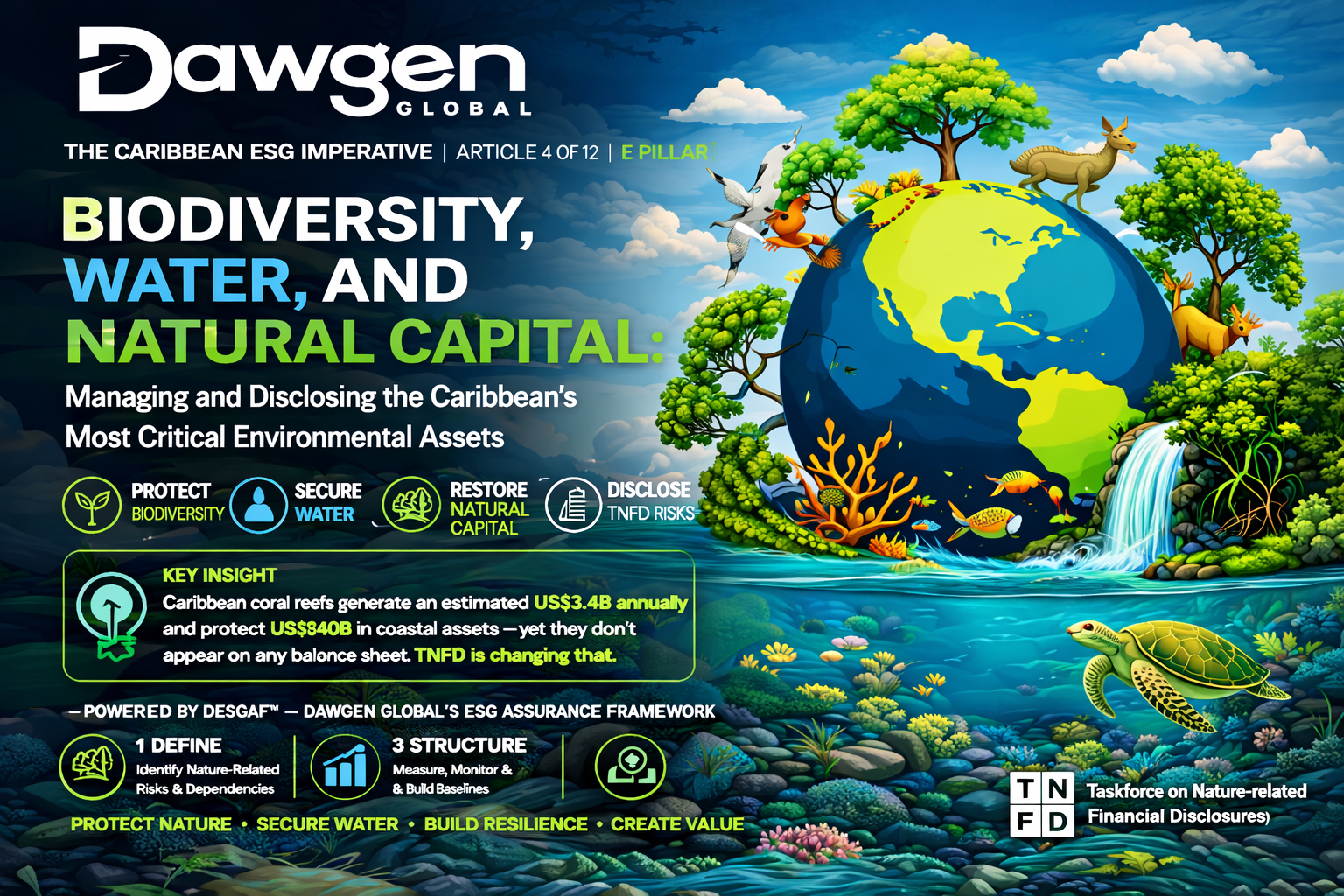
The Caribbean Economy Is Built on Natural Capital
Every Caribbean business operates within — and depends upon — a natural system. The hotel on the beachfront depends on a healthy reef to attract guests, attenuate storm surge, and maintain the beach width that makes the property attractive. The agricultural enterprise depends on rainfall patterns, soil health, and pollinator populations to produce its crop. The food and beverage manufacturer depends on freshwater supply from watersheds maintained by forests. The fishing company depends on the marine ecosystem integrity that determines where fish live and breed. The insurance company depends on the functioning of the natural systems that, when degraded, amplify the storm surge, flooding, and drought losses it is called upon to pay.
Natural capital — the stock of natural assets (ecosystems, species, minerals, water, air, and soil) and the flow of ecosystem services they provide — is the ultimate foundation of the Caribbean economy. Yet natural capital has historically been invisible in financial accounting, treated as a free good that businesses can draw upon without cost or consequence. That invisibility is ending. The Taskforce on Nature-related Financial Disclosures (TNFD) — whose final recommendations were published in September 2023 — provides a framework for assessing, managing, and disclosing nature-related risks and opportunities that mirrors the TCFD framework for climate. Investors and lenders with Caribbean exposure are beginning to ask nature risk questions with the same seriousness they now apply to climate questions.
This article — the fourth in Dawgen Global’s The Caribbean ESG Imperative series — completes the Environmental pillar by examining biodiversity, water, and natural capital. We map the Caribbean’s principal natural capital assets and their economic significance. We introduce the TNFD framework and the LEAP assessment methodology. We provide a comprehensive water stewardship guide for Caribbean businesses. We examine the emerging voluntary carbon and nature markets that create new revenue streams for Caribbean organisations that invest in ecosystem protection. And we connect natural capital management to DESGAF™ — showing how defining nature-related materiality (Pillar 1), building measurement systems (Pillar 3), and generating credible disclosures (Pillar 4) together produce a robust natural capital programme.
| KEY INSIGHT
The Caribbean’s coral reefs provide an estimated US$3.4 billion annually in economic value from tourism and fisheries — and protect an estimated US$140 billion in coastal assets from storm surge. Yet they appear nowhere in the financial statements of the tourism operators, fishing companies, coastal developers, and insurers that depend on them. TNFD is beginning to change this — making natural capital dependencies visible in investor analysis and corporate disclosure in ways that will reshape how Caribbean businesses understand and manage their relationship with the natural world. |
The Caribbean’s Natural Capital Asset Base: What We Are Protecting
The Caribbean’s natural capital portfolio is extraordinary in its diversity, ecological significance, and economic importance — and deeply threatened by a combination of climate change, over-exploitation, pollution, and coastal development. Understanding the specific natural capital assets most relevant to Caribbean businesses is the starting point for any credible nature-related risk assessment. The table below maps the six most economically significant natural capital assets in the Caribbean, the ecosystem services they provide, their economic value, their threat status, and the sectors most dependent on their continued health.
| Natural Capital Asset | Ecosystem Services Provided | Economic Value and Significance | Threat Status | Dependent Sectors |
| Coral Reefs | Coastal protection; fisheries habitat; tourism attraction; shoreline stabilisation; pharmaceutical discovery | The Caribbean contains approximately 9% of the world’s coral reefs — estimated to provide US$3.4 billion annually in economic value from tourism and fisheries alone; they protect an estimated US$140 billion in coastal assets from storm surge | Critical — over 50% of Caribbean reef area is severely degraded; average live coral cover declined from approximately 50% in the 1970s to below 15% today; warming and acidification threatening remaining reef systems | Tourism revenue; fisheries productivity; coastal property values; storm damage costs; pharmaceutical R&D |
| Mangroves | Coastal protection; carbon sequestration; fisheries nursery; water filtration; biodiversity habitat | Caribbean mangroves provide coastal protection services valued at over US$500 million annually — primarily from storm surge attenuation; they sequester carbon at rates 3–4 times higher per unit area than terrestrial forests; they serve as nursery habitat for approximately 75% of commercial fish species | High — Caribbean has lost approximately 24% of mangrove area since 1980; conversion to aquaculture, coastal development, and sea-level rise are primary threats; remaining mangroves are among the most carbon-dense ecosystems on earth | Coastal infrastructure protection; fisheries productivity; carbon credit generation; shrimp and aquaculture supply chain |
| Freshwater Systems | Drinking water supply; agricultural irrigation; industrial process water; hydroelectric generation; aquatic biodiversity | Caribbean freshwater resources are under severe and growing stress — several islands are classified as water-scarce; Jamaica’s main aquifers serve over 2.5 million people; Blue Mountains watershed provides Kingston’s primary water supply; Trinidad’s water system faces acute seasonal scarcity | High and growing — climate change reducing rainfall in many Caribbean territories; groundwater over-extraction; agricultural runoff and urban pollution degrading water quality; watershed deforestation reducing recharge rates | Agriculture; food and beverage manufacturing; tourism; hotels and resorts; municipalities; hydroelectric generation |
| Seagrass Meadows | Carbon sequestration (blue carbon); fisheries habitat; sea turtle feeding ground; sediment stabilisation; water clarity | Caribbean seagrass meadows are among the most productive marine ecosystems in the world — sequestering carbon at rates comparable to terrestrial forests; they provide feeding habitat for endangered green sea turtles and manatees; they support juvenile fish populations that underpin Caribbean fisheries | Moderate-High — threats from coastal development, boat anchoring, nutrient runoff, and dredging; climate-related water temperature increases causing dieback in several territories; poorly understood compared to coral reefs but increasingly recognised as critical blue carbon assets | Tourism (turtle watching); fisheries; carbon credit generation; coastal water quality |
| Terrestrial Forests and Mountains | Watershed protection; carbon sequestration; biodiversity habitat; agriculture climate moderation; tourism (eco-tourism); timber and non-timber forest products | Jamaica’s Blue and John Crow Mountains — a UNESCO World Heritage Site — support one of the most diverse endemic species assemblages in the Caribbean; forest cover provides watershed protection for major agricultural valleys; Eastern Caribbean rainforests support endemic parrot and reptile species; deforestation rates remain elevated across the region | High — deforestation for agriculture, charcoal production, and urban expansion continues; climate change altering rainfall patterns affecting forest health; forest fires increasing in frequency; several Caribbean territories below minimum sustainable forest cover | Agriculture (watershed services); eco-tourism; carbon credit generation; climate moderation for adjacent agricultural land; water utility operations |
| Marine Fisheries | Food security; livelihoods for coastal fishing communities; tourism (sport fishing, marine experiences); cultural identity | Caribbean marine fisheries support livelihoods for an estimated 120,000 fishers and their families across the region; fish protein provides a critical component of Caribbean food security; recreational fishing generates significant tourism revenue; coral reef and mangrove health directly determines fisheries productivity | Critical — Caribbean fisheries are overexploited across most species and territories; rising sea temperatures affecting fish stock distribution; ocean acidification threatening shellfish production; coral reef degradation reducing fish habitat; IUU (illegal, unreported, and unregulated) fishing compounding the pressure | Food security; fishing community livelihoods; tourism; food processing; export income |
The most important observation from this table is the pervasive interdependency between Caribbean natural capital assets and the commercial viability of core Caribbean sectors. Tourism — the largest single economic sector in most Caribbean territories — depends on reef health, beach width, water quality, and biodiversity in ways that are both direct (guest experience) and structural (coastal protection of hotel assets). Agriculture depends on watershed health, soil ecology, and pollinator populations. Fisheries depend on reef, mangrove, and seagrass health simultaneously. The natural capital degradation that is already underway in the Caribbean is not a future environmental scenario — it is a present threat to the economic foundations of the regional economy.
The TNFD Framework: Disclosing Nature-Related Risk
The Taskforce on Nature-related Financial Disclosures (TNFD) was established in 2021 as the nature equivalent of the TCFD climate disclosure framework — with the goal of redirecting global financial flows toward nature-positive outcomes by making nature-related risks and opportunities visible in corporate and financial institution disclosure. The TNFD’s final recommendations, published in September 2023, provide a comprehensive framework for assessing and disclosing how organisations depend on and impact nature — and how nature-related changes create financial risks and opportunities.
Like TCFD, the TNFD framework is organised around four pillars — Governance, Strategy, Risk and Impact Management, and Metrics and Targets — which map directly onto the TCFD structure and are designed to be implemented alongside TCFD climate disclosures as part of an integrated sustainability disclosure programme. The TNFD is also being incorporated into IFRS S1 (General Requirements for Disclosure of Sustainability-related Financial Information), which requires disclosure of any sustainability-related risk or opportunity material to the organisation — including nature-related risks.
The LEAP Assessment Methodology
The TNFD’s core analytical tool for assessing nature-related risks and opportunities is the LEAP methodology — Locate, Evaluate, Assess, Prepare. LEAP provides a systematic process for moving from a high-level acknowledgment that nature-related risks exist to a rigorous, location-specific assessment of which risks are material to a specific organisation’s financial performance, and what management responses are appropriate. The table below explains each LEAP step and provides Caribbean-specific examples.
| Step | Purpose | What It Involves | Caribbean Example |
| L — Locate | Identify the interface between the organisation’s activities and ecosystems | Map all the locations where the organisation operates, sources inputs, and sells products — and overlay those locations against natural ecosystem maps showing the presence of sensitive habitats, protected areas, biodiversity hotspots, and stressed water systems | A Jamaican food and beverage company would map its farming supply chain against Jamaica’s watershed maps, identifying farms in or near the Blue Mountains UNESCO World Heritage Site and farms drawing irrigation water from stressed aquifers — these are the locations of highest nature risk |
| E — Evaluate | Assess dependencies and impacts on nature at each interface location | Evaluate the organisation’s dependencies on ecosystem services at each location (what natural services does it rely on?) and its impacts on ecosystems (how does it affect the natural systems at each location?); use the ENCORE tool (Exploring Natural Capital Opportunities, Risks and Exposure) to identify dependencies and impacts by sector | A Caribbean hotel at the LOCATE step identifies coral reef proximity; at the EVALUATE step it assesses its dependency on the reef (guest diving, snorkelling revenue; coastal protection from reef-induced wave attenuation) and its impact on the reef (wastewater discharge; boat anchor damage; sunscreen chemical loading) |
| A — Assess | Determine material risks and opportunities arising from dependencies and impacts | Assess which of the identified nature-related risks and opportunities are material to the organisation’s financial performance — translating ecological dependencies and impacts into potential financial consequences: revenue at risk from ecosystem degradation; cost increases from resource scarcity; regulatory risk from protected species impacts; reputational risk from ecosystem damage | A Caribbean fishing company that identifies dependence on reef-associated fish species and degrading reef health would assess: What proportion of catch volume and revenue depends on reef-healthy species? What is the projected decline in catch if reef degradation continues on current trajectory? What is the cost of adaptive measures (aquaculture development, species diversification)? |
| P — Prepare | Respond to material risks and opportunities; disclose | Develop management responses to material nature-related risks and opportunities; set targets for reducing negative impacts and improving positive contributions to biodiversity; disclose nature-related risks, dependencies, impacts, and targets in line with TNFD recommendations and applicable reporting frameworks (GRI 304 Biodiversity, IFRS S1 general requirements) | A Caribbean resort that completes LEAP would disclose: its location relative to coral reef systems; its dependency on reef health for guest experience revenue; its impacts on reef health from wastewater and boat operations; its management programme (wastewater treatment upgrade; mooring buoy installation to eliminate anchoring); and its biodiversity targets (reef health monitoring programme; marine protected area partnership) |
TNFD and the Caribbean: Why This Framework Matters Now
The TNFD’s location-specific approach is particularly well-suited to the Caribbean context, where the concentration of economic activity in a small geographical area creates extremely high densities of nature-related risk exposure. A Caribbean hotel on a 200-metre beach front may have more reef-related nature risk concentrated in one kilometre than a European manufacturing company has across an entire country. The TNFD LEAP methodology captures this geographical concentration — identifying the specific ecosystem interfaces that are material to each specific location rather than aggregating to national or regional averages that would obscure the actual risk profile.
The urgency of TNFD implementation for Caribbean businesses is driven by three converging forces. First, major international investors and lenders with Caribbean exposure are beginning to ask TNFD-aligned questions in their due diligence and engagement processes. Second, IFRS S1 — which will incorporate nature-related disclosure requirements — is expected to be adopted by Caribbean standard-setters in their ISSB implementation programmes. Third, the voluntary carbon and nature markets described later in this article require the kind of baseline ecosystem assessment and monitoring that TNFD LEAP generates — meaning that TNFD implementation creates value both as a risk management and disclosure exercise and as the foundation for nature credit generation.
Water Stewardship: Managing the Caribbean’s Most Stressed Natural Resource
Water is the natural resource under greatest stress across the Caribbean — and the resource whose scarcity most directly threatens business continuity across the most economically significant Caribbean sectors. Several Caribbean territories are already classified as water-scarce under international water stress indices. Climate change is projected to reduce average rainfall in most Caribbean territories under 2°C warming scenarios and to dramatically reduce it under 4°C scenarios. Aquifer depletion from over-extraction is occurring faster than natural recharge rates in several major agricultural and urban zones. And the quality of Caribbean freshwater — from agricultural runoff, inadequate sewage treatment, and industrial discharge — is declining in many territories even as the quantity available shrinks.
For Caribbean businesses, water stewardship — the responsible management of water resources in ways that protect the long-term availability and quality of fresh water for all users — is both an operational resilience imperative and an increasingly significant ESG disclosure expectation. GRI 303 (Water and Effluents) is one of the most widely required disclosure standards in international ESG reporting frameworks, and the CDP Water Security questionnaire is now completed by thousands of companies annually. The table below provides a comprehensive water stewardship guide for Caribbean businesses.
| Water Management Area | Priority | What Good Practice Looks Like | Key Standards / Tools | Caribbean Context |
| Water withdrawal measurement | Foundation — required for all credible disclosure | Measure total water withdrawal by source (municipal supply, groundwater, surface water, rainwater harvesting) in cubic metres; measure by operational location; distinguish between consumptive and non-consumptive use; establish a baseline year for target-setting | GRI 303 Water and Effluents; CDP Water Security questionnaire; ISO 14046 Water Footprint; utility bills plus sub-metering for large users | Monthly water billing data is typically the starting point; large users (hotels, food processors, manufacturers) should install sub-metering to identify where water is consumed within operations; water-stressed location classification using WRI Aqueduct or WWF Water Risk Filter |
| Water intensity targets | Core metric for ESG reporting | Set water intensity targets — water consumed per unit of output (per hotel room night, per unit of product, per employee) — rather than absolute withdrawal targets, which penalise growth; intensity targets allow business to grow while improving water efficiency | Hotel sector: litres per occupied room night (industry benchmark: 300–500L/night for Caribbean resorts; best practice: below 200L); Food processing: litres per tonne of product; Manufacturing: litres per unit of production | Water intensity benchmarking against sector peers is the most useful starting point; Caribbean hotel water intensity is typically 40–60% higher than best practice — significant improvement potential without capital investment through operational changes alone |
| Wastewater management and discharge | Critical for coastal operations | Measure and manage wastewater volumes; characterise wastewater quality (biochemical oxygen demand, total suspended solids, nutrients); ensure treatment to regulatory standards before discharge; coastal operations particularly important — nutrient discharge causes algal bloom and coral reef damage | GRI 303-4; local regulatory standards (NEPA Jamaica; EPA Trinidad; BCCF Barbados); Caribbean Public Health Agency (CARPHA) wastewater standards; EU Bathing Water Directive (for EU-associated territories) | Coastal hotel and resort wastewater is one of the most significant anthropogenic threats to Caribbean coral reefs; inadequate treatment creates algal blooms that compete with and kill coral; investment in tertiary treatment (nitrogen and phosphorus removal) is both an environmental and business resilience imperative |
| Water recycling and rainwater harvesting | Efficiency and resilience | Implement water recycling for non-potable uses — cooling tower blowdown recycling; greywater recycling for irrigation and toilet flushing; rainwater harvesting for potable and non-potable use; condensate recovery from HVAC systems (high-humidity Caribbean climate generates significant condensate volumes) | Green Building Council LEED Water Efficiency credits; ENERGY STAR water management; IFC Performance Standard 3 resource efficiency | Caribbean hotels and resorts can typically reduce potable water consumption by 20–40% through greywater recycling and rainwater harvesting; HVAC condensate recovery alone can yield 10,000–50,000 litres per day in large resorts; payback typically 3–7 years |
| Watershed stewardship and collective action | Advanced — for water-stressed basins | Engage with watershed-level water stewardship beyond the fence line — supporting reforestation of upstream catchments, participating in water quality monitoring programmes, engaging with other water users in the same basin, advocating for sustainable water governance | Alliance for Water Stewardship (AWS) Standard; CEO Water Mandate; Caribbean Water and Wastewater Association (CWWA); National Water Commission Jamaica; WASA Trinidad | Caribbean businesses dependent on shared watersheds — particularly in Jamaica (Rio Minho, Black River, Yallahs River) and Trinidad (Northern Range watersheds) — have strong commercial incentives to participate in collective watershed stewardship, as their own water security depends on the health of the shared system |
| Climate risk to water supply | Forward-looking disclosure | Assess how climate change affects the quantity and quality of water available to the organisation’s operations over 10, 20, and 30 year horizons under different climate scenarios; integrate water supply risk into physical climate risk assessment; disclose under TCFD/IFRS S2 alongside other physical climate risks | TCFD physical risk assessment; WRI Aqueduct future water stress projections; climate model data from CARICOM Climate Change Centre (CCCCC) | Water supply is one of the most material physical climate risks for Caribbean businesses — several territories face projected reductions in average annual rainfall of 10–30% under 4°C warming scenarios; businesses dependent on unreliable municipal supply should assess alternative water source security under climate scenarios |
Water and Business Continuity: The Hidden Risk
Caribbean businesses that have not assessed their water supply risk — including the sources of their water supply, the reliability of those sources under current and projected climate conditions, and the cost and feasibility of alternative sources if primary supply is disrupted — are carrying an unquantified business continuity risk that is likely to become more material with every year of continued climate change. Water supply disruptions already affect Caribbean manufacturing operations, hotel occupancy rates, agricultural yields, and food processing capacity with regularity. As water stress increases, these disruptions will become more frequent, more severe, and more costly.
The most resilient Caribbean businesses are those that have invested in multiple water sources — municipal supply supplemented by rainwater harvesting, groundwater access, and water recycling — and that have implemented water efficiency programmes that reduce their total water demand. These businesses face less operational disruption, lower water costs, and greater regulatory goodwill than businesses that depend on a single water source and make no effort to manage consumption.
| KEY INSIGHT
A Caribbean hotel with 300 rooms consuming 500 litres per occupied room night — close to the regional average — uses approximately 50 million litres of water annually at typical occupancy rates. At best-practice water intensity of 200 litres per room night, the same hotel would use 20 million litres — a saving of 30 million litres, or approximately 60% of current consumption. At a water cost of J$50 per 1,000 litres, that saving represents J$1.5 million annually — before the resilience value of reduced municipal water dependency is considered. |
The Voluntary Carbon and Nature Markets: New Revenue Streams for Caribbean Guardians
The degradation of Caribbean natural capital is not only a risk — it is an opportunity. Caribbean organisations and governments that invest in protecting and restoring natural ecosystems can generate voluntary carbon and biodiversity credits that represent a revenue stream from the global carbon and nature markets. These markets are growing rapidly — driven by corporate net zero commitments that require offset credits for residual emissions and by emerging biodiversity credit schemes that are developing in parallel with the TNFD disclosure framework.
Blue Carbon: Mangroves, Seagrasses, and Coastal Wetlands
Blue carbon — the carbon sequestered by coastal and marine ecosystems, primarily mangroves, seagrasses, and tidal marshes — is among the most valuable and most relevant voluntary carbon opportunity for Caribbean organisations. Caribbean mangroves sequester carbon at rates 3–4 times higher per unit area than terrestrial forests, and the carbon they store in their soils and biomass persists for centuries. The Verified Carbon Standard (Verra) and the Gold Standard both have approved methodologies for generating voluntary carbon credits from mangrove conservation and restoration projects.
For Caribbean landowners, coastal developers, and government agencies with access to mangrove areas, voluntary carbon projects offer a mechanism for converting ecosystem protection expenditure into a revenue stream. A credible blue carbon project requires: baseline assessment of the mangrove area’s carbon stocks; a reference scenario demonstrating that the mangroves would be degraded or lost in the absence of the project; a management plan that credibly protects the mangroves; monitoring of carbon stocks over the project lifetime; and independent verification under the applicable methodology. The revenue from blue carbon credits — currently trading at US$10–50 per tonne of CO₂e — can meaningfully contribute to the economics of coastal conservation programmes.
Biodiversity Credits: The Emerging Nature Market
Alongside voluntary carbon markets, a voluntary biodiversity credit market is emerging — in which organisations can generate and sell credits representing verified improvements in biodiversity outcomes: species population recovery, habitat restoration, or ecosystem health improvement. The biodiversity credit market is less mature than the carbon credit market — standardised methodologies are still being developed, and market infrastructure is nascent — but it is developing rapidly, driven by the same corporate biodiversity commitments that the TNFD and the Kunming-Montreal Global Biodiversity Framework are generating.
The Caribbean’s extraordinary biodiversity — including endemic species found nowhere else on earth, globally significant reef systems, and marine environments of exceptional productivity — positions the region well for participation in biodiversity credit markets as they mature. Caribbean organisations that invest now in baseline biodiversity monitoring, conservation programme development, and the governance frameworks needed to support credible biodiversity credit verification will be positioned to access these markets as they develop. DESGAF™ Pillar 3 (Structure) — the measurement systems pillar — includes the biodiversity monitoring programme design that forms the foundation for nature credit generation.
Sustainable Certification: The Market-Facing Nature Credential
For Caribbean businesses that are not positioned to participate directly in voluntary carbon or nature markets, sustainability certification provides an alternative mechanism for making nature-positive commitments visible and credible to customers, investors, and partners. The principal sustainability certifications relevant to Caribbean businesses include: Rainforest Alliance and Fairtrade for agricultural exporters; Green Globe, LEED, and Travelife for tourism and hospitality; Marine Stewardship Council (MSC) for fishing and seafood companies; and the Alliance for Water Stewardship (AWS) Standard for water-intensive operations in water-stressed basins.
Sustainability certification is not a substitute for the systemic natural capital management and disclosure that TNFD and DESGAF™ require — but it is a commercially valuable complement that makes specific nature-related commitments verifiable and communicable in market contexts where full TNFD disclosure would be overwhelming. Caribbean agricultural exporters that pursue Rainforest Alliance or organic certification are making their biodiversity and water stewardship commitments visible in exactly the markets — European and North American food retailers — where those commitments command premium pricing and preferred supply chain status.
| NATURAL CAPITAL AND THE CARIBBEAN BOARD: THREE QUESTIONS THAT MATTER
1. Which of our operations are located in or near biodiversity-sensitive areas — coral reefs, mangroves, forests, freshwater systems — and have we assessed our dependency on and impact on those ecosystems? 2. What is our water supply risk — in terms of source reliability, climate change projections, and the cost of alternative supply if our primary source is disrupted? 3. Are there natural capital assets on or near our properties that could generate revenue through voluntary carbon or biodiversity credits — mangroves, forests, seagrass meadows — and have we investigated the certification and monetisation pathway? If the board cannot answer these three questions with confidence, a nature-related risk assessment is overdue. |
| DESGAF™ CONNECTION — PILLARS 1, 3, AND 4
Natural capital management engages three DESGAF™ pillars. Pillar 1 (Define) — the materiality assessment that identifies which natural capital assets and ecosystem services are material to the organisation’s business model, and which nature-related risks therefore require management attention and disclosure. Pillar 3 (Structure) — the measurement systems for biodiversity baseline assessment, water monitoring, and ecosystem health tracking that provide the data foundation for both TNFD disclosure and voluntary nature credit generation. Pillar 4 (Generate) — the nature-related disclosure that communicates the organisation’s dependencies, impacts, management responses, and targets to investors, customers, and other stakeholders in a format aligned with TNFD recommendations and GRI 303, 304 standards. |
Conclusion: Protecting Natural Capital Is Protecting Business Value
The Caribbean economy is built on natural capital — and the degradation of that natural capital is already reducing the economic productivity, resilience, and long-term viability of Caribbean businesses across every major sector. The TNFD framework for nature-related disclosure, the GRI water and biodiversity standards, and the emerging voluntary nature markets are collectively creating a new infrastructure for making natural capital dependencies visible, material, and actionable in corporate strategy and financial planning.
Caribbean businesses that treat natural capital management as a peripheral environmental concern — rather than as a core dimension of business risk management and value creation — are ignoring the most fundamental layer of their business model. The coral reef, the mangrove stand, the freshwater aquifer, the watershed forest — these are not amenities. They are infrastructure. And like all infrastructure, they require investment, maintenance, and active stewardship to continue providing the services that Caribbean businesses and communities depend on.
With this article, the Environmental pillar of The Caribbean ESG Imperative series is complete. In Article 5 — People, Labour, and Human Rights: The S Pillar for Caribbean Employers — we move to the Social dimension, examining the labour standards, diversity and inclusion, human rights, and employee wellbeing obligations that define the S pillar for Caribbean businesses — and the disclosure expectations that are making Social performance as visible to investors and stakeholders as Environmental performance.
| DISCLOSE AND MANAGE YOUR NATURAL CAPITAL DEPENDENCIES
Dawgen Global’s ESG Advisory Practice provides TNFD-aligned nature risk assessments, water stewardship programmes, biodiversity impact measurement, natural capital accounting, and independent assurance of nature-related disclosures under DESGAF™ — all calibrated to the specific ecological context of the Caribbean. Request an ESG Advisory Proposal Today:
|
About Dawgen Global
“Embrace BIG FIRM capabilities without the big firm price at Dawgen Global, your committed partner in carving a pathway to continual progress in the vibrant Caribbean region. Our integrated, multidisciplinary approach is finely tuned to address the unique intricacies and lucrative prospects that the region has to offer. Offering a rich array of services, including audit, accounting, tax, IT, HR, risk management, and more, we facilitate smarter and more effective decisions that set the stage for unprecedented triumphs. Let’s collaborate and craft a future where every decision is a steppingstone to greater success. Reach out to explore a partnership that promises not just growth but a future beaming with opportunities and achievements.
 Email: [email protected]
  Visit: Dawgen Global Website

 WhatsApp Global Number : +1 555-795-9071
Caribbean Office: +1876-6655926 / 876-9293670/876-9265210  WhatsApp Global: +1 5557959071
USA Office: 855-354-2447
Join hands with Dawgen Global. Together, let’s venture into a future brimming with opportunities and achievements


