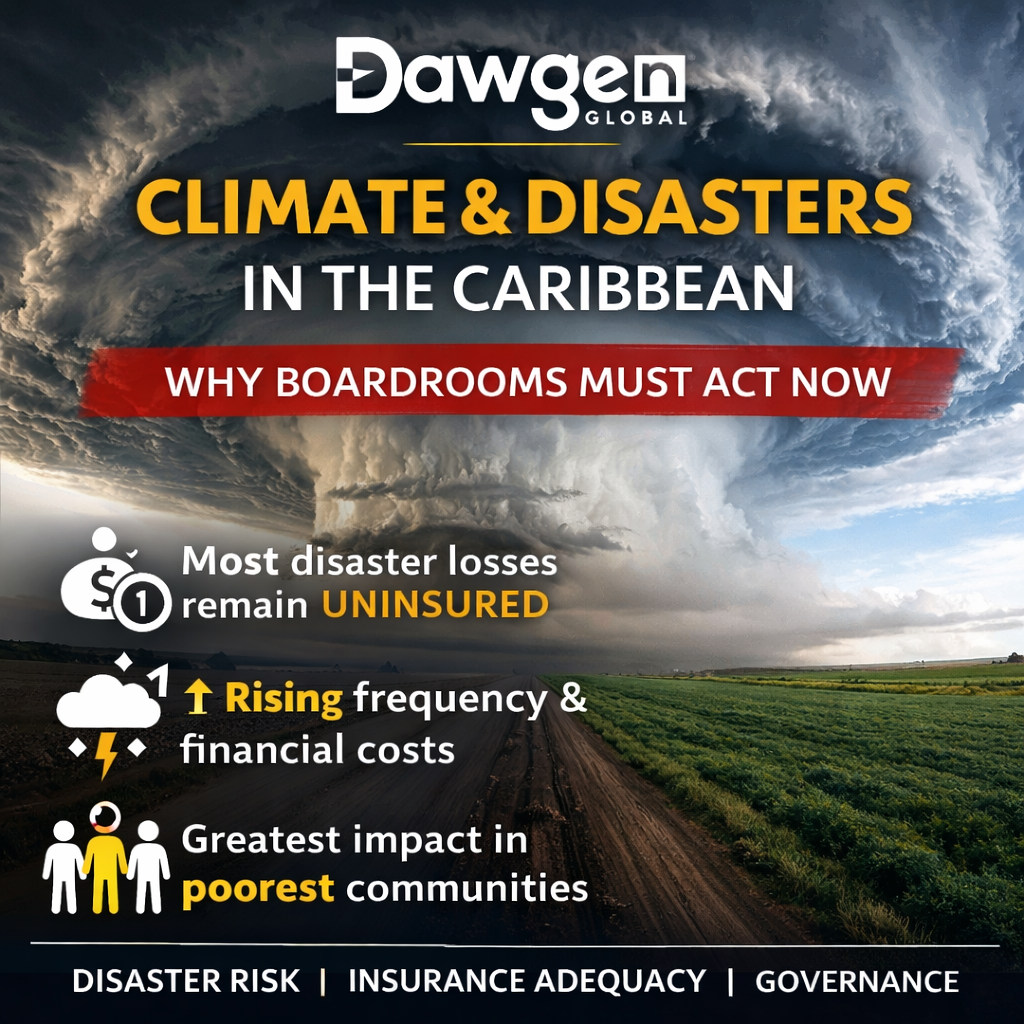
How the IDB’s 2026 disaster and environment data reframes climate as a boardroom risk management priority
The Caribbean sits at the epicentre of one of the most significant findings in the IDB’s 2026 Data Wall: disaster frequency and financial costs are both rising, governance of disaster risk is only slowly improving, and the overwhelming majority of losses across the region remain uninsured. That combination defines a board governance failure — not merely a public policy gap.
| “Disaster impact across Latin America and the Caribbean is not randomly distributed. The IDB’s data maps disaster concentration against poverty rates and finds a consistent pattern: the poorest subnational areas bear the greatest disaster burden. In the Caribbean, that pattern has direct implications for supply chains, workforce resilience, and community licence to operate.”
— IDB Group Data Wall 2026 |
From Background Risk to Boardroom Imperative
There is a version of the climate and disaster conversation that Caribbean boards have been having for years — episodic, reactive, and framed primarily as an insurance and recovery matter. The IDB’s 2026 Data Wall data makes that framing obsolete. What the IDB has documented is not a series of discrete events to be insured against. It is a structural and worsening trend that belongs permanently on the board’s strategic risk agenda.
The data is drawn from the EM-DAT International Disaster Database, accessed in October 2025, and from Swiss Re’s insurance gap analysis. The findings across the Disasters and Environment chapter are consistent and compounding: the region is experiencing more disasters, those disasters are generating larger financial losses, the governance of disaster risk is improving but from a low base, and the protection gap — the share of disaster losses that are uninsured — remains the defining financial vulnerability of the regional risk landscape.
The Three Findings That Demand Board Attention
- Both frequency and cost are rising simultaneously
The IDB’s disaster trend data shows that the number of recorded disaster events in Latin America and the Caribbean has increased over recent decades, and that the financial cost of those events has increased in parallel. These are not offsetting trends — they are compounding ones. More frequent events, each generating larger losses, creates an exposure profile that accumulates faster than most business continuity frameworks have been designed to absorb.
For Caribbean businesses, the relevant question is not whether a major weather event will affect their operations in the next decade. The data suggests that question has a high-probability answer already. The relevant question is whether the organisation has the financial resilience, the operational continuity plan, and the governance structure to absorb and recover from that event without permanent damage to its competitive position.
- The uninsured gap is the defining financial risk
The IDB’s analysis of Swiss Re data reveals that most disaster losses across Latin America and the Caribbean are uninsured. This finding deserves to sit at the centre of every Caribbean board’s risk management conversation. The protection gap — the difference between total economic losses from disasters and insured losses — represents the share of disaster impact that falls directly onto governments, businesses, households, and communities without financial mediation.
For a Caribbean business that experiences a significant weather event, an uninsured or underinsured loss position means absorbing the full economic impact from balance sheet and operating reserves. For many businesses, that is not a survivable position. The IDB data, combined with the trend of increasing disaster frequency and cost, creates a compelling and urgent case for comprehensive review of insurance coverage, self-insurance structures, and financial resilience mechanisms across every Caribbean operating entity.
| “Most disaster losses in the region are uninsured. That is not a statement about the insurance industry. It is a statement about the financial vulnerability of every Caribbean business, government, and household that has not taken deliberate steps to close the protection gap.” |
- Poor areas bear the greatest burden — and that affects your business
The IDB’s spatial analysis of disaster impact against subnational poverty rates reveals a consistent pattern: the highest concentrations of disaster events overlap strongly with the highest concentrations of poverty across the region. For Caribbean boards, this finding has implications that extend well beyond social concern.
Businesses source their workforces from communities. They source inputs from supply chains that pass through rural and lower-income areas. They build their social licence to operate in communities that the disaster data identifies as most exposed. A disaster that devastates a low-income community near your operations is not a separate event from your business continuity. It is part of the same system. Boards that have not mapped their exposure to community-level disaster risk are carrying an unquantified liability.
The Governance Improvement Signal — and Its Limits
The IDB data does contain an encouraging finding. Governance of disaster risk across Latin America and the Caribbean has been improving, as measured by the IDB’s RiskMONITOR index. Countries across the region have been developing disaster risk management frameworks, building institutional capacity, and in some cases deploying innovative financial instruments — including the IDB’s own Contingent Credit Facilities and Climate Resilient Debt Clauses — to create fiscal space for disaster response.
However, the governance improvement trend must be read alongside the deteriorating risk trend. Better governance of a worsening risk environment does not produce a net improvement in outcomes unless the governance improvement outpaces the risk increase. The IDB data does not yet show that threshold has been crossed. For Caribbean businesses, the appropriate response to improving public governance of disaster risk is not to reduce private preparedness — it is to treat public governance improvement as a complement to, not a substitute for, organisational resilience.
Amazonia and Regional Biodiversity: The Long-Term Risk Horizon
The IDB’s Disasters and Environment chapter extends beyond immediate disaster risk to document two longer-horizon environmental challenges that Caribbean boards should be tracking. Approximately 17,900 species are threatened across Latin America and the Caribbean, and the IDB’s dedicated publication on Amazonia — described as a global powerhouse of natural capital — documents the complex relationship between Amazonian urbanisation, ecosystem integrity, and regional climate regulation.
For Caribbean businesses, these findings matter because regional climate stability, rainfall patterns, and extreme weather frequency are all influenced by the health of ecosystems that extend well beyond national borders. The long-term business case for environmental stewardship is not abstract. It is embedded in the climate risk trajectory that the IDB’s disaster data describes.
A Board-Level Risk Framework for Caribbean Climate Exposure
Drawing directly from the IDB data, the following framework maps the key risk categories, what the evidence shows, and the governance response each demands from Caribbean boards.
| RISK CATEGORY | WHAT THE IDB DATA SHOWS | ADVISORY RESPONSE |
| Disaster Frequency | Event frequency across LAC is increasing. Both the number of recorded disasters and the financial losses they generate are on rising trends simultaneously. | Review business continuity plans against a higher-frequency baseline. Stress-test recovery timelines and financial reserves. |
| Protection Gap | Most disaster losses in the region are uninsured. The gap between economic loss and insured loss is the primary financial vulnerability. | Commission a full insurance adequacy review. Explore parametric insurance, self-insurance reserves, and captive structures. |
| Community Exposure | Disaster impact is concentrated in the poorest subnational areas. Supply chains and workforces are embedded in these communities. | Map supply chain and workforce community disaster exposure. Integrate community resilience into your ESG and risk frameworks. |
| Governance Gap | Public disaster risk governance is improving but from a low base and against a worsening risk trend. Public improvement does not substitute for private resilience. | Treat public governance improvement as complementary to — not a substitute for — your own organisational resilience investment. |
| Biodiversity & Climate | ~17,900 threatened species. Amazonian ecosystem health affects regional climate stability, rainfall, and extreme weather frequency. | Integrate long-horizon environmental risk into strategic planning. Assess regulatory and reputational exposure to biodiversity and deforestation risk. |
The Board Questions for Your Next Risk Review
- Risk agenda. Has our board received a formal briefing on the organisation’s climate and disaster risk exposure, calibrated against the trend data the IDB has now documented?
- Insurance coverage. Have we conducted an insurance adequacy review in the past 12 months, and does it account for the rising frequency and cost trend the IDB describes?
- Supply chain resilience. Do we have a mapped understanding of our supply chain’s and workforce’s exposure to the high-disaster-impact communities the IDB identifies?
- Business continuity. Does our business continuity plan reflect a higher-frequency disaster baseline, with tested recovery timelines and quantified financial resilience requirements?
- Stakeholder engagement. Are we engaging with the public disaster risk governance improvements in our territories as active participants, or as passive observers?
Engage Dawgen Global on Your Climate Risk Position
Climate and disaster risk management sits at the intersection of Dawgen Global’s risk advisory, audit, Virtual CFO, and legal process outsourcing practices. Across our 15 Caribbean territories, we work with boards and management teams to assess, quantify, and manage the climate risk exposure that the IDB data makes undeniable.
If your board has not yet had a structured conversation about climate risk governance — grounded in the kind of regional evidence the IDB has now provided — we would welcome the opportunity to facilitate that conversation. The gap between what the data shows and what most Caribbean organisations have built into their risk frameworks is where Dawgen Global’s advisory value is most tangible.
| Is your organisation’s climate risk framework fit for the data?
Dawgen Global’s Risk Management and Advisory teams work with Caribbean boards to assess, quantify, and govern climate and disaster risk exposure. Let us help you close the gap before the next event does it for you. Contact us : [email protected] About Dawgen Global“Embrace BIG FIRM capabilities without the big firm price at Dawgen Global, your committed partner in carving a pathway to continual progress in the vibrant Caribbean region. Our integrated, multidisciplinary approach is finely tuned to address the unique intricacies and lucrative prospects that the region has to offer. Offering a rich array of services, including audit, accounting, tax, IT, HR, risk management, and more, we facilitate smarter and more effective decisions that set the stage for unprecedented triumphs. Let’s collaborate and craft a future where every decision is a steppingstone to greater success. Reach out to explore a partnership that promises not just growth but a future beaming with opportunities and achievements.
Join hands with Dawgen Global. Together, let’s venture into a future brimming with opportunities and achievements |
 Email:
  Visit:
 WhatsApp Global Number
 WhatsApp Global: +1 5557959071

