
The Board That Did Not See It Coming
The chairman of a well-established Caribbean conglomerate — a group with interests spanning manufacturing, distribution, and retail across four territories — opened the February board meeting the way he had opened every board meeting for the past twelve years: with a review of the financial statements, a brief operational update from the managing director, and a perfunctory approval of the minutes from the previous session. The meeting lasted ninety minutes. The directors, several of whom had served for more than a decade, asked few questions. The audit committee had not met independently in over a year. There was no risk register on the agenda. There was no discussion of succession planning, regulatory developments, or strategic risk.
Six weeks later, the group’s largest subsidiary — a distribution company responsible for forty per cent of group revenue — was informed by its primary international supplier that it was terminating their exclusive distribution agreement. The supplier cited concerns about governance, compliance documentation, and the absence of an independent audit committee as contributing factors in their decision to appoint a competitor. The board had received no advance warning. The managing director had been aware of the supplier’s growing dissatisfaction but had not escalated the concern to the board because there was no structured mechanism for doing so. The risk had not been identified, monitored, or discussed because the board had no enterprise risk management framework in place.
In the twelve months that followed, the group lost approximately US$18 million in annual revenue, was forced to restructure its distribution operations, made redundant over one hundred employees, and faced a shareholder dispute that consumed nine months of management attention and legal fees exceeding US$600,000. The chairman, reflecting on the crisis in a private conversation with an advisor, said something that captured the essence of the governance gap afflicting Caribbean enterprises: “We thought we were governing. We were just meeting.”
This fictional scenario, while not attributable to any specific Caribbean organisation, reflects a pattern that Dawgen Global has observed across the region with troubling frequency. Boards that convene regularly but govern inadequately. Directors who attend faithfully but challenge rarely. Governance structures that satisfy the minimum legal requirements but fail to protect the organisations and stakeholders they are designed to serve.
The State of Corporate Governance in the Caribbean
Corporate governance in the Caribbean exists on a spectrum that ranges from internationally benchmarked excellence at one end to governance theatre at the other. A handful of large, publicly listed, and internationally connected organisations — particularly in banking, insurance, and telecommunications — maintain governance frameworks that approach international best practice. They have independent directors, functioning audit and risk committees, board evaluation processes, and meaningful engagement with shareholders and regulators. These organisations represent the exception rather than the norm.
The vast majority of Caribbean enterprises — including many substantial private companies, family-owned conglomerates, statutory bodies, and mid-market firms — operate with governance frameworks that are structurally deficient. Boards are often composed primarily of executive directors and close associates of the founding family, with limited or no independent representation. Committees exist on paper but meet infrequently or not at all. Board agendas are dominated by operational matters rather than strategic oversight. Risk management is informal, undocumented, and reactive. Succession planning for both management and the board itself is absent or unspoken.
This governance deficit is not the result of indifference or incompetence. It reflects the historical development of Caribbean business — a landscape dominated by founder-led enterprises, family ownership structures, and relationship-driven business cultures where formal governance was often seen as unnecessary bureaucracy rather than a strategic asset. For decades, many Caribbean businesses thrived under this model, relying on the judgement of strong founders, loyal management teams, and concentrated decision-making.
That era is ending. The forces reshaping the Caribbean business environment — regulatory modernisation, international compliance requirements, digital transformation, generational transition, climate risk, cybersecurity threats, and the increasing expectations of institutional investors, lenders, and international partners — demand governance capabilities that informal structures cannot provide. The cost of governance failure is rising sharply, while the tolerance for governance weakness is declining just as fast.
Five Dimensions of the Caribbean Governance Gap
Board Composition and Independence: The most visible dimension of the governance gap is the composition of Caribbean boards. In many organisations, the board is composed of individuals selected for their relationship to the founder, their social standing, or their technical expertise in the company’s operations — rather than for the independent judgement, strategic perspective, and governance experience that effective oversight requires. The absence of truly independent directors means there is often no voice in the boardroom prepared to challenge management assumptions, question strategic direction, or hold executive leadership accountable for performance. When every director has a personal or professional relationship with the CEO, the board’s ability to provide genuine oversight is fundamentally compromised.
Strategic Oversight versus Operational Interference: Effective governance requires boards to operate at the strategic level — setting direction, defining risk appetite, approving major investments, and holding management accountable for execution. Too many Caribbean boards instead oscillate between two extremes: rubber-stamping management recommendations without meaningful scrutiny, or diving into operational detail that is properly the domain of management. Both patterns undermine governance effectiveness. The rubber-stamp board fails to protect stakeholders. The operationally intrusive board undermines management authority and accountability while distracting itself from its strategic responsibilities.
Risk Governance: Enterprise risk management remains underdeveloped across the Caribbean corporate landscape. Many organisations lack formal risk registers, risk appetite statements, or structured processes for identifying, assessing, monitoring, and reporting on the risks that threaten their strategic objectives. Risk discussions at the board level are often reactive — triggered by incidents rather than informed by systematic analysis. This leaves boards perpetually responding to crises rather than anticipating and mitigating them. The fictional distribution company lost its primary supplier relationship because the risk of supplier dissatisfaction was never identified, monitored, or escalated — a failure that a basic enterprise risk management framework would have prevented.
Succession and Board Renewal: Succession planning is perhaps the most consequential governance gap in the Caribbean context. Many of the region’s most significant enterprises were built by founding entrepreneurs who remain in executive or board leadership positions decades after establishment. The question of who leads the organisation after the founder — and how the transition is managed — is often unspoken, unplanned, and unaddressed until it becomes an emergency. Board renewal is equally neglected. Directors who have served for fifteen or twenty years bring valuable institutional memory but may also bring entrenched perspectives, diminished independence, and relationships with management that have become too comfortable for effective oversight.
Governance of Emerging Risks: Caribbean boards are being confronted with categories of risk that did not exist a decade ago: cybersecurity threats that can cripple operations overnight, climate risks that threaten physical assets and business models, data protection obligations that carry personal liability for directors, ESG reporting requirements that demand new competencies and data systems, and digital transformation initiatives that reshape competitive dynamics. The governance frameworks of many Caribbean organisations were not designed to address these risks and have not evolved to incorporate them. The result is boards that are governing yesterday’s organisation in tomorrow’s risk environment.
The Cost of the Governance Gap
The consequences of governance failure are not abstract. They are financial, operational, reputational, and in some cases existential. Across the Caribbean, the governance gap has contributed to regulatory enforcement actions against financial institutions whose boards failed to ensure compliance. It has enabled fraud that went undetected for years because internal audit functions lacked board-level sponsorship. It has resulted in the destruction of shareholder value when family business succession disputes escalated to litigation in the absence of governance frameworks for managing generational transitions.
International partners, lenders, and investors are applying increasingly rigorous governance standards to their Caribbean relationships. Correspondent banking relationships — the lifeblood of Caribbean international commerce — are being reviewed and in some cases terminated based on governance assessments. International suppliers, as illustrated in the opening scenario, are evaluating governance as a factor in distribution and partnership decisions. Multilateral development banks are embedding governance requirements in lending conditions. The governance gap is no longer merely an internal matter — it is a competitive liability that affects access to capital, partnerships, and markets.
Caribbean regulators are simultaneously raising the governance bar. Jamaica’s Financial Services Commission, the Central Bank of Trinidad and Tobago, the Financial Services Regulatory Authority of Barbados, and the Eastern Caribbean Central Bank have all strengthened their governance expectations in recent years. Directors face growing personal liability under corporate governance codes, data protection legislation, and anti-money laundering frameworks. The era of board service as an honorary position with minimal accountability is giving way to an era where directorship carries genuine fiduciary responsibility and personal risk.
Dawgen Global’s Board Effectiveness Framework
Dawgen Global has developed a Board Effectiveness Framework specifically designed for Caribbean enterprises, recognising that effective governance in the region requires solutions that are proportionate to organisational scale, sensitive to ownership structures, and practical in their implementation.
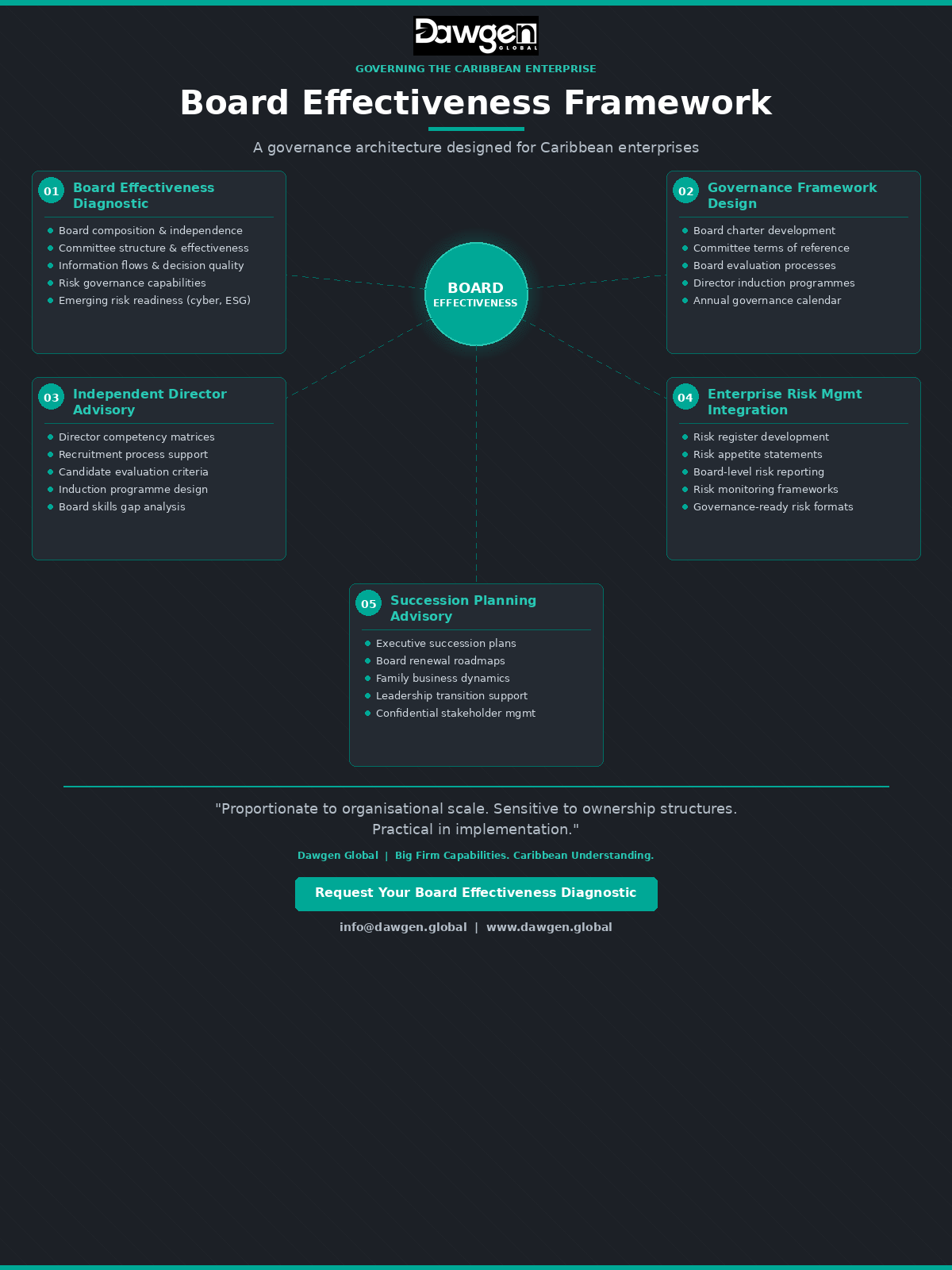
Board Effectiveness Diagnostic: Dawgen Global conducts comprehensive assessments of board composition, structure, processes, and performance against international best practice standards while accounting for the specific context of Caribbean organisations. The diagnostic evaluates the board’s composition and independence, committee structure and effectiveness, information flows between management and the board, the quality of board discussion and decision-making, risk governance capabilities, and the board’s readiness for emerging challenges including cybersecurity, ESG, and digital transformation.
Governance Framework Design: Based on diagnostic findings, Dawgen Global works with boards and executive leadership to design governance frameworks that are right-sized for the organisation. This includes board charter development, committee terms of reference, board evaluation processes, director induction programmes, and governance calendars that ensure the board addresses the full scope of its oversight responsibilities throughout the year.
Independent Director Advisory: Dawgen Global assists organisations in identifying, evaluating, and onboarding independent directors who bring the skills, experience, and perspective needed to strengthen board oversight. This includes developing director competency matrices, supporting recruitment processes, and designing induction programmes that enable new directors to contribute effectively from their first meeting.
Enterprise Risk Management Integration: Dawgen Global embeds enterprise risk management into the governance framework, ensuring that risk identification, assessment, monitoring, and reporting are structured processes with clear board-level accountability. This includes the development of risk registers, risk appetite statements, and board-level risk reporting that translates complex risk information into governance-ready formats.
Succession Planning Advisory: Dawgen Global works confidentially with boards and family shareholders to develop succession plans for both executive leadership and the board itself. This sensitive work requires deep understanding of Caribbean family business dynamics, cultural considerations, and the delicate balance between governance best practice and the personal relationships that underpin many Caribbean enterprises.
Building Governance That Protects and Creates Value
Caribbean organisations should begin their governance journey with an honest assessment of current board effectiveness. This assessment should be conducted independently — not by management, not by the company secretary, and not by a director evaluating their own performance — but by an external advisor who can provide an objective, evidence-based evaluation of how the board actually functions versus how it should function.
Board composition should be reviewed with a clear-eyed focus on independence, diversity of perspective, and alignment with the organisation’s strategic challenges. Every board should include directors who are genuinely independent — free from material relationships with the company, its management, or its controlling shareholders — and who bring the confidence and competence to challenge management constructively.
Governance should be treated not as a compliance cost but as a value-creation investment. Organisations with strong governance access better financing terms, attract higher-quality partners, retain talent more effectively, manage risk more proactively, and build the stakeholder trust that sustains long-term competitive advantage. In the Caribbean context, where business reputation is deeply personal and market memory is long, the reputational value of governance excellence is particularly significant.
The fictional conglomerate that lost its primary supplier — and US$18 million in annual revenue — did not fail because of a bad strategy or a weak product. It failed because its board was meeting without governing, overseeing without seeing, and approving without questioning. That gap between the appearance of governance and the reality of governance is the most dangerous vulnerability in Caribbean business today.
Close the Governance Gap
Dawgen Global invites Caribbean boards, chairpersons, and CEOs to take the first step toward governance excellence. A complimentary Board Effectiveness Diagnostic will provide a clear, confidential assessment of your board’s current effectiveness and a prioritised roadmap for closing the governance gaps that may be putting your organisation at risk.
Request your complimentary Board Effectiveness Diagnostic. Email [email protected] or visit www.dawgen.global to begin the conversation.
Take the First Step
Governance excellence is not achieved overnight. It is built through deliberate commitment, informed decision-making, and the willingness to hold leadership accountable to the standards that Caribbean enterprises and their stakeholders deserve.
Request a complimentary Board Effectiveness Diagnostic from Dawgen Global.
Email: [email protected] | Visit: www.dawgen.global
This article is part of the “Governing the Caribbean Enterprise” series by Dawgen Global, examining corporate governance, risk management, and institutional accountability across Caribbean industries. All scenarios described are fictional constructions based on observed governance patterns and are used for illustrative purposes only.
About Dawgen Global
“Embrace BIG FIRM capabilities without the big firm price at Dawgen Global, your committed partner in carving a pathway to continual progress in the vibrant Caribbean region. Our integrated, multidisciplinary approach is finely tuned to address the unique intricacies and lucrative prospects that the region has to offer. Offering a rich array of services, including audit, accounting, tax, IT, HR, risk management, and more, we facilitate smarter and more effective decisions that set the stage for unprecedented triumphs. Let’s collaborate and craft a future where every decision is a steppingstone to greater success. Reach out to explore a partnership that promises not just growth but a future beaming with opportunities and achievements.
 Email: [email protected]
  Visit: Dawgen Global Website

 WhatsApp Global Number : +1 555-795-9071
Caribbean Office: +1876-6655926 / 876-9293670/876-9265210  WhatsApp Global: +1 5557959071
USA Office: 855-354-2447
Join hands with Dawgen Global. Together, let’s venture into a future brimming with opportunities and achievements


