
| IN THIS ARTICLE
The third article of twelve. It answers the question every Caribbean SME owner is quietly asking: what does AI actually cost at my scale, what does it actually return, and in what order should I spend? Articles 1 and 2 established why the current technology cycle matters and what AI agents actually do. This article moves from concept to capital. It gives a Caribbean SME owner or finance director the specific numbers required to decide whether to act this quarter, next quarter, or later — and the sequence in which to spend. By the end of this article you will be able to: 1. State, with calibrated numbers, what a realistic AI investment costs and returns for a Caribbean SME at between US$1 million and US$50 million in revenue. 2. Apply the D-AGENTICA™ SME AI Sequencing Framework to place your organisation at the correct starting step — some SMEs should start at Step 1, others are ready for Step 3, a few are ready for Step 4. 3. Recognise the three most common ways Caribbean SMEs destroy capital on AI, so you can avoid making the same mistakes yourself. |
A Caribbean business owner I advise — she runs a successful mid-sized import and distribution business in Kingston, approximately US$12 million in revenue, eighty employees, twenty-two years in operation — telephoned me recently with what she described as a simple question. ‘Dr.Dawkins,’ she said, ‘I have read enough about AI now to know it matters. I have had three vendors pitch me in the last two months. Every one of them has quoted me a different number and promised me a different return. I have no confidence in any of those numbers. Just tell me, as a friend, how much this actually costs a business of my size and what I am actually going to get back.’
It was the most honest question I have been asked on this subject all year. And it is the question this article is going to answer.
Articles 1 and 2 of this series established the conceptual foundations. Article 1 argued that the current AI cycle is structurally different from the technology waves that came before it and that the Caribbean’s normal lag pattern will not provide cover this time. Article 2 installed the vocabulary required to distinguish a genuinely agentic product from a chatbot rebranded as one. Both articles were necessarily conceptual. They did not answer the question my client just asked me, which is the question every Caribbean SME owner is quietly asking: what does this actually cost at my scale, and what do I actually get back?
The reason that question is rarely answered honestly in our region is that the people with the most access to Caribbean SME executives — the vendors selling AI products — have a strong commercial incentive to inflate the returns and understate the costs. The published case studies from global consultancies, meanwhile, are typically drawn from Fortune 500 organisations whose economics translate imperfectly to a Jamaican distributor, a Trinidadian manufacturer, or a Bahamian hospitality group. The specific numbers a Caribbean SME owner needs are buried under a layer of case studies that do not quite fit their situation.
This article provides the answer I gave my client, generalised for every Caribbean SME owner who is asking the same question. I have spent considerable time with the specific numbers of Caribbean SME AI deployments over the last eighteen months — through advisory engagements where we built the business cases, through post-deployment reviews where we measured what actually happened, and through conversations with peers who have done the same. What I lay out below is not vendor marketing. It is the pattern I have observed in Caribbean SMEs that have actually done this work.
The article is organised into four parts. First, I will state the calibrated numbers — what a realistic AI investment costs and returns across three SME revenue bands. Second, I will introduce the D-AGENTICA™ SME AI Sequencing Framework, a five-step sequence that the Caribbean SMEs getting this right are actually following. Third, I will name the three specific mistakes that consume the most capital in Caribbean SME AI projects, so you can avoid making them. Fourth, I will walk through a concrete vignette — a composite based on real Caribbean engagements — so that the abstract framework becomes visible as an actual twelve-month story.
By the time you finish, you will be able to have a substantive conversation with your finance director, your board, or your business partner about what to do this year. Not the hype. Not the marketing. The actual economics, in numbers a Caribbean SME owner can defend.
The numbers, calibrated for Caribbean SME reality
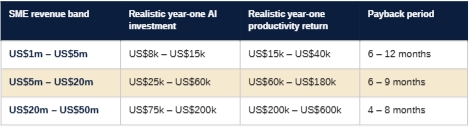
Let me state the calibrated economics up front. The table below shows the realistic year-one AI investment range for three SME revenue bands, the realistic year-one productivity return against that investment, and the typical payback period. These numbers are drawn from Caribbean SME engagements we have worked on or reviewed — not from vendor-sponsored case studies — and they are expressed as ranges rather than single-point estimates because the specific number depends materially on the starting maturity, the sector, and the quality of execution.
I want to unpack what these numbers mean, because ranges expressed in a table can be read too optimistically or too pessimistically depending on the reader’s disposition. Let me take each band in turn.
The US$1 million to US$5 million band
At this scale, the realistic year-one AI investment is US$8,000 to US$15,000. That is not a typo. An SME at the lower end of this band should not be buying enterprise agent platforms in their first year. They should be buying Microsoft 365 Copilot or Google Workspace Duet for their core team, Claude or ChatGPT Team for their analytical and client-facing roles, and investing the remainder in training so the tools are actually used. The productivity return from doing this well is typically 15 percent to 30 percent of the total payroll cost of the roles that adopt the tools — which for a five-to-ten-person professional services firm, for example, is US$15,000 to US$40,000 in year one. Payback is within nine months in most cases.
The US$5 million to US$20 million band
This is where the economics become materially more interesting. At this scale, you can afford both the Tier 2/3 deployments and a first agent deployment against a specific high-value workflow. Total year-one investment of US$25,000 to US$60,000 is realistic. The productivity return — measured against the specific workflows automated — is typically 2.5x to 3.5x of the investment in the first year, which for a business at the midpoint of this band is US$60,000 to US$180,000. The payback period compresses as the investment scales, because the fixed costs of deployment (process mapping, data preparation, change management) are amortised across more use cases.
The US$20 million to US$50 million band
At this scale, a Caribbean SME is closer in operational complexity to a small corporate than to a traditional small business. A year-one investment of US$75,000 to US$200,000 is appropriate and supports two or three agent deployments against distinct high-value workflows. The productivity return ranges from US$200,000 to US$600,000. Payback typically occurs within six to eight months of the first agent entering production, with the remaining deployments contributing return through the following quarters.
| The realistic year-one AI investment for a US$10 million Caribbean SME is under US$50,000. Any vendor telling you the number is materially larger is selling you something you do not yet need. |
Three observations about this table are worth dwelling on, because they are the observations most likely to be missed by a reader scanning quickly.
First, the returns are real but not extraordinary. A 2x to 3x return on year-one AI investment is a strong business outcome. It is not the 10x narrative that some vendors will present. A Caribbean SME that enters this investment expecting to transform its business in twelve months will be disappointed. A Caribbean SME that enters it expecting to compress specific high-value workflows and capture measurable operating leverage will be satisfied.
Second, the returns scale with starting maturity, not with spending. A US$10 million SME with weak processes, scattered data, and a leadership team that has not yet engaged seriously with the technology will not get a 3x return on US$60,000 of investment. They will get a 1x return, spend another year fixing what the AI deployment exposed, and then achieve the 3x return in year two. The Sequencing Framework below is specifically designed to force this sequence the right way round — literacy first, process next, technology last.
Third, the cost side is weighted toward people, not software. In most Caribbean SME AI deployments I have observed, the software licences are a minority of the total year-one cost. The majority goes to process redesign, data preparation, training, and the external advisory support required to do these correctly. Any business case that shows software licences as the dominant cost line is almost certainly understating what the deployment actually requires to succeed.
The D-AGENTICA™ SME AI Sequencing Framework
The numbers above are achievable. Most Caribbean SMEs, however, do not achieve them. The reason is almost never that the technology does not work. The reason is that Caribbean SMEs typically deploy AI in the wrong order. They buy the agent before the literacy, deploy the tool before the process redesign, scale the programme before measuring whether the first deployment paid back. Each of these errors is individually small. Compounded, they are the difference between a 3x return and a 1x return.
The framework below specifies the correct order. I developed it over the past two years through observation of what the Caribbean SMEs getting this right were actually doing — and what the ones getting it wrong were actually doing. The difference was not strategy, talent, or capital. The difference was the order of operations. The five steps are specified with enough concrete detail — what you do, what it costs, how long it takes — that a Caribbean SME owner can use this framework without further advisory engagement. The firms that genuinely need Dawgen Global’s help will surface themselves through the process; the firms that can do it themselves should do it themselves.
| A NAMED INSTRUMENT
The D-AGENTICA™ SME AI Sequencing Framework Five steps, taken in order, that a Caribbean SME of between US$1 million and US$20 million in revenue can follow in the next twelve months to deploy AI productively without wasting capital. The sequence is unglamorous. It is also the sequence the firms that are getting this right are actually following, whether they know it or not. STEP 1 Get your leadership AI-literate before you buy anything The foundation. If your leadership team cannot tell an agent from a chatbot (Article 2), every subsequent investment decision will be compromised. What you do: Commit your three most senior people to ten hours each of structured AI literacy over a six-week period. Work through Articles 1 and 2 of this series together. Each of them should personally use Claude or ChatGPT for at least twenty hours of their own professional work so that the capability becomes tangible rather than theoretical. Cost and time: Effectively free, other than the opportunity cost of ten hours per person. The most common mistake is skipping this step in the belief that it is indulgent. It is not indulgent; it is the precondition for every decision that follows. STEP 2 Identify the three to five workflows where AI would produce the highest immediate value Not every workflow is a good AI candidate. The ones that are share three characteristics: they are repetitive, they are well-documented, and their quality can be checked quickly by a human. Start there. What you do: Have your leadership team list the five most time-consuming repetitive workflows in the business. Typical candidates in the Caribbean SME context include monthly management account preparation, customer-service email handling, supplier invoice processing, inventory reconciliation, and statutory compliance filings (GCT, NIS, payroll). Rank them by time consumed per month and ease of verification. Cost and time: One working day of leadership time. Zero technology spend. The output is a ranked list of three to five workflows that you will address in the next twelve months. STEP 3 Deploy Tier 2 and Tier 3 tools against those workflows first Before buying agents, maximise what assistants and copilots can do. Most Caribbean SMEs will find that 40 to 60 percent of the productivity benefit available is achievable at the Tier 2 and Tier 3 level alone. What you do: Deploy Microsoft 365 Copilot or Google Workspace Duet for the general office workflows. Deploy Claude.ai or ChatGPT Team for the analytical and drafting workflows. Train your people through the first ninety days so the tools are actually used. Measure the change — time saved per workflow, quality maintained. Cost and time: US$300 to US$500 per user per year for the core licences, plus twenty hours of training per affected role. For a ten-person SME, total cost in year one is US$5,000 to US$10,000. This is where most SMEs should currently be. STEP 4 Commission a single agent deployment against your highest-value workflow Once your organisation has achieved operational literacy through Steps 1 to 3, you are ready for an agent deployment. Start with one. The single highest-value workflow from Step 2 that also has the cleanest data environment. What you do: Commission a scoped agent deployment with a vendor who passes the D-AGENTICA™ Agentic Vendor Assessment (Article 2). Common first deployments in the Caribbean SME context are GCT compliance agents, invoice processing agents, and management account preparation agents. Scope it tightly; succeed; then consider the next one. Cost and time: US$15,000 to US$60,000 for initial deployment depending on complexity, plus ongoing licence costs of US$500 to US$3,000 per month. Twelve to eighteen weeks from kick-off to production. Expect to spend as much on process redesign as on the agent itself. STEP 5 Measure, refine, and expand only when the first deployment has paid back This is the step most commonly skipped in Caribbean SME AI projects — and its absence is the single most common reason those projects fail. You do not scale an agent programme on faith. What you do: After six months of the initial agent running in production, measure the actual productivity change against your baseline from Step 2. If the payback is real and measurable, move to a second agent. If it is not, diagnose why before investing further. The discipline of measurement is what separates the SMEs that get AI right from those that keep buying new tools that never deliver. Cost and time: One day of leadership time every quarter for measurement. Possibly significant, if the first deployment revealed a larger data or process issue that requires remediation. Zero cost if the deployment is working and you are simply confirming it. |
A word about the order matters as much as a word about the steps themselves. Each step is a precondition for the one that follows. You cannot meaningfully identify the workflows to address (Step 2) without the AI literacy to recognise them (Step 1). You cannot successfully deploy an agent (Step 4) without the organisational operating literacy that comes from having used assistants and copilots (Step 3). You cannot scale the programme (implicit after Step 5) without having measured whether the first deployment paid back. Skipping steps is the single most common reason Caribbean SME AI programmes fail, because it feels efficient in the moment and costs more than it saves over the following twelve months.
| The firms getting this right are not using different technology. They are using the same technology in the right order. |
The three ways Caribbean SMEs destroy capital on AI
Across the Caribbean SME engagements we have observed, three specific mistakes consume more capital than all others combined. I want to name them directly, because naming them is the fastest way to prevent them.
Mistake one — skipping straight to Step 4
The owner of a US$8 million Caribbean distribution business reads about AI agents transforming enterprise operations, hears a compelling vendor pitch, and commissions a US$40,000 agent deployment against a workflow that leadership has not yet analysed properly, on data that has not been cleaned, in an organisation where no one has yet used an assistant or copilot for their own work. The agent deploys. It does not produce the projected return because the target workflow was poorly specified, the data feeding the agent was inconsistent, and the staff affected could not distinguish a product working well from a product working poorly because they had no prior AI operating experience. After twelve months the owner concludes that AI does not work for Caribbean SMEs. What did not work was the sequence. This pattern, in its various specific forms, accounts for more Caribbean SME AI capital destruction than any other single failure mode. The fix is Steps 1, 2, and 3 of the framework above, taken properly, before Step 4 is contemplated.
Mistake two — buying licences and calling it a deployment
An SME CEO subscribes the leadership team to Microsoft 365 Copilot or ChatGPT Team and considers the AI programme to have been launched. Eighteen months later, utilisation analytics reveal that the licences are used for approximately twelve minutes per user per week, mostly to draft personal messages that the executives would previously have drafted themselves. The US$6,000 annual licence cost has produced no measurable productivity impact because the tools were deployed without workflow integration, without training, and without the expectation-setting that would make their use routine. The organisation is using the tools at roughly 8 percent of their potential. This is not a failure of the technology. It is a failure to treat a technology deployment as a change management exercise. The fix is specific: every AI tool deployment, even at Tier 2 and Tier 3, requires a named internal owner, a measurable target for utilisation, and structured training during the first ninety days. Without these, the licence is a subscription, not a deployment.
Mistake three — letting the vendor own the business case
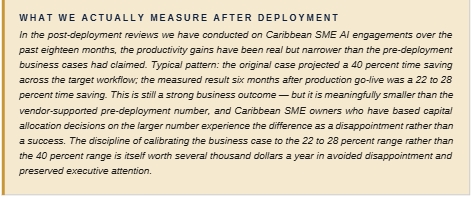
A Caribbean SME considering an agent deployment accepts a business case prepared by the vendor selling the agent. The case projects a 40 percent productivity gain against the target workflow, calculates a six-month payback, and recommends additional modules to extend the ROI. The owner signs the contract. Post-deployment, the actual productivity gain is 25 percent, the payback extends to fourteen months, and the additional modules produce even smaller returns because they target lower-value workflows. The owner feels misled. They were not misled, exactly — the vendor’s numbers were optimistic but not fraudulent. What failed was that no independent party had pressure-tested the business case. The fix is unambiguous: no Caribbean SME should commission an agent deployment above US$20,000 on the basis of vendor-prepared business case alone. The business case must be independently reviewed by someone with financial literacy and technology judgment who is not paid by the vendor. This is inexpensive — typically a day or two of independent advisory time — and it changes the commercial posture of the conversation in ways that tend to improve the quality of every subsequent decision.
| A CARIBBEAN VENDOR-DISCIPLINE PATTERN
Across eight Caribbean SME business cases we have independently reviewed on behalf of clients in the past year, the vendor-prepared cases projected year-one returns that averaged 2.1 times the returns we considered defensible after challenge. In five cases, the review resulted in a narrower initial scope that was successfully executed. In two, it resulted in the deal being deferred until a later time when the organisation would be ready. In one, it resulted in the vendor being disqualified in favour of a different vendor whose business case survived the review. The cumulative capital preservation impact of these eight reviews, for the clients involved, was several hundreds of thousands of US dollars. The review work itself cost a small fraction of that amount. The arithmetic of business case review in Caribbean SME AI deployments is, in our experience, among the highest-return advisory activities available. |
Twelve months in the life of a Caribbean SME
Let me make the framework concrete through a composite vignette drawn from real Caribbean SME engagements. The organisation, the names, and some operational details are changed; the economics, the sequence, and the outcomes are accurate to the underlying pattern we have observed repeatedly.
A Caribbean manufacturing SME — call the owner Marcus — runs a US$14 million business with approximately sixty employees. He is in month one of a twelve-month AI programme. His finance director is AI-curious but sceptical. His operations manager is open-minded but time-poor. His sales director considers AI a distraction. The three of them commit, at Marcus’s request, to ten hours each of structured AI literacy over the first six weeks. They work through Articles 1 and 2 of this series together on a weekly basis; they each use Claude or ChatGPT for twenty hours of real professional work; they emerge from the six weeks with materially different opinions of what the technology is and what it can do. Total cost: approximately US$1,500 in reading materials and the opportunity cost of ninety hours of senior time. This is Step 1 complete.
In weeks seven through ten, the leadership team lists the five most time-consuming repetitive workflows in the business. They rank them: monthly management account preparation, statutory compliance filings, customer-service email handling, inventory reconciliation, supplier invoice processing. Marcus makes the call that the first three are the highest priority. Step 2 complete at the end of week ten. Cost: one working day each of senior leadership time.
In weeks eleven through twenty, the organisation deploys Microsoft 365 Copilot to the twelve members of staff whose roles touch the three priority workflows, plus Claude Team for the finance director and operations manager specifically. They invest in twenty hours of structured training per affected role, which the firm’s HR manager coordinates over a six-week schedule. By week twenty, utilisation analytics show that Copilot is being used for approximately four hours per user per week — meaningfully above the industry median, because the training actually happened. Measured time savings across the three workflows are already in the 18 to 22 percent range. Total Step 3 cost: US$12,000 in licences, US$4,000 in training. Productivity return already visible at this stage: roughly US$30,000 annualised. Step 3 complete at the end of week twenty.
In weeks twenty-one through forty, the business commissions a scoped agent deployment against the monthly management account preparation workflow. The vendor is independently selected and survives the D-AGENTICA™ Agentic Vendor Assessment. The business case is independently reviewed before contract signature — the review compresses the scope to a single workflow rather than the three-workflow scope the vendor had proposed, and tightens the productivity projections from 40 percent to 25 percent. The agent enters production at week thirty-two. By week forty, eight weeks of operating data shows an actual productivity gain of 26 percent against the baseline — a near-perfect match to the independently reviewed business case. Total Step 4 cost: US$35,000 in deployment plus US$1,200 per month in licences. Productivity return: US$72,000 annualised on the agent alone, plus the US$30,000 from Step 3. Aggregate year-one return: approximately US$102,000 against aggregate year-one investment of approximately US$53,000.
In weeks forty through fifty-two, Marcus and the finance director measure the results, validate them against the original baseline, and plan the second agent deployment for year two. The business case for that second deployment benefits from year-one operating experience and will likely produce a stronger return than the first because the organisation’s process, data, and change management capability are now materially more mature. Step 5 complete at the end of week fifty-two.
That is what twelve months looks like when the framework is followed properly. No miracle, no transformation, no AI revolution. Just disciplined sequencing applied to a capable technology, in an organisation whose leadership team took the time to become literate before they committed capital. This is the specific pattern that distinguishes the Caribbean SMEs getting AI right from those getting it expensively wrong.
What this article has established, and what comes next
This article has done four things. It has stated the realistic year-one AI investment cost and productivity return for Caribbean SMEs across three revenue bands, with enough specificity that a Caribbean SME owner can size their own programme against calibrated numbers rather than vendor marketing. It has introduced the D-AGENTICA™ SME AI Sequencing Framework — five steps, taken in order, that the Caribbean SMEs getting AI right are actually following. It has named the three specific mistakes that consume the most capital in Caribbean SME AI deployments, so that readers can avoid them. And it has made the sequence visible through a twelve-month composite vignette that shows what disciplined execution actually looks like.
Taken together with the two instruments from Articles 1 and 2 — the Three-Question Board Diagnostic and the Agentic Vendor Assessment — the Sequencing Framework introduced here gives a Caribbean SME owner three instruments. The first tells them where their organisation stands. The second tells them whether the products being offered to them are actually what they are described as. The third tells them the order in which to spend. These three instruments together materially improve the quality of every AI decision a Caribbean SME will make in the next twelve months.
Acts I of the series — The Orientation — now concludes. You understand why the cycle matters, what the technology actually is, and what it costs and returns at Caribbean SME scale. The remainder of the series moves to harder questions. Act II addresses the guardrails — how to adopt this technology responsibly in our region. Article 4, published next week, takes the question every Caribbean board raises first: where does our data go? Data sovereignty is the single most significant objection Caribbean executives raise when AI is proposed, and it deserves its own article. By the end of Article 4 you will have a specific, defensible framework for answering that question for any workload your organisation is considering, and the next named instrument in the series — the D-AGENTICA™ Data Sovereignty Decision Matrix — will be in your hands.
One reflection to carry into your next executive conversation. The most expensive thing a Caribbean SME can do in the next twelve months is to commit capital to AI in the wrong order. The second most expensive thing is to commit no capital at all, while the market adjusts around you. These are the two failure modes worth guarding against. The Sequencing Framework is a tool to protect against both.
| FOR THE BOARD AGENDA
This article has specified the realistic economics of AI for Caribbean SMEs and the sequence in which to spend. A Caribbean SME owner or board reading this article has earned the right to ask their leadership team one specific question and to propose one specific decision that will materially improve how capital is committed over the next twelve months. THE QUESTION Which step of the D-AGENTICA™ SME AI Sequencing Framework is our organisation actually ready for today — and if our current AI plan assumes we are further along than that, what are we prepared to give up in the short term in order to rebuild the foundations that will make the programme succeed? THE DECISION That the leadership team will formally position the organisation against the five steps of the Sequencing Framework within thirty days, will revise the AI investment plan to start from the correct step rather than from where the organisation wishes it were, and will report the revised plan to ownership or the board at the next regularly-scheduled meeting. |
| THE CARIBBEAN AI ADOPTION IMPERATIVE
A 12-Article Series from Dawgen Global NEXT IN THIS SERIES Article 04 — Data Sovereignty Where does our data go, and how do we answer that question defensibly? MEASURE YOUR ORGANISATION’S AI READINESS Request the free D-AGENTICA™ AI Maturity Self-Assessment! Email us: info@dawgen.global |
About Dawgen Global
“Embrace BIG FIRM capabilities without the big firm price at Dawgen Global, your committed partner in carving a pathway to continual progress in the vibrant Caribbean region. Our integrated, multidisciplinary approach is finely tuned to address the unique intricacies and lucrative prospects that the region has to offer. Offering a rich array of services, including audit, accounting, tax, IT, HR, risk management, and more, we facilitate smarter and more effective decisions that set the stage for unprecedented triumphs. Let’s collaborate and craft a future where every decision is a steppingstone to greater success. Reach out to explore a partnership that promises not just growth but a future beaming with opportunities and achievements.
 Email: info@dawgen.global
  Visit: Dawgen Global Website

 WhatsApp Global Number : +1 555-795-9071
Caribbean Office: +1876-6655926 / 876-9293670/876-9265210  WhatsApp Global: +1 5557959071
USA Office: 855-354-2447
Join hands with Dawgen Global. Together, let’s venture into a future brimming with opportunities and achievements


