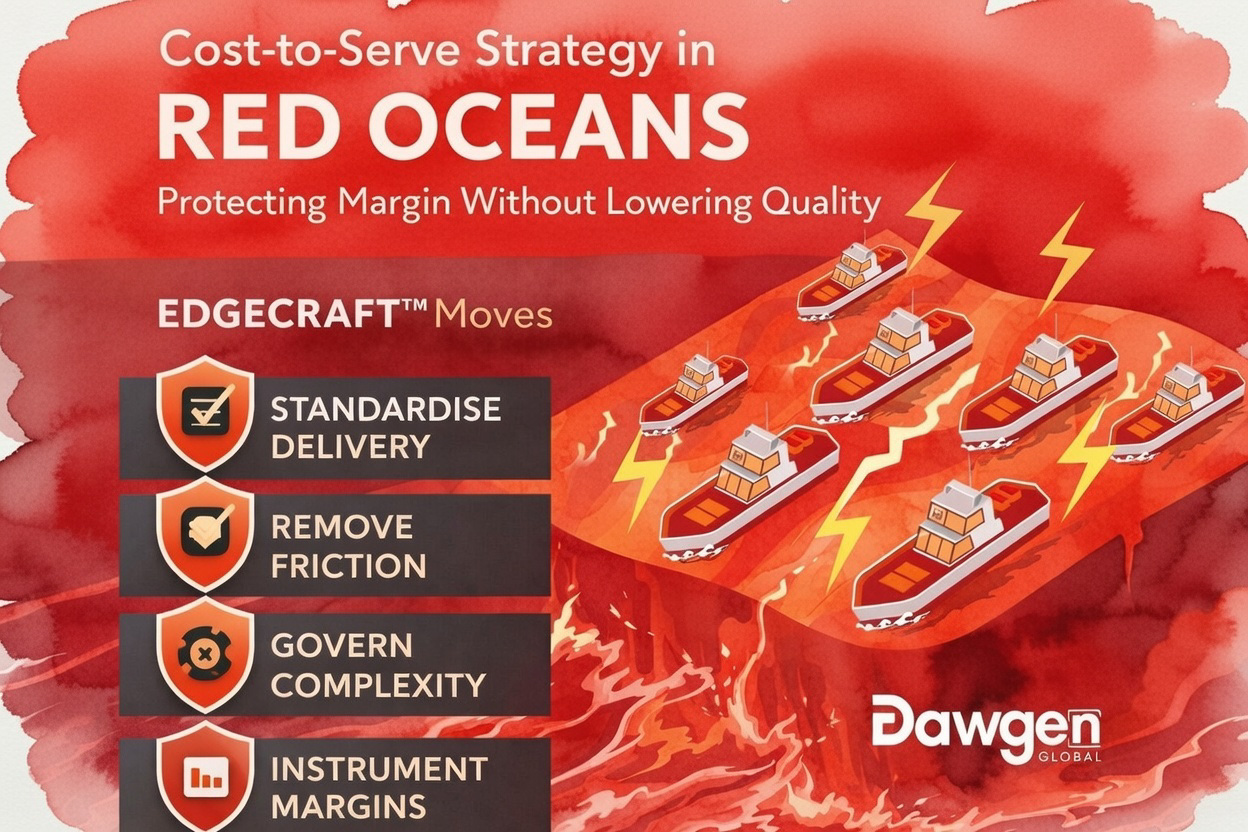
How to standardise delivery, reduce rework, and redesign operating economics using EDGECRAFT™
In Red Oceans, margin is won in delivery—not only in sales
Many organisations treat profitability as a pricing problem. In Red Ocean markets, it is often a delivery economics problem.
Two firms can sell the same service at roughly the same price. One earns strong margins. The other struggles. The difference is rarely effort. The difference is cost-to-serve discipline.
In crowded markets, you cannot rely on premium pricing alone. Customers compare options, procurement pressure is real, and competitors will always be willing to discount. That is why Red Ocean winners build a second kind of advantage:
They deliver with a lower and more predictable cost-to-serve—without reducing quality.
This is the role of EDGECRAFT™, Dawgen Global’s Red Ocean playbook within OceanSwitch™. EDGECRAFT™ is built for performance environments where:
-
margin is compressed,
-
clients demand speed and certainty,
-
and operational excellence creates differentiation.
This article introduces a practical Cost-to-Serve Strategy for Red Oceans—how to engineer delivery economics so every engagement strengthens profitability rather than silently eroding it.
What “cost-to-serve” really means
Cost-to-serve is not simply “staff cost.” It is the total internal effort and friction required to deliver outcomes, including:
-
sales-to-delivery handover time
-
onboarding and data collection cycles
-
rework due to unclear inputs or weak standards
-
senior time spent resolving avoidable issues
-
delivery tool gaps and manual work
-
client management and stakeholder complexity
-
reporting cycles and late-stage changes
-
billing and collection effort driven by unclear commercial terms
Cost-to-serve is the hidden engine behind margin.
In Red Oceans, your strategy must include engineering that engine.
The Red Ocean margin leak: rework, complexity, and variation
Most Red Ocean delivery models leak margin in three ways:
1) Rework
Rework is time spent fixing avoidable issues:
-
missing or inconsistent client data,
-
unclear deliverables,
-
conflicting client stakeholders,
-
repeated revisions,
-
“one more analysis” requests not priced into scope.
2) Complexity
Complexity is not always visible at the proposal stage. It grows through:
-
too many service variants,
-
too many exceptions,
-
different ways of doing the same task across teams.
3) Variation
Variation is the silent killer of efficiency. If every team delivers differently, you cannot scale quality, automate, or predict timelines.
If you want stronger margins in Red Oceans, your cost-to-serve strategy is fundamentally about reducing rework, complexity, and variation—while preserving outcomes.
The EDGECRAFT™ Cost-to-Serve System
Dawgen Global’s EDGECRAFT™ approach uses five disciplines:
-
Service Standardisation (reduce variation)
-
Friction Removal (reduce rework)
-
Complexity Governance (limit exceptions)
-
Delivery Cadence Design (improve predictability)
-
Margin Instrumentation (measure what matters)
These disciplines can be implemented without a heavy transformation programme. The goal is to build a practical operating system.
1) Service Standardisation: build “one best way” delivery paths
Standardisation does not mean “cookie-cutter service.” It means:
-
a defined baseline process,
-
clear deliverables,
-
standard templates,
-
and repeatable workflows.
The 80/20 delivery model
Most services contain a core that repeats:
-
common steps,
-
common outputs,
-
common risks.
Aim to standardise that 80% with:
-
checklists,
-
templates,
-
role guides,
-
and defined quality criteria.
Reserve customisation for the 20% that truly creates client value.
Practical standardisation tools
-
Standard statement of work (SOW) structure
-
Standard onboarding checklist
-
Standard client data request pack
-
Standard review and sign-off steps
-
Standard reporting templates
This creates predictability and reduces “reinventing the wheel.”
2) Friction Removal: design the engagement to eliminate rework
In Red Oceans, rework is a strategic problem—not a “team issue.”
Common sources of friction
-
unclear client responsibilities
-
late data and missing inputs
-
multiple stakeholders giving inconsistent direction
-
unstructured approval cycles
-
weak scope boundaries
EDGECRAFT™ solution: Client Responsibility Design
Make the client’s role explicit.
Every engagement should define:
-
what the client provides,
-
by when,
-
in what format,
-
and who signs off.
Then add a simple rule:
late or incomplete inputs shift the timeline and may trigger a change request.
This is not harsh. It is clarity. And clarity reduces rework.
3) Complexity Governance: stop exceptions from becoming the business model
In Red Oceans, exceptions often feel like “good service.” Over time, they become:
-
unpriced work,
-
inconsistent delivery,
-
and uncontrolled cost-to-serve.
Create an “exception policy”
A simple policy answers:
-
what can be customised freely,
-
what requires a priced add-on,
-
what requires executive approval,
-
and what is declined.
Use packaging to reduce exceptions
Instead of offering endless variation, create:
-
a “Standard” package,
-
an “Enhanced” package,
-
and a “Premium” package.
Packaging does two things:
-
it simplifies buying,
-
it reduces delivery variation.
Customers prefer clarity. Teams prefer predictability. Both improve margins.
4) Delivery Cadence Design: predictability is a competitive advantage
Many Red Ocean margins are destroyed by time compression:
-
“we need it tomorrow,”
-
“we need extra meetings,”
-
“can you revise again?”
Cadence design builds predictability through:
-
defined meeting rhythms,
-
defined review windows,
-
defined turnaround times,
-
defined escalation rules.
The “fixed rhythm” model
For complex engagements, set a rhythm:
-
weekly check-in,
-
biweekly deliverables review,
-
clear sign-off dates.
When cadence is defined, urgency becomes managed rather than chaotic.
5) Margin Instrumentation: measure cost-to-serve so it can be improved
You cannot manage what you do not measure. But the measurement must be practical.
Three essential cost-to-serve metrics
-
Hours / effort per deliverable (or per engagement stage)
-
Rework rate (revision cycles, repeated requests, late changes)
-
Exception rate (how often work deviates from standard path)
Add two client-side signals
-
Client responsiveness (speed of input provision and approvals)
-
Stakeholder complexity (number of stakeholders and alignment quality)
Over time, these metrics allow you to classify customers and deals:
-
“efficient to serve,”
-
“high friction,”
-
“premium complexity (priced),”
-
“unprofitable complexity (avoid).”
This is how Red Ocean firms build selective capability.
The Cost-to-Serve Redesign Workshop: a simple 2-hour method
To implement quickly, run a workshop for one service line:
-
Map the delivery flow from onboarding to completion
-
Identify the top 5 rework drivers
-
Identify the top 5 exceptions and why they occur
-
Select 3 standard templates/checklists to create
-
Define an exception policy and packaging model
-
Define a cadence model for client interactions
-
Choose 3 metrics to track for 90 days
This produces immediate improvement without a heavy programme.
How cost-to-serve strategy strengthens differentiation
Reducing cost-to-serve is not only about cutting effort. It improves value:
-
faster turnaround times
-
fewer errors and revisions
-
more predictable outcomes
-
clearer stakeholder management
-
better customer experience
In Red Oceans, operational excellence becomes differentiation—because customers are tired of chaos.
In Red Oceans, profitability is engineered
If your market is Red:
-
price pressure will not disappear,
-
competition will not weaken,
-
and customers will continue to compare.
Your strongest defence is not discounting. It is delivery economics.
EDGECRAFT™ Cost-to-Serve Strategy helps organisations protect margin without lowering quality by:
-
standardising delivery,
-
reducing rework,
-
governing complexity,
-
designing cadence,
-
and instrumenting the operating model.
In the next article in this series, we will address a core Red Ocean weakness: Pricing Leakage—how to identify where margin is being lost after the contract is signed, and how to stop it through commercial controls.
About Dawgen Global
“Embrace BIG FIRM capabilities without the big firm price at Dawgen Global, your committed partner in carving a pathway to continual progress in the vibrant Caribbean region. Our integrated, multidisciplinary approach is finely tuned to address the unique intricacies and lucrative prospects that the region has to offer. Offering a rich array of services, including audit, accounting, tax, IT, HR, risk management, and more, we facilitate smarter and more effective decisions that set the stage for unprecedented triumphs. Let’s collaborate and craft a future where every decision is a steppingstone to greater success. Reach out to explore a partnership that promises not just growth but a future beaming with opportunities and achievements.
 Email: [email protected]
  Visit: Dawgen Global Website

 WhatsApp Global Number : +1 555-795-9071
Caribbean Office: +1876-6655926 / 876-9293670/876-9265210  WhatsApp Global: +1 5557959071
USA Office: 855-354-2447
Join hands with Dawgen Global. Together, let’s venture into a future brimming with opportunities and achievements


