
Banks are not just another sector in the Caribbean economy — they are the financial operating system for households, businesses and governments. They intermediate savings, provide FX, support trade, process payments and increasingly deliver digital financial services.
So when a shareholder, regulator, board or potential investor asks:
“What is this bank really worth?”
…the answer has serious implications: for capital raising, acquisitions, divestments, regulatory decisions, succession planning and even financial stability.
Yet, in practice, the valuation of Caribbean banks is often reduced to a rule of thumb:
“Apply a price-to-book multiple” or “Compare to peers”.
That may have worked in a simpler world. Today, it is dangerously incomplete.
-
Regulation has become more demanding.
-
Interest rate and FX conditions are more volatile.
-
Climate and sovereign risk are impossible to ignore.
-
Digital disruption is reshaping how banks compete and earn.
-
Correspondent banking and de-risking have changed cross-border economics.
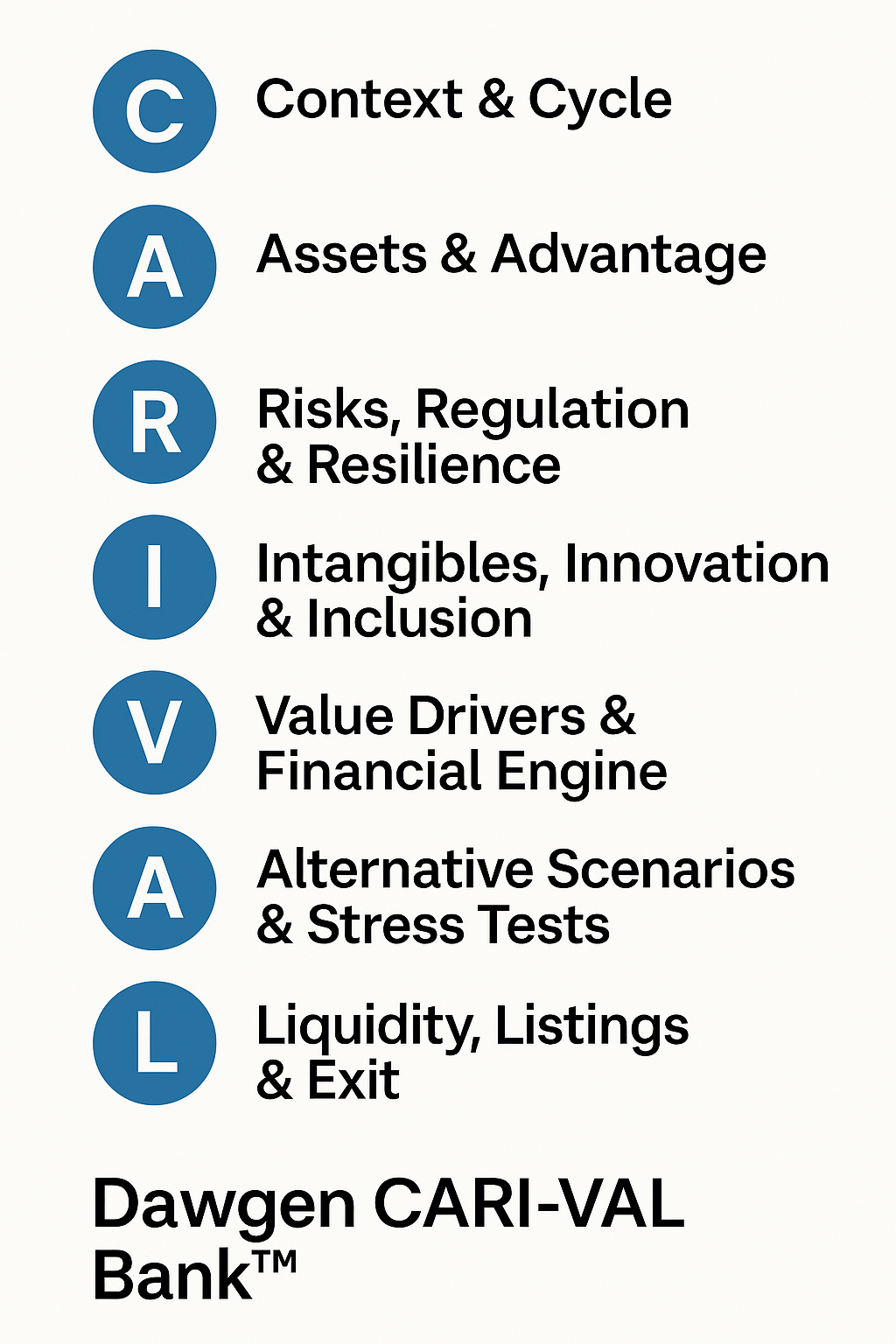
Recognising this, Dawgen Global has developed the Dawgen CARI-VAL Bank™ Framework – a structured, region-aware approach to valuing banks in Jamaica, the Caribbean and the wider LAC market. This article sets out that framework in detail and shows how it can support smarter, more defensible valuation decisions.
1. Why Bank Valuation Is Different
Before we explain the model, it’s worth recalling why banks cannot be valued like a typical trading or manufacturing business.
-
The product is money and risk
Banks are inherently leveraged; their raw material is deposits and wholesale funding, and their outputs are loans and other financial assets. Small changes in credit quality or funding costs can have big impacts on equity value. -
Balance sheet is both engine and risk map
For banks, the balance sheet is not just a snapshot; it is the primary driver of earnings, risk and regulatory capital consumption. Asset mix, loan segmentation and risk-weighting matter enormously. -
Heavy regulatory overlay
Capital adequacy, liquidity coverage, large exposure limits, provisioning requirements, governance standards — these rules limit what banks can do with their capital and how quickly they can grow or distribute earnings. -
Macro and sovereign dependency
Banks in small open economies are deeply exposed to domestic economic cycles, sovereign credit risk, FX volatility and external shocks (tourism demand, commodity prices, remittances). -
Digital disruption and changing customer behaviour
The value of a bank increasingly depends on its digital capabilities, data, customer experience and partnerships, not just its branch network and loan book.
Any serious valuation must therefore integrate risk, regulation, macro conditions, digital transformation and strategic positioning — not just balance-sheet numbers and simple multiples.
That is the role of Dawgen CARI-VAL Bank™.
2. The Dawgen CARI-VAL Bank™ Framework
Our banking model is part of the broader Dawgen CARI-VAL™ Sector Valuation Series and is tailored specifically to regulated financial institutions.
CARI-VAL stands for:
-
C – Context & Cycle
-
A – Assets & Advantage
-
R – Risks, Regulation & Resilience
-
I – Intangibles, Innovation & Inclusion
-
V – Value Drivers & Financial Engine
-
A – Alternative Scenarios & Stress Tests
-
L – Liquidity, Listings & Exit
For banks, we adapt it as Dawgen CARI-VAL Bank™, with sector-specific metrics and analytical lenses at each step.
3. C – Context & Cycle: Understanding the Playing Field
Valuation must be grounded in the environment the bank operates in.
3.1 Macro Environment
Key factors:
-
GDP Growth & Sector Mix – Is the economy diversifying (e.g. tourism, logistics, BPO, energy, digital services), or concentrated and vulnerable?
-
Inflation & Interest Rates – High and volatile rates can widen margins short term but increase credit risk and pressure borrowers.
-
FX Regime & Stability – FX availability, exchange rate volatility and convertibility risk affect funding costs, asset quality and investor appetite.
For a Caribbean bank, the same balance sheet can be valued very differently depending on whether the macro outlook suggests steady growth and gradual disinflation or stop–go cycles with FX stress.
3.2 Banking Sector Structure
We assess:
-
Market concentration (oligopoly vs fragmented market)
-
Foreign vs local ownership
-
Presence of non-bank competitors (microfinance, credit unions, fintechs, Big Tech payments)
-
Cross-border operations and regional footprint
The sector’s competitive intensity influences sustainable margins, required investment and realistic growth assumptions.
3.3 Strategic Position of the Bank
We locate the bank within its ecosystem:
-
Is it a market leader, niche player or challenger?
-
Does it have a clear strategic focus (e.g. SME, retail, corporate, wealth, digital-first)?
-
What is its record in delivering on strategy (e.g. integration of acquisitions, regional expansion, digital roll-outs)?
Context is the lens through which every subsequent valuation assumption is made.
4. A – Assets & Advantage: The Economic Engine
Banks are not valued on assets alone, but how those assets generate risk-adjusted returns.
4.1 Loan Book Composition and Quality
We dissect the loan portfolio by:
-
Segment: retail, SME, corporate, public sector, mortgages, credit cards, microfinance
-
Currency: local vs foreign
-
Sector exposures: tourism, construction, energy, agriculture, government, etc.
-
Maturity and repricing profile
We evaluate:
-
Non-performing loans (NPL) ratio and coverage
-
Rescheduled or restructured loans
-
Concentration: top borrowers, sector clusters, single-name and group exposures
This analysis influences:
-
Expected credit losses (and hence earnings normalisation)
-
Capital consumption via risk-weighted assets (RWA)
-
The risk profile embedded in the bank’s future cash flows.
4.2 Securities and Investments
For many Caribbean banks, sovereign bonds and other securities are a large part of the balance sheet.
We examine:
-
Duration and interest rate risk
-
Credit quality and sovereign exposure
-
Liquidity of the securities portfolio
-
Unrealised gains or losses and their sensitivity to rate moves
In some markets, banks effectively act as key financiers of government. This creates a tight link between sovereign and bank risk, which must be reflected in valuation.
4.3 Funding Franchise and Cost
The liability side is a major source of competitive advantage:
-
Deposit mix (current, savings, time deposits)
-
Cost of funds and ability to reprice
-
Stability and diversification of the depositor base
-
Reliance on wholesale funding or central bank facilities
A bank with a low-cost, sticky deposit base has a powerful structural advantage over peers, even if headline metrics look similar.
4.4 Business Model and Moat
We assess what makes this bank hard to replicate:
-
Geographic reach and branch network vs digital reach
-
Strength of corporate and SME relationships
-
Specialised product capabilities (trade finance, FX, structured lending, wealth management)
-
Brand, trust, and historical role in the market
These elements underpin sustainable value beyond the immediate numbers.
5. R – Risks, Regulation & Resilience
A bank’s value is as much about surviving bad times as thriving in good ones.
5.1 Regulatory Framework
We review:
-
Capital rules (Basel II/III implementation, local buffers)
-
Liquidity requirements (LCR, NSFR, local ratios)
-
Large exposure limits and related-party rules
-
Supervisory track record (onsite inspections, enforcement actions, remediation plans)
The regulator’s stance influences:
-
How much capital the bank must hold
-
Its permitted growth trajectory
-
Its dividend capacity and flexibility around business model changes.
5.2 Capital Adequacy and Quality
We analyse:
-
Total capital ratio, Tier 1 and Common Equity Tier 1 (CET1)
-
Composition of capital (common equity vs hybrids vs subordinated debt)
-
Internal capital generation (retained earnings vs external injections)
A bank may look profitable, but if capital is tight, its ability to grow or pay dividends is constrained — which directly impacts value.
5.3 Liquidity and Asset–Liability Management (ALM)
We focus on:
-
Liquidity buffers and funding gaps
-
Maturity mismatches between assets and liabilities
-
Interest rate risk in the banking book (repricing gaps, duration)
-
FX mismatches and hedging strategies
In small open economies, liquidity shocks and FX squeezes can occur quickly; resilient ALM is a core valuation driver.
5.4 Risk Governance and Controls
We consider:
-
Structure and independence of risk and compliance functions
-
Quality of internal audit
-
Board oversight, risk appetite and escalation processes
-
Track record on operational risk events, cyber incidents, AML/CFT issues
Weak governance can justify higher risk premia, lower valuation multiples or even explicit discounts.
6. I – Intangibles, Innovation & Inclusion
In a digital age, many of the most important value drivers are not visible on the balance sheet.
6.1 Brand and Customer Franchise
We examine:
-
Brand strength and reputation in retail, SME and corporate segments
-
Market share and customer loyalty
-
Net promoter scores or equivalent feedback metrics
A trusted brand is especially valuable in crisis-prone environments, where deposit flight is a real risk.
6.2 Digital Readiness and Innovation
Key questions:
-
How advanced is the bank’s digital platform (online, mobile, self-service, API connectivity)?
-
Is the bank a digital follower or leader in its market?
-
How effectively is it leveraging data and analytics for risk, marketing and product development?
-
What is the strategy regarding fintech partnerships, open banking and ecosystem plays?
Digital capability impacts:
-
Cost-to-income ratios (through process automation)
-
Customer acquisition and retention
-
Revenue diversification (e.g. interchange, digital fees, embedded finance)
Together, these influence both growth assumptions and valuation multiples.
6.3 Financial Inclusion and ESG Positioning
Caribbean banks operate in societies where access to finance, climate resilience and social impact are increasingly important.
We consider:
-
Role in supporting SMEs, micro-entrepreneurs and underbanked communities
-
Approach to green and sustainable finance
-
ESG policies, disclosures and commitments
Strong ESG positioning can reduce risk, attract new funding pools and support premium valuations over time.
7. V – Value Drivers & Financial Engine
With the context, assets, risks and intangibles understood, we turn to the quantitative engine of value.
7.1 Core Earnings Drivers
We break the bank’s earnings into:
-
Net Interest Income (NII)
-
Net interest margin (NIM)
-
Interest rate sensitivity (assets vs liabilities repricing)
-
Impact of structural hedging and duration strategy
-
-
Non-Interest Income
-
Fees and commissions (payments, cards, trade, wealth, advisory)
-
Trading and FX income
-
One-off gains (which must be normalised)
-
-
Operating Costs
-
Staff costs, IT and branch network expenses
-
Efficiency metrics: cost-to-income ratio, productivity ratios
-
-
Credit Costs
-
Expected credit losses (ECL) trends under IFRS 9
-
Normalised cost of risk across the cycle
-
-
Tax and Levies
-
Effective tax rate
-
Sector-specific levies or financial taxes
-
We normalise earnings by adjusting for non-recurring items, accounting changes and cycle distortions, building a credible base from which to project.
7.2 Capital Generation and Dividend Capacity
A bank’s value is closely tied to:
-
Its ability to generate capital organically (retained earnings net of growth consumption), and
-
Its sustainable dividend and buyback capacity within regulatory constraints.
We model capital generation after:
-
Growth in RWA
-
Regulatory buffers
-
Management’s stated capital targets
This informs both free cash flow to equity and the cost of capital.
7.3 Valuation Techniques for Banks
We typically blend several approaches:
-
Dividend Discount Model (DDM) / Free Cash Flow to Equity (FCFE)
-
Based on projected dividends or equity cash flows, consistent with regulatory capital needs.
-
-
Residual Income / Excess Return Model
-
Value derived from excess return on equity above cost of equity, applied to book value.
-
-
Market Multiples
-
Price-to-book (P/B), price-to-earnings (P/E), sometimes price-to-tangible-book (P/TB).
-
Carefully adjusted for differences in growth, risk, asset quality, capital and digital positioning.
-
-
Transaction Comparables (where relevant)
-
M&A deals in comparable markets, adjusted for control premiums and synergies.
-
The Dawgen CARI-VAL Bank™ framework ensures that inputs into these models are grounded in the earlier analysis, rather than generic assumptions.
8. A – Alternative Scenarios & Stress Tests
Bank value is highly sensitive to shocks and regime changes. We therefore insist on scenario-based valuation.
8.1 Scenario Design
Typical scenarios may include:
-
Base Case – management plan adjusted for our independent view of macro, rates, credit costs and regulation.
-
Upside Case – stronger growth, improved asset quality, successful digital initiatives.
-
Downside Case – recession, elevated NPLs, higher funding costs, sovereign or FX stress, climate event.
For each scenario we adjust:
-
Loan growth and mix
-
NIM and cost of risk
-
Fee income trajectory
-
Operating cost trends and investment needs
-
Capital actions (dividends, capital raising)
We then derive valuation ranges under each scenario.
8.2 Stress Testing
In addition to scenarios, we run sensitivity tests:
-
Interest rate shifts (parallel and non-parallel)
-
NPL shock and recovery rates
-
FX depreciation
-
Regulatory capital requirement increases
-
Higher funding spreads or loss of key correspondent relationships
Stress-testing supports:
-
A sense of downside protection (or lack of it)
-
Dialogue with boards and regulators about resilience and contingency planning
-
A valuation perspective that reflects risk, not just central expectations.
9. L – Liquidity, Listings & Exit
Finally, value is also shaped by how and where investors can realise that value.
9.1 Market Listing and Liquidity
We consider:
-
Is the bank listed? On which exchange(s)?
-
Trading liquidity: free float, daily volumes, investor base (local vs international).
-
Inclusion in indices or thematic funds.
A bank with thin trading and concentrated ownership may trade at a persistent liquidity discount, even if fundamentals are strong.
9.2 Control vs Minority Positions
We distinguish:
-
Minority stakes – where investors have limited influence and depend on dividend policy and market multiples.
-
Control transactions – where buyers can drive synergies, restructure, reallocate capital and change strategy.
Control positions may warrant premiums; minority positions may require discounts, especially in markets with weaker governance.
9.3 Exit Options
We assess realistic exit paths:
-
Trade sale to regional or international banks
-
Local or regional IPO / secondary offerings
-
Strategic partnerships and partial divestments
-
Long-term private or family ownership with limited liquidity
This informs reasonable assumptions about liquidity, required return and holding period.
10. Common Pitfalls in Caribbean Bank Valuation
Drawing on our experience, some recurring mistakes include:
-
Using raw P/B or P/E without context
Ignoring differences in asset quality, capital, growth prospects, digital capability and governance. -
Underestimating sovereign and climate risk
Treating government exposure or climate vulnerability as risk-free, rather than a factor requiring explicit adjustment. -
Overlooking regulatory constraints
Assuming dividend payout or growth rates inconsistent with capital and liquidity requirements. -
Ignoring digital disruption
Treating banks as static branch networks, when their future competitiveness depends on digital platforms, data and partnerships. -
No scenario or stress analysis
Presenting a single-point valuation without showing how sensitive value is to shocks.
The Dawgen CARI-VAL Bank™ framework is designed specifically to avoid these pitfalls.
11. How Dawgen Global Applies CARI-VAL Bank™ in Practice
At Dawgen Global, we use Dawgen CARI-VAL Bank™ across a variety of engagements:
-
Transaction Support
-
Buy-side and sell-side bank valuations for M&A, joint ventures or strategic stake sales.
-
Independent fairness opinions for boards and special committees.
-
-
Regulatory and Governance Support
-
Independent valuations for restructuring, resolution planning or capital raising.
-
Support to boards in assessing strategic options (divestment, consolidation, regional expansion).
-
-
Financial Reporting & IFRS
-
Valuation of banking subsidiaries, loan portfolios or equity stakes for IFRS fair value and impairment assessments.
-
-
Family and Private Ownership
-
Valuations for succession planning, shareholder rebalancing or estate planning in privately held financial groups.
-
What differentiates our approach is the combination of global valuation discipline with deep Caribbean and LAC insight — including the macro, regulatory, digital and sovereign realities that shape banking in the region.
Next Step: Understand What Your Bank Is Really Worth
If you are:
-
A board or CEO considering strategic options (acquisitions, divestments, capital raising, regional expansion),
-
A regulator or policymaker needing an independent view of systemic or institution-specific value,
-
A family or private owner looking at succession, buyout or partial exit, or
-
An investor or lender assessing the risk–return profile of a banking stake,
…a robust, independent valuation using a bank-specific, region-aware framework is essential.
The Dawgen CARI-VAL Bank™ Framework provides exactly that — combining rigorous quantitative models with a nuanced understanding of Caribbean and LAC banking realities.
To explore how Dawgen Global can support you with banking valuation and strategic advice:
📧 Email: [email protected]
📱 WhatsApp (Global): +1 555 795 9071
At Dawgen Global, we help you make Smarter and More Effective Valuation Decisions.
About Dawgen Global
“Embrace BIG FIRM capabilities without the big firm price at Dawgen Global, your committed partner in carving a pathway to continual progress in the vibrant Caribbean region. Our integrated, multidisciplinary approach is finely tuned to address the unique intricacies and lucrative prospects that the region has to offer. Offering a rich array of services, including audit, accounting, tax, IT, HR, risk management, and more, we facilitate smarter and more effective decisions that set the stage for unprecedented triumphs. Let’s collaborate and craft a future where every decision is a steppingstone to greater success. Reach out to explore a partnership that promises not just growth but a future beaming with opportunities and achievements.
✉️ Email: [email protected] 🌐 Visit: Dawgen Global Website
📞 📱 WhatsApp Global Number : +1 555-795-9071
📞 Caribbean Office: +1876-6655926 / 876-9293670/876-9265210 📲 WhatsApp Global: +1 5557959071
📞 USA Office: 855-354-2447
Join hands with Dawgen Global. Together, let’s venture into a future brimming with opportunities and achievements


