

Ask the finance director of almost any Caribbean company how tax is managed and you will hear about deadlines. The return is filed. The instalments are paid. The query from the revenue authority was answered in writing. By that measure, tax is under control.
But ask a different question — is our tax position set up well for where this business is going? — and the room often goes quiet. Most businesses in our region meet tax at the deadline, not at the decision. The structure was chosen when the company was founded. The financing was arranged by the bank. The second territory was entered because a customer was there, not because anyone compared the tax cost of the options. Tax arrives afterwards, as a bill.
That pattern was costly before. In 2027 it becomes risky.
The return is a record, not a plan
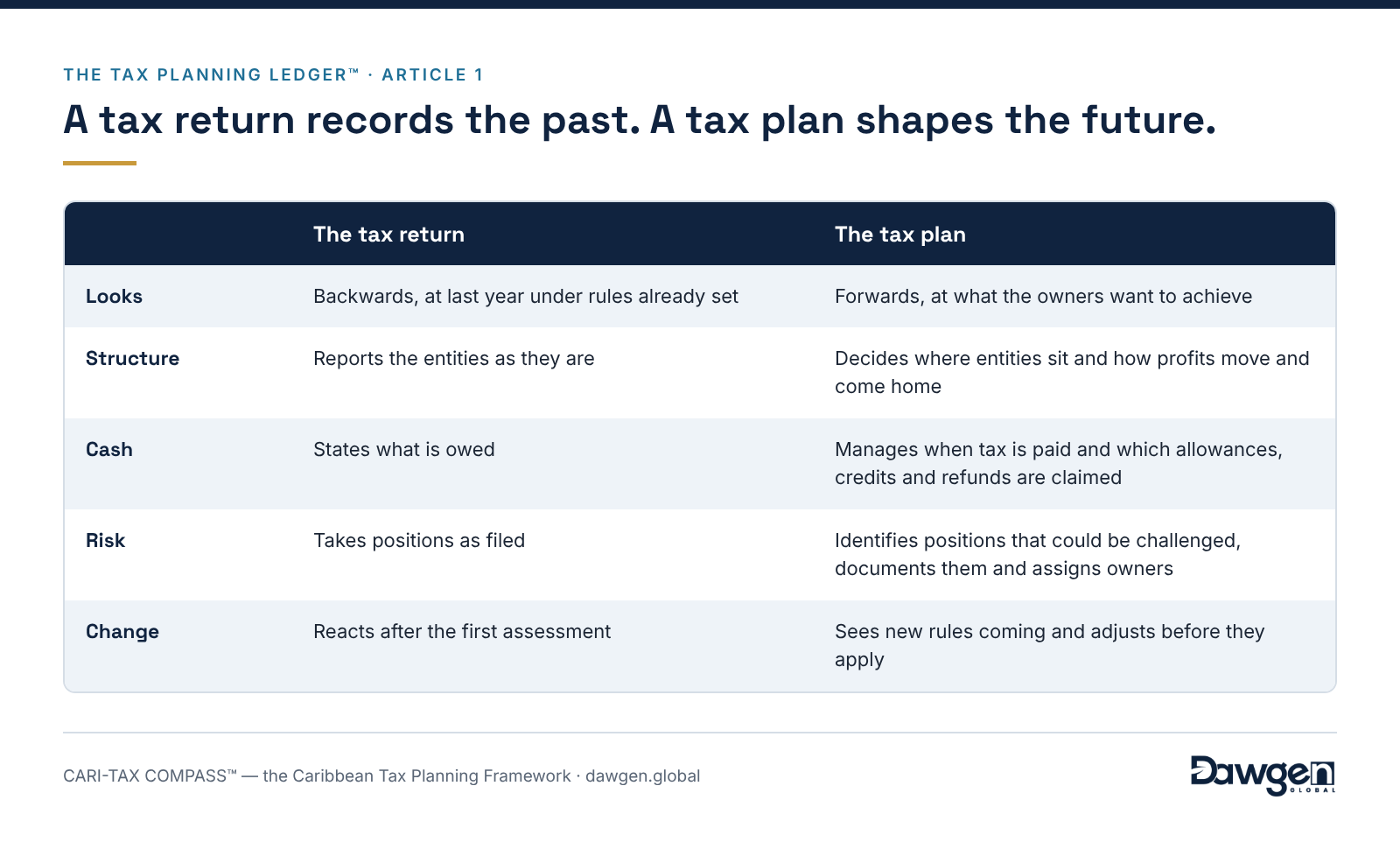
A tax return looks backwards. It reports what happened last year under rules that were already set, and it tells the revenue authority what you owe. It is essential, and it must be right. But it cannot tell a board whether the group is paying more than it needs to, whether its structure will survive a change in the law, or whether the next expansion will be taxed twice.
A tax plan looks forward. It starts with what the owners want to achieve — growth, a new market, a sale, a handover to the next generation — and asks how tax should be managed to support that goal, lawfully and with risks the board understands.
The difference shows up in four places:
- Where the group holds its entities, how profits move between them and how they come home to the owners.
- When tax is paid, which allowances and credits are claimed, and whether refunds are pursued.
- Which positions could be challenged, how well they are documented, and who in the business owns tax decisions.
- Whether the business sees new rules coming and adjusts before they apply, rather than after the first assessment.
A company can file every return on time and still lose ground on all four.
Why 2027 raises the stakes
The Caribbean tax map is changing faster than at any time in the past decade, and the changes are arriving in different territories, under different rules, at different times.
A global minimum tax has arrived in the region. Barbados enacted its Corporation Top-up Tax Act in 2024 and issued a series of guidance notes on registration, filing and payment during 2026. The Bahamas enacted its Domestic Minimum Top-up Tax Act in November 2024 and opened registration in 2026. These rules apply to large multinational groups, but their effects travel: one regional bank reported that the Bahamian top-up tax added US$10.98 million to its tax bill in a single year. Incentives that once made a territory attractive can be worth less when a top-up tax applies.
A former zero-tax centre now taxes large groups. Bermuda’s 15% corporate income tax has applied since 1 January 2025 to entities in multinational groups above the global revenue threshold. Groups that chose a structure partly for its tax result need to look again.
Foreign digital services are being brought into the tax net. Jamaica’s 2026/27 budget extends General Consumption Tax to digital services and intangibles supplied from abroad, expected to be fully operational in 2027. Trinidad and Tobago’s 2027 budget proposes VAT at the standard rate on digital services supplied by non-residents, alongside limits on the use of tax losses. Overseas suppliers will need to register and collect tax; local businesses buying software and online services will see their costs and their records change.
Revenue pressure is rising. After Hurricane Melissa, Jamaica introduced its first broad tax package in a decade, weighted towards consumption taxes. Governments under fiscal strain also tend to audit more closely.
For a business in one territory, each change is manageable. For a group in three or five territories, they combine into a question no tax return can answer: what does all of this mean for us, together, and what should we do now?
What a tax plan looks like
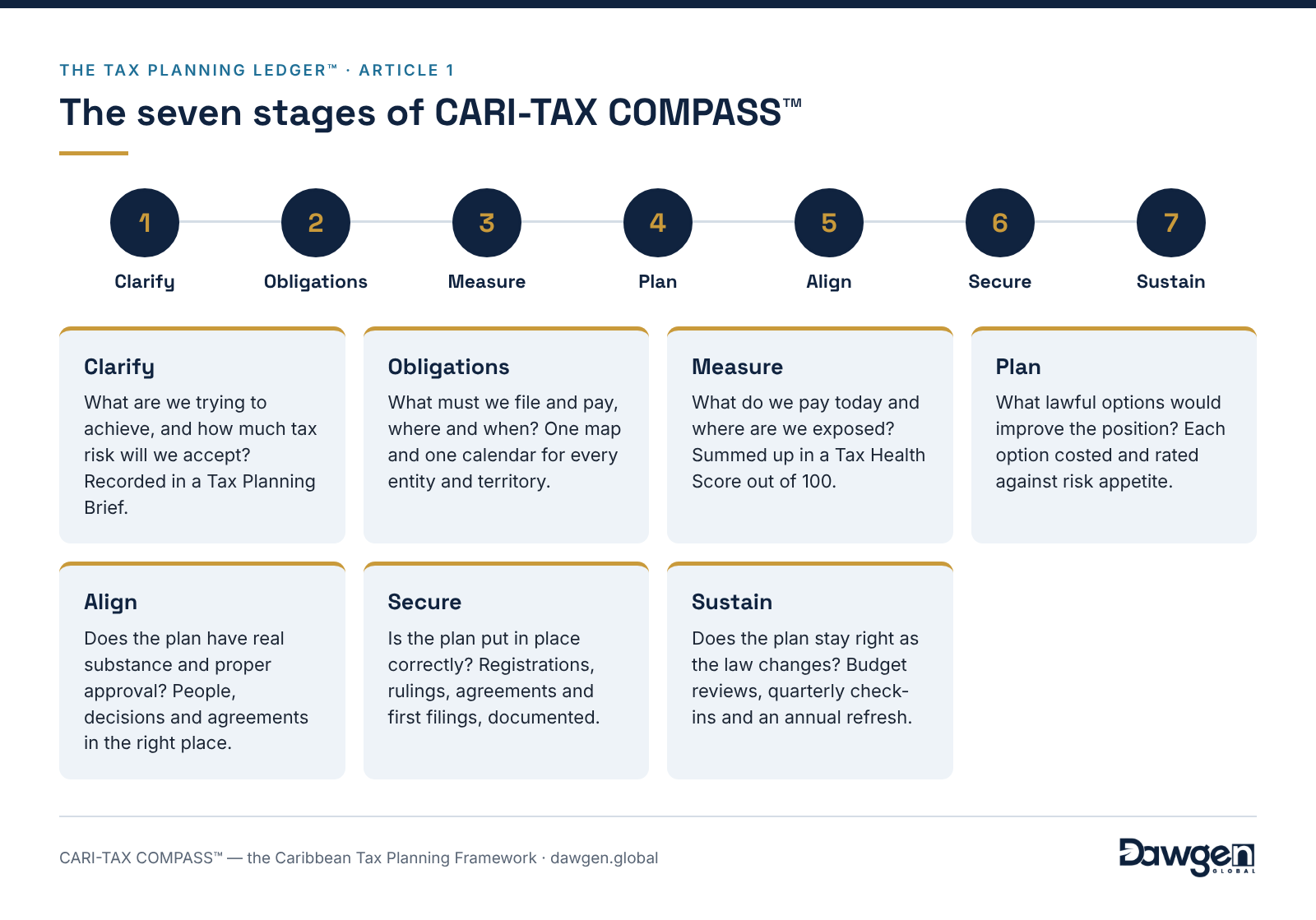
At Dawgen Global we have built our planning work around a seven-stage method, CARI-TAX COMPASS™ — the Caribbean Tax Planning Framework (CARI for Caribbean). The name matters less than the discipline behind it: every stage answers one question and ends with something the board can read and approve.
- Clarify — What are we trying to achieve, and how much tax risk will we accept? The answer is written down in a short Tax Planning Brief.
- Obligations — What must we file and pay, where and when? One map of every tax, for every entity, in every territory, with one calendar.
- Measure — What do we pay today, and where are we exposed? The effective tax rate, cash tax, exposures and unclaimed savings, summed up in a Tax Health Score out of 100.
- Plan — What lawful options would improve the position? Each option costed and rated against the board’s risk appetite.
- Align — Does the plan have real substance and proper approval? People, decisions and agreements must sit where the plan says they do.
- Secure — Is the plan put in place correctly? Registrations, rulings, agreements and first filings, completed and documented.
- Sustain — Does the plan stay right as the law changes? Budget reviews, quarterly check-ins and an annual refresh of the score.
Two things make this approach different from an annual compliance cycle. First, it starts with the business’s goals, not with the forms. Second, it repeats every year, because in a region of 35 tax systems and annual budgets, a plan that is not reviewed soon stops being a plan.
Five questions for your next board meeting
A board does not need to be expert in tax law to govern tax well. It needs to ask the right questions and expect clear answers:
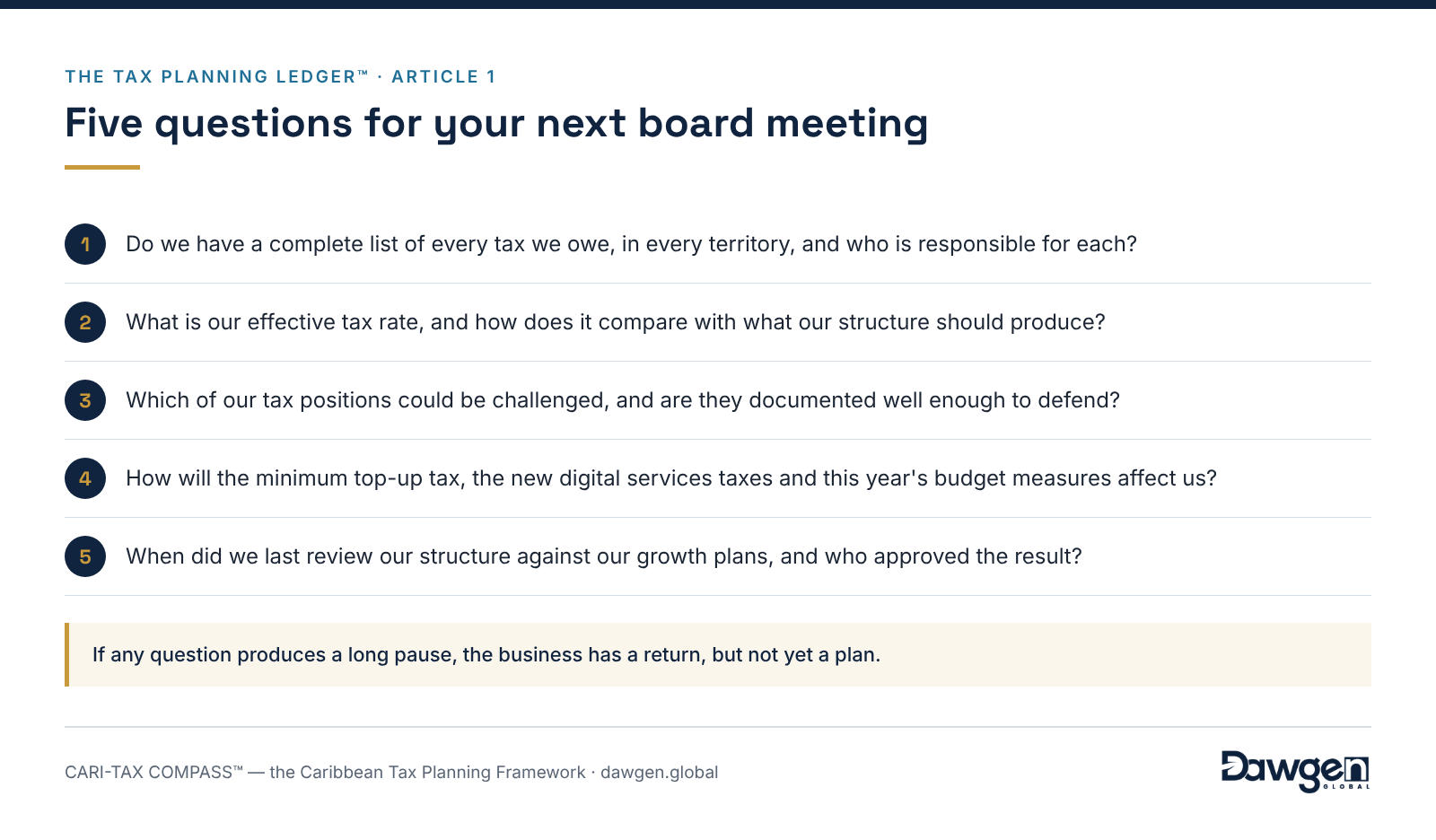
- Do we have a complete list of every tax we owe, in every territory we operate in, and who is responsible for each?
- What is our effective tax rate, and how does it compare with what our structure should produce?
- Which of our tax positions could be challenged, and are they documented well enough to defend?
- How will the minimum top-up tax, the new digital services taxes and this year’s budget measures affect us?
- When did we last review our structure against our growth plans, and who approved the result?
If any of these questions produces a long pause, the business has a return, but not yet a plan.
Where to start
The first step is to measure. Our CARI-TAX COMPASS™ Tax Health Score gives a board a single number for its tax position across six dimensions — compliance, exposure, efficiency, governance, documentation and readiness for change — and shows where attention is needed first. For businesses ready to go further, our Tax Position Diagnostic covers the first three stages of the framework in three to four weeks and ends with a costed plan.
Our 35 territory Tax Guides and Budget Reviews, one standard of analysis for every territory we serve, are the foundation for this work and are available on our website.
To discuss your tax position, contact the Caribbean Tax Service Desk at info@dawgen.global or (876) 926-5210, or reach your territory desk directly. In the next article in this series, we map what changed across the region’s 35 tax systems in 2026.
Dawgen Global — Big Firm Capabilities. Caribbean Understanding.
This article is general information and is not a substitute for advice on your circumstances.
About Dawgen Global
Dawgen Global is an independent, integrated multidisciplinary professional services firm headquartered at 47 Trinidad Terrace, New Kingston, Jamaica, serving 35 territories across the Caribbean. Founded and led by Dr. Dawkins Brown, Executive Chairman, the firm is independent and not affiliated with any international network. It delivers a full suite of professional services under one roof: audit and assurance; tax advisory; IT and digital transformation; risk management; cybersecurity; actuarial and insurance regulatory advisory; HR advisory; mergers and acquisitions; corporate recovery; business advisory and strategy; accounting BPO and virtual CFO services; and legal process outsourcing.
The proposition is simple: big-firm capability without the big-firm price. Dawgen Global’s integrated approach is built for the specific complexities and opportunities of the Caribbean market, helping organizations make sharper, better-informed decisions that drive measurable progress.
To explore a partnership, reach out:
- Website: dawgen.global
- Email: info@dawgen.global
- WhatsApp (Global): +1 555-795-9071
- Caribbean offices: +1 876-665-5926 | +1 876-929-3670 | +1 876-926-5210