

A well-designed scorecard can still fail. The measures can be balanced, defined and graded; the targets can be set by sound methods; the dashboards can be elegant. And yet nothing changes, because no one meets on a fixed rhythm to look at the results, explain them, decide what to do and check that it was done. Performance information that is not reviewed is simply decoration.
This article addresses the three elements that turn a measurement system into a management system: governance, which converts information into decisions; the link to people, which converts enterprise objectives into individual effort; and maturity, which gives the board a way to see whether the organisation’s performance capability is growing over time. Together they are what make the CARIMETRIX–CARIVANCE™ Performance System self-sustaining rather than a project that fades when the advisers leave.
Governance: the five forums
CARIMETRIX™ installs a review cadence of five forums, each with a defined purpose, chair, inputs and outputs.
| Forum | Frequency | Purpose | Key outputs |
| Board or strategy committee | Quarterly | Strategic oversight of the board scorecard, the CARIMETRIX Index and the CARIVANCE portfolio | Direction; approval of targets and major initiatives |
| Executive performance review | Monthly | Review the enterprise scorecard and exceptions | Corrective actions; resource reallocation; escalations |
| Divisional performance review | Monthly | Review divisional scorecards and process measures | Actions within divisional authority |
| CARIVANCE steering group | Fortnightly during waves | Govern improvement initiatives | Gate decisions; issue resolution |
| Team huddle | Daily or weekly | Review three to seven frontline measures | Same-day fixes; escalations |
The tiers connect. Issues that cannot be resolved at one level escalate to the next through action logs; direction and resources flow down. Each forum keeps an action log recording the action, the owner, the due date and the status, and every meeting begins by reviewing outstanding actions before any new business. This simple discipline is the single most reliable predictor of whether a performance system will change results.
Decision rights for variances
The second governance discipline is explicit decision rights: who must act, and how, when a measure goes off track.
| Variance | Who acts | Required response |
| Amber for one period | KPI owner | Commentary and corrective action |
| Amber for two periods, or red for one | Divisional head | Recovery plan with dates, reported to the executive review |
| Red for two periods | Chief executive and executive committee | Root cause review; candidate for a CARIVANCE initiative |
| Board scorecard measure red for two quarters | Board | Formal review of strategy, resources or management action |
Decision rights remove ambiguity and prevent two common failures: problems that linger because no one feels responsible for escalating them, and boards that intervene in operational detail because they have no confidence that management will act.
Commentary that drives action
Governance also depends on the quality of the commentary that accompanies each measure. CARIMETRIX requires owner commentary to answer three questions: what happened, why it happened, and what is being done about it, by whom and by when. Board packs lead with exceptions, the measures that are red or persistently amber, rather than with a full tour of every number. This keeps scarce board time focused on the decisions that matter.
Roles that make the system work
A performance system needs clear roles. The board approves the strategy, scorecard and targets and holds management to account. The chief executive owns the enterprise scorecard. A performance office, or the chief financial officer where no separate office exists, runs the performance calendar, maintains the KPI Dictionary and consolidates reporting. KPI owners are accountable for each measure’s performance; data owners are accountable for producing accurate figures on time; process owners are accountable for end-to-end processes and their control plans. Internal audit provides periodic assurance over performance data. In many Caribbean organisations these roles already exist informally; CARIMETRIX formalises them in a Performance Governance Charter approved by the board.
Linking enterprise and individual performance
The second element is the link to people. Enterprise performance improves fastest when every role can see how its objectives contribute to the scorecard. CARIMETRIX cascades the enterprise scorecard to divisional scorecards, then to process and team boards, and finally to individual performance agreements.
A typical individual agreement has four components: shared results (20–40%), drawn from enterprise or divisional measures the individual contributes to; individual results (30–50%), drawn from role-specific process or team measures; improvement contribution (10–20%), recognising CARIVANCE initiatives delivered or supported; and behaviours (20–30%), aligned to the organisation’s values.
Where performance is linked to incentives, five safeguards apply. Only measures graded A or B for data quality may drive variable pay. A gateway ensures no enterprise bonus pool is released unless minimum thresholds on profitability, or budget performance for public bodies, and compliance are met. Counter-measures prevent gaming. Incentive targets are approved by the board or its remuneration committee and are not changed mid-year except for defined events. And results are calibrated across teams so ratings are consistent. Managers hold quarterly conversations with staff using the same scorecard data the executive reviews, so individual discussions rest on shared facts rather than opinion.
The maturity model: measuring the measurement system
The third element is maturity. Boards need to know not only how the organisation is performing, but whether its capability to manage performance is improving. CARIMETRIX provides a five-level maturity model assessed across eight capabilities.
| Capability | Level 1 Reactive | Level 3 Defined | Level 5 Optimising |
| Strategy linkage | No documented link | Strategy map and scorecard in place | Strategy and measures refreshed dynamically |
| Measure design | Ad hoc, mostly financial | KPI Dictionary, balanced dimensions | Predictive measures and scenario modelling |
| Targets | Last year plus a percentage | Documented target methods | Rolling targets tied to strategic ambition |
| Data and reporting | Manual and late | Graded data, standard dashboards | Near real-time, self-service analytics |
| Review and governance | Reports circulated, rarely discussed | Fixed cadence with action logs | Performance conversations at every level |
| Improvement capability | Firefighting | CARIVANCE applied to priority gaps | Continuous improvement culture, staff-led |
| People linkage | Appraisals unrelated to results | Cascaded scorecards | Capability building linked to performance gaps |
| Assurance | None | Periodic internal audit review | Integrated assurance over performance reporting |
Levels 2 (Developing) and 4 (Managed) sit between these anchors. Each capability is scored from one to five using evidence such as documents, interviews and data tests, and the overall score is the average. Most organisations we assess begin at Level 1 or 2. A realistic target is one to two levels of improvement within 12 to 18 months, re-assessed annually so the board can see progress in the system itself, not only in the results it produces.
Caribbean realities in governing performance
Board time is scarce. Many Caribbean directors serve on several boards and meet quarterly. Exception-led packs, a one-page board scorecard and a single CARIMETRIX Index help them focus on what matters.
Management teams are small. In lean organisations the same executives sit in every forum. The cadence must be proportionate: monthly executive reviews may combine divisional reviews, and team huddles may be weekly rather than daily.
Group structures span territories. Multi-territory groups benefit from a common scorecard architecture and calendar, so subsidiaries can be compared and consolidated without reconciliation.
Public accountability. Public bodies answer to ministries, oversight bodies and citizens. A documented governance charter, timely performance reporting and assurance over performance information strengthen that accountability.
Eight questions for the board
- Does every performance forum keep an action log, reviewed at the start of each meeting?
- Are decision rights for off-track measures written down and followed?
- Does owner commentary explain what happened, why, and what will be done by whom and when?
- Does our board pack lead with exceptions?
- Can every manager see how their objectives contribute to the enterprise scorecard?
- Are incentives driven only by reliably graded measures, with a gateway and counter-measures?
- What maturity level are we at today, and what level do we target in 18 months?
- Would our performance system continue to run if our advisers left tomorrow?
The CARIMETRIX–CARIVANCE™ framework in full
Dawgen Global’s CARIMETRIX–CARIVANCE™ Performance System joins measurement and improvement in a single loop. CARIMETRIX™ shows leadership where performance stands and why it matters. CARIVANCE™ turns the gaps that CARIMETRIX reveals into funded, owned and verified improvements. A governance layer turns information into decisions, and a set of enablers (graded data, dashboards, trained owners and assurance) keeps the loop turning year after year.
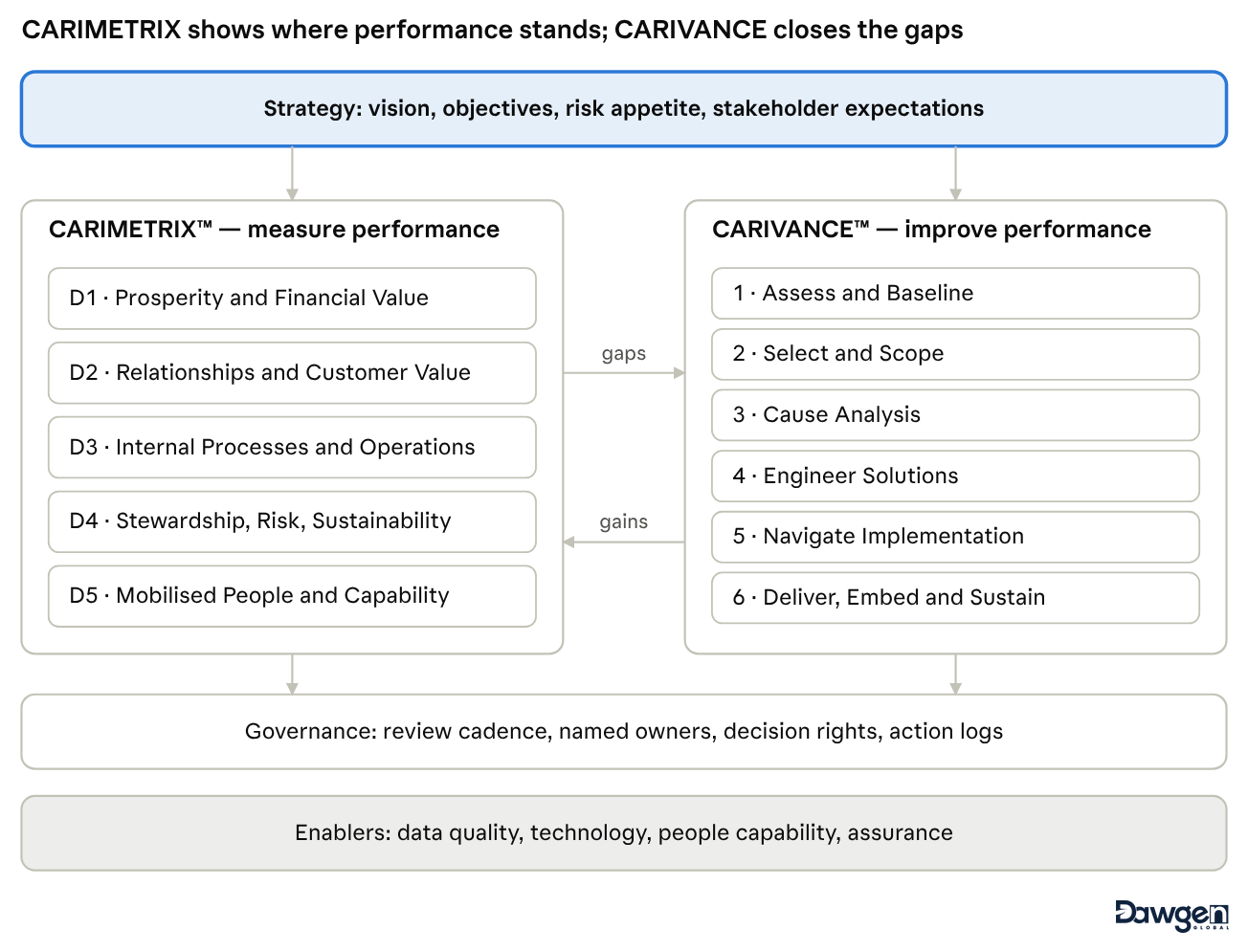
Exhibit 1 · The CARIMETRIX–CARIVANCE™ architecture
CARIMETRIX™: five dimensions of performance
| Code | Dimension | The board question it answers | Typical scorecard weight |
| D1 | Prosperity & Financial Value | Are we creating sustainable financial value? | 25–35% |
| D2 | Relationships & Customer Value | Are customers, members, citizens and partners better served? | 15–25% |
| D3 | Internal Processes & Operational Excellence | Are our processes efficient, reliable and cost-effective? | 15–25% |
| D4 | Stewardship, Risk & Sustainability | Are we well governed, compliant, resilient and responsible? | 10–20% |
| D5 | Mobilised People & Capability | Do we have the people, skills, culture and technology to deliver? | 10–20% |
The dimensions form a cause-and-effect chain read from the bottom up: capable people and systems (D5) enable excellent processes (D3) and sound stewardship (D4); these deliver valued relationships (D2), which in turn produce sustainable financial value (D1). Weights are calibrated to each organisation: a public body or charity shifts weight towards D2 and D4, while a business in turnaround shifts weight towards D1 and D3.
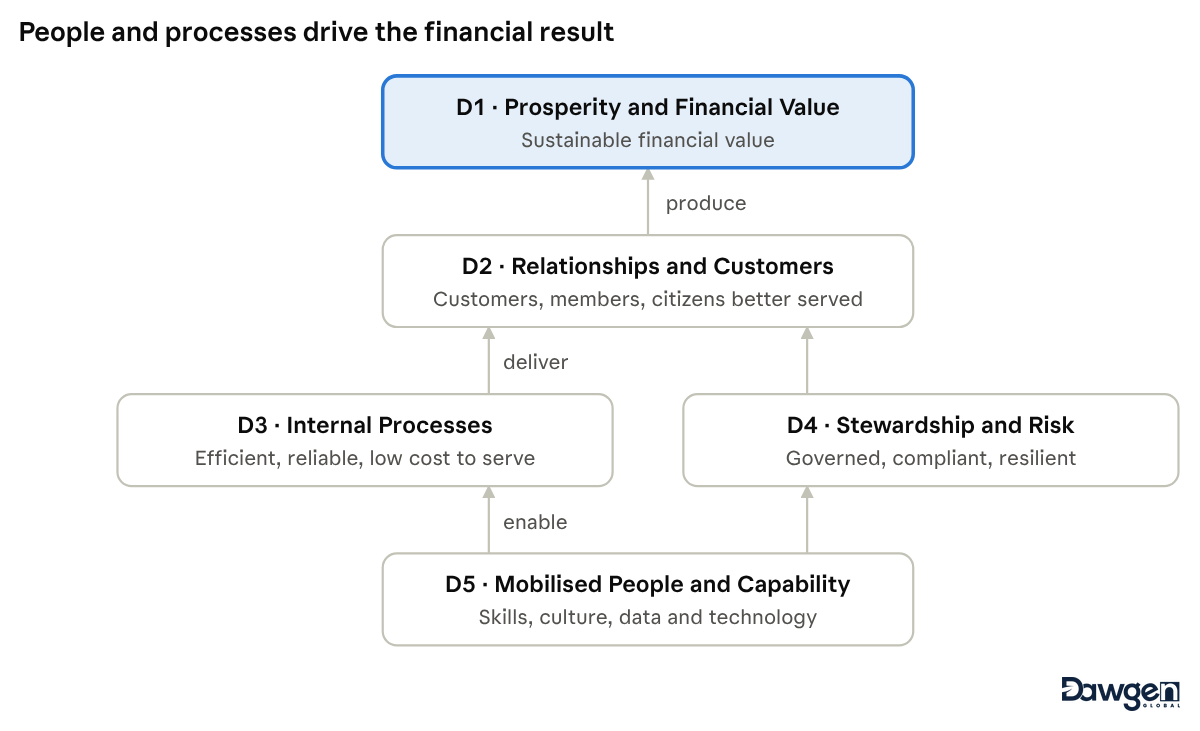
Exhibit 2 · The CARIMETRIX™ value linkage
Building the measurement system: eight steps
- M1 Mandate and strategic clarity — executive and board interviews and a health check of every existing measure.
- M2 Strategy mapping — 12–20 objectives across the five dimensions, with their cause-and-effect links.
- M3 Measure selection — candidate measures tested against seven tests: strategic, decision, controllable, measurable, understandable, timely and ungameable.
- M4 KPI definition — every key performance indicator (KPI) defined on a card recording its formula, source, owner, polarity, thresholds and a counter-measure against gaming.
- M5 Baselining and target setting — 12–36 months of history where available, and targets set by one of five documented methods: historical trend, benchmark, capability-based, strategic requirement, or stretch with a glide path.
- M6 Data and reporting architecture — data flows mapped, data quality graded from A to D, dashboards and board packs designed.
- M7 Cascade — the enterprise scorecard translated into divisional, process and team scorecards.
- M8 Governance and go-live — review cadence installed, two parallel reporting cycles run and owners trained.
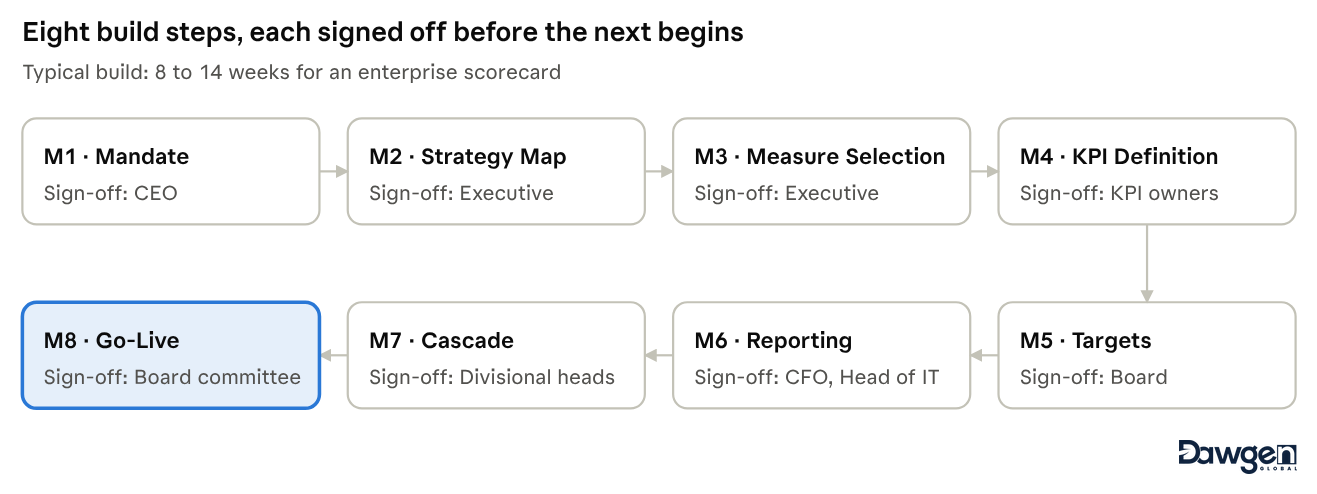 Exhibit 3 · Building the measurement system: steps M1–M8
A typical enterprise scorecard holds 15 to 25 measures. Every lagging outcome is paired with at least one leading indicator that predicts it. Each measure is scored from 0 to 100 against its thresholds: 100 at or beyond target, 50 at the edge of tolerance, and proportionally between. Scores roll up into five dimension scores and a single weighted CARIMETRIX Index, reported to the board with the trend and the data quality grade behind each figure. Grade A means system-generated, reconciled and independently reviewed; grade D means manual, unreconciled or estimated. Only grade A or B measures may drive incentive pay.
CARIVANCE™: six gated phases of improvement
| Phase | Core question | The gate that closes it |
| 1 Assess & Baseline | Where exactly are we, and how big is the gap? | Baseline agreed; value at stake quantified |
| 2 Select & Scope | Which gaps are worth closing first? | Charters signed; resources committed |
| 3 Cause Analysis | Why does the gap exist? | Root causes proven by data, not opinion |
| 4 Engineer Solutions | What will close the gap, and is it worth it? | Business case approved; benefits owner named |
| 5 Navigate Implementation | How do we deliver the change on time and on budget? | Solution live; procedures updated; owners trained |
| 6 Deliver, Embed & Sustain | Have the gains been achieved, and will they last? | Benefits verified by Finance; gains held for two cycles |
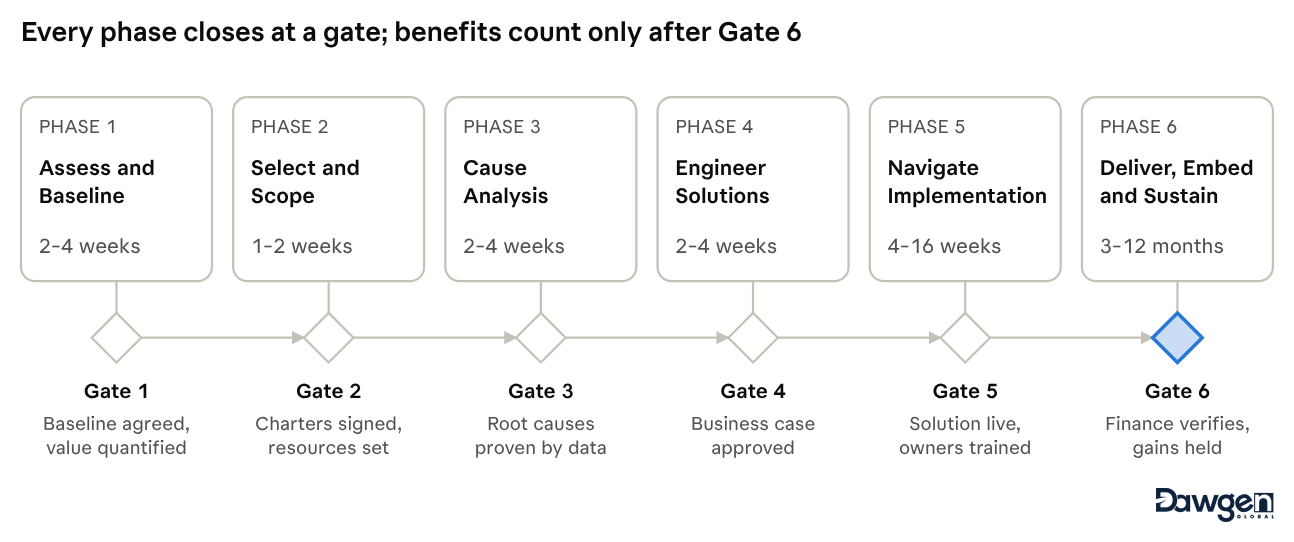 Exhibit 4 · CARIVANCE™ phases and gates
CARIVANCE draws on Lean, the Six Sigma DMAIC (Define, Measure, Analyse, Improve, Control) cycle, theory of constraints and benefits realisation management, adapted for lean Caribbean teams. Improvement runs in waves of three to seven initiatives so that projects finish. Four rules govern benefits: Finance, not the project team, signs off financial benefits; every benefit is classified as cash-releasing, non-cash or risk reduction; a single benefits register prevents double counting; and capacity freed is not counted as savings until it is redeployed or removed.
Governance, people and maturity
Five forums run on a fixed rhythm: the board or strategy committee quarterly; an executive performance review and divisional reviews monthly; a CARIVANCE steering group fortnightly during improvement waves; and team huddles daily or weekly. Every forum keeps an action log. Decision rights are explicit: a measure amber for one period requires owner action; amber for two periods or red for one requires a divisional recovery plan; red for two periods triggers an executive root cause review and becomes a candidate for CARIVANCE; a board measure red for two quarters prompts a formal board review.
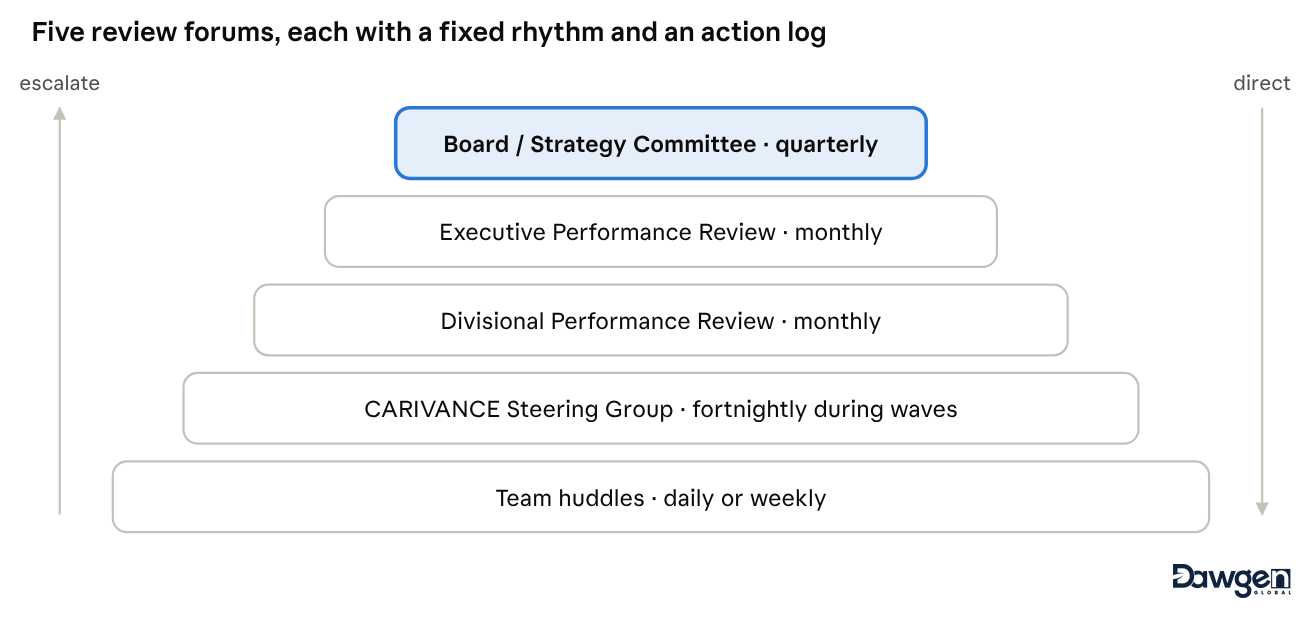 Exhibit 5 · The five review forums
The enterprise scorecard cascades to divisional scorecards, process and team boards, and individual performance agreements that typically weight shared results at 20–40%, individual results at 30–50%, improvement contribution at 10–20% and behaviours at 20–30%. Progress is tracked on a five-level maturity model (Reactive, Developing, Defined, Managed and Optimising) across eight capabilities: strategy linkage, measure design, targets, data and reporting, review and governance, improvement capability, people linkage and assurance. Most organisations begin at Level 1 or 2; a realistic aim is one to two levels within 12 to 18 months. The method is supported by a toolkit of 24 controlled templates, from the Strategic Clarity Interview Guide to the Benefits Tracker and Sustainment Audit.
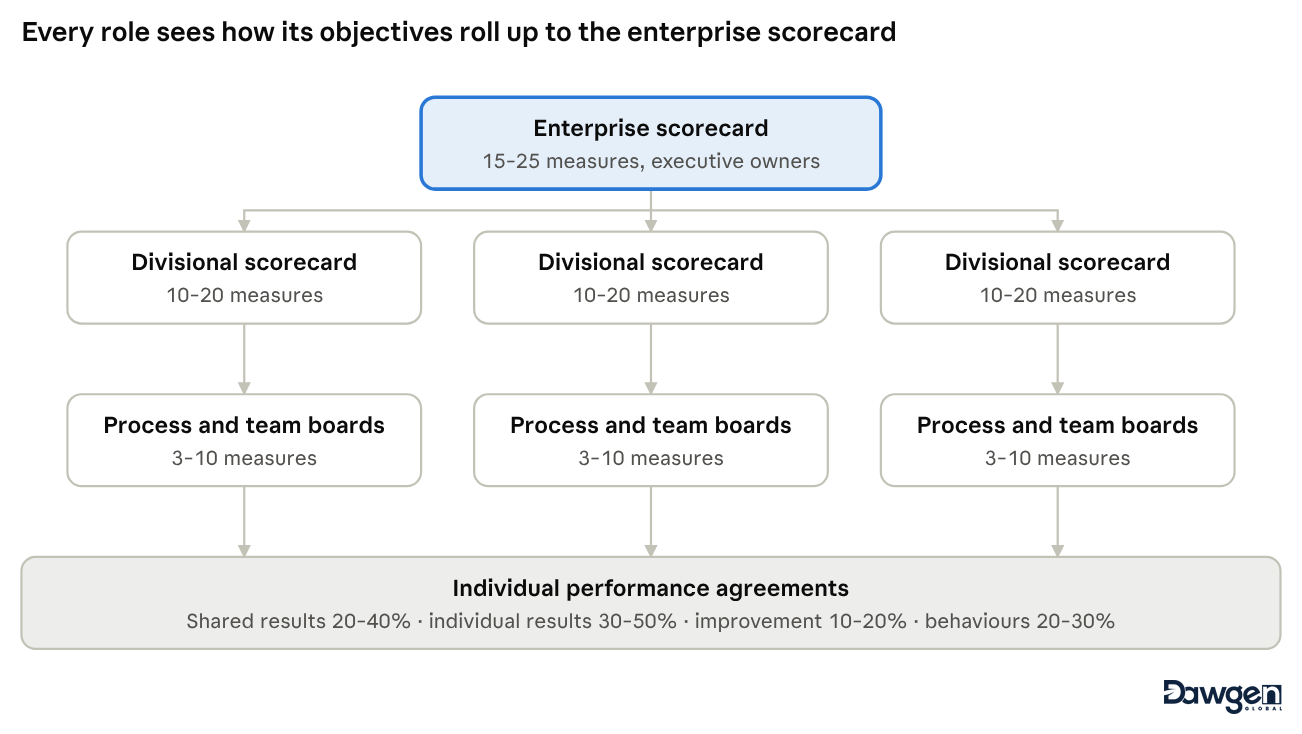 Exhibit 6 · Cascading the scorecard to individuals
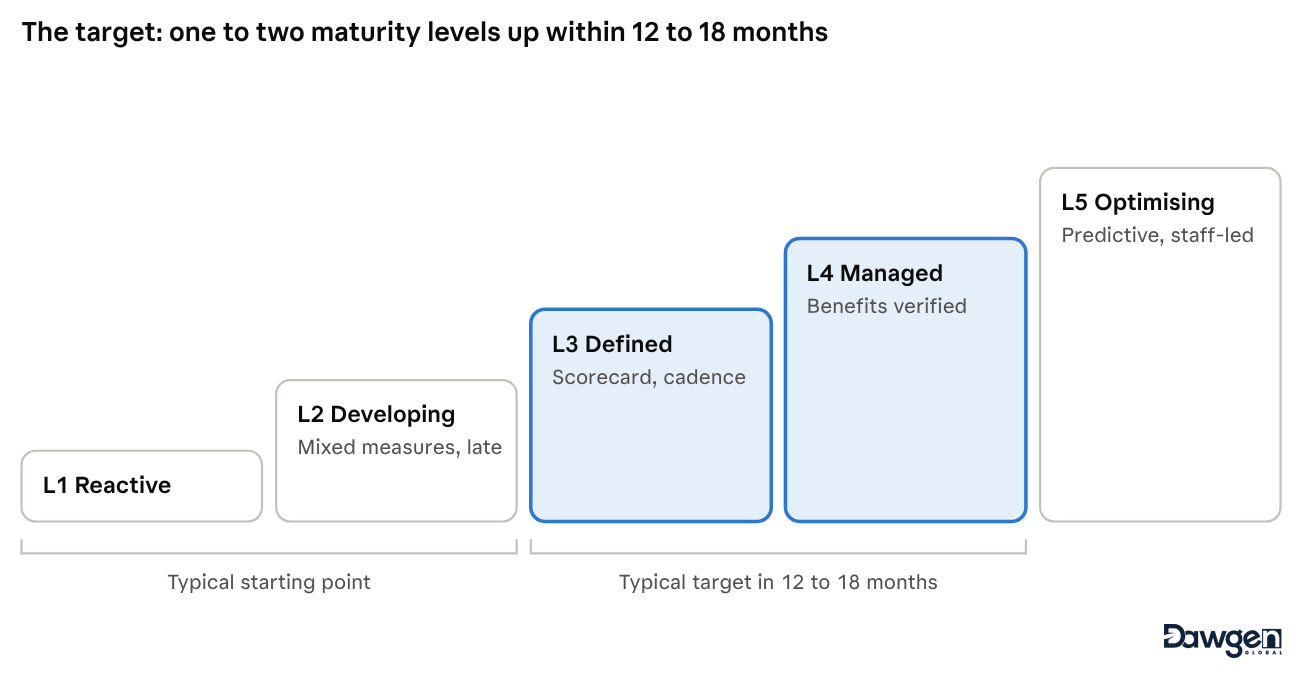 Exhibit 7 · The CARIMETRIX–CARIVANCE™ maturity journey
Design principles and delivery
Six principles govern every CARIMETRIX–CARIVANCE™ engagement. Strategy comes first: every measure traces to a stated objective, and measures without an owner or a decision attached are retired. Measures are few, balanced and decision-grade. Evidence comes before action: no improvement starts without a baseline, and none closes without verified, sustained results. Ownership and cadence are fixed: named owners meet on a set rhythm to review results and commit to dated actions. The system is built for Caribbean reality: thin data, lean teams, multi-territory groups, regulatory demands and exposure to climate and economic shocks. And Dawgen Global owns delivery, then transfers capability: the firm builds the system and completes the improvement work, then trains the client’s team to run it.
Clients can engage through five service modules, individually or as an integrated programme: a Performance Diagnostic (maturity assessment, measurement health check and value-at-stake estimate); a CARIMETRIX Scorecard Build covering steps M1 to M8; a CARIVANCE Improvement Wave of three to seven initiatives taken through all six phases; Performance Reporting as a Service, delivering monthly scorecards and board packs; and Assurance over Performance Information, an independent review of KPI data, definitions and published performance statements. In an indicative integrated programme, measurement is live within about four months and the first verified gains arrive within about nine, because the first improvement wave begins while the scorecard is being finished.
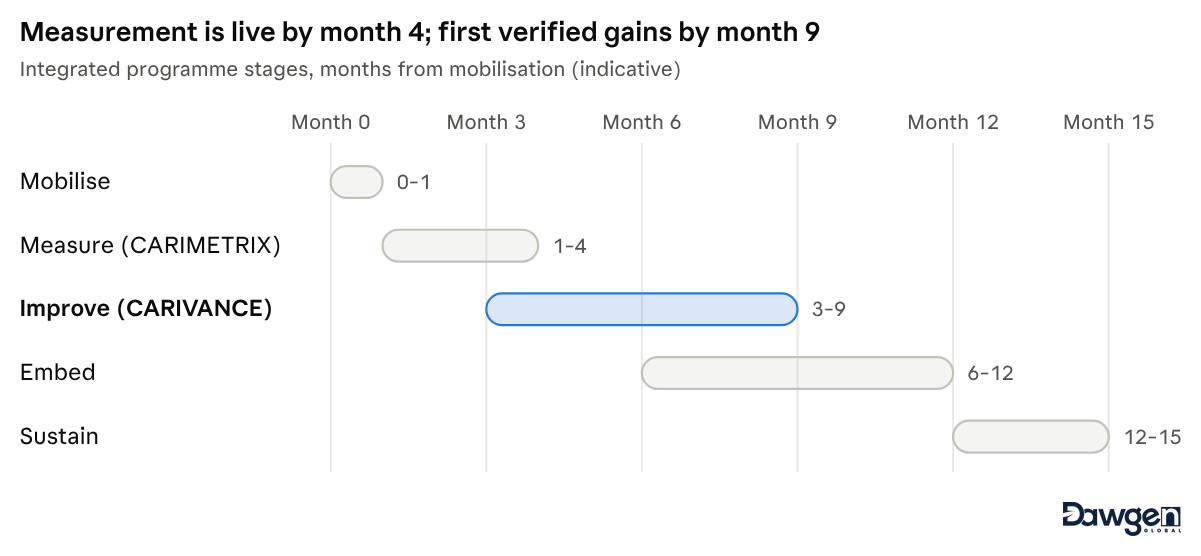 Exhibit 8 · Indicative integrated programme roadmap
Quality controls protect the result: every scorecard measure must trace to an objective; no measure goes live without an approved definition card; each KPI is reconciled to its source for at least two periods; two parallel reporting cycles run before go-live; each CARIVANCE gate is evidenced and signed by the sponsor; Finance signs off financial benefits; and a senior reviewer independent of the delivery team reviews final deliverables. These controls guard against the most common pitfalls: measuring what is easy rather than what matters, targets that drive the wrong behaviour, dashboards nobody uses, too many initiatives at once, solutions chosen before causes are proven, benefits claimed but never banked, and gains that fade once the project team leaves.
Taking the next step
If your performance reports are produced faithfully but rarely change what happens next, the missing ingredient is governance. Dawgen Global’s Growth & Recovery and Finance & BPO teams deliver CARIMETRIX–CARIVANCE™ engagements across the Caribbean, beginning with a Performance Diagnostic that assesses maturity, tests the health of current measures and estimates the value at stake. To discuss your organisation’s performance system, write to info@dawgen.global or visit dawgen.global.
Dawgen Global is an independent, integrated multidisciplinary professional services firm serving 35 territories across the Caribbean and the Americas, and is not affiliated with any international network. As a multidisciplinary firm, Dawgen Global offers some regulated services; in each case the head of the regulated division holds the appropriate professional practice licence in the respective jurisdiction. CARIMETRIX™ and CARIVANCE™ are proprietary frameworks of Dawgen Global.
About Dawgen Global
Dawgen Global is an independent, integrated multidisciplinary professional services firm headquartered at 47 Trinidad Terrace, New Kingston, Jamaica, serving 35 territories across the Caribbean. Founded and led by Dr. Dawkins Brown, Executive Chairman, the firm is independent and not affiliated with any international network. It delivers a full suite of professional services under one roof: audit and assurance; tax advisory; IT and digital transformation; risk management; cybersecurity; actuarial and insurance regulatory advisory; HR advisory; mergers and acquisitions; corporate recovery; business advisory and strategy; accounting BPO and virtual CFO services; and legal process outsourcing.
The proposition is simple: big-firm capability without the big-firm price. Dawgen Global’s integrated approach is built for the specific complexities and opportunities of the Caribbean market, helping organizations make sharper, better-informed decisions that drive measurable progress.
To explore a partnership, reach out:
- Website: dawgen.global
- Email: info@dawgen.global
- WhatsApp (Global): +1 555-795-9071
- Caribbean offices: +1 876-665-5926 | +1 876-929-3670 | +1 876-926-5210