
How Dawgen Global’s branded, end‑to‑end M&A model helps leaders de‑risk decisions and accelerate value creation
Mergers and acquisitions are never just financial events. They are strategic choices under uncertainty—choices that can redefine a company’s direction for a decade or more. Yet too many deals still hinge on optimistic narratives, incomplete diligence, and spreadsheet gymnastics. Dawgen Global’s ACQUIRE360™ changes that.
ACQUIRE360™ is our branded, end‑to‑end M&A framework that connects strategic intent to disciplined execution, value‑focused diligence, and triangulated valuation. It is designed for CEOs, boards, corporate development teams, private equity sponsors, and founder‑owners who want a repeatable way to find the right target, pay the right price, and realize the right value—fast.
At its core, ACQUIRE360™ integrates seven building blocks—ACQUIRE™—with a stage‑gated timeline, a three‑dimensional diligence engine (DILIGENCE3D™), and a four‑lens valuation toolkit (ValueQuad™). The result is a practical operating system that helps leaders move from thesis to term sheet to Day‑1 and the first 100 days of integration with clarity and control.
Why a Different M&A Model Is Needed Now
Global and regional dealmaking cycles have shifted. Capital has become more selective, financing costs are structurally higher than the ultra‑low rates of the past decade, and regulatory scrutiny is sharper. In the Caribbean and wider Americas, cross‑border transactions bring additional layers—FX exposure, legal regimes, capital controls, and cultural context. The traditional playbook—long lists and ad‑hoc filters, hurried diligence, and a “best guess” valuation—simply isn’t good enough.
Clients have told us they want three things: speed with discipline, transparency about risks, and confidence in value. ACQUIRE360™ was built to deliver on those three demands.
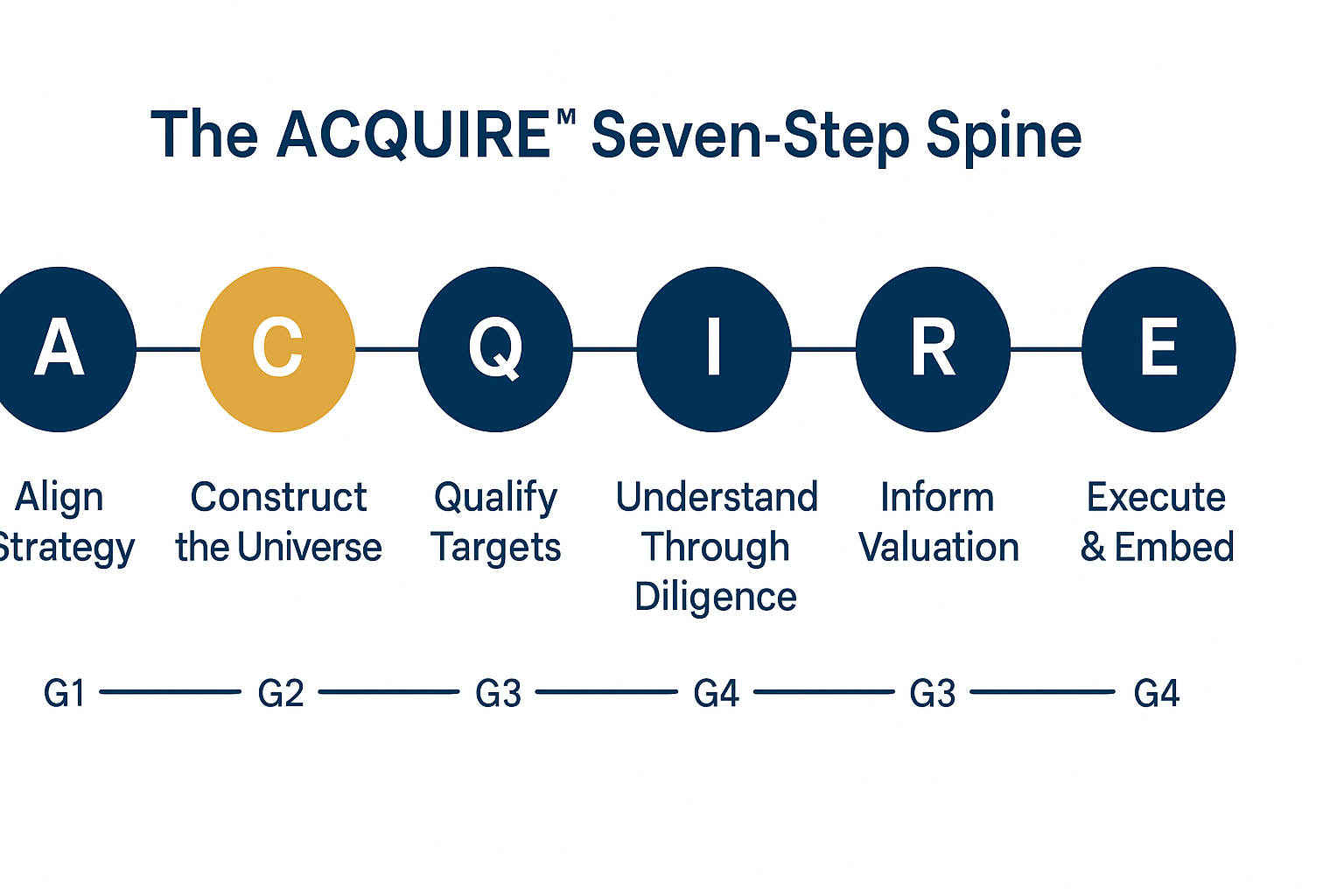
The ACQUIRE™ Seven‑Step Spine
ACQUIRE360™ is anchored in a memorable seven‑step sequence—ACQUIRE™—that supplies the logic and cadence for a successful transaction. Each step has clear objectives, artifacts, and decision gates.
A — Align Strategy
Every deal should start with a precise statement of why this deal and why now. We define the investment thesis, the sources of value (revenue acceleration, cost efficiency, capability lift, risk mitigation), the risk appetite, and the boundary conditions (ticket size, geography, capabilities, timing, and governance). The output is an Investment Charter that keeps all stakeholders aligned.
C — Construct the Universe
We go wide before we go deep. Using market mapping and proprietary screens, we create a Target Universe and visualize it with a Target Heatmap™. We then compute a Target Fit Score (TFS) to rank opportunities by strategic fit, market position, financial quality, customer resilience, and integration ease. The long‑list becomes a prioritized short‑list.
Q — Qualify Targets
Rapid Red/Amber/Green qualification removes sentiment from early decisions. We validate must‑have criteria and deal breakers, pressure‑test preliminary KPIs, and assess management access and data readiness. This minimizes time spent on low‑probability paths and protects process momentum.
U — Understand Through Diligence
This is where value is protected—or lost. Our DILIGENCE3D™ approach combines Market, Financial, and Customer lenses, augmented by Legal/Tax/People/Tech/ESG modules as needed. The aim isn’t to check every box; it is to concentrate effort where value lives and where risk hides.
I — Inform Valuation
We triangulate value, not fixate on a single number. ValueQuad™ combines Public Comps, M&A Comps, DCF, and Pro Forma analysis to generate a valuation range with a fairness narrative and sensitivity analysis. This protects you from paying strategic prices for commodity assets—or missing out on a mispriced gem.
R — Run the Process
We choose the right path—bilateral negotiation versus structured auction—and then manage the data room, bidder communications, term sheet architecture (locked‑box vs completion accounts), reps and warranties, W&I insurance, and financing certainty. The goal: win on terms that protect value creation.
E — Execute & Embed
Deals are signed by executives, but value is created by operators. We enter the Execution phase only when the integration plan is real. Our 100‑Day Value Map™ aligns leadership, customers, and systems with Day‑1 readiness, synergy tracking, and a KPI cadence that prevents “deal fatigue.”
The Four‑Phase Acquisition Timeline
ACQUIRE360™ runs on a stage‑gated timeline that aligns teams and decisions.
Phase 1: Preparation & Evaluation (Weeks 0–6)
- Objective: Clarify strategic intent; shape the target universe; prioritize the short‑list.
- Key Activities: Retain advisors; draft the Investment Charter; develop the value blueprint; build the Target Heatmap™; compute TFS; conduct early desktop diligence on market size/growth, competitive dynamics, and regulation.
- Deliverables: Investment Charter, Target Universe, TFS Top‑20, Diligence Plan v1.
- Gate: G1 — Go/No‑Go to Indicative Outreach.
Phase 2: Decision (Weeks 6–8)
- Objective: Narrow to the priority target(s); approve an IOI range and the diligence budget.
- Key Activities: Management calls, site visits, preliminary KPI pulls, early risk flagging, and IOI framing.
- Deliverables: IOI Deck, Diligence Scope v2, Valuation guardrails.
- Gate: G2 — Approve IOI & Diligence Spend.
Phase 3: Negotiation / Auction (Weeks 8–14)
- Objective: Win on terms that protect value creation.
- Key Activities: Populate VDR; manage Q&A; craft bid strategy; structure term sheet (earn‑outs, caps/baskets, MAC, covenants); secure financing term sheets and hedging plans.
- Deliverables: Binding Offer, Term Sheet, Financing Package, SPA/APA markups.
- Gate: G3 — Approve Binding Bid & Financing.
Phase 4: Execution (Weeks 14–24+)
- Objective: Sign, close, and embed value with momentum.
- Key Activities: Final diligence confirmations; regulatory clearances; CP tracking; Day‑1 operating rhythm; synergy tracking; leadership communications; culture plan.
- Deliverables: Signed/Closed Deal, Day‑1 Playbook, 100‑Day Value Map™, KPI dashboard.
- Gate: G4 — Close & Transition to Integration Office.
DILIGENCE3D™: Depth Where It Matters
Diligence should answer one question decisively: What must be true for this deal to create value—and how confident are we that it is true? Our three lenses combine to answer that question.
1) Market Lens
We assess TAM/SAM/SOM, growth drivers, supply chain resilience, buyer power, regulation, and margin dynamics. We map the industry structure with an extended Five Forces, identify the sources of pricing power, and score entry barriers. We also review policy environments and cross‑border constraints relevant to the Caribbean and wider Americas—competition thresholds, exchange controls, tax treaties, and local employment law.
2) Financial Lens
We conduct a focused Quality of Earnings (QoE) review, including revenue recognition policies, customer and product mix, seasonality, and unit economics. We evaluate cash conversion, working capital cadence, capex cycle, and off‑balance‑sheet exposures. We model historical performance alongside management projections to test sensitivities to FX, interest rates, and commodity prices. We also derive covenant headroom and test “ability to delever” under various downside cases.
3) Customer Lens
We analyze segmentation, cohort retention, LTV/CAC, churn, NPS/CSAT, and contract tenor/cliff risk. We compute the Customer Concentration Ratio (CCR) and build Key Account Risk Cards that inform commercial diligence priorities and Day‑1 actions. The aim is to protect the revenue base that underwrites your valuation.
Extended Modules
Depending on deal type, we extend to Legal/Tax, People/Leadership, Technology/Cyber, Operations/Footprint, ESG/Climate, IP/Data, Compliance, and Insurance. Each module has a right‑sized request list and a risk‑ranked output to focus decision makers quickly.
ValueQuad™: Four Lenses, One Decision
Price is a negotiation; value is an assessment. ValueQuad™ ensures the assessment is robust.
- Public Market Comparables — We curate a peer set by business model, growth, and quality. We examine trading multiples (EV/Revenue, EV/EBITDA, P/E, occasionally EV/EBIT or P/BV) and apply adjustments for scale, growth, cyclicality, and control/minority differences.
- M&A Transaction Comparables — We analyze private and public transactions by sector/size/region, adjusting for synergy content, process type (competitive auction vs negotiated), and vintage. This helps frame “what buyers actually paid.”
- Discounted Cash Flow (DCF) — We ground assumptions in the investment thesis and conduct structured sensitivity analysis on WACC, terminal value (Gordon vs exit multiple), and key operating drivers. Where appropriate, we incorporate real options (e.g., staged market expansion) to reflect managerial flexibility.
- Pro Forma (Deal Model) — We quantify accretion/dilution, timing of synergies, financing costs, purchase accounting impacts, and covenant tests. We track IRR/MOIC/payback across Base, Upside, and Downside cases—and show the implied Walk from Enterprise Value to Equity Price.
The output is a Valuation Range supported by a Fairness Narrative and a Sensitivity Tornado that makes trade‑offs explicit to boards and investment committees.
Strategic Considerations with STRAT‑ALIGN™
Deals do not happen in a vacuum. Our STRAT‑ALIGN™ overlay ensures strategy and structure reinforce each other.
- Motivations to Sell/Buy: consolidation, market entry, capability acquisition, vertical integration, portfolio optimization, spin‑offs/carve‑outs.
- Alternatives to Selling: partnerships/JVs, minority stakes, licensing, commercial alliances, or building internally.
- Buyer/Seller Universe: strategics, sponsors, family offices, sovereign investors, and MBO/MBI pathways.
- Financing the Deal: bank debt, private credit, mezzanine, seller notes, earn‑outs, equity bridges—plus hedging for currency and rates.
- Country/Regulatory Overlays: competition filings, data residency, exchange controls, tax treaty benefits, and local labor rules.
The decisions you make here affect price, speed, certainty, and integration complexity more than many leaders realize.
Governance, Roles, and Cadence
ACQUIRE360™ requires governance that is fast and auditable. We use four gates—G1 to G4—with clear entry/exit criteria. The Investment Committee owns capital allocation; the Diligence SteerCo manages cross‑functional workstreams; the Integration PMO holds Day‑1 and the first 100 days. A standard RACI keeps accountability visible: Sponsor (A), Strategy/Finance (R), Legal/HR/IT/Ops (C), Dawgen M&A (R), Board (I). We maintain a weekly SteerCo, bi‑weekly IC updates, and a shared KPI dashboard from Day‑1.
Metrics That Matter
- Target Fit Score (TFS) — Strategy fit (30), market position (20), financial quality (25), customer resilience (15), integration ease (10). Targets below threshold are paused.
- Integration Readiness Index (IRI) — Systems, people, culture, customers, compliance, each rated RAG with gating rules.
- Culture Compatibility Index (CCI) — Leadership style, decision rights, incentives, risk posture, and change capacity.
- Customer Concentration Ratio (CCR) — % of revenue from top clients, flagged against sector benchmarks.
Metrics give boards confidence to move quickly without losing control.
A (Fictionalised) Caselet: From Thesis to Day‑100
The Situation: A regional financial services platform sought to expand into payments, where merchant acquiring margins were compressing due to new entrants and tech shifts.
Phase 1: ACQUIRE360™ identified 48 potential targets across three markets. The Target Heatmap™ ranked them by product breadth, tech stack quality, and partner ecosystem. One fintech scored highest on TFS thanks to sticky SME customers and superior risk controls.
Phase 2: Management calls and a short site visit confirmed a strong compliance culture and scalable platform. IOI range was set with valuation guardrails derived from ValueQuad™.
Phase 3: In a three‑round auction, Dawgen’s process design emphasized certainty of funds and a balanced term sheet (locked‑box, W&I insurance, calibrated earn‑out). Financing combined bank debt with a modest vendor note to preserve cash.
Phase 4: Post‑signing, the 100‑Day Value Map™ prioritized merchant onboarding, interchange optimization, and cross‑selling to the acquirer’s SME base. At Day‑100, revenue run‑rate was +7% versus the base case, with CCR down 400 bps due to new mid‑market wins.
The Lesson: When the thesis, diligence, valuation, and process are synchronized, value creation compounds early.
Common Pitfalls ACQUIRE360™ Avoids
- Falling in love with the first target. Our TFS forces alternatives and creates real option value.
- Overpaying for momentum. ValueQuad™ anchors price to fundamentals, not froth.
- Under‑resourced diligence. DILIGENCE3D™ concentrates effort where it matters and time‑boxes the rest.
- Terms that undermine value. Auction ladders, W&I insurance, MAC/covenant design, and hedging protect the downside.
- Integration drift. The 100‑Day Value Map™ converts promises into operating actions with visible KPIs.
How to Get Started: The Diagnostic Sprint
Many clients begin with a 2–3 week Diagnostic Sprint:
- ACQUIRE360™ Baseline: Review strategy, boundary conditions, and sources of value.
- Target Heatmap™: Construct the universe and compute TFS for a Top‑10/Top‑20.
- ValueQuad™ Range: Develop a thesis‑driven valuation range with sensitivities and a fairness narrative.
- Roadmap: Define the G1→G4 plan, resource model, and communications.
You will know—quickly—whether a deal path exists, what it costs to explore, and what must be true for value to show up.
FAQ
Q: We are an SME considering our first acquisition. Is ACQUIRE360™ too heavy?
A: No. The framework scales. For SMEs, we compress activities and right‑size modules—especially diligence and modeling—so time and budget are protected while discipline remains intact.
Q: How does ACQUIRE360™ handle cross‑border risk in the Caribbean?
A: We build a Country Risk Compass into diligence and valuation: FX exposure and hedging, competition thresholds, exchange controls, tax treaties, and employment law. These feed directly into term sheet design and pricing.
Q: Can we use ACQUIRE360™ for carve‑outs or spin‑offs?
A: Yes. We add a Separation Workstream with a Transition Services Agreement (TSA), stranded‑cost modeling, and Day‑1 systems continuity planning.
Q: What about cultural integration?
A: Our CCI (Culture Compatibility Index) is assessed pre‑signing. Leadership announcements, decision rights, and incentive alignment are embedded in the 100‑Day Value Map™.
Q: How do you protect confidentiality?
A: We run tight data governance, need‑to‑know access, and encrypted collaboration environments. IC documentation keeps a defensible audit trail without compromising sensitive information.
The Dawgen Difference
Dawgen Global brings together audit, tax, strategy, finance, technology, legal and compliance expertise in one integrated firm. That breadth matters in M&A, where a single oversight—tax structuring, cyber exposure, covenant traps—can erode value. We combine big‑firm capability with regional insight and hands‑on execution, delivering senior attention from thesis to Day‑100.
When we put ACQUIRE360™ to work, clients see three consistent outcomes: better targets, smarter pricing, and fewer surprises. That is how strategy becomes a signed deal—and a performing asset.
Next Step!
If you are exploring acquisitions, divestitures, or strategic partnerships, we’d love to help you put ACQUIRE360™ to work.
Email us: [email protected]
WhatsApp (Global): +1 555 795 9071
At Dawgen Global, we help you make Smarter and More Effective Decisions. Let’s have a conversation about your goals and design a disciplined pathway from thesis to Day‑100 value.
© Dawgen Global. ACQUIRE360™, ACQUIRE™, DILIGENCE3D™, ValueQuad™, Target Heatmap™, Target Fit Score (TFS), 100‑Day Value Map™, STRAT‑ALIGN™ are service marks of Dawgen Global.
About Dawgen Global
“Embrace BIG FIRM capabilities without the big firm price at Dawgen Global, your committed partner in carving a pathway to continual progress in the vibrant Caribbean region. Our integrated, multidisciplinary approach is finely tuned to address the unique intricacies and lucrative prospects that the region has to offer. Offering a rich array of services, including audit, accounting, tax, IT, HR, risk management, and more, we facilitate smarter and more effective decisions that set the stage for unprecedented triumphs. Let’s collaborate and craft a future where every decision is a steppingstone to greater success. Reach out to explore a partnership that promises not just growth but a future beaming with opportunities and achievements.
✉️ Email: [email protected] 🌐 Visit: Dawgen Global Website
📞 📱 WhatsApp Global Number : +1 555-795-9071
📞 Caribbean Office: +1876-6655926 / 876-9293670/876-9265210 📲 WhatsApp Global: +1 5557959071
📞 USA Office: 855-354-2447
Join hands with Dawgen Global. Together, let’s venture into a future brimming with opportunities and achievements


