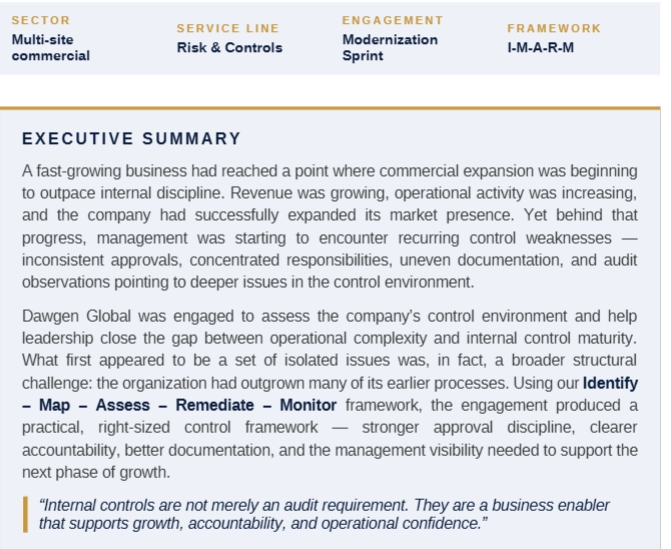
| “Internal controls are not merely an audit requirement. They are a business enabler that supports growth, accountability, and operational confidence.”
|
Client Profile
This composite case study reflects a privately owned, growth-oriented business operating in a multi-site commercial environment with a mix of distribution, service delivery, and operational support functions. Over a relatively short period, the company had expanded its customer base, transaction volume, and internal headcount — increasing both the volume and the complexity of decisions flowing through management and operations.
The organization had achieved meaningful commercial success, but many of its internal processes had developed informally over time. Leadership recognized that while the business had grown stronger commercially, its control environment had not matured at the same pace.
The Challenge
The company’s leadership team had begun to notice recurring signs of strain in the internal control environment. No single issue was severe enough on its own to threaten the business, but together they formed a pattern that was becoming difficult to ignore.
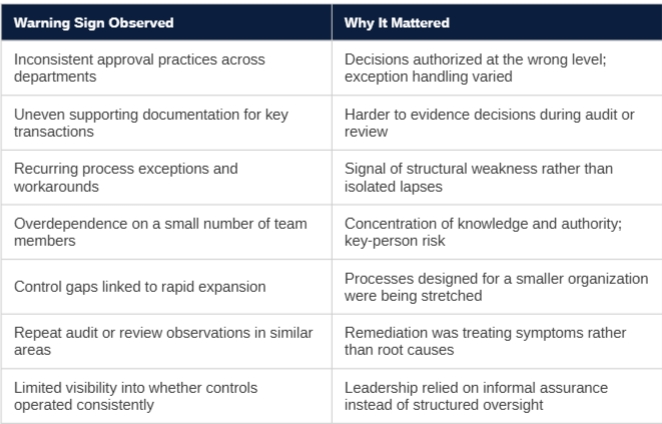
Management was increasingly concerned that the company’s operating discipline was becoming too dependent on personal oversight, informal workarounds, and reactive intervention. In practical terms, the business had outgrown its earlier model of control — processes that once functioned adequately in a smaller business were now being stretched by higher transaction volumes, more staff and handoffs, wider operational scope, more complex approvals, and greater expectations around accountability and reporting.
The result was an environment where control breakdowns were more likely to occur — not because people lacked commitment, but because the system itself was no longer well matched to the way the business now operated.
Why It Mattered
Leadership understood that control weakness was not just a technical issue. It was creating real operational, governance, and strategic exposure:
- Operational risk was rising. Inconsistent approvals, reconciliations, documentation, and oversight made the business more vulnerable to error, delay, miscommunication, and avoidable financial exposure.
- Management confidence was eroding. It became harder to assume that processes were being executed consistently without direct follow-up, which increased supervisory pressure on senior personnel.
- Governance posture was slipping. A growing business needs stronger internal discipline, not less. Leaving the control environment informal while the organization grew larger and more complex would increase the risk of more serious operational failures.
- Audit signals were reinforcing the concern. Review observations were starting to confirm that these were symptoms of an environment that needed modernization, not isolated incidents.
Most importantly, management recognized that sustained growth would require stronger process discipline. The business did not want to become slower or more bureaucratic — it wanted to become more reliable, more accountable, and better controlled.
Dawgen Global’s Diagnostic Perspective
When Dawgen Global reviewed the situation, it became clear that the company did not merely have a few weak controls. It had a control environment that had not kept pace with growth. Certain controls depended too much on the judgment or availability of specific individuals. Some processes lacked clarity around who should approve, review, or evidence key actions. In some areas, controls existed in principle but were not embedded consistently in daily workflow.
Our root-cause analysis identified five interconnected drivers:
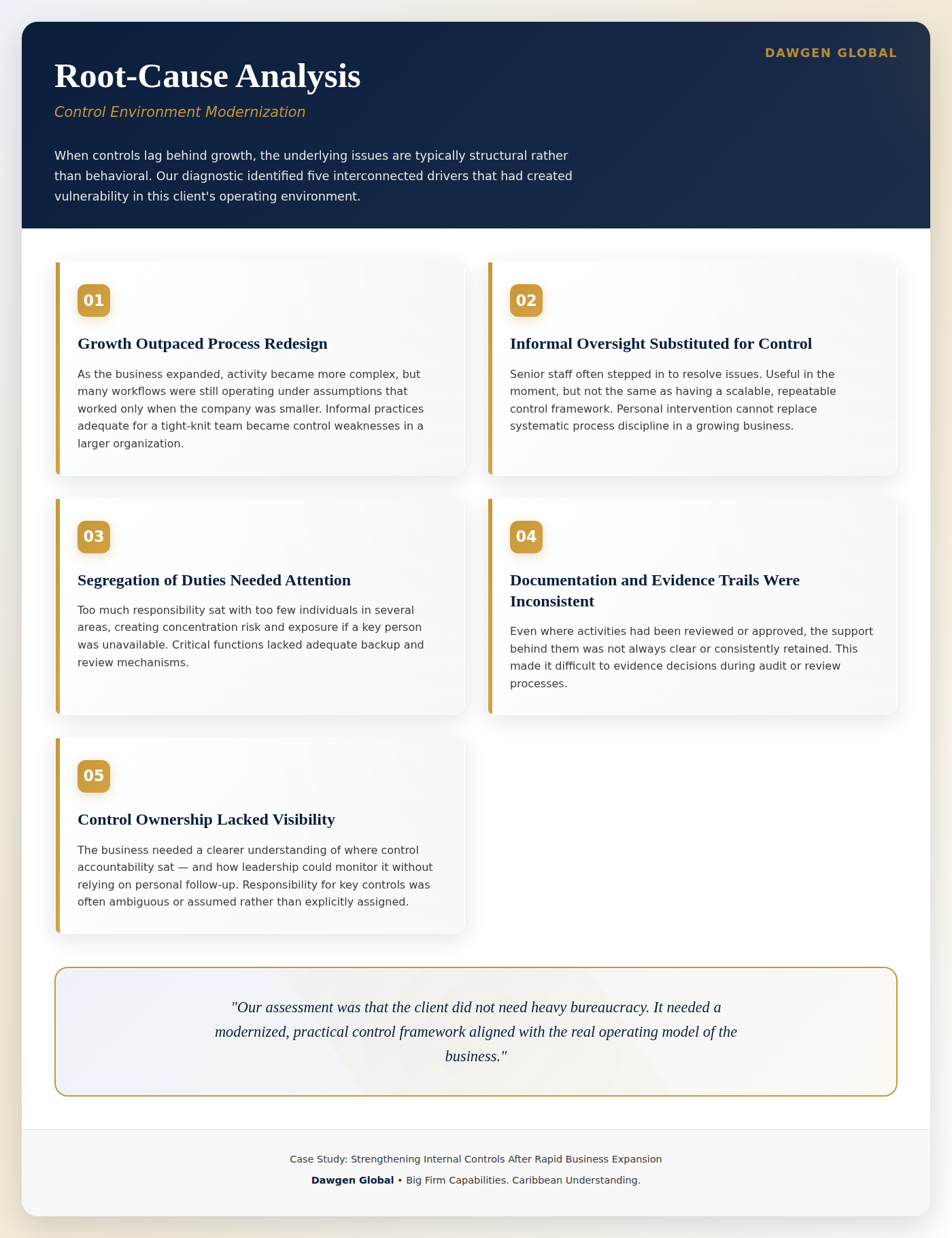
Our assessment was that the client did not need heavy bureaucracy. It needed a modernized, practical control framework aligned with the real operating model of the business.
Solution Design and Implementation
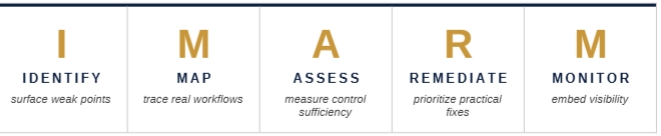
The engagement ran in six integrated workstreams, sequenced under the I-M-A-R-M framework so that design decisions were always grounded in what was actually happening in the business.
01 Control Environment Diagnostic
Dawgen began with a focused review of the client’s current control environment, combining:
- Structured discussions with leadership and key process owners
- Review of recurring audit and control observations
- Walkthroughs of selected operational and financial processes
- Assessment of approval practices and authority levels
- Examination of documentation quality and control evidence
- Identification of areas where duties were too concentrated
This diagnostic stage helped distinguish between isolated lapses and structural weaknesses, and framed the remainder of the engagement around the issues most material to the business.
02 Process and Control Mapping
A central part of the engagement involved mapping how important activities actually moved through the business, focusing on:
- Expenditure approval and payment processing
- Selected operational transactions
- Reporting and reconciliation cycles
- Exception handling routines
- Management review points
This mapping revealed where processes had become overly dependent on informal intervention, where roles were blurred, and where control points were either weak or inconsistently applied.
03 Risk and Control Gap Assessment
Once the process maps were clear, Dawgen assessed where the control gaps mattered most — weighing likelihood and operational consequence rather than treating every weakness equally. Key questions included:
- Were key approvals occurring at the right level?
- Were review activities sufficiently evidenced?
- Did certain roles create undue concentration risk?
- Did management have visibility into recurring exceptions?
- Where did documentation standards need strengthening?
- Which issues required near-term action versus staged improvement?
The output was a prioritized, risk-based remediation roadmap rather than a generic checklist.
04 Control Redesign and Remediation Priorities
Dawgen then worked with leadership to design and implement practical remediation steps:
- Clarifying approval thresholds and authority levels
- Strengthening evidence requirements for key decisions and transactions
- Improving segregation of duties where feasible
- Redesigning selected review and sign-off processes
- Standardizing documentation practices in priority areas
- Introducing clearer ownership for critical control points
The redesign focused on usability. Controls were calibrated to strengthen discipline without slowing the business — practical enough that teams could follow them consistently.
05 Management Visibility and Oversight Enhancement
A recurring issue was that leadership often learned about control weaknesses only after problems or review findings surfaced. To close that gap, the engagement introduced:
- Clearer escalation paths for exceptions
- More structured management review in selected areas
- Better identification and tracking of recurring control breakdowns
- Stronger alignment between operational oversight and control expectations
The effect was a shift from reactive problem-solving to proactive supervision, with control attention directed where it mattered most.
06 Embedding a More Mature Control Mindset
A final part of the engagement was cultural. Dawgen worked with the leadership team to reframe how the organization thought about controls — not as an audit obligation, but as infrastructure for better accountability, fewer avoidable errors, greater consistency, stronger reporting confidence, and more sustainable growth. That mindset change mattered because long-term improvement depends on more than redesigned processes. It depends on why teams choose to follow them.
Outcomes and Business Impact
The engagement helped the client create a stronger and more scalable control environment — one calibrated for the business the company had become, rather than the one it had been.
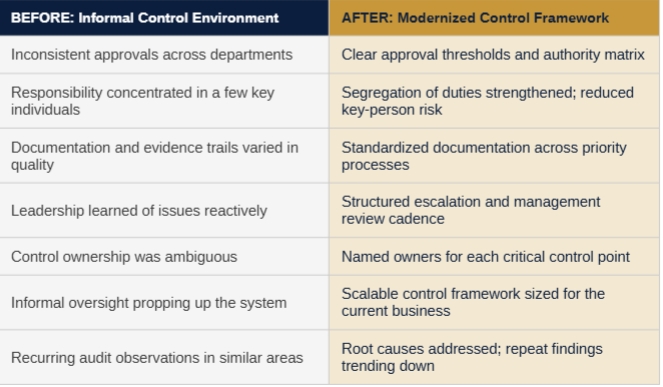
Beyond the individual control improvements, the work delivered six broader outcomes:
- Clearer approval discipline. Stronger clarity around who should authorize what, reducing inconsistency and helping limit avoidable exceptions.
- Better control visibility. Management gained a more structured understanding of where key risks and weaknesses sat within the operating model.
- Reduced concentration risk. By identifying areas where too much responsibility rested with too few individuals, the company strengthened resilience and reduced dependency.
- Improved documentation and evidence quality. Control activities became easier to support and review because expectations around documentation and sign-off became clearer.
- More practical internal discipline. The organization did not become bureaucratic — it became more deliberate. Processes were better structured without losing commercial responsiveness.
- Stronger platform for growth. Leadership gained confidence that the business was building the internal discipline needed to support further expansion.
The work also had a broader governance effect. The company began to see that controls are not simply defensive mechanisms — they are a necessary part of operating a growing business well.
Key Lessons for Business Leaders
- Commercial growth can hide control weakness. A business may appear successful while its underlying operating discipline is becoming increasingly fragile.
- Informal oversight does not scale. What works in a smaller business often becomes risky in a larger one if controls are not redesigned.
- Repeated exceptions usually signal a deeper issue. Recurring audit findings, approval inconsistencies, and documentation problems often reflect structural rather than isolated weakness.
- Better controls do not have to mean more bureaucracy. The strongest control improvements are often those that make processes clearer, not more cumbersome.
- Internal controls are a growth enabler. Businesses that strengthen controls thoughtfully are better able to expand with confidence and stability.
How Dawgen Global Helps
Dawgen Global helps organizations strengthen internal controls by combining risk insight, process understanding, governance awareness, and practical implementation support.
Through our Risk and Controls Modernization Sprint and related advisory services, we work with clients to:
- Identify control weaknesses and map real operational workflows
- Assess process, approval, and concentration risk
- Strengthen segregation of duties where feasible
- Improve documentation and review discipline
- Modernize control frameworks in line with business scale
- Build more resilient, transparent operating environments
For growing businesses that want stronger governance, better operational discipline, and a more scalable internal control structure, Dawgen Global provides a practical, commercially grounded path forward.
About Dawgen Global
“Embrace BIG FIRM capabilities without the big firm price at Dawgen Global, your committed partner in carving a pathway to continual progress in the vibrant Caribbean region. Our integrated, multidisciplinary approach is finely tuned to address the unique intricacies and lucrative prospects that the region has to offer. Offering a rich array of services, including audit, accounting, tax, IT, HR, risk management, and more, we facilitate smarter and more effective decisions that set the stage for unprecedented triumphs. Let’s collaborate and craft a future where every decision is a steppingstone to greater success. Reach out to explore a partnership that promises not just growth but a future beaming with opportunities and achievements.
 Email: [email protected]
  Visit: Dawgen Global Website

 WhatsApp Global Number : +1 555-795-9071
Caribbean Office: +1876-6655926 / 876-9293670/876-9265210  WhatsApp Global: +1 5557959071
USA Office: 855-354-2447
Join hands with Dawgen Global. Together, let’s venture into a future brimming with opportunities and achievements


