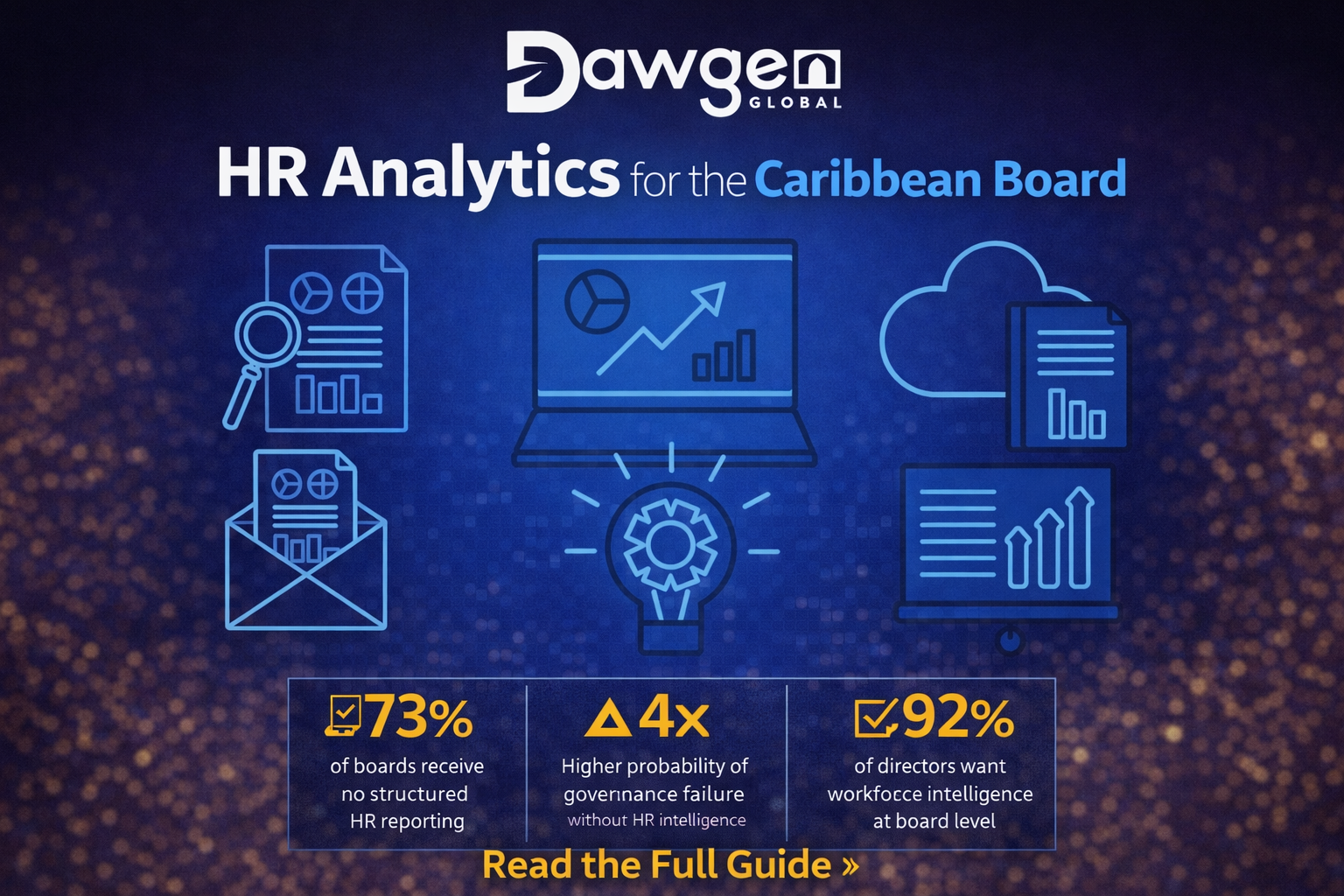
| Caribbean boards govern financial risk with precision: audited accounts, detailed management accounts, quarterly financial reports, and rigorous audit committee processes. They govern people risk — the organisation’s most material and most volatile asset — with almost none of the same discipline. This article makes the case for board-level HR intelligence as a governance imperative, not a reporting enhancement; maps the five-level board HR reporting maturity ladder; presents the PEOPLE360°™ Quarterly HR Intelligence Report template; and builds the people risk register framework that allows Caribbean boards to govern workforce risk with the same rigour they apply to financial risk. |
The Governance Gap Nobody Is Talking About
Sit in on the board meeting of a typical Caribbean organisation and you will find detailed discussion of financial performance: revenue variances, margin analysis, liquidity ratios, capital expenditure approvals, and audit committee findings. You will find risk committee reports on operational, reputational, and market risk. You will find strategy discussions anchored in data.
What you will rarely find is any of this rigour applied to the organisation’s people. HR, if it appears on the board agenda at all, surfaces as a headcount update, a recruitment report, or — most commonly — as a crisis: a senior departure, a tribunal matter, a pay dispute that has escalated, or a succession emergency that has arrived without warning because no pipeline was built.
This is the governance gap. Caribbean boards are making strategic decisions — about capital allocation, market expansion, acquisition targets, and organisational capability — with incomplete information. They know the financial state of the organisation with precision. They do not know the people state with anything approaching the same rigour. And because people are consistently the most expensive, most volatile, and most strategically consequential asset on the balance sheet, the governance gap is not a minor oversight. It is a material failure of corporate governance.
The irony is that the data required to close the gap exists in almost every organisation. Turnover rates, performance distributions, engagement scores, succession pipeline depth, compliance status, L&D investment: all of this is being tracked, in some form, somewhere in the organisation. What is missing is not the data. It is the analytical framework that transforms it into board-ready intelligence — and the organisational conviction that the board deserves to see it.
| 73%
of Caribbean boards receive no structured HR reporting at their regular board meetings (Dawgen Global regional survey) |
4×
higher probability of a major people-related governance failure in organisations without board HR reporting |
92%
of board directors say they would make better strategic decisions with access to structured workforce intelligence |
Why People Risk Is a Board Governance Matter
The argument for board-level HR intelligence is not that HR is important — that is already accepted. The argument is that people risk meets every criterion that boards apply when determining what belongs on their governance agenda, and that the failure to govern it with the same rigour applied to financial and operational risk is a structural deficit in Caribbean corporate governance.
People Risk Is Financial Risk
As established across this series, the financial exposure associated with unmanaged people risk is material and quantifiable. A major tribunal matter costs between USD 15,000 and USD 100,000 or more to resolve. The voluntary attrition of a senior leader costs between 100% and 150% of their annual salary to replace. An engagement crisis that drives a 5-percentage-point increase in turnover across a 200-person organisation costs between USD 250,000 and USD 600,000 in replacement costs annually. These are not HR metrics. They are financial risks — and they belong on the board’s risk agenda.
People Risk Is Strategic Risk
Every strategic plan has a people dimension. The plan to expand into three new Caribbean territories requires HR capability in each. The plan to double revenue in three years requires a leadership team capable of managing a larger, more complex organisation. The plan to execute a digital transformation requires talent with capabilities the current workforce may not have. Boards that approve strategic plans without assessing the people capability required to execute them are approving strategies on the basis of incomplete information. Workforce intelligence is not a support function input. It is a strategic planning input.
People Risk Is a Director Liability
Across Caribbean jurisdictions, directors bear personal liability for certain categories of employment law failure — including in some territories, NIS contribution arrears, unpaid statutory leave entitlements, and certain forms of discrimination. Beyond the legal exposure, the reputational consequences of high-profile employment tribunal matters, industrial action, or discriminatory practice findings can be severe for individual directors as well as for the organisation. Boards that are not receiving regular, structured HR compliance reporting are governing blind on their own personal liability.
People Risk Is a Succession Risk
The succession risk in most Caribbean organisations is, by any reasonable governance standard, unacceptable. The majority of Caribbean boards could not, if asked, name a ready-now successor for the five most critical roles in the organisation. Key person dependency — the concentration of critical knowledge, relationships, and capability in individuals who could depart, become incapacitated, or retire at any point — is among the most acute and most underreported strategic risks on Caribbean balance sheets. It belongs on the board agenda, quantified and managed, not managed reactively when it arrives as a crisis.
| THE GOVERNANCE STANDARD | The test for whether people risk belongs on the board agenda is simple: if this risk materialised tomorrow, would it be material to the organisation’s financial performance, strategic execution, regulatory standing, or reputational position? For every category of people risk described above, the answer is yes. The board has a governance obligation to oversee these risks — and it cannot discharge that obligation without the intelligence to see them. |
The Five Levels of Board HR Reporting Maturity
Caribbean boards currently sit across a wide spectrum of HR reporting maturity. The five-level ladder below maps where organisations typically sit and what each level enables and prevents in terms of board governance quality. Most Caribbean boards are at Levels 1 or 2. The governance standard requires Level 4 or above. Level 5 is the aspirational destination that the PEOPLE360°™ 360° Value Delivery pillar is designed to reach.
| Level | Stage | What the Board Receives | What the Board Can and Cannot Do |
| LEVEL 1 | No HR Reporting | The board receives no structured HR information. People issues surface reactively — when a crisis, complaint, or compliance matter forces them onto the agenda. | The board is flying blind on its most material risk. Compliance failures, succession crises, and talent emergencies arrive without warning. |
| LEVEL 2 | Headcount Updates | Periodic updates on headcount, recruitment activity, and sometimes voluntary turnover. No analytics, no risk context, no strategic framing. | The board knows how many people the organisation employs. It has no visibility on the quality, stability, or strategic alignment of that workforce. |
| LEVEL 3 | Compliance Reporting | HR reporting focuses on compliance status: leave liability, NIS contributions, outstanding tribunal matters. Structured but backward-looking. | The board can discharge its minimum compliance governance obligations. It cannot make strategic workforce decisions from this information alone. |
| LEVEL 4 | Performance Analytics | Reporting includes turnover rates, engagement scores, performance distribution, and L&D investment. Connected to operational outcomes but not yet to strategy. | The board has meaningful people intelligence. It can identify trends and make evidence-based talent decisions. Strategic alignment is partial. |
| LEVEL 5 | Strategic Workforce Intelligence | Board HR reporting is forward-looking: workforce plan, succession pipeline health, flight risk analysis, capability gap assessment, HR ROI, and strategic people risk register. | The board governs people as a strategic asset. HR intelligence informs capital allocation, strategic planning, and risk management at the highest level. |
The progression from Level 1 to Level 5 does not require a transformation programme or a technology overhaul. It requires a structured framework, a consistent reporting cadence, and — critically — a senior HR practitioner who can translate people data into board-ready intelligence. The PEOPLE360°™ 360° Value Delivery pillar provides all three.
Six Questions Caribbean Boards Ask — That HR Cannot Currently Answer
The following table maps six questions that Caribbean board directors consistently ask about their organisation’s people — questions that, in most Caribbean organisations, the HR function cannot currently answer with precision — and the PEOPLE360°™ analytics capability that makes each answerable.
| Board Question | Why Caribbean HR Cannot Currently Answer It | What PEOPLE360°™ Provides |
| “If our CFO left tomorrow, who would step up?” | Most HR functions in the Caribbean cannot answer this with precision. Succession planning, where it exists at all, is often confined to the CEO role. | Talent mapping across all critical roles; succession readiness ratings; development plans for successors. |
| “What is our voluntary turnover costing us?” | Few Caribbean organisations have calculated the fully-loaded replacement cost of their attrition. The HR function reports the headcount number; the financial implication is invisible. | Attrition cost analysis; regrettable loss tracking; turnover trend reporting with financial impact. |
| “Are we compliant in all 15 territories?” | For multi-territory employers, this question is rarely answered comprehensively. Compliance status is often known territory by territory, informally, not consolidated into a board view. | Multi-territory compliance dashboard; legislative change tracker; outstanding exposure register. |
| “What return are we getting on our L&D investment?” | Most organisations measure training attendance and completion, not capability development, performance improvement, or retention impact. The board cannot see what it is buying. | L&D ROI measurement framework; capability improvement tracking; retention correlation analysis. |
| “Where are our highest people risks?” | People risks are rarely quantified and almost never presented on the board risk register alongside financial and operational risks. The board is making risk decisions without the full picture. | People risk register; probability x impact matrix; quarterly risk movement reporting. |
| “Is our workforce aligned to our strategy?” | Workforce planning — the assessment of whether the organisation has the people it needs, where it needs them, with the right capabilities — is absent in most Caribbean boards. | Strategic workforce plan; capability gap analysis; scenario modelling for strategic options. |
The pattern across all six is consistent: the question is reasonable, the data to answer it exists somewhere in the organisation, and the gap is in the analytical framework and the reporting infrastructure that would transform that data into board-ready intelligence. The PEOPLE360°™ 360° Value Delivery pillar builds that infrastructure — systematically, across all six question areas, in a format that boards can use.
The PEOPLE360°™ Quarterly HR Intelligence Report
The centrepiece of the 360° Value Delivery pillar is the Quarterly HR Intelligence Report — a structured, board-ready document that consolidates the organisation’s people data across seven sections into a coherent narrative that enables governance, strategy, and risk management at the board level.
The report is not a data dump. It is an analytical product — one that contextualises each metric against a prior period, an internal target, and an external benchmark; that identifies trends and their strategic implications; that flags emerging risks and recommended responses; and that presents the people dimension of the organisation’s performance in the language that boards use to govern everything else they oversee.
The seven sections of the Quarterly HR Intelligence Report, and the data points each contains, are mapped in the template below.
| Report Section | Data Points Included |
| SECTION 1 Workforce Snapshot | Headcount by territory and function ▪ Net change vs. prior quarter ▪ Headcount plan vs. actuals ▪ Contractor / permanent ratio ▪ Open roles and time-to-fill |
| SECTION 2 Turnover & Stability | Voluntary turnover rate (vs. prior quarter and annual target) ▪ Involuntary turnover ▪ Regrettable loss index (high performers who departed) ▪ Tenure distribution ▪ Early attrition (departures within 12 months of hire) |
| SECTION 3 Compliance Status | Multi-territory compliance calendar status ▪ Outstanding tribunal and grievance matters ▪ NIS / statutory contribution status ▪ Employment contract review status ▪ Data protection compliance posture |
| SECTION 4 Performance & Engagement | Performance rating distribution ▪ High performer vs. underperformer ratio ▪ Engagement score (vs. prior period and benchmark) ▪ Manager effectiveness index ▪ Action plan status from prior engagement survey |
| SECTION 5 Talent & Succession | High-potential pipeline depth by critical role ▪ Succession readiness rating (Ready Now / 1–2 Years / 3+ Years) ▪ Key person dependency index ▪ L&D investment and completion rates ▪ Internal promotion rate |
| SECTION 6 People Risk Register | Top 5 people risks (rated by probability × impact) ▪ Change vs. prior quarter ▪ Mitigation status ▪ Escalations requiring board decision or awareness |
| SECTION 7 HR ROI Summary | Total people cost as % of revenue ▪ Cost-per-hire ▪ L&D ROI (where measurable) ▪ Absence cost ▪ Compliance penalty cost (YTD) ▪ HR investment vs. value delivered (PEOPLE360°™ framework summary) |
The report is prepared by the PEOPLE360°™ Virtual HR Director and presented to the board or HR and governance committee at each quarterly board cycle. For organisations without a board HR committee, the report is typically tabled as a standing agenda item at the main board meeting — occupying between 20 and 30 minutes of structured board time, focused on the highest-priority items in Sections 6 and 7 (People Risk Register and HR ROI Summary).
The People Risk Register: Governing What You Cannot Afford to Ignore
The single highest-value innovation that the PEOPLE360°™ 360° Value Delivery pillar introduces to most Caribbean boards is the People Risk Register — a structured assessment of the organisation’s top people risks, rated by probability and impact, with recommended board actions for each.
The concept is not novel in financial or operational risk management. Boards have governed financial and operational risks through structured risk registers for decades. The application of the same discipline to people risk is, in the Caribbean context, genuinely new — and the boards that adopt it consistently report that it changes the nature of the HR conversation at board level more profoundly than any other single change.
The People Risk Register does not replace the organisation’s main risk register. It feeds into it: the people risks that exceed defined probability and impact thresholds are escalated to the main board risk register, ensuring that the board’s integrated risk view includes the full spectrum of people risk alongside the financial, operational, and reputational risks it already governs.
The example below illustrates what a People Risk Register entry looks like in practice, drawn from a representative Caribbean multi-territory employer:
| Risk | Probability | Impact | Recommended Board Action |
| High flight risk in CFO role (identified successor 18 months from readiness) | High | High | Accelerate successor development programme; initiate contingency search brief; brief board chair on exposure. |
| NIS contribution arrears in Guyana entity (discovered in Q3 compliance audit) | Medium | High | Engage Dawgen Global tax advisory; calculate liability; establish payment plan with NIS authority. |
| Trade union recognition petition filed in Trinidad entity | Medium | High | Engage industrial relations counsel; brief management team on obligations; prepare recognition strategy. |
| Engagement scores in technology team at 3-year low (35% — sector benchmark: 55%) | High | Medium | Technology team focus group; manager coaching intervention; compensation benchmarking review. |
| Three of five senior leaders eligible for retirement within 24 months | Medium | High | Accelerate succession planning across all three roles; commission external successor search for most critical. |
Each entry in the register is reviewed quarterly: the probability and impact ratings are updated based on the latest intelligence, the mitigation status is reported, and new risks are added as they are identified. The register creates a rolling, structured accountability for people risk management at the board level — ensuring that risks are not only identified but actively managed between board meetings.
People Analytics: From Metrics to Intelligence
The distinction between people metrics and people intelligence is the most important concept in board HR reporting — and the one most commonly misunderstood.
A metric is a number: the voluntary turnover rate is 14.3%. An intelligence item is an analytical conclusion derived from multiple data points in context: the voluntary turnover rate of 14.3% represents a 3.1-percentage-point increase over the prior year, is concentrated in the technology function, correlates with a 12-point decline in engagement scores in that team, and is occurring at a moment when three of the four most critical technology roles have no identified internal successor. The recommended board action is a focused retention intervention in the technology team and an accelerated succession planning process for the three exposed roles.
This distinction — from metric to intelligence — is what the PEOPLE360°™ 360° Value Delivery pillar produces. It is not a reporting function. It is an analytical function — one that applies the same contextual, trend-aware, risk-oriented analytical framework to people data that the finance function applies to financial data.
The Four Analytical Lenses
Every intelligence item in the PEOPLE360°™ Quarterly HR Intelligence Report is analysed through four lenses before it is presented to the board:
- Trend lens: How has this metric changed over the past four quarters, and is the direction of travel positive, negative, or stable?
- Benchmark lens: How does this metric compare to the Caribbean sector benchmark, the organisational target, and — where available — the regional peer group?
- Risk lens: What is the financial and strategic implication if this metric continues on its current trajectory for the next 12 months?
- Action lens: What is the specific, time-bound intervention that would change the trajectory — and who is accountable for delivering it?
Applied consistently across all seven sections of the Quarterly HR Intelligence Report, these four lenses transform a collection of HR metrics into a strategic intelligence product that enables boards to govern people with the same analytical discipline they apply to everything else.
Building the Infrastructure: What the 360° Value Delivery Pillar Provides
The PEOPLE360°™ 360° Value Delivery pillar provides the full infrastructure required to move a Caribbean organisation from wherever it currently sits on the board HR reporting maturity ladder to Level 4 or Level 5 within the first twelve months of engagement. The infrastructure has four components:
Component 1: The HR Data Architecture
Before analytics are possible, the data must be structured, consistent, and accessible. The 360° Value Delivery pillar begins by designing the HR data architecture — defining which metrics are tracked, at what frequency, by whom, and in what format. For most Caribbean organisations, this is a relatively contained exercise: the data already exists, dispersed across payroll systems, performance management records, and spreadsheets maintained by individual HR team members. The architecture brings it together into a consistent, auditable framework.
Component 2: The Benchmarking Framework
HR metrics are only meaningful in context. The 360° Value Delivery pillar establishes the benchmarking framework that provides that context: Caribbean sector benchmarks for turnover, engagement, and people cost ratios; internal targets derived from the organisation’s strategic plan; and — where available — peer group comparisons drawn from Dawgen Global’s regional advisory database. The benchmarking framework transforms a number into a signal.
Component 3: The Reporting Cadence
Consistency is the foundation of board confidence in any reporting framework. The 360° Value Delivery pillar establishes a structured, quarterly reporting cadence — with defined data collection timelines, analytical review periods, and board presentation dates that align with the organisation’s board cycle. The cadence removes the variability that makes HR reporting unreliable and replaces it with the predictability that allows the board to plan its governance agenda around it.
Component 4: The Board Presentation
The Quarterly HR Intelligence Report is not distributed as a document and left for directors to read independently. It is presented by the Virtual HR Director at the board meeting, with a structured executive summary that directs the board’s attention to the highest-priority items, a people risk register review that focuses discussion on the risks requiring board decision or awareness, and a forward-looking section that connects the current people intelligence to the next quarter’s strategic agenda. The presentation format is calibrated to board culture — rigorous and data-driven for financially-oriented boards, more narrative and strategic for boards that govern by discussion.
| THE BOARD CONFIDENCE EFFECT | Boards that receive structured, consistent, analytically rigorous HR intelligence report a measurable improvement in their confidence in the organisation’s people management. Not because the HR function suddenly became perfect — but because the board can now see what is happening, understand what it means, and govern accordingly. The governance confidence effect is, in Dawgen Global’s experience, one of the most immediate and most valued outcomes of the PEOPLE360°™ 360° Value Delivery engagement. |
A Self-Assessment for Caribbean Boards
The following five questions are designed for Caribbean board directors and governance committee members to assess their organisation’s current board HR reporting posture. Honest answers identify the highest-priority gaps.
- At your last board meeting, did the board receive structured HR reporting that included turnover data, compliance status, and succession pipeline depth? If not, your board is governing without a critical category of strategic intelligence.
- Can you, as a director, name the succession plan for the three most critical roles in your organisation and the readiness timeline for each named successor? If not, the succession risk on your balance sheet is unquantified and unmanaged.
- Does your organisation’s risk register include people risks rated by probability and financial impact? If not, your integrated risk picture is incomplete.
- In the last twelve months, has the board made a strategic decision — about expansion, acquisition, restructuring, or capital allocation — that was informed by structured workforce intelligence? If not, your strategic decisions are being made without the full picture.
- Do you know what your organisation’s voluntary turnover cost the business in the last financial year, expressed as a USD figure? If not, one of your largest and most controllable costs is invisible to the board.
If three or more of these questions cannot be answered affirmatively, the board’s people governance posture requires structured attention. The PEOPLE360°™ HR Diagnostic provides the comprehensive assessment — and the roadmap to close the gap.
Closing the Governance Gap Starts Here
The governance gap between how Caribbean boards manage financial risk and how they manage people risk is not inevitable. It is addressable — with the right framework, the right analytical infrastructure, and the right senior HR practitioner presenting the intelligence in a format the board can use.
The PEOPLE360°™ 360° Value Delivery pillar provides all three. It begins with the complimentary HR Diagnostic that establishes the organisation’s current board HR reporting maturity and maps the path to Level 4 or Level 5. It builds from there, quarter by quarter, until the board has the workforce intelligence it needs to govern people with the same discipline it applies to every other strategic asset.
| Request your complimentary HR Diagnostic at [email protected] or Download the Caribbean HR Outsourcing Guide |
Next in The People Advantage Series
Article 10: The PEOPLE360°™ Framework — The Complete Picture. The series finale brings together all ten articles into a unified framework overview — the architecture of Caribbean people management excellence, the roadmap for implementation, and the invitation to begin the PEOPLE360°™ journey.
About Dawgen Global
“Embrace BIG FIRM capabilities without the big firm price at Dawgen Global, your committed partner in carving a pathway to continual progress in the vibrant Caribbean region. Our integrated, multidisciplinary approach is finely tuned to address the unique intricacies and lucrative prospects that the region has to offer. Offering a rich array of services, including audit, accounting, tax, IT, HR, risk management, and more, we facilitate smarter and more effective decisions that set the stage for unprecedented triumphs. Let’s collaborate and craft a future where every decision is a steppingstone to greater success. Reach out to explore a partnership that promises not just growth but a future beaming with opportunities and achievements.
 Email: [email protected]
  Visit: Dawgen Global Website

 WhatsApp Global Number : +1 555-795-9071
Caribbean Office: +1876-6655926 / 876-9293670/876-9265210  WhatsApp Global: +1 5557959071
USA Office: 855-354-2447
Join hands with Dawgen Global. Together, let’s venture into a future brimming with opportunities and achievements


