
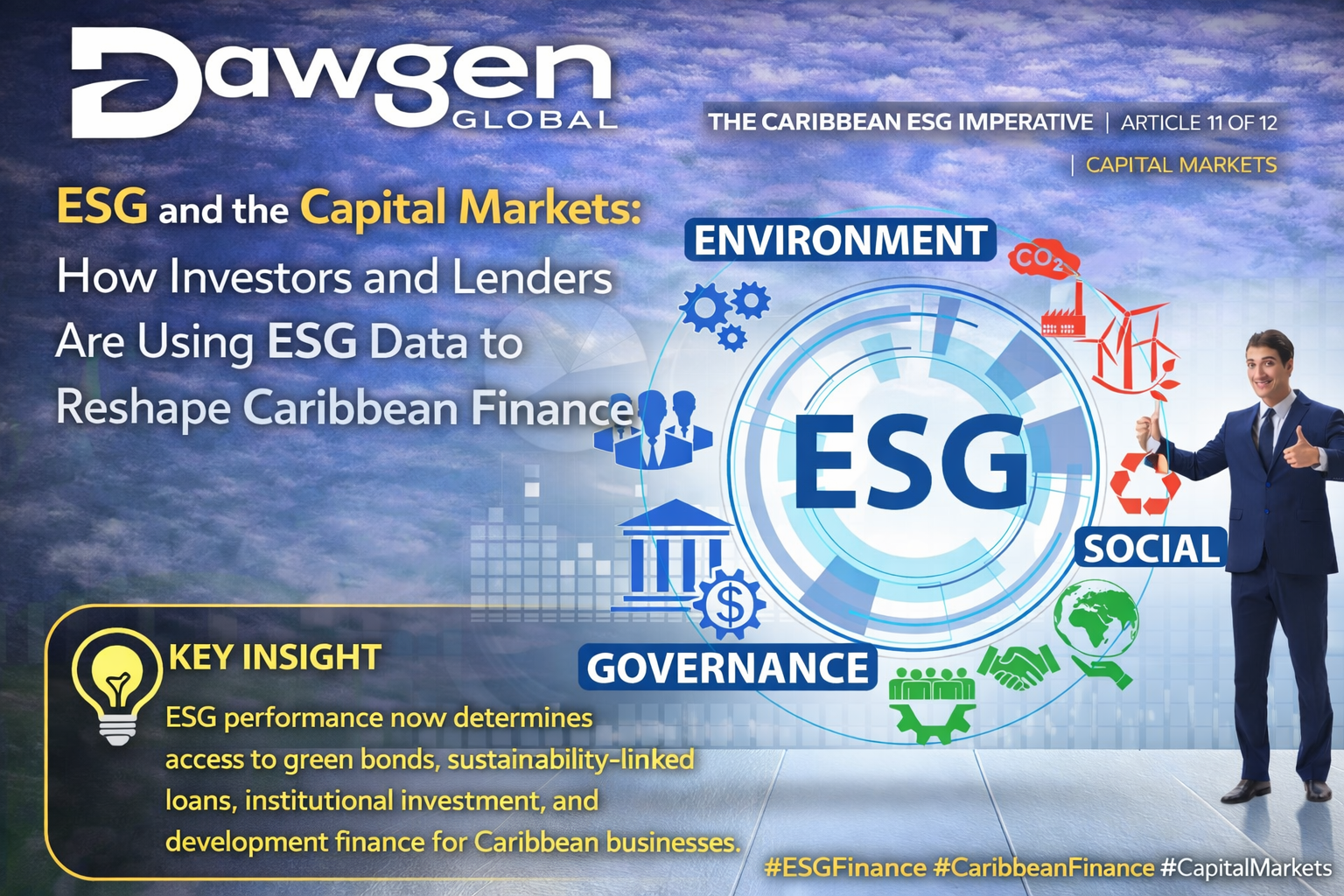
ESG Has Moved from the Boardroom to the Balance Sheet
The integration of ESG factors into investment and lending decisions — once the preserve of specialist impact investors and development finance institutions — has become mainstream in global capital markets. The assets under management that incorporate ESG factors in their investment process now exceed US$35 trillion globally. Every major development finance institution that finances Caribbean private sector growth has embedded ESG criteria into its lending and investment standards. Caribbean stock exchanges are developing ESG disclosure guidance. And the cost differential between financing available to ESG leaders and financing available to ESG laggards — though still modest in some markets — is growing and becoming more structural.
For Caribbean CFOs, treasurers, and boards, this shift has a direct and material consequence: the quality of an organisation’s ESG programme, disclosure, and assurance increasingly determines not just its reputational standing but its access to capital and its cost of financing. A Caribbean business seeking a green bond issuance, a sustainability-linked loan facility, IFC project financing, or institutional investor equity faces ESG requirements that are embedded in the terms of those instruments. Meeting those requirements is a financial discipline, not merely a governance aspiration.
This article — the eleventh in Dawgen Global’s The Caribbean ESG Imperative series — examines the capital market dimension of ESG in depth. We map the ESG-linked capital instruments available to Caribbean businesses and their specific requirements. We examine how ESG rating agencies assess Caribbean companies and how their ratings affect capital access. We review the ESG requirements of the principal development finance institutions active in the Caribbean. We examine the investor engagement dimension — how Caribbean businesses should communicate their ESG performance to investors and lenders. And we provide a practical capital strategy framework that enables Caribbean organisations to use ESG performance as a genuine financial asset.
| KEY INSIGHT
ESG performance is no longer just a reputational asset — it is a balance sheet asset. Caribbean businesses with credible ESG programmes, investor-grade disclosure, and independent assurance access capital at lower cost, from a wider pool of providers, and on better terms than those that cannot demonstrate equivalent ESG quality. The ROI on ESG investment is increasingly measurable in basis points of financing cost and in millions of dollars of capital availability. |
ESG-Linked Capital Instruments: The Caribbean Toolkit
The ESG capital market has produced a growing range of instruments through which Caribbean businesses can access financing explicitly linked to ESG performance — either through use-of-proceeds restrictions (green bonds, green loans), performance linkage (sustainability-linked bonds and loans), or ESG screening by the capital provider (DFI financing, ESG equity). The table below maps the seven principal ESG capital instruments available to Caribbean businesses.
| Instrument | Type | How It Works | Key Standards | ESG Requirements | Commercial Value | Best For |
| Green Bond | Fixed income — debt | Proceeds restricted to eligible green projects (renewable energy, energy efficiency, green buildings, clean transport, sustainable water, climate adaptation) | ICMA Green Bond Principles; CBI Climate Bonds Standard | Green bond framework development; second-party opinion (SPO); annual reporting on use of proceeds; DESGAF™ assurance over eligible green expenditure | No direct pricing advantage over vanilla bonds at issuance (greenium small but growing — typically 5–15 bps); access to ESG-dedicated investor pools; reputational premium; liquidity from ESG fund mandates | Utilities; real estate developers; financial institutions on-lending to green projects; governments; large corporates with identified green capex pipeline |
| Sustainability Bond | Fixed income — debt | Proceeds split between green and social eligible projects; combines the eligible project categories of both green bonds and social bonds | ICMA Sustainability Bond Guidelines | Combined green and social bond framework; SPO covering both pillars; use of proceeds tracking and reporting | Access to both ESG and impact investor pools; suitable for organisations with mixed environmental and social investment programmes | Development banks; financial institutions; organisations with significant social infrastructure investment alongside environmental projects |
| Sustainability-Linked Bond (SLB) | Fixed income — debt | Proceeds unrestricted — general corporate purposes; coupon linked to achievement of pre-agreed Sustainability Performance Targets (SPTs); coupon steps up if targets are missed | ICMA Sustainability-Linked Bond Principles | SPT selection and calibration; annual KPI verification by independent verifier; SPT ambition assessment; ongoing disclosure of KPI performance | Growing greenium in primary markets; access to ESG investor pools without use-of-proceeds restriction; stronger pricing incentive for target achievement than SLL margin step; reputational penalty for target miss visible to bond markets | Corporates without specific green project pipeline; organisations where sustainability improvements occur across operations rather than in specific capital projects |
| Sustainability-Linked Loan (SLL) | Bank loan — debt | Proceeds unrestricted; interest rate margin linked to borrower’s performance against pre-agreed ESG KPIs; margin reduces on target achievement, increases on target miss | LMA/APLMA Sustainability-Linked Loan Principles | KPI selection (material, ambitious, measurable); annual KPI verification by qualified assurance provider; margin adjustment mechanism; disclosure in annual reports | Most accessible ESG financing instrument for Caribbean businesses; no use of proceeds restriction; works for refinancing of existing facilities; commercially significant margin savings (10–25 bps per KPI met) over life of loan; multiple Caribbean banks now offering SLL products | All commercial enterprises seeking bank financing; particularly effective for Caribbean businesses with clear energy, water, or diversity improvement targets |
| Green Loan | Bank loan — debt | Proceeds restricted to eligible green projects as defined by the Green Loan Principles; project identification, use of proceeds, management, and reporting requirements apply | LMA/APLMA Green Loan Principles | Eligible project identification; use of proceeds tracking; DESGAF™ assurance over green loan proceeds; annual reporting | Pricing comparable to SLL; preferred by lenders for specific project financing where green project identification is clear; used in renewable energy, energy efficiency, and green building project financing | Project-specific green capex: solar installations, energy efficiency upgrades, green building construction, EV fleet purchases |
| Development Finance Institution Financing | Blended debt/equity — concessional | IFC, IDB Invest, CDB, Proparco, and similar DFIs provide financing on concessional (below-market) terms to private sector projects meeting their environmental, social, and governance criteria; may include grant co-financing for technical assistance | IFC Performance Standards; IDB Invest ESG requirements; CDB Environmental Policy; specific DFI E&S policies | IFC Performance Standards compliance assessment; E&S Action Plan development; ESAP monitoring; DESGAF™ programme as evidence of ESG governance quality; ongoing reporting to DFI throughout loan term | Most significant source of concessional financing for Caribbean private sector; E&S requirements are comprehensive but well-defined; DFI imprimatur provides commercial credibility alongside concessional pricing; particularly important for infrastructure, energy, and financial sector clients | Infrastructure; renewable energy; agri-business; financial institutions on-lending; healthcare and education; tourism infrastructure |
| ESG Equity — Impact Investment | Equity / quasi-equity | Private equity and institutional investors with ESG or impact mandates investing equity capital in Caribbean businesses that demonstrate ESG performance aligned with their investment thesis; may include social and environmental co-investment requirements | UN PRI; IRIS+ impact measurement; GIIN Impact Investing Principles; IFC Operating Principles for Impact Management | Impact measurement and management framework; DESGAF™ ESG programme; ESG reporting aligned with investor requirements; management of ESG conditions in the investment agreement | Access to patient, mission-aligned equity capital; ESG-mandated investors often provide strategic as well as financial value; growing pool of Caribbean-focused impact investors (IDB Lab, Caribbean Climate Finance, CARICOM private equity) | Growth-stage Caribbean businesses with clear ESG/impact thesis; renewable energy; sustainable agriculture; affordable housing; financial inclusion; health technology |
The practical capital strategy observation from this table is that Caribbean businesses of different sizes and capital market access levels have different optimal ESG instrument starting points. For the largest Caribbean corporations with capital market access, green bonds and sustainability-linked bonds are achievable and commercially attractive. For the broad middle tier of Caribbean businesses with banking relationships, the sustainability-linked loan is the most immediately accessible and commercially significant ESG instrument — requiring no capital market access, working with existing banking relationships, and providing measurable margin savings for achieving well-designed ESG targets. For smaller businesses seeking growth capital, DFI financing and impact equity provide access to patient capital on terms that reflect the ESG quality of the business.
ESG Ratings and How They Affect Caribbean Capital Access
ESG rating agencies — organisations that assess and score the ESG performance of companies for use by institutional investors, fund managers, and lenders — have become powerful gatekeepers in global capital markets. A poor ESG rating from MSCI or Sustainalytics can trigger exclusion from ESG-mandated fund portfolios, increase the cost of institutional equity capital, and create proxy voting challenges at annual general meetings. A strong rating signals ESG quality to the investment community in a way that self-produced ESG reports cannot fully replicate.
Caribbean businesses — particularly those listed on regional stock exchanges or seeking institutional investor capital — are increasingly subject to ESG rating agency assessment. Understanding how the principal rating agencies assess Caribbean companies, what factors drive strong and weak ratings, and how to manage the rating improvement process is becoming a practical investor relations priority for Caribbean CFO and corporate secretary functions. The table below maps the five most commercially significant ESG rating agencies and their specific implications for Caribbean businesses.
| Rating Agency | What It Measures | Why It Matters for Caribbean Businesses | How to Improve Your Score |
| MSCI ESG Ratings | ESG risk rating from AAA (leader) to CCC (laggard); industry-adjusted; based on public disclosure and industry-specific risk factors | Used by institutional investors managing approximately US$16 trillion in assets with MSCI ESG-integrated mandates; triggers inclusion/exclusion in ESG indices; directly affects institutional investor capital access for Caribbean listed companies | Improve public ESG disclosure quality; address the governance gaps MSCI identifies as primary rating detractors for Caribbean companies (board independence, ESG oversight); obtain assurance over key disclosures to improve data reliability score |
| Sustainalytics ESG Risk Rating | ESG risk score from 0 (negligible risk) to 40+ (severe risk); measures the degree to which ESG risks are unmanaged; used in Morningstar sustainability ratings | Used by Morningstar in fund sustainability ratings; referenced by European institutional investors; affects access to capital from ESG-screened European pension fund and insurance company investors | Address management score — the most controllable component; management score reflects policies, programmes, and disclosure quality; strong ESG programme under DESGAF™ directly improves management score |
| CDP (Climate Disclosure Project) Rating | A to D- rating based on completeness and quality of climate (and water and forest) disclosure; A-list companies considered climate leaders | Used by institutional investors and corporate customers in supply chain assessments; CDP A-list status is a strong signal of climate governance quality; relevant for Caribbean businesses with international institutional shareholders or large multinational customers | Complete CDP questionnaire annually — particularly water security (relevant for Caribbean) and climate change questionnaires; align responses with TCFD framework; obtain external assurance over climate data disclosed to CDP |
| S&P Global ESG Score | 0-100 score across environmental, social, and economic dimensions; data collected through the Annual Corporate Sustainability Assessment (CSA) | Used in S&P Global ESG indices; referenced by pension funds and asset managers using S&P ESG products; relevant for Caribbean businesses with US institutional investors or listed on markets where S&P ESG indices are tracked | Complete the annual S&P Global CSA — the primary data collection mechanism; detailed questionnaire covering all ESG dimensions; provides control over data used in the rating compared to ratings based on public data only |
| ISS ESG Quality Score | 1-10 score (1 = best); governance quality assessment with specific ESG governance emphasis; used in ISS proxy voting recommendations | Used by institutional investors in voting decisions at AGMs; poor ISS governance scores can trigger votes against board nominees and management proposals; particularly relevant for listed Caribbean companies with international institutional shareholders | Improve board composition (independence, gender diversity, skills); align executive remuneration with ESG targets; improve audit committee quality and internal control disclosure; transparent and consistent ESG governance disclosure |
The ESG Rating Agency Challenge for Caribbean Businesses
Caribbean businesses face a specific ESG rating challenge that is important to acknowledge: rating agencies primarily rely on publicly disclosed information to construct their assessments. Caribbean companies that have not yet produced comprehensive ESG reports — or that produce reports that do not address the specific data points that rating agencies look for — will typically receive lower ratings than their actual ESG performance might warrant, simply because the relevant information is not available to the rating agency.
This disclosure gap creates a material disadvantage for Caribbean businesses relative to their better-disclosed international peers — and it is a disadvantage that is entirely addressable through improved ESG disclosure quality. The investment in a comprehensive, GRI-aligned ESG report with independent assurance typically produces immediate improvements in ESG rating agency assessments — not because the underlying ESG performance has changed but because the performance that was already there has been made visible and verifiable.
Development Finance Institution Requirements: The Caribbean Financing Pathway
Development finance institutions — the IFC, IDB Invest, CDB, EIB, Proparco, and their peers — are the most significant providers of long-term, patient capital to Caribbean private sector businesses. Their financing typically comes at below-market rates, with longer tenors than commercial bank financing, and with technical assistance resources that help businesses improve their operations and governance alongside their financial performance. But DFI financing comes with comprehensive environmental and social requirements that must be understood and managed before the first due diligence meeting.
The table below maps the five principal DFIs active in Caribbean private sector financing, their E&S standards, their Caribbean relevance, and the key requirements that Caribbean borrowers must meet to access their financing.
| DFI | E&S Standard | Caribbean Relevance | Key Requirements for Caribbean Borrowers |
| International Finance Corporation (IFC) | IFC Performance Standards (PS) 1-8: Environmental and Social Assessment (PS1); Labour and Working Conditions (PS2); Resource Efficiency and Pollution Prevention (PS3); Community Health, Safety, and Security (PS4); Land Acquisition (PS5); Biodiversity Conservation (PS6); Indigenous Peoples (PS7); Cultural Heritage (PS8) | Most comprehensive and most frequently applied DFI E&S standard globally; IFC PS apply to all IFC direct investments and to financial intermediary loans where the intermediary on-lends to projects meeting threshold criteria; Caribbean financial institutions accessing IFC funding must apply IFC PS to their on-lending portfolio | Environmental and Social Management System (ESMS) aligned with IFC PS1; ESAP (Environmental and Social Action Plan) addressing identified gaps; annual E&S reporting to IFC; GHG emissions reporting for investments above threshold; community engagement plans; labour standards monitoring |
| IDB Invest (Inter-American Development Bank) | IDB Invest E&S Policy aligned with IFC PS; specific attention to climate risk, biodiversity, and gender equality given regional mandate; ESIA (Environmental and Social Impact Assessment) for larger transactions | Primary DFI for Latin America and the Caribbean private sector; significant presence in Caribbean renewable energy, financial sector, agri-business, and infrastructure financing; IDB Invest’s Caribbean focus makes its E&S requirements particularly relevant for regional businesses | E&S risk categorisation (A, B, C) determines depth of assessment required; gender equality and climate components stronger than some peer DFIs; IDB Invest’s Climate Smart Lending Programme provides additional climate-linked financing advantages for qualifying projects |
| Caribbean Development Bank (CDB) | CDB Environmental and Social Review Procedures; aligned with international good practice including IFC PS for private sector lending; specific Caribbean biodiversity and climate change focus in E&S standards | Primary regional development bank for CARICOM member states; significant presence in infrastructure, education, health, and private sector development in smaller Eastern Caribbean economies; CDB E&S standards are the most Caribbean-contextualised of any DFI | CDB E&S review tailored to Caribbean project scale and context; specific attention to hurricane resilience, coastal zone management, and Caribbean marine biodiversity; CDB technical assistance available for E&S capacity building alongside lending |
| European Investment Bank (EIB) | EIB Environmental and Social Standards (ESS); aligned with EU environmental law, IFC PS, and OECD Guidelines; specific EU legislative requirements apply to EU-associated territories and OT lending | Relevant for Caribbean Overseas Countries and Territories (OCTs) associated with EU member states; increasing lending activity in Caribbean through bilateral agreements; EIB requires full EU regulatory alignment in E&S standards | EU regulatory alignment required — more demanding than IFC PS in some areas (particularly environmental law); climate mainstreaming requirement — all EIB lending must be consistent with Paris Agreement; biodiversity no-net-loss requirement |
| Proparco (French DFI) | Proparco E&S standards aligned with IFC PS and French development policy; specific attention to gender equality, climate, and biodiversity in Francophone Caribbean and CARICOM territories | Active in French Caribbean territories (Martinique, Guadeloupe, French Guiana) and in CARICOM private sector financing; gender-sensitive investment approach; climate finance priority aligns with French NDC commitments | Similar E&S requirements to IFC PS with additional French development policy dimensions; gender equality component is a specific Proparco priority; climate screening required for all investments |
Navigating DFI Due Diligence: What Caribbean Businesses Need to Know
DFI due diligence is more comprehensive and more demanding than commercial bank credit assessment — and the ESG component is not a secondary concern but a primary determinant of whether financing proceeds and on what terms. Caribbean businesses that have not prepared for DFI-level ESG due diligence before approaching a DFI consistently experience one of two outcomes: either the financing is delayed by six to twelve months while the business addresses E&S gaps identified in due diligence, or the financing is declined because the gaps are too fundamental to address within the deal timeline.
The most effective approach is to begin preparing for DFI ESG requirements before a specific DFI financing is needed — building the ESG governance, measurement, and reporting systems that DFI due diligence will examine over the course of a normal ESG programme development, rather than attempting to compress this preparation into the weeks of a deal process. A Caribbean business that has implemented DESGAF™, is producing GRI-aligned ESG reports with ISAE 3000 assurance, and has addressed its most material E&S risks through documented management programmes is DFI-ready before it walks through the door — dramatically shortening the due diligence timeline and improving the terms on which financing is offered.
ESG Investor Engagement: Communicating Your ESG Story
The investment community that uses ESG data — institutional investors, fund managers, DFI investment committees, ESG-dedicated analysts — has specific expectations for how Caribbean businesses should communicate their ESG performance. Understanding these expectations is a practical investor relations skill that Caribbean CFOs, CEO, and board members increasingly need.
What ESG Investors Want to Know
ESG investors assessing Caribbean businesses typically focus on four questions in their engagement conversations. First, materiality: have you identified the ESG topics that are most material to your business — and are you managing and disclosing those topics in depth, rather than spreading shallow disclosure across every possible ESG topic? Second, targets: what specific, time-bound ESG targets have you set — and what is your progress against those targets? Third, governance: who at board and management level is accountable for ESG performance — and is that accountability backed by remuneration linkage and board-level oversight? Fourth, verification: is your ESG disclosure independently assured — and if so, by whom, to what level, and over what scope?
Caribbean businesses that can answer all four questions clearly and with evidence — supported by a comprehensive ESG report and an ISAE 3000 assurance statement — are in a fundamentally stronger position in investor engagement conversations than those that can answer only one or two. The progression from ‘we are committed to sustainability’ to ‘here are our material topics, our targets, our governance structure, and our assurance provider’ is the progression from ESG aspiration to ESG investor readiness.
Building an ESG Investor Relations Capability
Caribbean businesses that are actively seeking institutional equity capital or public bond market access should treat ESG investor relations as a dedicated function — not an afterthought to financial investor relations. The specific elements of an ESG investor relations capability include:
- ESG-focused sections in investor presentations and roadshow materials — not a separate sustainability slide deck but integration of ESG metrics and governance into the core investor narrative.
- A dedicated ESG section on the investor relations website — including the most recent ESG report, the assurance statement, the GHG data appendix, and the board ESG governance disclosure.
- Engagement with ESG rating agencies — proactive communication with MSCI, Sustainalytics, and CDP to ensure that data provided to these agencies is accurate and complete; correction of errors in agency assessments; engagement on methodology when agency scores appear inconsistent with actual performance.
- Response to investor ESG questionnaires — institutional investors, particularly European pension funds, routinely send detailed ESG questionnaires to investee companies; these must be answered accurately and completely, as the responses feed into the investor’s own ESG portfolio assessment.
- Board-to-board ESG engagement — for larger institutional investors with dedicated ESG engagement programmes, board-level engagement on ESG matters (typically with the chair, audit committee chair, or ESG committee chair) demonstrates the depth of governance commitment that distinguishes genuine ESG leaders from organisations managing ESG as a communications function.
The Caribbean ESG Capital Market: Where It Stands and Where It Is Going
The Caribbean ESG capital market is at an early but accelerating stage of development. The foundations are being built — in the regional stock exchanges, in the banking sector, in the DFI relationships that provide the largest proportion of long-term Caribbean private sector financing, and in the growing sophistication of Caribbean corporate ESG programmes. Understanding the current state and the near-term trajectory of Caribbean ESG capital market development is important for Caribbean businesses planning their ESG financing strategies.
Green Bonds in the Caribbean
The Caribbean green bond market has produced its first corporate issuances — primarily from financial institutions with DFI co-issuance support. Jamaica’s National Commercial Bank and Sagicor have been among the early issuers of ESG-linked debt instruments in the region. Caribbean sovereign green bonds — issued by several CARICOM governments as part of their climate finance strategies — have demonstrated the viability of the instrument in the regional context. The market is growing but remains small relative to the financing needs of Caribbean climate transition and resilience investment.
The primary constraint on Caribbean corporate green bond market growth is the combination of small transaction sizes relative to the fixed costs of green bond framework development and second-party opinion procurement, and the limited liquidity of Caribbean capital markets for fixed income instruments. Aggregation vehicles — pooled green bond facilities that aggregate smaller Caribbean issuers into a single larger issuance — are being developed by the CDB and IDB Invest specifically to address this scale challenge. Caribbean businesses interested in green bond issuance should monitor these aggregation developments as they provide a pathway to green bond market access that is not currently achievable on a standalone basis for most Caribbean issuers.
Sustainability-Linked Loans: The Growth Frontier
The sustainability-linked loan market in the Caribbean is the most actively developing segment of ESG finance — driven by the growing SLL product offerings of regional commercial banks (NCB, Scotiabank Caribbean, Republic Bank, First Citizens, Citibank Caribbean) and by IFC’s SLL partnership programmes in the region. SLLs are the most commercially accessible ESG finance instrument for Caribbean businesses — they work within existing banking relationships, require no capital market access, and provide immediately measurable commercial value through the margin step mechanism.
Caribbean businesses that are currently in discussions with their banking partners about refinancing, new facilities, or facility extensions should explicitly raise the option of converting those facilities to sustainability-linked structures. The conversation typically requires the business to identify two or three material, measurable ESG KPIs — energy intensity reduction, GHG emissions reduction, water intensity improvement, gender diversity target — and to agree with the bank on annual measurement, verification, and reporting of those KPIs. The ESG KPI verification requirement then creates a recurring assurance engagement with a qualified provider — which is precisely where DESGAF™ enters the SLL structure as the verification framework.
| THE ESG CAPITAL STRATEGY SELF-ASSESSMENT: FIVE QUESTIONS
1. Have we identified all the ESG-linked capital instruments relevant to our business model, sector, and capital structure — and do we have a plan to access the most beneficial of them within the next 18 months? 2. Do we know our current ESG rating from MSCI, Sustainalytics, or CDP — and have we engaged with these agencies to understand what is driving our current score and what would improve it? 3. Have we prepared for DFI ESG due diligence — do we have the ESMS, the E&S Action Plan, the GHG reporting, and the ESG governance documentation that IFC, IDB Invest, or CDB due diligence will request? 4. Do we have an ESG investor relations capability — a dedicated ESG section in our investor materials, an ESG-focused section on our IR website, and an established process for responding to investor ESG questionnaires? 5. Does our ESG report include the DESGAF™ assurance statement that transforms our ESG disclosures from self-reported narrative into independently verified accountability — the standard that ESG-mandated capital providers increasingly require? |
| DESGAF™ CONNECTION — PILLARS 4 AND 5 IN THE CAPITAL MARKET CONTEXT
In the capital market context, DESGAF™ Pillars 4 and 5 perform a specific and commercially valuable function. Pillar 4 (Generate) — the ESG report that is produced under DESGAF™ is structured and aligned with the frameworks (GRI, IFRS S2, TCFD, SASB) that ESG rating agencies, DFI due diligence teams, and institutional investors use to assess ESG performance. A DESGAF™-generated ESG report is not a communications document — it is an investor-grade accountability statement. Pillar 5 (Assure) — the DESGAF™ assurance statement transforms the ESG report from a document that capital providers must trust to a document that they can verify. For green bond frameworks, SLL KPI verification, DFI annual E&S reporting, and institutional investor due diligence, the DESGAF™ assurance statement is the specific evidence of ESG quality that converts ESG investment into capital market advantage. |
Conclusion: ESG Performance Is a Financial Asset
The argument that ESG is disconnected from financial performance — that it is a cost imposed on businesses by non-financial stakeholders with non-financial concerns — has been comprehensively refuted by the evolution of capital markets over the past decade. ESG performance is now a financial asset: it determines access to capital, influences cost of financing, shapes investor and lender relationships, and increasingly affects the terms on which Caribbean businesses can fund their growth.
Caribbean businesses that have built genuine ESG programmes — that manage material ESG risks, set and pursue ambitious targets, produce investor-grade disclosures, and obtain independent assurance under DESGAF™ — have access to a growing range of ESG-linked capital instruments at lower cost than their competitors. They pass DFI due diligence with less friction and on better terms. They score better with ESG rating agencies that influence institutional investor capital allocation. And they engage with the investor community from a position of evidenced ESG quality rather than aspiration.
The Caribbean ESG capital market is still early in its development — but the direction of travel is clear and accelerating. The businesses and institutions that invest in ESG quality today are building the capital market advantages that will compound over the next decade, as ESG expectations continue to rise and as the premium available to ESG leaders over ESG laggards continues to grow. In Article 12 — the series finale — we bring together everything covered in The Caribbean ESG Imperative into a strategic action plan: the ESG maturity model, the implementation roadmap, and the case for Dawgen Global as the strategic ESG partner for Caribbean organisations ready to make the ESG journey definitively.
| POSITION YOUR BUSINESS FOR ESG-LINKED CAPITAL WITH DAWGEN GLOBAL
Dawgen Global’s ESG Advisory Practice helps Caribbean businesses build the ESG programmes, disclosures, and assurance credentials needed to access green bonds, sustainability-linked loans, DFI financing, and institutional investment on the best available terms. From ESG programme design and DESGAF™ assurance through green bond framework development and investor relations ESG support, we are the Caribbean’s specialist ESG capital market advisor. Request an ESG Advisory Proposal Today:
|
About Dawgen Global
“Embrace BIG FIRM capabilities without the big firm price at Dawgen Global, your committed partner in carving a pathway to continual progress in the vibrant Caribbean region. Our integrated, multidisciplinary approach is finely tuned to address the unique intricacies and lucrative prospects that the region has to offer. Offering a rich array of services, including audit, accounting, tax, IT, HR, risk management, and more, we facilitate smarter and more effective decisions that set the stage for unprecedented triumphs. Let’s collaborate and craft a future where every decision is a steppingstone to greater success. Reach out to explore a partnership that promises not just growth but a future beaming with opportunities and achievements.
 Email: [email protected]
  Visit: Dawgen Global Website

 WhatsApp Global Number : +1 555-795-9071
Caribbean Office: +1876-6655926 / 876-9293670/876-9265210  WhatsApp Global: +1 5557959071
USA Office: 855-354-2447
Join hands with Dawgen Global. Together, let’s venture into a future brimming with opportunities and achievements


