
Executive Summary
Ask the leadership of almost any Caribbean organisation whether it takes cybersecurity seriously and the answer will be yes — supported by a list of investments: firewalls, endpoint protection, an IT provider, security policies, perhaps a certification. Then ask a different question: how do you know any of it works? The room usually goes quiet. What most organisations possess is cybersecurity activity. What very few possess is cyber assurance — independent, evidence-based confirmation that the controls they rely on are properly designed and actually operating.
The distinction is not academic. It is the same distinction every board already applies to financial reporting. Management prepares the accounts; an independent auditor confirms they can be relied upon. No director would accept the first without the second — yet on cyber risk, a threat capable of stopping the business, most boards accept management’s unverified word every day.
This second article in the Cyber Assurance Advantage™ series defines the missing category. It explains what cyber assurance is, how it differs from cybersecurity operations and from compliance certificates, why global internal audit standards now demand it, and how Caribbean organisations can build an assurance picture their boards can genuinely rely on. The first article in this series established that cyber risk belongs on the enterprise-risk agenda; this one explains how a board discharges that responsibility in practice.
What Do Organisations Mean When They Say “We Have Cybersecurity”?
Caribbean spending on cybersecurity has never been higher. Financial institutions have built security operations capabilities; mid-market firms have engaged managed service providers; government agencies are procuring security tooling as part of digital transformation programmes. This is genuine progress, and none of it is wasted. But listen carefully to what these investments allow an organisation to say. “We have a firewall” is a statement about equipment. “We have an IT provider who handles security” is a statement about delegation. “We have a security policy” is a statement about intent. “We passed our audit last year” is a statement about a moment in the past.
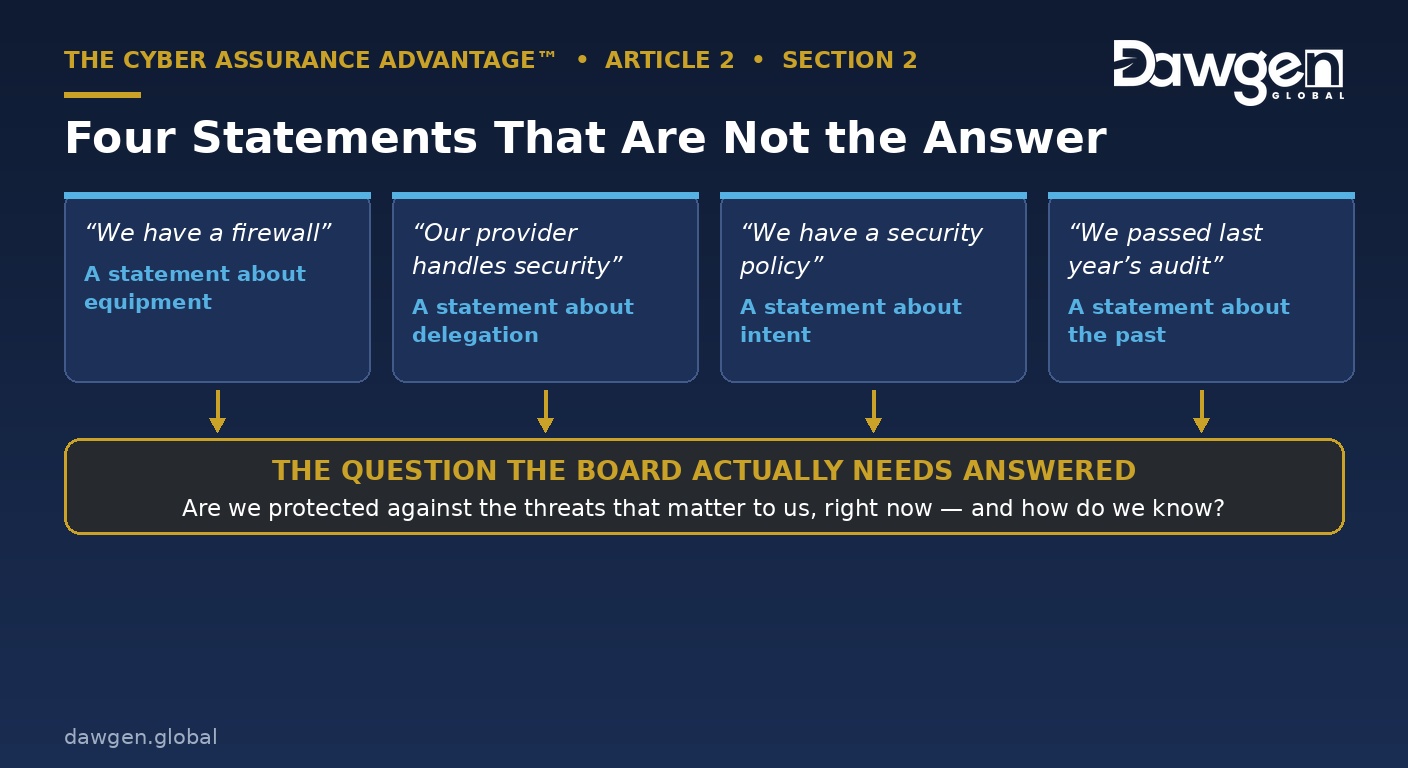
None of these statements answers the question a board actually needs answered: are we protected against the threats that matter to us, right now, and how do we know? The Caribbean market has largely been sold activity — tools, subscriptions, services — because activity is what vendors have to sell. Evidence is a different product. It requires someone independent of the people who built and operate the controls to examine whether those controls are well designed for the organisation’s actual risks, and then to test whether they operate as intended under real conditions. That product has been scarce in the region, and its absence is the missing link this article addresses.
The consequences of the gap are visible across the region. A credit union relies on its core-banking vendor’s brochure as proof of member-data security. A distributor discovers during a ransomware event — not before — that its nightly backups had been failing silently for months. A government agency holds a thick file of completed questionnaires and no evidence that any control was ever tested. In each case the organisation had cybersecurity. What it lacked was knowledge — and the moment that gap is discovered is almost always the most expensive possible moment to discover it.
What Is Cyber Assurance — and How Is It Different from Cybersecurity?
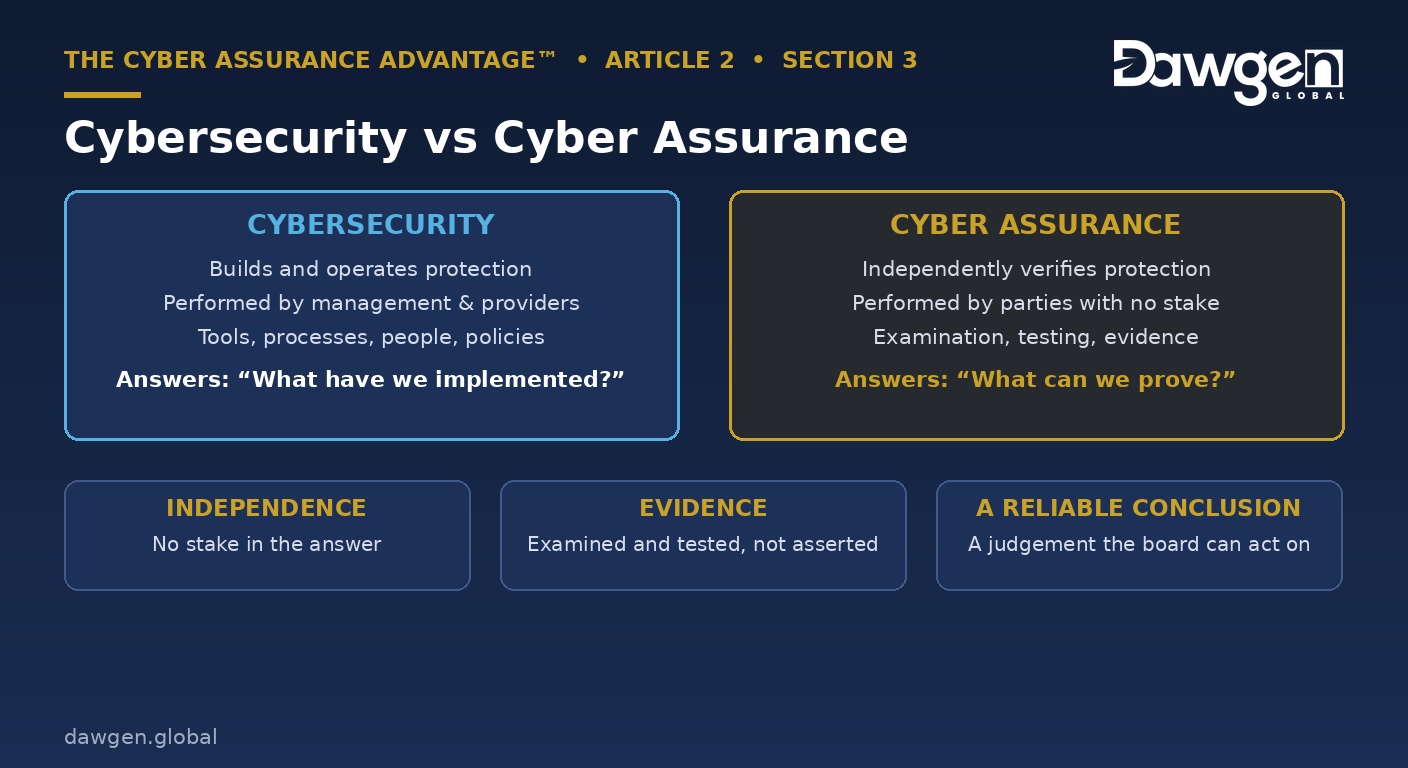
Cybersecurity is everything an organisation does to protect itself: the technologies deployed, the processes operated, the people trained, the policies written. It is performed by management and its providers, and it is indispensable. Cyber assurance is something categorically different: an independent, structured examination that produces evidence and a conclusion about whether that protection can be relied upon. Where cybersecurity builds and operates, assurance verifies. Three elements define it.
- Assurance must come from someone with no stake in the answer — not the team that configured the controls, and not the provider paid to operate them. Self-assessment is a useful management tool; it is not assurance.
- Assurance rests on examination and testing, not interviews and attestations alone: reviewing configurations, testing whether controls can be bypassed, verifying that backups restore, confirming that access rights match reality.
- A conclusion someone can rely on. The output is not a stack of technical data but a professional judgement, addressed to the board or another accountable audience, about control design and operating effectiveness — with the gaps clearly stated.
The financial-audit analogy carries the point. Bookkeeping, accounting software and a finance team are the equivalents of cybersecurity: essential, operated by management. The external audit is the equivalent of cyber assurance: independent, evidence-based, and existing precisely because the people who prepare information should not be the only ones vouching for it. Boards internalised that principle for financial statements generations ago. Cyber assurance simply applies it to a newer risk.
| THE DEFINING QUESTION
Cybersecurity answers: what have we implemented? Cyber assurance answers: what can we prove? A board can only govern with the second. |
Why Isn’t Compliance the Same as Assurance?
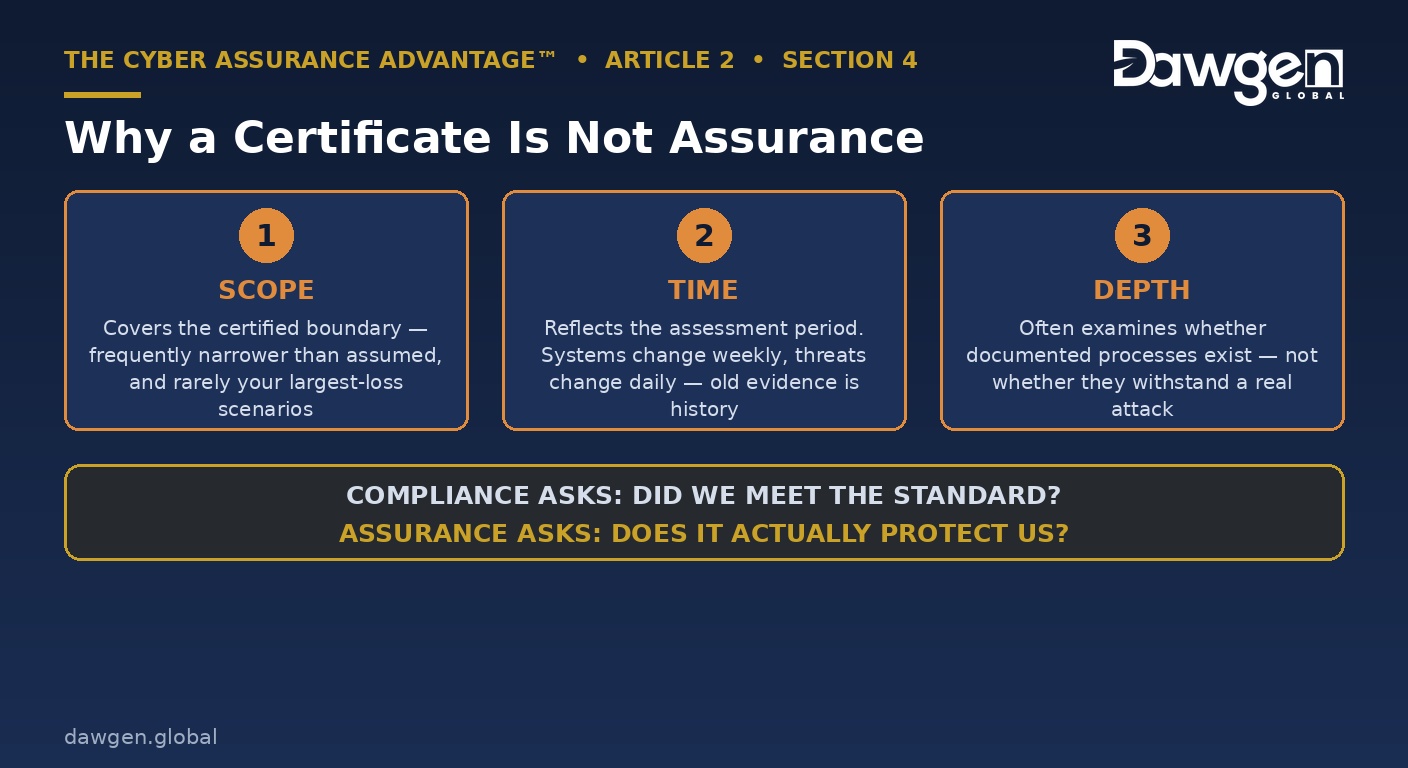
The most common objection is a certificate. “We are ISO certified.” “Our provider has a service-auditor report.” “We completed the regulator’s questionnaire.” These artefacts have real value — they demonstrate discipline and satisfy counterparties — but treating them as assurance over your organisation’s cyber risk involves three misunderstandings.
- A certification covers the systems, locations and processes inside its defined boundary — which is frequently narrower than the organisation assumes, and rarely covers the specific risks that would hurt it most.
- A certificate reflects the state of affairs during the assessment period. Systems change weekly; threats change daily. Twelve-month-old evidence is history, not assurance.
- Many compliance exercises examine whether documented processes exist, not whether they withstand attack. A policy can be fully compliant and completely ineffective. A provider’s report describes the provider’s controls — not whether you configured and use the service securely.
Compliance answers “did we meet the standard?” Assurance answers “does it actually protect us?” Well-governed organisations need both — but they must never mistake the first for the second. Later articles in this series examine the sharpest version of this confusion: the belief that a vulnerability scan is a penetration test, and that a clean report means a secure organisation.
What Are the Governance and Internal Audit Implications?
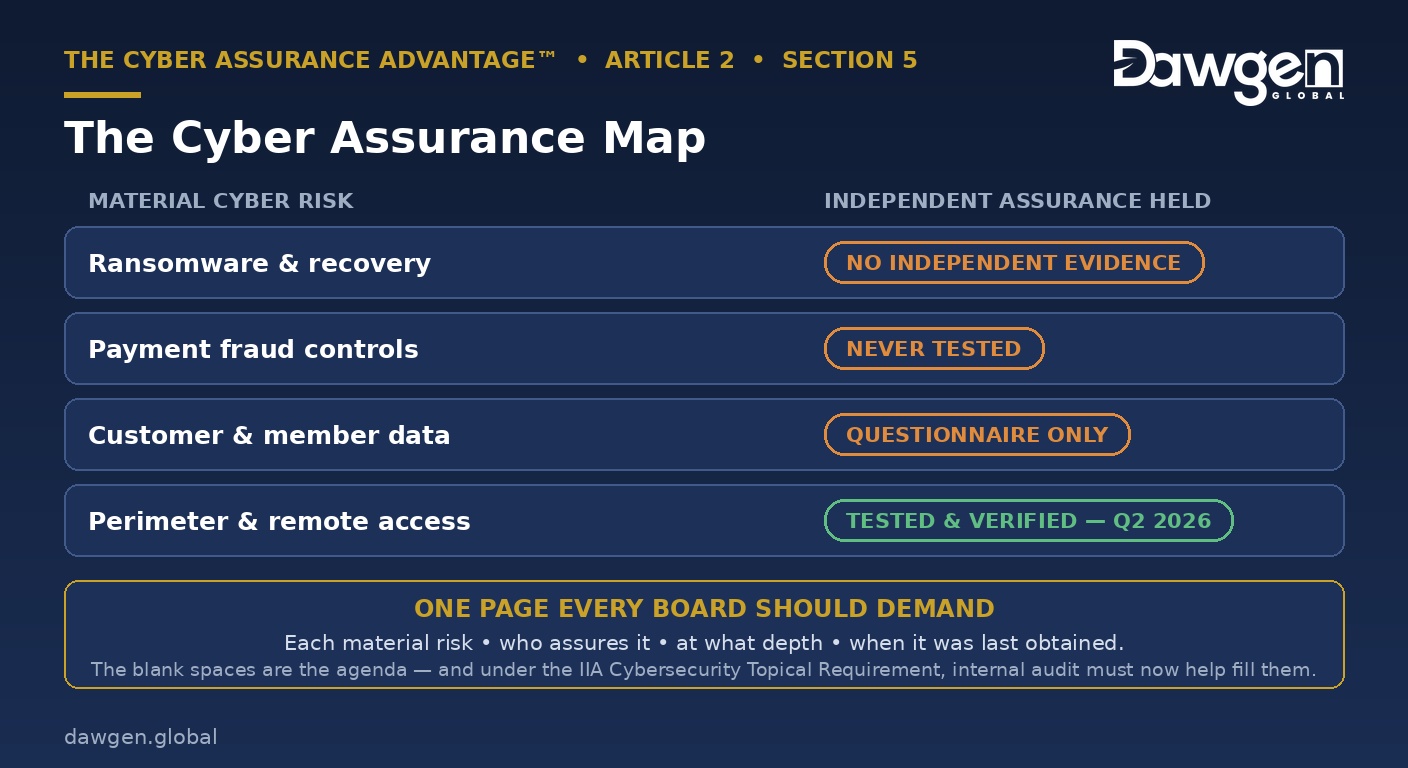
If assurance is the board’s instrument, then someone must be accountable for providing it — and the structure already exists. In the three-lines model, management and its providers operate cyber controls; risk and compliance functions oversee and challenge; and internal audit provides independent assurance to the board. The Institute of Internal Auditors’ Cybersecurity Topical Requirement, in force since February 2026, has converted that principle into a professional obligation: internal audit functions must now apply a defined baseline when assuring cybersecurity governance, risk management and controls. A cyber-silent audit plan no longer conforms to global standards.
The practical tool boards should ask for is a cyber assurance map: a single page showing each material cyber risk, who provides assurance over it, of what depth, and when it was last obtained. Mapping this for the first time is usually revealing. Some risks turn out to be covered by nothing more than a provider’s marketing claims. Others are covered three times over by overlapping questionnaires while the organisation’s most plausible loss scenario — a ransomware event, a payments fraud — has never been independently examined at all. The map converts a vague sense of coverage into a governed portfolio of evidence, and it exposes the gaps while they are still theoretical.
For most Caribbean organisations, the honest constraint is capability. Few internal audit functions in the region carry deep technical skills in-house, and they should not pretend to. The standards anticipate this: assurance can be delivered through co-sourcing, with specialists working under internal audit’s mandate and methodology. What cannot be delegated is accountability for ensuring the assurance exists.
What Does Cyber Assurance Look Like in Practice?
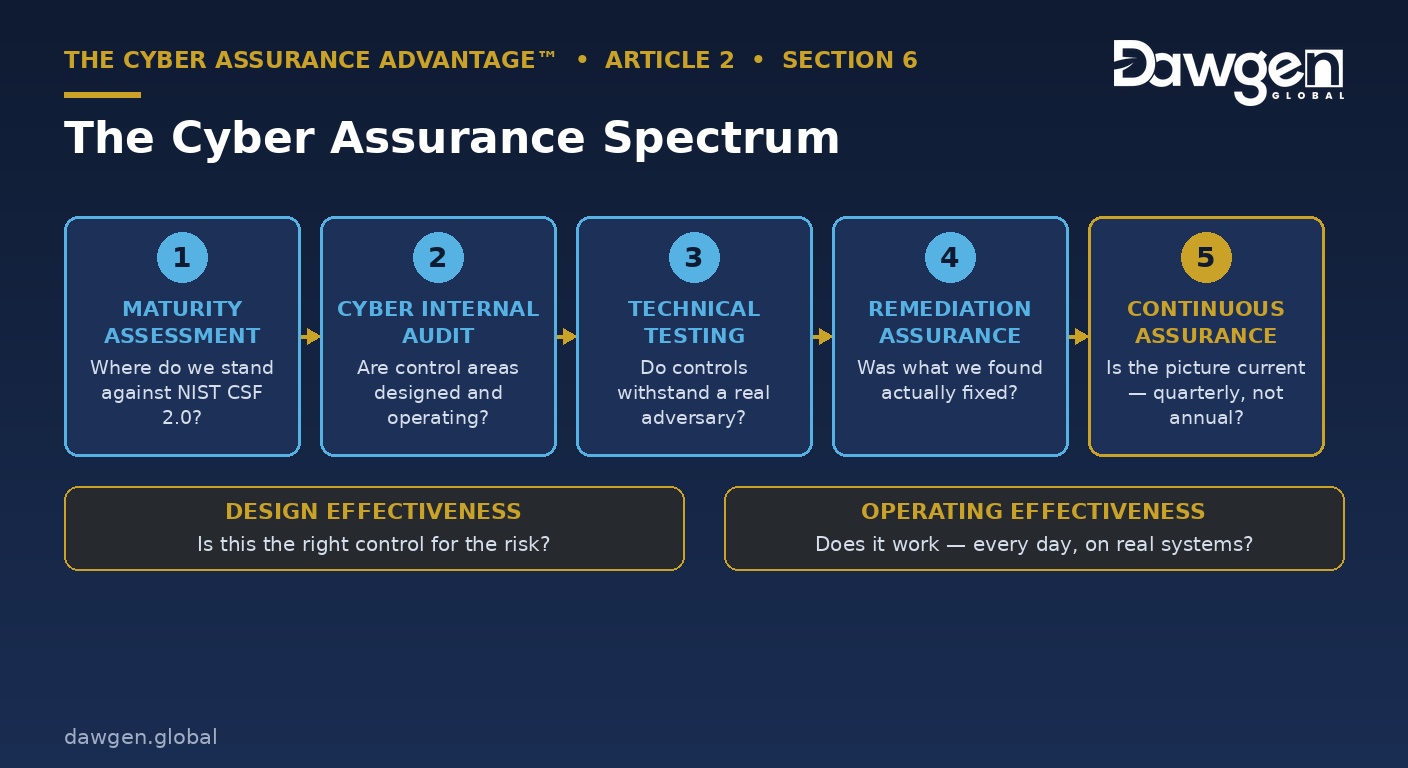
Assurance is not a single product but a spectrum of activities, sequenced to the organisation’s maturity and risk. A practical progression looks like this: a maturity and governance assessment establishes where the organisation stands against a recognised framework such as NIST CSF 2.0; cybersecurity internal audit examines whether specific control areas — access management, patching, backup and recovery, third-party risk — are designed and operating effectively; technical testing, including vulnerability assessment and penetration testing, proves whether controls withstand a real adversary; remediation assurance verifies that what was found was actually fixed; and continuous assurance keeps the picture current through periodic testing, monitoring and quarterly reporting rather than an annual snapshot.
Two disciplines hold the spectrum together. The first is the distinction between design effectiveness — is this the right control for the risk? — and operating effectiveness — does it actually work, every day, as performed by real people on real systems? Both must be examined; a well-designed control that nobody operates protects no one. The second is integration: governance findings, control findings and technical findings must be assembled into one risk narrative with one prioritisation, expressed in business terms. Fragmented reports from unconnected providers leave the board to perform the integration itself — which is to say, it never happens.
How Should an Organisation Begin? Five Practical Steps
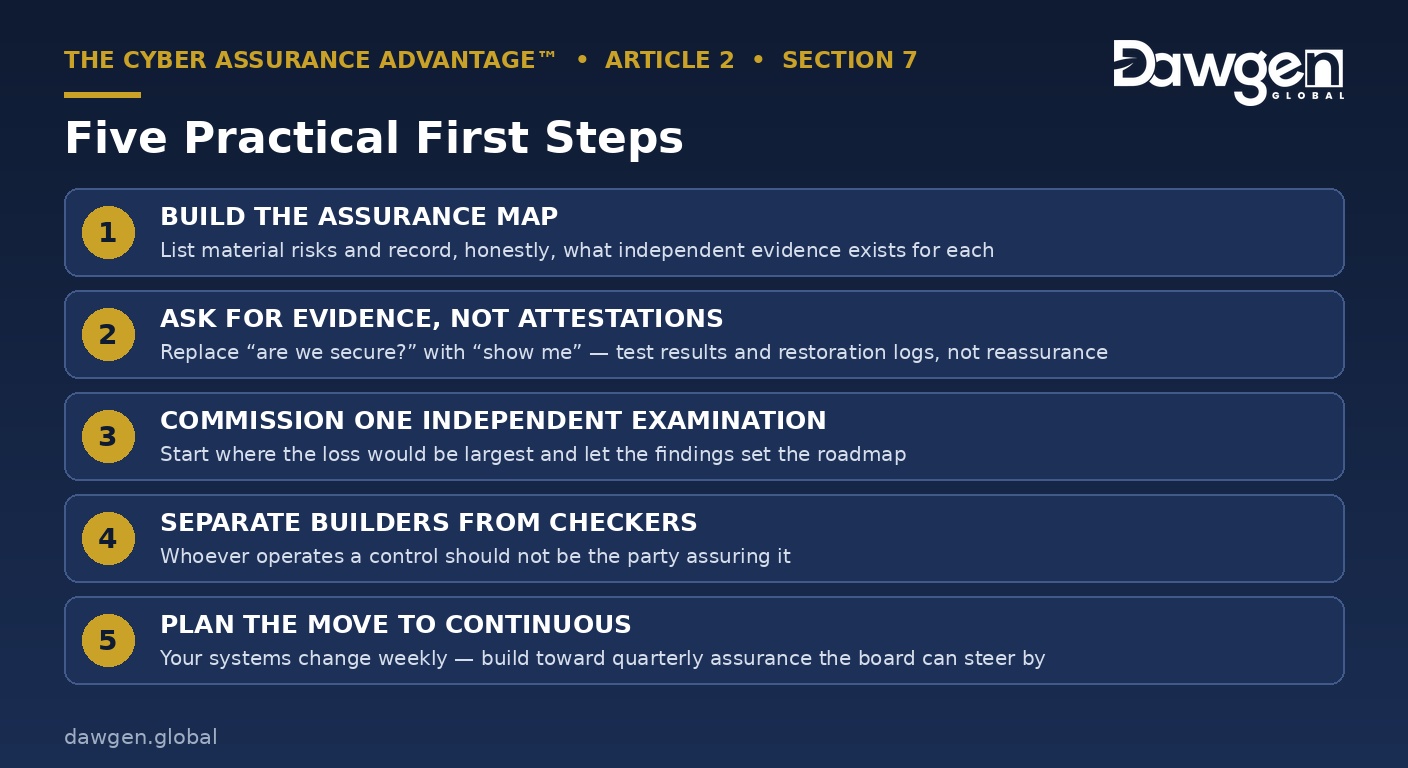
- Build the cyber assurance map. List your material cyber risks and record, honestly, what independent evidence exists for each. The blank spaces are your agenda.
- Change the question you ask providers. Replace “are we secure?” with “show me the evidence.” Attestations, dashboards and reassurance are not evidence; configurations, test results and restoration logs are.
- Commission one independent examination. Start where the loss would be largest — typically an integrated review combining control assessment with technical testing — and let its findings set the roadmap.
- Separate the builders from the checkers. Whoever designs, implements or operates a control should not be the party assuring it. Where one firm does both, demand separate teams and disclosure — or separate firms.
- Plan the move from annual to continuous. A yearly exercise made sense when systems changed yearly. Yours change weekly. Build toward quarterly assurance reporting the board can actually steer by.
The Dawgen Global Perspective
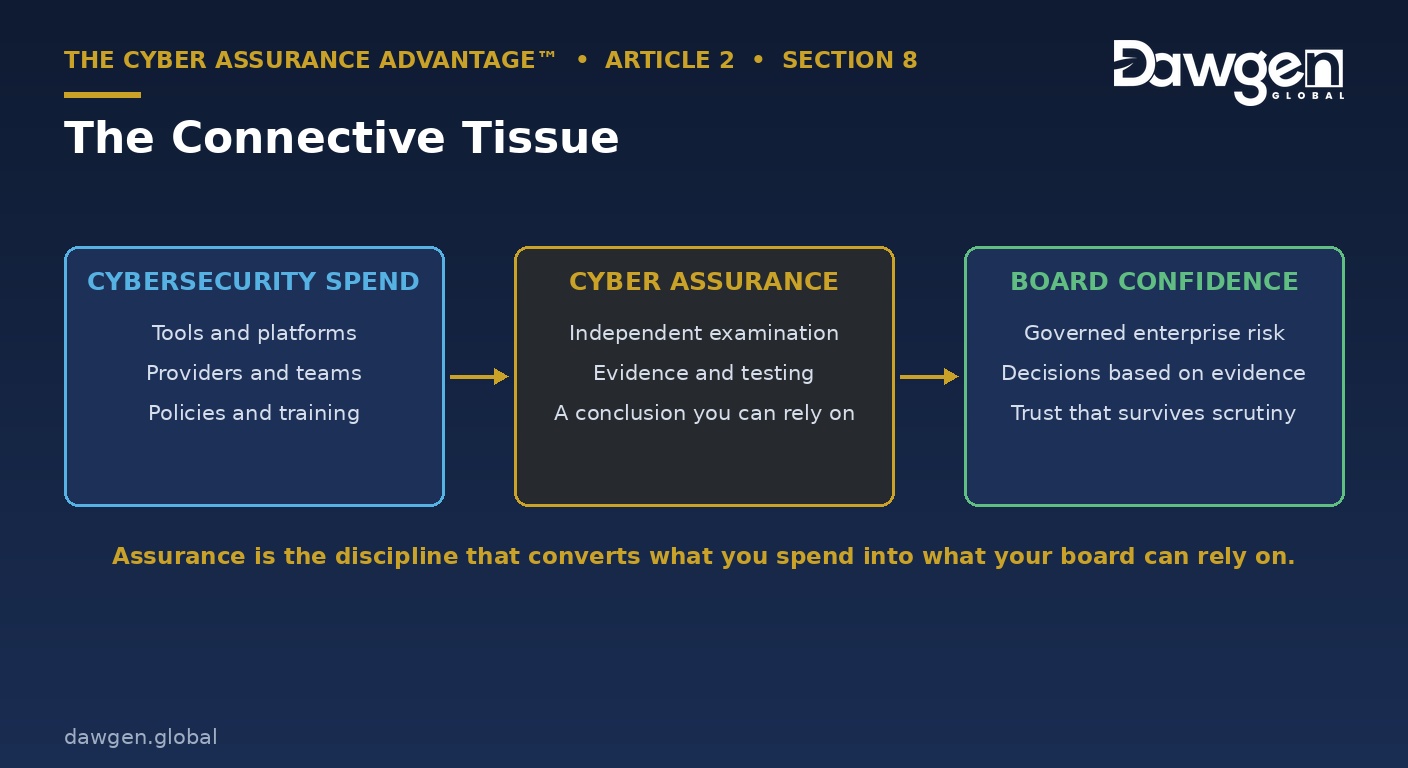
Dawgen Global’s conviction is that cyber assurance is not a product line but a discipline the Caribbean market has been missing — the connective tissue between the money organisations spend on cybersecurity and the confidence their boards are entitled to have. Providing it demands an unusual combination: the governance, audit and reporting rigour of a professional services firm, and the technical depth to test controls against genuine attack techniques, held together by one methodology and an uncompromised standard of independence.
That combination is what Dawgen Global’s Cyber Risk Assurance & Resilience practice was built to deliver — from board-level governance review through cybersecurity internal audit, penetration testing and resilience assessment to the independent validation that findings were genuinely closed. The next article in this series turns to the people accountable for demanding all of this: the directors themselves, and what a cyber-accountable board must know, ask and verify.
Eight Questions That Separate Activity from Assurance
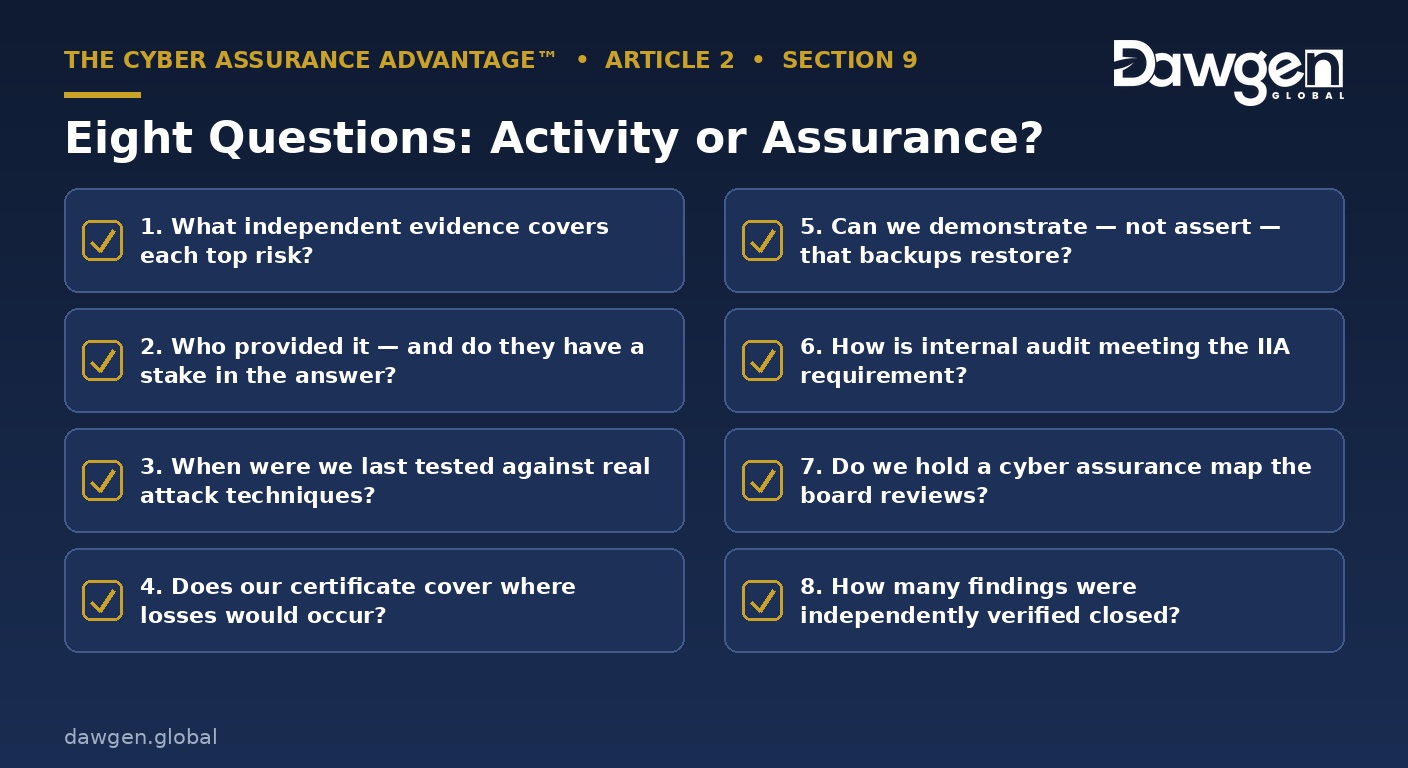
- For each of our top cyber risks, what independent evidence do we hold that controls are effective?
- Who provided that evidence — and do they have any stake in the answer being favourable?
- When was our environment last tested against real attack techniques, not just scanned or self-assessed?
- Does our certification or provider report actually cover the systems where our largest losses would occur?
- Can we demonstrate — not assert — that our backups restore and our recovery plan works?
- How is internal audit meeting the IIA Cybersecurity Topical Requirement, and with what specialist support?
- Do we hold a cyber assurance map, and when did the board last review it?
- Of the findings raised in our last assessment, how many have been independently verified as closed?
Frequently Asked Questions
Is cyber assurance the same as a cybersecurity audit?
A cybersecurity audit is one form of cyber assurance — typically an internal-audit examination of control areas. Cyber assurance is the broader discipline, which also includes technical testing, remediation validation and continuous assurance. The common thread is independence, evidence and a conclusion a board can rely on.
We hold a certification and our provider has a service-auditor report. Do we still need cyber assurance?
Yes. Certificates and provider reports are valuable but bounded: they cover a defined scope, at a point in time, often at documentation depth, and a provider’s report covers the provider’s controls rather than your use of the service. Assurance addresses your risks, your systems and the present.
Can our IT provider give us cyber assurance?
Not over the controls it built or operates — that is self-review, however competent the provider. Providers can and should supply evidence about their own performance, but independent assurance must come from a party with no stake in the answer.
How much cyber assurance does a mid-sized Caribbean organisation need?
Proportionate to risk, not to headcount. A sensible starting point is a fixed-scope diagnostic to establish the baseline, one integrated review of the highest-loss scenario each year, and verification that findings are closed — building toward continuous assurance as digital dependence grows.
Move From Cybersecurity Assumptions to Independent Cyber Assurance
Dawgen Global combines cyber governance, risk-based internal audit, penetration testing, resilience assessment and remediation validation to help Caribbean organisations determine whether their cybersecurity controls are properly designed and operating effectively. To explore what cyber assurance should look like for your organisation, request a confidential executive briefing for your board or leadership team.
About Dawgen Global
Dawgen Global is an independent, integrated multidisciplinary professional services firm headquartered at Dawgen Towers, 47-49 Trinidad Terrace, Kingston 5, Jamaica, serving more than 15 territories across the Caribbean. Founded and led by Dr. Dawkins Brown, Executive Chairman, the firm is independent and not affiliated with any international network. It delivers a full suite of professional services under one roof: audit and assurance; tax advisory; IT and digital transformation; risk management; cybersecurity; actuarial and insurance regulatory advisory; HR advisory; mergers and acquisitions; corporate recovery; business advisory and strategy; accounting BPO and virtual CFO services; and legal process outsourcing.
The proposition is simple: big-firm capability without the big-firm price. Dawgen Global’s integrated approach is built for the specific complexities and opportunities of the Caribbean market, helping organizations make sharper, better-informed decisions that drive measurable progress.
To explore a partnership, reach out:
- Website: dawgen.global
- Email: info@dawgen.global
- WhatsApp (Global): +1 555-795-9071
- Caribbean offices: +1 876-929-3670 | +1 876-926-5210


