
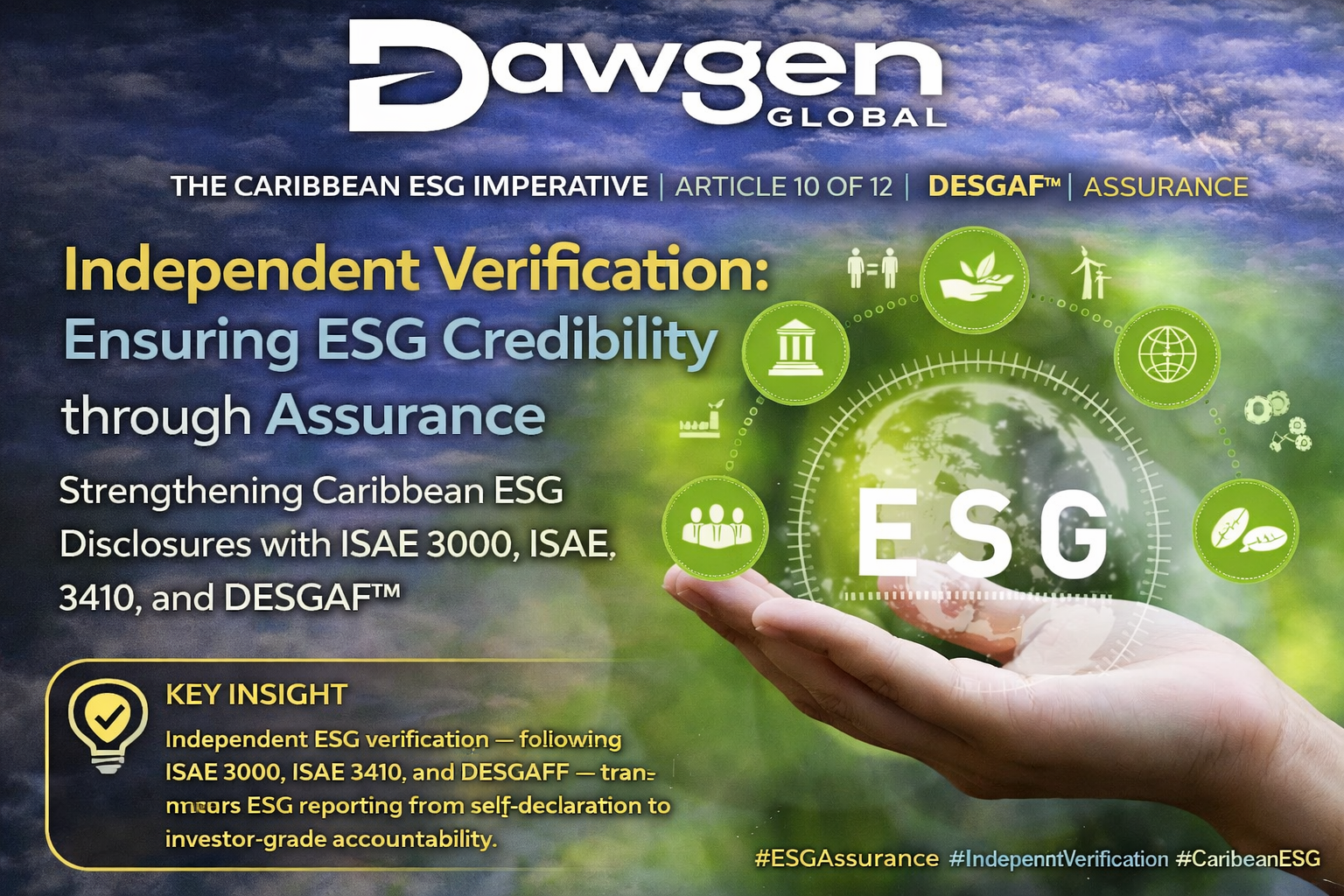
The Verification That Transforms Commitment into Credibility
Every article in The Caribbean ESG Imperative series has built toward this one. Articles 2 through 8 addressed what Caribbean businesses must do — manage climate risk, transition to clean energy, steward biodiversity, develop their people, create community value, build governance integrity, and implement anti-corruption controls. Article 9 addressed how they must communicate what they do — through GRI, IFRS S1/S2, TCFD, and the quality principles of credible ESG disclosure. This article addresses the question that sophisticated stakeholders ask after reading an ESG report: how do we know this is true?
Independent ESG assurance — the examination of an organisation’s ESG disclosures by a qualified, independent third party against recognised criteria — is the mechanism that answers that question. It transforms an ESG report from a self-reported narrative, which stakeholders must trust on faith, into an independently verified accountability statement, which stakeholders can trust because it has been tested. The difference between these two things is not semantic. It is the difference between a restaurant that claims its food is safe and a restaurant whose kitchen has been inspected by a qualified health authority.
This article — the tenth in Dawgen Global’s The Caribbean ESG Imperative series — examines ESG assurance in depth. We explain ISAE 3000 — the international assurance standard under which ESG assurance is conducted. We compare limited and reasonable assurance levels in detail. We examine DESGAF™ as a comprehensive ESG assurance framework — mapping exactly what the assurer does at each of the six DESGAF™ pillars. We provide guidance on assurance scope selection — what to assure first, and how to expand scope over time. We examine the growing market access requirements for assurance. And we position Dawgen Global as the Caribbean’s specialist ESG assurance provider — the firm that combines the technical assurance capability with the regional business context understanding that Caribbean ESG assurance requires.
| KEY INSIGHT
ESG assurance is not the last step in the ESG journey — it is the quality control mechanism that runs through every step. An assurance engagement that finds strong controls, accurate data, and honest disclosure is not just producing a credibility statement — it is confirming that the organisation’s ESG programme is genuinely managed rather than performatively reported. The most valuable assurance engagements are those that find something to improve — because improvement is the purpose. |
Why ESG Assurance Matters: The Case for Independent Verification
The Credibility Gap in Self-Reported ESG
ESG reporting without independent assurance suffers from an inherent credibility limitation that financial reporting resolved decades ago through mandatory audit. An organisation’s financial statements are not trusted because the organisation says they are accurate — they are trusted because an independent auditor has examined them and issued an opinion. An organisation’s ESG report, without equivalent independent examination, is trusted primarily because the reader chooses to believe it. In an environment of growing greenwashing allegations, regulatory scrutiny of ESG claims, and investor sophistication, that trust is increasingly insufficient.
The credibility gap in self-reported ESG is not primarily a matter of organisational dishonesty. Most Caribbean ESG reports are prepared in good faith by managers who believe their organisations are performing as described. The problem is that without external examination, honest errors in measurement methodology, data collection, and disclosure completeness go undetected and uncorrected. GHG emissions calculated using outdated emission factors; water intensity denominators that exclude certain facilities; OHS data that excludes contractor injuries; governance disclosures that describe aspirational policies rather than actual practices — these are not fraudulent misrepresentations. They are the routine quality issues that external verification identifies and corrects, transforming a report that is prepared in good faith into a report that is accurate in fact.
The Growing Market Access Requirement for Assurance
ESG assurance has moved from a voluntary quality signal to an increasingly mandatory market access requirement across multiple dimensions of the Caribbean business environment:
- Green Bond Standards: the Climate Bonds Standard and the ICMA Green Bond Principles both require or strongly recommend external assurance over the green bond framework and use of proceeds — and increasingly over the issuer’s climate performance disclosures. Caribbean green bond issuers who obtain assurance access a credibility premium that commands lower financing costs.
- Sustainability-Linked Loans: SLL covenants that link margin to specific ESG KPIs typically require annual verification of KPI achievement by an independent qualified assurance provider — creating a recurring assurance requirement for Caribbean businesses with SLL financing.
- Development Finance Institution requirements: IFC, IDB Invest, CDB, and similar institutions increasingly require ESG assurance as a condition of financing — or as a condition for maintaining preferred pricing under ESG-linked instruments.
- Institutional investor expectations: Major institutional investors — pension funds, insurance companies, and ESG-mandated fund managers — are moving from accepting self-reported ESG data to requiring assured ESG data as a condition of portfolio inclusion. This expectation is reaching Caribbean businesses as they access international capital markets.
- Regulatory requirements: The EU’s CSRD mandates assurance over sustainability disclosures — initially limited assurance, moving to reasonable assurance over time. This requirement directly affects Caribbean subsidiaries of EU companies and indirectly affects Caribbean companies in EU supply chains.
- Listing and exchange requirements: Caribbean stock exchanges are beginning to develop ESG disclosure guidelines; international exchanges on which Caribbean companies may seek listings require or strongly recommend assured ESG disclosure.
ISAE 3000: The International Standard for ESG Assurance
ISAE 3000 (Revised) — Assurance Engagements Other Than Audits or Reviews of Historical Financial Information — is the international standard issued by the International Auditing and Assurance Standards Board (IAASB) under which ESG assurance engagements are conducted. ISAE 3000 provides the framework of requirements and guidance that governs how assurance practitioners plan, execute, and report on ESG assurance engagements — establishing the professional standards that distinguish credible ESG assurance from self-certification or marketing review.
The Three Elements of an ISAE 3000 Assurance Engagement
Every ISAE 3000 ESG assurance engagement involves three parties and three essential elements. The three parties are: the responsible party (the organisation whose ESG disclosures are being assured, which prepares and is responsible for the subject matter information); the intended users (the stakeholders for whose benefit the assurance is obtained — investors, lenders, regulators, communities); and the practitioner (the independent assurance provider who examines the subject matter and issues the assurance conclusion).
The three essential elements are: the subject matter (the specific ESG information being assured — GHG emissions, OHS rates, governance disclosures, or the full ESG report); the criteria (the standards against which the subject matter is assessed — GRI Standards, ISAE 3410 for GHG emissions, or agreed-upon specific criteria); and the evidence (the procedures performed and the information obtained that provide the basis for the assurance conclusion).
Limited vs Reasonable Assurance: Understanding the Two Levels
ISAE 3000 recognises two levels of assurance — limited and reasonable — that differ in the nature and extent of procedures performed, the level of assurance provided, and the form of the assurance conclusion. The table below provides a comprehensive comparison of the two levels across all dimensions relevant to Caribbean organisations making assurance decisions.
| Dimension | Limited Assurance | Reasonable Assurance |
| Assurance level | Limited assurance | Reasonable assurance |
| ISAE 3000 description | The practitioner performs procedures primarily consisting of inquiries of management and analytical procedures; the work provides a moderate level of assurance | The practitioner performs a more extensive set of procedures — including testing of controls, independent data verification, and detailed substantive procedures — providing a high level of assurance |
| Conclusion language | ‘Nothing has come to our attention that causes us to believe the subject matter information is materially misstated’ — a negative form of conclusion | ‘In our opinion, the subject matter information is prepared, in all material respects, in accordance with the applicable criteria’ — a positive form of conclusion analogous to an audit opinion |
| Investor / stakeholder credibility | Good — signals genuine commitment to external verification; appropriate for organisations at earlier stages of ESG data maturity; widely accepted by DFI lenders and many institutional investors | High — equivalent to an audit in its rigour and credibility; required by some institutional investors, green bond standards, and regulated entities; the gold standard for ESG assurance |
| Data maturity required | Moderate — data systems and controls should be in place but do not need to have been tested to audit standard; methodology documentation required | High — data systems must be well-controlled and documented; internal controls tested; prior year comparative data available; management representations obtained |
| Cost and effort | Moderate — typically 30–50% of the cost of reasonable assurance over the same scope; appropriate starting point for most Caribbean organisations | High — comparable in cost to a financial audit over equivalent scope; appropriate for large organisations with mature ESG data systems and significant stakeholder assurance requirements |
| Recommended for | First and second year ESG assurance; smaller organisations; organisations building ESG data maturity; assurance over selected metrics where data systems are developing | Organisations with 3+ years of ESG reporting history; listed companies; organisations seeking institutional investor capital; green bond issuers; ESG-linked loan covenants requiring reasonable assurance |
| Common scope elements | GHG emissions (Scope 1 and 2); key environmental metrics (water, energy intensity); selected social metrics (LTIFR, gender diversity percentage); governance disclosures (board composition, anti-corruption training rate) | Full GHG inventory including material Scope 3; all disclosed environmental metrics; comprehensive social metrics; governance controls effectiveness; management disclosure controls; selected forward-looking statements |
For most Caribbean organisations commencing ESG assurance for the first time, limited assurance is the appropriate starting point — it signals genuine commitment to external verification, satisfies the assurance requirements of most DFI lenders and many institutional investors, and is achievable within the data maturity constraints that characterise early-stage ESG programmes. As data systems mature, controls strengthen, and stakeholder expectations grow, the progression from limited to reasonable assurance over key subject matter is a natural next step — typically achievable within three to five years of commencing the assurance journey.
ISAE 3410: Specialist Assurance for GHG Emissions
GHG emissions — the most widely assured ESG metric globally — has its own dedicated assurance standard: ISAE 3410 Assurance Engagements on Greenhouse Gas Statements. ISAE 3410 provides specific guidance on the assessment of GHG emissions inventories — including the evaluation of organisational and operational boundaries, the selection and application of emission factors, the treatment of uncertainties, and the verification of Scope 1, 2, and material Scope 3 emissions.
Caribbean GHG assurance engagements under ISAE 3410 face specific technical challenges that practitioners must be equipped to address. The quality and currency of Caribbean grid emission factors — the conversion rates that translate electricity consumption into GHG emissions — vary significantly by territory and are not always updated regularly by national utilities. The prevalence of captive diesel generation in Caribbean operations creates Scope 1 boundary questions. And the treatment of Caribbean-specific agricultural emissions — particularly in the sugar, livestock, and smallholder agriculture sectors — requires emission factor expertise that goes beyond standard IPCC tables.
Dawgen Global’s ESG Assurance Practice has developed Caribbean-specific expertise in ISAE 3410 engagements — including the emission factor databases, boundary-setting methodology, and sector-specific expertise needed to provide technically rigorous GHG assurance across Caribbean territories and sectors. This expertise is embedded in the DESGAF™ assurance framework — ensuring that GHG assurance conducted under DESGAF™ reflects the specific technical context of Caribbean emissions measurement.
DESGAF™ in Depth: The Six-Pillar Assurance Framework
DESGAF™ — Dawgen Global’s ESG Assurance Framework — was introduced in Article 1 of this series as the anchor of the entire Caribbean ESG Imperative programme. This article examines DESGAF™ at the level of detail that assurance practitioners and their clients need: what the organisation does in each pillar, and what the assurer does in each pillar. The table below provides a comprehensive DESGAF™ pillar reference — mapping both the organisational activities and the assurance procedures at each stage of the framework.
| Pillar | Name and Focus | What the Organisation Does in This Pillar | What the Assurer Does in This Pillar (ISAE 3000 Procedures) |
| D — DEFINE | Pillar 1: Foundation Setting | Board-approved ESG Policy; stakeholder identification and engagement; materiality assessment (impact and financial); ESG governance structure; ESG topic prioritisation; multi-year targets and commitments; boundary setting for reporting and assurance | Assurance procedures: Review board minutes and committee terms of reference for evidence of ESG Policy approval; review materiality assessment methodology and stakeholder engagement records; confirm that material topics are identified through a documented process; verify that ESG targets are board-endorsed and time-bound |
| E — EMBED | Pillar 2: Management Integration | ESG integrated into strategic planning; ESG risks in enterprise risk register; ESG-linked executive remuneration; sustainability considerations in capital allocation; ESG in procurement policies; supplier ESG requirements; human rights due diligence; climate considerations in investment decisions | Assurance procedures: Review strategic plan for ESG integration evidence; examine risk register for climate and social risk entries; review remuneration committee reports for ESG KPI inclusion and weighting; assess procurement policy ESG provisions; review supply chain ESG screening records |
| S — STRUCTURE | Pillar 3: Measurement Systems | GHG emissions measurement system (Scope 1, 2, 3); energy monitoring infrastructure; water metering; waste measurement; social metrics data collection (OHS data, turnover, training hours, diversity data); data governance and quality controls; internal audit coverage of ESG data; methodology documentation | Assurance procedures: Test GHG data collection from source documents to reported figures; verify emission factors and calculation methodology; confirm energy and water metering accuracy; review OHS incident recording systems; test diversity and workforce data completeness; assess internal controls over ESG data; re-perform key calculations |
| G — GENERATE | Pillar 4: ESG Disclosure | Materiality-aligned ESG report preparation; GRI Standards in accordance claim; IFRS S1/S2 alignment; TCFD four-pillar disclosure; SASB sector metrics; SDG mapping; balance of positive and negative disclosure; comparative data and trend analysis; methodology notes and data definitions; assurance scope notation | Assurance procedures: Verify that disclosed data matches underlying Pillar 3 data systems; confirm GRI in accordance claim by checking Universal Standards compliance; review IFRS S2 scenario analysis for methodological rigour; assess balance of positive and negative disclosure; verify comparative data consistency; check for selective disclosure omissions |
| A — ASSURE | Pillar 5: Independent Verification | Engagement acceptance and independence assessment; planning and risk assessment; materiality threshold setting; procedures execution (inquiries, analytical procedures, substantive testing); findings management; management representation letter; assurance conclusion preparation; assurance statement issuance; post-assurance improvement recommendations | This is the assurance engagement itself — the execution of the DESGAF™ framework through ISAE 3000 procedures. The assurance conclusion is the output of all procedures executed across Pillars 1–4. The assurance statement provides stakeholders with independent evidence of the quality of the organisation’s ESG programme and disclosure |
| F — FORWARD | Pillar 6: Continuous Improvement | Management letter to client communicating assurance findings and recommendations; identification of data system improvements; control deficiency reporting; benchmark comparison against sector peers; year-on-year improvement tracking; emerging standard monitoring; next cycle scope expansion planning; stakeholder feedback integration | Assurance procedures: Issue management letter with findings and recommendations from the assurance engagement; discuss improvement priorities with management and audit committee; agree timeline for addressing control deficiencies identified; plan scope expansions for the following year; monitor regulatory and standard developments that will affect next year’s assurance |
Why DESGAF™ Is Different from Generic ESG Assurance
Most international ESG assurance engagements are conducted against a specific subject matter — a GHG inventory, a set of GRI disclosures, or the ESG metrics in an annual report — using ISAE 3000 procedures calibrated to that specific subject matter. DESGAF™ is a more comprehensive approach: it assures not only the disclosures but the processes, governance structures, and measurement systems that produce those disclosures. An assurance engagement under DESGAF™ does not simply verify that the numbers in the ESG report match the underlying data — it verifies that the governance foundation (Pillar 1) is genuine, that management integration (Pillar 2) is real, that measurement systems (Pillar 3) are controlled and reliable, and that disclosures (Pillar 4) are complete, balanced, and accurately represent the organisation’s actual ESG performance.
This comprehensive approach is particularly important in the Caribbean context, where ESG programmes are often at earlier stages of maturity and where the gap between ESG governance aspiration and ESG management reality can be wider than in more established ESG markets. DESGAF™ is designed to identify and close that gap — providing not only assurance over current disclosure but a structured improvement pathway (Pillar 6) that enables Caribbean organisations to strengthen their ESG governance and measurement over successive years of engagement.
Selecting Your Assurance Scope: A Practical Guide
One of the most important decisions in commissioning ESG assurance is the scope — what subject matter will the assurance cover? Scope decisions involve trade-offs between comprehensiveness, data maturity, cost, and the specific assurance requirements of the organisation’s key stakeholders. The table below provides a prioritised guide to assurance scope selection for Caribbean organisations.
| Subject Matter | Assurance Priority | Recommended Level | Notes for Caribbean Assurance Engagements |
| GHG Emissions (Scope 1 and 2) | High — investor and regulatory baseline | Limited or Reasonable | Most important assurance subject matter; directly linked to net zero commitments; required by green bond standards and many DFI loans; ISAE 3410 (GHG emissions) provides specific assurance guidance; highest-quality data subject typically available |
| Energy Consumption and Intensity | High — linked to GHG and transition risk | Limited | Strong data trail from utility bills and metering; important for energy transition claims; relatively straightforward assurance procedures; often assured alongside GHG emissions |
| Water Withdrawal and Intensity | High — Caribbean water stress context | Limited | Data from meters and utility bills; important for water-stressed locations; GRI 303 alignment verification; relevant for tourism, agriculture, and manufacturing sectors |
| OHS Metrics (LTIFR, fatalities) | High — reputational and legal | Limited or Reasonable | Critical metric — any assurance finding on OHS data is material; data from incident records; RIDDOR-equivalent Caribbean regulatory reporting provides independent cross-check; ISO 45001 certification is complementary |
| Gender Diversity and Pay Equity | High — investor DEI focus | Limited | HR system data; payroll records for pay equity; relatively accessible data trail; increasingly required by institutional investors with DEI investment policies |
| Community Investment and SROI | Medium — social licence signal | Limited | More complex data trail than environmental metrics; program expenditure records plus outcome measurement; SROI methodology assessment required; relevant for anchor institution claims |
| Governance Disclosures (board composition, anti-corruption, training rates) | High — G pillar credibility | Limited | Board registers; training records; policy documents; board minutes; GRI 2 and GRI 205 alignment verification; important for governance-focused investors and DFI lenders |
| Supply Chain Social Standards | Medium-Growing — driven by EU CSDDD | Limited | More complex — requires supplier data and audit evidence; growing in importance as EU supply chain due diligence requirements reach Caribbean exporters; scope typically limited to tier 1 suppliers in first assurance year |
| Forward-looking statements (targets, transition plans) | Medium — greenwashing protection | Limited (specific procedures) | Assessment of the reasonableness of assumptions and methodologies underlying targets and transition plans; does not provide assurance on future outcomes; important for net zero and climate transition plan claims |
The recommended scope selection approach for Caribbean organisations is to begin with the subject matter most critical to the organisation’s principal stakeholder relationships — typically GHG emissions and governance disclosures for organisations with DFI lenders or institutional investors, and OHS and social metrics for organisations with supply chain ESG requirements from international customers. Expand scope annually as data systems mature and as stakeholder requirements evolve. Aim for comprehensive coverage of all material topics disclosed in the ESG report within three to five years of commencing assurance.
The Assurance Statement: What It Contains and What It Means
The assurance statement — the document issued by the independent assurance provider and included in or appended to the ESG report — is the tangible output of the assurance engagement that stakeholders read and rely upon. Understanding what a credible assurance statement must contain — and what it does and does not mean — is important for both the organisations that obtain assurance and the stakeholders who use it.
Components of a Credible ISAE 3000 Assurance Statement
A credible ESG assurance statement under ISAE 3000 must contain the following components:
- Title: clearly identified as an independent assurance report — distinguishing it from management’s own representations.
- Addressee: to whom the assurance statement is addressed — typically the board of the assurance subject, but sometimes addressed to a broader stakeholder audience.
- Description of subject matter: precise description of what has been assured — including the specific metrics, disclosures, or report sections covered and the reporting period.
- Identification of criteria: the standards against which the subject matter was assessed — GRI Standards, ISAE 3410, IFRS S2, or agreed specific criteria.
- Description of responsibilities: the respective responsibilities of management (for preparation of the subject matter information) and the assurance practitioner (for the assurance conclusion).
- Description of procedures performed: a description of the nature and extent of assurance procedures — sufficient for users to understand the basis for the conclusion without disclosing commercially sensitive details.
- Inherent limitations statement: acknowledgment of the inherent limitations of ESG assurance — including the limitations of measurement methodology, data completeness, and the distinction between assurance and audit.
- Assurance conclusion: the practitioner’s conclusion — in negative form for limited assurance, positive form for reasonable assurance — clearly stating the level of assurance obtained.
- Practitioner’s details: name and firm of the assurance practitioner; date of the assurance statement; location of the practitioner.
What Assurance Does Not Mean
Stakeholders reading an ESG assurance statement should understand its limitations as well as its value. Assurance does not guarantee that all information in the ESG report is accurate — it provides confidence, at either the limited or reasonable assurance level, that the specified subject matter is free from material misstatement. Assurance does not cover the full ESG report unless the scope explicitly covers the full report. Assurance does not validate the appropriateness of the organisation’s ESG strategy or targets — it assures that disclosed information about them is accurate. And assurance does not provide any forward-looking guarantee — it covers the subject matter information as at the reporting date.
These limitations do not diminish the value of ESG assurance — they define it. Within its scope and at its specified level, ESG assurance provides the most credible independent signal available that an ESG report’s disclosures are reliable. For investors, lenders, and regulators who rely on ESG information in their decision-making, that signal is increasingly indispensable.
Dawgen Global: The Caribbean’s Specialist ESG Assurance Provider
Credible ESG assurance requires two things that are rarely found together in Caribbean professional services: deep technical capability in assurance methodology — ISAE 3000, ISAE 3410, GRI Standards compliance assessment, IFRS S2 alignment verification — and genuine Caribbean business context understanding — sector-specific ESG risk knowledge, regional data quality constraints, Caribbean regulatory environment, and the practical realities of ESG programme implementation across the region’s diverse territories.
Dawgen Global’s ESG Assurance Practice combines both. Our assurance practitioners bring formal training in ISAE 3000 and ISAE 3410, GRI-certified reporting and assurance competencies, and technical expertise in GHG accounting, OHS data systems, and governance disclosure assessment. Our Caribbean market knowledge — developed through decades of professional services delivery across 15+ territories in every major sector — ensures that our assurance engagements are calibrated to the specific data, governance, and disclosure contexts of Caribbean organisations rather than transplanted from international contexts where ESG maturity and data infrastructure differ significantly.
DESGAF™ is the expression of this combined capability in a coherent, systematic framework. It is not a marketing construct — it is a practitioner methodology that defines how our assurance teams plan, execute, and conclude on ESG assurance engagements across the full spectrum of Caribbean ESG programmes. Every DESGAF™ assurance engagement produces not only an assurance statement but a management letter that communicates findings and recommendations for programme improvement — embedding the forward pillar (Pillar 6) into every engagement cycle.
| WHAT TO EXPECT FROM A DESGAF™ ASSURANCE ENGAGEMENT
A DESGAF™ assurance engagement with Dawgen Global involves: (1) Scope agreement — working with the client to define the subject matter, criteria, and assurance level appropriate to their stakeholder requirements and data maturity; (2) Planning — risk assessment of the ESG programme and disclosure, materiality threshold setting, and procedures planning; (3) Execution — field work including documentation review, data testing, management interviews, site visits where relevant, and analytical procedures; (4) Findings communication — findings and recommendations discussed with management before finalisation; (5) Conclusion — assurance statement drafted, reviewed with management for factual accuracy, and issued; (6) Management letter — detailed findings and improvement recommendations issued to the audit committee; (7) Forward planning — discussion of scope expansion for the following year’s engagement. Timeline: typically 8–12 weeks from engagement commencement to assurance statement issuance for a limited assurance engagement. |
| DESGAF™ — THE COMPLETE PICTURE: ALL SIX PILLARS IN THE ASSURANCE CONTEXT
This article has examined DESGAF™ Pillars 5 (Assure) and 6 (Forward) in detail — the assurance execution and continuous improvement pillars. But as the comprehensive DESGAF™ table in this article demonstrates, the assurance engagement engages all six pillars: the assurer examines the governance foundation (Pillar 1), the management integration (Pillar 2), and the measurement systems (Pillar 3) that produce the disclosures (Pillar 4) that are the direct subject of the assurance (Pillar 5), before issuing recommendations for improvement (Pillar 6). DESGAF™ is not six separate activities — it is one integrated system, with the assurance engagement as the quality control mechanism that tests the entire system and drives its continuous improvement. |
Conclusion: Assurance Is the Bridge Between Aspiration and Accountability
ESG assurance is the mechanism through which Caribbean businesses make the transition from ESG aspiration to ESG accountability — from organisations that say they are committed to sustainability to organisations that can demonstrate, through independent verification, that their commitments are genuine, their disclosures are accurate, and their performance is improving. In a global ESG environment where greenwashing scrutiny is intensifying, where market access requirements for assured disclosures are expanding, and where investors and regulators are raising their expectations for ESG transparency, that transition is no longer optional for Caribbean businesses seeking international capital, supply chain relationships, and regulatory confidence.
DESGAF™ provides the Caribbean-specific framework through which that transition is made systematically, progressively, and credibly — from governance foundation through management integration, measurement systems, reporting, and independent verification, to continuous improvement. It is the most comprehensive ESG assurance framework available to Caribbean organisations — and it is available exclusively through Dawgen Global’s ESG Assurance Practice.
In Article 11 — ESG and the Capital Markets: How Investors and Lenders Are Using ESG Data — we examine the financial dimension of the ESG journey: how ESG performance and disclosure are reshaping Caribbean businesses’ access to capital, their cost of financing, and their relationships with the investors and lenders who are increasingly using ESG as a central criterion in their allocation decisions.
| OBTAIN INDEPENDENT ESG ASSURANCE UNDER DESGAF™
Dawgen Global is the Caribbean’s specialist independent ESG assurance provider — delivering limited and reasonable assurance engagements under ISAE 3000 and ISAE 3410 (GHG emissions), aligned with DESGAF™, and calibrated to the specific governance, data, and reporting contexts of Caribbean organisations. Our assurance practice provides the independent verification that transforms ESG reports into investor-grade accountability statements. Request an ESG Assurance Proposal Today:
|
About Dawgen Global
“Embrace BIG FIRM capabilities without the big firm price at Dawgen Global, your committed partner in carving a pathway to continual progress in the vibrant Caribbean region. Our integrated, multidisciplinary approach is finely tuned to address the unique intricacies and lucrative prospects that the region has to offer. Offering a rich array of services, including audit, accounting, tax, IT, HR, risk management, and more, we facilitate smarter and more effective decisions that set the stage for unprecedented triumphs. Let’s collaborate and craft a future where every decision is a steppingstone to greater success. Reach out to explore a partnership that promises not just growth but a future beaming with opportunities and achievements.
 Email: [email protected]
  Visit: Dawgen Global Website

 WhatsApp Global Number : +1 555-795-9071
Caribbean Office: +1876-6655926 / 876-9293670/876-9265210  WhatsApp Global: +1 5557959071
USA Office: 855-354-2447
Join hands with Dawgen Global. Together, let’s venture into a future brimming with opportunities and achievements


