
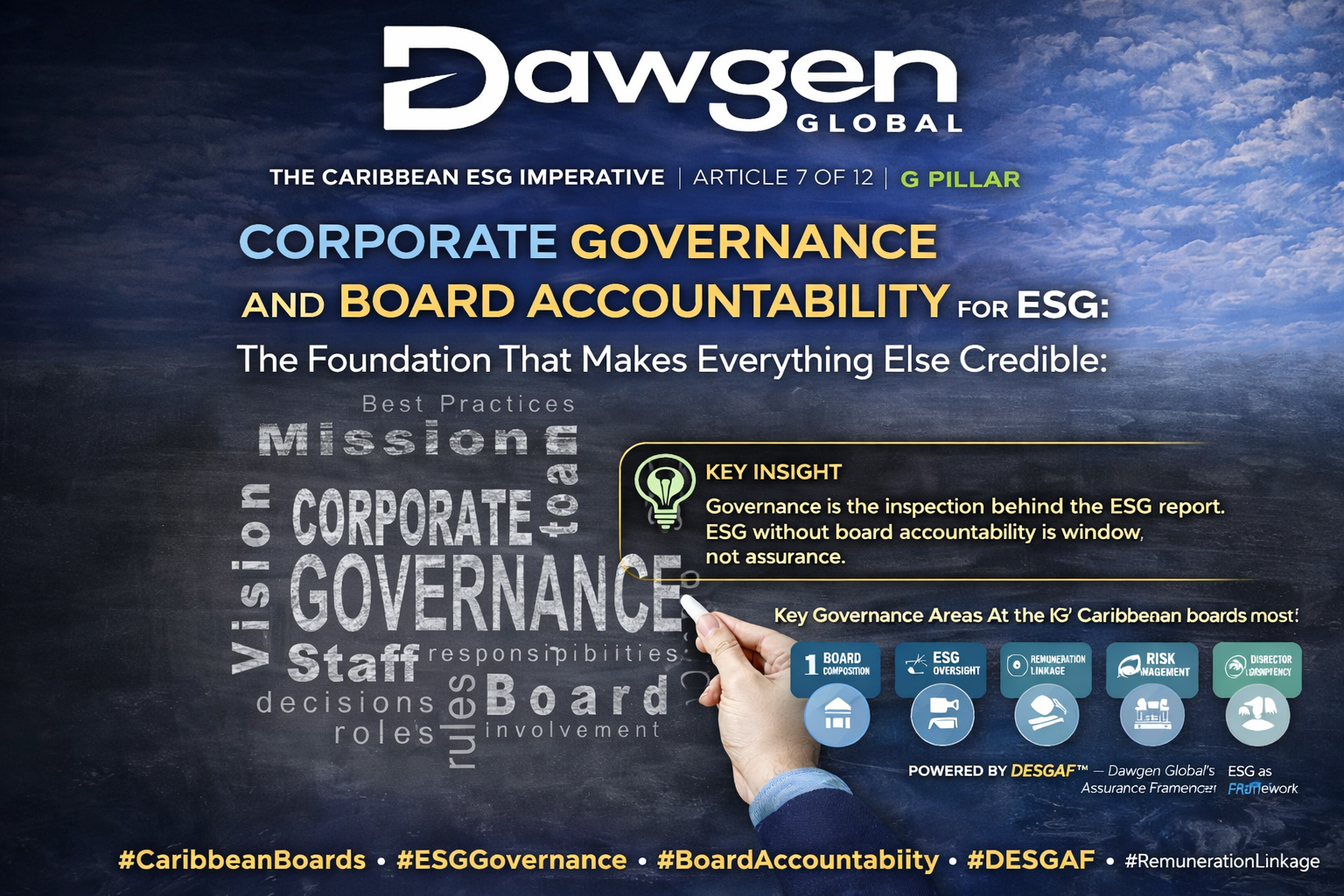
Governance Is the G That Makes E and S Credible
Environmental commitments without governance accountability are aspirations. Social commitments without governance structures are intentions. The Governance pillar of ESG is not the least exciting of the three pillars — it is the one that determines whether the other two are real. A Caribbean business that commits to net zero emissions, diverse and inclusive workplaces, and community development but lacks board-level oversight of those commitments, credible measurement systems to track them, and independent assurance to verify them has not built an ESG programme. It has built an ESG narrative — and the difference is increasingly apparent to the investors, lenders, regulators, and rating agencies whose assessment of Caribbean businesses is growing more rigorous with every passing year.
Corporate governance — the structures, processes, and relationships through which organisations are directed and controlled — has been a focus of investor and regulatory attention since the corporate scandals of the early 2000s. But the ESG era has expanded the governance agenda significantly. It is no longer sufficient for boards to oversee financial performance and legal compliance. The boards of Caribbean organisations seeking international capital, regulatory confidence, and stakeholder trust must now demonstrate competent oversight of climate risk, social performance, human rights, anti-corruption, tax governance, and the quality of ESG disclosure. And they must do so in ways that are measurable, transparent, and independently verifiable.
This article — the seventh in Dawgen Global’s The Caribbean ESG Imperative series — opens the Governance pillar by examining board accountability for ESG in depth. We map the full G pillar topic universe. We examine what genuine board ESG oversight looks like — from governance structures and committee design through director competencies and ESG-linked remuneration. We review the corporate governance codes that apply to Caribbean businesses and how they interact with international expectations. We address board composition, independence, and diversity. We explore the integration of ESG into enterprise risk management. And we connect governance to DESGAF™ — showing how defining governance accountability (Pillar 1), embedding governance disciplines (Pillar 2), and assuring governance disclosures (Pillar 5) together produce the credible governance foundation that every Caribbean ESG programme requires.
| KEY INSIGHT
An ESG report without governance accountability behind it is the corporate equivalent of a restaurant health certificate without a health inspection. The certificate may be beautiful. The display may be prominent. But without the inspection — without the independent assessment of whether the practices behind the certificate are genuine — the certificate is not evidence of food safety. It is evidence of a printer. Governance is the inspection behind the certificate. |
The Governance Pillar Topic Universe: Eight Areas Every Caribbean Board Must Own
The Governance pillar encompasses eight distinct topic areas — from board composition and ESG oversight through risk management, transparency, and anti-corruption. Each topic carries specific disclosure expectations that Caribbean businesses must meet to satisfy the governance assessment criteria of ESG investors, rating agencies, and development finance institutions. The table below maps the full G pillar topic universe for Caribbean boards.
| G Pillar Topic | Key Standards | Caribbean Priority | Key Disclosure Metrics |
| Board Composition and Structure | GRI 405; TCFD Governance; IFRS S1 Governance | High — investor baseline | Number of board members; % independent directors; % female directors; % directors from underrepresented groups; tenure distribution; skills matrix; separation of Chair and CEO roles; board size relative to organisation complexity |
| Board ESG Oversight | TCFD Governance pillar; IFRS S1; GRI 2 (General Disclosures) | High — rising rapidly | Board-level responsibility for ESG; frequency of ESG discussions at board level; integration of ESG into board strategy agenda; board access to ESG expertise; board approval of ESG targets and policies; board oversight of ESG assurance |
| Executive Remuneration and ESG Linkage | GRI 2-19; IFRS S1; Proxy Advisor Guidelines (ISS, Glass Lewis) | High — investor scrutiny intensifying | CEO and executive pay linked to ESG performance metrics; percentage of variable pay tied to ESG targets; ESG metrics used in remuneration (GHG reduction, safety performance, DEI targets); remuneration committee oversight of ESG linkage |
| Risk Management and Internal Controls | COSO ERM Framework; ISO 31000; GRI 2; TCFD Risk Management pillar | High — governance foundation | Enterprise risk management framework quality; internal audit function independence and scope; climate and ESG risk integration into ERM; internal control effectiveness; management of material risks disclosed to board |
| Transparency and Disclosure Quality | GRI 2 (General Disclosures); ISSB IFRS S1; Integrated Reporting Framework | High — credibility signal | Quality and completeness of ESG disclosure; alignment with recognised reporting frameworks; timeliness of disclosure; balance between positive and negative reporting; independent assurance obtained |
| Shareholder and Stakeholder Rights | GRI 2; Companies Act (Jamaica); CARICOM Company Law harmonisation | Medium — important for listed companies | AGM conduct and shareholder participation; minority shareholder protections; related party transaction governance; stakeholder engagement beyond shareholders; beneficial ownership transparency |
| Tax Governance | GRI 207; B Team Responsible Tax Principles; BEPS compliance | Growing — connected to trust and transparency | Tax policy publicly available; country-by-country reporting compliance; relationship with tax authorities; tax risk management framework; no use of abusive tax structures; tax as a component of ESG governance disclosure |
| Anti-Corruption and Ethics | GRI 205; UN Convention Against Corruption; OECD Anti-Bribery Convention | High — particularly in Caribbean context | Anti-corruption policy and training; whistleblower mechanism; incidents of corruption and actions taken; political contribution policy; gifts and hospitality policy; third-party due diligence on agents and partners |
The most striking feature of this topic map is how much of the G pillar is already within the scope of existing Caribbean corporate governance frameworks — JSE, FSC, BOJ, and TTSEC governance codes already address many of these areas. The ESG imperative is not introducing entirely new governance requirements; it is raising the bar on existing requirements, adding ESG-specific dimensions (particularly climate risk oversight and ESG-remuneration linkage), and demanding more rigorous and transparent public disclosure of governance practices that were previously managed behind closed doors.
Board Composition and Independence: The Governance Foundation
Independence: The Cornerstone of Credible Oversight
Board independence — the presence of directors who are genuinely free from relationships with management that would compromise their ability to exercise independent judgment — is the cornerstone of corporate governance quality. An independent board asks uncomfortable questions. It challenges management assumptions. It holds the CEO accountable when performance falls short. It protects shareholders and other stakeholders from the self-serving behaviours that can emerge when management has unchecked control over both decision-making and oversight.
The Caribbean corporate governance landscape has a structural independence challenge that is important to acknowledge honestly: the dominance of family-owned and family-controlled businesses, the relatively small pool of qualified directors in most Caribbean territories, and the social interconnectedness of Caribbean business communities all create conditions in which true board independence is harder to achieve than in larger, more anonymous markets. A Caribbean board whose independent directors are all connected to the controlling family through business relationships, social ties, or mutual directorship obligations is not, in practice, independent — regardless of how it is classified on paper.
ESG investors assessing Caribbean governance quality look beyond nominal independence classifications to the substance of independent oversight. They examine: whether independent directors have any prior relationships with management or the controlling shareholder; whether independent directors are prepared to vote against management recommendations on significant matters; whether the audit committee is genuinely independent of management; and whether the board’s record of challenging management is visible in meeting minutes and outcome decisions. Caribbean boards that cannot demonstrate genuine independence in substance, not just form, will score poorly in ESG governance assessments regardless of how their board classification matrix appears.
Board Size, Skills, and Composition
Effective boards are neither too small (insufficient diversity of perspective and experience) nor too large (insufficient individual accountability and coherent decision-making). For most Caribbean listed companies and large private enterprises, a board of seven to eleven members provides the right balance — sufficient diversity of expertise while maintaining individual director accountability. The board’s collective skills should reflect the complexity of the business it governs: financial expertise (mandatory for audit committee), industry expertise, legal and regulatory expertise, and — increasingly — ESG and climate expertise.
The ESG era has added a specific competency requirement that was absent from earlier governance frameworks: at least one board member with substantive knowledge of environmental, social, or governance issues — preferably all three — sufficient to provide genuine oversight of the organisation’s ESG strategy, targets, and disclosures. Many Caribbean boards currently lack this competency. The response should not be to appoint a token sustainability director with no real authority, but to either develop the ESG literacy of existing directors through targeted training or to recruit a new director whose background includes genuine ESG expertise.
Board Diversity: Gender, Background, and Experience
Board diversity — encompassing gender, professional background, industry experience, geographic diversity, and where legally appropriate, ethnic and demographic diversity — is both a governance quality indicator and an ESG Social pillar metric. Research consistently demonstrates that diverse boards make better decisions, are less susceptible to groupthink, and are more effective at managing risk than homogeneous boards. The investor community has moved from recommending board diversity to effectively requiring it — with major proxy advisors (ISS, Glass Lewis) and institutional investors issuing voting guidelines that withhold support from boards that fall below minimum diversity thresholds.
For Caribbean boards, the most immediately pressing diversity dimension is gender. Most Caribbean listed company and large private company boards remain majority male, and many are entirely male. International investors expect a minimum of 30% female representation on boards of companies they invest in — a threshold that few Caribbean boards currently meet. The pipeline of qualified female directors in the Caribbean exists — Caribbean women are well-represented in senior management, professional services, and public sector leadership — and the barrier to board gender diversity is more often cultural than practical.
Board ESG Governance: From Awareness to Accountability
The TCFD framework — now incorporated into IFRS S1 and referenced in every major ESG reporting standard — requires organisations to disclose how their board oversees climate-related risks and opportunities. This governance disclosure requirement is not satisfied by noting that the board ‘is aware of’ climate risk or that management ‘briefs the board annually’ on sustainability matters. It requires a detailed description of the specific governance structures, processes, and accountability mechanisms through which the board exercises genuine oversight of ESG — including climate, social, and governance dimensions. The table below provides a comprehensive guide to board ESG governance best practice for Caribbean organisations.
| Governance Element | What It Requires | Disclosure Evidence | Maturity Levels |
| Board ESG Policy Approval | The board formally approves an ESG Policy that sets out the organisation’s overall approach to environmental, social, and governance responsibilities — including the principles that guide ESG decision-making, the commitments made to stakeholders, and the oversight mechanisms through which the board holds management accountable | Board resolution; formal ESG Policy document; policy available publicly on organisation website; reviewed annually by board | Minimum: board-approved ESG Policy. Better: ESG Policy integrated into overall corporate governance framework. Best: ESG Policy reviewed annually with stakeholder input and progress against policy commitments publicly disclosed |
| Board-Level ESG Oversight Structure | Clear allocation of ESG oversight responsibility at board level — whether to the full board, to the audit and risk committee, or to a dedicated ESG/sustainability committee; management reporting line to board on ESG performance; board access to independent ESG expertise | Board charter or terms of reference specifying ESG oversight responsibility; committee terms of reference; ESG reporting schedule to board | Minimum: ESG on board agenda at least annually. Better: dedicated section in audit/risk committee terms of reference for ESG oversight. Best: standalone ESG/sustainability committee with independent ESG expertise; quarterly ESG reports to board |
| ESG Integrated into Strategy | Board-level discussion of ESG risks and opportunities as an integral part of strategic planning — not as a separate sustainability agenda item but as a dimension of the core strategic planning process; material ESG risks included in the enterprise risk register presented to the board | Strategic plan includes ESG considerations; risk register includes climate, social, and governance risks; board minutes reflect substantive ESG discussion in strategic contexts | Minimum: ESG mentioned in strategy document. Better: ESG risks quantified and included in risk register with risk appetite statement. Best: scenario analysis of ESG risks and opportunities used to stress-test strategy; capital allocation decisions incorporate ESG risk-adjusted return analysis |
| ESG Performance Reporting to Board | Regular management reports to the board on ESG performance — at minimum annually, preferably quarterly for material metrics; reports include progress against ESG targets, material incidents, regulatory developments, and stakeholder ESG feedback | Quarterly or annual board ESG report; metrics against targets; material incidents disclosed; emerging regulatory requirements flagged | Minimum: annual ESG update to board. Better: quarterly ESG dashboard report against targets with variance explanation. Best: real-time ESG performance integrated into board management information systems; material incidents escalated to board immediately |
| Board ESG Competencies | Ensuring that the board collectively has sufficient ESG knowledge and expertise to exercise genuine oversight — through director selection criteria that include ESG literacy, board-level ESG training programmes, and access to external ESG expertise through advisors or board observers | Board skills matrix includes ESG competencies; evidence of ESG training undertaken by directors; external ESG advisor engaged by board | Minimum: at least one director with ESG background or experience. Better: annual ESG literacy training for full board; external ESG advisor briefings. Best: designated ‘ESG Champion’ director; board skills matrix publicly disclosed; ESG competency included in director nomination criteria |
| ESG Linked to Executive Remuneration | ESG performance targets included in executive remuneration — specifically in variable pay elements (annual bonus and long-term incentive plans) — with meaningful weightings that signal that ESG performance is genuinely important rather than cosmetic | Remuneration report discloses ESG metrics and weightings; remuneration committee terms of reference include ESG oversight; proxy advisors (ISS, Glass Lewis) assess ESG-remuneration linkage | Minimum: ESG mentioned as qualitative modifier in remuneration. Better: 10–20% of variable pay linked to quantified ESG targets. Best: 30%+ of variable pay tied to ESG targets covering E, S, and G dimensions; targets independently verified; remuneration committee has ESG expertise |
ESG Committee Structures: Options for Caribbean Boards
Caribbean boards have several structural options for organising ESG oversight responsibility, each with different implications for the visibility, priority, and integration of ESG in board governance:
- Full board oversight: ESG is a standing agenda item for the full board — ensuring that all directors engage with ESG issues and that ESG is not siloed in a committee. Most appropriate for smaller boards or organisations at the beginning of their ESG journey. Risk: ESG may not receive sufficient depth of discussion in a full board agenda crowded with financial and operational matters.
- Audit and Risk Committee expansion: Existing audit and risk committee terms of reference are expanded to include ESG risk oversight — logical given the risk management dimension of ESG, and efficient in that it does not require a new committee. Risk: audit and risk committees are already heavily loaded; ESG may not receive the priority it deserves.
- Dedicated ESG/Sustainability Committee: A standalone board committee with specific ESG oversight responsibility — typically including the Chair of the main board, one or two independent directors, and the CEO; it reports to the full board quarterly. Most appropriate for organisations with complex ESG profiles or that are making significant ESG commitments. Risk: creates a potential disconnect between ESG governance and financial governance if the two committees do not communicate effectively.
- Combined Governance, Nomination, and ESG Committee: Combines governance, director nomination, and ESG oversight in a single committee — efficient for smaller boards, and ensures that director selection criteria include ESG competencies. Risk: may not give sufficient dedicated time to ESG oversight if governance and nomination matters dominate.
The most important principle across all these structures is that ESG oversight must be genuinely substantive — that the relevant board or committee actually engages with ESG performance data, challenges management on ESG targets, reviews ESG assurance reports, and holds management accountable for ESG commitments. A committee that meets once a year and receives a presentation is not providing ESG governance — it is providing ESG cover.
ESG-Linked Executive Remuneration: Making Commitments Real
The single most powerful signal that a Caribbean board is serious about ESG — more powerful than any governance statement, policy document, or committee structure — is the linkage of executive remuneration to ESG performance. When the CEO’s annual bonus and long-term incentive award depend in part on measurable ESG outcomes — GHG emission reductions, diversity improvements, safety performance, community impact — ESG becomes a genuine management priority rather than a communications exercise. Conversely, when executive pay is determined entirely by financial metrics with ESG treated as a qualitative modifier or an afterthought, the organisation’s true priorities are revealed regardless of what its ESG report says.
Designing Credible ESG Remuneration Linkage
Credible ESG-linked remuneration requires several design elements that distinguish genuine integration from cosmetic inclusion. First, the ESG metrics included in remuneration must be material — directly connected to the organisation’s most significant ESG risks and impacts, not selected for their ease of achievement. A hotel company that links CEO remuneration to guest satisfaction scores is not demonstrating ESG remuneration integration; one that links it to energy intensity reduction, water conservation targets, and waste diversion rates is.
Second, the ESG weighting in variable pay must be meaningful — typically at least 20-25% of variable pay to signal genuine priority rather than token acknowledgment. The growing proxy advisor expectation is that ESG metrics should represent at least 20% of short-term incentive plans and at least 15% of long-term incentive plans for organisations that have made material ESG commitments.
Third, the ESG targets must be independently verified — not self-assessed by management. The most credible ESG remuneration programmes use the same independently assured data that is disclosed in the ESG report as the basis for remuneration assessment — ensuring that the data cannot be manipulated to optimise bonuses without improving actual performance.
| KEY INSIGHT
A Caribbean CEO whose annual bonus includes a 25% weighting on GHG emissions reduction targets has a personal financial incentive to ensure that the organisation’s energy transition programme is funded, implemented, and tracked rigorously. A CEO whose bonus is determined entirely by financial metrics will rationally prioritise capital allocation toward financial return — which may or may not align with the ESG commitments that the organisation has publicly made. ESG-linked remuneration is not about punishing executives — it is about aligning incentives with commitments. |
Caribbean Governance Codes and International Standards
Caribbean businesses operate within a patchwork of corporate governance frameworks that vary significantly by territory, regulatory sector, and listing status. Understanding where Caribbean governance codes currently stand — and how they compare to the international benchmarks that sophisticated ESG investors apply — is essential for Caribbean boards seeking to assess and improve their governance quality. The table below provides a comparative overview of the principal corporate governance frameworks applicable to Caribbean businesses.
| Framework | Regulator / Body | Application | Key Governance Requirements |
| Jamaica Corporate Governance Framework | Jamaica Stock Exchange (JSE); Financial Services Commission (FSC); Bank of Jamaica (BOJ) | Comply-or-explain for JSE-listed companies; mandatory for FSC-regulated entities; BOJ Corporate Governance Guidelines for supervised financial institutions 2021 | Board composition; audit committee independence; risk management; internal audit; disclosure; ESG emerging in BOJ and FSC guidance as supervisory focus area |
| Trinidad and Tobago Corporate Governance Framework | Trinidad and Tobago Securities and Exchange Commission (TTSEC); Central Bank of T&T | Comply-or-explain for listed companies; mandatory elements for regulated financial institutions; Corporate Governance Guidelines 2022 | Strong board independence requirements; remuneration committee requirements; audit committee standards; ESG disclosure beginning to appear in TTSEC guidance |
| Barbados Corporate Governance Framework | Barbados Stock Exchange (BSE); Central Bank of Barbados; Financial Services Commission Barbados | Corporate Governance Code 2021; comply-or-explain basis; integrated reporting encouraged | Advanced relative to regional peers; integrated reporting framework referenced; sustainability disclosure encouraged; TCFD adoption being promoted by BSE |
| Eastern Caribbean Corporate Governance | Eastern Caribbean Securities Regulatory Commission (ECSRC); Eastern Caribbean Central Bank (ECCB) | Eastern Caribbean Corporate Governance Code; corporate governance guidelines for banking institutions | Developing relative to Jamaica, T&T, and Barbados; increasing regulatory attention to governance quality as financial sector matures; ESG governance guidance in early development |
| CARICOM Regional Harmonisation | CARICOM Secretariat; regional regulators’ cooperation | CARICOM Model Companies Act providing baseline company law across member states; limited harmonisation of corporate governance codes | Regional governance divergence remains significant; investors assessing Caribbean governance use home market standards (OECD, UK Corporate Governance Code) as benchmark; Caribbean companies seeking international capital should aspire to OECD-level governance standards |
| International Benchmarks (for Caribbean companies seeking international capital) | OECD Principles of Corporate Governance 2023; UK Corporate Governance Code; UN Principles for Responsible Investment (UN PRI); IFC Corporate Governance Methodology | Voluntary for Caribbean companies not listed on international exchanges; effectively mandatory for companies seeking IFC, IDB Invest, or institutional investor capital | Board independence; separation of Chair/CEO; at least 30% female board representation; audit committee quality; ESG oversight structure; executive remuneration transparency; shareholder rights; all assessed by institutional investors regardless of local regulatory requirements |
The most important practical implication of this table is that Caribbean businesses seeking international capital should not limit their governance assessment to the requirements of their domestic regulatory framework. IFC, IDB Invest, international institutional investors, and major ESG rating agencies apply OECD-level governance standards to their assessment of Caribbean companies — regardless of whether those standards are required by local law. The gap between domestic Caribbean governance requirements and international investor governance expectations is real and material — and closing it is a prerequisite for accessing the international capital that Caribbean businesses increasingly need for growth.
Integrating ESG into Enterprise Risk Management
The TCFD Risk Management pillar — and its equivalent in IFRS S1 — requires organisations to describe how climate and other ESG risks are identified, assessed, managed, and integrated into the overall enterprise risk management framework. This integration requirement reflects a fundamental governance principle: ESG risks are business risks, and they should be managed through the same rigorous risk management processes that govern financial, operational, credit, and reputational risks.
Why ESG Risks Belong in the Enterprise Risk Register
The enterprise risk register — the structured inventory of material risks facing the organisation, with assessments of likelihood and impact, risk appetite statements, and management response plans — is the operational tool through which boards exercise risk oversight. For ESG risks to receive board-level attention, they must appear in this register alongside financial and operational risks. An ESG risk that exists only in the sustainability report but not in the enterprise risk register is not being governed — it is being disclosed.
Caribbean boards should ensure that their enterprise risk registers explicitly include: physical climate risks (hurricane, sea-level rise, water stress, biodiversity) assessed by likelihood and financial impact; transition climate risks (carbon pricing, disclosure mandates, customer requirements); social risks (labour standard compliance, community relations, human rights in supply chains); and governance risks (corruption, regulatory compliance, ESG disclosure quality). Each risk should have a named risk owner at management level, a risk appetite statement approved by the board, and a management response plan with associated metrics.
The Internal Audit Function and ESG
The internal audit function — where it exists and operates with genuine independence — is a critical component of governance quality for ESG purposes. Internal audit can provide the board with independent assurance that ESG data collection processes are functioning as intended, that ESG targets are being tracked accurately, and that the controls around ESG disclosure are adequate. For DESGAF™ Pillar 5 (Assure), the internal audit function’s role in ESG assurance represents an important complement to external independent assurance — providing year-round monitoring of ESG data integrity rather than the point-in-time snapshot that annual external assurance provides.
Caribbean organisations whose internal audit function does not currently cover ESG-related processes should develop a plan to extend internal audit scope to include: verification of GHG emissions data collection and calculation; review of community impact measurement processes; assessment of human rights due diligence implementation; and evaluation of ESG disclosure controls. This extension of internal audit scope should be approved by the audit committee and resourced appropriately — including through training of internal auditors in ESG assurance methodology.
Board Self-Assessment: The Caribbean ESG Governance Health Check
Caribbean boards that have not previously assessed their ESG governance quality should treat the following questions as a starting-point health check — identifying the most significant gaps between current governance practice and the expectations of sophisticated ESG stakeholders:
- Governance structure: Does the board have a clear, formally documented ESG oversight structure — whether a dedicated committee, expanded audit/risk committee, or full board responsibility — with specific terms of reference for ESG oversight?
- Board competencies: Does at least one board member have substantive ESG knowledge — sufficient to challenge management on ESG strategy, targets, and reporting quality? Has the full board received ESG literacy training in the past 12 months?
- ESG in strategy: Was ESG explicitly considered in the most recent strategic planning process — with material ESG risks and opportunities quantified and included in the strategic analysis? Is ESG in the enterprise risk register?
- ESG reporting to board: Does the board receive regular (at minimum quarterly) ESG performance reports against targets — with variance explanations and material incident disclosure?
- Remuneration linkage: Is ESG performance — specifically, quantified and verified ESG metrics — included in executive remuneration with a meaningful weighting (at least 20% of variable pay)?
- Board diversity: Does the board meet minimum diversity standards — at least 30% female representation; range of professional disciplines; independence in substance, not just form?
- ESG policy: Has the board formally approved an ESG Policy — a public document that commits the organisation to specific ESG standards and establishes the board’s accountability for those standards?
- Assurance: Has the board received independent assurance over the organisation’s ESG disclosures — and does the assurance scope cover the ESG data and processes that are most material to the organisation’s stakeholders?
Caribbean boards that can answer yes, with evidence, to all eight questions are demonstrating governance quality that meets or approaches international investor expectations. Boards that cannot answer yes to three or more of these questions have material governance gaps that will be identified in ESG ratings assessments, in DFI due diligence, and in investor engagement — and that should be addressed through a structured governance improvement plan.
| THE GOVERNANCE GAP AND ITS COST
A Caribbean company assessed by MSCI ESG Ratings or Sustainalytics with material governance gaps — inadequate board independence, no ESG remuneration linkage, no ESG committee, and limited governance disclosure — will typically receive a governance score in the bottom quartile of its sector. Bottom-quartile governance scores increase the cost of capital from ESG-aware investors, reduce eligibility for green and sustainability-linked financing, and affect access to certain institutional investor capital pools whose mandates exclude poor-governance companies. The financial cost of governance quality gaps is real, measurable, and growing. |
| DESGAF™ CONNECTION — PILLARS 1, 2, AND 5
Governance is the backbone of DESGAF™. Pillar 1 (Define) — the governance structures through which the organisation defines its ESG commitments: the board-approved ESG Policy, the materiality assessment process that identifies what the organisation must manage and disclose, and the stakeholder engagement framework that informs both. Pillar 2 (Embed) — the governance mechanisms that embed ESG into management systems: ESG-linked remuneration that creates management incentives; ESG integration into enterprise risk management that operationalises oversight; and board reporting structures that maintain accountability throughout the year. Pillar 5 (Assure) — governance disclosure is among the most important subjects for independent assurance under DESGAF™: the governance statements in the ESG report — board oversight structures, ESG committee activities, remuneration linkage, risk management integration — are verified by independent assurers to confirm they accurately reflect actual governance practice. |
Conclusion: Governance Is Where ESG Commitments Are Kept or Broken
The Governance pillar is not the third and least important pillar of ESG — it is the pillar that determines whether the first two are genuine. Environmental targets without governance accountability become aspirations that management can quietly miss without consequence. Social commitments without governance structures become narratives that look good in annual reports but lack the management systems, performance tracking, and board oversight that would make them real. The Governance pillar is where Caribbean businesses decide whether their ESG programme is a management discipline or a communications exercise.
Caribbean boards that take the governance imperative seriously — that build genuine ESG oversight structures, develop their own ESG competencies, link executive remuneration to verified ESG performance, integrate ESG into enterprise risk management, and disclose their governance practices with the transparency that international investors require — are building the governance foundation on which every other dimension of ESG credibility rests. And they are building the governance quality that will increasingly determine their access to international capital, their relationships with international customers and partners, and their regulatory standing in an environment where governance expectations are rising across every dimension.
In Article 8 — Anti-Corruption, Ethics, and Integrity: The Governance Imperative — we examine the most consequential dimension of the G pillar for the Caribbean context: anti-corruption, ethical conduct, and integrity. We address the Caribbean corruption landscape, the anti-bribery frameworks that Caribbean businesses must implement, whistleblower protection, beneficial ownership transparency, and the governance structures that protect organisations from the reputational and financial consequences of corruption and ethical failure.
| STRENGTHEN YOUR BOARD’S ESG GOVERNANCE WITH DAWGEN GLOBAL
Dawgen Global’s ESG Advisory Practice provides board ESG governance assessments, ESG committee design, director ESG literacy programmes, board skills matrix development, governance code alignment reviews, and independent assurance of governance disclosures under DESGAF™ — helping Caribbean boards meet the governance expectations of international investors, regulators, and rating agencies. Request an ESG Advisory Proposal Today:
|
About Dawgen Global
“Embrace BIG FIRM capabilities without the big firm price at Dawgen Global, your committed partner in carving a pathway to continual progress in the vibrant Caribbean region. Our integrated, multidisciplinary approach is finely tuned to address the unique intricacies and lucrative prospects that the region has to offer. Offering a rich array of services, including audit, accounting, tax, IT, HR, risk management, and more, we facilitate smarter and more effective decisions that set the stage for unprecedented triumphs. Let’s collaborate and craft a future where every decision is a steppingstone to greater success. Reach out to explore a partnership that promises not just growth but a future beaming with opportunities and achievements.
 Email: [email protected]
  Visit: Dawgen Global Website

 WhatsApp Global Number : +1 555-795-9071
Caribbean Office: +1876-6655926 / 876-9293670/876-9265210  WhatsApp Global: +1 5557959071
USA Office: 855-354-2447
Join hands with Dawgen Global. Together, let’s venture into a future brimming with opportunities and achievements


